


Mark 10:30
Bible text: King James Version (1769 Blayney text) · Public domain
Bible text: King James Version with Strong's numbers · Public domain
Bible text: Berean Standard Bible · Public domain
Bible text: American Standard Version (1901) · Public domain
Bible text: World English Bible, Messianic edition · Public domain
Bible text: Geneva Bible (1599) · Public domain
Bible text: Young's Literal Translation · Public domain
- ἐὰνeanonlyG1437CONDConjunction
- μὴmēunlessG3361PRT-NNegative Particle Negative
- λάβῃlabēshall takeG2983V-2AAS-3SVerb 2nd Aorist Active Subjunctive 3rd Singular
- ἑκατονταπλασίοναhekatontaplasionaa hundredfoldG1542A-APNAdjective Accusative Plural Neuter
- νῦνnunnowG3568ADVAdverb
- ἐνeninG1722PREPPreposition
- τῷtō<the>G3588T-DSMDefinite article Dative Singular Masculine
- καιρῷkairōtimeG2540N-DSMNoun Dative Singular Masculine
- τούτῳtoutōthis —G3778D-DSMDemonstrative pronoun Dative Singular Masculine
- οἰκίαςoikiashousesG3614N-APFNoun Accusative Plural Feminine
- καὶkaiandG2532CONJConjunction
- ἀδελφοὺςadelphousbrothersG80N-APMNoun Accusative Plural Masculine
- καὶkaiandG2532CONJConjunction
- ἀδελφὰςadelphassistersG79N-APFNoun Accusative Plural Feminine
- καὶkaiandG2532CONJConjunction
- μητέραςmēterasmothersG3384N-APFNoun Accusative Plural Feminine
- καὶkaiandG2532CONJConjunction
- τέκναteknachildrenG5043N-APNNoun Accusative Plural Neuter
- καὶkaiandG2532CONJConjunction
- ἀγροὺςagrouslandsG68N-APMNoun Accusative Plural Masculine
- μετὰmetawithG3326PREPPreposition
- διωγμῶνdiōgmōnpersecutions —G1375N-GPMNoun Genitive Plural Masculine
- καὶkaiandG2532CONJConjunction
- ἐνeninG1722PREPPreposition
- τῷtōtheG3588T-DSMDefinite article Dative Singular Masculine
- αἰῶνιaiōniageG165N-DSMNoun Dative Singular Masculine
- τῷtōwhichG3588T-DSMDefinite article Dative Singular Masculine
- ἐρχομένῳerchomenōis comingG2064V-PNP-DSMVerb Present Middle Or Passive Deponent Participle Dative Singular Masculine
- ζωὴνzōēnlifeG2222N-ASFNoun Accusative Singular Feminine
- αἰώνιονaiōnioneternalG166A-ASFAdjective Accusative Singular Feminine
English is a literal word-by-word gloss of the Greek, not the KJV's wording. Why?
This is the original text the KJV's translators worked from — each Greek word with its own literal English meaning in this verse, prepared by scholars at Tyndale House, Cambridge. The KJV translates whole sentences, not word by word, so its wording differs: one Greek word can become several English words, and the KJV may choose “charity” where the gloss reads “love”. Both are faithful — they answer different questions. For the KJV's own rendering, switch to the KJV text.
Details
See on the biblical-era maps
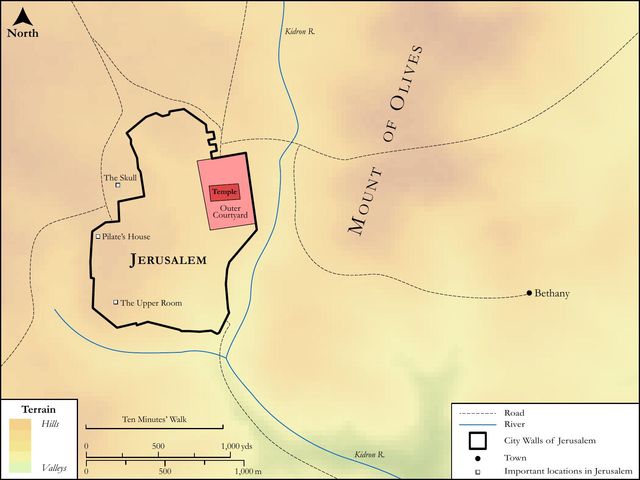
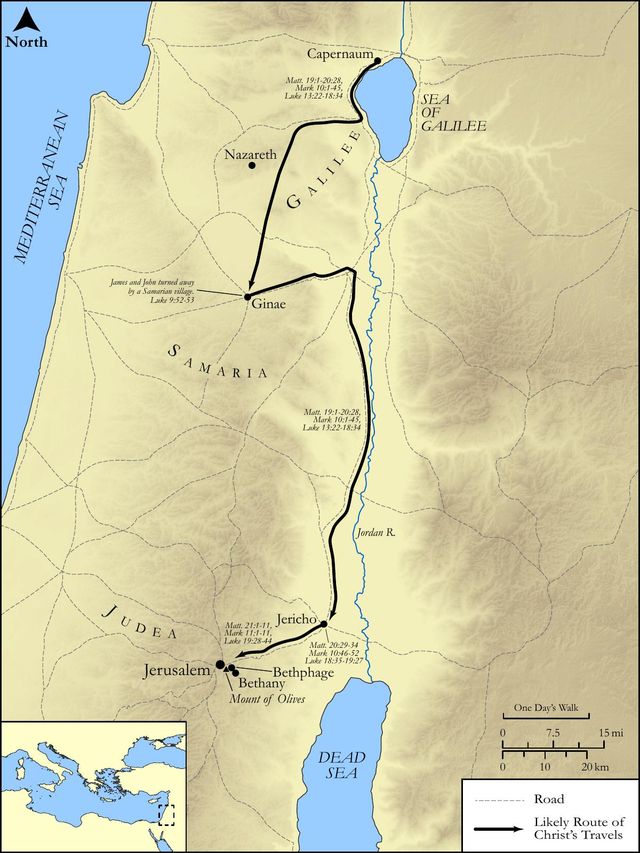
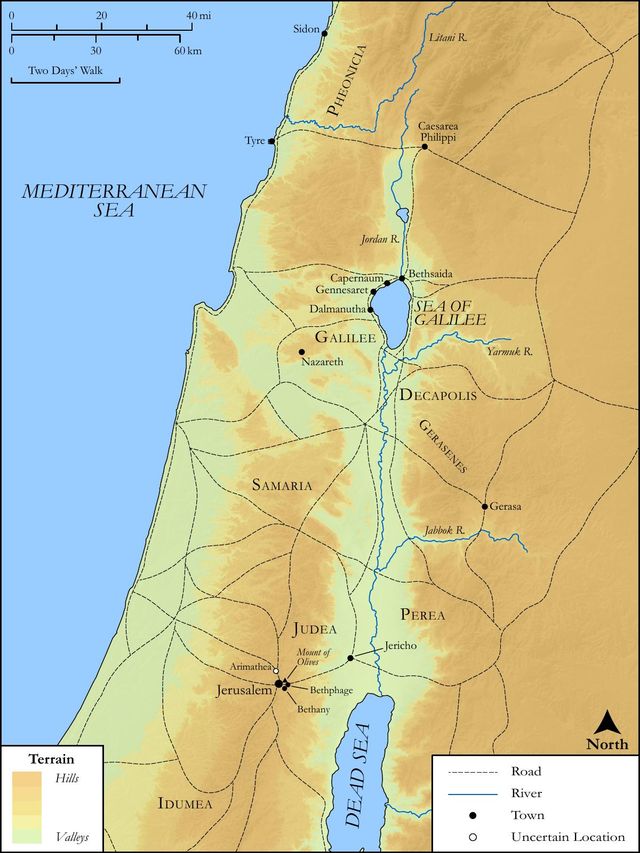
Study this verse
Public-domain commentary
Matthew Henry
From his Commentary on the Whole Bible. Henry comments on passages, not single verses — this entry covers Mark 10:17–31. His four-level outline is real structure in the source text, so it is rendered as structure.
I.Here is a hopeful meeting between Christ and a young man; such he is said to be (Mat 19:20, Mat 19:22), and a ruler (Luk 18:18), a person of quality. Some circumstances here are, which we had not in Matthew, which makes his address to Christ very promising.
1.He came running to Christ, which was an indication of his humility; he laid aside the gravity and grandeur of a ruler, when he came to Christ: thus too he manifested his earnestness and importunity; he ran as one in haste, and longing to be in conversation with Christ. He had now an opportunity of consulting this great Prophet, in the things that belonged to his peace, and he would not let slip the opportunity.
2.He came to him when he was in the way, in the midst of company: he did not insist upon a private conference with him by night, as Nicodemus did, though like him he was a ruler, but when he shall find him without, will embrace that opportunity of advising with him, and not be ashamed, Sol 8:1.
3.He kneeled to him, in token of the great value and veneration he had for him, as a teacher come from God, and his earnest desire to be taught by him. He bowed the knee to the Lord Jesus, as one that would not only do obeisance to him now, but would yield obedience to him always; he bowed the knee, as one that meant to bow the soul to him.
4.His address to him was serious and weighty; Good Master, what shall I do, that I may inherit eternal life? Eternal life was an article of his creed, though then denied by the Sadducees, a prevailing party: he asks, What shall he do now that he may be happy for ever. Most men enquire for good to be had in this world (Psa 4:6), any good; he asks for good to be done in this world, in order to the enjoyment of the greatest good in the other world; not, Who will make us to see good? But, "Who will make us to do good?" He enquires for happiness in the way of duty; the summum bonum - chief good which Solomon was in quest of, was that good for the sons of men which they do should do, Ecc 2:3. Now this was,
(1.)A very serious question in itself; it was about eternal things, and his own concern in those things. Note, Then there begins to be some hope of people, when they begin to enquire solicitously, what they shall do to get to heaven.
(2.)It was proposed to a right person, one that was every way fit to answer it, being himself the Way, the Truth, and the Life, the true way to life, to eternal life; who came from heaven on purpose, first to lay open for us, and then to lay open to us; first to make, and then to make known, the way to heaven. Note, Those who would know what they shall do to be saved, must apply themselves to Christ, and enquire of him; it is peculiar to the Christian religion, both to show eternal life, and to show the way to it.
(3.)It was proposed with a good design - to be instructed. We find this same question put by a lawyer, not kneeling, but standing up (Luk 10:25), with a bad design, to pick quarrels with him; he tempted him, saying, Master, what shall I do? It is not so much the good words as the good intention of them that Christ looks at.
5.Christ encouraged this address,
(1.)By assisting his faith, Mar 10:18. He called him good Master; Christ would have him mean thereby, that he looked upon him to be God, since there is none good but one, that is God, who is one, and his name one, Zac 14:9. Our English word God doubtless hath affinity with good; as the Hebrews name God by his power, Elohim, the strong God; so we by his goodness, the good God.
(2.)By directing his practice (Mar 10:19); Keep the commandments; and thou knowest what they are. He mentions the six commandments of the second table, which prescribe our duty to our neighbour; he inverts the order, putting the seventh commandment before the sixth, to intimate that adultery is a sin no less heinous than murder itself. The fifth commandment is here put last, as that which should especially be remembered and observed, to keep us to all the rest. Instead of the tenth commandment, Thou shalt not covet, our Saviour here puts, Defraud not. Mē aposterēsēs - that is, saith Dr. Hammond, "Thou shalt not rest contented with thy own, and not seek to increase it by the diminution of other men's." It is a rule of justice not to advance or enrich ourselves by doing wrong or injury to any other.
6.The young man bid fair for heaven, having been free from any open gross violations of the divine commands. Thus far he was able to same in some measure (Mar 10:20), Master, all these have I observed from my youth. He thought he had, and his neighbours thought so too. Note, Ignorance of the extent and spiritual nature of the divine law, makes people think themselves in a better condition than they really are. Paul was alive without the law. But when he saw that to be spiritual, he saw himself to be carnal, Rom 7:9, Rom 7:14. However, he that could say he was free from scandalous sin, went further than many in the way to eternal life. But though we know nothing by ourselves, yet are we not thereby justified. Co1 4:4.
7.Christ had a kindness for him; Jesus, beholding him, loved him, Mar 10:21. He was pleased to find that he had lived inoffensively, and pleased to see that he was inquisitive how to live better than so. Christ particularly loves to see young people, and rich people, asking the way to heaven, with their faces thitherward.
II.Here is a sorrowful parting between Christ and this young man.
1.Christ gave him a command of trial, by which it would appear whether he did in sincerity aim at eternal life, and press towards it: he seemed to have his heart much upon it, and if so, he is what he should be; but has he indeed his heart upon it? Bring him to the touchstone.
(1.)Can he find in his heart to part with his riches for the service of Christ? He hath a good estate, and now, shortly, at the first founding of the Christian church, the necessity of the case will require that those who have lands, sell them, and lay the money at the apostles' feet; and how will he dispense with that? Act 4:34, Act 4:35. After awhile, tribulation and persecution will arise, because of the word; and he must be forced to sell his estate, or have it taken from him, and how will he like that? Let him know the worst now; if he will not come up to these terms, let him quit his pretensions; as good as the first as at last. "Sell whatsoever thou hast over and above what is necessary for thy support;" probably, he had no family to provide for; let him therefore be a father to the poor, and make them his heirs. Every man, according to his ability, must relieve the poor, and be content, when there is occasion, to straiten himself to do it. Worldly wealth is given us, not only as maintenance to bear our charges through this world, according to our place in it, but as talent, to be used and employed for the glory of our great Master in the world, who hath so ordered it, that the poor we should have always with us as his receivers.
(2.)Can he find it in his heart to go through the hardest costliest services he may be called to as a disciple of Christ, and depend upon him for a recompence in heaven? He asks Christ what he should do more than he has done to obtain eternal life, and Christ puts it to him, whether he has indeed that firm belief of, and that high value for, eternal life that he seems to have. Doth he really believe there is a true treasure in heaven sufficient to make up all he can leave, or lose, or lay out, for Christ? Is he willing to deal with Christ upon trust? Can he give him credit for all he is worth; and be willing to bear a present cross, in expectation of a future crown?
2.Upon this he flew off (Mar 10:22); He was sad at that saying; was sorry that he could not be a follower of Christ upon any easier terms than leaving all to follow him; that he could not lay hold on eternal life, and keep hold of his temporal possessions too. But since he could not come up to the terms of discipleship, he was so fair as not to pretend to it; He went away grieved. Here appeared the truth of that (Mat 6:24), Ye cannot serve God and mammon; while he held to mammon he did in effect despise Christ, as all those do who prefer the world before him. He bids for what he has a mind for in the market, yet goes away grieved, and leaves it, because he cannot have it at his own price. Two words to a bargain. Motions are not marriages. That which ruined this young man was, he had great possessions; thus the prosperity of fools destroys them, and those who spend their days in wealth are tempted to say to God, Depart from us; or to their hearts, Depart from God.
III.Here is Christ's discourse with his disciples.
We are tempted to wish that Christ had mollified that saying which frightened this young gentleman from following him, and by an explanation taken off the harshness of it: but he knew all men's hearts; he would not court him to be his follower, because he was a rich man and a ruler; but, if he will go, let him go. Christ will keep no man against his will; and therefore we do not find that Christ called him back, but took this occasion to instruct his disciples in two things.
1.The difficulty of the salvation of those who have an abundance of this world; because there are few who have a deal to leave, that can be persuaded to leave it for Christ, or to lay it out in doing good.
(1.)Christ asserts this here; He looked about upon his disciples, because he would have them all take notice of what he said, that by it they might have their judgments rightly informed, and their mistakes rectified, concerning worldly wealth, which they were apt to over-rate; How hardly shall they who have riches enter into the kingdom of God! Mar 10:23. They have many temptations to grapple with, and many difficulties to get over, which lie not in the way of poor people. But he explains himself, Mar 10:24, where he calls the disciples children, because as such they should be taught by him, and portioned by him with better things than this young man left Christ to cleave to; and whereas he had said, How hardly will those who have riches get to heaven; here he tells them, that the danger arose not so much from their having riches as from their trusting to them, and placing their confidence in them, expecting protection, provision, and a portion from them; saying that to their gold, which they should say only to their God, Thou art my hope, Job 31:24. They have such a value as this for the wealth of the world, will never be brought to put a right value upon Christ and his grace. They that have ever so much riches, but do not trust in them, that see the vanity of them, and their utter insufficiency to make a soul happy, have got over the difficulty, and can easily part with them for Christ: but they have ever so little, if they set their hearts upon that little, and place their happiness in it, it will keep them from Christ. He enforces this assertion with, Mar 10:25, It is easier for a camel to go through the eye of a needle, than for a rich man, that trusts in riches, or inclines to do so, to enter into the kingdom of God. The disproportion here seems so great (though the more it is so the more it answers the intention), that some have laboured to bring the camel and the eye of the needle a little nearer together.
[1.]Some imagine there might be some wicket-gate, or door, to Jerusalem, commonly known by the name of the needle's eye, for its straitness, through which a camel could not be got, unless he were unloaded, and made to kneel, as those camel, Gen 24:11. So a rich man cannot get to heaven unless he is willing to part with the burthen of his worldly wealth, and stoop to the duties of a humble religion, and so enter at the strait gate.
[2.]Others suggest that the word we translate a camel, sometimes signifies a cable-rope, which, though not to be got through a needle's eye, yet is of great affinity to it. A rich man, compared with the poor, is as a cable to a single thread, stronger, but not so pliable, and it will not go through the needle's eye, unless it be untwisted. So the rich man must be loosed and disentangled from his riches, and then there is some hope of him, that thread by thread he may be got through the eye of the needle, otherwise he is good for nothing but to cast anchor in the earth.
(2.)This truth was very surprising to the disciples; They were astonished at his words, Mar 10:24. They were astonished out of measure, and said among themselves, Who then can be saved? They knew what were generally the sentiments of the Jewish teachers, who affirmed that the Spirit of God chooses to reside in rich men; nay, they knew what abundance of promises there were, in the Old Testament, of temporal good things; they knew likewise that all either are rich, or fain would be so, and that they who are rich, have so much the larger opportunities of doing good, and therefore were amazed to hear that it should be so hard for rich people to go to heaven.
(3.)Christ reconciled them to it, by referring it to the almighty power of God, to help even rich people over the difficulties that lie in the way of their salvation (Mar 10:27); He looked upon them, to engage their attention, and said, "With men it is impossible; rich people cannot by their own skill or resolution get over these difficulties, but the grace of God can do it, for with him all things are possible." If the righteous scarcely are saved, much more may we say so of the rich; and therefore when any get to heaven, they must give all the glory to God, who worketh in them both to will and to do.
2.The greatness of the salvation of those that have but a little of this world, and leave it for Christ. This he speaks of, upon occasion of Peter's mentioning what he and the rest of the disciples had left to follow him; Behold, (saith he), we have left all to follow thee, Mar 10:28. "You have done well," saith Christ, "and it will prove in the end that you have done well for yourselves; you shall be abundantly recompensed, and not only you shall be reimbursed, who have left but a little, but those that have ever so much, though it were so much as this young man had, that could not persuade himself to quit it for Christ; yet they shall have much more than an equivalent for it." (1.) The loss is supposed to be very great; he specifies, [1.] Worldly wealth; houses are here put first, and lands last: if a man quit his house, which should be for his habitation, and his land, which should be for his maintenance, and so make himself a beggar and an outcast. This has been the choice of suffering saints; farewell houses and lands, though ever so convenient and desirable, through the inheritance of fathers, for the house which is from heaven, and the inheritance of the saints in light, where are many mansions. [2.] Dear relations. Father and mother, wife and children, brethren and sisters. In these, as much as in any temporal blessing, the comfort of life is bound up; without these the world would be a wilderness; yet, when we must either forsake these or Christ, we must remember that we stand in nearer relation to Christ than we do to any creature; and therefore to keep in with him, we must be content to break with all the world, and to say to father and mother, as Levi did, I have not known you. The greatest trial of a good man's constancy is, when his love to Christ comes to stand in competition with a love that is lawful, nay, that is his duty. It is easy to such a one to forsake a lust for Christ, for he hath that within him, that rises against it; but to forsake a father, a brother, a wife, for Christ, that is, to forsake those whom he knows he must love, is hard. And yet he must do so, rather than deny or disown Christ. Thus great is the loss supposed to be; but it is for Christ's sake, that he may be honoured, and the gospel's, that it may be promoted and propagated. It is not the suffering, but the cause, that makes the martyr. And therefore, (2.) The advantage will be great. [1.] They shall receive a hundred-fold in this time, houses, and brethren, and sisters; not in specie, but that which is equivalent. He shall have abundance of comfort while he lives, sufficient to make up for all his losses; his relation to Christ, his communion with the saints, and his title to eternal life, shall be to him brethren, and sisters, and houses, and all. God's providence gave Job double to what he had had, but suffering Christians shall have a hundred-fold in the comforts of the Spirit sweetening their creature comforts. But observe, It is added here in Mark, with persecutions. Even when they are gainers by Christ, let them still expect to be sufferers for him; and not be out of the reach of persecution, till they come to heaven. Nay, The persecutions seem to come in here among the receivings in this present time; for unto you it is given, not only to believe in Christ, but also to suffer for his name; yet this is not all, [2.] They shall have eternal life in the world to come. If they receive a hundred-fold in this world, one would think they should not be encouraged to expect any more. Yet, as if that were a small matter, they shall have life eternal into the bargain; which is more than ten thousand-fold, ten thousand times told, for all their losses. But because they talked so much, and really more than became them, of leaving all for Christ, he tells them, though they were first called, that there should be disciples called after them, that should be preferred before them; as St. Paul, who was one born out of due time, and yet laboured more abundantly than all the rest of the apostles, Co1 15:10. Then the first were last, and the last first.
Historical interpretation
Nine Centuries of Reception
7 surviving comments on this verse. Each one is dated, so this reads as a timeline rather than a list.
Select a marker to jump to its quote. Markers stagger vertically where authors wrote within a few decades of each other.
(Hom. in Matt. 64) But it seems to me that by these words He intended covertly to proclaim that there were to be persecutions, as it would come to pass that many fathers would allure their sons to impiety, and many wives their husbands. Again He delays not to say, for my name's sake and the Gospel's, as Mark says, or for the kingdom of God, as Luke says; the name of Christ is the power of the Gospel, and of His kingdom; for the Gospel is received in the name of Jesus Christ, and the kingdom is made known, and comes by His name.
For he who for the sake of Christ’s name distances himself from his particular beloved father or mother or child, and gives himself over to the purest love of all who serve Christ, will receive a hundred times the measure of brothers and kinsfolk. Instead of but one he will begin to have so many fathers and brothers bound to him by a still more fervent and admirable affection. That this is so you can prove by your own experience, since you have each left but one father and mother and home, and as you have done so you have gained without any effort or care countless fathers and mothers and brothers, as well as houses and lands and most faithful servants, in any part of the world to which you go, who receive you as their own family, and welcome, and respect, and take care of you with the utmost attention.
(Cat. in Marc. Oxon.) This hundredfold reward therefore must be in participation, not in possession, for the Lord fulfilled this to them not carnally, but spiritually.
Jesus responded and said: Amen I say to you: There is no one who has left house, or brothers, or sisters, or father, or mother, or children, or fields for my sake, and for the sake of the Gospel, who will not receive a hundred times as much now in this time, houses, and brothers, and sisters, and mothers, and children, and fields, with persecutions, and in the age to come, eternal life. Some, using this kind of statement as an occasion, propagate the Jewish fable of a thousand-year reign after the resurrection of the just, during which all that we have given up for God's sake will be repaid to us a hundredfold, and eternal life will be granted besides. And the foolish do not see that, even if in other matters the promise is worthy, the remuneration of wives a hundred times over, according to other evangelists, would appear scandalous, especially since the Lord Himself testifies that in the resurrection there will be no marrying, and asserts that those things given up for His sake will be received in this present time with persecutions. But those Chiliasists confirm that all those persecutions, like other contrary things, are wholly absent from their millennium. Therefore, this is the sense: Whoever has left carnal things for the Gospel of Christ will receive spiritual goods, which, in their worth and merit, will be as if a hundredfold number were compared to a small number. Because clearly, from the brothers and associates of his purpose, who are bound to him in spiritual glue, he will receive much greater affection even in this life. Read the Acts of the Apostles, where it says that the heart and soul of the multitude of believers were one, and all things were common among them, and there was no needy person among them (Acts 4), who had left their own for the Lord's sake. Of whom also the Apostle says, "As having nothing, and yet possessing everything" (2 Cor. 6). Certainly, what he says, "He will receive a hundred times as much now in this time, houses, and brothers, and sisters, and mothers, and children, and fields with persecutions" (Mark 10), could be understood as a deeper signification. For the number one hundred, transferred from the left to the right, although it seems to hold the same figure in the bending of the fingers which ten had in the left, it greatly surpasses in magnitude. Because indeed, those who despise temporal things for the kingdom of God, even in this life full of persecutions, taste the joy of the same kingdom with certain faith, and in the expectation of the heavenly homeland (which is rightly signified in the right hand), they enjoy the most sincere love of all the elect equally. But because many do not complete the pursuit of virtues with the same intention of piety with which they begin, but either cool down after receiving the love of virtues or completely relapse into the mire of crimes, a terrifying sentence is immediately added.
(ubi sup.) And because it is not sufficient to have left all, he adds that which makes up perfection, and have followed thee. As if he said, We have done what Thou hast commanded. What reward therefore wilt Thou give us? But while Peter asks only concerning the disciples, our Lord makes a general answer; wherefore it goes on: Jesus answered and said, Verily I say unto you, There is no one that hath left house, or brethren, or sisters, or father, or mother, or children, or lands. But in saying this, He does not mean that we should leave our fathers, without helping them, or that we should separate ourselves from our wives; but He instructs us to prefer the glory of God to the things of this world.
Some, however, taking occasion from this saying, in which it is announced that he shall receive an hundredfold now in this time, teach that Jewish fable of a thousand years after the resurrection of the just, when all that we have left for the Lord's sake is to be restored with manifold usury, besides which we are to receive the crown of everlasting life. These persons do not perceive, that although the promise in other respects be honourable, yet in the hundred wives, which the other Evangelists mention, its foulness is made manifest: particularly when the Lord testifies that there shall be no marriage in the resurrection, and asserts that those things which are put away from us for His sake are to be received again in this life with persecutions, which, as they affirm, will not take place in their thousand yearss.
(ubi sup.) This which is here said, shall receive an hundredfold, may be understood in a higher sense1. For the number a hundred which is reckoned by changing from the left to the right hand, although it has the same appearance in the bending of the fingers as the ten had on the left, nevertheless is increased to a much greater quantity. This means, that all who have despised temporal things for the sake of the kingdom of heaven through undoubting faith, taste the joy of the same kingdom in this life which is full of persecutions, and in the expectation of the heavenly country, which is signified by the right hand, have a share in the happiness of all the elect. But because all do not accomplish a virtuous course of life with the same ardour as they began it, it is presently added, But many that are first shall be last, and the last first; for we daily see many persons who, remaining in a lay habit, are eminent for their meritorious life; but others, who from their youth have been ardent in a spiritual profession, at last wither away in the sloth of ease, and with a lazy folly finish in the flesh, what they had begun in the Spirit.
Although Peter had left but few things, still he calls these his all; for even a few things keep us by the bond of affection, so that he shall be beatified who leaves a few things.
For a wife is busied in a house about her husband's food and raiment. See also how this is the case with the Apostles; for many women busied themselves about their food and their clothing, and ministered unto them. In like manner the Apostles had many fathers and mothers, that is, persons who loved them; as Peter, for instance, leaving one house, had afterwards the houses of all the disciples. And what is more wonderful, they are to be persecuted and oppressed, for it is with persecutions that the Saints are to possess all things, for which reason there follows, But many that are first shall be last, and the last first. For the Pharisees who were first became the last; but those who left all and followed Christ were last in this world through tribulation and persecutions, but shall be first by the hope which is in God.
(non occ.) Because the youth, on hearing the advice of our Saviour concerning the casting away of his goods, had gone away sorrowful, the disciples of Christ, who had already fulfilled the foregoing precept, began to question Him concerning their reward, thinking that they had done a great thing, since the young man, who had fulfilled the commandments of the law, had not been able to hear it without sadness. Wherefore Peter questions the Lord for himself and the others, in these words, Then Peter began to say unto him, Lo, we have left all, and have followed thee.
Continue studying Mark 10:30 across the web’s major study libraries — every link below opens this exact verse, chapter, or book on the destination site.
Read & Compare
 BibleGatewayThis verse in more than 200 translations and 70 languages.
 Bible.comThe YouVersion reader — hundreds of translations, reading plans, and highlights.
 ESV.orgCrossway's official English Standard Version reader.
 NET BibleThe NET translation with 60,000+ translators' notes on every rendering decision.
 STEP BibleTyndale House's free study tool — original text, vocabulary, and scholarly resources.
 BibliaLogos Bible Software's free web reader.
 USCCBThe New American Bible (Revised Edition) with the U.S. bishops' study notes.
Commentaries
 BibleHub CommentariesDozens of classic commentaries on this verse, gathered on one page.
 StudyLightMore than 100 commentary sets — the largest collection on the web.
 BibleRefPlain-English commentary on what this verse means, verse by verse.
 Enduring WordDavid Guzik's free commentary on this chapter, widely used by Bible teachers.
 Bible Study ToolsVerse commentary alongside Greek and Hebrew study aids.
Original Language & Research
- BibleHub InterlinearThe verse word by word — original language, transliteration, and English.
- BibleHub LexiconEvery word's original-language definition and Strong's entry.
 Blue Letter BibleDeep-study tools — Strong's numbers, concordance, and word studies.
 CNTR CollationThe earliest Greek manuscripts of this verse, collated letter by letter.
Sermons, Hymns & Audio


TrulyRandomVerse is not affiliated with these sites and doesn’t control their content. They’re linked because they’re genuinely useful.
Summary
Mark 10:30 concludes Jesus' profound promise to His disciples, assuring them that those who sacrifice earthly possessions and familial ties for His sake and the Gospel's will receive an abundant return in this present age, encompassing spiritual family and provision, albeit accompanied by persecutions, and ultimately inherit eternal life in the age to come. This verse highlights the paradox of Christian discipleship: present blessings intertwined with hardship, culminating in ultimate, everlasting reward.
Context
ShowHideLiterary Context
Mark 10:30 is the climax of Jesus' response to Peter's question in Mark 10:28 ("Lo, we have left all, and have followed thee") which immediately follows the challenging encounter with the rich young ruler. The ruler, despite his earnest desire for eternal life, was unable to part with his great wealth to follow Jesus, departing sorrowfully (Mark 10:22). This stark contrast sets the stage for Jesus' teaching on the true cost and immense reward of discipleship. Peter's question, prompted by this event, seeks clarification on the disciples' own standing, having indeed "left all." Jesus' answer, beginning in Mark 10:29, affirms that no sacrifice made for the Kingdom will go unrewarded, culminating in the detailed promise of Mark 10:30.
Historical & Cultural Context
In ancient Jewish society, family and land were paramount for identity, security, and inheritance. To "leave all" would have meant severing deep-seated ties and abandoning economic stability, a radical act of faith. The concept of "houses, brethren, sisters, mothers, children, and lands" represented the core of one's social and economic existence. Furthermore, the term "persecutions" was not theoretical; early followers of Jesus, particularly in the Roman Empire, faced significant social ostracism, economic hardship, and even physical violence for their allegiance to Christ, as evidenced by historical accounts and New Testament epistles. Jesus' promise, therefore, was not merely spiritual but addressed the tangible losses and real dangers disciples would face.
Key Themes
ShowHideThis verse powerfully contributes to several key themes within the Gospel of Mark and broader New Testament theology. It reinforces the theme of Radical Discipleship, emphasizing that following Jesus demands a willingness to surrender everything (Mark 8:34-37). It also highlights Divine Recompense, assuring believers that God generously rewards faithfulness, often in unexpected ways (Matthew 6:33). Crucially, the inclusion of "with persecutions" introduces the theme of Suffering and Glory, a recurring motif in Mark, where the path to glory often involves suffering, mirroring Jesus' own journey to the cross (Mark 8:31). Finally, the promise of "eternal life" underscores the ultimate, Eschatological Hope that transcends all temporal blessings and trials, pointing to the consummation of God's Kingdom.
Exposition and Analysis
ShowHideKey Word Analysis
ShowHideThis term, derived from "one hundred" and "to mold or form," signifies an abundant, overflowing return, far exceeding a simple one-to-one replacement. It conveys a sense of generous divine recompense, not merely a literal mathematical increase, but a superabundant spiritual and relational blessing.
From the verb "to pursue" or "to chase," this word denotes active hostility, harassment, or affliction directed against someone. Its inclusion here is crucial, indicating that the promised blessings are not a guarantee of an easy life, but rather are received amidst or alongside significant opposition and suffering for one's faith.
This phrase combines "age" or "world" (aiṓn) with "life" (zōḗ). "Aiṓn" can refer to a specific period or to perpetuity. "Aiṓnios" describes that which pertains to the age to come, or that which is perpetual. "Zōḗ" refers to life in its fullest, spiritual sense, often contrasted with mere biological existence. Together, "eternal life" signifies not merely unending existence, but a quality of life that is divine, belonging to the age of God's full reign, characterized by fellowship with God and participation in His kingdom, beginning now and consummated in the future.
Verse Breakdown
ShowHide"But he shall receive an hundredfold now in this time"
This clause introduces the core promise of abundant return. The "hundredfold" signifies a superabundant blessing, far beyond what was given up. "Now in this time" (Greek: nŷn en toútōi kairōi) emphasizes that these blessings are not solely reserved for the afterlife but are experienced in the present age, within the earthly pilgrimage of the believer.
"houses, and brethren, and sisters, and mothers, and children, and lands"
This list directly counters the things the disciples (and the rich young ruler) might have given up. It speaks to the new, expansive family and provision found within the community of believers—the church. Believers gain spiritual "houses" (places of belonging), "brethren, sisters, mothers, and children" (a supportive spiritual family), and "lands" (provision and belonging in the broader Kingdom).
"with persecutions"
This critical phrase acts as a significant qualifier. It means that the abundant blessings are not offered instead of hardships, but alongside them. Discipleship, while richly rewarded, is not a path free from opposition, suffering, or trials from the world. This serves as a realistic expectation for those who follow Christ.
"and in the world to come eternal life"
This final clause presents the ultimate, crowning reward. "The world to come" (Greek: aiōni tōi erchomenōi) refers to the eschatological age, the future consummation of God's Kingdom. "Eternal life" is not merely endless existence but a qualitative, divine life that begins now through faith and is fully realized in the presence of God in eternity, encompassing perfect fellowship, joy, and peace.
Literary Devices
ShowHideMark 10:30 employs several literary devices to convey its powerful message. Hyperbole is evident in the "hundredfold" promise, which is not meant as a literal mathematical calculation but as an emphatic declaration of God's superabundant generosity. This exaggeration underscores the vastness of divine recompense for earthly sacrifice. The verse also utilizes Juxtaposition by placing the promise of abundant blessings ("houses, brethren... lands") directly alongside the reality of "persecutions." This creates a striking contrast that highlights the paradoxical nature of Christian discipleship, where joy and suffering coexist. Furthermore, the progression from "now in this time" to "in the world to come" demonstrates Climax, building from present, tangible (though spiritualized) rewards to the ultimate, eternal blessing of "eternal life," emphasizing its preeminence.
Theological and Thematic Connections
ShowHideMark 10:30 offers a profound theological statement on the nature of God's economy, where earthly sacrifice for the Kingdom is met with divine generosity that transcends human calculation. It affirms that God is not indebted to anyone, yet He delights to bless those who prioritize His will above all else. This verse also underscores the reality that the blessings of discipleship are often communal and relational, found within the new spiritual family of the church, which provides a rich tapestry of support and belonging that can surpass even biological ties. The inclusion of "persecutions" is a vital theological corrective, preventing a prosperity gospel interpretation and aligning with the consistent New Testament teaching that suffering is an expected, and even sanctifying, aspect of following Christ. Ultimately, the promise of eternal life grounds all temporal blessings and trials in the ultimate hope of God's everlasting Kingdom.
Reflection and Application
ShowHideMark 10:30 challenges us to evaluate our attachments and priorities. Are we holding onto earthly comforts, possessions, or even familial expectations in a way that hinders our full devotion to Christ and His Gospel? This verse assures us that any genuine sacrifice made for the Kingdom's advance is not a loss but an investment that yields immeasurable returns, both in the present and in eternity. It calls us to embrace the spiritual family of the church as a tangible expression of God's provision and belonging, recognizing that in Christ, we gain far more than we could ever lose. Simultaneously, it grounds our expectations in reality, reminding us that the Christian life is not devoid of challenges. We are called to endure persecutions with joy, knowing that they are part of the path to ultimate glory and that our ultimate reward—eternal life—is secure. This verse encourages radical faith, generous giving of self, and resilient endurance, all rooted in the certainty of God's faithfulness.
Questions for Reflection
ShowHideFAQ
ShowHideDoes "hundredfold" mean I will literally get 100 times more money or property?
ShowHideNo, the "hundredfold" (Greek: hekatontaplasíōn) is best understood as hyperbole, a literary device used to emphasize the superabundant generosity of God. It does not promise a literal, mathematical increase in material possessions. Instead, it points to a vastly greater return in spiritual, relational, and communal blessings. Those who leave biological family for the Gospel often find a much larger and deeper spiritual family in the church, and those who give up material security often experience God's provision in unexpected ways, often through the generosity of fellow believers. The emphasis is on a qualitative, not merely quantitative, increase, encompassing a richness of life and belonging that far surpasses what was surrendered.
Why does Jesus include "with persecutions" if He's promising blessings?
ShowHideThe inclusion of "with persecutions" (Greek: metá diōgmós) is a crucial and realistic qualifier. It serves to manage expectations and provide a balanced view of discipleship. Jesus never promised an easy life free from hardship for His followers; rather, He consistently taught that the path of following Him would involve suffering and opposition, just as He himself would suffer (Mark 8:34). This phrase highlights that the blessings are not a replacement for trials but are experienced alongside them. It prepares believers for the reality that living a godly life in a fallen world will inevitably bring conflict and opposition (2 Timothy 3:12). The presence of persecution does not negate God's blessings; rather, it often deepens faith, refines character, and demonstrates the true value of the spiritual rewards.
Christ-Centered Fulfillment
ShowHideMark 10:30 finds its ultimate fulfillment and deepest meaning in Christ Himself, who perfectly embodied the principle of radical sacrifice leading to ultimate glory. Jesus, "though he was rich, yet for your sakes he became poor, that ye through his poverty might be rich" (2 Corinthians 8:9). He "left all"—His heavenly glory and divine prerogatives—to enter human existence, ultimately sacrificing His life on the cross. In doing so, He received the ultimate "hundredfold" return: resurrection, exaltation to the right hand of God (Philippians 2:9-11), and the establishment of His church, a vast spiritual family composed of believers from every tribe and nation (Revelation 7:9-10). His journey was undeniably "with persecutions," enduring rejection, suffering, and crucifixion (Isaiah 53:3-5). Yet, through His perfect obedience and sacrifice, He secured "eternal life" not only for Himself but for all who believe in Him (John 3:16). Thus, Mark 10:30 is not merely a promise to disciples, but a reflection of the pattern established by the Master Himself, inviting believers to participate in His self-giving life and His glorious inheritance.