


Mark 10:19
Bible text: King James Version (1769 Blayney text) · Public domain
Bible text: King James Version with Strong's numbers · Public domain
Bible text: Berean Standard Bible · Public domain
Bible text: American Standard Version (1901) · Public domain
Bible text: World English Bible, Messianic edition · Public domain
Bible text: Geneva Bible (1599) · Public domain
Bible text: Young's Literal Translation · Public domain
- τὰςtasTheG3588T-APFDefinite article Accusative Plural Feminine
- ἐντολὰςentolascommandmentsG1785N-APFNoun Accusative Plural Feminine
- οἶδας·oidasyou knowG1492V-RAI-2SVerb Perfect Active Indicative 2nd Singular
- μὴmēNotG3361PRT-NNegative Particle Negative
- φονεύσῃςphoneusēsshall you murderG5407V-AAS-2SVerb Aorist Active Subjunctive 2nd Singular
- μὴmēnotG3361PRT-NNegative Particle Negative
- μοιχεύσῃςmoicheusēsshall you commit adulteryG3431V-AAS-2SVerb Aorist Active Subjunctive 2nd Singular
- μὴmēnotG3361PRT-NNegative Particle Negative
- κλέψῃςklepsēsshall you stealG2813V-AAS-2SVerb Aorist Active Subjunctive 2nd Singular
- μὴmēnotG3361PRT-NNegative Particle Negative
- ψευδομαρτυρήσῃςpseudomarturēsēsshall you bear false witnessG5576V-AAS-2SVerb Aorist Active Subjunctive 2nd Singular
- μὴmēnotG3361PRT-NNegative Particle Negative
- ἀποστερήσῃςaposterēsēsshall you defraudG650V-AAS-2SVerb Aorist Active Subjunctive 2nd Singular
- τίμαtimado honorG5091V-PAM-2SVerb Present Active Imperative 2nd Singular
- τὸνtontheG3588T-ASMDefinite article Accusative Singular Masculine
- πατέραpaterafatherG3962N-ASMNoun Accusative Singular Masculine
- σουsouof youG4771P-2GSPersonal pronoun Genitive 2nd Singular
- καὶkaiandG2532CONJConjunction
- τὴνtēntheG3588T-ASFDefinite article Accusative Singular Feminine
- μητέραmēteramother.’G3384N-ASFNoun Accusative Singular Feminine
English is a literal word-by-word gloss of the Greek, not the KJV's wording. Why?
This is the original text the KJV's translators worked from — each Greek word with its own literal English meaning in this verse, prepared by scholars at Tyndale House, Cambridge. The KJV translates whole sentences, not word by word, so its wording differs: one Greek word can become several English words, and the KJV may choose “charity” where the gloss reads “love”. Both are faithful — they answer different questions. For the KJV's own rendering, switch to the KJV text.
Details
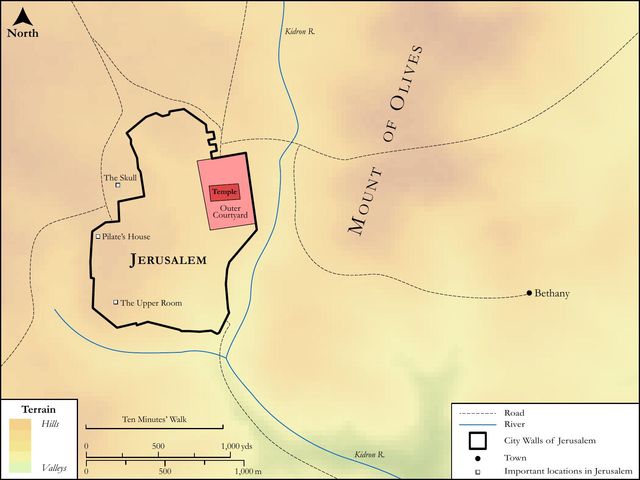
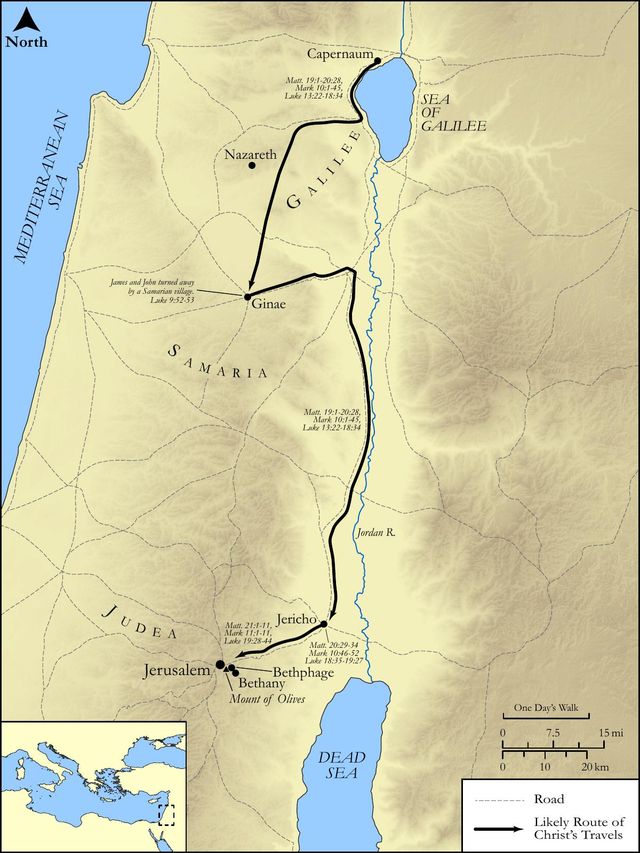
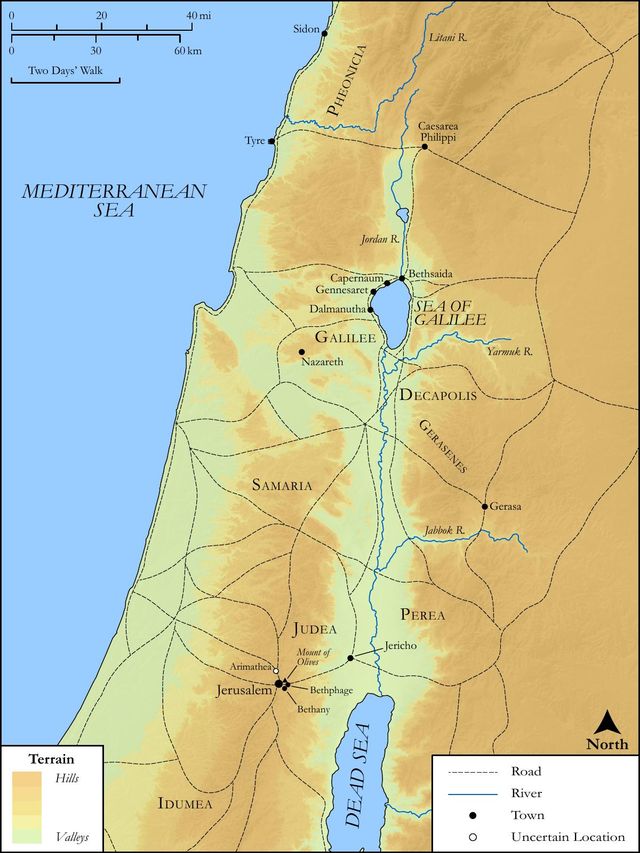
See on the biblical-era maps
Study this verse
Public-domain commentary
Matthew Henry
From his Commentary on the Whole Bible. Henry comments on passages, not single verses — this entry covers Mark 10:17–31. His four-level outline is real structure in the source text, so it is rendered as structure.
I.Here is a hopeful meeting between Christ and a young man; such he is said to be (Mat 19:20, Mat 19:22), and a ruler (Luk 18:18), a person of quality. Some circumstances here are, which we had not in Matthew, which makes his address to Christ very promising.
1.He came running to Christ, which was an indication of his humility; he laid aside the gravity and grandeur of a ruler, when he came to Christ: thus too he manifested his earnestness and importunity; he ran as one in haste, and longing to be in conversation with Christ. He had now an opportunity of consulting this great Prophet, in the things that belonged to his peace, and he would not let slip the opportunity.
2.He came to him when he was in the way, in the midst of company: he did not insist upon a private conference with him by night, as Nicodemus did, though like him he was a ruler, but when he shall find him without, will embrace that opportunity of advising with him, and not be ashamed, Sol 8:1.
3.He kneeled to him, in token of the great value and veneration he had for him, as a teacher come from God, and his earnest desire to be taught by him. He bowed the knee to the Lord Jesus, as one that would not only do obeisance to him now, but would yield obedience to him always; he bowed the knee, as one that meant to bow the soul to him.
4.His address to him was serious and weighty; Good Master, what shall I do, that I may inherit eternal life? Eternal life was an article of his creed, though then denied by the Sadducees, a prevailing party: he asks, What shall he do now that he may be happy for ever. Most men enquire for good to be had in this world (Psa 4:6), any good; he asks for good to be done in this world, in order to the enjoyment of the greatest good in the other world; not, Who will make us to see good? But, "Who will make us to do good?" He enquires for happiness in the way of duty; the summum bonum - chief good which Solomon was in quest of, was that good for the sons of men which they do should do, Ecc 2:3. Now this was,
(1.)A very serious question in itself; it was about eternal things, and his own concern in those things. Note, Then there begins to be some hope of people, when they begin to enquire solicitously, what they shall do to get to heaven.
(2.)It was proposed to a right person, one that was every way fit to answer it, being himself the Way, the Truth, and the Life, the true way to life, to eternal life; who came from heaven on purpose, first to lay open for us, and then to lay open to us; first to make, and then to make known, the way to heaven. Note, Those who would know what they shall do to be saved, must apply themselves to Christ, and enquire of him; it is peculiar to the Christian religion, both to show eternal life, and to show the way to it.
(3.)It was proposed with a good design - to be instructed. We find this same question put by a lawyer, not kneeling, but standing up (Luk 10:25), with a bad design, to pick quarrels with him; he tempted him, saying, Master, what shall I do? It is not so much the good words as the good intention of them that Christ looks at.
5.Christ encouraged this address,
(1.)By assisting his faith, Mar 10:18. He called him good Master; Christ would have him mean thereby, that he looked upon him to be God, since there is none good but one, that is God, who is one, and his name one, Zac 14:9. Our English word God doubtless hath affinity with good; as the Hebrews name God by his power, Elohim, the strong God; so we by his goodness, the good God.
(2.)By directing his practice (Mar 10:19); Keep the commandments; and thou knowest what they are. He mentions the six commandments of the second table, which prescribe our duty to our neighbour; he inverts the order, putting the seventh commandment before the sixth, to intimate that adultery is a sin no less heinous than murder itself. The fifth commandment is here put last, as that which should especially be remembered and observed, to keep us to all the rest. Instead of the tenth commandment, Thou shalt not covet, our Saviour here puts, Defraud not. Mē aposterēsēs - that is, saith Dr. Hammond, "Thou shalt not rest contented with thy own, and not seek to increase it by the diminution of other men's." It is a rule of justice not to advance or enrich ourselves by doing wrong or injury to any other.
6.The young man bid fair for heaven, having been free from any open gross violations of the divine commands. Thus far he was able to same in some measure (Mar 10:20), Master, all these have I observed from my youth. He thought he had, and his neighbours thought so too. Note, Ignorance of the extent and spiritual nature of the divine law, makes people think themselves in a better condition than they really are. Paul was alive without the law. But when he saw that to be spiritual, he saw himself to be carnal, Rom 7:9, Rom 7:14. However, he that could say he was free from scandalous sin, went further than many in the way to eternal life. But though we know nothing by ourselves, yet are we not thereby justified. Co1 4:4.
7.Christ had a kindness for him; Jesus, beholding him, loved him, Mar 10:21. He was pleased to find that he had lived inoffensively, and pleased to see that he was inquisitive how to live better than so. Christ particularly loves to see young people, and rich people, asking the way to heaven, with their faces thitherward.
II.Here is a sorrowful parting between Christ and this young man.
1.Christ gave him a command of trial, by which it would appear whether he did in sincerity aim at eternal life, and press towards it: he seemed to have his heart much upon it, and if so, he is what he should be; but has he indeed his heart upon it? Bring him to the touchstone.
(1.)Can he find in his heart to part with his riches for the service of Christ? He hath a good estate, and now, shortly, at the first founding of the Christian church, the necessity of the case will require that those who have lands, sell them, and lay the money at the apostles' feet; and how will he dispense with that? Act 4:34, Act 4:35. After awhile, tribulation and persecution will arise, because of the word; and he must be forced to sell his estate, or have it taken from him, and how will he like that? Let him know the worst now; if he will not come up to these terms, let him quit his pretensions; as good as the first as at last. "Sell whatsoever thou hast over and above what is necessary for thy support;" probably, he had no family to provide for; let him therefore be a father to the poor, and make them his heirs. Every man, according to his ability, must relieve the poor, and be content, when there is occasion, to straiten himself to do it. Worldly wealth is given us, not only as maintenance to bear our charges through this world, according to our place in it, but as talent, to be used and employed for the glory of our great Master in the world, who hath so ordered it, that the poor we should have always with us as his receivers.
(2.)Can he find it in his heart to go through the hardest costliest services he may be called to as a disciple of Christ, and depend upon him for a recompence in heaven? He asks Christ what he should do more than he has done to obtain eternal life, and Christ puts it to him, whether he has indeed that firm belief of, and that high value for, eternal life that he seems to have. Doth he really believe there is a true treasure in heaven sufficient to make up all he can leave, or lose, or lay out, for Christ? Is he willing to deal with Christ upon trust? Can he give him credit for all he is worth; and be willing to bear a present cross, in expectation of a future crown?
2.Upon this he flew off (Mar 10:22); He was sad at that saying; was sorry that he could not be a follower of Christ upon any easier terms than leaving all to follow him; that he could not lay hold on eternal life, and keep hold of his temporal possessions too. But since he could not come up to the terms of discipleship, he was so fair as not to pretend to it; He went away grieved. Here appeared the truth of that (Mat 6:24), Ye cannot serve God and mammon; while he held to mammon he did in effect despise Christ, as all those do who prefer the world before him. He bids for what he has a mind for in the market, yet goes away grieved, and leaves it, because he cannot have it at his own price. Two words to a bargain. Motions are not marriages. That which ruined this young man was, he had great possessions; thus the prosperity of fools destroys them, and those who spend their days in wealth are tempted to say to God, Depart from us; or to their hearts, Depart from God.
III.Here is Christ's discourse with his disciples.
We are tempted to wish that Christ had mollified that saying which frightened this young gentleman from following him, and by an explanation taken off the harshness of it: but he knew all men's hearts; he would not court him to be his follower, because he was a rich man and a ruler; but, if he will go, let him go. Christ will keep no man against his will; and therefore we do not find that Christ called him back, but took this occasion to instruct his disciples in two things.
1.The difficulty of the salvation of those who have an abundance of this world; because there are few who have a deal to leave, that can be persuaded to leave it for Christ, or to lay it out in doing good.
(1.)Christ asserts this here; He looked about upon his disciples, because he would have them all take notice of what he said, that by it they might have their judgments rightly informed, and their mistakes rectified, concerning worldly wealth, which they were apt to over-rate; How hardly shall they who have riches enter into the kingdom of God! Mar 10:23. They have many temptations to grapple with, and many difficulties to get over, which lie not in the way of poor people. But he explains himself, Mar 10:24, where he calls the disciples children, because as such they should be taught by him, and portioned by him with better things than this young man left Christ to cleave to; and whereas he had said, How hardly will those who have riches get to heaven; here he tells them, that the danger arose not so much from their having riches as from their trusting to them, and placing their confidence in them, expecting protection, provision, and a portion from them; saying that to their gold, which they should say only to their God, Thou art my hope, Job 31:24. They have such a value as this for the wealth of the world, will never be brought to put a right value upon Christ and his grace. They that have ever so much riches, but do not trust in them, that see the vanity of them, and their utter insufficiency to make a soul happy, have got over the difficulty, and can easily part with them for Christ: but they have ever so little, if they set their hearts upon that little, and place their happiness in it, it will keep them from Christ. He enforces this assertion with, Mar 10:25, It is easier for a camel to go through the eye of a needle, than for a rich man, that trusts in riches, or inclines to do so, to enter into the kingdom of God. The disproportion here seems so great (though the more it is so the more it answers the intention), that some have laboured to bring the camel and the eye of the needle a little nearer together.
[1.]Some imagine there might be some wicket-gate, or door, to Jerusalem, commonly known by the name of the needle's eye, for its straitness, through which a camel could not be got, unless he were unloaded, and made to kneel, as those camel, Gen 24:11. So a rich man cannot get to heaven unless he is willing to part with the burthen of his worldly wealth, and stoop to the duties of a humble religion, and so enter at the strait gate.
[2.]Others suggest that the word we translate a camel, sometimes signifies a cable-rope, which, though not to be got through a needle's eye, yet is of great affinity to it. A rich man, compared with the poor, is as a cable to a single thread, stronger, but not so pliable, and it will not go through the needle's eye, unless it be untwisted. So the rich man must be loosed and disentangled from his riches, and then there is some hope of him, that thread by thread he may be got through the eye of the needle, otherwise he is good for nothing but to cast anchor in the earth.
(2.)This truth was very surprising to the disciples; They were astonished at his words, Mar 10:24. They were astonished out of measure, and said among themselves, Who then can be saved? They knew what were generally the sentiments of the Jewish teachers, who affirmed that the Spirit of God chooses to reside in rich men; nay, they knew what abundance of promises there were, in the Old Testament, of temporal good things; they knew likewise that all either are rich, or fain would be so, and that they who are rich, have so much the larger opportunities of doing good, and therefore were amazed to hear that it should be so hard for rich people to go to heaven.
(3.)Christ reconciled them to it, by referring it to the almighty power of God, to help even rich people over the difficulties that lie in the way of their salvation (Mar 10:27); He looked upon them, to engage their attention, and said, "With men it is impossible; rich people cannot by their own skill or resolution get over these difficulties, but the grace of God can do it, for with him all things are possible." If the righteous scarcely are saved, much more may we say so of the rich; and therefore when any get to heaven, they must give all the glory to God, who worketh in them both to will and to do.
2.The greatness of the salvation of those that have but a little of this world, and leave it for Christ. This he speaks of, upon occasion of Peter's mentioning what he and the rest of the disciples had left to follow him; Behold, (saith he), we have left all to follow thee, Mar 10:28. "You have done well," saith Christ, "and it will prove in the end that you have done well for yourselves; you shall be abundantly recompensed, and not only you shall be reimbursed, who have left but a little, but those that have ever so much, though it were so much as this young man had, that could not persuade himself to quit it for Christ; yet they shall have much more than an equivalent for it." (1.) The loss is supposed to be very great; he specifies, [1.] Worldly wealth; houses are here put first, and lands last: if a man quit his house, which should be for his habitation, and his land, which should be for his maintenance, and so make himself a beggar and an outcast. This has been the choice of suffering saints; farewell houses and lands, though ever so convenient and desirable, through the inheritance of fathers, for the house which is from heaven, and the inheritance of the saints in light, where are many mansions. [2.] Dear relations. Father and mother, wife and children, brethren and sisters. In these, as much as in any temporal blessing, the comfort of life is bound up; without these the world would be a wilderness; yet, when we must either forsake these or Christ, we must remember that we stand in nearer relation to Christ than we do to any creature; and therefore to keep in with him, we must be content to break with all the world, and to say to father and mother, as Levi did, I have not known you. The greatest trial of a good man's constancy is, when his love to Christ comes to stand in competition with a love that is lawful, nay, that is his duty. It is easy to such a one to forsake a lust for Christ, for he hath that within him, that rises against it; but to forsake a father, a brother, a wife, for Christ, that is, to forsake those whom he knows he must love, is hard. And yet he must do so, rather than deny or disown Christ. Thus great is the loss supposed to be; but it is for Christ's sake, that he may be honoured, and the gospel's, that it may be promoted and propagated. It is not the suffering, but the cause, that makes the martyr. And therefore, (2.) The advantage will be great. [1.] They shall receive a hundred-fold in this time, houses, and brethren, and sisters; not in specie, but that which is equivalent. He shall have abundance of comfort while he lives, sufficient to make up for all his losses; his relation to Christ, his communion with the saints, and his title to eternal life, shall be to him brethren, and sisters, and houses, and all. God's providence gave Job double to what he had had, but suffering Christians shall have a hundred-fold in the comforts of the Spirit sweetening their creature comforts. But observe, It is added here in Mark, with persecutions. Even when they are gainers by Christ, let them still expect to be sufferers for him; and not be out of the reach of persecution, till they come to heaven. Nay, The persecutions seem to come in here among the receivings in this present time; for unto you it is given, not only to believe in Christ, but also to suffer for his name; yet this is not all, [2.] They shall have eternal life in the world to come. If they receive a hundred-fold in this world, one would think they should not be encouraged to expect any more. Yet, as if that were a small matter, they shall have life eternal into the bargain; which is more than ten thousand-fold, ten thousand times told, for all their losses. But because they talked so much, and really more than became them, of leaving all for Christ, he tells them, though they were first called, that there should be disciples called after them, that should be preferred before them; as St. Paul, who was one born out of due time, and yet laboured more abundantly than all the rest of the apostles, Co1 15:10. Then the first were last, and the last first.
Historical interpretation
Seven Centuries of Reception
5 surviving comments on this verse. Each one is dated, so this reads as a timeline rather than a list.
Select a marker to jump to its quote. Markers stagger vertically where authors wrote within a few decades of each other.
(Hom. in Matt. 63) Because however he had come to Christ as he would to a man, and to one of the Jewish doctors, Christ answered him as Man. Wherefore it goes on: And Jesus said unto him, Why callest thou me good? there is none good but the One God. In saying which He does not exclude men from goodness, but from a comparison with the goodness of God.
(ubi sup.) Well too did He say, not eternal life, but treasure, saying, And thou shalt have treasure in heaven; for since the question was concerning wealth, and the renouncing of all things, He shows that He returns more things than He has bidden us leave, in proportion as heaven is greater than earth.
(ubi sup.) And the Evangelist adds the cause of his grief, saying, For he had great possessions. The feelings of those who have little and those who have much are not the same, for the increase of acquired wealth lights up a greater flame of covetousness. There follows: And Jesus looked round about, and said unto his disciples, How hardly shall they that have riches enter into the kingdom of God.
(ubi sup.) But the Lord said this to His disciples, who were poor and possessed nothing, in order to teach them not to blush at their poverty, and as it were to make an excuse to them, and give them a reason, why He had not allowed them to possess any thing. It goes on: And the disciples were astonished at his words; for it is plain, since they themselves were poor, that they were anxious for the salvation of others.
(ubi sup.) Or else, after saying difficult, He then shows that it is impossible, and that not simply, but with a certain vehemence; and he shows this by an example, saying, It is easier for a camel to pass through the eye of a needle, than for a rich man to enter the kingdom of heaven.
(ubi sup.) And the reason why He says that this is the work of God is, that He may show that he who is put into this path by God, has much need of grace; from which it is proved, that great is the reward of those rich men, who are willing to follow the 1discipline of Christ.
The rich man asked the good teacher what he should do to gain eternal life. He regarded the good teacher as a man and nothing more (as distinct from the assumption that He is good as God incarnate). Hear the good teacher respond to him: if he wishes to enter into life, he should keep the commandments; that he should remove from himself the bitterness of malice and wickedness; that he should not kill, or commit adultery, or steal, or bear false witness, in order that dry land may appear and bring forth the honor of mother and father and the love of our neighbor.
(Cat. in Marc. Oxon.) It is worthy of enquiry, however, how He loved a man, who, He knew, would not follow Him? But this is so much as to say, that since he was worthy of love in the first instance, because he observed the things of the law from his youth, so in the end, though he did not take upon himself perfection, he did not suffer a lessening of his former love. For although he did not pass the bounds of humanity, nor follow the perfection of Christ, still he was not guilty of any sin, since he kept the law according to the capability of a man, and in this mode of keeping it, Christ loved himq.
(ubi sup.) A certain man had heard from the Lord that only they who are willing to be like little children are worthy to enter into the kingdom of heaven, and therefore he desires to have explained to him, not in parables, but openly, by the merits of what works a man may attain everlasting life. Wherefore it is said: And when he was gone forth into the way, there came one running, and kneeled to him, and asked him, Good Master, what shall I do that I may inherit eternal life?
(ubi sup.) But by this one God, who is good, we must not only understand the Father, but also the Son, who says, I am the good Shepherd; (John 10:11) and also the Holy Ghost, because it is said, The Father which is in heaven will give the good Spirit to them that ask him. (Luke 2:15. Vulg.) For the One and Undivided Trinity itself, Father, Son, and Holy Ghost, is the Only and One good God. The Lord, therefore, does not deny Himself to be good, but implies that He is God; He does not deny that He is good Master, but He declares that no master is good but God.
(ubi sup.) But observe that the righteousness of the law, when kept in its own time, conferred not only earthly goods, but also eternal life on those who chose it. Wherefore the Lord's answer to one who enquires concerning everlasting life is, Thou knowest the commandments, Do not commit adultery, Do not kill; for this is the childlike blamelessness which is proposed to us, if we would enter the kingdom of heaven. On which there follows, And he answered and said unto him, Master, all these have I observed from my youth. We must not suppose that this man either asked the Lord, with a wish to tempt him, as some have fancied, or lied in his account of his life; but we must believe that he confessed with simplicity how he had lived; which is evident, from what is subjoined, Then Jesus beholding him loved him, and said unto him. If however he had been guilty of lying or of dissimulation, by no means would Jesus, after looking on the secrets of his heart, have been said to love him.
(ubi sup.) For God loves those who keep the commandments of the law, though they be inferior; nevertheless, He shows to those who would be perfect the deficiency of the law, for He came not to destroy the law, but to fulfil it. Wherefore there follows: And said unto him, One thing thou lackest; go thy way, sell whatsoever thou hast, and give to the poor, and thou shalt have treasure in heaven: and come, follow me; (Matt. 5:17) for whosoever would be perfect ought to sell all that he has, not a part, like Ananias and Sapphira, but the whole.
(ubi sup) For he follows the Lord, who imitates Him, and walks in His footsteps. It goes on: And he was sad at that saying, and went away grieved.
But there is a great difference between having riches, and loving them; wherefore also Solomon says not, He that hath silver, but, He that loveth silver shall not be satisfied, with silver. (Eccl. 5:10) Therefore the Lord unfolds the words of His former saying to His astonished disciples, as follows: But Jesus answereth again, and saith unto them, Children, how hard it is for them that trust in their riches to enter the kingdom of God. Where we must observe that He says not, how impossible, but how hard; for what is impossible cannot in any way come to pass, what is difficult can be compassed, though with labour.
(ubi sup.) How then could either in the Gospel, Matthew and Joseph, or in the Old Testament, very many rich persons, enter into the kingdom of God, unless it be that they learned through the inspiration of God either to count their riches as nothing, or to quit them altogether. Or in a higher sense, it is easier for Christ to suffer for those who love Him, than for the lovers of this world to turn to Christ; for under the name of camel, He wished Himself to be understood, because He bore the burden of our weakness; and by the needle, He understands the prickings, that is, the pains of His Passion. By the eye of a needle, therefore, He means the straits of His Passion, by which He, as it were, deigned to mend the torn garments of our nature. It goes on; And they were astonished above measure, saying among themselves, Who then can be saved? Since the number of poor people is immeasurably the greater, and these might be saved, though the rich perished, they must have understood Him to mean that all who love riches, although they cannot obtain them, are reckoned in the number of the rich. It goes on; And Jesus looking upon them saith, With men it is impossible, but not with God; which we must not take to mean, that covetous and proud persons can enter into the kingdom of Heaven with their covetousness and pride, but that it is possible with God that they should be converted from covetousness and pride to charity and lowliness.
I wonder at this young man, who when all others come to Christ to be healed of their infirmities, begs of Him the possession of everlasting life, notwithstanding his love of money, the malignant passion which afterwards caused his sorrow.
Therefore the Lord intended by these words to raise the mind of the young man, so that he might know Him to be God. But He also implies another thing by these words, that when you have to converse with a man, you should not flatter him in your conversation, but look back upon God, the root and fount of goodness, and do honour to Him.
And when he has sold it, to give it to the poor, not to stage-players and luxurious persons.
But because there are many poor who are not humble, but are drunkards or have some other vice, for this reason He says, And come, follow me.
He says not here, that riches are bad, but that those are bad who only have them to watch them carefully; for He teaches us not to have them, that is, not to keep or preserve them, but to use them in necessary things.
It may be that by camel, we should understand the animal itself, or else that thick cable, which is used for large vessels.
Or we must understand that by, with man it is impossible, but not with God, He means, that when we listen to God, it becomes possible, but as long as we keep our human notions, it is impossible. There follows, For all things are possible with God; when He says all things, you must understand, that have a being; which sin has not, for it is a thing without being and substance.r. Or else: sin does not come under the notion of strength, but of weakness, therefore sin, like weakness, is impossible with God. But can God cause that not to have been done which has been done? To which we answer, that God is Truth, but to cause that what has been done should not have been done, is falsehood. How then can truth do what is false? He must first therefore quit His own nature, so that they who speak thus really say, Can God cease to be God? which is absurd.
Continue studying Mark 10:19 across the web’s major study libraries — every link below opens this exact verse, chapter, or book on the destination site.
Read & Compare
 BibleGatewayThis verse in more than 200 translations and 70 languages.
 Bible.comThe YouVersion reader — hundreds of translations, reading plans, and highlights.
 ESV.orgCrossway's official English Standard Version reader.
 NET BibleThe NET translation with 60,000+ translators' notes on every rendering decision.
 STEP BibleTyndale House's free study tool — original text, vocabulary, and scholarly resources.
 BibliaLogos Bible Software's free web reader.
 USCCBThe New American Bible (Revised Edition) with the U.S. bishops' study notes.
Commentaries
 BibleHub CommentariesDozens of classic commentaries on this verse, gathered on one page.
 StudyLightMore than 100 commentary sets — the largest collection on the web.
 BibleRefPlain-English commentary on what this verse means, verse by verse.
 Enduring WordDavid Guzik's free commentary on this chapter, widely used by Bible teachers.
 Bible Study ToolsVerse commentary alongside Greek and Hebrew study aids.
Original Language & Research
- BibleHub InterlinearThe verse word by word — original language, transliteration, and English.
- BibleHub LexiconEvery word's original-language definition and Strong's entry.
 Blue Letter BibleDeep-study tools — Strong's numbers, concordance, and word studies.
 CNTR CollationThe earliest Greek manuscripts of this verse, collated letter by letter.
Sermons, Hymns & Audio


TrulyRandomVerse is not affiliated with these sites and doesn’t control their content. They’re linked because they’re genuinely useful.
Summary
Mark 10:19 presents a pivotal moment in Jesus's encounter with a wealthy young man seeking eternal life, where Jesus directs him to a selection of the Ten Commandments. This response serves not as an affirmation that salvation is earned through legalistic adherence, but rather as a diagnostic tool to expose the young man's true spiritual condition and the ultimate object of his devotion, particularly highlighting the ethical demands of God's Law concerning human relationships.
Context
ShowHideLiterary Context
This verse is embedded within the broader narrative of Jesus's journey towards Jerusalem, a period marked by significant teaching moments regarding discipleship, the nature of the Kingdom of God, and the cost of following Him. Immediately preceding this encounter, Jesus has just affirmed the sanctity of marriage and welcomed children, emphasizing humility and a childlike faith as prerequisites for entering the Kingdom (Mark 10:13-16). The rich young man's question about inheriting eternal life in Mark 10:17 sets the stage for Jesus's response in Mark 10:19, which then leads to the challenging command to sell all possessions, revealing the young man's attachment to wealth (Mark 10:21-22). This entire pericope, therefore, serves as a profound commentary on the true nature of discipleship and the obstacles to entering God's Kingdom.
Historical & Cultural Context
The Jewish society of Jesus's time deeply revered the Torah, or Law, as the revealed will of God. Observance of the commandments was central to Jewish identity and piety, with many believing that meticulous adherence to the Law was the path to righteousness and eternal life. The Ten Commandments, or Decalogue (Exodus 20:1-17), were foundational to this understanding. The young man's question reflects a common rabbinic inquiry of the day: "What must I do to inherit eternal life?" This question typically sought a specific action or set of actions that would guarantee divine favor. Jesus's selective recitation of commandments, particularly those concerning human relationships (the "second table" of the Law), would have been immediately recognizable to any devout Jew, emphasizing the societal and ethical dimensions of faith.
Key Themes
ShowHideThis verse contributes significantly to several key themes within Mark's Gospel and the broader biblical narrative. Firstly, it highlights the Law as a revealer of sin and human inadequacy, rather than a means of salvation. Jesus uses the commandments to expose the young man's self-righteousness and his ultimate idolatry of wealth, demonstrating that outward obedience alone is insufficient for true spiritual transformation. Secondly, it underscores the importance of holistic obedience and the spirit of the Law. The commandments listed, particularly the unique inclusion of "Defraud not," emphasize ethical conduct in all human interactions, extending beyond mere avoidance of overt sin to active righteousness and justice in community. This resonates with the broader biblical principle that love for God is inextricably linked to love for neighbor, as taught in Matthew 22:37-40. Finally, the passage sets up the theme of the radical demands of discipleship, showing that true following of Christ requires complete surrender and a reordering of priorities, which often involves sacrificing what is most cherished in the world for the sake of the Kingdom (Mark 10:23-27).
Exposition and Analysis
ShowHideKey Word Analysis
ShowHideThis verb signifies more than mere intellectual awareness; it implies a deep, experiential knowledge or understanding. When Jesus says, "Thou knowest the commandments," He is not merely asking if the young man has heard of them, but if he truly understands and lives by them in a comprehensive sense. It implies a recognition of their authority and a claim to their observance.
Derived from a word meaning "to enjoin" or "to command," entolḗ refers to an authoritative precept or injunction. In this context, it specifically refers to the divine decrees given by God through Moses, emphasizing their origin and binding nature. These are not suggestions but divine requirements for righteous living.
This is a crucial and unique inclusion in Mark's account, distinguishing it from Matthew's and Luke's parallels which list "Do not covet." Aposteréō means "to deprive," "to withhold what is due," or "to cheat." Its inclusion broadens the scope of the commandment against stealing and coveting, moving beyond passive non-taking to active non-withholding. It implies a positive duty to ensure others receive what is justly theirs, whether in financial dealings, labor, or general fairness, highlighting honest dealing and integrity in social interactions.
Verse Breakdown
ShowHide"Thou knowest the commandments"
This opening phrase establishes a common ground. Jesus acknowledges the young man's familiarity with the Mosaic Law, setting the stage for a deeper examination of his understanding and adherence. It's an invitation to self-assessment based on established divine standards.
"Do not commit adultery, Do not kill, Do not steal, Do not bear false witness"
These are direct quotations from the latter half of the Decalogue (Exodus 20:13-16; Deuteronomy 5:17-20). They represent fundamental prohibitions against actions that harm one's neighbor in terms of relationships, life, property, and reputation. Jesus selects these specific commands, focusing on the horizontal dimension of the Law, which governs human-to-human interactions.
"Defraud not"
This command, unique to Mark's account among the Synoptics, is a significant addition. While related to "Do not steal" and "Do not covet," it carries a more active connotation of withholding what is due or cheating. It broadens the scope of ethical conduct to include honesty in business and financial dealings, implying a positive obligation to ensure fair and just transactions.
"Honour thy father and mother"
This command (Exodus 20:12; Deuteronomy 5:16) is the first of the "second table" of the Law and serves as a foundational command for family and societal order. It emphasizes respect for authority, care for elders, and the maintenance of the family unit, which is the bedrock of community. Its inclusion underscores the comprehensive nature of ethical living, extending to familial duties.
Literary Devices
ShowHideMark's presentation of Mark 10:19 employs several literary devices. The most prominent is Enumeration, as Jesus lists a series of commandments. This direct listing serves to remind the young man, and the reader, of the specific moral standards of the Law. There is also clear Allusion to the Decalogue, as Jesus directly quotes from the Ten Commandments, immediately connecting His teaching to the foundational covenantal requirements of Israel. The selection of specific commandments, particularly the inclusion of "Defraud not," can be seen as a form of Synecdoche, where a part (a few selected commandments) represents the whole (the entire Law's demand for righteousness in human relationships). Furthermore, the passage sets up a dramatic Irony: the young man, who claims to have kept all these from his youth, is about to have his self-perception shattered by a deeper command that reveals his true heart's allegiance to wealth, demonstrating that outward obedience can mask inward deficiency.
Theological and Thematic Connections
ShowHideMark 10:19 serves as a crucial theological bridge, connecting the Old Testament Law with New Testament principles of discipleship. It highlights that while the Law reveals God's righteous standards and exposes human sinfulness, it cannot, by itself, grant eternal life. The commandments listed are not a checklist for earning salvation, but rather a mirror reflecting the depth of God's expectations for human conduct and revealing where one falls short. This passage subtly underscores the New Testament emphasis on the spirit of the Law over mere letter-of-the-law observance, pointing to the need for an internal transformation that only God can provide. The focus on human relationships within the commandments reiterates the inseparable link between loving God and loving one's neighbor, a core tenet of biblical ethics.
Reflection and Application
ShowHideThe exchange in Mark 10:19 challenges us to move beyond a superficial understanding of righteousness. It forces us to confront whether our obedience is merely external, a performance designed to earn favor, or if it flows from a heart truly devoted to God and His ways. The specific commandments listed remind us that our faith is not abstract but profoundly practical, impacting how we interact with every person in our lives—from family members to strangers, in our personal relationships and our financial dealings. The inclusion of "Defraud not" is particularly convicting, urging us to consider not just what we don't do wrong, but what we fail to do right, especially in areas of justice, fairness, and generosity. True discipleship calls for an honest self-assessment, acknowledging our inability to perfectly keep God's Law, and recognizing our desperate need for grace and a transformed heart. This passage invites us to examine our own "idols" – those things we cling to more tightly than to God – and to consider the radical call of Christ to surrender all for the sake of the Kingdom.
Questions for Reflection
ShowHideFAQ
ShowHideWhy did Jesus only list some of the Ten Commandments, and specifically the ones about human relationships?
ShowHideJesus's selection of commandments in Mark 10:19 is highly intentional. He focuses on the "second table" of the Decalogue, which deals with one's duties to fellow human beings, rather than the "first table" concerning one's duty to God. This choice serves several purposes. Firstly, it directly addresses the young man's perceived area of strength; he likely considered himself righteous in his dealings with others. Secondly, it prepares the ground for Jesus's subsequent command to sell his possessions, which reveals the young man's failure in the first commandment (having no other gods before God) by exposing his idolatry of wealth. By focusing on human relationships, Jesus subtly leads the young man to confront the deeper implications of his love for God, which, as Jesus taught elsewhere, is inextricably linked to loving one's neighbor (Matthew 22:37-40). The Law, in this context, functions as a mirror to expose the heart's true allegiance.
Christ-Centered Fulfillment
ShowHideMark 10:19, while seemingly a straightforward recitation of the Law, finds its profound Christ-centered fulfillment in several ways. Jesus, as the perfect embodiment of God's righteousness, is the only one who truly fulfilled the Law in its entirety, not just outwardly but in spirit and truth (Matthew 5:17). He perfectly loved God and perfectly loved His neighbor, demonstrating the true intent behind every commandment. For the rich young ruler, the Law served as an impossible standard, exposing his sin and inability to earn eternal life. In Christ, however, the Law's demands are met, and its curse is borne on the cross (Galatians 3:13). Through faith in Jesus, believers are not merely given a new set of rules, but are given a new heart and the Holy Spirit, enabling them to genuinely desire and increasingly live out the righteous requirements of the Law, not for salvation, but as an overflow of a transformed life (Romans 8:3-4). Thus, Jesus fulfills the Law by perfectly obeying it, by bearing its penalty for us, and by empowering us to live in a way that truly honors God and loves our neighbor, something the Law alone could never accomplish (Hebrews 10:1-10).