


Matthew 27:57
Bible text: King James Version (1769 Blayney text) · Public domain
Bible text: Berean Standard Bible · Public domain
Bible text: American Standard Version (1901) · Public domain
Bible text: World English Bible, Messianic edition · Public domain
Bible text: Geneva Bible (1599) · Public domain
Bible text: Young's Literal Translation · Public domain
- ὈψίαςOpsiasWhen eveningG3798A-GSFAdjective Genitive Singular Feminine
- δὲdenowG1161CONJConjunction
- γενομένηςgenomenēshaving arrivedG1096V-2ADP-GSFVerb 2nd Aorist Middle Deponent Participle Genitive Singular Feminine
- ἦλθενēlthencameG2064V-2AAI-3SVerb 2nd Aorist Active Indicative 3rd Singular
- ἄνθρωποςanthrōposa manG444N-NSMNoun Nominative Singular Masculine
- πλούσιοςplousiosrichG4145A-NSMAdjective Nominative Singular Masculine
- ἀπὸapofromG575PREPPreposition
- ἉριμαθαίαςHarimathaiasArimatheaG707N-GSF-LNoun Genitive Singular Feminine Location
- τοὔνομαtounomanamedG5122N-ASNNoun Accusative Singular Neuter
- ἸωσήφIōsēphJosephG2501N-NSM-PNoun Nominative Singular Masculine Individual
- ὃςhoswhoG3739R-NSMRelative pronoun Nominative Singular Masculine
- καὶkaialsoG2532CONJConjunction
- αὐτὸςautoshimselfG846P-NSMPersonal pronoun Nominative Singular Masculine
- ἐμαθητεύθηemathēteuthēwas discipledG3100V-API-3SVerb Aorist Passive Indicative 3rd Singular
- τῷtō<the>G3588T-DSMDefinite article Dative Singular Masculine
- ἸησοῦIēsouto JesusG2424N-DSM-PNoun Dative Singular Masculine Individual
English is a literal word-by-word gloss of the Greek, not the KJV's wording. Why?
This is the original text the KJV's translators worked from — each Greek word with its own literal English meaning in this verse, prepared by scholars at Tyndale House, Cambridge. The KJV translates whole sentences, not word by word, so its wording differs: one Greek word can become several English words, and the KJV may choose “charity” where the gloss reads “love”. Both are faithful — they answer different questions. For the KJV's own rendering, switch to the KJV text.
Details
See on the biblical-era maps

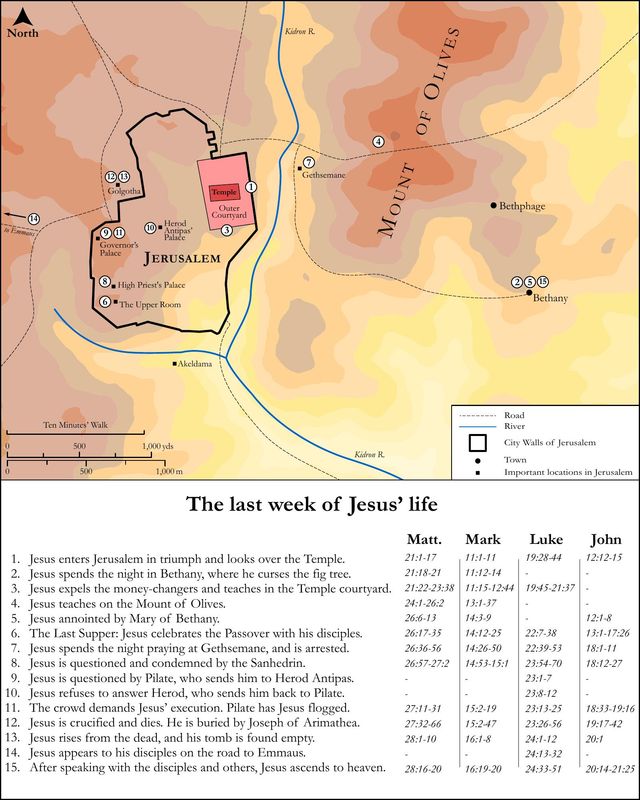
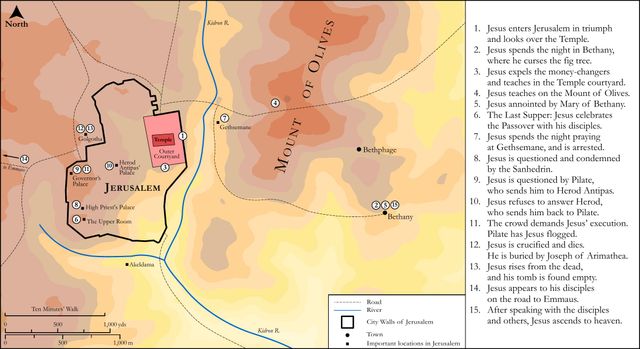
Study this verse
Historical interpretation
Nine Centuries of Reception
12 surviving comments on this verse. Each one is dated, so this reads as a timeline rather than a list.
Select a marker to jump to its quote. Markers stagger vertically where authors wrote within a few decades of each other.
(Serm. App. 248. 4.) The Saviour was laid in a tomb belonging to another man, because He died for the salvation of others. For why should He who in Himself had no death, have been laid in His own tomb? Or He whose place was reserved for Him in heaven, have had a monument upon earth? He who remained but three days space in the tomb, not as dead, but as resting on His bed? A tomb is the necessary abode of death; Christ then, who is our life, could not have an abode of death; He that ever liveth had no need of the dwelling of the departed.
('Aug. in Serm.' non occ.) Had the tomb been in the earth, it might have been said they undermined the place, and so carried Him off. Had a small stone been laid thereon, they might have said, They carried Him off while we slept.
Mystically, Joseph affords a figure of the Apostles. He wraps the body in a clean linen cloth, in which same linen sheet were let down to Peter out of heaven all manner of living creatures; whence we understand, that under the representation of this linen cloth the Church is buried together with Christ. The Lord's body moreover is laid in a chamber hewn out of rock, empty and new; that is, by the teaching of the Apostles, Christ is conveyed into the hard breast of the Gentiles hewn out by the toil of teaching, rude and new, hitherto unpenetrated by any fear of God. And for that besides Him ought nothing to enter our breasts, a stone is rolled to the mouth, that as before Him we had received no author of divine knowledge, so after Him we should admit none.
Joseph of Arimathea, having asked Pilate to return Jesus’ body, wrapped it in a shroud, placed it in a new tomb carved out from a rock and rolled a stone in front of the entrance to the tomb. Although this may indeed be the order of events and although it was necessary to bury him who would rise from the dead, these deeds are nevertheless recounted individually because each of them is not without some importance. Joseph is called a disciple of the Lord because he was an image of the apostles, even though he was not numbered among the twelve apostles. It was he who wrapped the Lord’s body in a clean linen shroud; in this same linen we find all kinds of animals descending to Peter from heaven. It is perhaps not too extravagant to understand from this parallel that the church is buried with Christ under the name of the linen shroud. Just as in the linen, so also in the confession of the church are gathered the full diversity of living beings, both pure and impure. The body of the Lord, therefore, through the teaching of the apostles, is laid to rest in the empty tomb newly cut from a rock. In other words, their teaching introduced Christ into the hardness of the Gentile heart, which was uncut, empty and previously impervious to the fear of God. And because he is the only one who should penetrate our hearts, a stone was rolled over the entrance to the tomb, so that just as no one previous to him had been introduced as the author of divine knowledge, neither would anyone be brought in after him.
"But Joseph went, and begged the body." This was Joseph, who was concealing his discipleship of late; now however he had become very bold after the death of Christ. For neither was he an obscure person, nor of the unnoticed; but one of the council, and highly distinguished; from which circumstance especially one may see his courage. For he exposed himself to death, taking upon him enmity with all, by his affection to Jesus, both having dared to beg the body, and not having desisted until he obtained it. But not by taking it only, nor by burying it in a costly manner, but also by laying it in his own new tomb, he showeth his love, and his courage. And this was not so ordered without purpose, but so there should not be any bare suspicion, that one had risen instead of another.
"And there was Mary Magdalene, and the other Mary, sitting over against the sepulchre." For what purpose do these wait by it? As yet they knew nothing great, as was meet, and high about Him, wherefore also they had brought ointments, and were waiting at the tomb, so that if the madness of the Jews should relax, they might go and embrace the body. Seest thou women's courage? seest thou their affection? seest thou their noble spirit in money? their noble spirit even unto death?
Let us men imitate the women; let us not forsake Jesus in temptations. For they for Him even dead spent so much and exposed their lives, but we (for again I say the same things) neither feed Him when hungry, nor clothe Him when naked, but seeing Him begging, we pass Him by. And yet if ye saw Himself, every one would strip himself of all his goods. But even now it is the same. For He Himself has said, I am he. Wherefore then dost thou not strip thyself of all? For indeed even now thou hearest Him say, Thou doest it unto me; and there is no difference whether thou givest to this man or to Him; thou hast nothing less than these women that then fed Him, but even much more. But be not perplexed! For it is not so much to have fed Him appearing in His own person, which would be enough to prevail with a heart of stone, as (because of His mere word) to wait upon the poor, the maimed, him that is bent down. For in the former case, the look and the dignity of Him who appears divides with thee that which is done; but here the reward is entire for thy benevolence; and there is the proof of the greater reverence towards Him, when at His mere word waiting upon thy fellow-servant thou refreshest him in all things. Refresh him, and believe Him, who receiveth it, and saith, Thou givest to me. For unless thou hadst given to Him, He would not have counted thee worthy of a kingdom. If thou hadst not turned away from Him, He would not have sent thee to hell, if thou hadst overlooked a chance person; but because it is He Himself that is despised, therefore great is the blame.
Consider this man's courage; he risked his life, and took upon him many enmities in order to render this service; and not only dares to ask for Christ's body, but also to bury it.
We are able to discern from the spiritual sense of Scripture that the body of the Lord must not be covered in gold nor in jewels and silk but in pure linen. This may also mean, however, that the one who wrapped Jesus in clean linen is he who received him with a pure mind.… His body was placed in a new tomb lest it be imagined after the resurrection that one of the other interred bodies had arisen. The new tomb, however, may also signify Mary’s virginal womb. The great stone was placed at the entrance to the tomb in order to show that it could not be opened without the help of several persons.
He is described as rich, not out of any ambition on the part of the writer to represent so noble and rich a man as Jesus' disciple, but to show how he was able to obtain the body of Jesus from Pilate. For poor and unknown individuals would not have dared to approach Pilate, the representative of Roman power, and ask the body of a crucified malefactor. In another Gospel this Joseph is called a counsellor; and it is supposed that the first Psalm has reference to him, Blessed is the man that walketh not in the counsel of the ungodly. (Ps. 1:1.)
By this simple burial of the Lord is condemned the ostentation of the rich, who cannot dispense with lavish expense even in their tombs. But we may also consider in a spiritual sense, that the Lord's body was wrapped not in gold, jewels, or silk, but in clean linen; and that he who wrapped it, is he who embraces Jesus with a pure heart.
He is laid in a new tomb, lest after His resurrection it should be pretended that it was some other who had risen when they saw the other bodies there remaining. The new tomb may also signify the virgin womb of Mary. And He was laid in a tomb hewn out of the rock, lest had it been one raised of many stones, it might have been said that He was stolen away by undermining the foundations of the pile.
That a great stone was rolled there, shows that the tomb could not have been reopened without the united strength of many.
Or, when the rest left the Lord, the women continued in their attendance, looking for what Jesus had promised; and therefore they deserved to be the first to see the resurrection, because he that endureth to the end shall be saved. (Matt. 10:22.)
Joseph of Arimathea is referred to as a rich man not because the writer of the Gospel wanted to boast that very wealthy and noble men were disciples of Jesus but rather in order to show why he was able to obtain Jesus’ body from Pilate. For the poor and obscure did not have the right to approach Pilate, the representative of Roman power, and obtain the body of the Crucified. In another Gospel, this same Joseph is called bouleutēs, which means “councilor” or “senator.” Some think that the first psalm was composed with him in view: “Blessed is the one who does not walk in the counsel of the impious,” and so on.
(Verse 57, 58.) And when it was evening, there came a rich man from Arimathea, named Joseph, who was also a disciple of Jesus. He went to Pilate and asked for the body of Jesus. Then Pilate commanded the body to be given. The mention of Joseph being rich is not to boast of the writer, but to show why he was able to obtain Jesus' body from Pilate. It would not have been possible for a poor and unknown person to approach Pilate, the governor of Roman authority, and obtain the body of someone who had been crucified. In another passage of the Evangelist (Luke 23), Joseph is called βουλευτὴς, that is, counselor, and some believe that the first psalm was composed about him: Blessed is the man who does not walk in the counsel of the wicked, and so on.
Arimathea is the same as Ramatha, the city of Helcana and Samuel, and is situated in the Chananitic country near Diospolis. This Joseph was a man of great dignity in respect of worldly station, but has the praise of much higher merit in God's sight, seeing he is described as righteous. Indeed he that should have the burial of the Lord's body ought to have been such, that he might be deserving of that office by righteous merit.
Or, otherwise; The linen is grown out of the ground, and is bleached to whiteness with great labour, and thus this signifies that His body which was taken of the earth, that is of a Virgin, through the toil of passion came to the whiteness of immortality.
When the Lord's body was buried, and the rest returned to their own places, the women alone, who had loved Him more attachedly adhered to Him, and with anxious care noted the place where the Lord's body was laid, that at fit time they might perform the service of their devotion to him.
And to this day the holy women, that is, the lowly souls of the saints, do the like in this present world, and with pious assiduity wait while Christ's passion is being completed.
From this also has prevailed in the Church the custom of celebrating the sacrifice of the altar not in silk, or in coloured robes, but in linen grown from the earth, as we read, was ordered by the Holy Pope Silvester.
(non occ.) When the Evangelist had finished the order of the Lord's Passion and death, he treats of His burial.
Continue studying Matthew 27:57 across the web’s major study libraries — every link below opens this exact verse, chapter, or book on the destination site.
Read & Compare
 BibleGatewayThis verse in more than 200 translations and 70 languages.
 Bible.comThe YouVersion reader — hundreds of translations, reading plans, and highlights.
 ESV.orgCrossway's official English Standard Version reader.
 NET BibleThe NET translation with 60,000+ translators' notes on every rendering decision.
 STEP BibleTyndale House's free study tool — original text, vocabulary, and scholarly resources.
 BibliaLogos Bible Software's free web reader.
 USCCBThe New American Bible (Revised Edition) with the U.S. bishops' study notes.
Commentaries
 BibleHub CommentariesDozens of classic commentaries on this verse, gathered on one page.
 StudyLightMore than 100 commentary sets — the largest collection on the web.
 BibleRefPlain-English commentary on what this verse means, verse by verse.
 Enduring WordDavid Guzik's free commentary on this chapter, widely used by Bible teachers.
 Bible Study ToolsVerse commentary alongside Greek and Hebrew study aids.
Original Language & Research
- BibleHub InterlinearThe verse word by word — original language, transliteration, and English.
- BibleHub LexiconEvery word's original-language definition and Strong's entry.
 Blue Letter BibleDeep-study tools — Strong's numbers, concordance, and word studies.
 CNTR CollationThe earliest Greek manuscripts of this verse, collated letter by letter.
Sermons, Hymns & Audio


TrulyRandomVerse is not affiliated with these sites and doesn’t control their content. They’re linked because they’re genuinely useful.
Summary
Matthew 27:57 introduces Joseph of Arimathaea, a wealthy man and a previously unmentioned disciple of Jesus, who courageously steps forward at sundown on the day of the crucifixion. This verse marks a crucial transition from the public spectacle of Jesus' death to the solemn, yet divinely orchestrated, preparations for His burial, highlighting God's meticulous providence even in moments of profound sorrow and apparent defeat.
Context
ShowHideLiterary Context
This verse immediately follows the climactic account of Jesus' death on the cross, accompanied by supernatural signs such as the darkening of the sky, the earthquake, and the tearing of the temple veil (Matthew 27:45-56). The preceding verses emphasize the profound spiritual and eternal significance of Jesus' sacrifice. The narrative then shifts from the public execution to the private, yet equally significant, act of burial. Joseph's appearance sets the stage for the fulfillment of prophecy regarding Jesus' interment and prepares the reader for the subsequent events of the resurrection. It bridges the gap between the cross and the tomb, demonstrating that even in death, Jesus' body was cared for and handled with respect, in stark contrast to the ignominy of His crucifixion.
Historical & Cultural Context
Jewish law and custom, particularly as derived from Deuteronomy 21:22-23, mandated that the bodies of executed criminals not remain exposed overnight, especially not into the Sabbath. Since Jesus died on the "Day of Preparation" (Friday), the Sabbath would begin at sundown. This urgent timeline necessitated immediate action for burial. Furthermore, crucifixion was a Roman form of execution, and typically, the bodies of those crucified were left to rot or be disposed of in a common grave, denying them a proper burial. For a prominent member of the Sanhedrin like Joseph to request the body of a condemned criminal was an act of immense courage and public risk, as it would defile him and associate him with a perceived enemy of the state and religious authorities.
Key Themes
ShowHideMatthew 27:57 contributes to several key themes within Matthew's Gospel and the broader biblical narrative. It highlights the theme of Divine Providence, demonstrating how God orchestrates events and uses unexpected individuals to fulfill His purposes, even the burial of His Son, as prophesied in Isaiah 53:9. The verse also underscores the theme of Unexpected Discipleship, revealing that Jesus had followers even among the wealthy and influential, like Joseph, who had previously remained secret (John 19:38). Joseph's emergence at this critical juncture exemplifies Courage in Crisis, contrasting sharply with the scattering of most of Jesus' public followers. His actions reveal a genuine faith that transcends social standing and personal risk, emphasizing that true commitment to Christ may require public action at the most challenging times.
Exposition and Analysis
ShowHideKey Word Analysis
ShowHideThis verb, often translated as "to come or go," signifies a purposeful movement or arrival. In this context, it emphasizes Joseph's deliberate and decisive action to approach Pilate and claim Jesus' body. It's not a passive appearance but an active stepping forward into a dangerous and defiling situation, highlighting his resolve.
Derived from the word for "wealth," this adjective describes Joseph's material abundance. Matthew's specific inclusion of this detail is significant, as it immediately brings to mind the prophecy in Isaiah 53:9 concerning the Messiah's burial "with the rich." It also highlights the unexpected nature of Joseph's discipleship, as wealth often posed a spiritual obstacle (Matthew 19:23-24).
While the KJV translates this as "was Jesus' disciple," the underlying Greek verb mathēteúō means "to become a pupil" or "to disciple, i.e., enroll as scholar." This implies that Joseph had been a follower of Jesus, learning from Him, even if his allegiance was not publicly known until this moment. His action here is the ultimate public declaration of his discipleship, demonstrating that he had indeed "enrolled as a scholar" of Christ, willing to bear the cost.
Verse Breakdown
ShowHide"When the even was come"
This phrase establishes the critical timing. "Even" (Greek, ópsios) refers to the late afternoon or early evening, specifically the period between 3 PM and 6 PM. This was the end of the Jewish day and the eve of the Sabbath, underscoring the urgency of burying Jesus' body before sundown, as required by Jewish law. The setting of the sun symbolizes the close of a dark and tragic day, yet it also sets the stage for a new beginning.
"there came a rich man of Arimathaea, named Joseph"
This introduces the pivotal character. Joseph is identified by his wealth, his hometown (Arimathaea, possibly Ramah in Benjamin), and his name. His wealth is a significant detail, immediately connecting to prophetic fulfillment. His origin from Arimathaea suggests he was not from Jerusalem, perhaps giving him a degree of separation from the immediate Sanhedrin politics, though he was still a respected member. His coming is a deliberate act, not a casual arrival.
"who also himself was Jesus' disciple"
This final clause reveals Joseph's true identity and allegiance. The phrase "who also himself" emphasizes that this man, despite his status and the risks involved, was genuinely a follower of Jesus. This revelation is striking because, up to this point, Joseph's discipleship had been private (as John 19:38 indicates, "for fear of the Jews"). His public act of claiming Jesus' body is a profound and courageous declaration of his faith at the most dangerous moment.
Literary Devices
ShowHideMatthew employs several Literary Devices in this verse. There is profound Irony in the fact that while Jesus' closest public disciples had largely fled, it is a wealthy, previously secret follower who steps forward to honor His body. This contrasts the expected behavior of those who had publicly proclaimed allegiance with the unexpected courage of one who had kept his faith hidden. The mention of Joseph being "a rich man" serves as a direct Fulfillment of Prophecy, specifically Isaiah 53:9, which states the Messiah would be "with the rich in his death." This detail subtly reinforces Jesus' identity as the promised Suffering Servant. Furthermore, Joseph's emergence acts as a form of Character Development, revealing a depth of faith and courage that was previously unstated. His actions foreshadow the divine care and provision surrounding Jesus' burial, setting the stage for the empty tomb and the resurrection.
Theological and Thematic Connections
ShowHideMatthew 27:57 powerfully illustrates the sovereign hand of God at work even in the darkest hours of human history. The emergence of Joseph of Arimathaea, a wealthy and influential man, at this precise moment is not coincidental but divinely orchestrated. His willingness to risk reputation, social standing, and ritual defilement to provide a proper burial for Jesus underscores that God's plan of redemption is meticulously fulfilled, down to the smallest details, including the burial of His Son. This verse highlights that genuine faith often manifests in unexpected ways and at the most critical junctures, challenging the notion that discipleship is always public or without cost. It reminds us that God uses individuals from all walks of life, with all their unique resources, to accomplish His redemptive purposes.
Reflection and Application
ShowHideJoseph of Arimathaea's story is a profound challenge to our understanding of discipleship. It reminds us that faith is not merely a private conviction but often calls for public, courageous action, especially when it is unpopular or carries personal risk. Joseph, a man of means and influence, could have easily remained silent, preserving his status. Yet, at the very moment when Jesus' public followers had scattered, Joseph stepped forward, demonstrating a deep love and commitment that transcended fear. His example encourages us to consider where our faith might be too private, too comfortable, or too fearful of association with Christ in a world that often rejects Him. It prompts us to reflect on how God might be calling us to use our unique resources—be it wealth, influence, time, or talent—for His kingdom, even if it means stepping out of our comfort zones and risking personal cost. Joseph's act was one of profound devotion, ensuring Jesus' body received honor in death, just as He deserved in life.
Questions for Reflection
ShowHideFAQ
ShowHideWhy is Joseph of Arimathaea described as "rich" in this verse?
ShowHideMatthew's description of Joseph as "rich" is highly significant for two primary reasons. First, it directly fulfills the prophecy found in Isaiah 53:9, which states concerning the Suffering Servant (the Messiah), "And they made his grave with the wicked, and with the rich in his death." Joseph's wealth enabled him to own a new, unused tomb (as mentioned in Matthew 27:60), ensuring that Jesus' burial aligned with this specific prophetic detail. Second, it highlights the unexpected nature of Joseph's discipleship. In a culture where wealth was often seen as a barrier to entering the kingdom of God (Matthew 19:23-24), Joseph's willingness to openly associate with a crucified criminal demonstrates a profound and genuine faith that transcended worldly status and fear.
Christ-Centered Fulfillment
ShowHideMatthew 27:57, by introducing Joseph of Arimathaea, plays a vital role in the Christ-centered narrative, primarily by ensuring the proper burial of Jesus, which is an essential precursor to the resurrection. Joseph's act of providing a tomb for Jesus directly fulfills the ancient prophecy of Isaiah 53:9, demonstrating God's meticulous orchestration of every detail of His Son's redemptive work. This seemingly minor detail underscores the truth that Jesus, the Lamb of God, was not merely a victim but the divinely appointed sacrifice whose every step, including His death and burial, was part of God's plan for salvation. The fact that a rich, influential man, previously a secret disciple, steps forward at this critical juncture highlights the universal reach of Christ's call and the unexpected ways God uses individuals to accomplish His purposes. Joseph's courageous act of devotion foreshadows the ultimate triumph over death, as the body laid in his tomb would not remain there, but would rise again, confirming Jesus' victory over sin and the grave, as declared in Romans 6:9-10 and 1 Corinthians 15:3-4. His actions, born of love for the crucified Christ, point forward to the hope of resurrection that is central to the Christian faith, making the tomb not a final resting place, but a temporary holding place before the dawn of eternal life.