


Genesis 13:3
Bible text: King James Version (1769 Blayney text) · Public domain
Bible text: Berean Standard Bible · Public domain
Bible text: American Standard Version (1901) · Public domain
Bible text: World English Bible, Messianic edition · Public domain
Bible text: Geneva Bible (1599) · Public domain
Bible text: Young's Literal Translation · Public domain
- וַיֵּלֶךְvai·Ye·lekhand he wentH1980Conj-w ¦ V-Qal-ConsecImperf-3msVerb Qal Consecutive Imperfect 3rd Singular Masculineוַandיֵּלֶךְhe went
- לְמַסָּעָיוle·ma·sa·'Avto his journeyingsH4550Prep-l ¦ N-mpc ¦ 3msNoun Plural Masculine Constructלְtoמַסָּעָיjourneyingsוhis
- מִנֶּגֶבmi·Ne·gevfrom [the] NegevH5045Prep-m ¦ N-properNoun Proper Locationמִfromנֶּגֶב[the] Negev
- וְעַדve·'adand toH5704Conj-w ¦ PrepPrepositionוְandעַדto
- בֵּיתbeitBeth-H1008N-properNoun Proper Location
- אֵל'El-elH1008N-properNoun Proper Location
- עַד'adtoH5704PrepPreposition
- הַמָּקוֹםha·ma·Komthe placeH4725Art ¦ N-msNoun Singular Masculine Absoluteהַtheמָּקוֹםplace
- אֲשֶׁר'a·SherwhereH834RelParticle Relative
- הָיָהHa·yahit had beenH1961V-Qal-Perf-3msVerb Qal Perfect 3rd Singular Masculine
- שָׁםshamthereH8033AdvAdverb
- אָהֳלוֹ'o·ho·lohis tentH168N-msc ¦ 3msNoun Singular Masculine Constructאָהֳלtentוֹhis
- בַּתְּחִלָּהba·te·chi·Lahat the beginningH8462Prep-b ¦ N-fsNoun Singular Feminine Absoluteבַּat theתְּחִלָּהbeginning
- בֵּיןbeinbetweenH996Adj-mscAdjective Numerical Singular Masculine Construct
- בֵּיתbeitBeth-H1008N-properNoun Proper Location
- אֵל'el-elH1008N-properNoun Proper Location
- וּבֵיןu·Veinand betweenH996Conj-w ¦ Adj-mscAdjective Numerical Singular Masculine Constructוּandבֵיןbetween
- הָעָיha·'Ai<the> AiH5857Art ¦ N-properNoun Proper Locationהָ<the>עָיAi
English is a literal word-by-word gloss of the Hebrew, not the KJV's wording. Why?
This is the original text the KJV's translators worked from — each Hebrew word with its own literal English meaning in this verse, prepared by scholars at Tyndale House, Cambridge. The KJV translates whole sentences, not word by word, so its wording differs: one Hebrew word can become several English words, and the KJV may choose “the LORD” where the gloss reads “Yahweh”. Both are faithful — they answer different questions. For the KJV's own rendering, switch to the KJV text.
Details
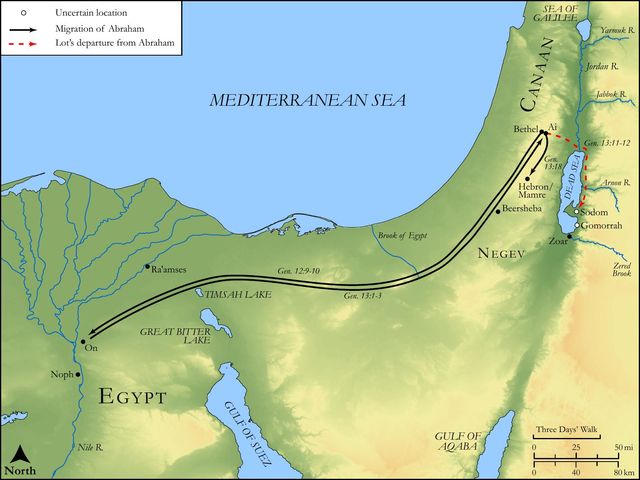
See on the biblical-era maps


Study this verse
Public-domain commentary
Matthew Henry
From his Commentary on the Whole Bible. Henry comments on passages, not single verses — this entry covers Genesis 13:1–4. His two-level outline is real structure in the source text, so it is rendered as structure.
I.Here is Abram's return out of Egypt, Gen 13:1.
He came himself and brought all his with him back again to Canaan. Note, Though there may be occasion to go sometimes into places of temptation, yet we must hasten out of them as soon as possible. See Rut 1:6.
II.His wealth:
He was very rich, Rut 1:2. He was very heavy, so the Hebrew word signifies; for riches are a burden, and those that will be rich do but load themselves with thick clay, Hab 2:6. There is a burden of care in getting them, fear in keeping them, temptation in using them, guilt in abusing them, sorrow in losing them, and a burden of account, at last, to be given up concerning them. Great possessions do but make men heavy and unwieldy. Abram was not only rich in faith and good works, and in the promises, but he was rich in cattle, and in silver and gold. Note,
1.God, in his providence, sometimes makes good men rich men, and teaches them how to abound, as well as how to suffer want.
2.The riches of good men are the fruits of God's blessing. God has said to Abram, I will bless thee; and that blessing made him rich without sorrow, Pro 10:22.
3.True piety will very well consist with great prosperity. Though it is hard for a rich man to get to heaven, yet it is not impossible, Mar 10:23, Mar 10:24. Abram was very rich and yet very religious. Nay, as piety is a friend to outward prosperity (Ti1 4:8), so outward prosperity, if well-managed, is an ornament to piety, and furnishes an opportunity of doing so much the more good.
III.His removal to Beth-el, Gen 13:3, Gen 13:4.
Thither he went, not only because there he had formerly had his tent, and he was willing to go among his old acquaintance, but because there he had formerly had his altar: and, though the altar was gone (probably he himself having taken it down, when he left the place, lest it should be polluted by the idolatrous Canaanites), yet he came to the place of the altar, either to revive the remembrance of the sweet communion he had had with God in that place, or perhaps to pay the vows he had there made to God when he undertook his journey into Egypt. Long afterwards God sent Jacob to this same place on that errand (Gen 35:1), Go up to Bethel, where thou vowedst the vow. We have need to be reminded, and should take all occasions to remind ourselves, of our solemn vows; and perhaps the place where they were made may help to bring them afresh to mind, and it may therefore do us good to visit it.
IV.His devotion there.
His altar was gone, so that he could not offer sacrifice; but he called on the name of the Lord, as he had done, Gen 12:8. Note,
1.All God's people are praying people. You may as soon find a living man without breath as a living Christian without prayer.
2.Those that would approve themselves upright with their God must be constant and persevering in the services of religion. Abram did not leave his religion behind him in Egypt, as many do in their travels.
3.When we cannot do what we would we must make conscience of doing what we can in the acts of devotion. When we want an altar, let us not be wanting in prayer, but, wherever we are, call on the name of the Lord.
Historical interpretation
Three Centuries of Reception
3 surviving comments on this verse. Each one is dated, so this reads as a timeline rather than a list.
Select a marker to jump to its quote. Markers stagger vertically where authors wrote within a few decades of each other.
Consider, I ask you, how he was a lover of peace and quiet and was constantly attentive to divine worship. The text says, remember, that he went down to that place where he had previously built the altar. By calling on the name of God he right from the very beginning fulfilled in anticipation that saying of David, “I would rather be of no account in the house of my God than take up residence in sinners’ dwellings.” In other words, solitude turned out to be preferred by him for invoking the name of God, instead of the cities. After all, he well knew that cities’ greatness is not constituted by multitude of inhabitants but by the virtue of its residents. Hence too the desert proved to be more desirable than the cities, adorned as it was by the just man’s virtue and thus a more resplendent vision than the whole world.
To the place where he had previously pitched his tent between Bethel and Ai: at the place of the altar which he had made formerly, and he called upon the name of the Lord. It is noteworthy that blessed Abraham, progressing in his chosen journey, is said to have returned from Bethel either from the south or through the south, yet it is not added that he entered the same city; but he is said to have reached the area between this place and Ai, and there he invoked the Lord. This place of prayer is mentioned to be situated on a mountain, because obviously, the elect, still restrained by the bond of flesh and set in the progress of virtues, strive with the whole intention of their mind to reach the house of heavenly habitation, hasten to it with continuous steps of good works; but they cannot yet enter it, nor can they see its King and citizens in their beauty: however, between the acceptance of faith by which they are consecrated to the Lord, and the entrance to the kingdom in which they desire to see Him, they climb the height of good action as a peak of a lofty mountain. For Ai indeed, or Aggai, as the ancient translators rendered the name of that city, is interpreted as Question or Festival: which name, evidently, most fittingly suits the time when each of the faithful is consecrated to the Lord with the saving sacraments: about which the Apostle admonishes saying: Do not grieve the Holy Spirit of God, by whom you were sealed for the day of redemption (Eph. 4:30). For what great festivity of mind it is to be redeemed from the power of darkness, and by the illumination of the Holy Spirit to be made a seal of the true King? Which city of invincible faith can also rightly be called Question: for by this the elect have learned either to seek the Lord from whom they have strayed farther away, or the Lord Himself, as a good shepherd, has shown Himself to have sought them as His sheep, according to what He says: The Son of man came to seek and to save the lost (Luke 19:10). Moreover, the saints build on the aforementioned mountain of good conversation an altar to the Lord, nothing else surely than their body and soul, in which they also invoke His name, knowing that without the help of His name they could neither begin the path of righteousness, nor complete the course of a good intention. We have thus carefully explicated these things about the place of Abraham's altar, lest anyone might think that blessed Moses, out of mere interest in the history rather than with a view to spiritual understanding, wanted to describe so diligently the place of his tent and altar or his repeated prayer. Where it is also noteworthy that Abraham is not described to have made an altar or invoked the Lord in Egypt, nor in Chaldea, nor in Haran, but solely in the land of Canaan, which he received in promise: because evidently, only within the unity of the Catholic faith, only in the hope of the heavenly promise, can we accomplish perfect works and offer vows worthy of God. Bethel itself, which was formerly called Luz, was named Bethel by Jacob, when, sleeping there, he saw heavenly miracles and hosts; the city, like Ai, is located approximately twelve miles from Jerusalem for those traveling to Neapolis.
And he returned by the way he had come from Bethel in the south. For by the south, we indeed tend towards Bethel through the light of heavenly knowledge, and through the inspiration of intimate love, we hasten by frequent steps of good works to the entrance of the house of God, which Bethel signifies; namely, that house which, as the Apostle says, is not made with hands, but is eternal in the heavens (II Cor. V, 1), which the Prophet desired to see, when he said: Lord, I have loved the beauty of your house, and the place of the tabernacle of your glory (Psalm XXVI, 8).
Continue studying Genesis 13:3 across the web’s major study libraries — every link below opens this exact verse, chapter, or book on the destination site.
Read & Compare
 BibleGatewayThis verse in more than 200 translations and 70 languages.
 Bible.comThe YouVersion reader — hundreds of translations, reading plans, and highlights.
 ESV.orgCrossway's official English Standard Version reader.
 NET BibleThe NET translation with 60,000+ translators' notes on every rendering decision.
 STEP BibleTyndale House's free study tool — original text, vocabulary, and scholarly resources.
 BibliaLogos Bible Software's free web reader.
 USCCBThe New American Bible (Revised Edition) with the U.S. bishops' study notes.
Commentaries
 BibleHub CommentariesDozens of classic commentaries on this verse, gathered on one page.
 StudyLightMore than 100 commentary sets — the largest collection on the web.
 BibleRefPlain-English commentary on what this verse means, verse by verse.
 Enduring WordDavid Guzik's free commentary on this chapter, widely used by Bible teachers.
 Bible Study ToolsVerse commentary alongside Greek and Hebrew study aids.
Original Language & Research
- BibleHub InterlinearThe verse word by word — original language, transliteration, and English.
- BibleHub LexiconEvery word's original-language definition and Strong's entry.
 Blue Letter BibleDeep-study tools — Strong's numbers, concordance, and word studies.
 SefariaThe Hebrew text with Rashi and centuries of Jewish commentary.
Sermons, Hymns & Audio


TrulyRandomVerse is not affiliated with these sites and doesn’t control their content. They’re linked because they’re genuinely useful.
Summary
Genesis 13:3 meticulously records Abram's purposeful return journey from the Negev, the "south," northward to a deeply significant location situated between Bethel and Hai. This movement is not merely a geographical relocation but a profound act of spiritual re-centering, marking his deliberate re-engagement with the very site where he had previously established an altar and worshipped the Lord, thereby signifying a renewed commitment to his covenant relationship with God following his sojourn in Egypt.
Context
ShowHideLiterary Context
Genesis 13 opens immediately after Abram's departure from Egypt, where he had sought refuge from a famine in Canaan. His sojourn in Egypt, detailed in Genesis 12:10-20, was marked by a significant moral lapse when he presented Sarai as his sister, endangering God's covenant promises. Despite this failure, God intervened to protect Sarai and Abram, and they departed Egypt with considerable wealth. Genesis 13:1-2 describes their journey out of Egypt, back towards the Negev. Verse 3 then specifies the continuation of this northward journey, leading Abram back to the exact location where he had previously built an altar and "called upon the name of the Lord" upon his initial entry into Canaan (Genesis 12:8). This retracing of steps highlights a narrative theme of spiritual restoration and a return to foundational acts of worship, setting the stage for the subsequent resolution of the conflict with Lot over land in Genesis 13:5-13.
Historical & Cultural Context
In the lands of the patriarchs, nomadic pastoralists like Abram frequently moved with their flocks in search of pasture and water. Their "journeys" (Hebrew: maççaʻ) were often not random wanderings but strategic movements between known grazing areas and water sources. The mention of "the south" (Negev) and "Bethel and Hai" provides precise geographical markers. Bethel, meaning "House of God," was a prominent landmark, later formally named by Jacob in Genesis 28:19. Even in Abram's time, it was a recognized place, likely due to its elevation and strategic location. The building of altars, as Abram did in Genesis 12:7-8, was a common practice to mark significant divine encounters, establish claims to land, or dedicate a place for worship. For a nomadic people, the "tent" (Hebrew: ʼôhel) symbolized their transient existence and dependence on God's leading, contrasting with the settled life of city dwellers. Abram's return to this specific tent site underscores a cultural understanding of returning to one's spiritual or familial roots.
Key Themes
ShowHideThis verse contributes to several overarching themes in Genesis. Firstly, it emphasizes Pilgrimage and Divine Guidance, as Abram's life is characterized by constant movement at God's direction, even when he falters. Secondly, it highlights the theme of Spiritual Restoration and Repentance. After the moral compromise in Egypt, Abram's deliberate return to the site of his initial worship signifies a desire to re-establish his relationship with God and re-center his life on the divine covenant, echoing God's faithfulness to His promises despite human failure (Genesis 12:1-3). Thirdly, the mention of "Bethel" reinforces the theme of Sacred Space and Worship, underscoring the importance of specific locations as markers of divine encounter and covenant remembrance. The repeated return to this place foreshadows its continued significance in the patriarchal narratives, particularly with Jacob's dream in Genesis 28.
Exposition and Analysis
ShowHideGenesis 13:3 meticulously details Abram's purposeful return to a sacred space, highlighting the spiritual significance embedded within his geographical movements.
Key Word Analysis
ShowHideThis primitive root means "to walk (literally or figuratively); causatively, to carry." In this context, it describes Abram's continuous, purposeful movement. It's not a mere wandering but a directed progression, emphasizing the active nature of his journey back to a specific spiritual landmark. This verb often implies a life lived in accordance with a path or divine leading.
Derived from a root meaning "to strike (tents)," maççaʻ refers to a "departure" or a "march." It implies a series of movements, not necessarily a single day's travel, but a sustained process of moving from one station to another. This word underscores Abram's nomadic lifestyle, where his life was characterized by breaking camp and moving forward, often at God's command.
From the words for "house" (בַּיִת) and "God" (אֵל), this name literally means "House of God." While Jacob would formally name it later, its mention here indicates that the site already held spiritual significance for Abram. It represents a place of divine encounter, worship, and covenant remembrance, serving as a spiritual anchor point in Abram's journey.
From a root meaning "to be clearly conspicuous from a distance," ʼôhel refers to a "tent" or "tabernacle." For Abram, the tent was his dwelling, symbolizing his transient, pilgrim status in the land of promise. His return to the "place where his tent had been" signifies a return to his foundational identity as a sojourner, dependent on God, and distinct from the settled Canaanite inhabitants.
Verse Breakdown
ShowHide"And he went on his journeys from the south even to Bethel,"
This clause describes Abram's northward progression. "The south" refers to the Negev, the semi-arid region south of Judah, where Abram had initially settled after leaving Egypt. His "journeys" imply a series of stages, a deliberate and sustained movement. The destination, "Bethel," is significant. It indicates a return to a known, important landmark, signaling a reorientation towards the central highlands of Canaan, the heart of the promised land.
"unto the place where his tent had been at the beginning, between Bethel and Hai;"
This part provides precise geographical and spiritual context. "The place where his tent had been at the beginning" directly references Genesis 12:8, where Abram first pitched his tent and, crucially, "built an altar unto the LORD, and called upon the name of the LORD." This return signifies more than just finding a familiar campsite; it is a spiritual homecoming to the site of initial worship and covenant affirmation. The mention of "between Bethel and Hai" (Ai, an ancient Canaanite city) provides a clear geographical marker, indicating a specific valley or plain between these two prominent locations, making the site identifiable to the original audience.
Literary Devices
ShowHideThe verse employs several literary devices to convey its profound meaning. Topography as Narrative Device is prominent, as the specific mention of "the south," "Bethel," and "Hai" grounds the spiritual journey in tangible geography, making Abram's return concrete and emphasizing the significance of the chosen location. The Repetition of "Bethel" (implicitly and explicitly) and the reference to "the place where his tent had been at the beginning" creates a sense of circularity and return, underscoring the theme of spiritual re-centering. Furthermore, the entire journey functions as Symbolism: Abram's physical return to the site of his original altar symbolizes his spiritual return to God after the moral compromise in Egypt. His movement from the worldly entanglements of Egypt back to the "House of God" represents a desire for repentance, renewed commitment, and a re-establishment of his foundational relationship with the Lord.
Theological and Thematic Connections
ShowHideAbram's journey in Genesis 13:3 offers a powerful theological statement about the nature of faith, repentance, and divine faithfulness. His return to the "place where his tent had been at the beginning" is a profound act of spiritual recalibration, demonstrating that true spiritual progress often involves returning to foundational truths and places of initial encounter with God, especially after periods of deviation or compromise. It highlights God's unwavering grace, which continually draws His people back to Himself, even when they falter. This narrative reinforces the concept that God's covenant promises are not nullified by human weakness but remain steadfast, inviting a response of renewed commitment and worship. The significance of Bethel as a "House of God" foreshadows the enduring importance of sacred spaces and dedicated worship in the life of faith, serving as tangible reminders of God's presence and His covenant.
Reflection and Application
ShowHideGenesis 13:3 serves as a timeless reminder that the spiritual journey is rarely a straight line; it often involves detours, missteps, and the need for intentional return. Abram's deliberate retracing of his steps to the "place where his tent had been at the beginning" offers a profound model for believers today. When we find ourselves having drifted from our spiritual moorings, entangled in worldly concerns, or compromised in our walk with God, this verse calls us to a similar act of re-centering. It encourages us to identify our own "Bethels"—those foundational moments of encounter with God, core truths of our faith, or practices that first ignited our devotion. Perhaps it's a specific scripture, a powerful worship experience, a season of deep prayer, or a foundational commitment. The application is to intentionally return to these spiritual roots, repenting of our deviations, and renewing our commitment to living a life centered on worship and obedience. This return is not a sign of failure but a testament to God's enduring grace and our capacity for spiritual resilience, trusting that He is always ready to meet us at our "beginning" again.
Questions for Reflection
ShowHideFAQ
ShowHideWhat is the significance of Abram returning to "the place where his tent had been at the beginning"?
ShowHideThis phrase refers to the specific location between Bethel and Hai where Abram had previously built an altar and "called upon the name of the Lord" upon his initial entry into Canaan (Genesis 12:8). His return signifies a profound spiritual re-centering, a deliberate act of re-establishing his communion with God after a period of moral compromise and worldly entanglement in Egypt. It marks a conscious return to his foundational spiritual practices, renewed commitment, and a desire to live in alignment with God's covenant promises. It symbolizes repentance and a fresh start.
Why is the location "Bethel and Hai" specifically mentioned?
ShowHideThe mention of both Bethel and Hai (Ai) provides a precise geographical reference point for the ancient audience, indicating a well-known and identifiable area. Bethel, meaning "House of God" (Hebrew: Bêyth-ʼÊl), was a site of immense spiritual significance for Abram, even before Jacob formally named it in Genesis 28:19. Hai was an ancient Canaanite city nearby. Naming both points to a specific, identifiable area that held deep personal and spiritual meaning for Abram, emphasizing his return to a familiar and sacred space, a place of past divine encounter and worship.
Christ-Centered Fulfillment
ShowHideAbram's return to Bethel, the "House of God," profoundly prefigures the ultimate "House of God" found in the person of Jesus Christ. Just as Abram sought restoration and communion with God at a specific sacred location, believers now find their true spiritual home, reconciliation, and unending communion with God not in a geographical place, but in and through Jesus Christ. He is the ultimate altar, the perfect sacrifice (as prophesied in Isaiah 53:5-6), and the true meeting place between God and humanity, for "in him dwelleth all the fulness of the Godhead bodily" (Colossians 2:9). Our "return" to spiritual foundations is not to a physical site, but to renewed faith in Christ, who perfectly fulfills the covenant promises made to Abram and provides the means for complete spiritual restoration and unending fellowship with God. He is the one who "tabernacled among us" (John 1:14), making God's presence accessible to all who believe, thereby establishing the true "House of God" in His very being. As the author of Hebrews reminds us, we have a better and more enduring dwelling place in Christ (Hebrews 11:10).