


Romans 16:6
Bible text: King James Version (1769 Blayney text) · Public domain
Bible text: Berean Standard Bible · Public domain
Bible text: American Standard Version (1901) · Public domain
Bible text: World English Bible, Messianic edition · Public domain
Bible text: Geneva Bible (1599) · Public domain
Bible text: Young's Literal Translation · Public domain
- ἀσπάσασθεaspasasthedo greetG782V-ADM-2PVerb Aorist Middle Deponent Imperative 2nd Plural
- ΜαρίανMarianMaryG3137N-ASF-PNoun Accusative Singular Feminine Individual
- ἥτιςhētiswhoG3748R-NSFRelative pronoun Nominative Singular Feminine
- πολλὰpollamuchG4183A-APNAdjective Accusative Plural Neuter
- ἐκοπίασενekopiasentoiledG2872V-AAI-3SVerb Aorist Active Indicative 3rd Singular
- εἰςeisforG1519PREPPreposition
- ὑμᾶςhumasyouG4771P-2APPersonal pronoun Accusative 2nd Plural
English is a literal word-by-word gloss of the Greek, not the KJV's wording. Why?
This is the original text the KJV's translators worked from — each Greek word with its own literal English meaning in this verse, prepared by scholars at Tyndale House, Cambridge. The KJV translates whole sentences, not word by word, so its wording differs: one Greek word can become several English words, and the KJV may choose “charity” where the gloss reads “love”. Both are faithful — they answer different questions. For the KJV's own rendering, switch to the KJV text.
Details
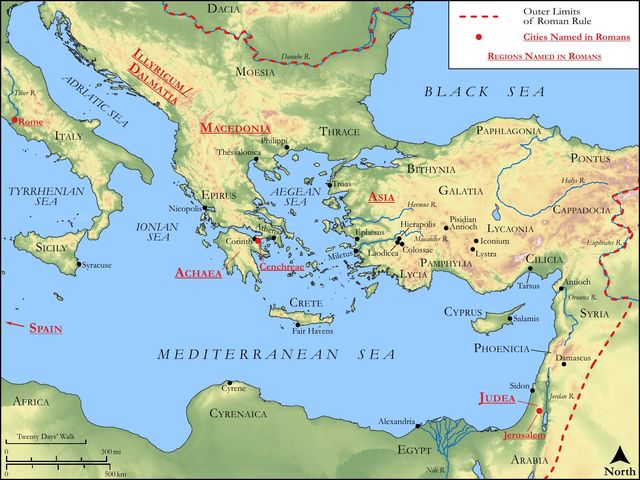
See on the biblical-era maps

Study this verse
Public-domain commentary
Matthew Henry
From his Commentary on the Whole Bible. Henry comments on passages, not single verses — this entry covers Romans 16:1–16. His three-level outline is real structure in the source text, so it is rendered as structure.
Such remembrances as these are usual in letters between friends; and yet Paul, by the savouriness of his expressions, sanctifies these common compliments.
I.Here is the recommendation of a friend, by whom (as some think) this epistle was sent - one Phebe, Rom 16:1, Rom 16:2.
It should seem that she was a person of quality and estate, who had business which called her to Rome, where she was a stranger; and therefore Paul recommends her to the acquaintance of the Christians there: an expression of his true friendship to her. Paul was as well skilled in the art of obliging as most men. True religion, rightly received, never made any man uncivil. Courtesy and Christianity agree well together. It is not in compliment to her, but in sincerity, that,
1.He gives a very good character of her.
(1.)As a sister to Paul: Phebe our sister; not in nature, but in grace; not in affinity or consanguinity, but in pure Christianity: his own sister in the faith of Christ, loving Paul, and beloved of him, with a pure and chaste and spiritual love, as a sister; for there is neither male nor female, but all are one in Christ Jesus, Gal 3:28. Both Christ and his apostles had some of their best friends among the devout (and upon that account honourable) women.
(2.)As a servant to the church at Cenchrea: diakonon, a servant by office, a stated servant, not to preach the word (that was forbidden to women), but in acts of charity and hospitality. Some think she was one of the widows that ministered to the sick and were taken into the church's number, Ti1 5:9. But those were old and poor, whereas Phebe seems to have been a person of some account; and yet it was no disparagement to her to be a servant to the church. Probably they used to meet at her house, and she undertook the care of entertaining the ministers, especially strangers. Every one in his place should strive to serve the church, for therein he serves Christ, and it will turn to a good account another day. Cenchrea was a small sea-port town adjoining to Corinth, about twelve furlongs distant. Some think there was a church there, distinct from that at Corinth, though, being so near, it is very probable that the church of Corinth is called the church of Cenchrea, because their place of meeting might be there, on account of the great opposition to them in the city (Act 18:12), as at Philippi they met out of the city by the water-side, Act 16:13. So the reformed church of Paris might be called the church at Charenton, where they formerly met, out of the city.
(3.)As a succourer of many, and particularly of Paul, Rom 16:2. She relieved many that were in want and distress - a good copy for women to write after that have ability. she was kind to those that needed kindness, intimated in her succouring them; and her bounty was extensive, she was a succourer of many. Observe the gratitude of Paul in mentioning her particular kindness to him: And to myself also. Acknowledgment of favours is the least return we can make. It was much to her honour that Paul left this upon record; for wherever this epistle is read her kindness to Paul is told for a memorial of her.
2.He recommends her to their care and kindness, as one worthy to be taken notice of with peculiar respect. (1.) "Receive her in the Lord. Entertain her; bid her welcome." This pass, under Paul's hand, could not but recommend her to any Christian church. "Receive her in the Lord," that is, "for the Lord's sake; receive her as a servant and friend of Christ." As it becometh saints to receive, who love Christ, and therefore love all that are his for his sake; or, as becometh saints to be received, with love and honour and the tenderest affection. There may be occasion sometimes to improve our interest in our friends, not only for ourselves, but for others also, interest being a price in the hand for doing good. (2.) Assist her in whatsoever business she has need of you. Whether she had business of trade, or law-business at the court, is not material; however being a woman, a stranger, a Christian, she had need of help: and Paul engaged them to be assistant to her. It becomes Christians to be helpful one to another in their affairs, especially to be helpful to strangers; for we are members one of another and we know not what need of help we may have ourselves. Observe, Paul bespeaks help for one that had been so helpful to many; he that watereth shall be watered also himself.
II.Here are commendations to some particular friends among those to whom he wrote, more than in any other of the epistles.
Though the care of all the churches came upon Paul daily, enough to distract an ordinary head, yet he could retain the remembrance of so many; and his heart was so full of love and affection as to send salutations to each of them with particular characters of them, and expressions of love to them and concern for them. Greet them, salute them; it is the same word, aspasasthe. "Let them know that I remember them, and love them, and wish them well." There is something observable in several of these salutations.
1.Concerning Aquila and Priscilla, a famous couple, that Paul had a special kindness for. They were originally of Rome, but were banished thence by the edict of Claudius, Act 18:2. At Corinth, Paul became acquainted with them, wrought with them at the trade of tent-making; after some time, when the edge of that edict was rebated, they returned to Rome, and thither he now sends commendations to them. He calls them his helpers in Christ Jesus, by private instructions and converse furthering the success of Paul's public preaching, one instance of which we have in their instructing Apollos, Act 18:26. Those are helpers to faithful ministers that lay out themselves in their families and among their neighbours to do good to souls. Nay, they did not only do much, but they ventured much, for Paul: They have for my life laid down their own necks. They exposed themselves to secure Paul, hazarded their own lives for the preservation of his, considering how much better they might be spared than he. Paul was in a great deal of danger at Corinth, while he sojourned with them; but they sheltered him, though they thereby made themselves obnoxious to the enraged multitudes, Act 18:12, Act 18:17. It was a good while ago that they had done Paul this kindness; and yet he speaks as feelingly of it as if it had been but yesterday. To whom (says he) not only I give thanks, but also all the churches of the Gentiles; who were all beholden to these good people for helping to save the life of him that was the apostle of the Gentiles. Paul mentions this, to engage the Christians at Rome to be the more kind to Aquila and Priscilla. He sends likewise greeting to the church in their house, Rom 16:5. It seems then, a church in a house is no such absurd thing as some make it to be. Perhaps there was a congregation of Christians that used to meet at their house at stated times; and then, no doubt, it was, like the house of Obed-Edom, blessed for the ark's sake. Others think that the church was no more than a religious, pious, well-governed family, that kept up the worship of God. Religion, in the power of it, reigning in a family, will turn a house into a church. And doubtless it had a good influence upon this that Priscilla the good wife of the family was so very eminent and forward in religion, so eminent that she is often named first. A virtuous woman, that looks well to the ways of her household, may do much towards the advancement of religion in a family. When Priscilla and Aquila were at Ephesus, though but sojourners there, yet there also they had a church in their house, Co1 16:19. A truly godly man will be careful to take religion along with him wherever he goes. When Abraham removed his tent, he renewed his altar, Gen 13:18.
2.Concerning Epenetus, Rom 16:5. He calls him his well-beloved. Where the law of love is in the heart the law of kindness will be in the tongue. Endearing language should pass among Christians to express love, and to engage love. So he calls Amplias, beloved in the Lord, with true Christian love for Christ's sake; and Stachys, his beloved: a sign that Paul had been in the third heaven, he was so much made up of love. Of Epenetus it is further said that he was the first-fruit of Achaia unto Christ; not only one of the most eminent believers in that country, but one of the first that was converted to the faith of Christ: one that was offered up to God by Paul, as the first-fruits of his ministry there; an earnest of a great harvest; for in Corinth, the chief city of Achaia, God had much people, Act 18:10. Special respect is to be paid to those that set out early, and come to work in the vineyard at the first hour, at the first call. The household of Stephanas is likewise said to be the first-fruits of Achaia, Co1 16:15. Perhaps Epenetus was one of that household; or, at least, he was one of the first three; not the first alone, but one of the first fleece of Christians, that the region of Achaia afforded.
3.Concerning Mary, and some others who were laborious in that which is good, industrious Christians: Mary, who bestowed much labour on us. True love never sticks at labour, but rather takes a pleasure in it; where there is much love there will be much labour. Some think this Mary had been at some of those places where Paul was, though now removed to Rome, and had personally ministered to him; others think Paul speaks of her labour as bestowed upon him because it was bestowed upon his friends and fellow-labourers, and he took what was done to them as done to himself. He says of Tryphena and Tryphosa, two useful women in their places, that they laboured in the Lord (Rom 16:12), and of the beloved Persis, another good woman, that she laboured much in the Lord, more than others, abounding more in the work of the Lord.
4.Concerning Andronicus and Junia, Rom 16:7. Some take them for a man and his wife, and the original will well enough bear it; and, considering the name of the latter, this is more probable than that they should be two men, as others think, and brethren. Observe,
(1.)They were Paul's cousins, akin to him; so was Herodion, Rom 16:11. Religion does not take away, but rectifies, sanctifies, and improves, our respect to our kindred, engaging us to lay out ourselves most for their good, and to rejoice in them the more, when we find them related to Christ by faith.
(2.)They were his fellow-prisoners. Partnership in suffering sometimes does much towards the union of souls and the knitting of affections. We do not find in the story of the Acts any imprisonment of Paul before the writing of this epistle, but that at Philippi, Act 16:23. But Paul was in prisons more frequent (Co2 11:23), in some of which, it seems, he met with his friends Andronicus and Junia, yoke-fellows, as in other things, so in suffering for Christ and bearing his yoke.
(3.)They were of note among the apostles, not so much perhaps because they were persons of estate and quality in the world as because they were eminent for knowledge, and gifts, and graces, which made them famous among the apostles, who were competent judges of those things, and were endued with a spirit of discerning not only the sincerity, but the eminency, of Christians.
(4.)Who also were in Christ before me, that is, were converted to the Christian faith. In time they had the start of Paul, though he was converted the next year after Christ's ascension. How ready was Paul to acknowledge in others any kind of precedency!
5.Concerning Apelles, who is here said to be approved in Christ (Rom 16:10), a high character! He was one of known integrity and sincerity in his religion, one that had been tried; his friends and enemies had tried him, and he was as gold. he was of approved knowledge and judgment, approved courage and constancy; a man that one might trust and repose a confidence in.
6.Concerning Aristobulus and Narcissus; notice is taken of their household, Rom 16:10, Rom 16:11. Those of their household who are in the Lord (as it is limited, Rom 16:11), that were Christians. How studious was Paul to leave none out of his salutations that he had any knowledge of or acquaintance with! Aristobulus and Narcissus themselves, some think, were absent, or lately dead; others think they were unbelievers, and such as did not themselves embrace Christianity; so Pareus: and some think this Narcissus was the same with one of that name who is frequently mentioned in the life of Claudius, as a very rich man that had a great family, but was very wicked and mischievous. It seems, then, there were some good servants, or other retainers, even in the family of a wicked man, a common case, Ti1 6:1. Compare Ti1 6:2. The poor servant is called, and chosen, and faithful, while the rich master is passed by, and left to perish in unbelief. Even so, Father, because it seemed good unto thee.
7.Concerning Rufus (Rom 16:13), chosen in the Lord. He was a choice Christian, whose gifts and graces evinced that he was eternally chosen in Christ Jesus. He was one of a thousand for integrity and holiness. - And his mother and mine, his mother by nature and mine by Christian love and spiritual affection; as he calls Phebe his sister, and teaches Timothy to treat the elder women as mothers, Ti1 5:2. This good woman, upon some occasion or other, had been as a mother to Paul, in caring for him, and comforting him; and Paul here gratefully owns it, and calls her mother.
8.Concerning the rest this is observable, that he salutes the brethren who are with them (Rom 16:14), and the saints who are with them (Rom 16:15), with them in family-relations, with them in the bond of Christian communion. It is the good property of saints to delight in being together; and Paul thus joins them together in his salutations to endear them one to another. Lest any should find themselves aggrieved, as if Paul had forgotten them, he concludes with the remembrance of the rest, as brethren and saints, though not named. In Christian congregations there should be smaller societies linked together in love and converse, and taking opportunities of being often together. Among all those to whom Paul sends greeting here is not a word of Peter, which gives occasion to suspect that he was not bishop of Rome, as the Papists say he was; for, if he was, we cannot but suppose him resident, or at least how could Paul write so long an epistle to the Christians there, and take no notice of him?
Lastly, He concludes with the recommendation of them to the love and embraces one of another: Salute one another with a holy kiss. Mutual salutations, as they express love, so they increase and strengthen love, and endear Christians one to another: therefore Paul here encourages the use of them, and only directs that they may be holy - a chaste kiss, in opposition to that which is wanton and lascivious; a sincere kiss, in opposition to that which is treacherous and dissembling, as Judas's, when he betrayed Christ with a kiss. He adds, in the close, a general salutation to them all, in the name of the churches of Christ (Rom 16:16): "The churches of Christ salute you; that is, the churches which I am with, and which I am accustomed to visit personally, as knit together in the bonds of the common Christianity, desire me to testify their affection to you and good wishes for you." This is one way of maintaining the communion of saints.
Historical interpretation
Two Centuries of Reception
3 surviving comments on this verse. Each one is dated, so this reads as a timeline rather than a list.
Select a marker to jump to its quote. Markers stagger vertically where authors wrote within a few decades of each other.
Paul is teaching here that women too ought to work for the churches of God. They work when they teach children how to behave, when they love their husbands, when they feed their children, when they are modest and chaste, when they keep a good household, when they are kind, when they are submissive to their husbands, when they exercise hospitality, when they wash the feet of the saints, and when they do all the other things which are allotted to women in the Bible.
"Greet Mary, who bestowed much labor on us."
How is this? a woman again is honored and proclaimed victorious! Again are we men put to shame. Or rather, we are not put to shame only, but have even an honor conferred upon us. For an honor we have, in that there are such women amongst us, but we are put to shame, in that we men are left so far behind by them. But if we come to know whence it comes, that they are so adorned, we too shall speedily overtake them. Whence then is their adorning? Let both men and women listen. It is not from bracelets, or from necklaces, nor from their eunuchs either, and their maid-servants, and gold-broidered dresses, but from their toils in behalf of the truth. For he says, "who bestowed much labor on us," that is, not on herself only, nor upon her own advancement, (see p. 520) (for this many women of the present day do, by fasting, and sleeping on the floor), but upon others also, so carrying on the race Apostles and Evangelists ran. In what sense then does he say, "I suffer not a woman to teach?" (1 Tim. ii. 12.) He means to hinder her from publicly coming forward (1 Cor. xiv. 35), and from the seat on the bema, not from the word of teaching. Since if this were the case, how would he have said to the woman that had an unbelieving husband, "How knowest thou, O woman, if thou shalt save thy husband?" (ib. vii. 16.) Or how came he to suffer her to admonish children, when he says, but "she shall be saved by child-bearing if they continue in faith, and charity, and holiness, with sobriety?" (1 Tim. ii. 15.) How came Priscilla to instruct even Apollos? It was not then to cut in sunder private conversing for advantage that he said this, but that before all, and which it was the teacher's duty to give in the public assembly; or again, in case the husband be believing and thoroughly furnished, able also to instruct her. When she is the wiser, then he does not forbid her teaching and improving him. And he does not say, who taught much, but "who bestowed much labor," because along with teaching (tou logou) she performs other ministries besides, those in the way of dangers, in the way of money, in the way of travels. For the women of those days were more spirited than lions, sharing with the Apostles their labors for the Gospel's sake. In this way they went travelling with them, and also performed all other ministries. And even in Christ's day there followed Him women, "which ministered unto Him of their substance" (Luke viii. 3), and waited upon the Teacher.
Yet another woman who is praised because of her labors.
Continue studying Romans 16:6 across the web’s major study libraries — every link below opens this exact verse, chapter, or book on the destination site.
Read & Compare
 BibleGatewayThis verse in more than 200 translations and 70 languages.
 Bible.comThe YouVersion reader — hundreds of translations, reading plans, and highlights.
 ESV.orgCrossway's official English Standard Version reader.
 NET BibleThe NET translation with 60,000+ translators' notes on every rendering decision.
 STEP BibleTyndale House's free study tool — original text, vocabulary, and scholarly resources.
 BibliaLogos Bible Software's free web reader.
 USCCBThe New American Bible (Revised Edition) with the U.S. bishops' study notes.
Commentaries
 BibleHub CommentariesDozens of classic commentaries on this verse, gathered on one page.
 StudyLightMore than 100 commentary sets — the largest collection on the web.
 BibleRefPlain-English commentary on what this verse means, verse by verse.
 Enduring WordDavid Guzik's free commentary on this chapter, widely used by Bible teachers.
 Bible Study ToolsVerse commentary alongside Greek and Hebrew study aids.
Original Language & Research
- BibleHub InterlinearThe verse word by word — original language, transliteration, and English.
- BibleHub LexiconEvery word's original-language definition and Strong's entry.
 Blue Letter BibleDeep-study tools — Strong's numbers, concordance, and word studies.
 CNTR CollationThe earliest Greek manuscripts of this verse, collated letter by letter.
Sermons, Hymns & Audio


TrulyRandomVerse is not affiliated with these sites and doesn’t control their content. They’re linked because they’re genuinely useful.
Summary
Romans 16:6 offers a concise yet profound commendation from the Apostle Paul to a woman named Mary, recognizing her significant and diligent service within the early Christian community. Paul's instruction to "Greet Mary, who bestowed much labour on us" highlights the invaluable contributions of individuals, particularly women, who tirelessly supported the burgeoning church and its apostolic mission, underscoring the communal and collaborative nature of early Christian ministry in Rome.
Context
ShowHideLiterary Context
Romans 16 serves as a remarkable and deeply personal conclusion to Paul's magnum opus, the Epistle to the Romans. After systematically unfolding profound theological doctrines concerning justification by faith, sanctification, and God's sovereign plan for Israel, Paul transitions to a practical demonstration of Christian community and fellowship. This chapter, comprising a lengthy list of greetings and commendations, reveals the relational fabric of the early church. Mary's mention in Romans 16:6 is nestled among numerous other individuals, both men and women, whom Paul recognizes for their specific contributions, demonstrating his personal connection and gratitude to believers he may or may not have met in person, but whose reputations for faithful service preceded them within the network of house churches. This practice underscores the interconnectedness and mutual recognition vital for the spread of the Gospel.
Historical & Cultural Context
The early Christian movement, particularly in bustling imperial centers like Rome, often found its strength in decentralized house churches. These informal gatherings, typically hosted by affluent or dedicated members, served as centers for worship, teaching, fellowship, and practical support. In this context, women played exceptionally prominent roles, often defying the more restrictive societal norms of the Greeks and Romans. While "Mary" was a common name, Paul's specific commendation indicates this Mary was a distinct and notable figure in the Roman Christian community. Her "labour" likely involved practical hospitality, financial support, organizing gatherings, or even evangelistic efforts, all crucial for sustaining the nascent church in a challenging environment. Paul's greetings were not mere formalities but vital affirmations, reinforcing bonds and validating the contributions of individuals in a time when communication and travel were arduous.
Key Themes
ShowHideThe commendation of Mary in Romans 16:6 contributes to several overarching themes in Romans and Paul's broader theology. Firstly, it powerfully illustrates the recognition and value of women in ministry and service. Paul consistently acknowledges women like Phoebe, a deaconess (Romans 16:1), and Priscilla, a fellow worker (Romans 16:3), highlighting their indispensable roles in the early church's mission. Secondly, the verse emphasizes the dignity and necessity of diligent service and partnership within the body of Christ. Mary's "much labour" underscores that all forms of strenuous, dedicated effort for the Gospel's sake are vital and recognized by God and His apostles, reflecting the principle that every member contributes to the whole, as discussed in 1 Corinthians 12. Lastly, Paul's personal acknowledgment showcases the theme of apostolic gratitude and mutual encouragement, modeling how leaders should affirm and appreciate the faithful work of those who serve alongside them, fostering unity and perseverance.
Exposition and Analysis
ShowHideKey Word Analysis
ShowHideThis verb (G782) means "to enfold in the arms," and by implication, "to salute" or "to welcome." In Paul's letters, it conveys a warm, affectionate, and respectful salutation, indicating a genuine personal regard for the individual. It's more than a casual hello; it implies a desire for their well-being and a recognition of their standing within the community.
Derived from kopos (toil, trouble), this verb (G2872) signifies "to feel fatigue" or, by implication, "to work hard" to the point of weariness. It describes intense, strenuous, and often exhausting effort. When applied to ministry, as it frequently is in the New Testament (e.g., 1 Thessalonians 5:12), it denotes sacrificial and dedicated exertion for the sake of the Gospel.
This adjective (G4183) means "much" or "many" in terms of quantity, degree, or extent. When paired with kopiáō, it intensifies the meaning, indicating that Mary's labor was not merely present but substantial, abundant, and significant in its scope and impact. It emphasizes the sheer volume and intensity of her dedicated service.
Verse Breakdown
ShowHide"Greet Mary"
This direct command from Paul underscores the personal nature of his relationships within the Christian community. Despite "Mary" being a common name, this specific individual was known to Paul (likely by reputation or through mutual acquaintances) and held in high esteem. The instruction to "greet" implies a warm, personal salutation, signifying her recognized place and value within the fellowship.
"who bestowed much labour on us"
This clause reveals the specific reason for Mary's commendation. The phrase "bestowed much labour" (combining kopiáō and polýs) indicates a profound, strenuous, and extensive effort on her part. The recipient of this labor, "us," likely refers to Paul and his missionary companions, or more broadly, to the apostolic mission and the wider Christian community. This suggests Mary was actively involved in supporting the Gospel's advancement, perhaps through hospitality, financial provision, practical assistance, or even direct participation in evangelism and teaching, to the point of personal exertion and fatigue.
Literary Devices
ShowHidePaul's brief commendation of Mary in Romans 16:6 masterfully employs several literary techniques. The primary device is Commendation, where Paul directly praises Mary for her specific contribution, setting her forth as an example of faithful service. This act of naming and affirming individuals is a powerful rhetorical tool for building community and encouraging others. The phrase "bestowed much labour" functions as a form of Understatement or Implication, where a concise statement hints at a vast amount of unseen, dedicated, and possibly sacrificial work. The brevity of the description belies the depth and extent of her efforts, inviting the reader to infer the true measure of her commitment. Furthermore, the use of "labour" can be seen as a form of Synecdoche, where the part (the toil) represents the whole (her comprehensive and tireless service to the church and its ministers), encapsulating her entire contribution in a single, potent word.
Theological and Thematic Connections
ShowHideMary's diligent service, so highly valued by Paul, resonates deeply with core Christian theological principles. Her "much labour" exemplifies the New Testament's emphasis on active, sacrificial service as a natural outflow of faith and love for Christ and His body. It underscores the truth that every believer, regardless of public prominence, is called to contribute their gifts and efforts for the building up of the church and the spread of the Gospel. This verse affirms the dignity of all work done in the Lord, recognizing that even seemingly ordinary acts of service—hospitality, practical aid, or personal exertion—are profoundly significant in God's economy. Mary's example challenges the notion that only those in formal leadership roles contribute meaningfully, highlighting the vital partnership between apostles and local believers, and the mutual dependence within the diverse body of Christ.
Reflection and Application
ShowHideMary's commendation in Romans 16:6 offers timeless lessons for believers today. Her example calls us to a deeper commitment to diligent, even strenuous, service within our communities and for the advancement of the Gospel. It reminds us that true Christian labor is often characterized by self-giving and perseverance, sometimes to the point of weariness, but that such effort is never in vain in the Lord. Moreover, Paul's specific and public acknowledgment of Mary serves as a powerful model for us to intentionally recognize, affirm, and appreciate those who serve faithfully, often behind the scenes, within our churches and ministries. Just as Paul relied on the practical support of individuals like Mary, so too do contemporary ministries depend on the tireless dedication of countless "Marys" whose quiet, consistent labor forms the backbone of the church's mission. We are challenged to consider how we can emulate Mary's selfless dedication, finding ways to "bestow much labour" for the glory of God and the good of His people.
Questions for Reflection
ShowHideFAQ
ShowHideIs this Mary the same as other Marys in the New Testament?
ShowHideWhile "Mary" (Maria/Mariam) was a very common name in that day, it is highly unlikely that the Mary mentioned in Romans 16:6 is Mary the mother of Jesus, Mary Magdalene, or Mary of Bethany (sister of Martha and Lazarus). Paul's letters typically refer to specific individuals within the local churches he was addressing or connected with. Given that Paul had not yet visited Rome when he wrote this letter, this Mary was likely a prominent member of the Roman Christian community, known to Paul through other believers or by her reputation for service. Her unique commendation for "much labour" suggests a distinct identity within the Roman church, separate from the more famous Marys of the Gospels.
What does "bestowed much labour" imply about Mary's service?
ShowHideThe phrase "bestowed much labour" (Greek: kopiáō polýs) signifies intense, strenuous, and extensive effort, often to the point of weariness. It implies that Mary's service was not casual or superficial but involved deep commitment and significant personal exertion. While the exact nature of her "labour" is not specified, in the context of early house churches and Paul's ministry, it could have encompassed various vital activities: providing hospitality to traveling missionaries like Paul's associates, hosting a house church, offering financial support, preparing meals, caring for the sick, teaching new converts, or even engaging in evangelism. It suggests she was a highly active and dedicated participant in the practical, day-to-day work of sustaining and expanding the Christian community in Rome, much like Phoebe who served the church at Cenchreae (Romans 16:1-2) or Priscilla and Aquila who risked their lives for Paul (Romans 16:3-4).
Christ-Centered Fulfillment
ShowHideMary's "much labour" for Paul and the early church finds its ultimate meaning and power in Christ, serving as a beautiful reflection of His own self-giving service and the transformative work He initiated. Her diligent efforts are not merely human exertions but are empowered by the Spirit of Christ, enabling believers to participate in the ongoing mission of God. Just as Christ "emptied himself" and "took the form of a servant" (Philippians 2:7), Mary's labor embodies a Christ-like humility and dedication to others. Our ability to "bestow much labour" is a direct result of Christ's victory over sin and death, which liberates us to serve with purpose and hope. Furthermore, all Christian service, including Mary's, contributes to the building up of the body of Christ, of which He is the head (Ephesians 4:15-16). Our labor is not for personal gain but for the glory of God and the advancement of His kingdom, a kingdom inaugurated and sustained by the Lord Jesus. Ultimately, every act of service, every "much labour," is a response to Christ's call to follow Him and to be His hands and feet in the world, knowing that our "labor in the Lord is not in vain" because He is faithful to reward those who serve Him (1 Corinthians 15:58).