


1 Corinthians 11:17
Bible text: King James Version (1769 Blayney text) · Public domain
Bible text: Berean Standard Bible · Public domain
Bible text: American Standard Version (1901) · Public domain
Bible text: World English Bible, Messianic edition · Public domain
Bible text: Geneva Bible (1599) · Public domain
Bible text: Young's Literal Translation · Public domain
- ΤοῦτοToutoIn thisG3778D-ASNDemonstrative pronoun Accusative Singular Neuter
- δὲdenowG1161CONJConjunction
- παραγγέλλωνparangellōninstructingG3853V-PAP-NSMVerb Present Active Participle Nominative Singular Masculine
- οὐκouknotG3756PRT-NNegative Particle Negative
- ἐπαινῶepainōI do praiseG1867V-PAI-1SVerb Present Active Indicative 1st Singular
- ὅτιhotibecauseG3754CONJConjunction
- οὐκouknotG3756PRT-NNegative Particle Negative
- εἰςeisforG1519PREPPreposition
- τὸtotheG3588T-ASNDefinite article Accusative Singular Neuter
- κρεῖσσονkreissonbetterG2908A-ASN-CAdjective Accusative Singular Neuter Comparative
- ἀλλ᾽all᾽butG235CONJConjunction
- εἰςeisforG1519PREPPreposition
- τὸtotheG3588T-ASNDefinite article Accusative Singular Neuter
- ἧσσονhēssonworseG2276A-ASN-CAdjective Accusative Singular Neuter Comparative
- συνέρχεσθεsunerchestheyou come togetherG4905V-PNI-2PVerb Present Middle Or Passive Deponent Indicative 2nd Plural
English is a literal word-by-word gloss of the Greek, not the KJV's wording. Why?
This is the original text the KJV's translators worked from — each Greek word with its own literal English meaning in this verse, prepared by scholars at Tyndale House, Cambridge. The KJV translates whole sentences, not word by word, so its wording differs: one Greek word can become several English words, and the KJV may choose “charity” where the gloss reads “love”. Both are faithful — they answer different questions. For the KJV's own rendering, switch to the KJV text.
Details
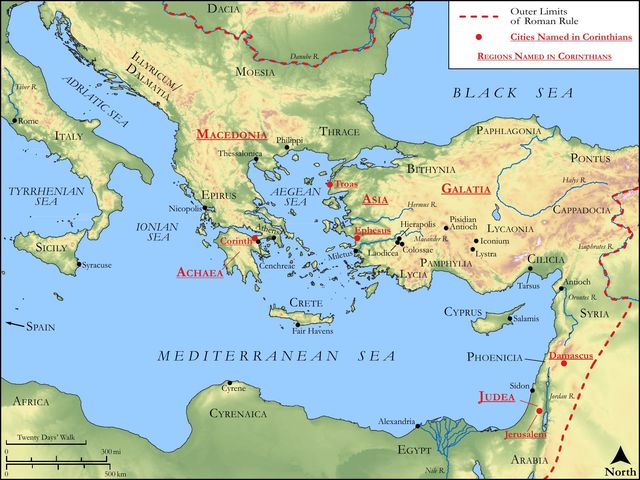
See on the biblical-era maps

Study this verse
Public-domain commentary
Matthew Henry
From his Commentary on the Whole Bible. Henry comments on passages, not single verses — this entry covers 1 Corinthians 11:17–22. His two-level outline is real structure in the source text, so it is rendered as structure.
In this passage the apostle sharply rebukes them for much greater disorders than the former, in their partaking of the Lord's supper, which was commonly done in the first ages, as the ancients tell us, with a love-feast annexed, which gave occasion to the scandalous disorders which the apostle here reprehends, concerning which observe,
I.The manner in which he introduces his charge:
"Now in this that I declare to you I praise you not, Co1 11:17. I cannot commend, but must blame and condemn you." It is plain, from the beginning of the chapter, that he was willing and pleased to commend as far as he could. But such scandalous disorders, in so sacred an institution, as they were guilty of, called for a sharp reprehension. They quite turned the institution against itself. It was intended to make them better, to promote their spiritual interests; but it really made them worse. They came together, not for the better, but for the worse. Note, The ordinances of Christ, if they do not make us better, will be very apt to make us worse; if they do not do our souls good, they do us harm; if they do not melt and mend, they will harden. Corruptions will be confirmed in us, if the proper means do not work a cure of them.
II.He enters upon his charge against them in more particulars than one.
1.He tells them that, upon coming together, they fell into divisions, schisms - schismata. Instead of concurring unanimously in celebrating the ordinance, they fell a quarrelling with one another. Note, There may be schism where there is no separation of communion. Persons may come together in the same church, and sit down at the same table of the Lord, and yet be schismatics. Uncharitableness, alienation of affection, especially if it grows up to discord, and feuds, and contentions, constitute schism. Christians may separate from each other's communion, and yet be uncharitable one towards another; they may continue in the same communion, and yet be uncharitable. This latter is schism, rather than the former. The apostle had heard a report of the Corinthians' divisions, and he tells them he had too much reason to believe it. For, adds he, there must be heresies also; not only quarrels, but factions, and perhaps such corrupt opinions as strike at the foundation of Christianity, and all sound religion. Note, No marvel there should be breaches of Christian love in the churches, when such offences will come as shall make shipwreck of faith and a good conscience. Such offences must come. Note that men are necessitated to be guilty of them; but the event is certain, and God permits them, that those who are approved (such honest hearts as will bear the trial) may be set to view, and appear faithful by their constant adherence to the truths and ways of God, notwithstanding the temptations of seducers. Note, The wisdom of God can make the wickedness and errors of others a foil to the piety and integrity of the saints.
2.He charges them not only with discord and division, but with scandalous disorder: For in eating every one taketh before the other his own supper; and one is hungry, and another is drunken, Co1 11:21. Heathens used to drink plentifully at their feasts upon their sacrifices. Many of the wealthier Corinthians seem to have taken the same liberty at the Lord's table, or at least at their Agapai, or love-feasts, that were annexed to the supper. They would not stay for one another; the rich despised the poor, and ate and drank up the provisions they themselves brought, before the poor were allowed to partake; and thus some wanted, while others had more than enough. This was profaning a sacred institution, and corrupting a divine ordinance, to the last degree. What was appointed to feed the soul was employed to feed their lusts and passions. What should have been a bond of mutual amity and affection was made an instrument of discord and disunion. The poor were deprived of the food prepared for them, and the rich turned a feast of charity into a debauch. This was scandalous irregularity.
III.The apostle lays the blame of this conduct closely on them,
1.By telling them that their conduct perfectly destroyed the purpose and use of such an institution: This is not to eat the Lord's supper, Co1 11:20. It was coming to the Lord's table, and not coming. They might as well have staid away. Thus to eat the outward elements was not to eat Christ's body. Note, There is a careless and irregular eating of the Lord's supper which is as none at all; it will turn to no account, but to increase guilt. Such an eating was that of the Corinthians; their practices were a direct contradiction to the purposes of this sacred institution.
2.Their conduct carried in it a contempt of God's house, or of the church, Co1 11:22. If they had a mind to feast, they might do it at home in their own houses; but to come to the Lord's table, and cabal and quarrel, and keep the poor from their share of the provision there made for them as well as rich, was such an abuse of the ordinance, and such a contempt of the poorer members of the church more especially, as merited a very sharp rebuke. Such a behaviour tended much to the shame and discouragement of the poor, whose souls were as dear to Christ, and cost him as much, as those of the rich. Note, Common meals may be managed after a common manner, but religious feasts should be attended religiously. Note, also, It is a heinous evil, and severely to be censured, for Christians to treat their fellow-christians with contempt and insolence, but especially at the Lord's table. This is doing what they can to pour contempt on divine ordinances. And we should look carefully to it that nothing in our behaviour at the Lord's table have the appearance of contemning so sacred an institution.
Historical interpretation
Historical reception
1 surviving comment on this verse from the historical church.
IT is necessary in considering the present charge to state also first the occasion of it. For thus again will our discourse be more intelligible. What then is this occasion?
As in the case of the three thousand who believed in the beginning, all had eaten their meals in common and had all things common; such also was the practice at the time when the Apostle wrote this: not such indeed exactly; but as it were a certain outflowing of that communion which abode among them descended also to them that came after. And because of course some were poor, but others rich, they laid not down all their goods in the midst, but made the tables open on stated days, as it should seem; and when the solemn service was completed, after the communion of the Mysteries, they all went to a common entertainment, the rich bringing their provisions with them, and the poor and destitute being invited by them, and all feasting in common. But afterward this custom also became corrupt. And the reason was, their being divided and addicting themselves, some to this party, and others to that, and saying, "I am of such a one," and "I of such a one;" which thing also to correct he said in the beginning of the Epistle, "For it hath been signified unto me concerning you, my brethren, by them which are of the household of Chloe, that there are contentions among you. Now this I mean, that each one of you saith, I am of Paul; and I of Apollos; and I of Cephas." Not that Paul was the person to whom they were attaching themselves; for he would not have borne it: but wishing by concession to tear up this custom from the root, he introduced himself, indicating that if any one had inscribed upon himself even his name when breaking off from the common body, even so the thing done was profane and extreme wickedness. And if in his case it were wickedness, much more in the case of those who were inferior to him.
Since therefore this custom was broken through, a custom most excellent and most useful; (for it was a foundation of love, and a comfort to poverty, and a corrective of riches, and an occasion of the highest philosophy, and an instruction of humility:) since however he saw so great advantages in a way to be destroyed, he naturally addresses them with severity, thus saying: "But in giving you this charge, I praise you not." For in the former charge, as there were many who kept (the ordinances), he began otherwise, saying thus: "Now I praise you that ye remember me in all things:" but here contrariwise, "But in giving you this charge, I praise you not." And here is the reason why he placed it not after the rebuke of them that eat the idol-sacrifices. But because that was unusually harsh he interposes the discourse about wearing of long hair, that he might not have to pass from one set of vehement reproofs to others again of an invidious kind and so appear too harsh: and then he returns to the more vehement tone, and says, "But in giving you this charge, I praise you not." What is this? That which I am about to tell you of. What is, "giving you this charge, I praise you not?" "I do not approve you," saith he, "because ye have reduced me to the necessity of giving advice: I do not praise you, because ye have required instruction in regard to this, because ye have need of an admonition from me." Dost thou perceive how from his beginning he signifieth that what was done was very profane? For when he that errs ought not to require so much as a hint to prevent his erring, the error would seem to be unpardonable.
And why dost thou not praise? Because "ye come together," saith he, "not for the better but for the worse;" i.e., because ye do not go forward unto virtue. For it were meet that your liberality should increase and become manifold, but ye have taken rather from the custom which already prevailed, and have so taken from it as even to need warning from me, in order that ye may return to the former order.
Further, that he might not seem to say these things on account of the poor only, he doth not at once strike in to the discourse concerning the tables, lest he render his rebuke such as they might easily come to think slightly of, but he searches for an expression most confounding and very fearful.
Continue studying 1 Corinthians 11:17 across the web’s major study libraries — every link below opens this exact verse, chapter, or book on the destination site.
Read & Compare
 BibleGatewayThis verse in more than 200 translations and 70 languages.
 Bible.comThe YouVersion reader — hundreds of translations, reading plans, and highlights.
 ESV.orgCrossway's official English Standard Version reader.
 NET BibleThe NET translation with 60,000+ translators' notes on every rendering decision.
 STEP BibleTyndale House's free study tool — original text, vocabulary, and scholarly resources.
 BibliaLogos Bible Software's free web reader.
 USCCBThe New American Bible (Revised Edition) with the U.S. bishops' study notes.
Commentaries
 BibleHub CommentariesDozens of classic commentaries on this verse, gathered on one page.
 StudyLightMore than 100 commentary sets — the largest collection on the web.
 BibleRefPlain-English commentary on what this verse means, verse by verse.
 Enduring WordDavid Guzik's free commentary on this chapter, widely used by Bible teachers.
 Bible Study ToolsVerse commentary alongside Greek and Hebrew study aids.
Original Language & Research
- BibleHub InterlinearThe verse word by word — original language, transliteration, and English.
- BibleHub LexiconEvery word's original-language definition and Strong's entry.
 Blue Letter BibleDeep-study tools — Strong's numbers, concordance, and word studies.
 CNTR CollationThe earliest Greek manuscripts of this verse, collated letter by letter.
Sermons, Hymns & Audio


TrulyRandomVerse is not affiliated with these sites and doesn’t control their content. They’re linked because they’re genuinely useful.
Summary
In 1 Corinthians 11:17, the Apostle Paul abruptly shifts his tone from commendation to severe rebuke, declaring his explicit disapproval of the Corinthian church's conduct during their communal gatherings. He asserts that their assemblies, far from fostering spiritual growth and unity, were actively detrimental, leading to division and spiritual harm rather than edification, thus undermining the very purpose of Christian fellowship.
Context
ShowHideLiterary Context
This verse marks a significant turning point in Paul's letter to the Corinthians. Prior to this, particularly in 1 Corinthians 11:2, Paul had offered a measure of praise for their adherence to certain traditions. However, 1 Corinthians 11:17 introduces a sharp contrast, initiating a strong critique of their behavior, especially concerning their practices during the Lord's Supper, which he addresses in detail in the subsequent verses (1 Corinthians 11:18-34). This transition underscores the gravity of the issues Paul is about to confront, indicating that the problems within their gatherings were so severe they negated any previous commendation.
Historical & Cultural Context
The Corinthian church was situated in a bustling, cosmopolitan Roman city known for its wealth, diverse population, and prevalent paganism. This environment often fostered individualism, social stratification, and a syncretistic approach to religious practices. Within the early Christian community, communal meals (often including the Lord's Supper) were central to their fellowship and worship. These meals, known as "love feasts" (agape meals), often took place in private homes and were meant to be expressions of unity and shared identity in Christ. However, in Corinth, social divisions, disparities between rich and poor, and self-serving attitudes from the broader culture had infiltrated these sacred gatherings, leading to a stark contrast between the wealthy, who ate in excess, and the poor, who went hungry, as highlighted in 1 Corinthians 11:20-22.
Key Themes
ShowHide1 Corinthians 11:17 powerfully introduces several key themes that permeate Paul's correction. Foremost is the theme of Disorder in Worship, where Paul laments that their assemblies, intended for spiritual edification, were instead causing harm. This relates directly to the Purpose of Christian Assembly, which, as Paul later explains in 1 Corinthians 14, should always be for mutual building up and glorifying God, not self-indulgence or division. The phrase "not for the better, but for the worse" directly addresses the theme of Unity versus Division, a recurring concern throughout the entire letter (e.g., 1 Corinthians 1:10 and 1 Corinthians 12:12-27). Their gatherings were exacerbating, rather than healing, the fractures within the community.
Exposition and Analysis
ShowHideKey Word Analysis
ShowHideThis word, derived from παρά (para, "beside") and the base of ἄγγελος (angelos, "messenger"), means "to transmit a message," or by implication, "to enjoin," "to give in charge," or "to command." Paul is not merely stating an opinion but delivering an authoritative instruction or charge. This highlights the weight and seriousness of his upcoming rebuke.
From ἐπί (epi, "upon") and αἰνέω (ainéō, "to praise"), this verb means "to applaud," "to commend," or "to laud." Paul's explicit "I praise you not" (οὐκ ἐπαινῶ) is a direct and strong negative, indicating a complete absence of commendation and, conversely, a profound disapproval of their collective behavior. It's a stark reversal from any previous praise.
This is the neuter comparative of a word meaning "slightly," used here as the comparative of κακός (kakos, "bad"). It means "worse" as a noun, and by implication, "less" as an adverb. The contrast with κρείττων (kreíttōn, "better") emphasizes the negative spiritual trajectory of their gatherings, indicating that their assemblies were not just unproductive but actively harmful and detrimental to their spiritual well-being and corporate witness.
Verse Breakdown
ShowHide"Now in this that I declare [unto you]"
Paul introduces a new, critical point of instruction. The "Now" (G1161, dé) signals a transition, often an adversative one, indicating a shift from what he has just discussed. "In this that I declare" (G5124, toûto + G3853, parangéllō) emphasizes that what follows is a formal and weighty pronouncement, not a casual observation. He is setting the stage for a serious rebuke.
"I praise [you] not"
This is a blunt, unequivocal statement of disapproval. The Greek negative particle οὐκ (G3756, ou) before ἐπαινῶ (G1867, epainéō) conveys absolute negation. Paul is not withholding partial praise; he is offering no praise whatsoever. This directly contradicts the positive affirmations he might have given earlier in the letter, underscoring the severity of the issues he is about to address.
"that ye come together not for the better, but for the worse"
This clause reveals the core problem. Their communal gatherings (G4905, synérchomai), which should have been occasions for spiritual improvement and mutual edification, were instead having the opposite effect. The preposition "for" (G1519, eis) indicates purpose or result. Their coming together was resulting "not for the better" (G2909, kreíttōn), meaning not for spiritual advancement or greater unity, "but for the worse" (G2276, hḗtton), indicating actual spiritual regression, increased division, and a perversion of the divine intent for their assemblies.
Literary Devices
ShowHidePaul employs Contrast as a primary literary device in 1 Corinthians 11:17. The phrase "not for the better, but for the worse" is a stark antithesis, highlighting the tragic perversion of their communal gatherings. This contrast underscores the profound discrepancy between what their assemblies should be (edifying, unifying) and what they had become (divisive, detrimental). Furthermore, Paul's declarative statement, "I praise you not," serves as a form of Apostolic Authority and Rhetorical Shift. It marks an abrupt change in tone from earlier commendations, signaling the gravity of the issues and Paul's firm stance as an apostle correcting errant behavior. The directness of his language also functions as a Rebuke, designed to shock the Corinthians into recognizing the seriousness of their conduct.
Theological and Thematic Connections
ShowHidePaul's declaration in 1 Corinthians 11:17 establishes a foundational principle for all Christian gatherings: they must be for edification and unity, not for division or harm. The very act of "coming together" (G4905, synérchomai) implies a corporate body, a community united in Christ. When such gatherings lead to "the worse," it signifies a profound failure to embody the gospel's transforming power and a dishonor to God. This verse sets the stage for Paul's subsequent instructions regarding the Lord's Supper, revealing that their internal divisions were so severe that they rendered their most sacred communal act meaningless, if not blasphemous. The theological implication is that true Christian fellowship is not merely about physical proximity but about spiritual alignment and mutual love, reflecting the character of Christ.
Reflection and Application
ShowHide1 Corinthians 11:17 serves as a timeless mirror for every Christian community, challenging us to critically examine the true impact of our gatherings. It forces us to ask whether our coming together genuinely fosters spiritual growth, strengthens unity, and glorifies God, or if, like the Corinthians, our assemblies inadvertently contribute to division, self-indulgence, or spiritual stagnation. The verse reminds us that the purpose of corporate worship and fellowship is not merely to fulfill a religious obligation, but to actively build up the body of Christ, encourage one another in faith, and collectively bear witness to the transforming power of the gospel. When we gather, our attitudes, actions, and interactions should consistently aim "for the better," ensuring that every assembly is a conduit for God's grace and a testament to His unifying Spirit.
Questions for Reflection
ShowHideFAQ
ShowHideWhat specific issues was Paul addressing that made their gatherings "for the worse"?
ShowHidePaul was primarily addressing the severe social and economic divisions that manifested during their communal meals, particularly the Lord's Supper. The wealthier members were eating their fill, sometimes even getting drunk, while the poorer members, who arrived later or had less, went hungry. This selfish behavior negated the communal, unifying nature of the meal, turning it into an occasion for shame and division rather than fellowship and remembrance of Christ's sacrifice. Paul elaborates on this in 1 Corinthians 11:20-22 and provides correctives in the subsequent verses.
Does this verse imply that all church gatherings must be perfectly ordered to be beneficial?
ShowHideWhile Paul certainly advocates for order and reverence in church gatherings (as seen in 1 Corinthians 14:40), the primary concern in 1 Corinthians 11:17 is not about minor imperfections in liturgy or structure, but about the fundamental purpose and outcome of the assembly. Their gatherings were "for the worse" because they were actively causing division, shaming the poor, and dishonoring the very body and blood of Christ. The emphasis is on the spiritual fruit (or lack thereof) and the presence of genuine love and unity, which are far more crucial than mere external order.
Christ-Centered Fulfillment
ShowHide1 Corinthians 11:17 implicitly points to Christ as the ultimate standard for Christian community and the true source of unity. The Corinthians' gatherings were "for the worse" because they failed to embody the self-giving love and humility perfectly demonstrated by Jesus, who "did not come to be served, but to serve, and to give his life as a ransom for many" (Mark 10:45). Their selfish divisions at the Lord's Supper directly contradicted the very act Christ instituted, where His body was broken and His blood poured out "for you" (Luke 22:19-20). True Christian fellowship, therefore, is a participation in Christ's sacrificial love, where believers are united by His Spirit, forming one body, as articulated in 1 Corinthians 12:13. When a church gathers in a way that truly reflects Christ, prioritizing love, humility, and the needs of others, their coming together inevitably leads "for the better," fulfilling the divine purpose of His church, which is to be His visible presence in the world, marked by unity and mutual edification (Ephesians 4:1-3).