


New Testament · Pauline Epistles · Book 47 of 66
2 Corinthians
Paul writes again to Corinth to defend his ministry, to complete the collection for the saints at Jerusalem, and to answer rivals who despised his weakness.
- 13 chapters
- 257 verses
- About 28 minutes to read
- Letters to the Churches, c. AD 48–96
Second Corinthians is Paul’s answer to a church that had begun to doubt him. He had changed his plans to visit, had written to them “with many tears” (2:4), and had “no rest in my spirit” until Titus came with news of them (2:13; 7:6–7). Meanwhile men had come to Corinth commending themselves, and some there said of Paul that “his bodily presence is weak, and his speech contemptible” (10:10). His answer rests on no letters of commendation. He points to the Corinthians themselves as his letter, to what he has suffered, and to the gospel: “we preach not ourselves, but Christ Jesus the Lord” (4:5).
One conviction holds the letter together: “we have this treasure in earthen vessels, that the excellency of the power may be of God, and not of us” (4:7). It runs through the comfort of chapter 1, the glory of the new covenant in chapter 3 and the gift of chapters 8 and 9. It comes into the open in the boasting of chapters 11 and 12, where the Lord’s answer to Paul’s prayer states it outright: “my strength is made perfect in weakness” (12:9).
And he said unto me, My grace is sufficient for thee: for my strength is made perfect in weakness. Most gladly therefore will I rather glory in my infirmities, that the power of Christ may rest upon me.
Before you read
- Who wrote it
- Paul, who names himself at the start and again at 10:1, with “Timothy our brother” beside him (1:1). The letter often says “we,” but the defence of chapters 10–13 is in Paul’s own voice.
- When it was written
- From Macedonia, where Titus had met Paul with news from Corinth (7:5–7), as Paul prepared to come to them “the third time” (13:1). This fits his journey through Macedonia into Greece in Acts 20:1–3.
- To whom
- Written “unto the church of God which is at Corinth, with all the saints which are in all Achaia” (1:1).
- When it happens
- Before this letter Paul had changed his plan to visit, and had written “with many tears” a letter that grieved them and brought them to repentance (2:4; 7:8–9). He now asks them to forgive a man the church had punished (2:5–8). The text names neither the letter nor the man.
Chrysostom and Ambrosiaster The man to be forgiven is the one who had his father’s wife, whom the church had put out and who has now repented. The letter of tears is then 1 Corinthians itself.
Grounds John Chrysostom 407 · On Repentance And Almsgiving 1.3.22Ambrosiaster 384 · Commentary On Paul’s Epistles1 Corinthians 5:1–52 Corinthians 2:6–8
Tertullian, and many later commentators The man forgiven is not the one who had his father’s wife but another offender, and 7:12 speaks of one who did a wrong and one who suffered it. Many who read it so take the letter of tears to be a later one, now lost, sent after a sorrowful visit, since Paul is coming “the third time.”
Grounds Tertullian 220 · On Modesty2 Corinthians 2:12 Corinthians 7:122 Corinthians 13:1
How 2 Corinthians is laid out
8 movements · 47 passages · 257 verses
Comfort, and a changed plan
1:1–2:13 · 37 verses
Paul blesses “the God of all comfort,” who comforted him in a trouble in Asia so heavy that he despaired even of life. He answers the charge that his changed plans showed lightness: he stayed away to spare them, and wrote instead. He asks the church to forgive and restore the man it has punished. At Troas he found no rest without Titus, and went on into Macedonia.
8 passages
- 1:1–2 Salutation and Greeting
- 1:3–11 The God of All Comfort in Affliction
- 1:12–14 Paul Defends His Sincerity
- 1:15–22 Defense of the Changed Travel Plans
- 1:23–24 The Pastoral Reason for Delay
- 2:1–4 The Purpose of the Severe Letter
- 2:5–11 Forgiveness and Restoration of the Offender
- 2:12–13 Anxiety and the Journey to Macedonia
Ministers of a new covenant
2:14–4:6 · 28 verses
Paul thanks God, who “always causeth us to triumph in Christ.” He needs no letters of commendation: the Corinthians are his letter, written by the Spirit in hearts, not on stone. The ministry of the Spirit outshines the glory Moses veiled. In Christ the veil is taken away, and God, who commanded light out of darkness, shines in the heart “in the face of Jesus Christ.”
Treasure in earthen vessels
4:7–5:10 · 22 verses
The gospel’s treasure is held in earthen vessels, so the power is seen to be God’s. Paul is troubled on every side but not destroyed, bearing the dying of Jesus so that the life of Jesus is seen in him. The outward man perishes and the inward is renewed. If this earthly tabernacle is dissolved there is a building of God. All must appear before the judgment seat of Christ.
The ministry of reconciliation
5:11–6:10 · 21 verses
The love of Christ constrains Paul: one died for all, so that the living should live to him. Whoever is in Christ is a new creature. God has reconciled the world to himself in Christ, made him who knew no sin to be sin for us, and sent ambassadors to plead, “be ye reconciled to God.” Now is the day of salvation, and his hardships prove him God’s minister.
Open hearts, and Titus returns
6:11–7:16 · 24 verses
Paul’s heart is open to the Corinthians, and he asks them to open theirs. They are the temple of the living God and must not be yoked with unbelievers. In Macedonia, troubled on every side, Paul is comforted by the coming of Titus. His letter grieved them, but their godly sorrow worked repentance, and he rejoices in their obedience.
Ministering to the saints
Chapters 8–9 · 39 verses
The churches of Macedonia, in deep poverty, gave beyond their power. Paul urges Corinth to finish the gift it began a year before, after the pattern of Christ, who became poor to make them rich. Titus and two brethren come to gather it, so that no one can blame its handling. God loves a cheerful giver, and the gift will overflow in thanksgiving to God.
Weapons not carnal
10:1–11:15 · 33 verses
Paul, called base in presence and bold by letter, warns that his weapons are “not carnal, but mighty through God.” He boasts only within the measure God assigned him. He fears the church may be beguiled as Eve was, and receive another Jesus. He preached to them free of charge, and calls his rivals false apostles, transformed as Satan is into an angel of light.
Boasting in infirmities
11:16–13:14 · 53 verses
Speaking as a fool, Paul boasts of his perils and of the care of all the churches. Caught up to the third heaven, he was given a thorn in the flesh, and the Lord answered, “My grace is sufficient for thee.” He is coming a third time and warns those who have not repented: “Examine yourselves.” The letter ends with the threefold blessing.
9 passages
- 11:16–21 Paul Adopts the Fool’s Boast
- 11:22–33 The Catalog of Hardships
- 12:1–6 Paul's Vision and Revelation
- 12:7–10 The Thorn in the Flesh
- 12:11–13 Apostolic Credentials Defended
- 12:14–21 Planning the Third Visit
- 13:1–4 Final Warning and Apostolic Authority
- 13:5–10 Test Yourselves
- 13:11–14 Final Exhortations and Benediction
The words 2 Corinthians turns on
Comfort opens the letter and weakness closes it. Ministry covers Paul’s preaching (3:8) and the collection (9:1), and Paul calls the gift a grace (8:6).
- παράκλησις paráklēsiscomfort, consolation; also exhortation10 verses
- διακονία diakoníaministry, ministration, service11 verses
- δόξα dóxaglory, splendour14 verses
- χάρις chárisgrace, favour; a gift freely given18 verses
- καυχάομαι kaucháomaiboast, glory, rejoice17 verses
- ἀσθένεια asthéneiaweakness, infirmity5 verses
What 2 Corinthians teaches
paráklēsis · comfort
The God of all comfort
The letter opens by blessing “the Father of mercies, and the God of all comfort” (1:3), and the word paraklēsis stands in every verse from there to 1:7. This comfort comes in the trouble, not after it, and it is given to be passed on: God “comforteth us in all our tribulation, that we may be able to comfort them which are in any trouble” (1:4). In Asia Paul had “the sentence of death in ourselves,” so that he would trust “in God which raiseth the dead” (1:9). The word returns when the news from Corinth arrives: “God, that comforteth those that are cast down, comforted us by the coming of Titus” (7:6). The comfort reached Paul through the repentance of the church he had grieved.
dóxa · glory
The glory that remains
The law came with glory, though it was “the ministration of death, written and engraven in stones” (3:7); Moses’ face shone, and he veiled it. The ministry of the Spirit has more glory, because it remains (3:11). In Christ the veil is taken away, and believers are “changed into the same image from glory to glory” (3:18). The Fathers read “the letter killeth” (3:6) two ways. Origen took it of how Scripture is read, which fits the veil “in the reading of the old testament” (3:14): The letter means what is material and the spirit what is intellectual, which we also call spiritual.
Augustine took it of the law without grace, which fits the “tables of stone” (3:3): How does the Spirit give life? By causing the letter to be fulfilled, so that it may not kill.
cháris · grace
The grace of giving
Paul calls the collection a grace, the word he uses for God’s favour in Christ. It begins as “the grace of God bestowed on the churches of Macedonia,” who gave out of “a great trial of affliction” and “deep poverty” (8:1–2), and Titus is sent to “finish in you the same grace also” (8:6). Its pattern is Christ: “though he was rich, yet for your sakes he became poor, that ye through his poverty might be rich” (8:9). Paul gives no command (8:8), for “God loveth a cheerful giver” (9:7), and the manna sets the measure: “he that had gathered little had no lack” (8:15; Exodus 16:18). The whole ends in thanksgiving: “Thanks be unto God for his unspeakable gift” (9:15).
asthéneia · weakness
Strength made perfect in weakness
Others at Corinth gloried after the flesh (11:18). When Paul is driven to boast, he glories “of the things which concern mine infirmities” (11:30). After he was caught up into paradise he was given “a thorn in the flesh, the messenger of Satan to buffet me” (12:7). The text does not say what it was. Severian of Gabala records one answer, Many people think this was some kind of headache
, and Paul speaks elsewhere of an “infirmity of the flesh” (Galatians 4:13). Severian and Theodoret took it of persecution: By ‘messenger of Satan’ Paul means the insults, attacks and riots which he had to face.
Paul asked three times for it to go. The answer was grace, not removal: “my strength is made perfect in weakness” (12:9), “for when I am weak, then am I strong” (12:10).
Christ in 2 Corinthians
Paul preaches a Son in whom God’s word does not waver: “all the promises of God in him are yea, and in him Amen” (1:20). The God who said at the creation, “Let there be light” (Genesis 1:3), now gives “the light of the knowledge of the glory of God in the face of Jesus Christ” (4:6), and the veil that lay over the reading of Moses “is done away in Christ” (3:14).
At the centre of the letter, God “was in Christ, reconciling the world unto himself” (5:19), and the ground of it is an exchange: “he hath made him to be sin for us, who knew no sin; that we might be made the righteousness of God in him” (5:21). The sinless one bears our sin, as Isaiah said of the Servant: “the LORD hath laid on him the iniquity of us all” (Isaiah 53:6). The same pattern shapes the whole letter. Christ “became poor” that others might be rich (8:9), and “though he was crucified through weakness, yet he liveth by the power of God” (13:4). So his apostle can be weak and still carry his power.
People
By how many verses name them
- Paul2
- TimotheusHis mother was Eunice2
- Titus8
- MosesSon of Amram and Jochebed; a brother of Aaron and Miriam; husband of Zipporah3
- Satan3
- AbrahamSon of Terah; a brother of Nahor, Haran and Sarah1
- Aretas1
- EveWife of Adam; mother of Cain, Abel and Seth1
1 more are named.
Places
7 named
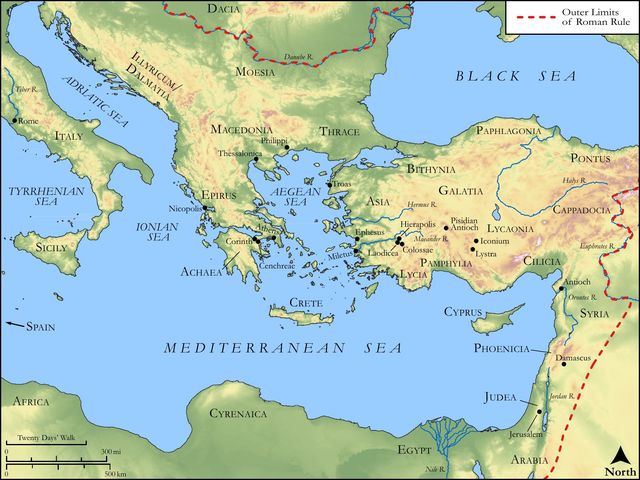
- MacedoniaWhere Paul met Titus; its churches gave beyond their power6
- AchaiaCorinth’s province, whose readiness to give Paul boasted of3
- CorinthThe church addressed; Paul stayed away to spare it2
- AsiaWhere Paul despaired even of life, and God delivered him1
- DamascusWhere Paul escaped the governor under Aretas, in a basket1
- JudaeaWhere Paul planned to go, sent on his way from Corinth1
- TroasAn open door for the gospel, but no Titus and no rest1
Where 2 Corinthians reaches
The passages it leans on, and the ones that lean on it
2 Corinthians 3:3 Jeremiah 31:33
The new covenant written “in their hearts,” which Paul sees in the Corinthians: “fleshy tables of the heart.”
2 Corinthians 3:13–16 Exodus 34:33–35
Moses veiled his shining face and unveiled it before the LORD; Paul says the veil is taken away when the heart turns to the Lord.
The God who first said “Let there be light” shines in the heart with the knowledge of his glory in Christ.
2 Corinthians 6:16 Leviticus 26:12 Revelation 21:3
God’s promise to dwell among his people: given at Sinai, claimed for the church, fulfilled in the new Jerusalem.
2 Corinthians 8:15 Exodus 16:18
The manna in the wilderness, where no one had too much or too little, gives Paul his measure for the churches’ giving.
Books 2 Corinthians links to most
The Church Fathers on 2 Corinthians
1,097 quotations from 52 writers before AD 800 · the ten most quoted, in date order
- Clement215
- Tertullian220
- Origen253
- Cyprian258
- Basil379
- Ambrosiaster384
- Chrysostom407
- Pelagius418
- Augustine430
- Theodoret458
Chrysostom, on the letter written with many tears.
What more tenderly affectioned than this man's spirit is? for he showeth himself to have been not less pained than they who had sinned, but even much more.
Theodoret of Cyrus put the exchange of 5:21 in a single line.
Christ was called what we are in order to call us to be what he is.
Basil, on giving “not grudgingly, or of necessity.”
People who give reluctantly or under compulsion present a blemished sacrifice which should not be accepted.
Cyprian took the Lord’s answer to Paul as a word for every believer under trial.
When some infirmity and weakness and desolation attacks us, then our power is made perfect, and our faith is crowned if it has stood firm through temptation.
Keep studying
Articles