


New Testament · Pauline Epistles · Book 50 of 66
Philippians
Paul writes from prison to thank the church at Philippi for its gift, and sets before it the mind of Christ, who humbled himself and was exalted.
- 4 chapters
- 104 verses
- About 10 minutes to read
- Letters to the Churches, c. AD 48–96
Philippians is a letter of thanks written in bonds. The church at Philippi had sent Epaphroditus with a gift, and Paul writes back while he awaits a verdict that could mean release or death. He weighs both and settles the matter in one line: “For to me to live is Christ, and to die is gain” (Philippians 1:21). The word rejoice runs through all four chapters, written by a man in chains: he rejoices that Christ is preached, in the church’s faith, and in its care for him (4:10).
At the centre of the letter stands 2:5–11. Christ, “being in the form of God,” took the form of a servant, humbled himself to “the death of the cross,” and was given “a name which is above every name.” Paul sets it there to meet a plain need, that the church be “of one mind” (2:2), and the rest of the letter takes its shape from it. Timotheus cares for others’ state, Epaphroditus risks his life for the work of Christ, and Paul counts his own gains loss to win Christ (3:7–8).
For to me to live is Christ, and to die is gain.
Philippians 1:21 KJV
Before you read
- Who wrote it
- Paul, in his own name. Timotheus is joined with him in the greeting (1:1), and Paul hopes to send him shortly as one who has served with him “as a son with the father” (2:22).
- To whom
- “All the saints in Christ Jesus which are at Philippi, with the bishops and deacons” (1:1). Philippi was “the chief city of that part of Macedonia, and a colony,” and the church there began with Lydia and the jailer (Acts 16:12–34).
- Where
- Paul writes in bonds, and the letter does not name the city. His bonds are “manifest in all the palace” (1:13), the saints of “Caesar’s household” send greetings (4:22), and he awaits a verdict of life or death (1:20).
Rome, the traditional view Paul wrote during the two years of custody in Rome with which Acts closes. The palace and Caesar’s household fit the capital, and Theodoret took the release Paul expected (1:25) as his escape from Nero.
Grounds Acts 28:16Acts 28:30Theodoret of Cyrus 458 · Epistle To The Philippians 1.25
Ephesus, held by some Paul was in prisons more often than Acts records, and despaired even of life in Asia. Ephesus lies far nearer Philippi than Rome does, which suits the journeys the letter assumes: news of Epaphroditus’ sickness reached the church, and word of their concern came back to him.
Grounds 2 Corinthians 11:232 Corinthians 1:8Philippians 2:26
Caesarea, held by others Paul was kept in Herod’s judgment hall at Caesarea and left bound there two years, and the Greek word for that hall is the one rendered palace in Philippians 1:13.
Grounds Acts 23:35Acts 24:27
How Philippians is laid out
7 movements · 18 passages · 104 verses · gold dots mark key verses
Thanks for a partnership
1:1–11 · 11 verses
Paul and Timotheus greet the saints at Philippi with the bishops and deacons. Paul thanks God for their fellowship in the gospel “from the first day until now,” and is confident that he who began a good work in them will perform it until the day of Jesus Christ. He prays that their love may abound in knowledge and in all judgment.
To live is Christ
1:12–30 · 19 verses
Paul’s bonds have turned to the furtherance of the gospel: they are known in all the palace, and many brethren preach more boldly. Some preach Christ of envy, and still he rejoices that Christ is preached. Between life and death he is “in a strait betwixt two,” but expects to remain for their sake. They are to stand fast in one spirit, unafraid of their adversaries.
The mind of Christ
2:1–18 · 18 verses
Paul asks them to be of one mind, each looking also on the things of others. The pattern is Christ, who being in the form of God took the form of a servant, became obedient unto the death of the cross, and was highly exalted. So they are to work out their own salvation, for God works in them, and shine as lights in the world.
Timotheus and Epaphroditus
2:19–30 · 12 verses
Paul hopes to send Timotheus shortly, who has served with him “as a son with the father” and naturally cares for their state. Meanwhile he sends back Epaphroditus, the church’s messenger to him, who was sick nigh unto death for the work of Christ until God had mercy on him. They are to receive him with all gladness and hold such in reputation.
No confidence in the flesh
Chapter 3 · 21 verses
Paul warns against those who press circumcision: “we are the circumcision,” who rejoice in Christ Jesus. His own standing under the law he counts loss, to win Christ and be found in him with the righteousness of God by faith. Not yet perfect, he presses toward the mark, and waits for the Saviour from heaven, who will fashion our bodies like his glorious body.
Stand fast and rejoice
4:1–9 · 9 verses
Paul calls his “joy and crown” to stand fast, and beseeches Euodias and Syntyche to be of the same mind in the Lord. He commands joy in the Lord always, moderation, and prayer with thanksgiving in place of care, and promises the peace of God to keep their hearts. They are to think on whatever is true and honest, and do what they have seen in him.
The gift received
4:10–23 · 14 verses
Paul rejoices that their care for him has flourished again. He has learned to be content in want and in plenty, and can do all things through Christ. Their gift by Epaphroditus follows gifts sent to Thessalonica, and he calls it “a sacrifice acceptable, wellpleasing to God”; his God will supply all their need. Greetings close the letter, chiefly from Caesar’s household.
The words Philippians turns on
Rejoice and mind carry the commands; count joins Christ’s choice to Paul’s; fellowship and conversation name the church’s partnership and its heavenly citizenship.
What Philippians teaches
phronéō · mind
Of one mind
The verb phroneō, to set the mind on something, runs through the letter. Paul asks the church “that ye be likeminded … being of one accord, of one mind” (2:2), and grounds the request in Christ: “Let this mind be in you, which was also in Christ Jesus” (2:5). The hymn that follows is the pattern for the verses before it: “in lowliness of mind let each esteem other better than themselves” (2:3). The same verb names the alternatives. The enemies of the cross “mind earthly things” (3:19); as many as be perfect are to “be thus minded” (3:15); Euodias and Syntyche are besought to “be of the same mind in the Lord” (4:2). Even the church’s gift is its “care” for Paul, the same word (4:10).
chaírō · rejoice
Rejoice in the Lord
Paul writes from prison, and rejoice appears in every chapter. Some preach Christ “of envy and strife” (1:15), and still Paul says, “I therein do rejoice, yea, and will rejoice” (1:18). If he is “offered upon the sacrifice and service of your faith,” he will “joy, and rejoice with you all” (2:17). The command comes twice, “rejoice in the Lord” (3:1) and “Rejoice in the Lord alway: and again I say, Rejoice” (4:4), and its ground is the Lord himself, who “is at hand” (4:5). The church had seen this at its beginning, when Paul and Silas, beaten and set in the stocks at Philippi, “prayed, and sang praises unto God” at midnight (Acts 16:25).
hēgéomai · count
Gain counted loss
One verb, hēgeomai, to count or reckon, joins Christ’s choice to Paul’s. Christ “thought it not robbery to be equal with God” (2:6); the church is to “esteem other better than themselves” (2:3); and Paul says, “what things were gain to me, those I counted loss for Christ” (3:7). The gains are named: circumcised the eighth day, of the tribe of Benjamin, a Pharisee, and “touching the righteousness which is in the law, blameless” (3:5–6). He counts them “but dung” beside Christ, to “be found in him, not having mine own righteousness, which is of the law, but that which is through the faith of Christ, the righteousness which is of God by faith” (3:8–9). That righteousness is received, not achieved, and the one who has it still presses “toward the mark” (3:14).
koinōnía · fellowship
Fellowship in the gospel
Paul thanks God for the church’s “fellowship in the gospel from the first day until now” (1:5). Koinōnia is a sharing, and in this letter it runs both ways. In his bonds they are all “partakers of my grace” (1:7), and he seeks “the fellowship of his sufferings” with Christ (3:10). Their gifts are its plainest form: when he left Macedonia “no church communicated with me as concerning giving and receiving, but ye only,” and “even in Thessalonica ye sent once and again unto my necessity” (4:15–16). He receives the latest, brought by Epaphroditus, as “a sacrifice acceptable, wellpleasing to God” (4:18). Theodoret noted what it cost them: Their praise is enhanced by their poverty.
Paul says the same of the churches of Macedonia, whose “deep poverty abounded unto the riches of their liberality” (2 Corinthians 8:2).
Christ in Philippians
Christ was “in the form of God,” and “thought it not robbery to be equal with God” (Philippians 2:6): equality with God was his own, not seized. Novatian pressed the wording: If Christ were only a man, he would have been said to have been ‘in the image of God,’ not ‘in the form of God.’
He “made himself of no reputation, and took upon him the form of a servant” (2:7). He did it by taking, not by losing: he did not lay down the form of God but added the form of a servant, and in it “became obedient unto death, even the death of the cross” (2:8).
Then “God also hath highly exalted him” (2:9). The words that follow are Isaiah’s, where the LORD swears, “unto me every knee shall bow, every tongue shall swear” (Isaiah 45:23). Paul gives that oath to the name of Jesus, so that every tongue confesses “that Jesus Christ is Lord, to the glory of God the Father” (2:11). The same Lord is awaited from heaven as Saviour, who “shall change our vile body, that it may be fashioned like unto his glorious body” (3:21).
People
By how many verses name them
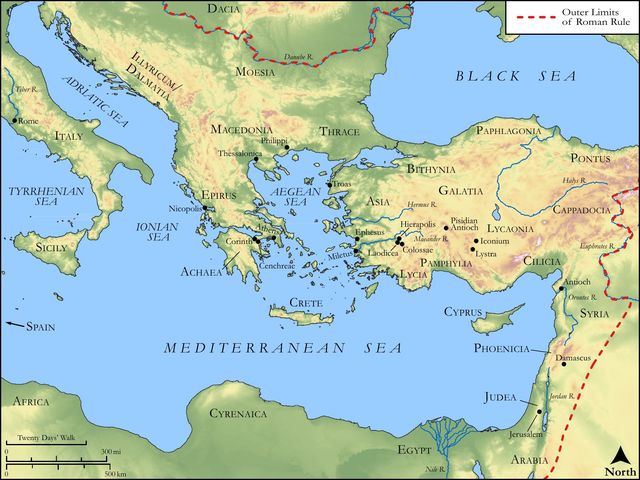
Where Philippians reaches
The passages it leans on, and the ones that lean on it
Philippi, “the chief city of that part of Macedonia, and a colony,” where the church began.
The LORD’s oath that every knee shall bow to him, spoken over the name of Jesus.
Philippians 2:7 2 Corinthians 8:9
Christ, though rich, became poor: the same descent, set before the Corinthians to move their giving.
Philippians 2:17 2 Timothy 4:6
Paul’s word for being “offered” means poured out as a drink offering; its only other use comes when his departure is at hand.
Philippians 4:13 2 Corinthians 12:9
The strength Paul can do all things through is Christ’s, made perfect in weakness.
Books Philippians links to most
The Church Fathers on Philippians
499 quotations from 52 writers before AD 800 · the ten most quoted, in date order
- Ignatius108
- Clement215
- Tertullian220
- Cyprian258
- Gaius Marius Victorinus370
- Ambrosiaster384
- Gregory of Nyssa395
- Chrysostom407
- Augustine430
- Theodoret458
Chrysostom asked why only this letter greets the bishops and deacons.
How is it that though he nowhere else writes to the Clergy … yet here he writes to the Clergy? Because it was they that sent, and bare fruit, and it was they that dispatched Epaphroditus to him.
Marius Victorinus, on what makes death gain.
It is not death itself that is gain, but to die in Christ. Life is Christ. The one who has hope in him is always alive, both now and forever.
Augustine, on working out salvation while God works within.
It is not that the will or the deed is not ours, but without his aid we neither will nor do anything good.
Polycarp of Smyrna, writing to the same church, recalls how Paul boasted of them.
But I have neither seen nor heard of any such thing among you, in the midst of whom the blessed Paul laboured, and who are commended in the beginning of his Epistle. For he boasts of you in all those Churches which alone then knew the Lord
Keep studying
Articles