


New Testament · Pauline Epistles · Book 51 of 66
Colossians
From prison Paul writes to a church he had not seen: Christ is the image of the invisible God, and in him they are complete.
- 4 chapters
- 95 verses
- About 9 minutes to read
- Letters to the Churches, c. AD 48–96
Colossians is a letter from prison to a church Paul knew by report. Epaphras had taught them the gospel (1:7) and brought Paul word of their love. Paul writes to keep them where they began: “As ye have therefore received Christ Jesus the Lord, so walk ye in him” (2:6).
At the letter’s centre stands the Son: the image of the invisible God, by whom and for whom all things were created, the head of the church and the firstborn from the dead, in whom God made peace “through the blood of his cross” (1:15–20). Every warning that follows rests on that passage: against “philosophy and vain deceit, after the tradition of men” (2:8), against rules about meats and days, and against the worshipping of angels (2:16–18). Paul answers each with Christ himself: “ye are complete in him” (2:10). The last two chapters show that completeness at work in the church, in the household and toward “them that are without” (4:5), for “Christ is all, and in all” (3:11).
And he is the head of the body, the church: who is the beginning, the firstborn from the dead; that in all things he might have the preeminence.
Colossians 1:18 KJV
Before you read
- Who wrote it
- Paul, who names himself with Timotheus in the greeting (1:1), again as the gospel’s minister (1:23), and signs the close “by the hand of me Paul” (4:18).
- When it was written
- From prison: Paul asks prayer for a door to speak “the mystery of Christ, for which I am also in bonds” (4:3). Tychicus carries the letter, with Onesimus (4:7–9). Philemon, written as Onesimus was sent back, carries greetings from the same companions (Philemon 1:23–24).
Those who place it in Rome Paul wrote during his two years under guard at Rome, where he received all who came and preached “with all confidence, no man forbidding him.” Aristarchus, his fellowprisoner here, had set sail with him for Rome.
Those who place it in Caesarea Paul wrote during the two years Felix held him at Caesarea, with liberty for his friends to come and minister to him.
Grounds Acts 24:23Acts 24:27
Those who place it in Ephesus Paul wrote from an imprisonment at Ephesus, during the troubles he names there, one of the “prisons more frequent” that Acts does not record.
How Colossians is laid out
7 movements · 17 passages · 95 verses
Thanksgiving and prayer
1:1–14 · 14 verses
Paul and Timotheus greet the faithful brethren at Colosse. Paul gives thanks for their faith, their love to all the saints and the hope laid up in heaven, of which they heard in the gospel Epaphras taught them. He prays that they be filled with the knowledge of God’s will, and gives thanks to the Father, who “hath translated us into the kingdom of his dear Son.”
Preeminent in all things
1:15–23 · 9 verses
The Son is “the image of the invisible God, the firstborn of every creature.” All things in heaven and earth were created by him and for him, and by him all things consist. He is head of the church and firstborn from the dead. Through the blood of his cross God reconciles all things, and the Colossians, once enemies, are reconciled, if they continue in the faith.
The mystery and its minister
1:24–2:7 · 13 verses
Paul rejoices in his sufferings for the church, Christ’s body, filling up “that which is behind of the afflictions of Christ.” He serves a mystery hidden from ages and now made known among the Gentiles: “Christ in you, the hope of glory.” He strives for Colosse and Laodicea, and bids them walk in Christ as they received him, for in him are hid all the treasures of wisdom.
Complete in him
2:8–23 · 16 verses
Paul warns against philosophy after the tradition of men. All the fulness of the Godhead dwells in Christ bodily, and in him they are complete: circumcised without hands, buried and risen with him in baptism, forgiven, the handwriting against them nailed to his cross. No one may judge them in meat or sabbaths, beguile them into worshipping angels, or bind them with “Touch not; taste not; handle not.”
Risen with Christ
3:1–17 · 17 verses
Risen with Christ, they are to seek the things above, where he sits at God’s right hand, for their life is hid with him. They put to death fornication and covetousness, having put off the old man and put on the new, where Christ is all. Mercy, forbearance and charity follow, with the peace of God, the word of Christ, and thanks in all they do.
The household and those without
3:18–4:6 · 14 verses
Wives submit to their husbands, and husbands love their wives; children obey, and fathers do not provoke them. Servants obey their masters, working “heartily, as to the Lord,” and masters give what is just and equal, having a Master in heaven. All are to continue in prayer, pray for Paul’s door of utterance, and walk in wisdom toward them that are without, their speech seasoned with salt.
Messengers and greetings
4:7–18 · 12 verses
Tychicus and Onesimus, “who is one of you,” bring word of Paul. Aristarchus, Marcus, Jesus called Justus, Epaphras, Luke and Demas send greetings. Paul greets the brethren in Laodicea and Nymphas, asks that the two churches exchange letters, and charges Archippus to fulfil his ministry. He signs with his own hand: “Remember my bonds.”
The words Colossians turns on
All fills the passage on the Son; image links the Son to the new man; with joins believers to Christ’s death, life and glory.
What Colossians teaches
prōtótokos · firstborn
Firstborn of every creature
Paul calls the Son “the firstborn of every creature” (1:15) and gives the reason at once: “For by him were all things created” (1:16). The firstborn is the heir, and the title is rank, not birth order. God says of David, the youngest of Jesse’s sons (1 Samuel 16:11), “I will make him my firstborn, higher than the kings of the earth” (Psalm 89:27). The title sets the Son over creation, not within it, for “he is before all things, and by him all things consist” (1:17). It returns in 1:18, “the firstborn from the dead.” Severian of Gabala kept the two apart: ‘Firstborn of all creation’ applied to his status before the emergence of the created order, whereas ‘firstborn from the dead’ refers to the fact that he was raised first of all the brothers who will share in salvation.
plḗrōma · fulness
All the fulness
Twice the letter says where the fulness of God is found: “it pleased the Father that in him should all fulness dwell” (1:19), and “in him dwelleth all the fulness of the Godhead bodily” (2:9). Bodily places it in the Son made flesh, who reconciled “in the body of his flesh through death” (1:22). From this Paul draws his answer to every addition urged on the church: “ye are complete in him, which is the head of all principality and power” (2:10). Complete is the verb of the same root: the fulness dwells in him, and they are filled in him. Philosophy, the worshipping of angels and rules with “a shew of wisdom” (2:23) offer something beyond Christ. Nothing lies beyond him, for in him “are hid all the treasures of wisdom and knowledge” (2:3).
skiá · shadow
Shadow and body
Meat and drink, holyday, new moon and sabbath days are “a shadow of things to come; but the body is of Christ” (2:16–17). A shadow is cast by a body and shows its outline before it arrives. Hebrews says the same of the law, “having a shadow of good things to come” (Hebrews 10:1). The days pointed ahead; what they pointed to has come, so no one may judge a believer by them. Christians have read “sabbath days” in two ways. Some take it as the whole calendar of Israel, sabbaths with new moons and set feasts (1 Chronicles 23:31); Eusebius wrote of the holy days and the sabbath, like shadowy things
. Others hold that the weekly rest God blessed at creation (Genesis 2:3) and set among the commandments (Exodus 20:8) still stands, and read the verse of Israel’s ceremonial sabbaths.
eikṓn · image
Renewed after the image
The word that names the Son in 1:15, “the image of the invisible God,” returns in 3:10. Believers “have put off the old man with his deeds” and “have put on the new man, which is renewed in knowledge after the image of him that created him” (3:9–10). The words recall man’s creation “in the image of God” (Genesis 1:27), and Paul names the end elsewhere: to be “conformed to the image of his Son” (Romans 8:29). Renewal after the Creator’s image is renewal into the likeness of the Son, who is that image. So the new man is not divided by nation or station: “there is neither Greek nor Jew, circumcision nor uncircumcision, Barbarian, Scythian, bond nor free: but Christ is all, and in all” (3:11).
Christ in Colossians
Colossians sets Christ at the centre of creation, the church and the cross, and gathers into one passage what other books say of him. John says of the Word, “All things were made by him” (John 1:3), and Hebrews calls the Son “the express image of his person” (Hebrews 1:3). Paul calls him “the image of the invisible God” and adds that “by him all things consist” (Colossians 1:15–17).
The letter reads the Old Testament in him. David heard the LORD say to his Lord, “Sit thou at my right hand” (Psalm 110:1), and Paul bids those risen with Christ seek the things above, “where Christ sitteth on the right hand of God” (3:1). The circumcision of the heart that Moses promised (Deuteronomy 30:6) is given in “the circumcision of Christ,” made without hands (2:11). And the cross is a triumph: the handwriting that was against us was nailed to it, and “having spoiled principalities and powers, he made a shew of them openly, triumphing over them in it” (2:14–15).
People
By how many verses name them
- Paul3
- TimotheusHis mother was Eunice1
- Tychicus1
- Onesimus1
- Aristarchus1
- MarcusHis mother was Mary1
- Justus1
- Epaphras2
4 more are named.
Places
3 named
- LaodiceaThe neighbouring city, whose church is to read this letter too4
- ColosseHome of the saints Paul writes to, and of Epaphras, their teacher1
- HierapolisThe third city in Epaphras’s care, with Colosse and Laodicea1
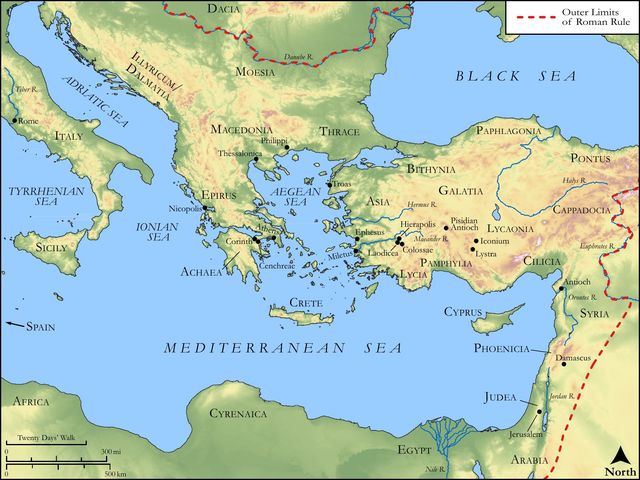
Where Colossians reaches
The passages it leans on, and the ones that lean on it
John says of the Word what Paul says of the Son: all things were made by him.
The powers spoiled at the cross: through death he destroyed “him that had the power of death.”
Colossians 3:10 Ephesians 4:24
The sister letter’s new man, “created in righteousness and true holiness.”
Colossians 4:7–8 Ephesians 6:21–22
Tychicus carries both letters, commended in nearly the same words.
Onesimus, “one of you,” is the son of Paul’s bonds whom he sends back to Philemon.
Books Colossians links to most
The Church Fathers on Colossians
396 quotations from 45 writers before AD 800 · the ten most quoted, in date order
- Ignatius108
- Irenaeus202
- Clement215
- Tertullian220
- Cyprian258
- Ambrosiaster384
- Ambrose397
- Chrysostom407
- Severian425
- Augustine430
Gregory of Nyssa, on what follows from confessing Christ as “the beginning” (1:18).
But what benefits do we derive from believing that he is the beginning? We become ourselves what we believe our beginning to be.
Augustine read the afflictions Paul fills up (1:24) as those of Christ’s body, the church, not of its Head.
That can’t be understood of the head, which now in heaven is not suffering any such thing; but of the body, that is, the church; the body, which with its head is the one Christ.
Ambrosiaster drew from 2:9 the answer to the worshipping of angels.
All that the Father has, he has given to the Son when he begot him bodily in the fullness of divinity, so that as he is the head, the creation is his body. Therefore, whatever can be supposed to be a heavenly creature must be seen as fully subordinate to Christ, so that no lesser being may be thought worthy of worship. .
Chrysostom, on Paul calling the slave Onesimus “a faithful and beloved brother” (4:9).
Paul calleth a slave, brother: with reason; seeing that he styleth himself the servant of the faithful.
Keep studying
Articles