


Colossians 4:9
Bible text: King James Version (1769 Blayney text) · Public domain
Bible text: King James Version with Strong's numbers · Public domain
Bible text: Berean Standard Bible · Public domain
Bible text: American Standard Version (1901) · Public domain
Bible text: World English Bible, Messianic edition · Public domain
Bible text: Geneva Bible (1599) · Public domain
Bible text: Young's Literal Translation · Public domain
- σὺνsunwithG4862PREPPreposition
- ὈνησίμῳOnēsimōOnesimusG3682N-DSM-PNoun Dative Singular Masculine Individual
- τῷtōtheG3588T-DSMDefinite article Dative Singular Masculine
- πιστῷpistōfaithfulG4103A-DSMAdjective Dative Singular Masculine
- καὶkaiandG2532CONJConjunction
- ἀγαπητῷagapētōbelovedG27A-DSMAdjective Dative Singular Masculine
- ἀδελφῷadelphōbrotherG80N-DSMNoun Dative Singular Masculine
- ὅςhoswhoG3739R-NSMRelative pronoun Nominative Singular Masculine
- ἐστινestinisG1510V-PAI-3SVerb Present Active Indicative 3rd Singular
- ἐξex[one] ofG1537PREPPreposition
- ὑμῶν·humōnyouG4771P-2GPPersonal pronoun Genitive 2nd Plural
- πάνταpantaAll thingsG3956A-APNAdjective Accusative Plural Neuter
- ὑμῖνhuminto youG4771P-2DPPersonal pronoun Dative 2nd Plural
- γνωρίσουσινgnōrisousinthey will make knownG1107V-FAI-3PVerb Future Active Indicative 3rd Plural
- τὰta<the>G3588T-APNDefinite article Accusative Plural Neuter
- ὧδεhōdehereG5602ADVAdverb
English is a literal word-by-word gloss of the Greek, not the KJV's wording. Why?
This is the original text the KJV's translators worked from — each Greek word with its own literal English meaning in this verse, prepared by scholars at Tyndale House, Cambridge. The KJV translates whole sentences, not word by word, so its wording differs: one Greek word can become several English words, and the KJV may choose “charity” where the gloss reads “love”. Both are faithful — they answer different questions. For the KJV's own rendering, switch to the KJV text.
Details
See on the biblical-era maps

Study this verse
Public-domain commentary
Matthew Henry
From his Commentary on the Whole Bible. Henry comments on passages, not single verses — this entry covers Colossians 4:7–18. His two-level outline is real structure in the source text, so it is rendered as structure.
In the close of this epistle the apostle does several of his friends the honour to leave their names upon record, with some testimony of his respect, which will be spoken of wherever the gospel comes, and last to the end of the world.
I.Concerning Tychicus, Col 4:7.
By him this epistle was sent; and he does not give them an account in writing of his present state, because Tychicus would do it by word of mouth more fully and particularly. He knew they would be glad to hear how it fared with him. The churches cannot but be concerned for good ministers and desirous to know their state. He gives him this character, A beloved brother and faithful minister. Paul, though a great apostle, owns a faithful minister for a brother and a beloved brother. Faithfulness in any one is truly lovely, and renders him worthy our affection and esteem. And a fellow-servant in the Lord. Ministers are servants to Christ, and fellow-servants to one another. They have one Lord, though they have different stations and capacities of service. Observe, It adds much to the beauty and strength of the gospel ministry when ministers are thus loving and condescending one to another, and by all just means support and advance one another's reputation. Paul sent him not only to tell them of his affairs, but to bring him an account of theirs: Whom I have sent unto you for the same purpose, that he might know your estate, and comfort your hearts, Col 4:8. He was willing to hear from them as they could be to hear from him, and thought himself as much obliged to sympathize with them as he thought them obliged to sympathize with him. It is a great comfort, under the troubles and difficulties of life, to have the mutual concern of fellow-christians.
II.Concerning Onesimus (Col 4:9):
With Onesimus, a faithful and beloved brother, who is one of you. He was sent back from Rome along with Tychicus. This was he whom Paul had begotten in his bonds, Plm 1:10. He had been servant to Philemon, and was a member, if not a minister, of their church. He was converted at Rome, whither he had fled from his master's service; and was now sent back, it is probable, with the epistle to Philemon, to introduce him again into his master's family. Observe, Though he was a poor servant, and had been a bad man, yet, being now a convert, Paul calls him a faithful and beloved brother. The meanest circumstance of life, and greatest wickedness of former life, make no difference in the spiritual relation among sincere Christians: they partake of the same privileges, and are entitles to the same regards. The righteousness of God by faith of Jesus Christ is unto all and upon all those that believe; for there is no difference (Rom 3:22): and there is neither Jew nor Greek, neither bond nor free, for you are all one in Christ Jesus, Gal 3:28. Perhaps this was some time after he was converted and sent back to Philemon, and by this time he had entered into the ministry, because Paul calls him a brother.
III.Aristarchus, a fellow-prisoner.
Those who join in services and sufferings should be thereby engaged to one another in holy love. Paul had a particular affection for his fellow-servants and his fellow-prisoners.
IV.Marcus, sister's son to Barnabas.
This is supposed to be the same who wrote the gospel which bears his name. If he come unto you receive him. Paul had a quarrel with Barnabas upon the account of this Mark, who was his nephew, and thought not good to take him with them, because he departed from them from Pamphylia, and went not with them to the work, Act 15:38. He would not take Mark with him, but took Silas, because Mark had deserted them; and yet Paul is not only reconciled to him himself, but recommends him to the respect of the churches, and gives a great example of a truly Christian forgiving spirit. If men have been guilty of a fault, it must not be always remembered against them. We must forget as well as forgive. If a man be overtaken in a fault, you who are spiritual restore such a one in the spirit of meekness, Gal 6:1.
V.Here is one who is called Jesus, which is the Greek name for the Hebrew Joshua.
If Jesus had given them rest, then would he not afterwards have spoken of another day, Heb 4:8. Who is called Justus. It is probable that he changed his name for that of Justus, in honour to the name of the Redeemer. Or else Jesus was his Jewish name, for he was of the circumcision; and Justus his Roman or Latin name. These are my fellow-labourers unto the kingdom of God, who have been a comfort unto me. Observe, What comfort the apostle had in the communion of saints and ministers! One is his fellow-servant, another his fellow-prisoner, and all his fellow-workers, who were working out their own salvation and endeavouring to promote the salvation of others. Good ministers take great comfort in those who are their fellow-workers unto the kingdom of God. Their friendship and converse together are a great refreshment under the sufferings and difficulties in their way.
VI.Epaphras (Col 4:12), the same with Epaphroditus.
He is one of you, one of your church; he salutes you, or sends his service to you, and his best affections and wishes. Always labouring fervently for you in prayers. Epaphras had learned of Paul to be much in prayer for his friends. Observe,
1.In what manner he prayed for them. He laboured in prayer, laboured fervently, and always laboured fervently for them. Those who would succeed in prayer must take pains in prayer; and we must be earnest in prayer, not only for ourselves, but for others also. It is the effectual fervent prayer which is the prevailing prayer, and availeth much (Jam 5:16), and Elias prayed earnestly that it might not rain, Col 4:17.
2.What is the matter of this prayer: That you may stand perfect and complete in all the will of God. Observe, To stand perfect and complete in the will of God is what we should earnestly desire both for ourselves and others. We must stand complete in all the will of God; in the will of his precepts by a universal obedience, and in the will of his providence by a cheerful submission to it: and we stand perfect and complete in both by constancy and perseverance unto the end. The apostle was witness for Epaphras that he had a great zeal for them: "I bear him record; I can testify for him that he has a great concern for you, and that all he does for you proceeds from a warm desire for your good." And his zeal extended to all about them: to those who are in Laodicea and Hierapolis. He had a great concern for the Christian interest in the neighbouring places, as well as among them.
VII.Luke is another here mentioned, whom he calls the beloved physician.
This is he who wrote the Gospel and Acts, and was Paul's companion. Observe, He was both a physician and an evangelist. Christ himself both taught and healed, and was the great physician as well as prophet of the church. He was the beloved physician; one who recommended himself more than ordinary to the affections of his friends. Skill in physic is a useful accomplishment in a minister and may be improved to more extensive usefulness and greater esteem among Christians.
VIII.Demas.
Whether this was written before the second epistle to Timothy or after is not certain. There we read (Ti2 4:10), Demas hath forsaken me, having loved this present world. Some have thought that this epistle was written after; and then it is an evidence that, though Demas forsook Paul, yet he did not forsake Christ; or he forsook him but for a time, and recovered himself again, and Paul forgave him and owned him as a brother. But others think more probably that this epistle was written before the other; this in anno 62, that in 66, and then it is an evidence how considerable a man Demas was, who yet afterwards revolted. Many who have made a great figure in profession, and gained a great name among Christians, have yet shamefully apostatized: They went forth from us, because they were not of us, Jo1 2:19.
IX.The brethren in Laodicea are here mentioned, as living in the neighbourhood of Colosse:
and Paul sends salutations to them, and orders that this epistle should be read in the church of the Laodiceans (Col 4:16), that a copy of it should be sent thither, to be read publicly in their congregation. And some think Paul sent another epistle at this time to Laodicea, and ordered them to send for that from Laodicea, and read it in their church: And that you likewise read the epistle from Laodicea. If so, that epistle is now lost, and did not belong to the canon; for all the epistles which the apostles ever wrote were not preserved, any more than the words and actions of our blessed Lord. There are many other things which Jesus did, which if they should be written every one, I suppose the world itself could not contain the books which would be written, Joh 21:25. But some think it was the epistle to the Ephesians, which is still extant.
X.Nymphas is mentioned (Col 4:15) as one who lived at Colosse, and had a church in his house; that is, either a religious family, where the several parts of worship were daily performed; or some part of the congregation met there, when they had no public places of worship allowed, and they were forced to assemble in private houses for fear of their enemies. The disciples were assembled for fear of the Jews (Joh 20:19), and the apostle preached in his own lodging and hired house, Act 28:23, Act 28:30. In the former sense it showed his exemplary piety; in the latter his zeal and public spirit.
XI.Concerning Archippus, who was one of their ministers at Colosse.
They are bidden to admonish him to mind his work as a minister, to take heed to it, and to fulfil it - to be diligent and careful of all the parts of it, and to persevere in it unto the end. They must attend to the main design of their ministry, without troubling themselves or the people with things foreign to it, or of less moment. Observe, (1.) The ministry we have received is a great honour; for it is received in the Lord, and is by his appointment and command. (2.) Those who have received it must fulfil it, or do the full duty of it. Those betray their trust, and will have a sad account at last, who do this work of the Lord negligently. (3.) The people may put their ministers in mind of their duty, and excite them to it: Say to Archippus, Take heed to the ministry, though no doubt with decency and respect, not from pride and conceit.
XII.Concerning himself (Col 4:18):
The salutation of me Paul. Remember my bonds. He had a scribe to write all the rest of the epistle, but these words he wrote with his own hand: Remember my bonds. He does not say, "Remember I am a prisoner, and send me supply;" but, "Remember I am in bonds as the apostle of the Gentiles, and let this confirm your faith in the gospel of Christ:" it adds weight to this exhortation: I therefore, the prisoner of the Lord, beseech you to walk worthy, Eph 4:1. "Grace be with you. The favour of God, and all good, the blessed fruits and effects of it, be with you, and be your portion."
Historical interpretation
Historical reception
2 surviving comments on this verse. Each one is dated, so this reads as a timeline rather than a list.
"They shall make known unto you," he saith, "all things that are done here." Why didst thou not come with them, says one? But what is, "They shall make known unto you all things"? My bonds, that is, and all the other things that detain me. I then, who pray to see them, who also send others, should not myself have remained behind, had not some great necessity detained me. And yet this is not the language of accusations-yes, of vehement accusation. For the assuring them that he had both fallen into trials, and was bearing them nobly, is the part of one who was confirming the fact, and lifting up again their souls.
"With Onesimus," he saith, "the beloved, and faithful brother."
Paul calleth a slave, brother: with reason; seeing that he styleth himself the servant of the faithful. (2 Cor. iv. 5.) Bring we down all of us our pride, tread we under foot our boastfulness. Paul nameth himself a slave, he that is worth the world, and ten thousands of heavens; and dost thou entertain high thoughts? He that seizeth all things for spoil as he will, he that hath the first place in the kingdom of heaven, he that was crowned, he that ascended into the third heaven, calleth servants, "brethren," and "fellow-servants." Where is your madness? where is your arrogance?
So trustworthy was Onesimus become, as to be entrusted even with such things as these.
Onesimus is the one about whom, writing to Philemon, he said, "Whom I would fain have kept with me, that in thy behalf he might minister unto me in the bonds of the Gospel: but without thy mind I would do nothing." (Philem. 13, 14.) And he adds too the praise of their city, that they might not only not be ashamed, but even pride themselves on him. "Who is one of you," he saith. "They shall make known unto you all things that are done here."
Continue studying Colossians 4:9 across the web’s major study libraries — every link below opens this exact verse, chapter, or book on the destination site.
Read & Compare
 BibleGatewayThis verse in more than 200 translations and 70 languages.
 Bible.comThe YouVersion reader — hundreds of translations, reading plans, and highlights.
 ESV.orgCrossway's official English Standard Version reader.
 NET BibleThe NET translation with 60,000+ translators' notes on every rendering decision.
 STEP BibleTyndale House's free study tool — original text, vocabulary, and scholarly resources.
 BibliaLogos Bible Software's free web reader.
 USCCBThe New American Bible (Revised Edition) with the U.S. bishops' study notes.
Commentaries
 BibleHub CommentariesDozens of classic commentaries on this verse, gathered on one page.
 StudyLightMore than 100 commentary sets — the largest collection on the web.
 BibleRefPlain-English commentary on what this verse means, verse by verse.
 Enduring WordDavid Guzik's free commentary on this chapter, widely used by Bible teachers.
 Bible Study ToolsVerse commentary alongside Greek and Hebrew study aids.
Original Language & Research
- BibleHub InterlinearThe verse word by word — original language, transliteration, and English.
- BibleHub LexiconEvery word's original-language definition and Strong's entry.
 Blue Letter BibleDeep-study tools — Strong's numbers, concordance, and word studies.
 CNTR CollationThe earliest Greek manuscripts of this verse, collated letter by letter.
Sermons, Hymns & Audio


TrulyRandomVerse is not affiliated with these sites and doesn’t control their content. They’re linked because they’re genuinely useful.
Summary
Colossians 4:9 introduces Onesimus, a formerly runaway slave now transformed into a "faithful and beloved brother" in Christ, whom Paul sends back to Colossae alongside Tychicus. This verse highlights the radical social and spiritual transformation wrought by the Gospel, demonstrating that in Christ, all believers are united as equals, transcending earthly distinctions. Onesimus's return serves not only as a personal act of reconciliation but also as a means for the Colossian church to receive direct, firsthand news from Paul regarding his circumstances and the broader work of the Gospel.
Context
ShowHideLiterary Context
Colossians 4:9 is part of Paul's concluding remarks in his letter, following profound theological exposition on Christ's supremacy and practical exhortations for Christian living. The immediate literary context begins in Colossians 4:7, where Paul introduces Tychicus as his primary messenger, who will deliver the letter and provide a full report on Paul's situation. Onesimus is presented as Tychicus's companion, indicating a joint mission. These personal greetings and updates serve to reinforce the bond between Paul and the Colossian church, assuring them of his continued care and involvement despite his imprisonment. The mention of Onesimus here also sets the stage for the deeply personal letter to Philemon, which elaborates on Onesimus's past and Paul's plea for his reception.
Historical & Cultural Context
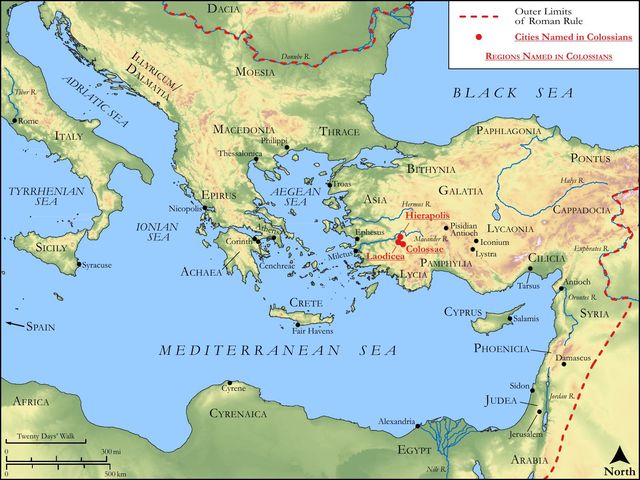
Paul is writing from imprisonment, most likely in Rome (around A.D. 60-62). The city of Colossae was located in Phrygia, Asia Minor, a region where slavery was a pervasive social institution. Runaway slaves faced severe penalties, often death or brutal punishment. Onesimus was a slave belonging to Philemon, a prominent Christian in Colossae. His flight and subsequent encounter with Paul in prison, leading to his conversion, represent a dramatic turn of events. Paul's decision to send Onesimus back to his master, not as a recaptured fugitive but as a "brother" in Christ, directly challenged the prevailing social norms and expectations of the Roman world, underscoring the revolutionary nature of the Gospel's impact on human relationships.
Key Themes
ShowHideThis verse powerfully contributes to several key themes in Colossians and Paul's broader theology. First, it exemplifies Transformation and New Creation, showing how the Gospel radically changes individuals, turning a runaway slave into a "faithful and beloved brother." This aligns with the broader theme of believers being made new in Christ. Second, it underscores Christian Unity and Equality, demonstrating that in Christ, social distinctions like master and slave are transcended by spiritual kinship, as seen in Galatians 3:28. Third, it highlights Paul's Pastoral Care and Apostolic Authority, as he maintains communication with the churches even from prison, entrusting vital information and personal reconciliation to trusted messengers like Onesimus. Finally, it subtly introduces the theme of Reconciliation, which is fully developed in the letter to Philemon, showcasing the Gospel's power to heal broken relationships.
Exposition and Analysis
ShowHideKey Word Analysis
ShowHideFrom ὀνίνημι, meaning "profitable." This name is highly significant, as Paul plays on its meaning in Philemon 1:11, stating that Onesimus was formerly "unprofitable" but is now "profitable" to both Paul and Philemon. His name thus becomes a living parable of the Gospel's transformative power.
From ἀγαπάω, meaning "beloved" or "dearly loved." This term, rooted in the concept of agape (unconditional, divine love), signifies deep affection and spiritual bond. Paul uses it to elevate Onesimus's status far beyond that of a mere slave, positioning him as a cherished member of the Christian family and emphasizing the love with which the Colossian church should receive him.
From a derivative of γινώσκω, meaning "to make known" or "to certify." This word indicates the purpose of Onesimus's visit: to provide a comprehensive and reliable report of Paul's circumstances. It highlights the importance of accurate communication and the trust Paul placed in Onesimus to convey the truth of his situation to the Colossian believers.
Verse Breakdown
ShowHide"With Onesimus, a faithful and beloved brother"
This phrase immediately establishes Onesimus's new identity and standing within the Christian community. He is no longer merely a slave but a "brother" in Christ, signifying spiritual equality. The descriptors "faithful" (trustworthy, reliable) and "beloved" (dearly cherished) underscore his transformed character and the high regard in which Paul holds him.
"who is [one] of you"
This clause emphasizes Onesimus's connection to the Colossian church. He is not a stranger but a local, implying that his return is a homecoming, and he is a familiar figure to many there. This personal connection would facilitate the reception of news and reinforce the message of reconciliation.
"They shall make known unto you all things which [are done] here"
This final clause states the primary purpose of Onesimus's (and Tychicus's) visit. "They" refers to both Tychicus and Onesimus. Their mission is to provide a full and accurate report ("all things") about Paul's circumstances ("which are done here," referring to his imprisonment and ministry in Rome). This demonstrates Paul's desire for transparency and his reliance on trusted messengers to convey vital information to the churches.
Literary Devices
ShowHideThe verse employs Ethos by presenting Onesimus with strong commendations ("faithful and beloved brother"), thereby establishing his credibility and character before the Colossian church, which would have remembered him as a runaway slave. This positive portrayal aims to influence their reception of him. There is also a powerful sense of Symbolism in Onesimus himself; his transformed status from a runaway slave to a respected "brother" symbolizes the radical, leveling power of the Gospel to break down social barriers and create a new community founded on spiritual kinship rather than worldly hierarchies. Furthermore, the Juxtaposition of Onesimus's past identity as a slave (implied by his return to Philemon) with his present identity as a "faithful and beloved brother" powerfully illustrates the redemptive work of Christ.
Theological and Thematic Connections
ShowHideColossians 4:9 is a microcosm of the Gospel's power to transform individuals and redefine relationships within the community of faith. It vividly illustrates that in Christ, earthly distinctions of status, race, or social standing are rendered secondary to the spiritual reality of being united as one family under God. The radical inclusion and affirmation of Onesimus, a former runaway slave, as a "beloved brother" underscores the profound theological truth that all believers are equally valued and integrated into the body of Christ, reflecting God's impartial love and the breaking down of dividing walls through the cross. This verse serves as a practical demonstration of the new humanity created in Christ, where grace and reconciliation triumph over social norms and past transgressions.
Reflection and Application
ShowHideColossians 4:9 offers a profound challenge and encouragement for believers today. Onesimus's story reminds us that the Gospel is not merely a set of doctrines but a transformative power that redefines our identities and relationships. We are called to embody the same radical acceptance and love that Paul extended to Onesimus, seeing every fellow believer as a "faithful and beloved brother" or "sister," regardless of their past, social standing, or perceived worth in the eyes of the world. This means actively working to dismantle any barriers or prejudices within our communities that contradict the spiritual equality we share in Christ. Furthermore, Onesimus's journey from runaway to trusted messenger underscores the redemptive potential within every individual and the importance of offering second chances, reconciliation, and opportunities for faithful service. We are invited to trust in God's power to redeem and repurpose even the most broken stories for His glory, fostering environments where grace, forgiveness, and genuine brotherhood flourish.
Questions for Reflection
ShowHideFAQ
ShowHideWho was Onesimus, and why was he significant to Paul and the Colossian church?
ShowHideOnesimus was a slave belonging to Philemon, a Christian in Colossae. He had run away from Philemon, a serious offense in the Roman world. During his flight, he encountered Paul, likely in prison in Rome, and was converted to Christianity through Paul's ministry. His significance lies in his transformation from a runaway slave to a "faithful and beloved brother" in Christ, as described in Colossians 4:9. Paul sent him back to Philemon not as a recaptured slave, but as a fellow believer, urging Philemon to receive him as such (see Philemon 1:10-16). This act powerfully demonstrates the Gospel's ability to transcend social hierarchies and bring about reconciliation and spiritual equality within the early Christian community.
Christ-Centered Fulfillment
ShowHideColossians 4:9, through the person of Onesimus, beautifully foreshadows and embodies the Christ-centered fulfillment of reconciliation and new creation. Onesimus, once lost and estranged from his master, is brought into a new relationship through Paul's intercession, mirroring how humanity, estranged from God by sin, is reconciled through the mediatorial work of Jesus Christ. Just as Paul advocates for Onesimus, presenting him as a "faithful and beloved brother," Christ Himself intercedes for us, presenting us as righteous before God, having taken our sin upon Himself (as seen in 2 Corinthians 5:21). Onesimus's transformation from a "unprofitable" slave (as Paul subtly puns in Philemon 1:11) to a "profitable" and beloved brother powerfully illustrates the redemptive work of Christ, who makes all things new (a theme echoed in Revelation 21:5). In Christ, social barriers are shattered, and all believers are united as one body, reflecting the profound unity and equality found in the new humanity established by Christ's sacrifice, where there is "neither bond nor free" but all are "one in Christ Jesus" (Galatians 3:28). Thus, Onesimus's story is a living parable of the Gospel's power to redeem, reconcile, and integrate all who are in Christ into the beloved family of God.