


New Testament · Pauline Epistles · Book 52 of 66
1 Thessalonians
Paul writes to a young church he could not return to: thanks for its faith, an account of his conduct, and teaching on holy living and the Lord’s coming.
- 5 chapters
- 89 verses
- About 8 minutes to read
- Letters to the Churches, c. AD 48–96
Paul wrote this letter to a church he had been forced to leave. An uproar cut short his preaching at Thessalonica, and the brethren sent him away by night (Acts 17:5–10). He tried to return “once and again; but Satan hindered us” (2:18). So he sent Timotheus, and the letter answers Timotheus’s report. It gives thanks for their faith under affliction, recalls how the apostles lived among them, and supplies what was “lacking in your faith” (3:10): how to walk, and what becomes of believers who die before the Lord comes.
Every chapter ends with that coming in view: the Son awaited from heaven (1:10), the church as Paul’s crown “at his coming” (2:19), hearts stablished unblameable at his coming (3:13), the dead raised and the living caught up (4:16–17), and the whole person kept blameless “unto the coming” (5:23). The holiness the letter asks for is holiness with that day in view.
And the very God of peace sanctify you wholly; and I pray God your whole spirit and soul and body be preserved blameless unto the coming of our Lord Jesus Christ.
Before you read
- Who wrote it
- Paul, with Silvanus and Timotheus (1:1). The letter mostly speaks as “we”, but Paul writes in his own person at 2:18, “even I Paul”, and at 5:27.
- When it was written
- Soon after Timotheus came back from Thessalonica with “good tidings of your faith and charity” (3:6), a short time after Paul was sent away from the city by night (Acts 17:10). It is one of his earliest letters.
Those who follow the subscription printed after the letter in the KJV It was written from Athens, where Paul stayed alone when he sent Timotheus back to Thessalonica.
Grounds 1 Thessalonians 3:1
Those who read it beside Acts 18 It was written from Corinth, where Silas and Timotheus came to Paul from Macedonia, which fits Timotheus’s return with his report.
Grounds Acts 18:51 Thessalonians 3:6
How 1 Thessalonians is laid out
7 movements · 15 passages · 89 verses
Turned to God from idols
Chapter 1 · 10 verses
Paul, Silvanus and Timotheus greet the church and give thanks for its work of faith, labour of love and patience of hope. The gospel came to them “in power, and in the Holy Ghost,” and they received it in much affliction with joy. Their faith is spoken of through Macedonia and Achaia: they turned from idols to serve God and wait for his Son.
As a nurse, as a father
2:1–16 · 16 verses
Paul recalls his entrance: bold after being shamefully entreated at Philippi, speaking to please God, not men. He was gentle “as a nurse cherisheth her children,” worked night and day, and charged them as a father. They received his word as the word of God, and suffered from their own countrymen as the churches of Judaea did from the Jews.
Timotheus sent and returned
2:17–3:13 · 17 verses
Taken from them, Paul tried again and again to return, “but Satan hindered us.” Left at Athens alone, he sent Timotheus to establish them in their afflictions. Timotheus came back with good tidings of their faith and love: “now we live, if ye stand fast in the Lord.” Paul prays to see them, and that the Lord make them abound in love, unblameable at his coming.
How ye ought to walk
4:1–12 · 12 verses
Paul urges them to abound more and more in the walk he taught them. The will of God is their sanctification: to abstain from fornication, possess each his vessel in honour, and wrong no brother, for God has called them “unto holiness.” They are taught of God to love one another; they are to live quietly, work with their own hands, and walk honestly toward outsiders.
Them which are asleep
4:13–18 · 6 verses
The church is not to sorrow for its dead “as others which have no hope.” As Jesus died and rose, God will bring with him those who sleep in Jesus. The Lord will descend with a shout and the trump of God; the dead in Christ rise first, and the living are caught up with them to meet the Lord. With these words they are to comfort one another.
1 passages
Children of the day
5:1–11 · 11 verses
Of times and seasons they need no letter: the day of the Lord comes “as a thief in the night,” with sudden destruction on those who say “Peace and safety.” But they are children of light, and are to watch and be sober, armed with faith, love and the hope of salvation, for God has not appointed them to wrath.
Last charges and blessing
5:12–28 · 17 verses
Paul asks them to esteem those who labour among them and are over them, to warn the unruly, comfort the feebleminded, support the weak, and render no one evil for evil. Short charges follow: rejoice, pray without ceasing, give thanks, quench not the Spirit, prove all things. He prays that the God of peace sanctify them wholly, and charges that the letter be read to all.
The words 1 Thessalonians turns on
Paul’s exhort and comfort are one verb; what he urges is sanctification, and what he comforts with is the hope of the Lord’s coming.
What 1 Thessalonians teaches
lógos · word
Not as the word of men
Paul’s thanks turn on how the gospel was received. It came “not unto you in word only, but also in power, and in the Holy Ghost” (1:5), and the Thessalonians took it “not as the word of men, but as it is in truth, the word of God, which effectually worketh also in you that believe” (2:13). The proof was a turning: from idols to “the living and true God” (1:9), and from them the word sounded out through Macedonia and Achaia (1:8). So Paul sets the messengers beside the message. They used no “flattering words” and no “cloke of covetousness” (2:5), and spoke “not as pleasing men, but God, which trieth our hearts” (2:4).
hagiasmós · sanctification
The will of God, your sanctification
“For this is the will of God, even your sanctification, that ye should abstain from fornication” (4:3). Sanctification here is concrete: it concerns the body, and the brother who must not be wronged (4:6). Each is to “possess his vessel in sanctification and honour” (4:4). Chrysostom took the vessel as a man’s own body: we possess our vessel, when it is pure; when it is impure, sin possesses it.
Others have read it as his wife, whom Peter calls “the weaker vessel” (1 Peter 3:7). Either way the call is the same: “God hath not called us unto uncleanness, but unto holiness” (4:7), and he who sets it aside despises God, who has given his holy Spirit (4:8). The letter closes by asking God to do it himself: “sanctify you wholly” (5:23).
koimáō · sleep
Asleep in Jesus
Paul calls the believing dead “them which are asleep” (4:13): “if we believe that Jesus died and rose again, even so them also which sleep in Jesus will God bring with him” (4:14). The dead rise first, and the living are “caught up together with them in the clouds, to meet the Lord in the air” (4:17). Christians have differed on when this falls. Some place it before the day of wrath, since God “hath not appointed us to wrath” (5:9). Others place it at his one coming in glory, when the elect are gathered with a trumpet (Matthew 24:30–31), and Tertullian named the Lord met in the air as the Son of man, who shall come in the clouds, according to Daniel
. Both readings end where Paul does: “so shall we ever be with the Lord.”
hēméra · day
Of the day, not of the night
The day of the Lord comes “as a thief in the night” (5:2), and on those who say “Peace and safety” it brings sudden destruction, “as travail upon a woman with child” (5:3). Paul gives no date; the Thessalonians already know that it cannot be known. Instead he tells them what they already are: “Ye are all the children of light, and the children of the day” (5:5). So they watch and are sober, armed with “the breastplate of faith and love; and for an helmet, the hope of salvation” (5:8), the same three graces Paul gave thanks for at the start (1:3). Their safety is not their watching but Christ, “who died for us, that, whether we wake or sleep, we should live together with him” (5:10).
Christ in 1 Thessalonians
The letter’s hope rests on the gospel itself: “we believe that Jesus died and rose again” (4:14). The church waits for God’s “Son from heaven, whom he raised from the dead, even Jesus, which delivered us from the wrath to come” (1:10), and its salvation is “by our Lord Jesus Christ” (5:9).
What Paul says of the coming he gives “by the word of the Lord” (4:15). The angels at the ascension said that “this same Jesus” would come as he went (Acts 1:11). Zechariah foresaw that “the LORD my God shall come, and all the saints with thee” (Zechariah 14:5), and Paul writes of “the coming of our Lord Jesus Christ with all his saints” (3:13).
He also names the Father and the Lord Jesus Christ together as the one source of grace (1:1), and in one prayer asks both to direct his way (3:11). Athanasius saw that there Paul has guarded the unity of the Father and of the Son.
People
By how many verses name them
Places
5 named
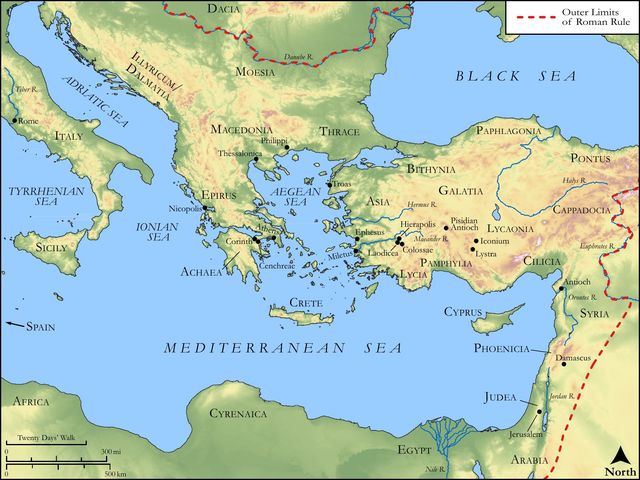
- MacedoniaThessalonica’s province, where their example and love were known3
- AchaiaThe province to the south, where word of their faith spread2
- AthensWhere Paul stayed alone when he sent Timotheus back1
- JudaeaIts churches, whose sufferings the Thessalonians came to share1
- PhilippiWhere Paul was shamefully entreated before he came1
Where 1 Thessalonians reaches
The passages it leans on, and the ones that lean on it
1 Thessalonians 2:2 Acts 16:22–24
“Shamefully entreated, as ye know, at Philippi”: the stripes, the inner prison and the stocks.
1 Thessalonians 4:9 John 6:45 Isaiah 54:13
“Taught of God”: Isaiah’s promise, which Christ quoted, seen in a church that needs no letter on brotherly love.
1 Thessalonians 4:16 1 Corinthians 15:52 John 14:3
The trump and the raised dead, told again to Corinth; and Christ’s promise, “I will come again, and receive you unto myself.”
1 Thessalonians 5:2 2 Peter 3:10 Revelation 16:15
The day of the Lord as a thief: Peter repeats the figure, and Christ says, “Behold, I come as a thief.”
1 Thessalonians 5:8 Isaiah 59:17 Ephesians 6:14–17
The breastplate and helmet the LORD puts on in Isaiah, given to his people; Ephesians fills out the armour.
Books 1 Thessalonians links to most
The Church Fathers on 1 Thessalonians
262 quotations from 46 writers before AD 800 · the ten most quoted, in date order
- Clement215
- Tertullian220
- Origen253
- Cyprian258
- Basil379
- Ambrose397
- Chrysostom407
- Jerome420
- Augustine430
- Desert Fathers500
Origen heard the three names that open the letter as one voice.
And even three made a symphony when Paul and Silvanus and Timothy gave instruction by letter to the Thessalonians.
Chrysostom, on what “now we live” shows of a teacher.
The attitude of a teacher should be such as to regard his disciples as everything. “Now we live,” Paul says, “if you stand fast in the Lord.”
Theodoret, on the travail of 5:3: certain to come, unknown in its hour.
The woman who is pregnant knows that she has a fetus in the womb but does not know when birth will occur. So it is with us as we know that the Lord will come, but we do not teach the time itself with certainty.
Tertullian read the closing prayer as the whole person kept for the resurrection.
Here you have the entire substance of man destined to salvation, and that at no other time than at the coming of the Lord, which is the key of the resurrection.
Keep studying
Articles