


New Testament · Pauline Epistles · Book 48 of 66
Galatians
Paul calls the churches of Galatia back to the gospel he received from Christ: a man is justified by faith in Christ, not by the works of the law.
- 6 chapters
- 149 verses
- About 14 minutes to read
- Letters to the Churches, c. AD 48–96
Galatians passes from its greeting straight to rebuke, without the thanksgiving for its readers that opens most of Paul’s letters. Paul marvels that they are “so soon removed from him that called you into the grace of Christ unto another gospel” (Galatians 1:6). Teachers had come among them pressing Gentile believers to be circumcised and keep the law (1:7; 6:12). Paul answers that this is not an addition to the gospel but its undoing: “if righteousness come by the law, then Christ is dead in vain” (2:21).
The letter moves in three steps. Paul shows that his gospel came by revelation, and that the apostles at Jerusalem gave him the right hands of fellowship. He argues from Scripture, beginning with Abraham, who “believed God, and it was accounted to him for righteousness” (3:6), that the promise came before the law and is received by faith. Then he shows what the liberty is for: not “an occasion to the flesh,” but a life led by the Spirit, in which love fulfils the law (5:13–14).
I am crucified with Christ: nevertheless I live; yet not I, but Christ liveth in me: and the life which I now live in the flesh I live by the faith of the Son of God, who loved me, and gave himself for me.
Galatians 2:20 KJV
Before you read
- Who wrote it
- Paul, who names himself (Galatians 1:1; 5:2) and writes with “all the brethren which are with me” (1:2). He writes “with mine own hand” (6:11).
- To whom
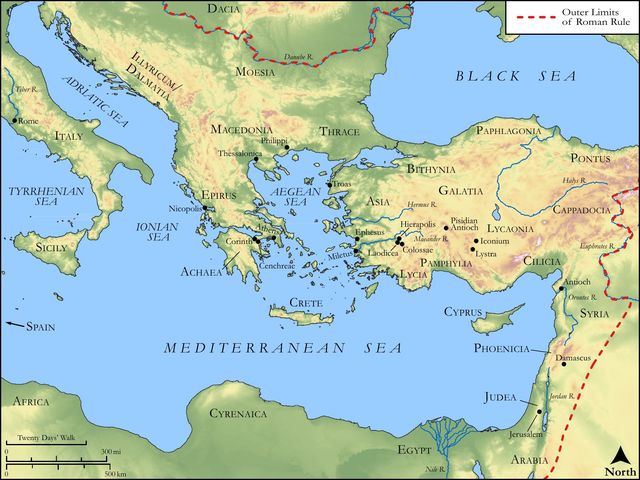
- Addressed to “the churches of Galatia” (Galatians 1:2): Gentile believers who had received Paul “as an angel of God” when he first preached to them (4:13–14), and were now being pressed to be circumcised (6:12). Which churches these were is read two ways.
Those who read Galatia as the Roman province The churches Paul and Barnabas planted on their first journey, at Antioch in Pisidia, Iconium, Lystra and Derbe, all within the province. Barnabas is named to these readers as someone they know.
Those who read Galatia as the land of the Galatian people Churches in the northern territory of the Galatians themselves, which Paul passed through on his second journey and again on his third, when Luke names “the region of Galatia” and “all the country of Galatia.”
Grounds Acts 16:6Acts 18:23Galatians 3:1
- When it was written
- After the visit to Jerusalem made “fourteen years after” (Galatians 2:1), and not long after the Galatians believed, for they are “so soon removed” (1:6). How long after depends on which churches it addresses.
Those who read the southern churches Written early, from Antioch, before or soon after the council at Jerusalem in Acts 15, whose ruling on circumcision the letter never cites.
Grounds Acts 14:26Acts 15:2
Those who read the northern churches Written later, after Paul went over “all the country of Galatia” a second time, during his stay at Ephesus.
Grounds Acts 18:23Acts 19:1
Theodoret of Cyrus Written from Rome, to churches Paul had already seen and taught.
Grounds Theodoret of Cyrus 458 · Epistle To The Galatians 6.18
How Galatians is laid out
8 movements · 24 passages · 149 verses · gold dots mark key verses
No other gospel
1:1–10 · 10 verses
Paul names himself an apostle “not of men, neither by man, but by Jesus Christ.” He marvels that they are so soon turning to another gospel, which is no gospel, and pronounces any preacher of it accursed, were it Paul himself or an angel from heaven. He seeks to please God, not men.
Received by revelation
1:11–2:10 · 24 verses
Paul’s gospel came “by the revelation of Jesus Christ,” not from men. He recounts how he persecuted the church, how God called him, his time in Arabia and Damascus, fifteen days with Peter, and his preaching in Syria and Cilicia. Fourteen years later at Jerusalem, Titus is not compelled to be circumcised, and James, Cephas and John give Paul the right hands of fellowship.
Peter withstood at Antioch
2:11–21 · 11 verses
At Antioch Peter stops eating with Gentile believers when men come from James, and Barnabas is carried away with him. Paul rebukes him before them all: Jews too are justified “by the faith of Jesus Christ,” not by the works of the law. Paul is crucified with Christ, and Christ lives in him.
Abraham believed God
3:1–14 · 14 verses
The Galatians received the Spirit by the hearing of faith, not by the works of the law. Abraham was counted righteous by believing, and the Scripture preached the gospel to him beforehand: “In thee shall all nations be blessed.” The law curses all who do not continue in it, and Christ redeems from that curse by being made a curse.
The promise before the law
3:15–4:7 · 22 verses
A law given four hundred and thirty years later cannot annul the covenant made with Abraham and his seed, “which is Christ.” The law was added because of transgressions, a schoolmaster until Christ came. In the fulness of the time God sent forth his Son, so that those under the law might receive the adoption of sons and cry, Abba, Father.
The bondwoman and the free
4:8–31 · 24 verses
Having known God, the Galatians are turning back to weak and beggarly elements, observing days and months. Paul recalls how they once received him, and travails again until Christ is formed in them. Hagar and Sarah are two covenants: Sinai, bearing children into bondage, and the Jerusalem above, which is free, “the mother of us all.”
Liberty, flesh and Spirit
Chapter 5 · 26 verses
Christ has made them free, and to seek justification by the law, beginning with circumcision, is to fall from grace. Liberty is not for the flesh but for serving one another in love, which fulfils the law. The works of the flesh are set against the fruit of the Spirit, and those who are Christ’s have crucified the flesh.
Glory only in the cross
Chapter 6 · 18 verses
The spiritual restore the fallen gently and bear one another’s burdens, so fulfilling the law of Christ. Whatever a man sows he reaps, corruption from the flesh or life everlasting from the Spirit. Writing with his own hand, Paul exposes those who “desire to make a fair shew in the flesh,” and glories only in the cross, by which the world is crucified to him.
The words Galatians turns on
Law and faith carry the argument of chapters 2–3, and promise chapters 3–4; liberty opens chapter 5, and flesh and Spirit fill the rest.
What Galatians teaches
euangélion · gospel
The truth of the gospel
Paul’s curse falls on any other gospel, even one he might preach himself (1:8), because the gospel is not his: “I neither received it of man, neither was I taught it, but by the revelation of Jesus Christ” (1:12). He would not let Titus be circumcised, “that the truth of the gospel might continue with you” (2:5), and for the same truth he rebuked Peter at Antioch (2:14). The Fathers read that rebuke two ways. Chrysostom held that Paul does not condemn Peter, but so expresses himself for the benefit of those who were to be reformed by the reproof of Peter
. Augustine answered that such a defence ends by charging the apostle Paul not only with the crime of lying but even with perjury
, since Paul had written, “before God, I lie not” (1:20).
dikaióō · justify
Justified by faith
Galatians names one way to be justified before God: “a man is not justified by the works of the law, but by the faith of Jesus Christ” (2:16). Paul proves it from Abraham, who “believed God, and it was accounted to him for righteousness” (3:6), and from Habakkuk: “The just shall live by faith” (3:11). The law cannot justify, because it requires a man to continue “in all things which are written in the book of the law to do them” (3:10). If it could, “then Christ is dead in vain” (2:21). The faith that justifies is not idle: what avails in Christ is “faith which worketh by love” (5:6).
nómos · law
The law until Christ
If the promise justifies, “Wherefore then serveth the law?” (3:19). Paul’s answer gives the law a place in time. It came four hundred and thirty years after the promise and cannot annul it (3:17). It “was added because of transgressions, till the seed should come,” and it kept those under it “shut up unto the faith which should afterwards be revealed” (3:23). The law was “our schoolmaster to bring us unto Christ” (3:24), the guardian who keeps an heir until the time appointed by his father. It is not against the promises of God (3:21). Love fulfils it (5:14), and those who bear one another’s burdens “fulfil the law of Christ” (6:2).
pneûma · Spirit
Walk in the Spirit
The Galatians received the Spirit “by the hearing of faith” (3:2), and Paul asks whether, having begun in the Spirit, they will now be made perfect by the flesh (3:3). God has sent the Spirit of his Son into the hearts of those he has adopted, “crying, Abba, Father” (4:6). The same Spirit is the answer to the flesh. Liberty from the law is not licence, for “the flesh lusteth against the Spirit, and the Spirit against the flesh” (5:17), and those who walk in the Spirit do not fulfil its lust (5:16). The fruit of the Spirit is one fruit in nine parts, beginning with love, and “against such there is no law” (5:23). Whoever sows to the Spirit reaps life everlasting (6:8).
Christ in Galatians
Galatians sets the cross at the centre of its argument. Christ “gave himself for our sins, that he might deliver us from this present evil world” (Galatians 1:4), and Paul can say, “I am crucified with Christ” (2:20). The law called the man hanged on a tree “accursed of God” (Deuteronomy 21:23), and “Christ hath redeemed us from the curse of the law, being made a curse for us” (3:13). Tertullian put it plainly: The Lord Himself was ‘cursed’ in the eye of the law; and yet is He the only Blessed One.
Paul also reads the promises to Abraham as spoken of Christ. God said “to thy seed,” not to seeds, and that seed is Christ (3:16), so all who are Christ’s are “Abraham’s seed, and heirs according to the promise” (3:29). And he came at the time God set: “God sent forth his Son, made of a woman, made under the law, To redeem them that were under the law” (4:4–5).
- Abraham to whom the promises were made
- Isaac born by promise
- … Matthew 1:2–16
- thy seed, which is Christ
People
By how many verses name them
- Paul2
- AbrahamSon of Terah; a brother of Nahor, Haran and Sarah9
- PeterSon of Jona (Matthew 16:17); a brother of Andrew6
- BarnabasA Levite of Cyprus (Acts 4:36); Mark was his sister's son (Colossians 4:10)3
- JamesThe Lord's brother (Galatians 1:19)3
- AgarConcubine of Abraham; mother of Ishmael2
- Titus2
- IsaacA son of Abraham and Sarah1
1 more are named.
Places
9 named
- JerusalemWhere Paul met the apostles; two Jerusalems in the allegory5
- ArabiaWhere Paul went after his call, and where Sinai stands2
- SinaiThe mount of the law, Hagar in Paul’s allegory2
- AntiochWhere Paul withstood Peter to the face1
- CiliciaWith Syria, where Paul preached after his first Jerusalem visit1
- DamascusThe city Paul returned to from Arabia1
- GalatiaThe region whose churches the letter is sent to1
- JudaeaIts churches knew Paul only by report1
Where Galatians reaches
The passages it leans on, and the ones that lean on it
Genesis 15:6 Galatians 3:6 Romans 4:3
Abraham believed, and it was counted to him for righteousness: the verse both letters build on.
Habakkuk 2:4 Galatians 3:11 Romans 1:17
“The just shall live by faith,” quoted by Paul in both letters.
Deuteronomy 21:23 Galatians 3:13 2 Corinthians 5:21
The hanged man accursed of God, and Christ made a curse and made sin for us.
Sarah’s demand at Isaac’s weaning, which Paul cites as what the scripture says.
Leviticus 19:18 Galatians 5:14 Romans 13:8
Love of neighbour, in which the whole law is fulfilled.
Books Galatians links to most
The Church Fathers on Galatians
879 quotations from 45 writers before AD 800 · the ten most quoted, in date order
- Clement215
- Tertullian220
- Cyprian258
- Gaius Marius Victorinus370
- Ambrosiaster384
- Chrysostom407
- Jerome420
- Augustine430
- Theodoret458
- John Damascene749
Tertullian, on why Paul puts himself first under the curse of 1:8.
His meaning, however, is clear, for he has mentioned himself first (in the anathema): ‘But though we or an angel from heaven preach any other gospel.’ It is by way of an example that he has expressed himself.
Jerome, on the many who handed Christ over, and the one who gave himself.
Judas and the priests, with the princes, handed him over, and Pilate, to whom he was finally handed over, handed him over again. But the Father handed him over that he might save the abandoned world. Jesus gave himself, that he might do the Father’s will. But Judas and the priests and elders of the people and Pilate unwittingly handed over their lives to death.
Leo the Great read 4:4 as a witness to Christ’s two natures.
He is God in that ‘all things were made through him and nothing was made without him.’ He is human in that he was ‘made from a woman, made under the law.’ The nativity of his flesh shows his human nature. The virgin birth is an indicator of his divine nature.
Macarius, among the Desert Fathers, on restoring another “in the spirit of meekness.”
Macarius said also, ‘If you are stirred to anger when you want to reprove someone, you are gratifying your own passions. Do not lose yourself in order to save another.’
Keep studying
Articles