


Galatians 6:11
Bible text: King James Version (1769 Blayney text) · Public domain
Bible text: Berean Standard Bible · Public domain
Bible text: American Standard Version (1901) · Public domain
Bible text: World English Bible, Messianic edition · Public domain
Bible text: Geneva Bible (1599) · Public domain
Bible text: Young's Literal Translation · Public domain
- ἼδετεIdetedo seeG1492V-2AAM-2PVerb 2nd Aorist Active Imperative 2nd Plural
- πηλίκοιςpēlikoisin how largeG4080A-DPNAdjective Dative Plural Neuter
- ὑμῖνhuminto youG4771P-2DPPersonal pronoun Dative 2nd Plural
- γράμμασινgrammasinlettersG1121N-DPNNoun Dative Plural Neuter
- ἔγραψαegrapsaI have writtenG1125V-2AAI-1SVerb 2nd Aorist Active Indicative 1st Singular
- τῇtēa<the>G3588T-DSFDefinite article Dative Singular Feminine
- ἐμῇemēawith my ownG1473S-1SDSFPossessive pronoun Dative 1st Person Singular Feminine
- χειρίcheirihandG5495N-DSFNoun Dative Singular Feminine
English is a literal word-by-word gloss of the Greek, not the KJV's wording. Why?
This is the original text the KJV's translators worked from — each Greek word with its own literal English meaning in this verse, prepared by scholars at Tyndale House, Cambridge. The KJV translates whole sentences, not word by word, so its wording differs: one Greek word can become several English words, and the KJV may choose “charity” where the gloss reads “love”. Both are faithful — they answer different questions. For the KJV's own rendering, switch to the KJV text.
Details
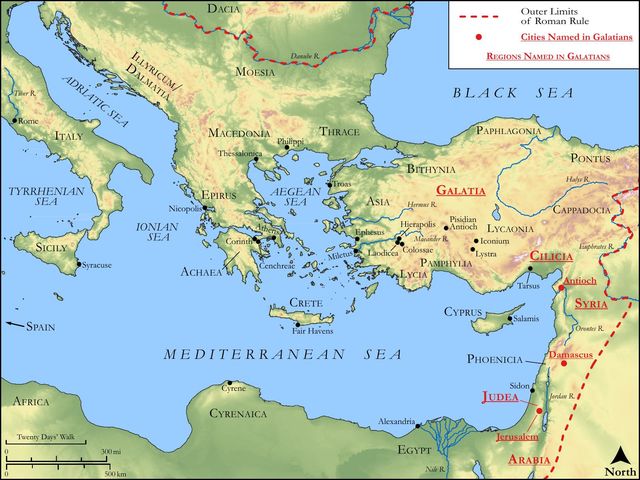
See on the biblical-era maps

Study this verse
Public-domain commentary
Matthew Henry
From his Commentary on the Whole Bible. Henry comments on passages, not single verses — this entry covers Galatians 6:11–18. His three-level outline is real structure in the source text, so it is rendered as structure.
The apostle, having at large established the doctrine of the gospel, and endeavoured to persuade these Christians to a behaviour agreeable to it, seems as if he intended here to have put an end to the epistle, especially when he had acquainted them that, as a particular mark of his respect for them, he had written this large letter with his own hand, and had not made use of another as his amanuensis, and only subscribed his name to it, as he was wont to do in his other epistles: but such is his affection to them such his concern to recover them from the bad impressions made upon them by their false teachers, that he cannot break off till he has once again given them the true character of those teachers, and an account of his own contrary temper and behaviour, that by comparing these together they might the more easily see how little reason they had to depart from the doctrine he had taught them and to comply with theirs.
I.He gives them the true character of those teachers who were industrious to seduce them, in several particulars. As,
1.They were men who desired to make a fair show in the flesh, Gal 6:12. They were very zealous for the externals of religion, forward to observe, and to oblige others to observe, the rites of the ceremonial law, though at the same time they had little or no regard to real piety; for, as the apostle says of them in the following verse, neither do they themselves keep the law. Proud, vain, and carnal hearts desire nothing more than to make a fair show in the flesh, and they can easily be content with so much religion as will help them to keep up such a fair show; but frequently those have least of the substance of religion who are most solicitous to make a show of it.
2.They were men who were afraid of suffering, for they constrained the Gentile Christians to be circumcised, only lest they should suffer persecution for the cross of Christ. It was not so much out of a regard to the law as to themselves; they were willing to sleep in a whole skin, and to save their worldly cargo, and cared not though they made shipwreck of faith and a good conscience. That which they chiefly aimed at was to please the Jews, and to keep up their reputation among them, and so to prevent the trouble that Paul, and other faithful professors of the doctrine of Christ, lay open to. And,
3.Another part of their character was that they were men of a party spirit, and who had no further zeal for the law than as it subserved their carnal and selfish designs; for they desired to have these Christians circumcised, that they might glory in their flesh (Gal 6:13), that they might say they had gained them over to their side, and made proselytes of them, of which they carried the mark in their flesh. And thus, while they pretended to promote religion, they were the greatest enemies of it; for nothing has been more destructive to the interest of religion than men-siding and party-making.
II.He acquaints us, on the other hand, with his own temper and behaviour, or makes profession of his own faith, hope, and joy; particularly,
1.That his principle glory was in the cross of Christ: God forbid, says he, that I should glory, save in the cross of our Lord Jesus Christ, Gal 6:14. By the cross of Christ is here meant his sufferings and death on the cross, or the doctrine of salvation by a crucified Redeemer. This was what the Jews stumbled at and the Greeks accounted foolishness; and the judaizing teachers themselves, though they had embraced Christianity, yet were so far ashamed of it that in compliance with the Jews, and to avoid persecution from them, they were for mixing the observance of the law of Moses with faith in Christ, as necessary to salvation. But Paul had a very different opinion of it; he was so far from being offended at the cross of Christ, or ashamed of it, or afraid to own it, that he gloried in it; yea, he desired to glory in nothing else, and rejected the thought of setting up anything in competition with it, as the object of his esteem, with the utmost abhorrence; God forbid, etc. This was the ground of all his hope as a Christian: this was the doctrine which, as an apostle, he was resolved to preach; and, whatever trials his firm adherence to it might bring upon him, he was ready, not only to submit to them, but to rejoice in them. Note, The cross of Christ is a good Christian's chief glory, and there is the greatest reason why we should glory in it, for to it we owe all our joys and hopes.
2.That he was dead to the world. By Christ, or by the cross of Christ, the world was crucified to him, and he to the world; he had experienced the power and virtue of it in weaning him from the world, and this was one great reason of his glorying in it. The false teachers were men of a worldly temper, their chief concern was about their secular interests, and therefore they accommodated their religion thereunto. But Paul was a man of another spirit; as the world had no kindness for him, so neither had he any great regard to it; he had got above both the smiles and the frowns of it, and had become as indifferent to it as one who is dying out of it. This is a temper of mind that all Christians should be labouring after; and the best way to attain it is to converse much with the cross of Christ. The higher esteem we have of him the meaner opinion shall we have of the world, and the more we contemplate the sufferings our dear Redeemer met with from the world the less likely shall we be to be in love with it.
3.That he did not lay the stress of his religion on one side or the other of the contesting interests, but on sound Christianity, Gal 6:15. There was at that time an unhappy division among Christians; circumcision and uncircumcision had become names by which they were distinguished from each other; for (Gal 2:9, Gal 2:12) the Jewish Christians are called the circumcision, and those of the circumcision. The false teachers were very zealous for circumcision; yea, to such a degree as to represent it as necessary to salvation, and therefore they did all they could to constrain the Gentile Christians to submit to it. In this they had carried the matter much further than others did; for, though the apostles connived at the use of it among the Jewish converts, yet they were by no means for imposing it upon the Gentiles. But what they laid so great a stress upon Paul made very little account of. It was indeed of great importance to the interest of Christianity that circumcision should not be imposed on the Gentile converts, and therefore this he had set himself with the utmost vigour to oppose; but as for mere circumcision or uncircumcision, whether those who embraced the Christian religion had been Jews or Gentiles, and whether they were for or against continuing the use of circumcision, so that they did not place their religion in it - this was comparatively a matter of little moment with him; for he very well knew that in Jesus Christ, that is, in his account, or under the Christian dispensation, neither circumcision availed any thing nor uncircumcision, as to men's acceptance with God, but a new creature. Here he instructs us both wherein real religion does not and wherein it does consist. It does not consist in circumcision or uncircumcision, in our being in this or the other denomination of Christians; but it consists in our being new creatures; not in having a new name, or putting on a new face, but in our being renewed in the spirit of our minds and having Christ formed in us: this is of the greatest account with God, and so it was with the apostle. If we compare this text with some others, we may more fully see what it is that renders us most acceptable to God, and about which we should therefore be chiefly concerned. Here we are told that it is a new creature, and in Gal 5:6 that it is faith which worketh by love, and in Co1 7:19 that it is the keeping of the commandments of God, from all which it appears that it is a change of mind and heart, whereby we are disposed and enabled to believe in the Lord Jesus and to live a life of devotedness to God; and that where this inward, vital, practical religion is wanting, no outward professions, nor particular names, will ever stand us in any stead, or be sufficient to recommend us to him. Were Christians duly concerned to experience this in themselves, and to promote it in others, if it did not make them lay aside their distinguishing names, yet it would at least take them off from laying so great a stress upon them as they too often do. Note, Christians should take care to lay the stress of their religion where God has laid it, namely, on those things which are available to our acceptance with him; so we see the apostle did, and it is our wisdom and interest herein to follow his example. The apostle having shown what was of chief consideration in religion, and what he laid the greatest stress upon, namely, not a mere empty name or profession, but a sound and saving change, in Gal 6:16 he pronounces a blessing upon all those who walk according to this rule: And as many as walk according to this rule peace be upon them, and mercy upon the Israel of God. The rule which he here speaks of may signify more generally the whole word of God, which is the complete and perfect rule of faith and life, or that doctrine of the gospel, or way of justification and salvation, which he had laid down in this epistle, namely, by faith in Christ without the works of the law; or it may be considered as more immediately referring to the new creature, of which he had just before been speaking. The blessings which he desires for those who walk according to this rule, or which he gives them the hope and prospect of (for the words may be taken either as a prayer or a promise), are peace and mercy - peace with God and conscience, and all the comforts of this life as far as they are needful for them, and mercy, or an interest in the free love and favour of God in Christ, which are the spring and fountain of all other blessings. A foundation is laid for these in that gracious change which is wrought in them; and while they behave themselves as new creatures, and govern their lives and hopes by the rule of the gospel, they may most assuredly depend upon them. These, he declares, shall be the portion of all the Israel of God, by whom he means all sincere Christians, whether Jews or Gentiles, all who are Israelites indeed, who, though they may not be the natural, yet are become the spiritual seed of Abraham; these, being heirs of his faith, are also heirs together with him of the same promise, and consequently entitled to the peace and mercy here spoken of. The Jews and judaizing teachers were for confining these blessings to such as were circumcised and kept the law of Moses; but, on the contrary, the apostle declares that they belong to all who walk according to the rule of the gospel, or of the new creature, even to all the Israel of God, intimating that those only are the true Israel of God who walk according to this rule, and not that of circumcision, which they insisted so much upon, and therefore that this was the true way to obtain peace and mercy. Note,
(1.)Real Christians are such as walk by rule; not a rule of their own devising, but that which God himself has prescribed to them.
(2.)Even those who walk according to this rule do yet stand in need of the mercy of God. But,
(3.)All who sincerely endeavour to walk according to this rule may be assured that peace and mercy will be upon them: this is the best way to have peace with God, ourselves, and others; and hereupon, as we may be sure of the favour of God now, so we may be sure that we shall find mercy with him hereafter.
4.That he had cheerfully suffered persecution for the sake of Christ and Christianity, Gal 6:17. As the cross of Christ, or the doctrine of salvation by a crucified Redeemer, was what he chiefly gloried in, so he had been willing to run all hazards rather than he would betray this truth, or suffer it to be corrupted. The false teachers were afraid of persecution, and this was the great reason why they were zealous for circumcision, as we see, Gal 6:12. But this was the least of Paul's concern; he was not moved at any of the afflictions he met with, nor did he count his life dear to him, so that he might finish his course with joy, and the ministry which he had received of the Lord Jesus, to testify the gospel of the grace of God, Act 20:24. He had already suffered much in the cause of Christ, for he bore in his body the marks of the Lord Jesus, the scars of those wounds which he had sustained from persecuting enemies, for his steady adherence to him, and that doctrine of the gospel which he had received from him. As from this it appeared that he was firmly persuaded of the truth and importance of it, and that he was far from being a favourer of circumcision, as they had falsely reported him to be, so hereupon, with a becoming warmth and vehemence, suitable to his authority as an apostle and to the deep concern of mind he was under, he insists upon it that no man should henceforth trouble him, namely by opposing his doctrine or authority, or by any such calumnies and reproaches as had been cast upon him; for as, both from what he had said and what he had suffered, they appeared to be highly unjust and injurious, so also those were very unreasonable who either raised or received them. Note, (1.) It may justly be presumed that men are fully persuaded of those truths in the defence of which they are willing to suffer. And (2.) It is very unjust to charge those things upon others which are contrary not only to their profession, but their sufferings too.
III.The apostle, having now finished what he intended to write for the conviction and recovery of the churches of Galatia, concludes the epistle with his apostolical benediction, Gal 6:18. He calls them his brethren, wherein he shows his great humility, and the tender affection he had for them, notwithstanding the ill treatment he had met with from them; and takes his leave of them with this very serious and affectionate prayer, that the grace of our Lord Jesus Christ may be with their spirit. This was a usual farewell wish of the apostle's, as we see, Rom 16:20, Rom 16:24, and Co1 16:23. And herein he prays that they might enjoy the favour of Christ, both in its special effects and its sensible evidences, that they might receive from him all that grace which was needful to guide them in their way, to strengthen them in their work, to establish them in their Christian course, and to encourage and comfort them under all the trials of life and the prospect of death itself. This is fitly called the grace of our Lord Jesus Christ, as he is both the sole purchaser and the appointed dispenser of it; and though these churches had done enough to forfeit it, by suffering themselves to be drawn into an opinion and practice highly dishonourable to Christ, as well as dangerous to them, yet, out of his great concern for them, and knowing of what importance it was to them, he earnestly desires it on their behalf; yea, that it might be with their spirit, that they might continually experience the influences of it upon their souls, disposing and enabling them to act with sincerity and uprightness in religion. We need desire no more to make us happy than the grace of our Lord Jesus Christ. This the apostle begs for these Christians, and therein shows us what we are chiefly concerned to obtain; and, both for their and our encouragement to hope for it, he adds his Amen.
Historical interpretation
Historical reception
3 surviving comments on this verse. Each one is dated, so this reads as a timeline rather than a list.
Select a marker to jump to its quote. Markers stagger vertically where authors wrote within a few decades of each other.
"See with how large letters I have written unto you with mine own hand. As many as desire to make a fair show in the flesh, they compel you to be circumcised."
Observe what grief posesses his blessed soul. As those who are oppressed with some sorrow, who have lost one of their own kindred, and suffered an unexpected calamity, rest neither by night nor day, because their grief besieges their soul, so the blessed Paul, after a short moral discourse, returns again to that former subject which chiefly disturbed his mind, saying as follows: "see with how large letters I have written unto you with mine own hand." By this he signifies that he had written the whole letter himself, which was a proof of great sincerity. In his other Epistles he himself only dictated, another wrote, as is plain from the Epistle to the Romans, for at its close it is said, "I Tertius, who write the Epistle, salute you;" (Rom. xvi: 22.) but in this instance he wrote the whole himself. And this he did by necessity, not from affection merely, but in order to remove an injurious suspicion. Being charged with acts wherein he had no part, and being reported to preach Circumcision yet to pretend to preach it not, he was compelled to write the Epistle with his own hand, thus laying up beforehand a written testimony. By the expression "what sized," he appears to me to signify, not the magnitude, but, the misshapen appearance of the letters, as if he had said, "Although not well skilled in writing, I have been compelled to write with my own hand to stop the mouth of these traducers."
Those who wanted the Galatians to be circumcised had put it about that Paul preached one way and acted another, destroying his words by his own deeds, since he who proclaimed the abolition of the law was found to be obeying the law. Because Paul could not refute their opinions in person in the sight of all (being prevented by the chains that he bore as a testimony to Christ), he acts as his own lawyer through his letter. So that no suspicion that the letter was false might arise, he himself has written it from this point right to the end, showing that the preceding part was copied by another’s hand. … It is not that the letters were larger (though indeed the word would bear this sense in Greek) but because the marks of his own handwriting were known to them. So when they recognized the angles and contours of his own letters, they would feel that they had encountered him.… Paul wrote his letter in great characters because the meaning of the characters was great and had been traced out by the Spirit of God, not merely by pen and ink.
(Verse 11) See with what letters I have written to you with my own hand. Those who wanted the Galatians to be circumcised had spread the rumor that Paul was doing one thing and preaching something else, and by his own actions, he was destroying the message. They claimed that anyone who asserted that the Law was abolished would themselves be found to be within the Law. Paul was unable to personally refute this belief with everyone present because he was restrained by the chains he bore for the sake of Christ's martyrdom. Therefore, he represents himself through letters. And so that no suspicion of forged letters should arise, he himself wrote by his own hand from this place to the end, showing that the previous [letters] were written by someone else. And he also demonstrates that letters were sent in his name by false teachers, writing to the Thessalonians: But we ask you, brothers, through the coming of our Lord Jesus Christ and our gathering together with him, not to be quickly shaken from your senses, nor be alarmed, either by spirit, or by word, or by letter supposedly from us, as if the day of the Lord is imminent, so that no one deceives you in any way (2 Thessalonians 2, 1 seqq.). And in order to dispel any suspicion of falsehood about the entire letter that he was sending, he subscribed with his own hand at the end, saying: My greeting in the hand of Paul, which is the sign in every letter; this is how I write. The grace of our Lord Jesus Christ be with all of you (2 Thess. 3:17-18). He also marked with his own hand the letters he dictated to the Colossians, saying: My greeting in the hand of Paul; remember my chains. And wherever he knew that false teachers were present, who could spread new doctrines through the authority of the Apostles, he subscribed the letter with his own hand. Finally, writing to the Corinthians, among whom there were schisms and heresies, with each one saying, 'I am of Paul,' and 'I am of Apollos,' and 'I am of Cephas' (I Cor. 1:12), he signed his letter with this annotation: My greeting [is] in the hand of Paul: If anyone does not love the Lord Jesus Christ, let him be anathema. Maranatha, and so on. Therefore, desiring to remove any occasion for false teachers who had corrupted the Galatians from the truth of the Gospel, he completed the end of the letter with the annotation of his hand, saying: See with what letters I have written to you; not that the letters were large (for this indeed signifies 'great' in Greek), but that his hand was known to them by distinct traces, so that while they recognize the tops of the letters, they might suppose that they were seeing the very person who had written [the letter]. In this place, a man most learned in our times, I wonder how he spoke such a ridiculous thing. Paul, he says, was a Hebrew and did not know Greek letters. And because necessity demanded it, that he himself would subscribe the letter by his own hand, contrary to the usual curving paths of the letters, he barely expressed with large points: also showing in this his signs of love towards the Galatians, that for their sake he would even attempt that which he could not. Paul, the great writer, wrote a letter, because there was great meaning in his words, and it was written with the Holy Spirit, not with ink or pen. But what he added, with my hand, let us understand in his works. For this reason, it is often written in the prophets: The word of God that was made in the hand of Jeremiah, or Haggai, so that we also know through this similarity that the word of God was made in the hand of Paul. Paul writes great letters not only to the Galatians back then, but also to everyone today, and although the tips with which his letters are written are small, the letters themselves are great, because there is great meaning in them.
Continue studying Galatians 6:11 across the web’s major study libraries — every link below opens this exact verse, chapter, or book on the destination site.
Read & Compare
 BibleGatewayThis verse in more than 200 translations and 70 languages.
 Bible.comThe YouVersion reader — hundreds of translations, reading plans, and highlights.
 ESV.orgCrossway's official English Standard Version reader.
 NET BibleThe NET translation with 60,000+ translators' notes on every rendering decision.
 STEP BibleTyndale House's free study tool — original text, vocabulary, and scholarly resources.
 BibliaLogos Bible Software's free web reader.
 USCCBThe New American Bible (Revised Edition) with the U.S. bishops' study notes.
Commentaries
 BibleHub CommentariesDozens of classic commentaries on this verse, gathered on one page.
 StudyLightMore than 100 commentary sets — the largest collection on the web.
 BibleRefPlain-English commentary on what this verse means, verse by verse.
 Enduring WordDavid Guzik's free commentary on this chapter, widely used by Bible teachers.
 Bible Study ToolsVerse commentary alongside Greek and Hebrew study aids.
Original Language & Research
- BibleHub InterlinearThe verse word by word — original language, transliteration, and English.
- BibleHub LexiconEvery word's original-language definition and Strong's entry.
 Blue Letter BibleDeep-study tools — Strong's numbers, concordance, and word studies.
 CNTR CollationThe earliest Greek manuscripts of this verse, collated letter by letter.
Sermons, Hymns & Audio


TrulyRandomVerse is not affiliated with these sites and doesn’t control their content. They’re linked because they’re genuinely useful.
Summary
Galatians 6:11 marks a significant and emphatic conclusion to Paul's passionate defense of the gospel of grace, where he personally takes up the pen to write the final admonitions and benediction. This deliberate act of writing "with mine own hand" underscores the profound importance and authenticity of his message, serving as a powerful personal endorsement of the foundational truths concerning justification by faith alone, in stark contrast to the legalistic demands of the Judaizers. It conveys a sense of urgency and deep personal investment, ensuring the Galatian believers fully grasp the gravity and sincerity of his final appeal.
Context
ShowHideLiterary Context
This verse serves as a crucial transition point in the epistle, immediately following Paul's practical exhortations regarding bearing one another's burdens and sowing to the Spirit in Galatians 6:1-10. It signals a shift from practical application of gospel freedom to a final, personal, and forceful summary of his core arguments against legalism. Paul then proceeds to deliver his final warnings against those who promote circumcision and his ultimate benediction, making this personal signature a powerful seal on his entire polemic. The unusual act of taking the pen himself highlights the gravity of the preceding theological arguments and the urgent need for the Galatians to stand firm in the liberty of Christ.
Historical & Cultural Context
In that day, it was common practice for authors to dictate letters to an amanuensis (scribe), who would then write the epistle. The author might then add a personal greeting or signature at the end to authenticate the letter. Paul frequently employed amanuenses (e.g., Tertius in Romans 16:22). His decision to personally write the closing section of Galatians, indicated by "with mine own hand," was therefore a highly significant and deliberate act. It served to emphasize the authenticity of the message, counter any potential accusations that the letter was not truly from him, and underscore his deep personal conviction and apostolic authority in the face of the Judaizers' false teachings. This personal touch would have resonated powerfully with the original recipients, conveying a level of earnestness beyond mere dictation.
Key Themes
ShowHideGalatians 6:11 contributes significantly to several key themes woven throughout the epistle. Firstly, it reinforces the theme of Apostolic Authority and Authenticity. Paul's personal handwriting authenticates his message and reasserts his divinely given authority in the face of those who challenged it. Secondly, it underscores the Urgency and Gravity of the Gospel Message. The "large letters" (as commonly interpreted) and the personal effort convey the paramount importance of the message of justification by faith alone, which Paul has passionately defended from the very beginning of the letter (Galatians 1:6-9). Finally, it highlights Paul's Personal Investment and Pastoral Concern for the Galatian churches, demonstrating his deep love and desire for them to remain steadfast in the freedom found in Christ, rather than returning to the bondage of the Law (Galatians 5:1).
Exposition and Analysis
ShowHideKey Word Analysis
ShowHideThis primary verb (G1492) means "to see" literally or figuratively, and by implication, "to know" or "perceive." In this context, it is an imperative, "Ye see!" (or "Look!"), drawing the readers' immediate and direct attention to what follows. Paul is not merely informing them but commanding them to observe, implying that the physical act of his handwriting is a visible testament to the importance of his concluding words.
This quantitative form (G4080) means "how much" or "how great," referring to size or dignity. In the context of writing, it most likely refers to the physical size of the letters Paul penned. The phrase "how large a letter" (πηλίκοις γράμμασιν) is often interpreted as Paul writing in unusually large, perhaps bold or uneven, characters. This could be due to a physical ailment (like poor eyesight, though not explicitly stated) but is more commonly understood as a deliberate rhetorical device to emphasize the gravity and personal weight of his final message, making it stand out visually.
Derived from the verb "to write" (G1125, gráphō), this noun (G1121) refers to a writing, a letter, or a document. Here, it refers to the physical characters or letters that comprise the final portion of his epistle. The plural form (grammasin) reinforces the idea of the physical script itself, emphasizing the visual impact of his handwriting.
This noun (G5495) refers to the physical hand, but often carries figurative meaning, especially in a Hebraic sense, denoting power, agency, or means. When Paul states he wrote "with mine own hand," it signifies his personal agency and direct involvement, lending an undeniable authenticity and authority to the words. It is a tangible sign of his personal investment and a counter to any potential skepticism about the letter's true authorship or intent.
Verse Breakdown
ShowHide"Ye see"
Paul immediately commands the attention of his readers, urging them to observe something significant. This direct address creates an intimate and urgent tone, signaling that what follows is of utmost importance and requires their careful consideration. It is an invitation to witness a personal act that carries profound meaning.
"how large a letter"
This phrase refers to the physical characteristics of Paul's handwriting. The prevailing interpretation is that Paul wrote in unusually large, perhaps bold or even clumsy, characters. This was likely a deliberate choice to add emphasis and visual impact to his concluding remarks, ensuring that his final, crucial points regarding the gospel's purity and freedom from legalism were undeniable and clearly legible.
"I have written unto you with mine own hand"
This is the core declaration of the verse. Paul explicitly states that he, himself, has taken up the pen to write this portion of the letter, rather than dictating it to a scribe. This personal act served multiple purposes: it authenticated the letter as genuinely from him, underscored the deep personal conviction behind his message, and conveyed his profound pastoral concern for the Galatian believers, leaving no doubt about the sincerity and gravity of his final warnings and blessings.
Literary Devices
ShowHideGalatians 6:11 employs several powerful literary devices. The most prominent is Emphasis and Personalization. By explicitly stating that he wrote with his "own hand," Paul draws direct attention to his personal involvement, lending an undeniable weight and authenticity to his concluding statements. This act serves as a Rhetorical Device, compelling the readers to pay close attention to the final section of the letter, which contains crucial warnings against the Judaizers and a summary of the true gospel. The phrase "how large a letter" can be seen as a form of Hyperbole or a visual Symbolism. If interpreted as physically large letters, it visually symbolizes the magnitude and importance of the message. If interpreted as the overall length or gravity of the content, it underscores the profound theological weight of the epistle. Regardless, the entire verse functions as a powerful Signature and Seal, validating the preceding arguments and reinforcing Paul's apostolic authority in a deeply personal and memorable way.
Theological and Thematic Connections
ShowHidePaul's personal signature in Galatians 6:11 is more than a mere authentication; it is a theological statement. It underscores the profound personal investment of God's chosen messenger in the purity and integrity of the gospel. The truth of justification by faith, so vehemently defended throughout Galatians, was not a detached theological concept for Paul but a life-altering reality for which he was willing to suffer and exert personal effort. This act highlights the divine inspiration of Scripture, as even the human elements—like Paul's own hand—are providentially guided to convey God's authoritative and deeply personal message. It reminds us that the transmission of divine truth, while authoritative, is often mediated through the passionate and personal commitment of God's servants, who, like Paul, bear the "marks of Jesus" (Galatians 6:17) in their ministry.
Reflection and Application
ShowHidePaul's deliberate act of taking the pen in Galatians 6:11 offers profound lessons for contemporary believers. It calls us to consider the authenticity and personal investment we bring to our faith and our communication of spiritual truths. In an age saturated with information, the genuine, heartfelt, and personally affirmed message stands out. This verse challenges us to not merely parrot doctrines but to own them, to embody the truths we proclaim with conviction and passion, just as Paul did. It reminds us that the gospel is not an abstract theory but a living, transformative reality that demands our full commitment and personal engagement. Furthermore, it highlights the importance of clarity and emphasis when conveying vital spiritual matters, ensuring that the core message of grace and freedom in Christ is never obscured or diluted.
Questions for Reflection
ShowHideFAQ
ShowHideWhy did Paul write this portion of the letter himself, rather than using a scribe?
ShowHidePaul's decision to write Galatians 6:11 "with mine own hand" was a deliberate and significant act. In that day, it was common practice to dictate letters to an amanuensis (scribe). Paul likely did this for most of his letters due to the sheer volume of his correspondence and perhaps a physical ailment (though this is speculative). However, by personally writing the conclusion of Galatians, Paul achieved several crucial objectives. Firstly, it served as an authentication of the letter, confirming that it was genuinely from him and countering any potential claims by his opponents that it was a forgery or misrepresented his views. Secondly, it added immense emphasis and gravity to his final warnings against the Judaizers and his summary of the gospel of grace. It was a personal seal of approval, underscoring his deep conviction and the vital importance of the message. Finally, it conveyed his profound pastoral concern and personal investment in the Galatian churches, demonstrating his love and desire for them to stand firm in the truth of Christ.
What does "how large a letter" mean in this verse?
ShowHideThe Greek phrase "pēlikois grammasin" (πηλίκοις γράμμασιν) literally translates to "with what large letters." There are two main interpretations. The first, and most widely accepted, is that Paul was referring to the physical size of his handwriting. He may have intentionally written the concluding verses in large, bold, or perhaps even clumsy characters to make them stand out visually and emphasize their importance. This could have been due to a physical condition, such as poor eyesight (a common speculation, though not explicitly stated elsewhere in his letters), but it is more likely a deliberate rhetorical choice to add weight and urgency to his final message. The second, less common, interpretation suggests it refers to the magnitude or importance of the content of the letter itself, or even its overall length. However, given Paul's specific mention of "mine own hand," the physical act of writing seems to be the primary focus, making the "large letters" a visual sign of emphasis.
Christ-Centered Fulfillment
ShowHideGalatians 6:11, with Paul's personal emphasis on the gospel, ultimately points to Christ as the ultimate and most personal "letter" from God to humanity. Just as Paul took up the pen to authenticate and underscore the vital message of salvation by grace through faith, God Himself has personally intervened in human history through His Son. Hebrews 1:1-2 declares that "God, who at sundry times and in divers manners spake in time past unto the fathers by the prophets, hath in these last days spoken unto us by his Son." Christ is the living Word, the full and final revelation of God's heart and plan, written not with ink but in flesh, dwelling among us (John 1:14). Paul's passionate defense of the gospel in Galatians is a defense of the person and work of Christ, who perfectly fulfilled the Law and offers true freedom and new creation to all who believe (Galatians 3:13; Galatians 6:15). Thus, Paul's personal handwriting foreshadows the intensely personal nature of God's redemptive act in Christ, the ultimate divine signature on the covenant of grace.