


Galatians 6:12
Bible text: King James Version (1769 Blayney text) · Public domain
Bible text: King James Version with Strong's numbers · Public domain
Bible text: Berean Standard Bible · Public domain
Bible text: American Standard Version (1901) · Public domain
Bible text: World English Bible, Messianic edition · Public domain
Bible text: Geneva Bible (1599) · Public domain
Bible text: Young's Literal Translation · Public domain
- ὅσοιhosoiAs many asG3745K-NPMCorrelative pronoun Nominative Plural Masculine
- θέλουσινthelousinwishG2309V-PAI-3PVerb Present Active Indicative 3rd Plural
- εὐπροσωπῆσαιeuprosōpēsaito have a fair appearanceG2146V-AANVerb Aorist Active Infinitive
- ἐνeninG1722PREPPreposition
- σαρκίsarki[the] fleshG4561N-DSFNoun Dative Singular Feminine
- οὗτοιhoutoitheseG3778D-NPMDemonstrative pronoun Nominative Plural Masculine
- ἀναγκάζουσινanagkazousincompelG315V-PAI-3PVerb Present Active Indicative 3rd Plural
- ὑμᾶςhumasyouG4771P-2APPersonal pronoun Accusative 2nd Plural
- περιτέμνεσθαιperitemnesthaito be circumcisedG4059V-PPNVerb Present Passive Infinitive
- μόνονmonononlyG3441A-ASNAdjective Accusative Singular Neuter
- ἵναinathatG2443CONJConjunction
- τῷtōfor theG3588T-DSMDefinite article Dative Singular Masculine
- σταυρῷstaurōcrossG4716N-DSMNoun Dative Singular Masculine
- τοῦtou<the>G3588T-GSMDefinite article Genitive Singular Masculine
- ΧριστοῦChristouof ChristG5547N-GSM-TNoun Genitive Singular Masculine Title
- μὴmēnotG3361PRT-NNegative Particle Negative
- διώκωνται·diōkōntaithey may be persecutedG1377V-PPS-3PVerb Present Passive Subjunctive 3rd Plural
English is a literal word-by-word gloss of the Greek, not the KJV's wording. Why?
This is the original text the KJV's translators worked from — each Greek word with its own literal English meaning in this verse, prepared by scholars at Tyndale House, Cambridge. The KJV translates whole sentences, not word by word, so its wording differs: one Greek word can become several English words, and the KJV may choose “charity” where the gloss reads “love”. Both are faithful — they answer different questions. For the KJV's own rendering, switch to the KJV text.
Details
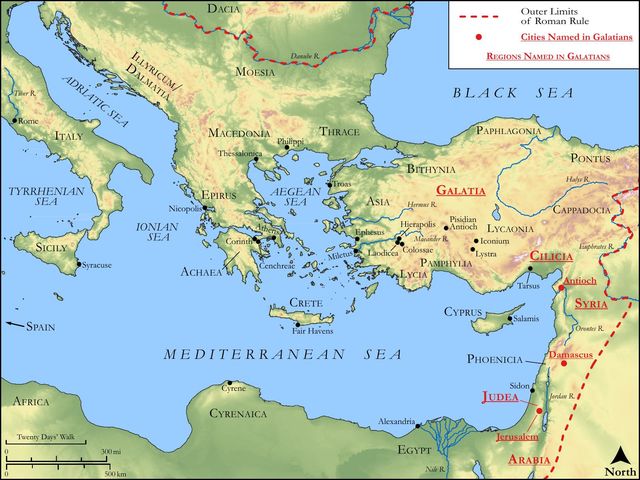
See on the biblical-era maps

Study this verse
Public-domain commentary
Matthew Henry
From his Commentary on the Whole Bible. Henry comments on passages, not single verses — this entry covers Galatians 6:11–18. His three-level outline is real structure in the source text, so it is rendered as structure.
The apostle, having at large established the doctrine of the gospel, and endeavoured to persuade these Christians to a behaviour agreeable to it, seems as if he intended here to have put an end to the epistle, especially when he had acquainted them that, as a particular mark of his respect for them, he had written this large letter with his own hand, and had not made use of another as his amanuensis, and only subscribed his name to it, as he was wont to do in his other epistles: but such is his affection to them such his concern to recover them from the bad impressions made upon them by their false teachers, that he cannot break off till he has once again given them the true character of those teachers, and an account of his own contrary temper and behaviour, that by comparing these together they might the more easily see how little reason they had to depart from the doctrine he had taught them and to comply with theirs.
I.He gives them the true character of those teachers who were industrious to seduce them, in several particulars. As,
1.They were men who desired to make a fair show in the flesh, Gal 6:12. They were very zealous for the externals of religion, forward to observe, and to oblige others to observe, the rites of the ceremonial law, though at the same time they had little or no regard to real piety; for, as the apostle says of them in the following verse, neither do they themselves keep the law. Proud, vain, and carnal hearts desire nothing more than to make a fair show in the flesh, and they can easily be content with so much religion as will help them to keep up such a fair show; but frequently those have least of the substance of religion who are most solicitous to make a show of it.
2.They were men who were afraid of suffering, for they constrained the Gentile Christians to be circumcised, only lest they should suffer persecution for the cross of Christ. It was not so much out of a regard to the law as to themselves; they were willing to sleep in a whole skin, and to save their worldly cargo, and cared not though they made shipwreck of faith and a good conscience. That which they chiefly aimed at was to please the Jews, and to keep up their reputation among them, and so to prevent the trouble that Paul, and other faithful professors of the doctrine of Christ, lay open to. And,
3.Another part of their character was that they were men of a party spirit, and who had no further zeal for the law than as it subserved their carnal and selfish designs; for they desired to have these Christians circumcised, that they might glory in their flesh (Gal 6:13), that they might say they had gained them over to their side, and made proselytes of them, of which they carried the mark in their flesh. And thus, while they pretended to promote religion, they were the greatest enemies of it; for nothing has been more destructive to the interest of religion than men-siding and party-making.
II.He acquaints us, on the other hand, with his own temper and behaviour, or makes profession of his own faith, hope, and joy; particularly,
1.That his principle glory was in the cross of Christ: God forbid, says he, that I should glory, save in the cross of our Lord Jesus Christ, Gal 6:14. By the cross of Christ is here meant his sufferings and death on the cross, or the doctrine of salvation by a crucified Redeemer. This was what the Jews stumbled at and the Greeks accounted foolishness; and the judaizing teachers themselves, though they had embraced Christianity, yet were so far ashamed of it that in compliance with the Jews, and to avoid persecution from them, they were for mixing the observance of the law of Moses with faith in Christ, as necessary to salvation. But Paul had a very different opinion of it; he was so far from being offended at the cross of Christ, or ashamed of it, or afraid to own it, that he gloried in it; yea, he desired to glory in nothing else, and rejected the thought of setting up anything in competition with it, as the object of his esteem, with the utmost abhorrence; God forbid, etc. This was the ground of all his hope as a Christian: this was the doctrine which, as an apostle, he was resolved to preach; and, whatever trials his firm adherence to it might bring upon him, he was ready, not only to submit to them, but to rejoice in them. Note, The cross of Christ is a good Christian's chief glory, and there is the greatest reason why we should glory in it, for to it we owe all our joys and hopes.
2.That he was dead to the world. By Christ, or by the cross of Christ, the world was crucified to him, and he to the world; he had experienced the power and virtue of it in weaning him from the world, and this was one great reason of his glorying in it. The false teachers were men of a worldly temper, their chief concern was about their secular interests, and therefore they accommodated their religion thereunto. But Paul was a man of another spirit; as the world had no kindness for him, so neither had he any great regard to it; he had got above both the smiles and the frowns of it, and had become as indifferent to it as one who is dying out of it. This is a temper of mind that all Christians should be labouring after; and the best way to attain it is to converse much with the cross of Christ. The higher esteem we have of him the meaner opinion shall we have of the world, and the more we contemplate the sufferings our dear Redeemer met with from the world the less likely shall we be to be in love with it.
3.That he did not lay the stress of his religion on one side or the other of the contesting interests, but on sound Christianity, Gal 6:15. There was at that time an unhappy division among Christians; circumcision and uncircumcision had become names by which they were distinguished from each other; for (Gal 2:9, Gal 2:12) the Jewish Christians are called the circumcision, and those of the circumcision. The false teachers were very zealous for circumcision; yea, to such a degree as to represent it as necessary to salvation, and therefore they did all they could to constrain the Gentile Christians to submit to it. In this they had carried the matter much further than others did; for, though the apostles connived at the use of it among the Jewish converts, yet they were by no means for imposing it upon the Gentiles. But what they laid so great a stress upon Paul made very little account of. It was indeed of great importance to the interest of Christianity that circumcision should not be imposed on the Gentile converts, and therefore this he had set himself with the utmost vigour to oppose; but as for mere circumcision or uncircumcision, whether those who embraced the Christian religion had been Jews or Gentiles, and whether they were for or against continuing the use of circumcision, so that they did not place their religion in it - this was comparatively a matter of little moment with him; for he very well knew that in Jesus Christ, that is, in his account, or under the Christian dispensation, neither circumcision availed any thing nor uncircumcision, as to men's acceptance with God, but a new creature. Here he instructs us both wherein real religion does not and wherein it does consist. It does not consist in circumcision or uncircumcision, in our being in this or the other denomination of Christians; but it consists in our being new creatures; not in having a new name, or putting on a new face, but in our being renewed in the spirit of our minds and having Christ formed in us: this is of the greatest account with God, and so it was with the apostle. If we compare this text with some others, we may more fully see what it is that renders us most acceptable to God, and about which we should therefore be chiefly concerned. Here we are told that it is a new creature, and in Gal 5:6 that it is faith which worketh by love, and in Co1 7:19 that it is the keeping of the commandments of God, from all which it appears that it is a change of mind and heart, whereby we are disposed and enabled to believe in the Lord Jesus and to live a life of devotedness to God; and that where this inward, vital, practical religion is wanting, no outward professions, nor particular names, will ever stand us in any stead, or be sufficient to recommend us to him. Were Christians duly concerned to experience this in themselves, and to promote it in others, if it did not make them lay aside their distinguishing names, yet it would at least take them off from laying so great a stress upon them as they too often do. Note, Christians should take care to lay the stress of their religion where God has laid it, namely, on those things which are available to our acceptance with him; so we see the apostle did, and it is our wisdom and interest herein to follow his example. The apostle having shown what was of chief consideration in religion, and what he laid the greatest stress upon, namely, not a mere empty name or profession, but a sound and saving change, in Gal 6:16 he pronounces a blessing upon all those who walk according to this rule: And as many as walk according to this rule peace be upon them, and mercy upon the Israel of God. The rule which he here speaks of may signify more generally the whole word of God, which is the complete and perfect rule of faith and life, or that doctrine of the gospel, or way of justification and salvation, which he had laid down in this epistle, namely, by faith in Christ without the works of the law; or it may be considered as more immediately referring to the new creature, of which he had just before been speaking. The blessings which he desires for those who walk according to this rule, or which he gives them the hope and prospect of (for the words may be taken either as a prayer or a promise), are peace and mercy - peace with God and conscience, and all the comforts of this life as far as they are needful for them, and mercy, or an interest in the free love and favour of God in Christ, which are the spring and fountain of all other blessings. A foundation is laid for these in that gracious change which is wrought in them; and while they behave themselves as new creatures, and govern their lives and hopes by the rule of the gospel, they may most assuredly depend upon them. These, he declares, shall be the portion of all the Israel of God, by whom he means all sincere Christians, whether Jews or Gentiles, all who are Israelites indeed, who, though they may not be the natural, yet are become the spiritual seed of Abraham; these, being heirs of his faith, are also heirs together with him of the same promise, and consequently entitled to the peace and mercy here spoken of. The Jews and judaizing teachers were for confining these blessings to such as were circumcised and kept the law of Moses; but, on the contrary, the apostle declares that they belong to all who walk according to the rule of the gospel, or of the new creature, even to all the Israel of God, intimating that those only are the true Israel of God who walk according to this rule, and not that of circumcision, which they insisted so much upon, and therefore that this was the true way to obtain peace and mercy. Note,
(1.)Real Christians are such as walk by rule; not a rule of their own devising, but that which God himself has prescribed to them.
(2.)Even those who walk according to this rule do yet stand in need of the mercy of God. But,
(3.)All who sincerely endeavour to walk according to this rule may be assured that peace and mercy will be upon them: this is the best way to have peace with God, ourselves, and others; and hereupon, as we may be sure of the favour of God now, so we may be sure that we shall find mercy with him hereafter.
4.That he had cheerfully suffered persecution for the sake of Christ and Christianity, Gal 6:17. As the cross of Christ, or the doctrine of salvation by a crucified Redeemer, was what he chiefly gloried in, so he had been willing to run all hazards rather than he would betray this truth, or suffer it to be corrupted. The false teachers were afraid of persecution, and this was the great reason why they were zealous for circumcision, as we see, Gal 6:12. But this was the least of Paul's concern; he was not moved at any of the afflictions he met with, nor did he count his life dear to him, so that he might finish his course with joy, and the ministry which he had received of the Lord Jesus, to testify the gospel of the grace of God, Act 20:24. He had already suffered much in the cause of Christ, for he bore in his body the marks of the Lord Jesus, the scars of those wounds which he had sustained from persecuting enemies, for his steady adherence to him, and that doctrine of the gospel which he had received from him. As from this it appeared that he was firmly persuaded of the truth and importance of it, and that he was far from being a favourer of circumcision, as they had falsely reported him to be, so hereupon, with a becoming warmth and vehemence, suitable to his authority as an apostle and to the deep concern of mind he was under, he insists upon it that no man should henceforth trouble him, namely by opposing his doctrine or authority, or by any such calumnies and reproaches as had been cast upon him; for as, both from what he had said and what he had suffered, they appeared to be highly unjust and injurious, so also those were very unreasonable who either raised or received them. Note, (1.) It may justly be presumed that men are fully persuaded of those truths in the defence of which they are willing to suffer. And (2.) It is very unjust to charge those things upon others which are contrary not only to their profession, but their sufferings too.
III.The apostle, having now finished what he intended to write for the conviction and recovery of the churches of Galatia, concludes the epistle with his apostolical benediction, Gal 6:18. He calls them his brethren, wherein he shows his great humility, and the tender affection he had for them, notwithstanding the ill treatment he had met with from them; and takes his leave of them with this very serious and affectionate prayer, that the grace of our Lord Jesus Christ may be with their spirit. This was a usual farewell wish of the apostle's, as we see, Rom 16:20, Rom 16:24, and Co1 16:23. And herein he prays that they might enjoy the favour of Christ, both in its special effects and its sensible evidences, that they might receive from him all that grace which was needful to guide them in their way, to strengthen them in their work, to establish them in their Christian course, and to encourage and comfort them under all the trials of life and the prospect of death itself. This is fitly called the grace of our Lord Jesus Christ, as he is both the sole purchaser and the appointed dispenser of it; and though these churches had done enough to forfeit it, by suffering themselves to be drawn into an opinion and practice highly dishonourable to Christ, as well as dangerous to them, yet, out of his great concern for them, and knowing of what importance it was to them, he earnestly desires it on their behalf; yea, that it might be with their spirit, that they might continually experience the influences of it upon their souls, disposing and enabling them to act with sincerity and uprightness in religion. We need desire no more to make us happy than the grace of our Lord Jesus Christ. This the apostle begs for these Christians, and therein shows us what we are chiefly concerned to obtain; and, both for their and our encouragement to hope for it, he adds his Amen.
Historical interpretation
Historical reception
6 surviving comments on this verse. Each one is dated, so this reads as a timeline rather than a list.
Select a marker to jump to its quote. Markers stagger vertically where authors wrote within a few decades of each other.
To please “in the flesh” means to please human beings. For those he calls false apostles, in order that they gain the approval of the Jews or at least not elicit their hostility, were preaching Christ in such a way that they also taught the necessity of observing the law. Paul was never intimidated by his opponents. He consistently refused to keep silent about the truth. He constantly was attentive to what he was teaching and how he was living.
"As many as desire to make a fair show in the flesh, they compel you to be circumcised; only that they may not be persecuted for the cross of Christ. For not even they who receive circumcision do themselves keep the Law; but they desire to have you circumcised, that they may glory in your flesh."
Here he shows that they suffered this, not willingly but of necessity, and affords them an opportunity of retreat, almost speaking in their defence, and exhorting them to abandon their teachers with all speed. What is the meaning of "to make a fair show in the flesh?" it means, to be esteemed by men. As they were reviled by the Jews for deserting the customs of their fathers, they desire, says he, to injure you, that they may not have this charged against them, but vindicate themselves by means of your flesh. His object here is to show that they did not so act from respect to God; it is as if he said, This procedure is not founded in piety, all this is done through human ambition; in order that the unbelievers may be gratified by the mutilation of the faithful, they choose to offend God that they may please men; for this is the meaning of, "to make a fair show in the flesh." Then, as a proof that for another reason too they are unpardonable, he again convinces them that, not only in order to please others, but for their own vain glory, they had enjoined this. Wherefore he adds, "that they may glory in your flesh," as if they had disciples, and were teachers. And what is the proof of this? "For not even they themselves," he says, "keep the Law;" even if they did keep it, they would incur grave censure, but now their very purpose is corrupt.
"See with how large letters I have written unto you with mine own hand. As many as desire to make a fair show in the flesh, they compel you to be circumcised."
Observe what grief posesses his blessed soul. As those who are oppressed with some sorrow, who have lost one of their own kindred, and suffered an unexpected calamity, rest neither by night nor day, because their grief besieges their soul, so the blessed Paul, after a short moral discourse, returns again to that former subject which chiefly disturbed his mind, saying as follows: "see with how large letters I have written unto you with mine own hand." By this he signifies that he had written the whole letter himself, which was a proof of great sincerity. In his other Epistles he himself only dictated, another wrote, as is plain from the Epistle to the Romans, for at its close it is said, "I Tertius, who write the Epistle, salute you;" (Rom. xvi: 22.) but in this instance he wrote the whole himself. And this he did by necessity, not from affection merely, but in order to remove an injurious suspicion. Being charged with acts wherein he had no part, and being reported to preach Circumcision yet to pretend to preach it not, he was compelled to write the Epistle with his own hand, thus laying up beforehand a written testimony. By the expression "what sized," he appears to me to signify, not the magnitude, but, the misshapen appearance of the letters, as if he had said, "Although not well skilled in writing, I have been compelled to write with my own hand to stop the mouth of these traducers."
(Verse 12) Whoever wants to please in the flesh, these compel you to be circumcised, only so that they may not suffer persecution for the cross of Christ. He shows above where he has subscribed with his own hand: now he repeats what he has written. Gaius Caesar, and Octavian Augustus, and Tiberius, successor of Augustus, had promulgated laws that the Jews who were scattered throughout the entire Roman Empire should live according to their own customs and perform their ancestral ceremonies. Therefore, whoever was circumcised, even if they believed in Christ, was considered a Jew by the Gentiles. But those who claimed that they were not Jews because they were uncircumcised, were subject to persecution by both the Gentiles and the Jews. Now, those who had deceived the Galatians wanted to avoid these persecutions, so they were persuading the disciples to be circumcised for their own protection. The Apostle calls this confidence in the flesh, because they were proposing circumcision in persecution to both the Gentiles whom they feared and the Jews whom they wanted to please. Neither the Jews could persecute them, nor the Gentiles, whom they ((wanted)) to see and circumcise, and to keep the precepts of the Law themselves.
For neither those who are circumcised keep the Law, but they wish to have you circumcised so that they may boast in your flesh. For the law cannot be fulfilled, he says, because of the weakness of the flesh. Therefore, the Jews keep the precepts and teachings of men more than the commandments of God, neither fulfilling the bodily Law, for it is indeed impossible, nor the spiritual Law, which they do not understand. Therefore, this is all that they strive for, that they do, that they exert themselves, so that they may boast among the Jews of the injury to your flesh, and boast of their Gentiles circumcised by their teaching. But they do all of this in order to please the Jews, and the envy of the conquered Law may subside.
Caius [Julius] Caesar and Octavianus Augustus, and Tiberius, the successor of Augustus, had published laws that permitted the Jews scattered throughout the whole sphere of the Roman Empire to live by their own code and observe their ancestral ceremonies. Whoever was circumcised, therefore, even if he was a Christian, was reckoned as a Jew by the Roman authorities. But anyone who was not circumcised and by his uncircumcision proclaimed himself no Jew became liable to persecution, both from Jews and from Gentiles! So those who were leading the Galatians into evil, wishing to evade the persecution, were persuading the disciples to circumcise themselves for protection. This the apostle calls “making a good show” in the flesh.
The Jews were inflicting great persecution on those who seemed to be deserting their traditional observances such as circumcision. Paul’s lack of fear has been demonstrated through his composing such a letter in his own handwriting. In this way he shows that those who force the Gentiles into circumcision are operating under fear’s control, as though they were subject to the law.
Continue studying Galatians 6:12 across the web’s major study libraries — every link below opens this exact verse, chapter, or book on the destination site.
Read & Compare
 BibleGatewayThis verse in more than 200 translations and 70 languages.
 Bible.comThe YouVersion reader — hundreds of translations, reading plans, and highlights.
 ESV.orgCrossway's official English Standard Version reader.
 NET BibleThe NET translation with 60,000+ translators' notes on every rendering decision.
 STEP BibleTyndale House's free study tool — original text, vocabulary, and scholarly resources.
 BibliaLogos Bible Software's free web reader.
 USCCBThe New American Bible (Revised Edition) with the U.S. bishops' study notes.
Commentaries
 BibleHub CommentariesDozens of classic commentaries on this verse, gathered on one page.
 StudyLightMore than 100 commentary sets — the largest collection on the web.
 BibleRefPlain-English commentary on what this verse means, verse by verse.
 Enduring WordDavid Guzik's free commentary on this chapter, widely used by Bible teachers.
 Bible Study ToolsVerse commentary alongside Greek and Hebrew study aids.
Original Language & Research
- BibleHub InterlinearThe verse word by word — original language, transliteration, and English.
- BibleHub LexiconEvery word's original-language definition and Strong's entry.
 Blue Letter BibleDeep-study tools — Strong's numbers, concordance, and word studies.
 CNTR CollationThe earliest Greek manuscripts of this verse, collated letter by letter.
Sermons, Hymns & Audio


TrulyRandomVerse is not affiliated with these sites and doesn’t control their content. They’re linked because they’re genuinely useful.
Summary
Galatians 6:12 exposes the true, self-serving motives of the Judaizers who were pressuring Gentile believers in Galatia to undergo circumcision. Paul reveals that their insistence on this Old Covenant ritual was not born of genuine theological conviction or a desire for spiritual purity, but rather from a pragmatic desire to avoid the social and religious persecution that inevitably accompanied a full embrace of the scandalous message of the cross of Christ, which rendered such external observances irrelevant for salvation.
Context
ShowHideLiterary Context
This verse appears in the concluding section of Paul's letter to the Galatians, where he is summarizing his core arguments and delivering final warnings and exhortations. Having spent the bulk of the epistle passionately defending the doctrine of justification by faith alone, apart from works of the Mosaic Law (chapters 1-4), and outlining the implications of this freedom for Christian living (chapter 5), Paul now directly addresses the motivations of his opponents. Verse 12 immediately follows a warning against boasting in anything but the cross of Christ in Galatians 6:14. It sets the stage for Paul's concluding remarks about the "new creation" being the only thing that matters, not circumcision or uncircumcision, in Galatians 6:15.
Historical & Cultural Context
The churches in Galatia were composed primarily of Gentile converts who had embraced the gospel preached by Paul. However, after his departure, a group of Jewish Christians, often called "Judaizers," infiltrated these communities. These individuals taught that Gentile believers needed to be circumcised and observe other aspects of the Mosaic Law to be truly saved or fully accepted by God. This teaching directly contradicted Paul's gospel of grace. Historically, the message of a crucified Messiah who abolished the necessity of the Law for salvation was deeply offensive to many Jews, particularly those zealous for the Law. Adhering to Jewish customs like circumcision could offer a measure of protection or acceptance from Jewish authorities or conservative Jewish factions, thereby avoiding the social ostracism or physical violence that could befall those who fully identified with the "cross of Christ" and its implications.
Key Themes
ShowHideGalatians 6:12 powerfully contributes to several overarching themes in the letter. It underscores the profound conflict between grace and law that permeates the entire book, highlighting how the Judaizers sought to add human effort (circumcision) to God's finished work in Christ. The verse also exposes the hypocrisy and self-interest of false teachers, contrasting their desire for "a fair shew in the flesh" with Paul's genuine commitment to the gospel, even unto suffering. Furthermore, it emphasizes the centrality and offense of the cross, revealing that the "cross of Christ" is not merely an event but a theological reality that challenges human pride and religious systems, leading to inevitable opposition for those who truly embrace it, as seen in Galatians 5:11. This verse also reinforces the theme of true versus false freedom, showing that the Judaizers' "freedom" was merely an escape from persecution, not the liberating truth of Christ.
Exposition and Analysis
ShowHideKey Word Analysis
ShowHideThis word indicates a strong inclination, a deliberate choice, or a preference stemming from subjective impulse. It suggests that the Judaizers' actions were not accidental or coerced, but a conscious, intentional decision to "make a fair shew." It highlights their internal motivation to achieve a certain outcome.
Literally meaning "to make a good face" or "to present a good appearance," this term vividly portrays the superficiality of the Judaizers' agenda. Their concern was not with genuine spiritual transformation or theological truth, but with outward appearances and human approval. It implies a performative religiosity aimed at impressing others or maintaining social standing.
This word signifies to pursue, to chase, or to harass, often with hostile intent. In this context, it refers to the suffering, opposition, or affliction experienced by those who align themselves fully with the gospel of Christ and its radical implications, particularly the abrogation of the Law for salvation. It reveals the very real threat faced by early Christians who preached a message that was a "stumbling block" to Jews and "foolishness" to Gentiles (1 Corinthians 1:23).
Verse Breakdown
ShowHide"As many as desire to make a fair shew in the flesh"
This clause identifies the specific group Paul is addressing – the Judaizers. Their core motivation is exposed: a desire for outward approval and a good reputation among those who value external religious observances ("in the flesh"). This "fair shew" implies a superficial display of piety, designed to impress or appease, rather than a genuine commitment to God's truth.
"they constrain you to be circumcised"
This reveals the coercive and manipulative tactics employed by the Judaizers. They were not merely suggesting circumcision but actively "constraining" or compelling the Gentile believers. This pressure was a means to an end, forcing compliance with a ritual that Paul had vehemently argued was no longer necessary for salvation and, in fact, undermined the gospel of grace.
"only lest they should suffer persecution for the cross of Christ"
This final clause unveils the ultimate, self-preserving motive behind the Judaizers' actions. Their insistence on circumcision was not for God's glory or the Galatians' spiritual benefit, but solely to avoid the "persecution" that came with openly identifying with "the cross of Christ." The cross, representing salvation by grace through faith alone, was a radical departure from traditional Jewish legalism and provoked severe opposition from those who clung to the Law as the path to righteousness. By advocating circumcision, the Judaizers could present themselves as still adhering to Jewish tradition, thereby sidestepping the antagonism directed at followers of the crucified Messiah.
Literary Devices
ShowHidePaul employs several potent literary devices in this verse. Irony is evident as the Judaizers, claiming to promote righteousness, are exposed as acting out of fear and self-preservation rather than conviction. Their "fair shew" is revealed to be a false front. Paul uses Motivation Analysis to peel back the layers of their religious posturing, exposing the shallow and self-serving core of their actions. There is a stark Contrast drawn between the "flesh" (representing human effort, external show, and self-preservation) and the "cross of Christ" (representing divine grace, self-sacrifice, and the true path to salvation). The phrase "the cross of Christ" functions as a powerful Symbol, encapsulating the entire gospel message of Christ's atoning work and its radical implications for the Law and human righteousness.
Theological and Thematic Connections
ShowHideGalatians 6:12 serves as a sharp theological critique, exposing the insidious nature of legalism and the human tendency to compromise divine truth for personal comfort or social acceptance. It underscores that true faith is not about external rituals or gaining human approval, but about a radical commitment to the finished work of Christ on the cross. The Judaizers' actions reveal a fundamental misunderstanding of the gospel: they sought to blend grace with works, effectively nullifying the power and sufficiency of Christ's sacrifice. Paul's condemnation highlights that the "cross of Christ" is not merely a historical event but a theological principle that demands exclusive allegiance and often invites opposition from those who prefer self-righteousness or worldly peace.
Reflection and Application
ShowHideGalatians 6:12 is a timeless mirror, reflecting back not only the dangers of external religiosity but also the subtle temptations to compromise the gospel for personal ease. For believers today, this verse serves as a potent warning against any form of legalism that adds human works, rituals, or cultural conformity to the finished work of Christ for salvation or sanctification. We are challenged to deeply examine our own motivations: are we seeking to please God alone, or are we, like the Judaizers, subtly seeking the approval of others, avoiding discomfort, or maintaining a "fair shew" that masks a lack of true submission to Christ? The "cross of Christ" remains an offense to the world because it strips away all human boasting and self-sufficiency, demanding complete reliance on God's grace. To truly embrace the cross means being willing to stand apart, to face misunderstanding, and even to endure opposition for the sake of the gospel, rather than bending the truth to fit societal or religious expectations. Our call is to boast in nothing but the cross, for it is there that our salvation is secured, and our true identity found.
Questions for Reflection
ShowHideFAQ
ShowHideWhat is the "fair shew in the flesh" that the Judaizers desired?
ShowHideThe "fair shew in the flesh" refers to the Judaizers' desire to maintain a respectable outward appearance, particularly to conservative Jewish factions or authorities. By compelling Gentile converts to be circumcised, they could demonstrate adherence to Jewish traditions and avoid being seen as radical or disloyal to the Law. This was a superficial display, focused on human approval and external conformity, rather than genuine spiritual transformation or adherence to the true gospel of Christ. It was about appearing righteous or acceptable to certain groups, not about pleasing God.
Why would they "suffer persecution for the cross of Christ"?
ShowHideThe "cross of Christ" symbolized the message that salvation comes solely through Christ's atoning death, rendering the Mosaic Law (including circumcision) obsolete as a means of justification. This message was profoundly offensive to many Jews who believed righteousness came through strict adherence to the Law. Preaching the cross meant challenging deeply ingrained religious and cultural norms, and it often led to social ostracism, harassment, and even physical violence from those who rejected this new covenant. Paul himself frequently suffered such persecution for preaching this very gospel, as he recounts in 2 Corinthians 11:23-27. The Judaizers sought to avoid this suffering by compromising the gospel.
Christ-Centered Fulfillment
ShowHideGalatians 6:12, though exposing the false motives of the Judaizers, ultimately points to the profound and exclusive sufficiency of Christ's work on the cross. The "cross of Christ" is the singular point of fulfillment, rendering all human efforts and external rituals, like circumcision, utterly irrelevant for salvation. Christ's perfect obedience and sacrificial death on the cross fully satisfied the demands of the Law, establishing a new covenant grounded in grace, not works. He endured the ultimate "persecution" and shame, not to avoid suffering, but to secure our redemption, as prophesied in Isaiah 53:5. His cross is the definitive act that creates a "new creation" (Galatians 6:15), where identity is found not in ethnic markers or religious performance, but in union with Him. Unlike the Judaizers who sought human approval and self-preservation, Christ emptied Himself, taking the form of a servant, and became obedient to death, even death on a cross (Philippians 2:7-8). Therefore, our boasting is not in our own "flesh" or adherence to any human system, but solely in the cross of our Lord Jesus Christ, through whom the world has been crucified to us and we to the world (Galatians 6:14).