


1 Corinthians 1:1
Bible text: King James Version (1769 Blayney text) · Public domain
Bible text: Berean Standard Bible · Public domain
Bible text: American Standard Version (1901) · Public domain
Bible text: World English Bible, Messianic edition · Public domain
Bible text: Geneva Bible (1599) · Public domain
Bible text: Young's Literal Translation · Public domain
- ΠαῦλοςPaulosPaulG3972N-NSM-PNoun Nominative Singular Masculine Individual
- κλητὸςklētosa calledG2822A-NSMAdjective Nominative Singular Masculine
- ἀπόστολοςapostolosapostleG652N-NSMNoun Nominative Singular Masculine
- ΧριστοῦChristouof ChristG5547N-GSM-TNoun Genitive Singular Masculine Title
- ἸησοῦIēsouJesusG2424N-GSM-PNoun Genitive Singular Masculine Individual
- διὰdiathroughG1223PREPPreposition
- θελήματοςthelēmatos[the] willG2307N-GSNNoun Genitive Singular Neuter
- θεοῦtheouof GodG2316N-GSM-TNoun Genitive Singular Masculine Title
- καὶkaiandG2532CONJConjunction
- ΣωσθένηςSōsthenēsSosthenesG4988N-NSM-PNoun Nominative Singular Masculine Individual
- ὁhotheG3588T-NSMDefinite article Nominative Singular Masculine
- ἀδελφὸςadelphosbrotherG80N-NSMNoun Nominative Singular Masculine
English is a literal word-by-word gloss of the Greek, not the KJV's wording. Why?
This is the original text the KJV's translators worked from — each Greek word with its own literal English meaning in this verse, prepared by scholars at Tyndale House, Cambridge. The KJV translates whole sentences, not word by word, so its wording differs: one Greek word can become several English words, and the KJV may choose “charity” where the gloss reads “love”. Both are faithful — they answer different questions. For the KJV's own rendering, switch to the KJV text.
Details
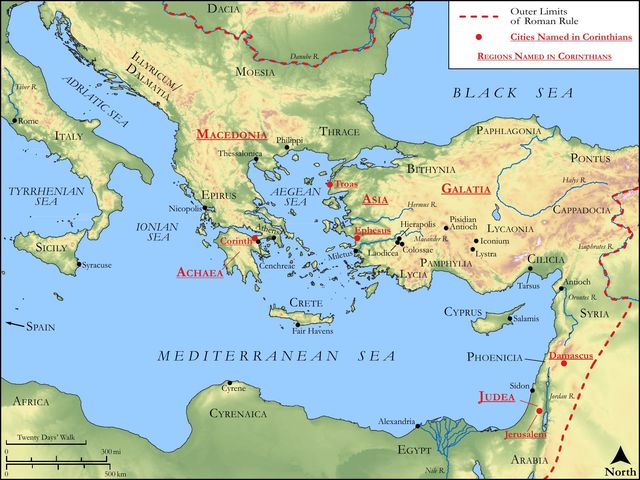
See on the biblical-era maps

Study this verse
Public-domain commentary
Matthew Henry
From his Commentary on the Whole Bible. Henry comments on passages, not single verses — this entry covers 1 Corinthians 1:1–9. His two-level outline is real structure in the source text, so it is rendered as structure.
We have here the apostle's preface to his whole epistle, in which we may take notice,
I.Of the inscription, in which, according to the custom of writing letters then, the name of the person by whom it was written and the persons to whom it was written are both inserted. 1. It is an epistle from Paul, the apostle of the Gentiles, to the church of Corinth, which he himself had planted, though there were some among them that now questioned his apostleship (Co1 9:1, Co1 9:2), and vilified his person and ministry, Co2 10:10. The most faithful and useful ministers are not secure from this contempt. He begins with challenging this character: Paul, called to be an apostle of Jesus Christ, through the will of God. He had not taken this honour to himself, but had a divine commission for it. It was proper at any time, but necessary at this time, to assert his character, and magnify his office, when false teachers made a merit of running him down, and their giddy and deluded followers were so apt to set them up in competition with him. It was not pride in Paul, but faithfulness to his trust, in this juncture, to maintain his apostolical character and authority. And, to make this more fully appear, he joins Sosthenes with him in writing, who was a minister of a lower rank. Paul, and Sosthenes his brother, not a fellow-apostle, but a fellow-minister, once a ruler of the Jewish synagogue, afterwards a convert to Christianity, a Corinthian by birth, as is most probable, and dear to this people, for which reason Paul, to ingratiate himself with them, joins them with himself in his first salutations. There is no reason to suppose he was made a partaker of the apostle's inspiration, for which reasons he speaks, through the rest of the epistle, in his own name, and in the singular number. Paul did not in any case lessen his apostolical authority, and yet he was ready upon all occasions to do a kind and condescending thing for their good to whom he ministered. The persons to whom this epistle was directed were the church of God that was at Corinth, sanctified in Christ Jesus, and called to be saints. All Christians are thus far sanctified in Christ Jesus, that they are by baptism dedicated and devoted to him, they are under strict obligations to be holy, and they make profession of real sanctity. If they be not truly holy, it is their own fault and reproach. Note, It is the design of Christianity to sanctify us in Christ. He gave himself for us, to redeem us from all iniquity, and purify us to himself a peculiar people, zealous of good works. In conjunction with the church at Corinth, he directs the epistle to all that in every place call on the name of Christ Jesus our Lord, both theirs and ours. Hereby Christians are distinguished from the profane and atheistical, that they dare not live without prayer; and hereby they are distinguished from Jews and Pagans, that they call on the name of Christ. He is their common head and Lord. Observe, In every place in the Christian world there are some that call on the name of Christ. God hath a remnant in all places; and we should have a common concern for and hold communion with all that call on Christ's name.
II.Of the apostolical benediction.
Grace be to you, and peace, from God our Father, and from the Lord Jesus Christ. An apostle of the prince of peace must be a messenger and minister of peace. This blessing the gospel brings with it, and this blessing every preacher of the gospel should heartily wish and pray may be the lot of all among whom he ministers. Grace and peace - the favour of God, and reconciliation to him. It is indeed the summary of all blessings. The Lord lift up his countenance upon thee, and give thee peace, was the form of benediction under the Old Testament (Num 6:26), but this advantage we have by the gospel,
1.That we are directed how to obtain that peace from God: it is in and by Christ. Sinners can have no peace with God, nor any good from him, but through Christ.
2.We are told what must qualify us for this peace; namely, grace: first grace, then peace. God first reconciles sinners to himself, before he bestows his peace upon them.
III.Of the apostle's thanksgiving to God on their behalf.
Paul begins most of his epistles with thanksgiving to God for his friends and prayer for them. Note, The best way of manifesting our affection to our friends is by praying and giving thanks for them. It is one branch of the communion of saints to give thanks to God mutually for our gifts, graces, and comforts. He gives thanks,
1.For their conversion to the faith of Christ: For the grace which was given you through Jesus Christ, Co1 1:4. He is the great procurer and disposer of the favours of God. Those who are united to him by faith, and made to partake of his Spirit and merits, are the objects of divine favour. God loves them, bears them hearty good-will, and bestows on them his fatherly smiles and blessings.
2.For the abundance of their spiritual gifts. This the church of Corinth was famous for. They did not come behind any of the churches in any gift, Co1 1:7. He specifies utterance and knowledge, Co1 1:5. Where God has given these two gifts, he has given great capacity for usefulness. Many have the flower of utterance that have not the root of knowledge, and their converse is barren. Many have the treasure of knowledge, and want utterance to employ it for the good of others, and then it is in a manner wrapped up in a napkin. But, where God gives both, a man is qualified for eminent usefulness. When the church of Corinth was enriched with all utterance and all knowledge, it was fit that a large tribute of praise should be rendered to God, especially when these gifts were a testimony to the truth of the Christian doctrine, a confirmation of the testimony of Christ among them, Co1 1:6. They were signs and wonders and gifts of the Holy Ghost, by which God did bear witness to the apostles, both to their mission and doctrine (Heb 2:4), so that the more plentifully they were poured forth on any church the more full attestation was given to that doctrine which was delivered by the apostles, the more confirming evidence they had of their divine mission. And it is no wonder that when they had such a foundation for their faith they should live in expectation of the coming of their Lord Jesus Christ, Co1 1:7. It is the character of Christians that they wait for Christ's second coming; all our religion has regard to this: we believe it, and hope for it, and it is the business of our lives to prepare for it, if we are Christians indeed. And the more confirmed we are in the Christian faith the more firm is our belief of our Lord's second coming, and the more earnest our expectation of it.
IV.Of the encouraging hopes the apostle had of them for the time to come, founded on the power and love of Christ, and the faithfulness of God, Co1 1:8, Co1 1:9. He who had begun a good work in them, and carried it on thus far, would not leave it unfinished. Those that wait for the coming of our Lord Jesus Christ will be kept by him, and confirmed to the end; and those that are so will be blameless in the day of Christ: not upon the principle of strict justice, but gracious absolution; not in rigour of law, but from rich and free grace. How desirable is it to be confirmed and kept of Christ for such a purpose as this! How glorious are the hopes of such a privilege, whether for ourselves or others! To be kept by the power of Christ from the power of our own corruption and Satan's temptation, that we may appear without blame in the great day! O glorious expectation, especially when the faithfulness of God comes in to support our hopes! He who hath called us into the fellowship of his Son is faithful, and will do it, Th1 5:24. He who hath brought us into near and dear relation to Christ, into sweet and intimate communion with Christ, is faithful; he may be trusted with our dearest concerns. Those that come at his call shall never be disappointed in their hopes in him. If we approve ourselves faithful to God, we shall never find him unfaithful to us. He will not suffer his faithfulness to fail, Psa 89:33.
Historical interpretation
Historical reception
4 surviving comments on this verse. Each one is dated, so this reads as a timeline rather than a list.
Select a marker to jump to its quote. Markers stagger vertically where authors wrote within a few decades of each other.
Paul begins this epistle differently, because his subject matter is different. He writes that he is an apostle by the will of God, alluding to those false apostles who had not been sent by Christ and whose teaching was not true. There were many sects which had emerged and which preached Christ according to their own whims. They broke up churches, and some of their dried-up branches are still with us today. For this reason, Paul sets out everything which is opposed to the heresies and asserts that he is a true preacher because he has been sent by Christ, according to God’s will.
See how immediately, from the very beginning, he casts down their pride, and dashes to the ground all their fond imagination, in that he speaks of himself as "called." For what I have learnt, saith he, I discovered not myself, nor acquired by my own wisdom, but while I was persecuting and laying waste the Church I was called. Now here of Him that calleth is everything: of him that is called, nothing, (so to speak,) but only to obey.
"Of Jesus Christ." Your teacher is Christ; and do you register the names of men, as patrons of your doctrine?
"Through the will of God." For it was God who willed that you should be saved in this way. We ourselves have wrought no good thing, but by the will of God we have attained to this salvation; and because it seemed good to him, we were called, not because we were worthy.
"And Sosthenes our brother." Another instance of his modesty; he puts in the same rank with himself one inferior to Apollos; for great was the interval between Paul and Sosthenes. Now if where the interval was so wide he stations with himself one far beneath him, what can they have to say who despise their equals?
By calling Sosthenes his brother, Paul is both demonstrating his own humility and pointing out that Sosthenes is a fellow worker in the gospel.
Paul is saying in effect: “You Corinthians have been called by men, but I have been called by God.” I think that Sosthenes was a Corinthian. He is mentioned in Acts [18:17], where Luke says that in the time of Gallio the Greeks arrested him and beat him.
Continue studying 1 Corinthians 1:1 across the web’s major study libraries — every link below opens this exact verse, chapter, or book on the destination site.
Read & Compare
 BibleGatewayThis verse in more than 200 translations and 70 languages.
 Bible.comThe YouVersion reader — hundreds of translations, reading plans, and highlights.
 ESV.orgCrossway's official English Standard Version reader.
 NET BibleThe NET translation with 60,000+ translators' notes on every rendering decision.
 STEP BibleTyndale House's free study tool — original text, vocabulary, and scholarly resources.
 BibliaLogos Bible Software's free web reader.
 USCCBThe New American Bible (Revised Edition) with the U.S. bishops' study notes.
Commentaries
 BibleHub CommentariesDozens of classic commentaries on this verse, gathered on one page.
 StudyLightMore than 100 commentary sets — the largest collection on the web.
 BibleRefPlain-English commentary on what this verse means, verse by verse.
 Enduring WordDavid Guzik's free commentary on this chapter, widely used by Bible teachers.
 Bible Study ToolsVerse commentary alongside Greek and Hebrew study aids.
Original Language & Research
- BibleHub InterlinearThe verse word by word — original language, transliteration, and English.
- BibleHub LexiconEvery word's original-language definition and Strong's entry.
 Blue Letter BibleDeep-study tools — Strong's numbers, concordance, and word studies.
 CNTR CollationThe earliest Greek manuscripts of this verse, collated letter by letter.
Sermons, Hymns & Audio


TrulyRandomVerse is not affiliated with these sites and doesn’t control their content. They’re linked because they’re genuinely useful.
Summary
First Corinthians opens with a foundational statement of apostolic authority and divine purpose, identifying the letter's primary author as Paul, unequivocally "called to be an apostle of Jesus Christ through the will of God." This salutation immediately establishes the divine mandate behind Paul's ministry and the ensuing message, setting the authoritative tone for addressing the complex issues within the Corinthian church. The inclusion of Sosthenes, identified as "our brother," signifies communal partnership and solidarity in the gospel mission.
Context
ShowHideLiterary Context
This verse serves as the customary Pauline epistolary opening, immediately identifying the sender and establishing his credentials. It precedes the address to the recipients (the church in Corinth) and a typical Pauline greeting of grace and peace. By asserting his apostleship "through the will of God" at the outset, Paul preemptively addresses any potential challenges to his authority, which will prove crucial given the numerous doctrinal and ethical issues he intends to confront throughout the letter. The emphasis on divine calling sets the stage for Paul's subsequent commands, exhortations, and theological arguments, grounding them not in human wisdom or personal opinion, but in God's sovereign design.
Historical & Cultural Context
Corinth was a prominent Roman provincial capital, a bustling port city renowned for its commercial activity, diverse population, and a reputation for moral laxity (hence the term "Corinthianize" to mean to live immorally). Its strategic location on the Isthmus of Corinth made it a crossroads of trade and culture, leading to a melting pot of philosophical ideas, religious practices, and social customs. Paul had founded the church in Corinth during his second missionary journey, spending approximately eighteen months there (as detailed in Acts 18:1-18). This letter, likely written from Ephesus (referenced in 1 Corinthians 16:8), addresses a range of problems that had arisen in the young church, including factions, sexual immorality, lawsuits among believers, misuse of spiritual gifts, and theological misunderstandings regarding the resurrection.
Key Themes
ShowHideThis opening verse immediately introduces several key themes that resonate throughout the entire epistle. The theme of Apostolic Authority is paramount, as Paul's divine calling undergirds every command and correction he issues to the wayward Corinthians. His apostleship is not self-appointed but a direct, sovereign appointment by God, a point he frequently reiterates in his letters (e.g., Romans 1:1). Closely related is the theme of Divine Will and Purpose, emphasizing that Paul's ministry and the very existence of the church are rooted in God's eternal plan, not human initiative or merit. Finally, the inclusion of Sosthenes highlights the theme of Christian Fellowship and Partnership, demonstrating that ministry is a collaborative effort within the broader community of believers, even as Paul retains primary apostolic authority. Sosthenes may be the former synagogue ruler mentioned in Acts 18:17, who possibly converted to Christianity after being beaten by the crowd.
Exposition and Analysis
ShowHideKey Word Analysis
ShowHideFrom the same root as klēsis (calling), this word signifies being "invited," "appointed," or "chosen." It emphasizes that Paul's role as an apostle is not a self-chosen career path or a result of human ambition, but a divine summons and specific appointment by God. It denotes a status conferred by God, implying both privilege and responsibility.
This term literally means "one who is sent" or "a delegate." In the New Testament, it refers specifically to those commissioned by Christ with unique authority to preach the Gospel, establish churches, and lay down foundational doctrine. It implies a direct commission from a higher authority, carrying the full weight of that authority. Paul's use of this title here asserts his divinely given commission and the authoritative nature of his message.
This word denotes a "determination," "purpose," or "decree." When applied to God, it refers to His sovereign plan, intention, and desire. Paul's apostleship is not merely by God's permission but by His active, deliberate, and intentional purpose. This underscores the divine origin and legitimacy of his calling, making it clear that his ministry is an outworking of God's perfect and unchangeable plan.
Verse Breakdown
ShowHide"Paul, called to be an apostle of Jesus Christ"
This opening phrase immediately identifies the primary author, Paul, and establishes his unique identity and authority. The Greek word klētós ("called") is significant, indicating a divine summons rather than a self-appointed role. Paul's apostleship is directly linked to "Jesus Christ," signifying that his commission originates from the risen Lord Himself, not from human institutions or personal ambition. This divine appointment is crucial for the legitimacy of his message.
"through the will of God"
This clause further reinforces the divine origin and authority of Paul's apostleship. His calling is not accidental or arbitrary but is an intentional act stemming from God's sovereign "will" (thélēma). This emphasizes that Paul's ministry is an integral part of God's overarching plan for humanity, lending ultimate weight and authority to his words. It also serves to counter any potential human skepticism or opposition to his message.
"and Sosthenes our brother"
The inclusion of Sosthenes, identified as "our brother," signifies a partnership in ministry and a shared bond in Christ. While Paul is the primary author and apostle, Sosthenes' presence indicates communal support and solidarity. This might imply he was an amanuensis (secretary) or simply a co-sender who endorsed the letter's contents. His designation as "brother" highlights the familial nature of the Christian community and the collaborative spirit of gospel work, even within the context of apostolic authority.
Literary Devices
ShowHideThe opening of 1 Corinthians 1:1 employs several key literary devices. It begins with an Apostolic Salutation, a standard feature of Pauline epistles, immediately identifying the sender and establishing his authority. The phrase "called to be an apostle" is a form of Divine Passive, implying that God is the active agent in Paul's calling, even if not explicitly named as the subject of the verb "called." This subtly but powerfully emphasizes God's sovereignty. The repetition of the concept of divine origin ("called... through the will of God") serves as Emphasis, underscoring the non-human source of Paul's authority, which is critical for the letter's persuasive power. Finally, the inclusion of Sosthenes introduces an element of Partnership and Community, balancing the assertion of individual apostolic authority with the communal nature of Christian ministry.
Theological and Thematic Connections
ShowHidePaul's assertion of his divinely ordained apostleship in 1 Corinthians 1:1 is not merely a formality but a theological declaration. It establishes that his authority to address the deep-seated problems in Corinth derives directly from God's sovereign will, not from human wisdom, charisma, or ecclesiastical appointment. This divine mandate elevates the letter's contents from mere human advice to authoritative divine instruction. It underscores the New Testament principle that genuine ministry flows from a divine call and purpose, empowering the messenger with God's authority to speak His truth. This foundation is crucial for the Corinthians, who were struggling with divisions based on human leaders and worldly wisdom, reminding them that the ultimate authority rests with God and His appointed messengers.
Reflection and Application
ShowHideThe opening verse of 1 Corinthians offers profound insights for contemporary believers. Paul's identity is wholly rooted in God's calling and purpose, not in his own accomplishments or the approval of others. For us, this means that our truest identity and purpose are found not in what we do or achieve, but in who God has called us to be in Christ. Whether in vocational ministry or daily life, our service is most effective and enduring when it flows from a clear understanding that we are "called" by God, operating "through His will." This perspective liberates us from the need for human validation and empowers us to pursue God's purposes with confidence and humility. Furthermore, the inclusion of Sosthenes reminds us that even those with unique callings operate within a community of faith. Christian life and ministry are not meant to be solitary endeavors but are enriched by partnership, mutual support, and shared brotherhood in Christ. We are called not just to individual service, but to participate in the collective mission of God's people.
Questions for Reflection
ShowHideFAQ
ShowHideWhy does Paul so frequently emphasize his apostleship "through the will of God" at the beginning of his letters?
ShowHidePaul's consistent emphasis on his apostleship being "through the will of God" (e.g., 2 Corinthians 1:1, Ephesians 1:1, Colossians 1:1) served several crucial purposes. First, it asserted the divine origin and authority of his message, particularly vital when addressing churches (like Corinth) that were questioning his leadership or teachings. His apostleship was not self-proclaimed or humanly conferred, but a direct commission from God Himself. Second, it underscored the theological weight of his instructions, making it clear that his words were not mere human opinions but divine revelation. Third, it provided a strong foundation for the unity of the church, as it pointed believers to a common, divine authority rather than human factions.
Who was Sosthenes, and why is he included in the salutation?
ShowHideSosthenes is identified as "our brother" in this verse, indicating he was a fellow believer and partner in ministry with Paul. While the New Testament provides limited information about him, many scholars believe he is the same Sosthenes mentioned in Acts 18:17, who was the synagogue ruler in Corinth. In Acts, Sosthenes was beaten by the crowd in front of Gallio, the proconsul, after Gallio refused to intervene in a dispute between the Jews and Paul. If this is the same individual, his inclusion here would be highly significant, demonstrating a remarkable conversion and partnership with Paul, the very person he once opposed. His presence in the salutation could signify his role as Paul's amanuensis (secretary), a co-sender endorsing the letter's contents, or simply a prominent figure in the Christian community who was with Paul at the time of writing. His inclusion highlights the communal nature of the early church's ministry.
Christ-Centered Fulfillment
ShowHidePaul's declaration of being "called to be an apostle of Jesus Christ through the will of God" finds its ultimate fulfillment and meaning in the person and work of Christ. Jesus Christ is the supreme Apostle, the one "sent" by God the Father to accomplish His will for humanity (as seen in Hebrews 3:1). Paul's apostleship is therefore a participation in Christ's own mission and authority, a delegated commission flowing from the ultimate divine sending. The "will of God" that called Paul is the same divine will that purposed Christ's incarnation, atoning death, and resurrection, which are the very core of the apostolic message (e.g., 1 Corinthians 15:3-4). Furthermore, Paul's role as an apostle is to build up the church, which is the body of Christ (Ephesians 1:22-23), uniting believers under Christ as the head (Colossians 1:18). Thus, Paul's divinely appointed authority serves to magnify Christ, bring people into His kingdom, and establish churches that reflect His glory and embody His saving purpose in the world.