


Romans 16:27
Bible text: King James Version (1769 Blayney text) · Public domain
Bible text: King James Version with Strong's numbers · Public domain
Bible text: Berean Standard Bible · Public domain
Bible text: American Standard Version (1901) · Public domain
Bible text: World English Bible, Messianic edition · Public domain
Bible text: Geneva Bible (1599) · Public domain
Bible text: Young's Literal Translation · Public domain
- μόνῳmonō[to the] onlyG3441A-DSMAdjective Dative Singular Masculine
- σοφῷsophōwiseG4680A-DSMAdjective Dative Singular Masculine
- θεῷtheōGodG2316N-DSM-TNoun Dative Singular Masculine Title
- διὰdiathroughG1223PREPPreposition
- ἸησοῦIēsouJesusG2424N-GSM-PNoun Genitive Singular Masculine Individual
- ΧριστοῦChristouChristG5547N-GSM-TNoun Genitive Singular Masculine Title
- ᾧhōwhich [is]G3739R-DSMRelative pronoun Dative Singular Masculine
- ἡhē[be] theG3588T-NSFDefinite article Nominative Singular Feminine
- δόξαdoxagloryG1391N-NSFNoun Nominative Singular Feminine
- εἰςeistoG1519PREPPreposition
- τοὺςtoustheG3588T-APMDefinite article Accusative Plural Masculine
- αἰῶναςaiōnasagesG165N-APMNoun Accusative Plural Masculine
- ἀμήνamēnAmenG281INJ-HEBInterjection
- πρόςprostoG4314PREPPreposition
- ῬωμαίουςRhōmaiousRomansG4514N-APM-LGNoun Accusative Plural Masculine Location Gentilic
- ἐγράφηegraphēit was writtenG1125V-2API-3SVerb 2nd Aorist Passive Indicative 3rd Singular
- ἀπόapofromG575PREPPreposition
- ΚορίνθουKorinthouCorinthG2882N-GSF-LNoun Genitive Singular Feminine Location
- διὰdiathroughG1223PREPPreposition
- φοίβηςphoibēsPhoebeG5402N-GSF-PNoun Genitive Singular Feminine Individual
- τῆςtēstheG3588T-GSFDefinite article Genitive Singular Feminine
- διακόνουdiakonouservantG1249N-GSFNoun Genitive Singular Feminine
- τῆςtēs<the>G3588T-GSFDefinite article Genitive Singular Feminine
- ἕνheninG1722PREPPreposition
- ΚεγχρεαῖςKegchreaisCenchreaG2747N-DPF-LNoun Dative Plural Feminine Location
- ἐκκλησίαςekklēsiaschurchG1577N-GSFNoun Genitive Singular Feminine
English is a literal word-by-word gloss of the Greek, not the KJV's wording. Why?
This is the original text the KJV's translators worked from — each Greek word with its own literal English meaning in this verse, prepared by scholars at Tyndale House, Cambridge. The KJV translates whole sentences, not word by word, so its wording differs: one Greek word can become several English words, and the KJV may choose “charity” where the gloss reads “love”. Both are faithful — they answer different questions. For the KJV's own rendering, switch to the KJV text.
Details
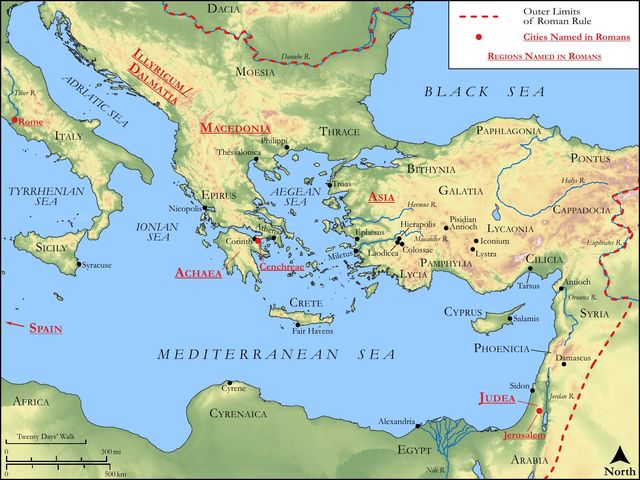
See on the biblical-era maps

Study this verse
Public-domain commentary
Matthew Henry
From his Commentary on the Whole Bible. Henry comments on passages, not single verses — this entry covers Romans 16:25–27. His four-level outline is real structure in the source text, so it is rendered as structure.
Here the apostle solemnly closes his epistle with a magnificent ascription of glory to the blessed God, as one that terminated all in the praise and glory of God, and studied to return all to him, seeing all is of him and from him. He does, as it were, breathe out his soul to these Romans in the praise of God, choosing to make that the end of his epistle which he made the end of his life. Observe here,
I.A description of the gospel of God, which comes in in a parenthesis; having occasion to speak of it as the means by which the power of God establishes souls, and the rule of that establishment: To establish you according to my gospel. Paul calls it his gospel, because he was the preacher of it and because he did so much glory in it. Some think he means especially that declaration, explication, and application, of the doctrine of the gospel, which he had now made in this epistle; but it rather takes in all the preaching and writing of the apostles, among whom Paul was a principal labourer. Through their word (Joh 17:20), the word committed to them. Ministers are the ambassadors, and the gospel is their embassy. Paul had his head and heart so full of the gospel that he could scarcely mention it without a digression to set forth the nature and excellency of it.
1.It is the preaching of Jesus Christ. Christ was the preacher of it himself; it began to be spoken by the Lord, Heb 2:3. So pleased was Christ with his undertaking for our salvation that he would himself be the publisher of it. Or, Christ is the subject-matter of it; the sum and substance of the whole gospel is Jesus Christ and him crucified. We preach not ourselves, says Paul, but Christ Jesus the Lord. That which establishes souls is the plain preaching of Jesus Christ.
2.It is the revelation of the mystery which was kept secret since the world began, and by the scriptures of the prophets made known. The subject-matter of the gospel is a mystery. Our redemption and salvation by Jesus Christ, in the foundation, method, and fruits of it, are, without controversy, a great mystery of godliness, Ti1 3:16. This bespeaks the honour of the gospel; it is no vulgar common thing, hammered out by any human wit, but it is the admirable product of the eternal wisdom and counsel of God, and has in it such an inconceivable height, such an unfathomable depth, as surpass knowledge. It is a mystery which the angels desire to look into, and cannot find the bottom of. And yet, blessed be God, there is as much of this mystery made plain as will suffice to bring us to heaven, if we do not wilfully neglect so great salvation. Now,
(1.)This mystery was kept secret since the world began: chronois aiōniois sisigēmenou. It was wrapped up in silence from eternity; so some - a temporibus aeternis; it is no new and upstart notion, no late invention, but took rise from the days of eternity and the purposes of God's everlasting love. Before the foundation of the world was laid, the mystery was hid in God, Eph 3:9. Or, since the world began, so we translate it. During all the times of the Old Testament this mystery was comparatively kept secret in the types and shadows of the ceremonial law, and the dark predictions of the prophets, which pointed at it, but so that they could not stedfastly look to the end of those things, Co2 3:13. Thus it was hid from ages and generations, even among the Jews, much more among the Gentiles that sat in darkness and had no notices at all of it. Even the disciples of Christ themselves, before his resurrection and ascension, were very much in the dark about the mystery of redemption, and their notion of it was very much clouded and confused; such a secret was it for many ages. But,
(2.)It is now made manifest. The veil is rent, the shadows of the evening are done away, and life and immortality are brought to light by the gospel, and the Sun of righteousness has risen upon the world. Paul does not pretend to have the monopoly of this discovery, as if he alone knew it; no, it is made manifest to many others. But how is it made manifest by the scriptures of the prophets? Surely, because now the event has given the best exposition to the prophecies of the Old Testament. Being accomplished, they are explained. The preaching of the prophets, as far as it related to this mystery, was in a great measure dark and unintelligible in the ages wherein they lived; but the scriptures of the prophets, the things which they left in writing, are now not only made plain in themselves, but by them this mystery is made known to all nations. The Old Testament does not only borrow light fRom. but return light to, the revelation of the New Testament. If the New Testament explains the Old, the Old Testament, by way of requital, very much illustrates the New. Thus the Old Testament prophets prophesy again, now their prophecies are fulfilled, before many people, and nations, and tongues. I refer to Rev 10:11, which this explains. Now Christ appears to have been the treasure hid in the field of the Old Testament. To him bear all the prophets witness. See Luk 24:27.
(3.)It is manifested according to the commandment of the everlasting God - the purpose, counsel, and decree of God from eternity, and the commission and appointment given first to Christ and then to the apostles, in the fulness of time. They received commandment from the Father to do what they did in preaching the gospel. Lest any should object, "Why was this mystery kept secret so long, and why made manifest now?" - he resolves it into the will of God, who is an absolute sovereign, and gives not an account of any of his matters. The commandment of the everlasting God was enough to bear out the apostles and ministers of the gospel in their preaching. The everlasting God. This attribute of eternity is here given up to God very emphatically.
[1.]He is from everlasting, which intimates that though he had kept this mystery secret since the world began, and had but lately revealed it, yet he had framed and contrived it from everlasting, before the worlds were. The oaths and covenants in the written word are but the copy of the oath and covenant which were between the Father and the Son from eternity: those the extracts, these the original. And,
[2.]He is to everlasting, intimating the eternal continuance to us. We must never look for any new revelation, but abide by this, for this is according to the commandment of the everlasting God. Christ, in the gospel, is the same yesterday, today, and for ever.
(4.)It is made known to all nations for the obedience of faith. The extent of this revelation he often takes notice of; that whereas hitherto in Judah only God was known, now Christ is salvation to the ends of the earth, to all nations. And the design of it is very observable; it is for the obedience of faith - that they may believe and obey it, receive it and be rules by it. The gospel is revealed, not to be talked of and disputed about, but to be submitted to. The obedience of faith is that obedience which is paid to the word of faith (see that phrase, Act 6:7), and which is produced by the grace of faith. See here what is the right faith - even that which works in obedience; and what is the right obedience - even that which springs from faith; and what is the design of the gospel - to bring us to both.
II.A doxology to that God whose gospel it is, ascribing glory to him for ever (Rom 16:27), acknowledging that he is a glorious God, and adoring him accordingly, with the most awful affections, desiring and longing to be at this work with the holy angels, where we shall be doing it to eternity. This is praising God, ascribing glory to him for ever. Observe,
1.The matter of this praise. In thanking God, we fasten upon his favours to us; in praising and adoring God, we fasten upon his perfections in himself. Two of his principal attributes are here taken notice of: - (1.) His power (Rom 16:25): To him that is of power to establish you. It is no less than a divine power that establishes the saints. Considering the disposition there is in them to fall, the industry of their spiritual enemies that seek to overthrow them, and the shaking times into which their lot is cast, no less than an almighty power will establish them. That power of God which is put forth for the establishment of the saints is and ought to be the matter of our praise, as Jde 1:24, To him that is able to keep you from falling. In giving God the glory of this power we may, and must, take to ourselves the comfort of it - that whatever our doubts, and difficulties, and fears, may be, our God, whom we serve, is of power to establish us. See Pe1 1:5; Joh 10:29. (2.) His wisdom (Rom 16:27): To God only wise. Power to effect without wisdom to contrive, and wisdom to contrive without power to effect, are alike vain and fruitless; but both together, and both infinite, make a perfect being. He is only wise; not the Father only wise, exclusive of the Son, but Father, Son, and Holy Ghost, three persons and one God, only wise, compared with the creatures. Man; the wisest of all the creatures in the lower world, is born like a wild ass's colt; nay, the angels themselves are charged with folly, in comparison with God. He only is perfectly and infallibly wise; he only is originally wise, in and of himself; for he is the spring and fountain of all the wisdom of the creatures, the Father of all the lights of wisdom that any creature can pretend to (Jam 1:17): with him are strength and wisdom, the deceived and deceiver are his.
2.The Mediator of this praise: Through Jesus Christ. To God only wise through Jesus Christ; so some. It is in and through Christ that God is manifested to the world as the only wise God; for he is the wisdom of God, and the power of God. Or rather, as we read it, glory through Jesus Christ. All the glory that passes from fallen man to God, so as to be accepted of him, must go through the hands of the Lord Jesus, in whom alone it is that our persons and performances are, or can be, pleasing to God. Of his righteousness therefore we must make mention, even of his only, who, as he is the Mediator of all our prayers, so he is, and I believe will be to eternity, the Mediator of all our praises.
Historical interpretation
Two Centuries of Reception
6 surviving comments on this verse. Each one is dated, so this reads as a timeline rather than a list.
Select a marker to jump to its quote. Markers stagger vertically where authors wrote within a few decades of each other.
God cannot be called wise in the way that human beings are wise, because a wise man merely has a share in wisdom, whereas God is its author and source.
Without Christ nothing is complete, because all things are through him. It is acknowledged that praise is given to God the Father through him, because it is understood that “through Christ” means “through his wisdom,” in whom he has saved believers. Therefore glory to the Father through the Son is glory to both in the Holy Spirit, because both are in the one glory.
It is always a custom with Paul to conclude his exhortation with prayers and doxologies. For he knows that the thing is one of no slight importance. And it is out of affectionateness and caution that he is in the habit of doing this. For it is the character of a teacher devoted to his children, and to God, not to instruct them in words only, but by prayer too to bring upon his teaching the assistance which is from God. And this he does here also. But the connection is as follows: "To Him that is of power to stablish you, be glory for ever. Amen." For he again clings to those weak brethren, and to them he directs his discourse. For when he was rebuking, he made all share his rebuke; but now, when he is praying, it is for these that he wears the attitude of a suppliant. And after saying, "to stablish," he proceeds to give the mode of it, "according to my Gospel;" and this was what one would do to show that as yet they were not firmly fixed, but stood, though with wavering. Then to give a trustworthiness to what he says, he proceeds, "and the preaching of Jesus Christ;" that is, which He Himself preached. But if He preached it, the doctrines are not ours, but the laws are of Him. And afterwards, in discussing the nature of the preaching, He shows that this gift is one of much benefit, and of much honor; and this he first proves from the person of the declarer thereof, and then likewise from the things declared. For it was glad tidings. Besides, from His not having made aught of them known to any before us. And this he intimates in the words, "according to the revelation of the mystery." And this is a sign of the greatest friendliness, to make us share in the mysteries, and no one before us. "Which was kept secret since the world began, but now is made manifest." For it had been determined long ago, but was only manifested now. How was it made manifest? "By the Scriptures of the Prophets." Here again he is releasing the weak person from fear. For what dost thou fear? is it lest thou depart from the Law? This the Law wishes, this it foretold from of old. But if thou pryest into the cause of its being made manifest now, thou art doing a thing not safe to do, in being curious about the mysteries of God, and calling Him to account. For we ought not with things of this nature to act as busybodies, but to be well pleased and content with them. Wherefore that he might himself put a check upon a spirit of this sort, he adds, "according to the commandment of the everlasting God, for the obedience of faith." For faith requires obedience, and not curiosity. And when God commands, one ought to be obedient, not curious. Then he uses another argument to encourage them, saying "made known to all nations." That is, it is not thou alone but the whole world that is of this Creed, as having had not man, but God for a Teacher. Wherefore also he adds, "through Jesus Christ." But it was not only made known, but also confirmed. Now both are His work. And on this ground too the way it is to be read is, "Now to Him that is of power to stablish you through Jesus Christ;" and, as I was saying, he ascribes them both to Him; or rather, not both of these only, but the glory belonging to the Father also. And this too is why he said, "to Whom be glory forever, Amen." And he uses a doxology again through awe at the incomprehensibleness of these mysteries. For even now they have appeared, there is no such thing as comprehending them by reasonings, but it is by faith we must come to a knowledge of them, for in no other way can we. He well says, "To the only wise God." For if you will only reflect how He brought the nations in, and blended them with those who in olden time had wrought well, how He saved those who were desperate, how He brought men not worthy of the earth up to heaven, and brought those who had fallen from the present life into that undying and unalterable life, and made those who were trampled down by devils to vie with Angels, and opened Paradise, and put a stop to all the old evils, and this too in a short time and by an easy and compendious way, then wilt thou learn His wisdom;-when thou seest that which neither Angels nor Archangels knew, they of the Gentiles learnt on a sudden through Jesus. Right then is it to admire His wisdom, and to give Him glory! But thou keepest dwelling over little things, still sitting under the shadow. And this is not much like one that giveth glory. For he who has no confidence in Him, and no trust in the faith, does not bear testimony to the grandeur of His doings. But he himself offers glory up in their behalf, in order to bring them also to the same zeal. But when you hear him say, "to the only wise God," think not that this is said in disparagement of the Son. For if all these things whereby His wisdom is made apparent were done by Christ, and without Him no single one, it is quite plain that he is equal in wisdom also. What then is the reason of his saying "only?" To set Him in contrast with every created being.
God commanded that all the Gentiles obey and acknowledge God. He alone knew that this would one day happen, for he alone is naturally wise just as he is naturally good. Mankind is also called good, it is true, but we have the ability to be good or wise as a result of instruction, whereas God is good and wise by nature. To him be glory and honor through Jesus Christ forever. Amen.
God alone is wise, although both Solomon and many other holy men were called wise.
If the heretics try to use this [verse] to prove that Christ is not God, it should be remembered that Christ not only is called wise, he is even called Wisdom.
Continue studying Romans 16:27 across the web’s major study libraries — every link below opens this exact verse, chapter, or book on the destination site.
Read & Compare
 BibleGatewayThis verse in more than 200 translations and 70 languages.
 Bible.comThe YouVersion reader — hundreds of translations, reading plans, and highlights.
 ESV.orgCrossway's official English Standard Version reader.
 NET BibleThe NET translation with 60,000+ translators' notes on every rendering decision.
 STEP BibleTyndale House's free study tool — original text, vocabulary, and scholarly resources.
 BibliaLogos Bible Software's free web reader.
 USCCBThe New American Bible (Revised Edition) with the U.S. bishops' study notes.
Commentaries
 BibleHub CommentariesDozens of classic commentaries on this verse, gathered on one page.
 StudyLightMore than 100 commentary sets — the largest collection on the web.
 BibleRefPlain-English commentary on what this verse means, verse by verse.
 Enduring WordDavid Guzik's free commentary on this chapter, widely used by Bible teachers.
 Bible Study ToolsVerse commentary alongside Greek and Hebrew study aids.
Original Language & Research
- BibleHub InterlinearThe verse word by word — original language, transliteration, and English.
- BibleHub LexiconEvery word's original-language definition and Strong's entry.
 Blue Letter BibleDeep-study tools — Strong's numbers, concordance, and word studies.
 CNTR CollationThe earliest Greek manuscripts of this verse, collated letter by letter.
Sermons, Hymns & Audio


TrulyRandomVerse is not affiliated with these sites and doesn’t control their content. They’re linked because they’re genuinely useful.
Summary
Romans 16:27 concludes Paul's magnum opus with a profound doxology, attributing singular and eternal glory to God, who is uniquely wise, and emphasizing that this praise is rendered solely through the person and work of Jesus Christ. This verse serves as a fitting theological summation, affirming God's ultimate sovereignty and wisdom in orchestrating the grand plan of salvation, which was once a mystery but has now been revealed through the Gospel. It directs the believer's gaze heavenward, acknowledging God as the supreme object of all worship and honor, eternally mediated by Christ.
Context
ShowHideLiterary Context
Romans 16:27 forms the concluding verse of Paul's Epistle to the Romans, specifically as part of a final doxology (Romans 16:25-27). This doxology follows a lengthy section of personal greetings, commendations (like that of Phoebe in Romans 16:1-2), and a final warning against divisive teachers (Romans 16:17-20). The preceding verses (Romans 16:25-26) introduce the theme of God's power to establish believers according to Paul's Gospel, which unveils a mystery kept secret for ages but now revealed through prophetic writings. Thus, verse 27 acts as the climactic declaration of praise, grounding all the theological exposition and practical instruction of the letter in the ultimate glory of the "only wise God."
Historical & Cultural Context
The Epistle to the Romans was written by the Apostle Paul from Corinth, likely during his third missionary journey, around 57-58 AD. The letter was intended for the church in Rome, a diverse community of Jewish and Gentile believers. Paul had not yet visited Rome, but he hoped to do so, using it as a base for further missionary work into Spain (Romans 15:23-24). The letter was carried by Phoebe, a deaconess from the church at Cenchrea, a port city near Corinth. This final doxology, while a common feature in ancient letters, takes on particular significance here as Paul encapsulates the profound theological arguments of the entire letter—justification by faith, the role of the Law, Israel's place in God's plan, and Christian living—into a singular statement of praise to the God who orchestrated it all.
Key Themes
ShowHideThis concluding verse powerfully encapsulates several overarching themes of Romans and Pauline theology. It highlights God's singular wisdom (a theme seen in Romans 11:33-36), which is perfectly displayed in His redemptive plan for humanity, a plan that was once a mystery but is now revealed through the Gospel. The verse also underscores the ultimate purpose of all things: the glory of God. Throughout Romans, Paul consistently points to God's glory as the end goal of salvation (Romans 3:23) and Christian living. Crucially, it emphasizes Jesus Christ as the indispensable mediator through whom this glory is rendered, aligning with the letter's consistent Christ-centered focus on salvation and reconciliation. Finally, the phrase "for ever" points to the eternal nature of God's attributes and His reign, providing an enduring foundation for the believer's hope and worship, as seen in the eternal purposes of God in Ephesians 1:3-14.
Exposition and Analysis
ShowHideKey Word Analysis
ShowHideThis word, meaning "wise (in a most general application)," emphasizes God's unique and unparalleled wisdom. It is not merely intellectual knowledge but a profound, perfect understanding and execution of His divine will, particularly evident in His intricate plan of salvation. This wisdom is supreme, incomparable, and the source of all true understanding.
Derived from a base meaning "to seem," this term refers to God's inherent majesty, splendor, renown, and honor. In this context, it signifies the ultimate praise, adoration, and recognition of His supreme excellence and worthiness. It is the visible manifestation of His divine attributes.
A primary preposition denoting the "channel of an act." Here, it signifies the means or agency. It is crucial for understanding that Jesus Christ is not merely the object of glory but the indispensable mediator and channel through whom all glory is rightly rendered to God. It underscores Christ's role in revealing God's wisdom and enabling humanity to offer appropriate worship.
Verse Breakdown
ShowHide"To God only wise"
This opening phrase immediately establishes the unique nature of God's wisdom. He is not merely wise, but "only wise," signifying His singular, incomparable, and perfect understanding of all things, especially His redemptive plan. This wisdom is the foundation of His actions and purposes.
"be glory"
This is a declarative statement of praise, a doxology. It expresses the conviction that all honor, majesty, splendor, and adoration are due to God alone. It is the ultimate purpose and response to His divine character and His mighty works.
"through Jesus Christ"
This critical phrase specifies the means by which glory is given to God. Jesus Christ is the mediator, the channel, and the very embodiment of God's wisdom and redemptive power. It is through His life, death, resurrection, and ongoing work that God's character is most profoundly revealed, enabling and inspiring all true worship and praise.
"for ever"
This phrase emphasizes the eternal and unchanging nature of God's wisdom and the perpetual duration of His glory. It signifies that God's attributes are timeless and His reign is everlasting, ensuring that His praise will continue without end.
"Amen."
This Hebrew word (G281), meaning "firm" or "trustworthy," functions as an affirmation, signifying "so be it," "truly," or "let it be established." It serves as a solemn and conclusive endorsement of the preceding declaration, expressing full agreement and conviction.
Literary Devices
ShowHideRomans 16:27 is a powerful example of a Doxology, a hymn or expression of praise to God. As the concluding statement of Paul's letter, it serves as a climactic declaration, summarizing the theological thrust of the entire epistle by directing all honor to God. The phrase "only wise" employs Emphasis and Hyperbole to underscore the unique and unparalleled nature of God's wisdom, setting Him apart from all creation. The use of "through Jesus Christ" highlights Mediation and Agency, clearly articulating Christ's indispensable role as the conduit for both God's revelation to humanity and humanity's worship back to God. The structure also exhibits a form of Inclusio with other Pauline doxologies, creating a sense of theological completeness and divine purpose.
Theological and Thematic Connections
ShowHideThis concluding doxology in Romans 16:27 is a powerful theological statement, encapsulating the very heart of Christian worship and understanding of God. It affirms God's absolute sovereignty and His unique wisdom, which is perfectly displayed in His intricate plan of salvation through Christ. The verse grounds all Christian life and theology in the ultimate purpose of glorifying God, a glory that is eternally mediated and made possible by Jesus Christ. It connects the revealed mystery of the Gospel, previously hidden for ages, to the eternal praise due to the God who conceived and executed this plan.
Reflection and Application
ShowHideRomans 16:27 serves as a profound call to worship and a foundational truth for the believer's life. It reminds us that our ultimate purpose is to bring glory to God, acknowledging His unparalleled wisdom and His sovereign plan, which unfolds perfectly even when we cannot fully grasp it. This verse encourages a posture of humility and trust, knowing that the "only wise God" is at work in all circumstances, orchestrating everything for His eternal purposes and our ultimate good. It calls us to live lives that reflect His glory, understanding that our ability to truly worship and serve Him is entirely "through Jesus Christ." This means that our prayers, our service, our suffering, and our joys are all to be offered in and through Christ, making our entire existence an act of worship. Embracing the "for ever" aspect provides enduring hope and stability, knowing that God's truth and His kingdom are eternal, giving meaning and purpose to our transient lives.
Questions for Reflection
ShowHideFAQ
ShowHideWhy does Paul emphasize God as "only wise" in this concluding doxology?
ShowHidePaul emphasizes God as "only wise" (Greek: monō sophō) to highlight His unique, incomparable, and perfect wisdom, especially as revealed in His intricate and previously hidden plan of salvation. Throughout Romans, Paul unpacks the profound mystery of how God, in His sovereign wisdom, has brought salvation to both Jews and Gentiles through faith in Christ (Romans 11:25-36). This wisdom is not merely intellectual knowledge but also His perfect understanding and execution of His divine will, which human minds cannot fully comprehend but can only adore. By concluding with this phrase, Paul attributes the entire grand theological narrative of Romans—from justification to sanctification to Israel's future—to the singular, unsearchable wisdom of God.
Christ-Centered Fulfillment
ShowHideRomans 16:27, while a doxology to God, is profoundly Christ-centered in its declaration that glory is rendered "through Jesus Christ." This highlights Christ's indispensable role as the mediator of all divine revelation and all human worship. In the New Testament, Jesus is consistently presented as the ultimate manifestation of God's wisdom and glory. He is "the power of God and the wisdom of God" (1 Corinthians 1:24), through whom "all things were created, in heaven and on earth, visible and invisible" (Colossians 1:16). It is through His atoning sacrifice and resurrection that humanity is reconciled to God, enabling us to approach the Father with confidence (Ephesians 3:12). Therefore, all praise and honor given to God are made possible and acceptable only through the person and work of Jesus Christ, who perfectly revealed the Father's character and accomplished His redemptive plan. As Philippians 2:11 declares, "every tongue [will] confess that Jesus Christ is Lord, to the glory of God the Father" (Philippians 2:11), underscoring that Christ is the eternal channel through whom God's glory is both manifested and returned.