


1 Corinthians 1:7
- ὥστεhōsteso as forG5620CONJConjunction
- ὑμᾶςhumasyouG4771P-2APPersonal pronoun Accusative 2nd Plural
- μὴmēnotG3361PRT-NNegative Particle Negative
- ὑστερεῖσθαιhustereisthaito be lackingG5302V-PPNVerb Present Passive Infinitive
- ἐνeninG1722PREPPreposition
- μηδενὶmēdeninot oneG3367A-DSNAdjective Dative Singular Neuter
- χαρίσματιcharismatigiftG5486N-DSNNoun Dative Singular Neuter
- ἀπεκδεχομένουςapekdechomenouseagerly awaitingG553V-PNP-APMVerb Present Middle Or Passive Deponent Participle Accusative Plural Masculine
- τὴνtēntheG3588T-ASFDefinite article Accusative Singular Feminine
- ἀποκάλυψινapokalupsinrevelationG602N-ASFNoun Accusative Singular Feminine
- τοῦtouof theG3588T-GSMDefinite article Genitive Singular Masculine
- κυρίουkuriouLordG2962N-GSM-TNoun Genitive Singular Masculine Title
- ἡμῶνhēmōnof usG3165P-1GPPersonal pronoun Genitive 1st Plural
- ἸησοῦIēsouJesusG2424N-GSM-PNoun Genitive Singular Masculine Individual
- Χριστοῦ·ChristouChristG5547N-GSM-TNoun Genitive Singular Masculine Title
English is a literal word-by-word gloss of the Greek, not the KJV's wording. Why?
This is the original text the KJV's translators worked from — each Greek word with its own literal English meaning in this verse, prepared by scholars at Tyndale House, Cambridge. The KJV translates whole sentences, not word by word, so its wording differs: one Greek word can become several English words, and the KJV may choose “charity” where the gloss reads “love”. Both are faithful — they answer different questions. For the KJV's own rendering, switch to the KJV text.
Details
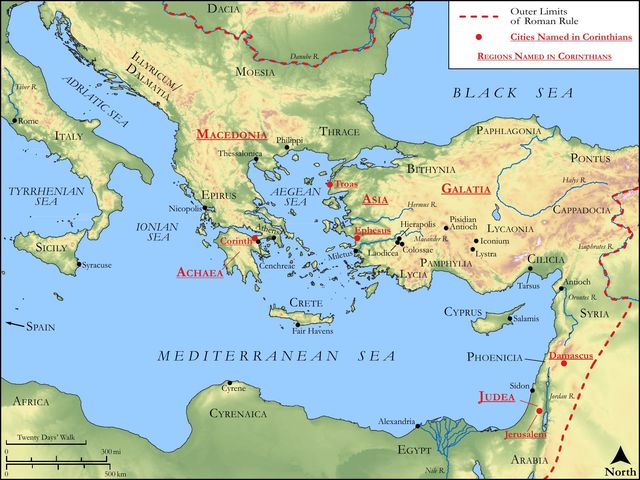
See on the biblical-era map

Study this verse
Public-domain commentary
Matthew Henry
From his Commentary on the Whole Bible. Henry comments on passages, not single verses — this entry covers 1 Corinthians 1:1–9. His two-level outline is real structure in the source text, so it is rendered as structure.
We have here the apostle's preface to his whole epistle, in which we may take notice,
I.Of the inscription, in which, according to the custom of writing letters then, the name of the person by whom it was written and the persons to whom it was written are both inserted. 1. It is an epistle from Paul, the apostle of the Gentiles, to the church of Corinth, which he himself had planted, though there were some among them that now questioned his apostleship (Co1 9:1, Co1 9:2), and vilified his person and ministry, Co2 10:10. The most faithful and useful ministers are not secure from this contempt. He begins with challenging this character: Paul, called to be an apostle of Jesus Christ, through the will of God. He had not taken this honour to himself, but had a divine commission for it. It was proper at any time, but necessary at this time, to assert his character, and magnify his office, when false teachers made a merit of running him down, and their giddy and deluded followers were so apt to set them up in competition with him. It was not pride in Paul, but faithfulness to his trust, in this juncture, to maintain his apostolical character and authority. And, to make this more fully appear, he joins Sosthenes with him in writing, who was a minister of a lower rank. Paul, and Sosthenes his brother, not a fellow-apostle, but a fellow-minister, once a ruler of the Jewish synagogue, afterwards a convert to Christianity, a Corinthian by birth, as is most probable, and dear to this people, for which reason Paul, to ingratiate himself with them, joins them with himself in his first salutations. There is no reason to suppose he was made a partaker of the apostle's inspiration, for which reasons he speaks, through the rest of the epistle, in his own name, and in the singular number. Paul did not in any case lessen his apostolical authority, and yet he was ready upon all occasions to do a kind and condescending thing for their good to whom he ministered. The persons to whom this epistle was directed were the church of God that was at Corinth, sanctified in Christ Jesus, and called to be saints. All Christians are thus far sanctified in Christ Jesus, that they are by baptism dedicated and devoted to him, they are under strict obligations to be holy, and they make profession of real sanctity. If they be not truly holy, it is their own fault and reproach. Note, It is the design of Christianity to sanctify us in Christ. He gave himself for us, to redeem us from all iniquity, and purify us to himself a peculiar people, zealous of good works. In conjunction with the church at Corinth, he directs the epistle to all that in every place call on the name of Christ Jesus our Lord, both theirs and ours. Hereby Christians are distinguished from the profane and atheistical, that they dare not live without prayer; and hereby they are distinguished from Jews and Pagans, that they call on the name of Christ. He is their common head and Lord. Observe, In every place in the Christian world there are some that call on the name of Christ. God hath a remnant in all places; and we should have a common concern for and hold communion with all that call on Christ's name.
II.Of the apostolical benediction.
Grace be to you, and peace, from God our Father, and from the Lord Jesus Christ. An apostle of the prince of peace must be a messenger and minister of peace. This blessing the gospel brings with it, and this blessing every preacher of the gospel should heartily wish and pray may be the lot of all among whom he ministers. Grace and peace - the favour of God, and reconciliation to him. It is indeed the summary of all blessings. The Lord lift up his countenance upon thee, and give thee peace, was the form of benediction under the Old Testament (Num 6:26), but this advantage we have by the gospel,
1.That we are directed how to obtain that peace from God: it is in and by Christ. Sinners can have no peace with God, nor any good from him, but through Christ.
2.We are told what must qualify us for this peace; namely, grace: first grace, then peace. God first reconciles sinners to himself, before he bestows his peace upon them.
III.Of the apostle's thanksgiving to God on their behalf.
Paul begins most of his epistles with thanksgiving to God for his friends and prayer for them. Note, The best way of manifesting our affection to our friends is by praying and giving thanks for them. It is one branch of the communion of saints to give thanks to God mutually for our gifts, graces, and comforts. He gives thanks,
1.For their conversion to the faith of Christ: For the grace which was given you through Jesus Christ, Co1 1:4. He is the great procurer and disposer of the favours of God. Those who are united to him by faith, and made to partake of his Spirit and merits, are the objects of divine favour. God loves them, bears them hearty good-will, and bestows on them his fatherly smiles and blessings.
2.For the abundance of their spiritual gifts. This the church of Corinth was famous for. They did not come behind any of the churches in any gift, Co1 1:7. He specifies utterance and knowledge, Co1 1:5. Where God has given these two gifts, he has given great capacity for usefulness. Many have the flower of utterance that have not the root of knowledge, and their converse is barren. Many have the treasure of knowledge, and want utterance to employ it for the good of others, and then it is in a manner wrapped up in a napkin. But, where God gives both, a man is qualified for eminent usefulness. When the church of Corinth was enriched with all utterance and all knowledge, it was fit that a large tribute of praise should be rendered to God, especially when these gifts were a testimony to the truth of the Christian doctrine, a confirmation of the testimony of Christ among them, Co1 1:6. They were signs and wonders and gifts of the Holy Ghost, by which God did bear witness to the apostles, both to their mission and doctrine (Heb 2:4), so that the more plentifully they were poured forth on any church the more full attestation was given to that doctrine which was delivered by the apostles, the more confirming evidence they had of their divine mission. And it is no wonder that when they had such a foundation for their faith they should live in expectation of the coming of their Lord Jesus Christ, Co1 1:7. It is the character of Christians that they wait for Christ's second coming; all our religion has regard to this: we believe it, and hope for it, and it is the business of our lives to prepare for it, if we are Christians indeed. And the more confirmed we are in the Christian faith the more firm is our belief of our Lord's second coming, and the more earnest our expectation of it.
IV.Of the encouraging hopes the apostle had of them for the time to come, founded on the power and love of Christ, and the faithfulness of God, Co1 1:8, Co1 1:9. He who had begun a good work in them, and carried it on thus far, would not leave it unfinished. Those that wait for the coming of our Lord Jesus Christ will be kept by him, and confirmed to the end; and those that are so will be blameless in the day of Christ: not upon the principle of strict justice, but gracious absolution; not in rigour of law, but from rich and free grace. How desirable is it to be confirmed and kept of Christ for such a purpose as this! How glorious are the hopes of such a privilege, whether for ourselves or others! To be kept by the power of Christ from the power of our own corruption and Satan's temptation, that we may appear without blame in the great day! O glorious expectation, especially when the faithfulness of God comes in to support our hopes! He who hath called us into the fellowship of his Son is faithful, and will do it, Th1 5:24. He who hath brought us into near and dear relation to Christ, into sweet and intimate communion with Christ, is faithful; he may be trusted with our dearest concerns. Those that come at his call shall never be disappointed in their hopes in him. If we approve ourselves faithful to God, we shall never find him unfaithful to us. He will not suffer his faithfulness to fail, Psa 89:33.
Historical interpretation
Two Centuries of Reception
6 surviving comments on this verse. Each one is dated, so this reads as a timeline rather than a list.
Select a marker to jump to its quote. Markers stagger vertically where authors wrote within a few decades of each other.
It is surely noteworthy that nobody doubted that it was kept by a Christian and Apostolic ordinance. So St. Paul argues from its Christian observance, in his rebuke of the Corinthians.
In this life the righteous person does not yet enjoy what he hopes for but rather endures suffering and danger. He is waiting for the revelation of Christ to come.
It is clear that Paul was a circumspect man who was full of concern as he awaited the day of judgment. On that day the Lord Jesus Christ will be revealed both to believers and to unbelievers. Then unbelievers will realize that what they did not want to believe is in fact true. Believers will rejoice, finding that what they believed in is more wonderful than they had imagined.
"So that ye come behind in no gift." A great question here arises. They who had been "enriched in all utterance," so as in no respect to "come behind in any gift," are they carnal? For if they were such at the beginning, much more now. How then does he call them "carnal?" For, saith he, "I was not able to speak unto you as unto spiritual, but as unto carnal." What must we say then? That having in the beginning believed, and obtained all gifts, (for indeed they sought them earnestly,) they became remiss afterwards. Or, if not so, that not unto all are either these things said or those; but the one to such as were amenable to his censures, the other to such as were adorned with his praises. For as to the fact that they still had gifts; "Each one," saith he, "hath a psalm, hath a revelation, hath a tongue, hath an interpretation; let all things be done unto edifying." And, "Let the prophets speak two or three." Or we may state it somewhat differently; that as it is usual with us to call the greater part the whole, so also he hath spoken in this place. Withal, I think he hints at his own proceedings; for he too had shewn forth signs; even as also he saith in the second Epistle to them, "Truly the signs of an Apostle were wrought among you in all patience:" and again, "For what is there wherein you were inferior to other churches?"
Or, as I was saying, he both reminds them of his own miracles and speaks thus with an eye to those who were still approved. For many holy men were there who had "set themselves to minister unto the saints," and had become "the first fruits of Achaia;" as he declareth towards the end.
In any case, although the praises be not very close to the truth, still however they are inserted by way of precaution, preparing the way beforehand for his discourse. For whoever at the very outset speaks things unpleasant, excludes his words from a hearing among the weaker: since if the hearers be his equals in degree they feel angry; if vastly inferior they will be vexed. To avoid this, he begins with what seem to be praises. I say, seem; for not even did this praise belong to them, but to the grace of God. For that they had remission of sins, and were justified, this was of the Gift from above. Wherefore also he dwells upon these points, which shew the loving-kindness of God, in order that he may the more fully purge out their malady.
"Waiting for the revelation of our Lord Jesus Christ." "Why make ye much ado," saith he, "why are ye troubled that Christ is not come? Nay, he is come; and the Day is henceforth at the doors." And consider his wisdom; how withdrawing them from human considerations he terrifies them by mention of the fearful judgment-seat, and thus implying that not only the beginnings must be good, but the end also. For with all these gifts, and with all else that is good, we must be mindful of that Day: and there is need of many labors to be able to come unto the end. "Revelation" is his word; implying that although He be not seen, yet He is, and is present even now, and then shall appear. Therefore there is need of patience: for to this end did ye receive the wonders, that ye may remain firm.
Christ’s second coming is described as a revelation, because now it is hidden from us.
Although we lack no gift, nevertheless we await the appearance of our Lord Jesus Christ. He will then keep us secure in all things and present us unimpeachable when the day of our Lord Jesus Christ comes. The end of the world shall arrive, when no flesh may glory in his sight.
Continue studying 1 Corinthians 1:7 across the web’s major study libraries — every link below opens this exact verse, chapter, or book on the destination site.
Read & Compare
 BibleGatewayThis verse in more than 200 translations and 70 languages.
 Bible.comThe YouVersion reader — hundreds of translations, reading plans, and highlights.
 ESV.orgCrossway's official English Standard Version reader.
 NET BibleThe NET translation with 60,000+ translators' notes on every rendering decision.
 STEP BibleTyndale House's free study tool — original text, vocabulary, and scholarly resources.
 BibliaLogos Bible Software's free web reader.
 USCCBThe New American Bible (Revised Edition) with the U.S. bishops' study notes.
Commentaries
 BibleHub CommentariesDozens of classic commentaries on this verse, gathered on one page.
 StudyLightMore than 100 commentary sets — the largest collection on the web.
 BibleRefPlain-English commentary on what this verse means, verse by verse.
 Enduring WordDavid Guzik's free commentary on this chapter, widely used by Bible teachers.
 Bible Study ToolsVerse commentary alongside Greek and Hebrew study aids.
Original Language & Research
- BibleHub InterlinearThe verse word by word — original language, transliteration, and English.
- BibleHub LexiconEvery word's original-language definition and Strong's entry.
 Blue Letter BibleDeep-study tools — Strong's numbers, concordance, and word studies.
 CNTR CollationThe earliest Greek manuscripts of this verse, collated letter by letter.
Sermons, Hymns & Audio


TrulyRandomVerse is not affiliated with these sites and doesn’t control their content. They’re linked because they’re genuinely useful.
Summary
First Corinthians 1:7 serves as a powerful affirmation of God's abundant grace bestowed upon the Corinthian believers, despite their many spiritual and ethical challenges. Paul declares that they lack no spiritual endowment, having been richly equipped by God for ministry and life in Christ. This verse also immediately directs their gaze, and ours, toward the ultimate hope of the Christian faith: the glorious return of the Lord Jesus Christ, for which they, and all believers, are called to eagerly wait.
Context
ShowHideLiterary Context
This verse is an integral part of Paul's opening thanksgiving (1 Corinthians 1:4-9), which immediately follows his customary apostolic greeting (1 Corinthians 1:1-3). Rather than immediately addressing the myriad of problems plaguing the Corinthian church—such as divisions, immorality, and doctrinal errors—Paul begins by commending them for God's gracious work among them. Specifically, verses 4-6 highlight that they were "enriched in everything" through Christ, in "all speech and all knowledge," confirming the "testimony about Christ" among them. Verse 7 then summarizes this divine endowment, stating their completeness in spiritual gifts, and seamlessly transitions to the eschatological hope that grounds their present reality. This initial commendation sets a foundational tone, reminding both Paul and the Corinthians that despite their failures, God's grace and faithfulness are paramount, providing the basis for the subsequent exhortations and corrections in the letter.
Historical & Cultural Context
The city of Corinth was a bustling, cosmopolitan hub in the Roman province of Achaia, known for its strategic location, thriving commerce, and diverse population. Its wealth and prominence also contributed to a reputation for moral laxity and syncretism, with numerous pagan temples and cults. The church in Corinth, established by Paul during his second missionary journey (Acts 18), was a diverse congregation composed of both Jews and Gentiles, including former idolaters and those from various social strata. This diverse background, coupled with the prevailing cultural influences of philosophical pride, sexual immorality, and social stratification, significantly impacted the church's internal dynamics. The concept of "spiritual gifts" (charismata) was particularly relevant in a culture that valued rhetoric, wisdom, and public displays of power, leading to potential misuse or misunderstanding of these divine endowments within the church. The expectation of Christ's "coming" (apokalypsis) was a vital counter-cultural hope for early Christians living in a pagan world, providing an anchor for their identity and conduct amidst societal pressures.
Key Themes
ShowHideFirst Corinthians 1:7 contributes significantly to several overarching themes within the letter and Pauline theology. It underscores the Sovereignty and Generosity of God in equipping His church, emphasizing that spiritual gifts are divine endowments, not human achievements. This theme is extensively developed in 1 Corinthians 12-14, where Paul addresses the proper understanding and use of these gifts amidst the Corinthians' abuses. Furthermore, the verse introduces the crucial theme of Eschatological Hope and the Second Coming of Christ, which serves as the ultimate motivation and perspective for Christian living. This future orientation is a recurring motif in Paul's writings, grounding present conduct in the anticipation of Christ's glorious return and the consummation of God's redemptive plan, as seen in passages like 1 Thessalonians 4:13-18. Finally, implicit in Paul's assurance is the theme of God's Faithfulness to Preserve His People, a foundational truth that assures believers that the God who initiates a work of grace will also bring it to completion, a concept echoed in Philippians 1:6.
Exposition and Analysis
ShowHideKey Word Analysis
ShowHideFrom charizomai, meaning "to give freely" or "to show favor," charisma refers to a "divine gratuity" or a "spiritual endowment." It denotes a special ability or capacity given by God's grace, not earned by human merit. In this context, it emphasizes that the Corinthians' spiritual richness was a direct result of God's unmerited favor, empowering them for service within the church.
This verb means "to be later," and by implication, "to be inferior" or "to fall short," "to be deficient," or "to lack." When Paul states they "come behind in no gift," he is emphatically declaring their complete sufficiency in spiritual endowments. They are not lacking or deficient in any spiritual ability necessary for their life and ministry as a church.
From apokalyptō, meaning "to uncover" or "to reveal," apokalypsis signifies a "disclosure," "unveiling," or "revelation." In this eschatological context, it refers to the glorious, public manifestation of Jesus Christ at His Second Coming. It is not merely an arrival but a full disclosure of His person, power, and glory, which will be evident to all.
Verse Breakdown
ShowHide"So that ye come behind in no gift;"
This opening clause serves as a powerful affirmation of the Corinthians' spiritual completeness. Despite their numerous moral and theological failings, Paul asserts that they are not deficient in any spiritual endowment. This is a profound statement of God's grace, highlighting that the Holy Spirit had generously distributed various charismata (gifts of grace) among them. This divine provision underscores God's faithfulness to equip His people, even those who are struggling, with everything necessary for their spiritual growth and the building up of the church.
"waiting for the coming of our Lord Jesus Christ:"
The second clause shifts focus from their present spiritual endowment to their future hope. The phrase "waiting for" (Greek: apekdéchomai) denotes an eager, earnest expectation and patient endurance. The object of this intense anticipation is "the coming" (Greek: apokálypsis, meaning "revelation" or "unveiling") of "our Lord Jesus Christ." This refers to the Second Advent of Christ, His glorious return, which is the ultimate culmination of God's redemptive plan. This eschatological hope provides the essential framework for understanding the purpose of their present gifts and serves as a powerful motivation for faithful living and perseverance.
Literary Devices
ShowHidePaul employs several literary devices in this concise verse. The most prominent is Affirmation, as he begins his letter by commending the Corinthian church for their spiritual richness, despite his later need to address their profound moral and theological issues. This initial praise establishes a tone of grace and acknowledges God's work among them, creating a foundation for the corrective instruction that follows. The verse also utilizes Eschatological Framing, immediately placing the present reality of their spiritual gifts within the broader context of Christ's future return. This serves to orient their perspective, reminding them that their present blessings and struggles are ultimately directed toward a glorious future. Furthermore, there is an implicit Contrast between the Corinthians' spiritual giftedness and their behavioral shortcomings, which will be extensively detailed in the subsequent chapters. By highlighting their completeness in gifts, Paul subtly sets up the tension that will drive the rest of his argument: how can such a gifted church be so deeply flawed in practice?
Theological and Thematic Connections
ShowHideThis verse powerfully connects the present reality of the Holy Spirit's work in the church with the future hope of Christ's return. The divine endowment of spiritual gifts is not an end in itself but serves to equip believers for faithful living and service while they eagerly await the consummation of God's kingdom. It highlights the generosity of God, who freely bestows His grace and power upon His people, and the faithfulness of Christ, who will ultimately return to perfect His church. This dual emphasis on present provision and future hope underscores the holistic nature of Christian discipleship, where spiritual empowerment in the present is always informed by the ultimate goal of Christ's glorious revelation.
Reflection and Application
ShowHideFirst Corinthians 1:7 offers profound encouragement and practical guidance for believers today. It reminds us that God, in His boundless grace, has fully equipped His church with every necessary spiritual gift. No believer is left wanting in the divine provision needed to serve God and build up the body of Christ. This truth should inspire confidence and humility: confidence in the Spirit's power working through us, and humility in recognizing that these abilities are unmerited gifts, not earned achievements. Furthermore, the verse calls us to live with a vivid and active expectation of Christ's return. This eschatological hope is not merely a theological concept but a living reality that shapes our priorities, motivates our perseverance through trials, and fuels our commitment to holiness and mission. Our present use of gifts and our daily walk are to be lived in light of His imminent "unveiling," ensuring that our lives reflect the glory of the One we eagerly await.
Questions for Reflection
ShowHideFAQ
ShowHideWhat does Paul mean by "ye come behind in no gift"?
ShowHideBy stating "ye come behind in no gift," Paul is affirming that the Corinthian believers were fully and abundantly endowed with all the spiritual gifts (Greek: charismata) necessary for the life and ministry of the church. This means they were not lacking any specific spiritual ability or manifestation of the Holy Spirit's power. Despite the many problems and divisions that plagued the Corinthian church, Paul's opening thanksgiving emphasizes God's faithfulness in equipping them, highlighting that their spiritual deficiency was not due to a lack of divine provision, but rather to their misuse or misunderstanding of the gifts they already possessed. This sets the stage for Paul's later instructions regarding the proper exercise of spiritual gifts in 1 Corinthians 12-14.
Why is "waiting for the coming of our Lord Jesus Christ" so important in this context?
ShowHideThe phrase "waiting for the coming of our Lord Jesus Christ" (Greek: apekdéchomai for "waiting for" and apokálypsis for "coming") is crucial because it provides the ultimate eschatological framework for the Corinthians' present reality and the purpose of their spiritual gifts. This eager anticipation of Christ's glorious return (His "unveiling") served as a powerful motivation for early Christians to live faithfully, endure suffering, and utilize their gifts for God's glory. It shifts their focus from present struggles and earthly concerns to the future hope of God's completed work and the final redemption. For the Corinthians, this reminder of Christ's return would have underscored the temporary nature of their current challenges and the eternal significance of their spiritual walk, urging them toward holiness and unity in light of His imminent revelation, a theme also found in Philippians 3:20-21.
Christ-Centered Fulfillment
ShowHideFirst Corinthians 1:7 finds its profound Christ-centered fulfillment in the person and work of Jesus Christ, who is both the source of all spiritual gifts and the ultimate object of our hope. It is "in Christ Jesus" (1 Corinthians 1:4) that the Corinthians were enriched with every spiritual endowment, for He is the one through whom the Holy Spirit is poured out (Acts 2:33). All charismata flow from His ascended Lordship, enabling His body, the church, to function and grow until His return, as described in Ephesians 4:7-8. Moreover, the "coming of our Lord Jesus Christ" is the climactic event toward which all of redemptive history moves. His first coming inaugurated the age of grace, bringing salvation and the indwelling Spirit; His second coming, His glorious "revelation" (apokálypsis), will consummate His kingdom, bring final judgment, and usher in the new heavens and new earth. Thus, our present spiritual giftedness is a foretaste and a means of preparation for the full manifestation of His glory, when we will see Him "as He is" (1 John 3:2) and be fully conformed to His image (Romans 8:29). He is the Alpha and the Omega, the beginning and the end, the one who equips us now and the one for whom we eagerly wait to return in triumph (Revelation 22:20).