


Acts 3:8
“The Healing of the Lame Man”Acts 3:1–11
Bible text: King James Version (1769 Blayney text) · Public domain
Bible text: King James Version with Strong's numbers · Public domain
Bible text: Berean Standard Bible · Public domain
Bible text: American Standard Version (1901) · Public domain
Bible text: World English Bible, Messianic edition · Public domain
Bible text: Geneva Bible (1599) · Public domain
Bible text: Young's Literal Translation · Public domain
- καὶkaiAndG2532CONJConjunction
- ἐξαλλόμενοςexallomenosleaping upG1814V-PNP-NSMVerb Present Middle Or Passive Deponent Participle Nominative Singular Masculine
- ἔστηestēhe stoodG2476V-2AAI-3SVerb 2nd Aorist Active Indicative 3rd Singular
- καὶkaiandG2532CONJConjunction
- περιεπάτειperiepateiwas walkingG4043V-IAI-3SVerb Imperfect Active Indicative 3rd Singular
- καὶkaiandG2532CONJConjunction
- εἰσῆλθενeisēlthenhe enteredG1525V-2AAI-3SVerb 2nd Aorist Active Indicative 3rd Singular
- σὺνsunwithG4862PREPPreposition
- αὐτοῖςautoisthemG846P-DPMPersonal pronoun Dative Plural Masculine
- εἰςeisintoG1519PREPPreposition
- τὸtotheG3588T-ASNDefinite article Accusative Singular Neuter
- ἱερὸνhi'erontempleG2411N-ASNNoun Accusative Singular Neuter
- περιπατῶνperipatōnwalkingG4043V-PAP-NSMVerb Present Active Participle Nominative Singular Masculine
- καὶkaiandG2532CONJConjunction
- ἁλλόμενοςhallomenosleapingG242V-PNP-NSMVerb Present Middle Or Passive Deponent Participle Nominative Singular Masculine
- καὶkaiandG2532CONJConjunction
- αἰνῶνainōnpraisingG134V-PAP-NSMVerb Present Active Participle Nominative Singular Masculine
- τὸνton[the]G3588T-ASMDefinite article Accusative Singular Masculine
- θεόνtheonGodG2316N-ASM-TNoun Accusative Singular Masculine Title
English is a literal word-by-word gloss of the Greek, not the KJV's wording. Why?
This is the Greek text the KJV’s translators worked from, with each word given its own literal English meaning in this verse. The word-by-word meanings were prepared by scholars at Tyndale House, Cambridge. The KJV translates whole sentences rather than single words, so its wording often differs: one Greek word can become several English words, and the KJV may say “charity” where the word-by-word meaning reads “love”. The two are made for different purposes, and both are faithful to the Greek. To read the KJV’s own wording, switch to the KJV text.
Words in [ ] are added by the English.
Details
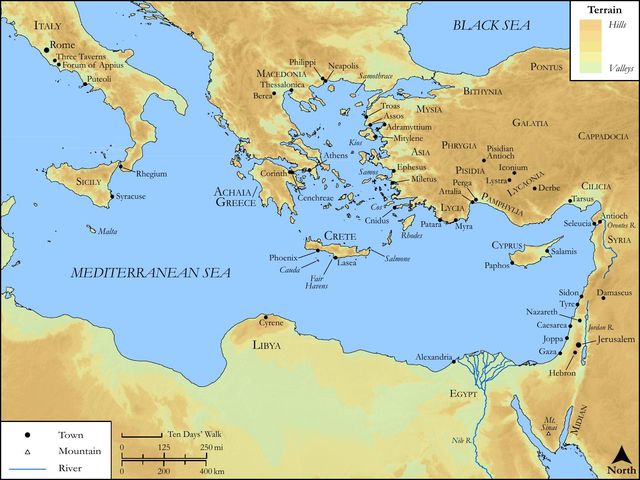
See on the biblical-era map
Study this verse
Public-domain commentary
Matthew Henry
From his Commentary on the Whole Bible. Henry wrote on whole passages, and this entry covers Acts 3:1–11. He set out his notes in a four-level outline, kept here as he numbered it.
We were told in general (Acts 2:43) that many signs and wonders were done by the apostles, which are not written in this book; but here we have one given us for an instance. As they wrought miracles, not upon every body as every body had occasion for them, but as the Holy Spirit gave direction, so as to answer the end of their commission; so all the miracles they did work are not written in this book, but such only are recorded as the Holy Ghost thought fit, to answer the end of this sacred history.
I.The persons by whose ministry this miracle was wrought were Peter and John, two principal men among the apostles; they were so in Christ's time, one speaker of the house for the most part, the other favourite of the Master; and they continue so. When, upon the conversion of thousands, the church was divided into several societies, perhaps Peter and John presided in that which Luke associated with, and therefore he is more particular in recording what they said and did, as afterwards what Paul said and did when he attended him, both the one and the other being designed for specimens of what the other apostles did.
Peter and John had each of them a brother among the twelve, with whom they were coupled when they were sent out; yet now they seem to be knit together more closely than either of them to his brother, for the bond of friendship is sometimes stronger than that of relation: there is a friend that sticks closer than a brother. Peter and John seem to have had a peculiar intimacy after Christ's resurrection more than before, John 20:2. The reason of which (if I may have liberty to conjecture) might be this, that John, a disciple made up of love, was more compassionate to Peter upon his fall and repentance, and more tender of him in his bitter weeping for his sin, than any other of the apostles were, and more solicitous to restore him in the spirit of meekness, which made him very dear to Peter ever after; and it was good evidence of Peter's acceptance with God, upon his repentance, that Christ's favourite was made his bosom friend. David prayed, after his fall, Let those that fear thee turn unto me, Psalm 119:79.
II.The time and place are here set down.
1.It was in the temple, whither Peter and John went up together, because it was the place of concourse; there were the shoals of fish among which the net of the gospel was to be cast, especially during the days of pentecost, within the compass of which we may suppose this to have happened. Note, It is good to go up to the temple, to attend on public ordinances; and it is comfortable to go up together to the temple: I was glad when they said unto me, Let us go. The best society is society in worshipping God.
2.It was at the hour of prayer, one of the hours of public worship commonly appointed and observed among the Jews. Time and place are two necessary circumstances of every action, which must be determined by consent, as is most convenient for edification. With reference to public worship, there must be a house of prayer and an hour of prayer: the ninth hour, that is, three o'clock in the afternoon, was one of the hours of prayer among the Jews; nine in the morning and twelve at noon were the other two. See Psalm 55:17; Daniel 6:10. It is of use for private Christians so far to have their hours of prayer as may serve, though not to bind, yet to remind conscience: every thing is beautiful in its season.
III.The patient on whom this miraculous cure was wrought is here described, Acts 3:2.
He was a poor lame beggar at the temple gate. 1. he was a cripple, not by accident, but born so; he was lame from his mother's womb, as it should seem, by a paralytic distemper, which weakened his limbs; for it is said in the description of his cure (Acts 3:7), His feet and ankle bones received strength. Some such piteous cases now and then there are, which we ought to be affected with and look upon with compassion, and which are designed to show us what we all are by nature spiritually: without strength, lame from our birth, unable to work or walk in God's service. 2. He was a beggar. Being unable to work for his living, he must live upon alms; such are God's poor. He was laid daily by his friends at one of the gates of the temple, a miserable spectacle, unable to do any thing for himself but to ask alms of those that entered into the temple or came out. There was a concourse, - a concourse of devout good people, from whom charity might be expected, and a concourse of such people when it might be hoped they were in the best frame; and there he was laid. Those that need, and cannot work, must not be ashamed to beg. He would not have been laid there, and laid there daily, if he had not been used to meet with supplies, daily supplies there. Note, Our prayers and our alms should go together; Cornelius's did, Acts 10:4. Objects of charity should be in a particular manner welcome to us when we go up to the temple to pray; it is a pity that common beggars at church doors should any of them be of such a character as to discourage charity; but they ought not always to be overlooked: some there are surely that merit regard, and better feed ten drones, yea, and some wasps, than let one bee starve. The gate of the temple at which he was laid is here named: it was called Beautiful, for the extraordinary splendour and magnificence of it. Dr. Lightfoot observes that this was the gate that led out of the court of the Gentiles into that of the Jews, and he supposes that the cripple would beg only of the Jews, as disdaining to ask any thing of the Gentiles. But Dr. Whitby takes it to be at the first entrance into the temple, and beautified sumptuously, as became the frontispiece of that place where the divine Majesty vouchsafed to dwell; and it was no diminution to the beauty of this gate that a poor man lay there begging. 3. He begged of Peter and John (Acts 3:3), begged an alms; this was the utmost he expected from them, who had the reputation of being charitable men, and who, though they had not much, yet did good with what they had. It was not many weeks ago that the blind and the lame came to Christ in the temple, and were healed there, Matthew 21:14. And why might not he have asked more than an alms, if he knew that Peter and John were Christ's messengers, and preached and wrought miracles in his name? But he had that done for him which he looked not for; he asked an alms, and had a cure.
IV.We have here the method of the cure.
1.His expectations were raised. Peter, instead of turning his eyes form him, as many do from objects of charity, turned his eyes to him, nay, he fastened his eyes upon him, that his eye might affect his heart with compassion towards him, Acts 3:4. John did so too, for they were both guided by one and the same Spirit, and concurred in this miracle; they said, Look on us. Our eye must be ever towards the Lord (the eye of our mind), and, in token of this, the eye of the body may properly be fixed on those whom he employs as the ministers of his grace. This man needed not to be bidden twice to look on the apostles; for he justly thought this gave him cause to expect that he should receive something form them, and therefore he gave heed to them, Acts 3:5. Note, We must come to God both to attend on his word and to apply ourselves to him in prayer, with hearts fixed and expectations raised. We must look up to heaven and expect to receive benefit by that which God speaks thence, and an answer of peace to the prayers sent up thither. I will direct my prayer unto thee, and will look up.
2.His expectation of an alms was disappointed. Peter said, "Silver and gold have I none, and therefore none to give thee;" yet he intimated that if he had had any he would have given him an alms, not brass, but silver or gold. Note,
(1.)It is not often that Christ's friends and favourites have abundance of the wealth of this world. The apostles were very poor, had but just enough for themselves, and no overplus. Peter and John had abundance of money laid at their feet, but this was appropriated to the maintenance of the poor of the church, and they would not convert any of it to their own use, nor dispose of it otherwise than according tot he intention of the donors. Public trusts ought to be strictly and faithfully observed.
(2.)Many who are well inclined to works of charity are yet not in a capacity of doing any thing considerable, while others, who have wherewithal to do much, have not a heart to do any thing.
3.His expectations, notwithstanding, were quite outdone. Peter had not money to give him; but,
(1.)He had that which was better, such an interest in heaven, such a power from heaven, as to be able to cure his disease. Note, Those who are poor in the world may yet be rich, very rich, in spiritual gifts, graces, and comforts; certainly there is that which we are capable of possessing which is infinitely better than silver and gold; the merchandise and gain of it are better, Job 28:12, etc.; Proverbs 3:14, etc.
(2.)He gave him that which was better - the cure of his disease, which he would gladly have given a great deal of silver and gold for, if he had had it, and the cure could have been so obtained. This would enable him to work for his living, so that he would not need to beg any more; nay, he would have to give to those that needed, and it is more blessed to give than to receive. A miraculous cure would be a greater instance of God's favour, and would put a greater honour upon him, than thousands of gold and silver could. observe, When Peter had no silver and gold to give, yet (says he) such as I have I give thee. Note, Those may be, and ought to be, otherwise charitable and helpful to the poor, who have not wherewithal to give in charity; those who have not silver and gold have their limbs and senses, and with these may be serviceable to the blind, and lame, and sick, and if they be not, as there is occasion, neither would they give to them if they had silver and gold. As every one hath received the gift, so let him minister it. Let us now see how the cure was wrought.
[1.]Christ sent his word, and healed him (Psalm 107:20); for healing grace is given by the word of Christ; this is the vehicle of the healing virtue derived from Christ. Christ spoke cures by himself; the apostles spoke them in his name. Peter bids a lame man rise up and walk, which would have been a banter upon him if he had not premised in the name of Jesus Christ of Nazareth: "I say it by warrant from him, and it shall be done by power from him, and all the glory and praise of it shall be ascribed to him." He calls Christ Jesus of Nazareth, which was a name of reproach, to intimate that the indignities done him on earth served but as a foil to his glories now that he was in heaven. "Give him what name you will, call him if you will in scorn Jesus of Nazareth, in that name you shall see wonders done; for, because he humbled himself, thus highly was he exalted." He bids the cripple rise up and walk, which does not prove that he had power in himself to do it, but that if he attempt to rise and walk, and, in a sense of his own impotency, depend upon a divine power to enable him to do it, he shall be enabled; and by rising and walking he must evidence what that power has wrought upon him; and then let him take the comfort, and let God have the praise. Thus it is in the healing of our souls, which are spiritually impotent.
[2.]Peter lent his hand, and helped him (Acts 3:7): He took him by the right hand, in the same name in which he had spoken to him to arise and walk, and lifted him up. Not that this could contribute any thing to his cure; but it was a sign, plainly intimating the help he should receive from God, if he exerted himself as he was bidden. When God by his word commands us to rise, and walk in the way of his commandments, if we mix faith with that word, and lay our souls under the power of it, he will give his Spirit to take us by the hand, and lift us up. If we set ourselves to do what we can, God has promised his grace to enable us to do what we cannot; and by that promise we partake of a new nature, and that grace shall not be in vain; it was not here: His feet and ankle-bones received strength, which they had not done if he had not attempted to rise, and been helped up; he does his part, and Peter does his, and yet it is Christ that does all: it is he that puts strength into him. As the bread was multiplied in the breaking, and the water turned into wine in the pouring out, so strength was given to the cripple's feet in his stirring them and using them.
V.Here is the impression which this cure made upon the patient himself, which we may best conceive of if we put our soul into his soul's stead.
1.He leaped up, in obedience to the command, Arise. He found in himself such a degree of strength in his feet and ankle-bones that he did not steal up gently, with fear and trembling, as weak people do when they begin to recover strength; but he started up, as one refreshed with sleep, boldly, and with great agility, and as one that questioned not his own strength. The incomes of strength were sudden, and he was no less sudden in showing them. He leaped, as one glad to quit the bed or pad of straw on which he had lain so long lame.
2.He stood, and walked. He stood without either leaning or trembling, stood straight up, and walked without a staff. He trod strongly, and moved steadily; and this was to manifest the cure, and that it was a thorough cure. Note, Those who have had experience of the working of divine grace upon them should evidence what they have experienced. Has God put strength into us? Let us stand before him in the exercises of devotion; let us walk before him in all the instances of a religious conversation. Let us stand up resolutely for him, and walk cheerfully with him, and both in strength derived and received form him.
3.He held Peter and John, Acts 3:11. We need not ask why he held them. I believe he scarcely knew himself: but it was in a transport of joy that he embraced them as the best benefactors he had ever met with, and hung upon them to a degree of rudeness; he would not let them go forward, but would have them stay with him, while he published to all about him what God had done for him by them. Thus he testified his affection to them; he held them, and would not let them go. Some suggest that he clung to them for fear lest, if they should leave him, his lameness should return. Those whom God hath healed love those whom he made instruments of their healing, and see the need of their further help.
4.He entered with them into the temple. His strong affection to them held them; but it could not hold them so fast as to keep them out of the temple, whither they were going to preach Christ. We should never suffer ourselves to be diverted by the utmost affectionate kindnesses of our friends from going in the way of our duty. But, if they will not stay with him, he is resolved to go with them, and the rather because they are going into the temple, whence he had been so long kept by his weakness and his begging: like the impotent man whom Christ cured, he was presently found in the temple, John 5:14. He went into the temple, not only to offer up his praises and thanksgivings to God, but to hear more from the apostles of that Jesus in whose name he had been healed. Those that have experienced the power of Christ should earnestly desire to grow in their acquaintance with Christ.
5.He was there walking, and leaping, and praising God. Note, The strength God has given us, both in mind and body, should be made us of to his praise, and we should study how to honour him with it. Those that are healed in his name must walk up and down in his name and in his strength, Zechariah 10:12. This man, as soon as he could leap, leaped for joy in God, and praised him. Here was that scripture fulfilled (Isaiah 35:6): Then shall the lame man leap as a hart. Now that this man was newly cured he was in this excess of joy and thankfulness. All true converts walk and praise God; but perhaps young converts leap more in his praises.
VI.How the people that were eye-witnesses of this miracle were influenced by it we are next told.
1.They were entirely satisfied in the truth of the miracle, and had nothing to object against it. They knew it was he that sat begging at the beautiful gate of the temple, Acts 3:10. He had sat there so long that they all knew him; and for this reason he was chosen to be the vessel of this mercy. Now they were not so perverse as to make any doubt whether he was the same man, as the Pharisees had questioned concerning the blind man that Christ cured, John 9:9, John 9:18. They now saw him walking, and praising God (Acts 3:9), and perhaps took notice of a change in his mind; for he was now as loud in praising God as he had before been in begging relief. The best evidence that it was a complete cure was that he now praised God for it. Mercies are then perfected, when they are sanctified.
2.They were astonished at it: They were filled with wonder and amazement (Acts 3:10); greatly wondering, Acts 3:11. They were in an ecstasy. There seems to have been this effect of the pouring out of the Spirit, that the people, at least those in Jerusalem, were much more affected with the miracles the apostles wrought than they had been with those of the same kind that had been wrought by Christ himself; and this was in order to the miracles answering their end.
3.They gathered about Peter and John: All the people ran together unto them in Solomon's porch: some only to gratify their curiosity with the sight of men that had such power; others with a desire to hear them preach, concluding that their doctrine must needs be of divine origin, which thus had a divine ratification. They flocked to them in Solomon's porch, a part of the court of the Gentiles, where Solomon had built the outer porch of the temple; or, some cloisters or piazzas which Herod had erected upon the same foundation upon which Solomon had built the stately porch that bore his name, Herod being ambitious herein to be a second Solomon. Here the people met, to see this great sight.
Historical interpretation
Eleven Centuries of Reception
4 surviving comments on this verse. Each one is dated, so this reads as a timeline rather than a list.
Select a marker to jump to its quote. Markers stagger vertically where authors wrote within a few decades of each other.
"And immediately his feet and ankle bones received strength. And he leaping up stood, and walked." Perhaps it was by way of trying himself that he put it thus to further proof, whether perchance the thing done might not be to no purpose. His feet were weak; it was not that he had lost them. Some say that he did not even know how to walk. "And entered with them into the temple." Of a truth it was marvellous. The Apostles do not urge him; but of his own accord he follows, by the act of following pointing out his benefactors. "And leaping and praising God;" not admiring them, but God that wrought by them. The man was grateful.
And the wonder is, that he believed so readily. For those who are set free from diseases of long standing, hardly believe their very eyesight. Once healed, he remains with the Apostles, giving thanks to God. "And he entered," it is said, "with them into the temple, walking, and leaping, and praising God." Observe how restless he is, in the eagerness of his delight, at the same time shutting the mouths of the Jews. Also, that he leaped, was to prevent the suspicion of hypocrisy; for after all, this was beyond the possibility of deception. For if previously he was totally unable to walk, even when hunger pressed hard (and indeed he would not have chosen to share with his bearers the proceeds of his begging, if he had been able to manage for himself), this holds still more in the present case. And how should he have feigned in behalf of those who had given him no alms? But the man was grateful, even after his recovery. And thus on either side his faith is shown, both by his thankfulness, and by the recent event.
And leaping up, he stood and walked. And he entered the temple with them. The order of perfection is clear: first, he who had lain down rises, then he seizes strength, and thus he enters the gate of the kingdom with the apostles.
And leaping and praising God:
To conceal the kind deeds of God is a matter of ingratitude; to attribute them to human endeavor is impiety.
Continue studying Acts 3:8 across the web’s major study libraries — every link below opens this exact verse, chapter, or book on the destination site.
Read & Compare
 BibleGatewayThis verse in more than 200 translations and 70 languages.
 Bible.comThe YouVersion reader — hundreds of translations, reading plans, and highlights.
 ESV.orgCrossway's official English Standard Version reader.
 NET BibleThe NET translation with 60,000+ translators' notes on every rendering decision.
 STEP BibleTyndale House's free study tool — original text, vocabulary, and scholarly resources.
 BibliaLogos Bible Software's free web reader.
 USCCBThe New American Bible (Revised Edition) with the U.S. bishops' study notes.
Commentaries
 BibleHub CommentariesDozens of classic commentaries on this verse, gathered on one page.
 StudyLightMore than 100 commentary sets — the largest collection on the web.
 BibleRefPlain-English commentary on what this verse means, verse by verse.
 Enduring WordDavid Guzik's free commentary on this chapter, widely used by Bible teachers.
 Bible Study ToolsVerse commentary alongside Greek and Hebrew study aids.
Original Language & Research
- BibleHub InterlinearThe verse word by word — original language, transliteration, and English.
- BibleHub LexiconEvery word's original-language definition and Strong's entry.
 Blue Letter BibleDeep-study tools — Strong's numbers, concordance, and word studies.
 CNTR CollationThe earliest Greek manuscripts of this verse, collated letter by letter.
Sermons, Hymns & Audio


TrulyRandomVerse is not affiliated with these sites and does not control their content.
Written with AI assistance. Always check it against Scripture.
This verse
The man leaps up, stands and walks, then goes into the temple with Peter and John, walking, leaping and praising God.
“And he leaping up stood, and walked,”
He springs up, stands and walks, three things he had never done.
“and entered with them into the temple,”
He goes through the gate where he had always sat outside, into the courts of worship.
“walking, and leaping, and praising God.”
His joy is in his feet and on his lips, and he gives the praise to God.
Passage studyActs 3:1–11
The Lame Man Walks in the Name of Jesus
Summary
Peter and John go up to the temple at the ninth hour, the hour of prayer. At the gate called Beautiful they meet a man who has been lame from birth and is carried there every day to beg from the worshippers, and he asks them for alms. Peter fixes his eyes on him and says, “Look on us,” and the man looks up, expecting a gift. Then Peter says, “Silver and gold have I none; but such as I have give I thee: In the name of Jesus Christ of Nazareth rise up and walk.” He takes the man by the right hand and lifts him, and at once his feet and ankle bones are made strong. The man leaps up, walks into the temple with them, and praises God. The people know him as the beggar from the gate, they are filled with wonder, and they run together to Solomon’s porch, where Peter will tell them whose power has done this (Acts 3:12–26). The risen Christ heals by his name, openly and completely, and he gives the man far more than he asked for.
Peter and John Go Up at the Hour of Prayer
This scene follows Pentecost (Acts 2). The Spirit had been poured out, thousands had believed, and the believers continued in the apostles’ teaching, in fellowship, in breaking of bread and in prayers, while many wonders and signs were done by the apostles (Acts 2:42–47). Luke now turns from that wider picture to one afternoon. Peter and John go up “together”, and the two stand side by side again when the rulers marvel at their boldness (Acts 4:13).
“Went up” is anabaínō, to go up, a fitting word for a temple that stood on its mount. The word for the temple, hierón, means the whole sacred precinct, with its courts and porches, as distinct from the naos, the sanctuary itself. The apostles are going into the public courts where the people of Israel gathered. The prayer they go to, proseuchḗ, is prayer to God, and the same word can also name a place of prayer.
The word énnatos simply means “ninth”. The hours were counted from sunrise, at about six in the morning, so the ninth hour fell at about three in the afternoon. It was the time of the evening sacrifice and the prayers that went with it, and with the third hour (about nine in the morning) and the sixth (about noon) it was one of the set hours when Jews prayed. David speaks of praying evening, morning and noon (Psalm 55:17), and Daniel knelt to pray three times a day (Daniel 6:10). After the ascension the disciples were continually in the temple, praising and blessing God (Luke 24:53). Peter and John keep that same habit, and God uses it. Their ordinary hour of prayer brings them to the gate at the very time this man is lying there.
Why were Peter and John still going to the temple?
They were Jews who had come to know Jesus as Israel’s Messiah, and the temple was still the house where Israel came to pray, so they went on worshipping there at the set hours. Their faith in Christ grew out of the worship of their fathers. Jesus came to fulfil the law and the prophets (Matthew 5:17), and the Spirit who filled the apostles had been poured out by the exalted Christ (Acts 2:33). Going to the temple also put them among the many devout Jews who gathered there, in a public place where the gospel could be heard. Jesus had spoken of his own body as the temple (John 2:19–21), so the apostles walk into the old house of prayer carrying the news of the one it pointed to, and the healing at its gate is done in his name.
A Man Lame from His Mother’s Womb
The man in verse 2 is chōlós, lame or halt, and he has been so “from his mother’s womb”. He was born unable to walk, so his lameness had lasted his whole life and no human means had cured it. That is why the healing that follows is so plainly God’s work. Jesus said of a man born blind that his blindness was there so that the works of God should be made manifest in him, and then he healed him (John 9:1–7).
He “was carried”, and the verb bastázō means to lift or bear. Others laid him at the gate every day. He depended on them to bring him and on the worshippers to keep him alive. For a man unable to work, begging was the common way to live, and the temple gates were the best places for it, because devout people passed through them on their way to pray. Giving to the poor, called tzedakah, was counted an act of piety in Israel, rooted in the law’s commands to care for the needy. Daniel counselled Nebuchadnezzar to break off his sins by righteousness and by showing mercy to the poor (Daniel 4:27). The man had chosen his place well. Soon the believers themselves would share what they had so that each one’s need was met (Acts 4:32–35).
The alms he begs for is eleēmosýnē, a word for compassion shown to the poor and then for the gift itself, and the same word stands behind “alms” in verses 3 and 10. He was asking for mercy in the only form he expected to get it.
In verse 3 he sees Peter and John “about to go into the temple”. “Seeing” is eídō, to see, the ordinary verb for sight. Behind “asked” the Greek has erōtáō, to ask or request, together with lambánō, to take or receive, so he asks to receive an alms. It is a small request from a man who asks everyone the same thing, and it is about to be answered with far more than he knew to ask.
Where was the Beautiful gate?
The gate “which is called Beautiful” was one of the temple’s more ornate and prominent entrances, with a steady stream of worshippers passing through it. Its exact place is uncertain. It is often taken to have been on the eastern side, perhaps the gate known as the Nicanor Gate, and it may have been made of costly Corinthian bronze. The word for Beautiful, hōraîos, means timely, and so flourishing or lovely. In verse 2 the gate is a thýra, a doorway or entrance, and in verse 10 it is a pýlē, a gate, so the two verses share the English word over different Greek ones. A man broken in body sat every day at the lovely gate of God’s house, and that is where God chose to make him whole.
“Look on Us”
Peter, “fastening his eyes upon him”, looks at the man intently. The verb atenízō means to gaze intently or fix the eyes on something, and it is used of ordinary looks as well as solemn ones. Luke tells of eyes fastened on Jesus in the synagogue at Nazareth (Luke 4:20) and of the council looking steadfastly on Stephen (Acts 6:15). John looks too, for Peter does this “with” him (sýn, together with), and the two act as one.
Then Peter “said”, with épō, the common verb for speaking, “Look on us.” The verb blépō means to look at. Peter has fixed his own eyes on the man, and now he asks the man to fix his eyes on them. A beggar at a busy gate calls out to a crowd that hurries by, and a coin is often dropped with hardly a glance. Peter stops, looks at him, and asks for his whole attention.
Verse 5 gives the man’s answer. “He gave heed unto them”, and epéchō means to hold upon, and so to fix one’s attention on something. He was “expecting”, prosdokáō, to look for something in thought, in hope or in fear, and to wait for it. He expected “to receive something of them”, with lambánō again, to take or receive. Everything in his life told him that “something” meant a coin or some food. He was right to look to them, though his hope was small, and God was about to give him more than he could have thought to ask.
Why did Peter tell the man to look on them?
Peter wanted the man’s full attention, so that he would know who was speaking to him and take in what was about to be given. The command turned him from the passing crowd and from his usual plea to the two men in front of him, and it made the moment personal. It also prepared him to receive the healing knowingly and then to praise God for it (Acts 3:8). Peter asks for the man’s eyes only for a moment. In his sermon he makes clear that the power was Jesus’ own, and that faith in his name made the man strong (Acts 3:16). The man’s look at the apostles leads on to the one Hebrews calls the author and finisher of our faith (Hebrews 12:2).
“Silver and Gold Have I None”
Peter begins with the plain truth, “Silver and gold have I none.” The words behind silver and gold, argýrion and chrysíon, can both mean money in coin. The apostles had no wealth to draw on, and their work rested on Christ’s power. Then he turns, “but such as I have give I thee.” The verb is dídōmi, to give. Peter does have something, and he gives it freely. What he has is the authority of Jesus, who had given his apostles power to heal every sickness (Matthew 10:1).
The gift comes “In the name of Jesus Christ of Nazareth”. The word for name, ónoma, means a name and also what stands behind it, authority and character. “Christ” (Christós) means the anointed one, the Messiah, and “of Nazareth” (Nazōraîos) ties him to the town he came from, the town of which Nathanael once asked whether any good thing could come out of it (John 1:46). In the temple courts Peter names the Nazarene as the Messiah, and the healing shows that name to be true.
Then come the commands, “rise up and walk”. “Rise up” is egeírō, to wake or raise, the word used of rising from sleep, from lying down, from sickness and from death, and of Christ raised by God. It is the same verb that stands behind “lifted him up” in verse 7. “Walk” is peripatéō, to walk or walk about, and figuratively to live and conduct oneself. The man has never taken a step in his life, and Peter tells him to walk.
What does it mean to act “in the name of Jesus Christ”?
To act in his name is to act by his authority, as his representative, so that the deed is his. Peter heals as Christ’s servant, and Christ himself makes the man whole. Peter tells the rulers so, when he says that this man stands before them whole by the name of Jesus Christ of Nazareth, whom they crucified and whom God raised from the dead (Acts 4:10). He goes on, “Neither is there salvation in any other: for there is none other name under heaven given among men, whereby we must be saved” (Acts 4:12). The name carries this power because God raised Jesus up, loosing the pains of death (Acts 2:24). Believers are given the same name to pray in (John 14:13–14), and Paul tells the Colossians to do all things in the name of the Lord Jesus (Colossians 3:17). Calling on the name means calling on a living Lord who does the work himself.
Were healings like this common in the early church?
Acts records many such signs in those first years. Many wonders and signs were done by the apostles (Acts 2:43), more were done by their hands among the people (Acts 5:12), and Stephen, full of faith and power, did great wonders and miracles (Acts 6:8). Jesus had promised his apostles power when the Holy Spirit came on them (Acts 1:8), and he had said that whoever believes in him would do the works that he did (John 14:12). These signs confirmed the apostles’ witness that Jesus had risen, and they drew many to faith.
Lifted Up and Made Strong
Peter acts on his word. “He took him by the right hand”, and the verb piázō means to take firm hold, used both of gently taking someone by the hand and of an arrest. The words for the right hand, dexiós and cheír, mean simply “right” and “hand”, the hand a man would hold out. Then Peter “lifted him up”, with the same egeírō as “rise up” in verse 6, so Peter’s hand helps the man do what the command has told him to do. Jesus once took Peter’s mother-in-law by the hand and lifted her up in the same way (Mark 1:31).
“And immediately his feet and ankle bones received strength.” “Immediately” is parachrēma, instantly, at that very moment. “Feet” is básis, a step or base and so the foot, and “ankle bones” is sphyrón, the ankle. These are the very parts that had never held him up. “Received strength” is stereóō, to make solid or firm, to make strong. What had been weak from birth was made firm at once, with nothing gradual about it, just as the palsied man Jesus healed rose up immediately before them all (Luke 5:25).
Walking, Leaping and Praising God
“And he leaping up stood.” Exállomai means to spring forth or leap up, and the man who had been carried every day of his life springs to his feet and stands (hístēmi). Then he “walked”, with peripatéō, the very verb of Peter’s command. He “entered with them into the temple”, going in with Peter and John through the gate where he had always sat outside. Then Luke says it again, “walking, and leaping, and praising God”. The second “leaping” is a different word, hállomai, to jump, so the two share the English. “Praising” is ainéō, the word for praising God, and the man gives the glory where it belongs.
Isaiah had promised, “Then shall the lame man leap as an hart” (Isaiah 35:6), and here a lame man leaps in the courts of the temple. The psalm says that God sent his word and healed them (Psalm 107:20). Like the leper who turned back and glorified God when he saw that he was healed (Luke 17:15–16), this man goes straight into the house of God to praise him.
His entering the temple matters too. As a lame man he may have been kept out of some parts of the temple, and his place at the gate kept him on the edge of the people’s worship. Now he walks in among the worshippers on his own feet, made whole in body and brought back into the life of God’s people.
All the People Saw Him and Knew Him
“All the people saw him walking and praising God.” The word for people, laós, is the people at large, and “saw” is eídō, the same verb as “seeing” in verse 3. The man who once saw Peter and John as possible givers is now seen by everyone. The healing happened at a busy gate at the hour of prayer, before the crowds. Isaiah had promised that when God came to save his people, the blind would see and the lame would leap (Isaiah 35:5–6), and the people at the temple watch that happen.
Verse 10 says they “knew” him. The verb epiginṓskō means to know someone by some mark, to recognize him. They knew this was the man who “sat for alms” at the Beautiful gate, and many of them had passed him there for years. So the healing rested on the witness of people who had known his lameness for themselves. Even the rulers later admit that the miracle is known to all who live in Jerusalem (Acts 4:16).
“They were filled with wonder and amazement.” The word thámbos is astonishment, the stunned surprise of people struck dumb by what they see. Ékstasis means a displacement of the mind, bewilderment, and it is the word from which English takes “ecstasy”. Luke puts the two together for an astonishment that took hold of them completely. People met Jesus’ healings the same way. When the man let down through the roof took up his bed, the crowd was amazed and glorified God (Mark 2:12), saying they had seen strange things that day (Luke 5:25–26), and the multitudes marvelled and glorified God who had given such power to men (Matthew 9:6–8).
The Crowd Runs Together in Solomon’s Porch
The healed man is still “the lame man” (chōlós) in verse 11, now described as the one “which was healed”, from iáomai, to cure or make whole. He “held Peter and John”, and the verb kratéō means to seize or hold. Here he simply holds on to them, the men God used to heal him, and his presence beside them is the living proof of what has happened.
“All the people ran together unto them”, and syntréchō means to rush together or gather in haste. They meet “in the porch that is called Solomon’s”. The word stoá means a colonnade, and this was a covered colonnade on the eastern side of the temple courts, named for Solomon (Solomṓn), a well-known place where people gathered and teachers taught. They come “greatly wondering”, ékthambos, utterly astounded, a word built on the same root as the thámbos of verse 10.
Crowds followed Jesus because they saw the miracles he did on the sick (John 6:2), and they were amazed at the authority of his word (Mark 1:27). Now the same crowds gather around his apostles. The people in Solomon’s porch are ready to hear how this happened, and Peter tells them in the sermon that follows. That sermon leads to the arrest of Peter and John (Acts 4), and many of those who heard the word believed (Acts 4:4).
Christ the Healer at Work through His Apostles
The healing at the Beautiful gate carries on what Jesus did in his own ministry. He went about teaching and healing all manner of sickness among the people (Matthew 4:23–24, Matthew 9:35). When John the Baptist sent to ask whether he was the one who should come, Jesus pointed to his works, among them that the lame walk (Luke 7:22, Matthew 11:5). He said he was anointed to preach deliverance and to set at liberty them that are bruised (Luke 4:18). Now he has risen, and the same works go on in his name. He came that people might have life, and have it more abundantly (John 10:10), and he is the Lamb of God, which taketh away the sin of the world (John 1:29).
The healing is also a picture of what Christ does for the soul. The verb for walking, peripatéō, is also Scripture’s word for how a person lives, and Paul says that we are raised with Christ to walk in newness of life (Romans 6:4). The man was born lame, carried by others and laid outside the house of God, and the name of Jesus raised him up to walk into it praising God. In the same way people born in sin, unable to come to God in their own strength, are raised by Christ to a new life. God gives power to the faint (Isaiah 40:29), and he so loved the world that he gave his only begotten Son (John 3:16).
The healing points forward as well. Christ will change our lowly bodies to be like his glorious body (Philippians 3:21), and death will be swallowed up in victory (1 Corinthians 15:54–57). God will dwell with his people and wipe away every tear (Revelation 21:3–4), the one on the throne makes all things new (Revelation 21:5), and every creature will give praise to the Lamb (Revelation 5:12–13). In the ages to come God will show the exceeding riches of his grace in his kindness toward us through Christ Jesus (Ephesians 2:7). A man leaping in the temple court is a small foretaste of that day.
More Than He Asked For
The man asked for a coin. He received strong feet, a place among the worshippers and a mouth full of praise. God gives in this way. Paul praises him as able to do exceeding abundantly above all that we ask or think (Ephesians 3:20). Jesus taught his disciples to ask, seek and knock, and said that the heavenly Father will give the Holy Spirit to those who ask him (Luke 11:9–13). God’s thoughts and ways are higher than ours (Isaiah 55:8–9), and here they are higher in kindness.
The passage also shows God at work in ordinary days. Two men keep their hour of prayer, a beggar is laid in his usual place, and God meets them there. Peter had little to give by the world’s measure, and what he had in Christ was worth more than all the silver and gold in Jerusalem. Everyone who belongs to Christ has that same name to call on, and the God who heard it at the Beautiful gate still answers to it.
Acts 3:1
“Now Peter and John went up together”
The two leading apostles act side by side, as they do again before the council (Acts 4:13).
“into the temple”
The hierón, the open courts where the people gathered, with the sanctuary itself at the centre.
“at the hour of prayer, being the ninth hour.”
About three in the afternoon, the hour of the evening sacrifice. Their habit of prayer puts them at the gate at the right time.
Acts 3:2
“And a certain man lame from his mother’s womb”
Born lame, so the whole of his life had been spent this way.
“was carried, whom they laid daily”
Others had to carry him, and they did it every day. His need never let up.
“at the gate of the temple which is called Beautiful,”
A grand entrance busy with worshippers, the best place a beggar could find.
“to ask alms of them that entered into the temple;”
Those going in to pray were the most likely to give, since giving to the poor was part of their devotion.
Acts 3:3
“Who seeing Peter and John about to go into the temple”
He catches them just before they go in, at the gate where he waits for everyone.
“asked an alms.”
Literally he asked to receive an alms. He asks them what he asks every passer-by.
Acts 3:4
“And Peter, fastening his eyes upon him with John,”
Peter stops and looks hard at him, and John looks with him.
“said, Look on us.”
Peter turns the man’s eyes from the crowd to the two men about to speak to him.
Acts 3:5
“And he gave heed unto them,”
He fixes his attention on them, as he was told.
“expecting to receive something of them.”
He looks for a gift, most likely money or food, the only kind of help he knew to hope for.
Acts 3:6
“Then Peter said, Silver and gold have I none;”
Peter is honest about his empty purse before he says anything else.
“but such as I have give I thee:”
What Peter has is worth more than money, and he gives it freely.
“In the name of Jesus Christ of Nazareth”
The healing is done by Jesus’ authority, the Messiah from Nazareth, now risen.
“rise up and walk.”
Two commands to a man who had never stood. The same verb for rising comes back as “lifted him up” in verse 7.
Acts 3:7
“And he took him by the right hand,”
The verse opens with kaí, the ordinary “and”, which joins Peter’s word to his deed. Peter grasps his hand firmly.
“and lifted him up:”
Peter helps him to his feet as he says the word.
“and immediately his feet and ankle bones received strength.”
The weak joints are made firm at that very moment, with no time of recovery.
Acts 3:8 This verse
“And he leaping up stood, and walked,”
He springs up, stands and walks, three things he had never done.
“and entered with them into the temple,”
He goes through the gate where he had always sat outside, into the courts of worship.
“walking, and leaping, and praising God.”
His joy is in his feet and on his lips, and he gives the praise to God.
Acts 3:9
“And all the people saw him”
The healing happens in full view of the crowds at the hour of prayer.
“walking and praising God:”
What they see is the proof of the healing, and what they hear points them to God as the healer.
Acts 3:10
“And they knew that it was he which sat for alms at the Beautiful gate of the temple:”
They recognize him as the familiar beggar, so they know his lameness was real.
“and they were filled with wonder and amazement”
Two strong words for astonishment that overwhelmed them.
“at that which had happened unto him.”
Their wonder is fixed on what God has done for the man.
Acts 3:11
“And as the lame man which was healed held Peter and John,”
He keeps hold of the men God used to heal him, and stands beside them as living proof.
“all the people ran together unto them”
The crowd rushes to the spot, ready to hear an explanation.
“in the porch that is called Solomon’s,”
A covered colonnade in the temple courts, where people gathered and teachers taught, and where Peter now preaches.
“greatly wondering.”
Utterly astounded, which prepares them to hear Peter’s sermon.
Last revised