


Acts 3:4
- ἀτενίσαςatenisasHaving looked intentlyG816V-AAP-NSMVerb Aorist Active Participle Nominative Singular Masculine
- δὲdenowG1161CONJConjunction
- ΠέτροςPetrosPeterG4074N-NSM-PNoun Nominative Singular Masculine Individual
- εἰςeisuponG1519PREPPreposition
- αὐτὸνautonhimG846P-ASMPersonal pronoun Accusative Singular Masculine
- σὺνsunwithG4862PREPPreposition
- τῷtō<the>G3588T-DSMDefinite article Dative Singular Masculine
- ἸωάννῃIōannēJohnG2491N-DSM-PNoun Dative Singular Masculine Individual
- εἶπεν·eipenhe saidG2036V-2AAI-3SVerb 2nd Aorist Active Indicative 3rd Singular
- βλέψονblepsondo lookG991V-AAM-2SVerb Aorist Active Imperative 2nd Singular
- εἰςeisuntoG1519PREPPreposition
- ἡμᾶςhēmasusG3165P-1APPersonal pronoun Accusative 1st Plural
English is a literal word-by-word gloss of the Greek, not the KJV's wording. Why?
This is the original text the KJV's translators worked from — each Greek word with its own literal English meaning in this verse, prepared by scholars at Tyndale House, Cambridge. The KJV translates whole sentences, not word by word, so its wording differs: one Greek word can become several English words, and the KJV may choose “charity” where the gloss reads “love”. Both are faithful — they answer different questions. For the KJV's own rendering, switch to the KJV text.
Details
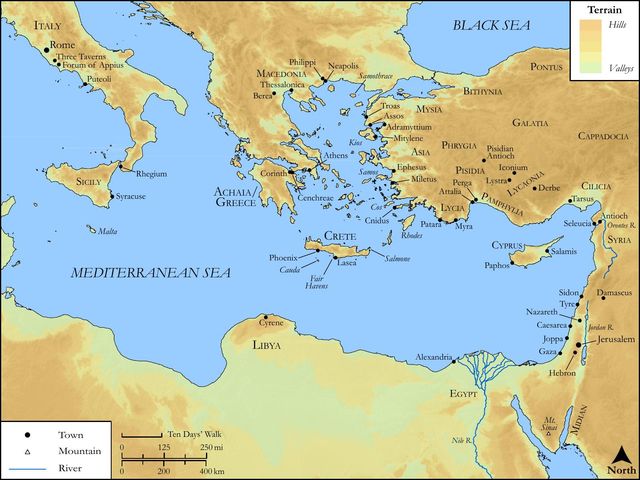
See on the biblical-era map
Study this verse
Public-domain commentary
Matthew Henry
From his Commentary on the Whole Bible. Henry comments on passages, not single verses — this entry covers Acts 3:1–11. His four-level outline is real structure in the source text, so it is rendered as structure.
We were told in general (Act 2:43) that many signs and wonders were done by the apostles, which are not written in this book; but here we have one given us for an instance. As they wrought miracles, not upon every body as every body had occasion for them, but as the Holy Spirit gave direction, so as to answer the end of their commission; so all the miracles they did work are not written in this book, but such only are recorded as the Holy Ghost thought fit, to answer the end of this sacred history.
I.The persons by whose ministry this miracle was wrought were Peter and John, two principal men among the apostles; they were so in Christ's time, one speaker of the house for the most part, the other favourite of the Master; and they continue so. When, upon the conversion of thousands, the church was divided into several societies, perhaps Peter and John presided in that which Luke associated with, and therefore he is more particular in recording what they said and did, as afterwards what Paul said and did when he attended him, both the one and the other being designed for specimens of what the other apostles did.
Peter and John had each of them a brother among the twelve, with whom they were coupled when they were sent out; yet now they seem to be knit together more closely than either of them to his brother, for the bond of friendship is sometimes stronger than that of relation: there is a friend that sticks closer than a brother. Peter and John seem to have had a peculiar intimacy after Christ's resurrection more than before, Joh 20:2. The reason of which (if I may have liberty to conjecture) might be this, that John, a disciple made up of love, was more compassionate to Peter upon his fall and repentance, and more tender of him in his bitter weeping for his sin, than any other of the apostles were, and more solicitous to restore him in the spirit of meekness, which made him very dear to Peter ever after; and it was good evidence of Peter's acceptance with God, upon his repentance, that Christ's favourite was made his bosom friend. David prayed, after his fall, Let those that fear thee turn unto me, Psa 119:79.
II.The time and place are here set down.
1.It was in the temple, whither Peter and John went up together, because it was the place of concourse; there were the shoals of fish among which the net of the gospel was to be cast, especially during the days of pentecost, within the compass of which we may suppose this to have happened. Note, It is good to go up to the temple, to attend on public ordinances; and it is comfortable to go up together to the temple: I was glad when they said unto me, Let us go. The best society is society in worshipping God.
2.It was at the hour of prayer, one of the hours of public worship commonly appointed and observed among the Jews. Time and place are two necessary circumstances of every action, which must be determined by consent, as is most convenient for edification. With reference to public worship, there must be a house of prayer and an hour of prayer: the ninth hour, that is, three o'clock in the afternoon, was one of the hours of prayer among the Jews; nine in the morning and twelve at noon were the other two. See Psa 55:17; Dan 6:10. It is of use for private Christians so far to have their hours of prayer as may serve, though not to bind, yet to remind conscience: every thing is beautiful in its season.
III.The patient on whom this miraculous cure was wrought is here described, Act 3:2.
He was a poor lame beggar at the temple gate. 1. he was a cripple, not by accident, but born so; he was lame from his mother's womb, as it should seem, by a paralytic distemper, which weakened his limbs; for it is said in the description of his cure (Act 3:7), His feet and ankle bones received strength. Some such piteous cases now and then there are, which we ought to be affected with and look upon with compassion, and which are designed to show us what we all are by nature spiritually: without strength, lame from our birth, unable to work or walk in God's service. 2. He was a beggar. Being unable to work for his living, he must live upon alms; such are God's poor. He was laid daily by his friends at one of the gates of the temple, a miserable spectacle, unable to do any thing for himself but to ask alms of those that entered into the temple or came out. There was a concourse, - a concourse of devout good people, from whom charity might be expected, and a concourse of such people when it might be hoped they were in the best frame; and there he was laid. Those that need, and cannot work, must not be ashamed to beg. He would not have been laid there, and laid there daily, if he had not been used to meet with supplies, daily supplies there. Note, Our prayers and our alms should go together; Cornelius's did, Act 10:4. Objects of charity should be in a particular manner welcome to us when we go up to the temple to pray; it is a pity that common beggars at church doors should any of them be of such a character as to discourage charity; but they ought not always to be overlooked: some there are surely that merit regard, and better feed ten drones, yea, and some wasps, than let one bee starve. The gate of the temple at which he was laid is here named: it was called Beautiful, for the extraordinary splendour and magnificence of it. Dr. Lightfoot observes that this was the gate that led out of the court of the Gentiles into that of the Jews, and he supposes that the cripple would beg only of the Jews, as disdaining to ask any thing of the Gentiles. But Dr. Whitby takes it to be at the first entrance into the temple, and beautified sumptuously, as became the frontispiece of that place where the divine Majesty vouchsafed to dwell; and it was no diminution to the beauty of this gate that a poor man lay there begging. 3. He begged of Peter and John (Act 3:3), begged an alms; this was the utmost he expected from them, who had the reputation of being charitable men, and who, though they had not much, yet did good with what they had. It was not many weeks ago that the blind and the lame came to Christ in the temple, and were healed there, Mat 21:14. And why might not he have asked more than an alms, if he knew that Peter and John were Christ's messengers, and preached and wrought miracles in his name? But he had that done for him which he looked not for; he asked an alms, and had a cure.
IV.We have here the method of the cure.
1.His expectations were raised. Peter, instead of turning his eyes form him, as many do from objects of charity, turned his eyes to him, nay, he fastened his eyes upon him, that his eye might affect his heart with compassion towards him, Act 3:4. John did so too, for they were both guided by one and the same Spirit, and concurred in this miracle; they said, Look on us. Our eye must be ever towards the Lord (the eye of our mind), and, in token of this, the eye of the body may properly be fixed on those whom he employs as the ministers of his grace. This man needed not to be bidden twice to look on the apostles; for he justly thought this gave him cause to expect that he should receive something form them, and therefore he gave heed to them, Act 3:5. Note, We must come to God both to attend on his word and to apply ourselves to him in prayer, with hearts fixed and expectations raised. We must look up to heaven and expect to receive benefit by that which God speaks thence, and an answer of peace to the prayers sent up thither. I will direct my prayer unto thee, and will look up.
2.His expectation of an alms was disappointed. Peter said, "Silver and gold have I none, and therefore none to give thee;" yet he intimated that if he had had any he would have given him an alms, not brass, but silver or gold. Note,
(1.)It is not often that Christ's friends and favourites have abundance of the wealth of this world. The apostles were very poor, had but just enough for themselves, and no overplus. Peter and John had abundance of money laid at their feet, but this was appropriated to the maintenance of the poor of the church, and they would not convert any of it to their own use, nor dispose of it otherwise than according tot he intention of the donors. Public trusts ought to be strictly and faithfully observed.
(2.)Many who are well inclined to works of charity are yet not in a capacity of doing any thing considerable, while others, who have wherewithal to do much, have not a heart to do any thing.
3.His expectations, notwithstanding, were quite outdone. Peter had not money to give him; but,
(1.)He had that which was better, such an interest in heaven, such a power from heaven, as to be able to cure his disease. Note, Those who are poor in the world may yet be rich, very rich, in spiritual gifts, graces, and comforts; certainly there is that which we are capable of possessing which is infinitely better than silver and gold; the merchandise and gain of it are better, Job 28:12, etc.; Pro 3:14, etc.
(2.)He gave him that which was better - the cure of his disease, which he would gladly have given a great deal of silver and gold for, if he had had it, and the cure could have been so obtained. This would enable him to work for his living, so that he would not need to beg any more; nay, he would have to give to those that needed, and it is more blessed to give than to receive. A miraculous cure would be a greater instance of God's favour, and would put a greater honour upon him, than thousands of gold and silver could. observe, When Peter had no silver and gold to give, yet (says he) such as I have I give thee. Note, Those may be, and ought to be, otherwise charitable and helpful to the poor, who have not wherewithal to give in charity; those who have not silver and gold have their limbs and senses, and with these may be serviceable to the blind, and lame, and sick, and if they be not, as there is occasion, neither would they give to them if they had silver and gold. As every one hath received the gift, so let him minister it. Let us now see how the cure was wrought.
[1.]Christ sent his word, and healed him (Psa 107:20); for healing grace is given by the word of Christ; this is the vehicle of the healing virtue derived from Christ. Christ spoke cures by himself; the apostles spoke them in his name. Peter bids a lame man rise up and walk, which would have been a banter upon him if he had not premised in the name of Jesus Christ of Nazareth: "I say it by warrant from him, and it shall be done by power from him, and all the glory and praise of it shall be ascribed to him." He calls Christ Jesus of Nazareth, which was a name of reproach, to intimate that the indignities done him on earth served but as a foil to his glories now that he was in heaven. "Give him what name you will, call him if you will in scorn Jesus of Nazareth, in that name you shall see wonders done; for, because he humbled himself, thus highly was he exalted." He bids the cripple rise up and walk, which does not prove that he had power in himself to do it, but that if he attempt to rise and walk, and, in a sense of his own impotency, depend upon a divine power to enable him to do it, he shall be enabled; and by rising and walking he must evidence what that power has wrought upon him; and then let him take the comfort, and let God have the praise. Thus it is in the healing of our souls, which are spiritually impotent.
[2.]Peter lent his hand, and helped him (Act 3:7): He took him by the right hand, in the same name in which he had spoken to him to arise and walk, and lifted him up. Not that this could contribute any thing to his cure; but it was a sign, plainly intimating the help he should receive from God, if he exerted himself as he was bidden. When God by his word commands us to rise, and walk in the way of his commandments, if we mix faith with that word, and lay our souls under the power of it, he will give his Spirit to take us by the hand, and lift us up. If we set ourselves to do what we can, God has promised his grace to enable us to do what we cannot; and by that promise we partake of a new nature, and that grace shall not be in vain; it was not here: His feet and ankle-bones received strength, which they had not done if he had not attempted to rise, and been helped up; he does his part, and Peter does his, and yet it is Christ that does all: it is he that puts strength into him. As the bread was multiplied in the breaking, and the water turned into wine in the pouring out, so strength was given to the cripple's feet in his stirring them and using them.
V.Here is the impression which this cure made upon the patient himself, which we may best conceive of if we put our soul into his soul's stead.
1.He leaped up, in obedience to the command, Arise. He found in himself such a degree of strength in his feet and ankle-bones that he did not steal up gently, with fear and trembling, as weak people do when they begin to recover strength; but he started up, as one refreshed with sleep, boldly, and with great agility, and as one that questioned not his own strength. The incomes of strength were sudden, and he was no less sudden in showing them. He leaped, as one glad to quit the bed or pad of straw on which he had lain so long lame.
2.He stood, and walked. He stood without either leaning or trembling, stood straight up, and walked without a staff. He trod strongly, and moved steadily; and this was to manifest the cure, and that it was a thorough cure. Note, Those who have had experience of the working of divine grace upon them should evidence what they have experienced. Has God put strength into us? Let us stand before him in the exercises of devotion; let us walk before him in all the instances of a religious conversation. Let us stand up resolutely for him, and walk cheerfully with him, and both in strength derived and received form him.
3.He held Peter and John, Act 3:11. We need not ask why he held them. I believe he scarcely knew himself: but it was in a transport of joy that he embraced them as the best benefactors he had ever met with, and hung upon them to a degree of rudeness; he would not let them go forward, but would have them stay with him, while he published to all about him what God had done for him by them. Thus he testified his affection to them; he held them, and would not let them go. Some suggest that he clung to them for fear lest, if they should leave him, his lameness should return. Those whom God hath healed love those whom he made instruments of their healing, and see the need of their further help.
4.He entered with them into the temple. His strong affection to them held them; but it could not hold them so fast as to keep them out of the temple, whither they were going to preach Christ. We should never suffer ourselves to be diverted by the utmost affectionate kindnesses of our friends from going in the way of our duty. But, if they will not stay with him, he is resolved to go with them, and the rather because they are going into the temple, whence he had been so long kept by his weakness and his begging: like the impotent man whom Christ cured, he was presently found in the temple, Joh 5:14. He went into the temple, not only to offer up his praises and thanksgivings to God, but to hear more from the apostles of that Jesus in whose name he had been healed. Those that have experienced the power of Christ should earnestly desire to grow in their acquaintance with Christ.
5.He was there walking, and leaping, and praising God. Note, The strength God has given us, both in mind and body, should be made us of to his praise, and we should study how to honour him with it. Those that are healed in his name must walk up and down in his name and in his strength, Zac 10:12. This man, as soon as he could leap, leaped for joy in God, and praised him. Here was that scripture fulfilled (Isa 35:6): Then shall the lame man leap as a hart. Now that this man was newly cured he was in this excess of joy and thankfulness. All true converts walk and praise God; but perhaps young converts leap more in his praises.
VI.How the people that were eye-witnesses of this miracle were influenced by it we are next told.
1.They were entirely satisfied in the truth of the miracle, and had nothing to object against it. They knew it was he that sat begging at the beautiful gate of the temple, Act 3:10. He had sat there so long that they all knew him; and for this reason he was chosen to be the vessel of this mercy. Now they were not so perverse as to make any doubt whether he was the same man, as the Pharisees had questioned concerning the blind man that Christ cured, Joh 9:9, Joh 9:18. They now saw him walking, and praising God (Act 3:9), and perhaps took notice of a change in his mind; for he was now as loud in praising God as he had before been in begging relief. The best evidence that it was a complete cure was that he now praised God for it. Mercies are then perfected, when they are sanctified.
2.They were astonished at it: They were filled with wonder and amazement (Act 3:10); greatly wondering, Act 3:11. They were in an ecstasy. There seems to have been this effect of the pouring out of the Spirit, that the people, at least those in Jerusalem, were much more affected with the miracles the apostles wrought than they had been with those of the same kind that had been wrought by Christ himself; and this was in order to the miracles answering their end.
3.They gathered about Peter and John: All the people ran together unto them in Solomon's porch: some only to gratify their curiosity with the sight of men that had such power; others with a desire to hear them preach, concluding that their doctrine must needs be of divine origin, which thus had a divine ratification. They flocked to them in Solomon's porch, a part of the court of the Gentiles, where Solomon had built the outer porch of the temple; or, some cloisters or piazzas which Herod had erected upon the same foundation upon which Solomon had built the stately porch that bore his name, Herod being ambitious herein to be a second Solomon. Here the people met, to see this great sight.
Historical interpretation
Historical reception
1 surviving comment on this verse from the historical church.
And observe how John is everywhere silent, while Peter makes excuse for him also. "And Peter fastening his eyes upon him, with John, said, Look on us."
Continue studying Acts 3:4 across the web’s major study libraries — every link below opens this exact verse, chapter, or book on the destination site.
Read & Compare
 BibleGatewayThis verse in more than 200 translations and 70 languages.
 Bible.comThe YouVersion reader — hundreds of translations, reading plans, and highlights.
 ESV.orgCrossway's official English Standard Version reader.
 NET BibleThe NET translation with 60,000+ translators' notes on every rendering decision.
 STEP BibleTyndale House's free study tool — original text, vocabulary, and scholarly resources.
 BibliaLogos Bible Software's free web reader.
 USCCBThe New American Bible (Revised Edition) with the U.S. bishops' study notes.
Commentaries
 BibleHub CommentariesDozens of classic commentaries on this verse, gathered on one page.
 StudyLightMore than 100 commentary sets — the largest collection on the web.
 BibleRefPlain-English commentary on what this verse means, verse by verse.
 Enduring WordDavid Guzik's free commentary on this chapter, widely used by Bible teachers.
 Bible Study ToolsVerse commentary alongside Greek and Hebrew study aids.
Original Language & Research
- BibleHub InterlinearThe verse word by word — original language, transliteration, and English.
- BibleHub LexiconEvery word's original-language definition and Strong's entry.
 Blue Letter BibleDeep-study tools — Strong's numbers, concordance, and word studies.
 CNTR CollationThe earliest Greek manuscripts of this verse, collated letter by letter.
Sermons, Hymns & Audio


TrulyRandomVerse is not affiliated with these sites and doesn’t control their content. They’re linked because they’re genuinely useful.
Summary
Acts 3:4 captures a pivotal moment at the Beautiful Gate of the Jerusalem Temple, where Peter and John, on their way to prayer, encounter a man lame from birth begging for alms. Rather than offering a customary coin, Peter, with John, intently fixes his gaze upon the man and commands him to "Look on us." This deliberate act of engagement shifts the beggar's expectation from a mere financial transaction to an encounter of profound spiritual significance, preparing him to receive a miraculous healing far beyond his earthly desires.
Context
ShowHideLiterary Context
Acts 3:4 is situated immediately after the apostles' regular practice of attending prayer at the Temple, as described in Acts 3:1. The preceding verse introduces the lame man, who had been placed daily at the Beautiful Gate to beg for money (Acts 3:2). The man's request for alms in Acts 3:3 sets up the unexpected response from Peter and John. This verse, therefore, serves as the critical turning point, establishing direct eye contact and verbal command that precedes the dramatic healing narrative that unfolds in Acts 3:6-8. It highlights the apostles' intentional, Spirit-led interaction, distinguishing their ministry from typical charitable acts.
Historical & Cultural Context
The setting is the Jerusalem Temple, a central hub of Jewish life, worship, and social interaction in the first century. The Beautiful Gate, likely a prominent and ornate entrance, was a common place for beggars due to the high volume of worshippers and pilgrims. Begging was a recognized, albeit unfortunate, part of the social fabric, as there were no formal care for the needy systems. Lame individuals, often seen as overlooked and sometimes even as cursed, relied entirely on the charity of others. The act of going to the Temple at the "ninth hour" (3 PM) for prayer was a common Jewish custom, demonstrating the apostles' continued adherence to Jewish religious practices even after Pentecost. Peter's command to "Look on us" would have been an unusual and authoritative departure from the expected interaction, demanding a level of personal engagement not typically given to beggars.
Key Themes
ShowHideThis verse contributes significantly to several overarching themes in the book of Acts. It underscores the theme of Divine Power through Human Instruments, as Peter and John are not merely dispensing charity but are conduits for God's miraculous intervention, foreshadowed by their authoritative gaze and command. The encounter highlights Evangelistic Engagement, demonstrating how the early church actively sought to meet profound human needs, not just superficial ones, leading to opportunities to proclaim Jesus Christ. Furthermore, it subtly introduces the theme of Spiritual Authority, as Peter's direct command reflects the authority granted to the apostles by the Holy Spirit, enabling them to act in God's name, a theme recurrent throughout Acts. The immediate focus on the lame man's attention also speaks to the theme of Preparation for Revelation, where human focus is redirected to God's work, a necessary precursor for spiritual and physical transformation.
Exposition and Analysis
ShowHideKey Word Analysis
ShowHideThis verb signifies an intense, fixed, and unwavering gaze. It is not a casual glance but a deliberate, focused stare, often implying deep concentration, discernment, or an expectation of something significant. In this context, Peter and John's "fastening their eyes" on the lame man indicates a profound, Spirit-led attention that transcends mere observation, preparing for a divine encounter.
This verb denotes the act of speaking or saying, often with authority or intention. While a common verb, its use here in conjunction with the intense gaze suggests that Peter's words were not a casual utterance but a deliberate command, carrying weight and purpose, setting the stage for the subsequent miracle.
This imperative verb means "to look at," "to perceive," or "to see." Unlike atenízō, which describes the intensity of the apostles' gaze, blépō is the command for the lame man to direct his own sight. It is a call to attention, demanding the man's full focus, which is crucial for him to comprehend and receive the extraordinary event about to unfold.
Verse Breakdown
ShowHide"And Peter, fastening his eyes upon him with John"
This clause establishes the joint, intentional action of the two apostles. Peter, as the primary speaker, takes the lead, but John's presence and shared intense gaze underscore the unity and shared purpose of their ministry. The phrase "fastening his eyes" (from atenízō) is critical, indicating a profound, fixed, and discerning look, not merely a casual observation. This intense gaze communicates a seriousness and an expectation that something significant is about to transpire, drawing the beggar's full attention away from his usual routine.
"said, Look on us"
This is Peter's direct, authoritative command to the lame man. It shifts the dynamic from a passive request for alms to an active demand for the man's focused attention. The command "Look on us" (from blépō) prepares the man for an encounter that will be personal and transformative, directing his gaze from the ground or the passing crowd to the apostles themselves, who are acting as instruments of God's power. It is a necessary prerequisite for the subsequent revelation of God's power through them.
Literary Devices
ShowHideThe verse effectively employs Foreshadowing and Dramatic Irony. The intense, "fastening" gaze of Peter and John, coupled with the direct command "Look on us," subtly foreshadows the extraordinary event about to occur. It signals to the reader that this will not be a typical interaction. There is also an element of Dramatic Irony, as the lame man "gave heed unto them, expecting to receive something of them" (Acts 3:5), anticipating only money. The reader, however, is aware, through the apostles' authoritative demeanor and the preceding narrative, that something far greater than financial alms is about to be bestowed, highlighting the gap between the man's limited expectation and God's boundless power. The Imperative Mood of "Look on us" also functions as a literary device, conveying the apostles' spiritual authority and the urgency of the moment.
Theological and Thematic Connections
ShowHideActs 3:4 profoundly illustrates the shift from a transactional understanding of charity to a transformative encounter with divine power. Peter and John's focused attention and direct command signify that God's intervention is not a passive act but requires active engagement and a redirection of human expectation. This moment underscores the principle that true spiritual help often begins with intentional presence and a call to focus on the source of genuine power, which is God working through His chosen instruments. It moves beyond mere physical relief to address deeper needs, pointing to the holistic nature of God's redemption.
Reflection and Application
ShowHideActs 3:4 serves as a powerful reminder for believers to cultivate intentionality and discernment in their interactions, particularly when engaging with those in need. Peter and John did not merely walk past the lame man or offer a perfunctory handout; they stopped, made direct eye contact, and commanded his attention. This act speaks volumes about the importance of truly "seeing" people—looking beyond their immediate circumstances or superficial requests to discern deeper spiritual or physical needs. It challenges us to move beyond casual charity to compassionate engagement, recognizing that God often desires to work through us in ways that transcend our own limited resources or expectations. Our focused attention and Spirit-led words can be the catalyst for God's transformative power in another person's life, shifting their gaze from their problems to the One who offers true healing and hope.
Questions for Reflection
ShowHideFAQ
ShowHideWhy did Peter and John command the lame man to "Look on us" instead of just healing him immediately?
ShowHideThe command "Look on us" (from the Greek blépō) was crucial for several reasons. First, it was a call to intentional engagement. The lame man's expectation was purely financial, a routine transaction. Peter's command broke this routine, demanding the man's full attention and shifting his focus from his physical ailment and typical begging to the apostles themselves. Second, it was an act of preparation for revelation. For a miracle to be truly impactful and understood as divine, the recipient often needs to be actively engaged and aware of the source of the power. By drawing the man's gaze, Peter was preparing him to be a conscious witness and recipient of God's extraordinary work, which would then lead to faith and praise (Acts 3:8-9). Finally, it demonstrated apostolic authority. Peter and John were acting as God's instruments, and this direct command underscored the spiritual authority given to them by the Holy Spirit, setting the stage for the powerful declaration in Acts 3:6.
Christ-Centered Fulfillment
ShowHideActs 3:4, though seemingly a simple command, powerfully foreshadows the Christ-centered nature of true transformation. Peter and John, as instruments of God, direct the lame man's gaze to themselves, not as the source of power, but as the immediate conduits through whom God's power will flow. This mirrors how Jesus consistently drew people's attention to Himself as the embodiment of God's kingdom and the source of all healing and salvation. Just as the lame man was called to "Look on us" to receive physical healing, humanity is called to "look to Jesus" for spiritual healing and eternal life. The ultimate fulfillment of this concept is found in the person of Christ, who is the "author and finisher of our faith" (Hebrews 12:2). Peter's subsequent sermon in Acts 3:16 explicitly attributes the healing to "faith in His name," clarifying that the power did not reside in the apostles but in Jesus. Thus, the apostles' command to "Look on us" ultimately served to point the lame man, and indeed all who witness the miracle, to the true source of power and salvation, Jesus Christ, the Lamb of God who takes away the sin of the world (John 1:29).