


John 11:40
Bible text: King James Version (1769 Blayney text) · Public domain
Bible text: Berean Standard Bible · Public domain
Bible text: American Standard Version (1901) · Public domain
Bible text: World English Bible, Messianic edition · Public domain
Bible text: Geneva Bible (1599) · Public domain
Bible text: Young's Literal Translation · Public domain
- λέγειlegeiSaysG3004V-PAI-3SVerb Present Active Indicative 3rd Singular
- αὐτῇautēato herG846P-DSFPersonal pronoun Dative Singular Feminine
- ὁho<the>G3588T-NSMDefinite article Nominative Singular Masculine
- Ἰησοῦς·IēsousJesusG2424N-NSM-PNoun Nominative Singular Masculine Individual
- οὐκoukSurelyG3756PRT-NNegative Particle Negative
- εἶπόνeiponI saidG2036V-2AAI-1SVerb 2nd Aorist Active Indicative 1st Singular
- σοιsoito youG4771P-2DSPersonal pronoun Dative 2nd Singular
- ὅτιhotithatG3754CONJConjunction
- ἐὰνeanifG1437CONDConjunction
- πιστεύσῃςpisteusēsyou shall believeG4100V-AAS-2SVerb Aorist Active Subjunctive 2nd Singular
- ὄψῃopsēyou will seeG3708V-FDI-2SVerb Future Middle Deponent Indicative 2nd Singular
- τὴνtēntheG3588T-ASFDefinite article Accusative Singular Feminine
- δόξανdoxangloryG1391N-ASFNoun Accusative Singular Feminine
- τοῦtou<the>G3588T-GSMDefinite article Genitive Singular Masculine
- θεοῦ;theouof God?G2316N-GSM-TNoun Genitive Singular Masculine Title
English is a literal word-by-word gloss of the Greek, not the KJV's wording. Why?
This is the original text the KJV's translators worked from — each Greek word with its own literal English meaning in this verse, prepared by scholars at Tyndale House, Cambridge. The KJV translates whole sentences, not word by word, so its wording differs: one Greek word can become several English words, and the KJV may choose “charity” where the gloss reads “love”. Both are faithful — they answer different questions. For the KJV's own rendering, switch to the KJV text.
Details
See on the biblical-era maps
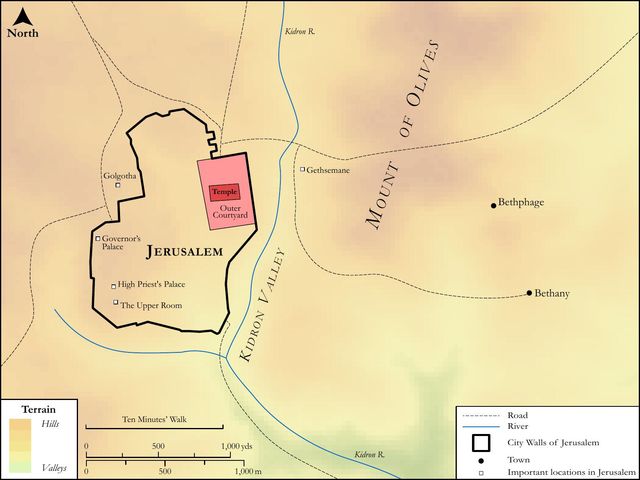
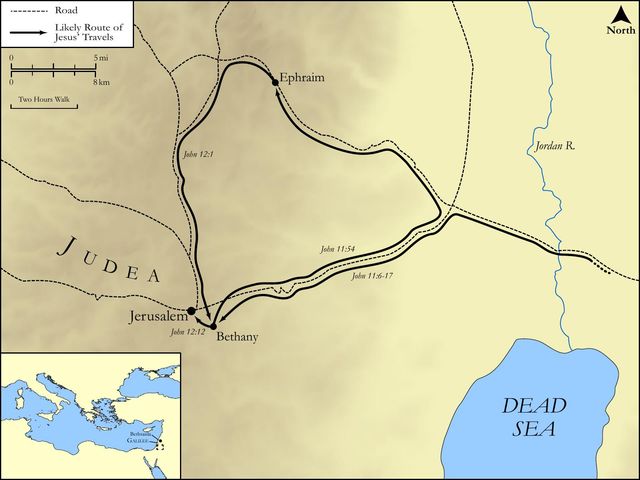
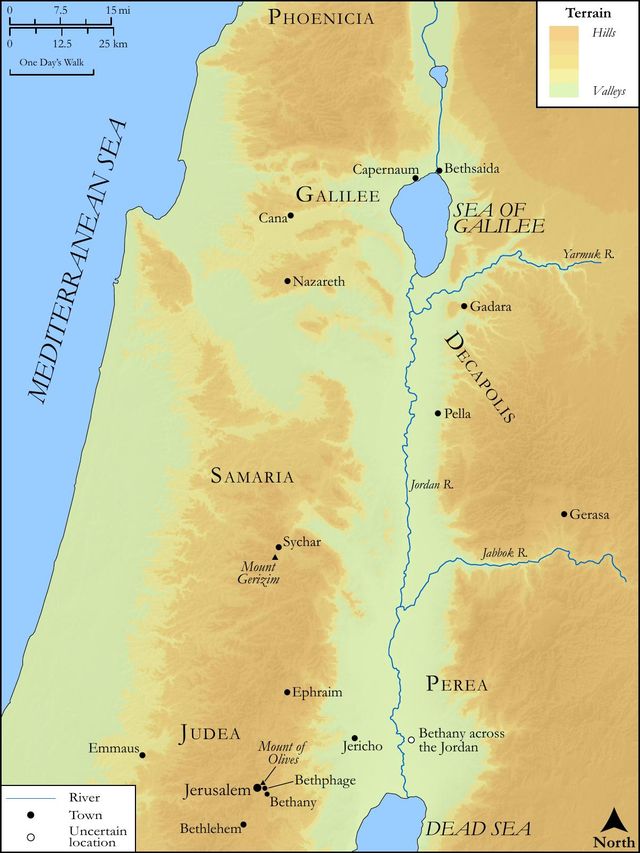
Study this verse
Public-domain commentary
Matthew Henry
From his Commentary on the Whole Bible. Henry comments on passages, not single verses — this entry covers John 11:33–44. His four-level outline is real structure in the source text, so it is rendered as structure.
Here we have, I. Christ's tender sympathy with his afflicted friends, and the share he took to himself in their sorrows, which appeared three ways: -
1.By the inward groans and troubles of his spirit (Joh 11:33): Jesus saw Mary weeping for the loss of a loving brother, and the Jews that came with her weeping for the loss of a good neighbour and friend; when he saw what a place of weepers, a bochim, this was, he groaned in the spirit, and was troubled. See here,
(1.)The griefs of the sons of men represented in the tears of Mary and her friends. What an emblem was here of this world, this vale of tears! Nature itself teaches us to weep over our dear relations, when they are removed by death; Providence thereby calls to weeping and mourning. It is probable that Lazarus's estate devolved upon his sisters, and was a considerable addition to their fortunes; and in such a case people say, now-a-days, though they cannot wish their relations dead (that is, they do not say they do), yet, if they were dead, they would not wish them alive again; but these sisters, whatever they got by their brother's death, heartily wished him alive again. Religion teaches us likewise to weep with them that weep, as these Jews wept with Mary, considering that we ourselves also are in the body. Those that truly love their friends will share with them in their joys and griefs; for what is friendship but a communication of affections? Job 16:5.
(2.)The grace of the Son of God and his compassion towards those that are in misery. In all their afflictions he is afflicted, Isa 63:9; Jdg 10:16. When Christ saw them all in tears,
[1.]He groaned in the spirit. He suffered himself to be tempted (as we are when we are disturbed by some great affliction), yet without sin. This was an expression, either, First, Of his displeasure at the inordinate grief of those about him, as Mar 5:39 : "Why make ye this ado and weep? What a hurry is here! does this become those that believe in a God, a heaven, and another world?" Or, Secondly, Of his feeling sense of the calamitous state of human lie, and the power of death, to which fallen man is subject. Having now to make a vigorous attack upon death and the grave, he thus stirred up himself to the encounter, put on the garments of vengeance, and his fury it upheld him; and that he might the more resolutely undertake the redress of our grievances, and the cure of our griefs, he was pleased to make himself sensible of the weight of them, and under the burden of them he now groaned in spirit. Or, Thirdly, It was an expression of his kind sympathy with his friends that were in sorrow. Here was the sounding of the bowels, the mercies which the afflicted church so earnestly solicits, Isa 63:15. Christ not only seemed concerned, but he groaned in the spirit; he was inwardly and sincerely affected with the case. David's pretended friends counterfeited sympathy, to disguise their enmity (Psa 41:6); but we must learn of Christ to have our love and sympathy without dissimulation. Christ's was a deep and hearty sigh.
[2.]He was troubled. He troubled himself; so the phrase is, very significantly. He had all the passions and affections of the human nature, for in all things he must be like to his brethren; but he had a perfect command of them, so that they were never up, but when and as they were called; he was never troubled, but when he troubled himself, as he saw cause. He often composed himself to trouble, but was never discomposed or disordered by it. He was voluntary both in his passion and in his compassion. He had power to lay down his grief, and power to take it again.
2.His concern for them appeared by his kind enquiry after the poor remains of his deceased friend (Joh 11:34): Where have you laid him? He knew where he was laid, and yet asks, because,
(1.)He would thus express himself as a man, even when he was going to exert the power of a God. Being found in fashion as a man, he accommodates himself to the way and manner of the sons of men: Non nescit, sed quasi nescit - He is not ignorant, but he makes as if he were, saith Austin here.
(2.)He enquired where the grave was, lest, if he had gone straight to it of his own knowledge, the unbelieving Jews should have thence taken occasion to suspect a collusion between him and Lazarus, and a trick in the case. Many expositors observe this from Chrysostom.
(3.)He would thus divert the grief of his mourning friends, by raising their expectations of something great; as if he had said, "I did not come hither with an address of condolence, to mingle a few fruitless insignificant tears with yours; no, I have other work to do; come, let us adjourn to the grave, and go about our business there." Note, A serious address to our work is the best remedy against inordinate grief.
(4.)He would hereby intimate to us the special care he takes of the bodies of the saints while they lie in the grave; he takes notice where they are laid, and will look after them. There is not only a covenant with the dust, but a guard upon it.
3.It appeared by his tears. Those about him did not tell him where the body was buried, but desired him to come and see, and led him directly to the grave, that his eye might yet more affect his heart with the calamity.
(1.)As he was going to the grave, as if he had been following the corpse thither, Jesus wept, Joh 11:35. A very short verse, but it affords many useful instructions.
[1.]That Jesus Christ was really and truly man, and partook with the children, not only of flesh and blood, but of a human soul, susceptible of the impressions of joy, and grief, and other affections. Christ gave this proof of his humanity, in both senses of the word; that, as a man, he could weep, and, as a merciful man, he would weep, before he gave this proof of his divinity.
[2.]That he was a man of sorrows, and acquainted with grief, as was foretold, Isa 53:3. We never read that he laughed, but more than once we have him in tears. Thus he shows not only that a mournful state will consist with the love of God, but that those who sow to the Spirit must sow in tears.
[3.]Tears of compassion well become Christians, and make them most to resemble Christ. It is a relief to those who are in sorrow to have their friends sympathize with them, especially such a friend as their Lord Jesus.
(2.)Different constructions were put upon Christ's weeping. [1.] Some made a kind and candid interpretation of it, and what was very natural (Joh 11:36): Then said the Jews, Behold how he loved him! They seem to wonder that he should have so strong an affection for one to whom he was not related, and with whom he had not had any long acquaintance, for Christ spent most of his time in Galilee, a great way from Bethany. It becomes us, according to this example of Christ, to show our love to our friends, both living and dying. We must sorrow for our brethren that sleep in Jesus as those that are full of love, though not void of hope; as the devout men that buried Stephen, Act 8:2. Though our tears profit not the dead, they embalm their memory. These tears were indications of his particular love to Lazarus, but he has given proofs no less evident of his love to all the saints, in that he died for them. When he only dropped a tear over Lazarus, they said, See how he loved him! Much more reason have we to say so, for whom he hath laid down his life: See how he loved us! Greater love has no man than this [2.] Others made a peevish unfair reflection upon it, as if these tears bespoke his inability to help his friend (Joh 11:37): Could not this man, who opened the eyes of the blind, have prevented the death of Lazarus? Here it is slyly insinuated, First, That the death of Lazarus being (as it seemed by his tears) a great grief to him, if he could have prevented it he would, and therefore because he did not they incline to think that he could not; as, when he was dying, they concluded that he could not, because he did not, save himself, and come down from the cross; not considering that divine power is always directed in its operations by divine wisdom, not merely according to his will, but according to the counsel of his will, wherein it becomes us to acquiesce. If Christ's friends, whom he loves, die, - if his church, whom he loves, be persecuted and afflicted, - we must not impute it to any defect either in his power or love, but conclude that it is because he sees it for the best. Secondly, That therefore it might justly be questioned whether he did indeed open the eyes of the blind, that is, whether it was not a sham. His not working this miracle they thought enough to invalidate the former; at least, it should seem that he had limited power, and therefore not a divine one. Christ soon convinced these whisperers, by raising Lazarus from the dead, which was the greater work, that he could have prevented his death, but therefore did not because he would glorify himself the more.
II.Christ's approach to the grave, and the preparation that was made for working this miracle.
1.Christ repeats his groans upon his coming near the grave (Joh 11:38): Again groaning in himself, he comes to the grave: he groaned,
(1.)Being displeased at the unbelief of those who spoke doubtingly of his power, and blamed him for not preventing the death of Lazarus; he was grieved for the hardness of their hearts. He never groaned so much for his own pains and sufferings as for the sins and follies of men, particularly Jerusalem's, Mat 23:37.
(2.)Being affected with the fresh lamentations which, it is likely, the mourning sisters made when they came near the grave, more passionately and pathetically than before, his tender spirit was sensibly touched with their wailings.
(3.)Some think that he groaned in spirit because, to gratify the desire of his friends, he was to bring Lazarus again into this sinful troublesome world, from that rest into which he was newly entered; it would be a kindness to Martha and Mary, but it would be to him like thrusting one out to a stormy sea again who was newly got into a safe and quiet harbour. If Lazarus had been let alone, Christ would quickly have gone to him into the other world; but, being restored to life, Christ quickly left him behind in this world.
(4.)Christ groaned as one that would affect himself with the calamitous state of the human nature, as subject to death, from which he was now about to redeem Lazarus. Thus he stirred up himself to take hold on God in the prayer he was to make, that he might offer it up with strong crying, Heb 5:7. Ministers, when they are sent by the preaching of the gospel to raise dead souls, should be much affected with the deplorable condition of those they preach to and pray for, and groan in themselves to think of it.
2.The grave wherein Lazarus lay is here described: It was a cave, and a stone lay upon it. The graves of the common people, probably, were dug as ours are; but persons of distinction were, as with us, interred in vaults, so Lazarus was, and such was the sepulchre in which Christ was buried. Probably this fashion was kept up among the Jews, in imitation of the patriarchs, who buried their dead in the cave of Machpelah, Gen 23:19. This care taken of the dead bodies of their friends intimates their expectation of their resurrection; they reckoned the solemnity of the funeral ended when the stone was rolled to the grave, or, as here, laid upon it, like that on the mouth of the den into which Daniel was cast (Dan 6:17), that the purpose might not be changed; intimating that the dead are separated from the living, and gone the way whence they shall not return. This stone was probably a gravestone, with an inscription upon it, which the Greeks called mnēmeion - a memorandum, because it is both a memorial of the dead and a memento to the living, putting them in remembrance of that which we are all concerned to remember. It is called by the Latins, Monumentum, monendo, because it gives warning.
3.Orders are given to remove the stone (Joh 11:39): Take away the stone. He would have this stone removed that all the standersby might see the body lie dead in the sepulchre, and that way might be made for its coming out, and it might appear to be a true body, and not a ghost or spectre. He would have some of the servants to remove it, that they might be witnesses, by the smell of the putrefaction of the body, and that therefore it was truly dead. It is a good step towards the raising of a soul to spiritual life when the stone is taken away, when prejudices are removed and got over, and way made for the word to the heart, that it may do its work there, and say what it has to say.
4.An objection made by Martha against the opening of the grave: Lord, by this time he stinketh, or is become noisome, for he has been dead four days, tetartaios gar esti quatriduanus est; he is four days old in the other world; a citizen and inhabitant of the grave of four days' standing. Probably Martha perceived the body to smell, as they were removing the stone, and therefore cried out thus.
(1.)It is easy to observe hence the nature of human bodies: four days are but a little while, yet what a great change will this time make with the body of man, if it be but so long without food, much more if so long without life! Dead bodies (saith Dr. Hammond) after a revolution of the humours, which is completed in seventy-two hours, naturally tend to putrefaction; and the Jews say that by the fourth day after death the body is so altered that one cannot be sure it is such a person; so Maimonides in Lightfoot. Christ rose the third day because he was not to see corruption.
(2.)It is not so easy to say what was Martha's design in saying this.
[1.]Some think she said it in a due tenderness, and such as decency teaches to the dead body; now that it began to putrefy, she did not care it should be thus publicly shown and made a spectacle of.
[2.]Others think she said it out of a concern for Christ, lest the smell of the dead body should be offensive to him. That which is very noisome is compared to an open sepulchre, Psa 5:9. If there were any thing noisome she would not have her Master near it; but he was none of those tender and delicate ones that cannot bear as ill smell; if he had, he would not have visited the world of mankind, which sin had made a perfect dunghill, altogether noisome, Psa 14:3.
[3.]It should seem, by Christ's answer, that it was the language of her unbelief and distrust: "Lord, it is too late now to attempt any kindness to him; his body begins to rot, and it is impossible that this putrid carcase should live." She gives up his case as helpless and hopeless, there having been no instances, either of late or formerly, of any raised to life after they had begun to see corruption. When our bones are dried, we are ready to say, Our hope is lost. Yet this distrustful word of hers served to make the miracle both the more evident and the more illustrious; by this it appeared that he was truly dead, and not in a trance; for, though the posture of a dead body might be counterfeited, the smell could not. Her suggesting that it could not be done puts the more honour upon him that did it.
5.The gentle reproof Christ gave to Martha for the weakness of her faith (Joh 11:40): Said I not unto thee that if thou wouldest believe thou shouldest see the glory of God? This word of his to her was not before recorded; it is probable that he said it to her when she had said (Joh 11:27), Lord, I believe: and it is enough that it is recorded here, where it is repeated. Note,
(1.)Our Lord Jesus has given us all the assurances imaginable that a sincere faith shall at length be crowned with a blessed vision: "If thou believe, thou shalt see God's glorious appearances for thee in this world, and to thee in the other world." If we will take Christ's word, and rely on his power and faithfulness, we shall see the glory of God, and be happy in the sight.
(2.)We have need to be often reminded of these sure mercies with which our Lord Jesus hath encouraged us. Christ does not give a direct answer to what Martha had said, nor any particular promise of what he would do, but orders her to keep hold of the general assurances he had already given: Only believe. We are apt to forget what Christ has spoken, and need him to put us in mind of it by his Spirit: "Said I not unto thee so and so? And dost thou think that he will ever unsay it?"
6.The opening of the grave, in obedience to Christ's order, notwithstanding Martha's objection (Joh 11:41): Then they took away the stone. When Martha was satisfied, and had waived her objection, then they proceeded. If we will see the glory of God, we must let Christ take his own way, and not prescribe but subscribe to him. They took away the stone, and this was all they could do; Christ only could give life. What man can do is but to prepare the way of the Lord, to fill the valleys, and level the hills, and, as here, to take away the stone.
III.The miracle itself wrought.
The spectators, invited by the rolling away of the stone, gathered about the grave, not to commit dust to dust, earth to earth, but to receive dust from the dust, and earth from the earth again; and, their expectations being raised, our Lord Jesus addresses himself to his work.
1.He applies himself to his living Father in heaven, so he had called him (Joh 6:17), and so eyes him here.
(1.)The gesture he used was very significant: He lifted up his eyes, an outward expression of the elevation of his mind, and to show those who stood by whence he derived his power; also to set us an example; this outward sign is hereby recommended to our practice; see Joh 17:1. Look how those will answer it who profanely ridicule it; but that which is especially charged upon us hereby is to lift up our hearts to God in the heavens; what is prayer, but the ascent of the soul to God, and the directing of its affections and motions heavenward? He lifted up his eyes, as looking above, looking beyond the grave where Lazarus lay, and overlooking all the difficulties that arose thence, that he might have his eyes fixed upon the divine omnipotence; to teach us to do as Abraham, who considered not his own body now dead, nor the deadness of Sarah's womb, never took these into his thoughts, and so gained such a degree of faith as not to stagger at the promise, Rom 4:20.
(2.)His address to God was with great assurance, and such a confidence as became him: Father, I thank thee that thou hast heard me.
[1.]He has here taught us, by his own example, First, In prayer to call God Father, and to draw nigh to him as children to a father, with a humble reverence, and yet with a holy boldness. Secondly, In our prayers to praise him, and, when we come to beg for further mercy, thankfully to acknowledge former favours. Thanksgivings, which bespeak God's glory (not our own, like the Pharisee's God, I thank thee), are decent forms into which to put our supplications.
[2.]But our Saviour's thanksgiving here was intended to express the unshaken assurance he had of the effecting of this miracle, which he had in his own power to do in concurrence with his Father: "Father, I thank thee that my will and thine are in this matter, as always, the same." Elijah and Elisha raised the dead, as servants, by entreaty; but Christ, as a Son, by authority, having life in himself, and power to quicken whom he would; and he speaks of this as his own act (Joh 11:11): I go, that I may awake him; yet he speaks of it as what he had obtained by prayer, for his Father heard him: probably he put up the prayer for it when he groaned in spirit once and again (Joh 11:33, Joh 11:38), in a mental prayer, with groanings which could not be uttered.
First, Christ speaks of this miracle as an answer to prayer, 1. Because he would thus humble himself; though he was a Son, yet learned he this obedience, to ask and receive. His mediatorial crown was granted him upon request, though it is of right, Psa 2:8, and Joh 17:5. He prays for the glory he had before the world was, though, having never forfeited it, he might have demanded it. 2. Because he was pleased thus to honour prayer, making it the key wherewith even he unlocked the treasures of divine power and grace. Thus he would teach us in prayer, by the lively exercise of faith, to enter into the holiest.
Secondly, Christ, being assured that his prayer was answered, professes,
a.His thankful acceptance of this answer: I thank thee that thou hast heard me. Though the miracle was not yet wrought, yet the prayer was answered, and he triumphs before the victory. No other can pretend to such an assurance as Christ had; yet we may by faith in the promise have a prospect of mercy before it be actually given in, and may rejoice in that prospect, and give God thanks for it. In David's devotions, the same psalm which begins with prayer for a mercy closes with thanksgivings for it. Note, (a.) Mercies in answer to prayer ought in a special manner to be acknowledged with thankfulness. Besides the grant of the mercy itself, we are to value it as a great favour to have our poor prayers taken notice of. (b.) We ought to meet the first appearances of the return of prayer with early thanksgivings. As God answers us with mercy, even before we call, and hears while we are yet speaking, so we should answer him with praise even before he grants, and give him thanks while he is yet speaking good words and comfortable words.
b.His cheerful assurance of a ready answer at any time (Joh 11:42): And I know that thou hearest me always. Let none think that this was some uncommon favour granted him now, such as he never had before, nor should ever have again; no, he had the same divine power going along with him in his whole undertaking, and undertook nothing but what he knew to be agreeable to the counsel of God's will. "I gave thanks" (saith he) "for being heard in this, because I am sure to be heard in every thing." See here, (a.) The interest our Lord Jesus had in heaven; the Father heard him always, he had access to the Father upon every occasion, and success with him in every errand. And we may be sure that his interest is not the less for his going to heaven, which may encourage us to depend upon his intercession, and put all our petitions into his hand, for we are sure that him the Father hears always. (b.) The confidence he had of that interest: I knew it. He did not in the least hesitate or doubt concerning it, but had an entire satisfaction in his own mind of the Father's complacency in him and concurrence with him in every thing. We cannot have such a particular assurance as he had; but this we know, that whatsoever we ask according to his will he heareth us, Jo1 5:14, Jo1 5:15.
Thirdly, But why should Christ give this public intimation of his obtaining this miracle by prayer? He adds, It is because of the people who stand by, that they may believe that thou hast sent me; for prayer may preach. 1. It was to obviate the objections of his enemies, and their reflections. It was blasphemously suggested by the Pharisees, and their creatures, that he wrought his miracles by compact with the devil; now, to evidence the contrary, he openly made his address to God, using prayers, and not charms, not peeping and muttering as those did that used familiar spirits (Isa 8:19), but, with elevated eyes and voice professing his communication with Heaven, and dependence on Heaven. 2. It was to corroborate the faith of those that were well inclined to him: That they may believe that thou hast sent me, not to destroy men's lives, but to save them. Moses, to show that God sent him, made the earth open and swallow men up (Num 16:31); Elijah, to show that God sent him, made fire come from heaven and devour men; for the law was a dispensation of terror and death but Christ proves his mission by raising to life one that was dead. Some give this sense: had Christ declared his doing it freely by his own power, some of his weak disciples, who as yet understood not his divine nature, would have thought he took too much upon him, and have been stumbled at it. These babes could not bear that strong meat, therefore he chooses to speak of his power as received and derived he speaks self-denyingly of himself, that he might speak the more plainly to us. Non ita respexit ad swam dignitatem atque ad nostram salutem - In what he said, he consulted not so much his dignity as our salvation. - Jansenius.
2.He now applies himself to his dead friend in the earth. He cried with a loud voice, Lazarus come forth.
(1.)He could have raised Lazarus by a silent exertion of his power and will, and the indiscernible operations of the Spirit of life; but he did it by a call, a loud call,
[1.]To be significant of the power then put forth for the raising of Lazarus, how he created this new thing; he spoke, and it was done. He cried aloud, to signify the greatness of the work, and of the power employed in it, and to excite himself as it were to this attack upon the gates of death, as soldiers engage with a shout. Speaking to Lazarus, it was proper to cry with a loud voice; for, First, The soul of Lazarus, which was to be called back, was at a distance, not hovering about the grave, as the Jews fancied, but removed to Hades, the world of spirits; now it is natural to speak loud when we call to those at a distance. Secondly, The body of Lazarus, which was to be called up, was asleep, and we usually speak loud when we would awake any out of sleep. He cried with a loud voice that the scripture might be fulfilled (Isa 45:19), I have not spoken in secret, in a dark place of the earth.
[2.]To be typical of other works of wonder, and particularly other resurrections, which the power of Christ was to effect. This loud call was a figure, First, Of the gospel call, by which dead souls were to be brought out of the grave of sin, which resurrection Christ had formerly spoken of (Joh 5:25), and of his word as the means of it (Joh 6:63), and now he gives a specimen of it. By his word, he saith to souls, Live, yea, he saith to them, Live, Eze 16:6. Arise from the dead, Eph 5:14. The spirit of life from God entered into those that had been dead and dry bones, when Ezekiel prophesied over them, Eze 37:10. Those who infer from the commands of the word to turn and live that man has a power of his own to convert and regenerate himself might as well infer from this call to Lazarus that he had a power to raise himself to life. Secondly, Of the sound of the archangel's trumpet at the last day, with which they that sleep in the dust shall be awakened and summoned before the great tribunal, when Christ shall descend with a shout, a call, or command, like this here, Come forth, Psa 50:4. He shall call both to the heavens for their souls, and to the earth for their bodies, that he may judge his people.
(2.)This loud call was but short, yet mighty through God to the battering down of the strongholds of the grave.
[1.]He calls him by name, Lazarus, as we call those by their names whom we would awake out of a fast sleep. God said to Moses, as a mark of his favour, I know thee by name. The naming of him intimates that the same individual person that died shall rise again at the last day. He that calls the stars by their names can distinguish by name his stars that are in the dust of the earth, and will lose none of them.
[2.]He calls him out of the grave, speaking to him as if he were already alive, and had nothing to do but to come out of his grave. He does not say unto him, Live; for he himself must give life; but he saith to him, Move, for when by the grace of Christ we live spiritually we must stir up ourselves to move; the grave of sin and this world is no place for those whom Christ has quickened, and therefore they must come forth.
[3.]The event was according to the intention: He that was dead came forth, Joh 11:44. Power went along with the word of Christ to reunite the soul and the body of Lazarus, and then he came forth. The miracle is described, not by its invisible springs, to satisfy our curiosity, but by its visible effects, to conform our faith. Do any ask where the soul of Lazarus was during the four days of its separation? We are not told, but have reason to think it was in paradise; in joy and felicity; but you will say, "Was it not then really an unkindness to it to cause it to return into the prison of the body?" And if it were, yet, being for the honour of Christ and the serving of the interests of his kingdom, it was no more an injury to him than it was to St. Paul to continue in the flesh when he knew that to depart to Christ was so much better. If any ask whether Lazarus, after he was raised, could give an account or description of his soul's removal out of the body or return to it, or what he saw in the other world, I suppose both those changes were so unaccountable to himself that he must say with Paul, Whether in the body or out of the body, I cannot tell; and of what he saw and heard, that it was not lawful nor possible to express it. In a world of sense we cannot frame to ourselves, much less communicate to others, any adequate ideas of the world of spirits and the affairs of that world. Let us not covet to be wise above what is written, and this is all that is written concerning the resurrection of that Lazarus, that he that was dead came forth. Some have observed that though we read of many who were raised from the dead, who no doubt conversed familiarly with men afterwards, yet the scripture has not recorded one word spoken by any of them, except by our Lord Jesus only.
(3.)This miracle was wrought,
[1.]Speedily. Nothing intervenes between the command, Come forth, and the effect, He came forth; dictum factum - no sooner said than done; let there be life, and there was life. Thus the change in the resurrection will be in a moment, in the twinkling of an eye, Co1 15:52. The almighty power that can do it can do it in an instant: Then shalt thou call and I will answer; will come at the call, as Lazarus, Here am I.
[2.]Perfectly. He was so thoroughly revived that he got up out of his grave as strongly as ever he got up out of his bed, and returned not only to life, but health. He was not raised to serve a present turn, but to live as other men.
[3.]With this additional miracle, as some reckon it, that he came out of his grave, though he was fettered with his grave-clothes, with which he was bound hand and foot, and his face bound about with a napkin (for so the manner of the Jews was to bury); and he came forth in the same dress wherein he was buried, that it might appear that it was he himself and not another, and that he was not only alive, but strong, and able to walk, after a sort, even in his grave-clothes. The binding of his face with a napkin proved that he had been really dead, for otherwise, in less than so many days' time, that would have smothered him. And the standers-by, in unbinding him, would handle him, and see him, that it was he himself, and so be witnesses of the miracle. Now see here, First, How little we carry away with us, when we leave the world - only a winding-sheet and a coffin; there is no change of raiment in the grave, nothing but a single suit of grave-clothes. Secondly, What condition we shall be in in the grave. What wisdom or device can there be where the eyes are hoodwinked, or what working where the hands and feet are fettered? And so it will be in the grave, whither we are going. Lazarus being come forth, hampered and embarrassed with his grave-clothes, we may well imagine that those about the grave were exceedingly surprised and frightened at it; we should be so if we should see a dead body rise; but Christ, to make the thing familiar, sets them to work: "Loose him, slacken his grave-clothes, that they may serve for day-clothes till he comes to his house, and then he will go himself, so clad, without guide or supporter to his own house." As, in the Old Testament, the translations of Enoch and Elias were sensible demonstrations of an invisible and future state, the one about the middle of the patriarchal age, the other of the Mosaic economy, so the resurrection of Lazarus, in the New Testament, was designed for the confirmation of the doctrine of the resurrection.
Historical interpretation
Nine Centuries of Reception
5 surviving comments on this verse. Each one is dated, so this reads as a timeline rather than a list.
Select a marker to jump to its quote. Markers stagger vertically where authors wrote within a few decades of each other.
But now, between the words “Take away the stone” and “therefore, they took away the stone,” the words of the dead man’s sister hindered the removal of the stone. And it would not have been taken away at all even later had not Jesus answered and said to her unbelief, “Did I not say to you that if you believe, you will see the glory of God?” It is good, then, that nothing intervenes between Jesus’ command and the action enjoined by his bidding.
(Hom. lxiii) She did not remember what He said above, He that believeth in Me, though he were dead, yet shall he live. To the disciples He had said, That the Son of God might be glorified thereby; here it is the glory of the Father He speaks of. The difference is made to suit the different hearers. Our Lord could not rebuke her before such a number, but only says, Thou shalt see the glory of God.
Among all the miracles wrought by our Lord Jesus Christ, the resurrection of Lazarus holds a foremost place in preaching. But if we consider attentively who did it, our duty is to rejoice rather than to wonder. A man was raised up by Him who made man: for He is the only One of the Father, by whom, as you know, all things were made. And if all things were made by Him, what wonder is it that one was raised by Him, when so many are daily brought into the world by His power? It is a greater deed to create men than to raise them again from the dead. Yet He deigned both to create and to raise again; to create all, to resuscitate some.
We have, however, read in the Gospel of three dead persons who were raised to life by the Lord, and, let us hope, to some good purpose. For surely the Lord's deeds are not merely deeds, but signs. And if they are signs, besides their wonderful character, they have some real significance: and to find out this in regard to such deeds is a somewhat harder task than to read or hear of them. We were listening with wonder, as at the sight of some mighty miracle enacted before our eyes, in the reading of the Gospel, how Lazarus was restored to life. If we turn our thoughts to the still more wonderful works of Christ, every one that believeth riseth again: if we all consider, and understand that more horrifying kind of death, every one who sinneth dies. But every man is afraid of the death of the flesh; few, of the death of the soul.
If, then, the Lord in the greatness of His grace and mercy raiseth our souls to life, that we may not die for ever, we may well understand that those three dead persons whom He raised in the body, have some figurative significance of that resurrection of the soul which is effected by faith: He raised up the ruler of the synagogue's daughter, while still lying in the house; He raised up the widow's young son, while being carried outside the gates of the city; and He raised up Lazarus, when four days in the grave. Let each one give heed to his own soul: in sinning he dies: sin is the death of the soul. But sometimes sin is committed only in thought. Thou hast felt delight in what is evil, thou hast assented to its commission; thou hast sinned: that assent has slain thee; but the death is internal, because the evil thought had not yet ripened into action.
"But Mary was she who anointed the Lord with ointment, and wiped His feet with her hair, whose brother Lazarus was sick. Therefore his sisters sent unto Him, saying." We now understand whither it was they sent, namely, where the Lord was; for He was away, as you know, beyond the Jordan. They sent messengers to the Lord to tell Him that their brother was ill. He delayed to heal, that He might be able to raise to life.
"But when Jesus heard that, He said, This sickness is not unto death, but for the glory of God, that the Son of God may be glorified." Such a glorifying of Himself did not add to His dignity, but benefited us. Hence He says, "is not unto death," because even that death itself was not unto death, but rather unto the working of a miracle whereby men might be led to faith in Christ, and so escape the real death. And mark how the Lord, as it were indirectly, called Himself God, for the sake of some who deny that the Son is God. For there are heretics who make such a denial, that the Son of God is God. Let them hearken here: "This sickness" He says. "is not unto death, but for the glory of God." For what glory? For the glory of what God? Hear what follows: "That the Son of God may be glorified."
"Jesus saith unto her, Thy brother shall rise again." This was ambiguous. For He said not, Even now I will raise thy brother; but, "Thy brother shall rise again. Martha saith unto Him, I know that he shall rise again in the resurrection, at the last day." Of that resurrection I am sure, but uncertain about this. "Jesus saith unto her, I am the resurrection." Thou sayest, My brother shall rise again at the last day: true; but by Him, through whom he shall rise then, can he rise even now, for "I," He says, "am the resurrection and the life." Give ear, brethren, give ear to what He says.
"He that believeth in me, though he were dead, yet shall he live: and whosoever liveth and believeth in me shall never die." What meaneth this? "He that believeth in me, though he were dead," just as Lazarus is dead, "yet shall he live;" for He is not the God of the dead, but of the living. Believe then, and though thou wert dead, yet shalt thou live: but if thou believest not, even while thou livest thou art dead.
"When Jesus therefore saw her weeping, and the Jews also weeping, who were with her, He groaned in the spirit, and troubled Himself, and said, Where have ye laid him?" Something there is, did we but know it, that He has suggested to us by groaning in the spirit, and troubling Himself. For who could trouble Him, save He Himself? Therefore, my brethren, first give heed here to the power that did so, and then look for the meaning. Thou art troubled against thy will; Christ was troubled because He willed. Jesus hungered, it is true, but because He willed; Jesus slept, it is true, but because He willed; He was sorrowful, it is true, but because He willed; He died, it is true, but because He willed: in His own power it lay to be thus and thus affected or not.
I have spoken of the power: look now to the meaning. It is a great criminal that is signified by that four days' death and burial. Why is it, then, that Christ troubleth Himself, but to intimate to thee how thou oughtest to be troubled, when weighed down and crushed by so great a mass of iniquity? For here thou hast been looking to thyself, been seeing thine own guilt, been reckoning for thyself: I have done this, and God has spared me; I have committed this, and He hath borne with me; I have heard the gospel, and despised it; I have been baptized, and returned again to the same course: what am I doing? whither am I going? how shall I escape? When thou speakest thus, Christ is already groaning; for thy faith is groaning. In the voice of one who groaneth thus, there comes to light the hope of his rising again.
"Jesus wept. Then said the Jews, Behold how He loved him!" "Loved him," what does that mean? "I came not to call the righteous, but sinners to repentance." "But some of them said, Could not this man, who opened the eyes of the blind, have caused that even this man should not die?" But He, who would do nought to hinder his dying, had something greater in view in raising him from the dead.
"Jesus therefore again groaning in Himself, cometh to the tomb." May His groaning have thee also for its object, if thou wouldst re-enter into life! Every man who lies in that dire moral condition has it said to him, "He cometh to the tomb." "It was a cave, and a stone had been laid upon it." Dead under that stone, guilty under the law. For you know that the law, which was given to the Jews, was inscribed on stone. And all the guilty are under the law: the right-living are in harmony with the law. The law is not laid on a righteous man. What mean then the words, "Take ye away the stone"? Preach grace. For the Apostle Paul calleth himself a minister of the New Testament, not of the letter, but of the spirit; "for the letter," he says, "killeth, but the spirit giveth life."
"Martha, the sister of him that was dead, saith unto Him, Lord, by this time he stinketh: for he hath been dead four days. Jesus saith unto her, Have I not said unto thee, that, if thou believest, thou shalt see the glory of God?" What does He mean by this, "thou shall see the glory of God"? That He can raise to life even one who is putrid and hath been four days dead. "For all have sinned, and come short of the glory of God; and, Where sin abounded, grace also did superabound."
"Then they took away the stone. And Jesus lifted up His eyes, and said, Father, I thank Thee, that Thou hast heard me. And I knew that Thou hearest me always: but because of the people that stand by I said it, that they may believe that Thou hast sent me. And when He had thus spoken, He cried with a loud voice." He groaned, He wept, He cried with a loud voice. With what difficulty does one rise who lies crushed under the heavy burden of a habit of sinning! And yet he does rise: he is quickened by hidden grace within; and after that loud voice he riseth. For what followed? "He cried with a loud voice, Lazarus, come forth. And immediately he that was dead came forth, bound hand and foot with bandages; and his face was bound about with a napkin." Dost thou wonder how he came forth with his feet bound, and wonderest not at this, that after four days' interment he rose from the dead? In both events it was the power of the Lord that operated, and not the strength of the dead.
"Then many of the Jews who had come to Mary, and had seen the things which Jesus did, believed on Him. But some of them went away to the Pharisees, and told them what things Jesus had done." All of the Jews who had come to Mary did not believe, but many of them did.
"Then gathered the chief priests and the Pharisees a council, and said, What do we?" But they did not say, Let us believe. For these abandoned men were more occupied in considering what evil they could do to effect His ruin, than in consulting for their own preservation.
"And one of them, named Caiaphas, being the high priest that same year, said unto them, Ye know nothing at all, nor consider that it is expedient for us that one man should die for the people, and that the whole nation perish not. And this spake he not of himself; but being high priest that year, he prophesied." We are here taught that the Spirit of prophecy used the agency even of wicked men to foretell what was future; which, however, the evangelist attributes to the divine sacramental fact that he was pontiff, which is to say, the high priest.
"Then, from that day forth, they took counsel together for to put Him to death. Jesus therefore walked no more openly among the Jews; but went thence unto a country near to the wilderness, into a city called Ephraim, and there continued with His disciples." Not that there was any failure in His power, by which, had He only wished, He might have continued His intercourse with the Jews, and received no injury at their hands; but in His human weakness He furnished His disciples with an example of living, by which He might make it manifest that it was no sin in His believing ones, who are His members, to withdraw from the presence of their persecutors, and escape the fury of the wicked by concealment, rather than inflame it by showing themselves openly.
A most excellent thing is faith, when it is produced from an ardent mind; and it has such great power that not only is the believer healed, but in fact others also have been healed besides them that believed; as the paralytic let down [through the tiles] at Capernaum, by the faith of those who carried him; and as Lazarus, by that of his sister, to whom the Lord said: If thou believest, thou shall see the glory of God; all but saying: "Since Lazarus, being dead, is not able to believe, do thou fill up that which is lacking of the faith of him that is dead." And the form of faith is twofold: first, dogmatic, consisting of an assent of the soul to something, as: He that believeth on the Son is not judged; and secondly, a gift by the participation of grace from Christ: For to one, He says, is given through the Spirit the word of wisdom, and to another faith, which is not merely dogmatic, but also capable of effecting things beyond human power, so as even to remove mountains. The faith of Martha however, by the feebleness of her reason, fell away into unbelief. But the Lord does not permit it to remain so: He effects a speedy remedy for the suffering. For He says she must believe, that she may behold what was beyond hope. For double-mindedness is a great infirmity and deprives us of the gracious gifts of God. Wherefore, by rebuking her, [Christ] warned the whole human race not to be detected in the evil ways of double-mindedness. And shunning vainglory, the Christ did not say: Thou shalt see My glory, but: the glory of God. And the glory of God was the raising the dead. Surely therefore He Himself Who said: I am the Resurrection, is by Nature the God Whose glory He says not long afterwards the woman should see, since Thou wilt suppose that the Truth----and the Christ is the Truth----does not lie. And it was promised to her that her dead brother should rise again. And Mary, being more intelligent, utters no word of doubt; but Martha was affected by the disease of double-mindedness.
Christ reminds Martha of what He had told her before, which she had forgotten: Jesus saith unto her, Said I not unto thee, that, if thou wouldest believe, thou shouldest see the glory of God?
Continue studying John 11:40 across the web’s major study libraries — every link below opens this exact verse, chapter, or book on the destination site.
Read & Compare
 BibleGatewayThis verse in more than 200 translations and 70 languages.
 Bible.comThe YouVersion reader — hundreds of translations, reading plans, and highlights.
 ESV.orgCrossway's official English Standard Version reader.
 NET BibleThe NET translation with 60,000+ translators' notes on every rendering decision.
 STEP BibleTyndale House's free study tool — original text, vocabulary, and scholarly resources.
 BibliaLogos Bible Software's free web reader.
 USCCBThe New American Bible (Revised Edition) with the U.S. bishops' study notes.
Commentaries
 BibleHub CommentariesDozens of classic commentaries on this verse, gathered on one page.
 StudyLightMore than 100 commentary sets — the largest collection on the web.
 BibleRefPlain-English commentary on what this verse means, verse by verse.
 Enduring WordDavid Guzik's free commentary on this chapter, widely used by Bible teachers.
 Bible Study ToolsVerse commentary alongside Greek and Hebrew study aids.
Original Language & Research
- BibleHub InterlinearThe verse word by word — original language, transliteration, and English.
- BibleHub LexiconEvery word's original-language definition and Strong's entry.
 Blue Letter BibleDeep-study tools — Strong's numbers, concordance, and word studies.
 CNTR CollationThe earliest Greek manuscripts of this verse, collated letter by letter.
Sermons, Hymns & Audio


TrulyRandomVerse is not affiliated with these sites and doesn’t control their content. They’re linked because they’re genuinely useful.
Summary
In John 11:40, Jesus challenges Martha's wavering faith at the tomb of her brother Lazarus, reminding her of a foundational truth: belief precedes the manifestation of God's power and glory. This pivotal statement, delivered just moments before Jesus raises Lazarus from the dead, underscores the vital connection between human faith and divine action, serving as a powerful prelude to one of Jesus's most profound miracles and a visible demonstration of His authority over death.
Context
ShowHideLiterary Context
John 11:40 is situated at the climax of the narrative concerning Lazarus's death and resurrection. The preceding verses detail Jesus's delayed arrival in Bethany, the sisters' expressions of grief and their shared lament, "Lord, if thou hadst been here, my brother had not died" (John 11:21 and John 11:32). Martha, despite her earlier profound confession of faith in Jesus as "the Christ, the Son of God" (John 11:27), expresses practical doubt when Jesus commands the stone to be removed from Lazarus's tomb, stating, "Lord, by this time he stinketh: for he hath been dead four days" (John 11:39). Jesus's words in verse 40 directly address this moment of human skepticism, serving as a crucial prompt for Martha to elevate her perspective from the natural to the supernatural, preparing her for the astonishing display of God's glory that is about to unfold.
Historical & Cultural Context
The setting is Bethany, a village near Jerusalem, a place Jesus often visited. Jewish burial customs of the time involved prompt burial, usually within 24 hours, and a period of intense mourning. The belief was prevalent that the soul lingered near the body for three days, but by the fourth day, decomposition would be undeniable, and any hope of resuscitation was considered impossible. Martha's comment about the stench in John 11:39 reflects this cultural understanding of irreversible death. Jesus's actions and words in this chapter directly confront and transcend these deeply held cultural and natural expectations, demonstrating His unique divine authority over life and death, a concept radical in the Jewish context where only God had such power.
Key Themes
ShowHideThis verse powerfully contributes to several overarching themes in John's Gospel. Foremost is the sovereignty of Jesus over life and death, dramatically illustrated by the resurrection of Lazarus. It reinforces Jesus's earlier declaration, "I am the resurrection, and the life" (John 11:25), proving His claims through miraculous power. The theme of faith and sight is also central, as Jesus explicitly links Martha's belief to her ability to "see the glory of God." This highlights that true spiritual perception often requires a prior act of trust, moving beyond what is physically observable. Furthermore, the entire narrative, including this verse, serves to reveal the glory of God through the Son (John 11:4), confirming Jesus's divine identity and mission.
Exposition and Analysis
ShowHideKey Word Analysis
ShowHideMeaning to have faith (in, upon, or with respect to, a person or thing), i.e., credit; by implication, to entrust (especially one's spiritual well-being to Christ). In this context, it signifies not merely intellectual assent to a fact, but a deep, active trust in Jesus's power and word, even when circumstances seem to contradict it. Martha is called to move from a theoretical belief in Jesus's power to raise the dead at the last day to a present, active trust in His immediate ability to act.
To gaze (i.e., with wide-open eyes, as at something remarkable); differing from mere observation or casual vision. This verb implies a profound, awe-struck perception of something extraordinary. It suggests that Martha's "seeing" of God's glory would be a profound, undeniable experience, not just a casual glance.
Glory (as very apparent), in a wide application (literal or figurative, objective or subjective): dignity, glory(-ious), honour, praise, worship. Here, "the glory of God" refers to the visible, manifest presence and power of God, particularly as revealed through a miraculous act. It is the radiant splendor and majesty that accompanies divine intervention, demonstrating God's inherent character and authority.
Verse Breakdown
ShowHide"Jesus saith unto her, 'Said I not unto thee,'"
Jesus directly addresses Martha, recalling a previous conversation or implicit understanding. This serves as a gentle rebuke and a reminder, suggesting that the principle He is about to state was not entirely new, but perhaps forgotten or not fully grasped in her moment of grief and doubt. It highlights Jesus's consistent teaching on the relationship between faith and divine manifestation.
"that, if thou wouldest believe, thou shouldest see the glory of God?"
This is a conditional statement, a promise contingent on Martha's faith. The "if" (G1437, eán) introduces a condition, emphasizing that her belief is the prerequisite. The "glory of God" (G1391, dóxa G2316, theós) refers to the visible, awe-inspiring manifestation of God's power and presence. In this immediate context, it specifically refers to the resurrection of Lazarus, which would unequivocally demonstrate Jesus's divine authority and God's power working through Him. This clause encapsulates the core theological message: faith is the lens through which one perceives God's mighty works.
Literary Devices
ShowHideThe verse employs Rhetorical Question ("Said I not unto thee...?") to engage Martha directly and prompt her memory, making her reflect on previous teachings or promises. This technique is not for seeking information but for emphasis and conviction. Conditional Clause ("if thou wouldest believe, thou shouldest see") is central, establishing a clear cause-and-effect relationship between faith and experiencing divine manifestation. The phrase "the glory of God" functions as Symbolism, representing the visible, awe-inspiring power and majesty of God, which is about to be revealed through the miracle of resurrection. This glory is not merely abstract but tangible and perceivable, demonstrating God's active presence in the world through Jesus.
Theological and Thematic Connections
ShowHideJohn 11:40 stands as a foundational statement on the nature of faith and divine revelation. It teaches that while God's power is absolute, its manifestation in human experience is often contingent upon a responsive faith. This is not to say that human faith "earns" God's action, but rather that faith positions the individual to perceive and receive what God is already willing to do. The "glory of God" is not just an abstract concept but a dynamic, active display of His character and power, particularly His life-giving authority over death. This verse challenges believers to look beyond the natural and the seemingly impossible, trusting in God's supernatural capabilities.
Reflection and Application
ShowHideJohn 11:40 serves as a profound and enduring challenge to our own faith, especially in moments of despair, doubt, or when circumstances seem insurmountable. Like Martha, we often allow our human logic and sensory input to dictate our expectations, limiting our vision of what God can do. Jesus's words invite us to shift our focus from the observable reality of death and decay to the unseen reality of God's limitless power. This doesn't mean denying the pain or difficulty of our situations, but rather choosing to believe that God's glory can break through even the darkest circumstances. It calls us to cultivate a faith that trusts in God's character and promises, even when we don't understand His timing or methods. When we dare to believe, we open ourselves to witnessing God's transformative work, not always in the way we expect, but always in a way that reveals His sovereign power and love.
Questions for Reflection
ShowHideFAQ
ShowHideWhat "glory of God" is Jesus referring to in John 11:40?
ShowHideIn this specific context, the "glory of God" refers to the visible, undeniable manifestation of God's power and divine nature, which was immediately revealed through the resurrection of Lazarus. This miracle served as a powerful testament to Jesus's divine authority over death and His identity as the Son of God. It was the fulfillment of Jesus's earlier statement that Lazarus's sickness was "for the glory of God, that the Son of God might be glorified thereby" (John 11:4). More broadly, "the glory of God" encompasses the full display of His majesty, holiness, and redemptive power throughout salvation history.
Christ-Centered Fulfillment
ShowHideJohn 11:40 is profoundly Christ-centered, as Jesus Himself is the ultimate manifestation of God's glory. His words to Martha, "if thou wouldest believe, thou shouldest see the glory of God," are fulfilled not just in Lazarus's resurrection, but supremely in Jesus's own death and resurrection. The raising of Lazarus was a preview, a sign pointing to the greater glory revealed in Christ's victory over death on the cross and His subsequent resurrection, which is the ultimate demonstration of God's power and glory. As the "Lamb of God, which taketh away the sin of the world" (John 1:29), Jesus's sacrifice and resurrection open the way for all who believe to experience God's glory, not merely in physical resuscitation, but in spiritual new life and eternal fellowship with Him. The glory seen at Lazarus's tomb foreshadows the even greater glory of the resurrected Christ, through whom believers are promised "eternal life" (John 3:16) and the hope of their own resurrection, echoing "I am the resurrection, and the life" (John 11:25). Thus, to "see the glory of God" is ultimately to behold Christ, in whom "dwelleth all the fulness of the Godhead bodily" (Colossians 2:9).