


Acts 6:15
Bible text: King James Version (1769 Blayney text) · Public domain
Bible text: Berean Standard Bible · Public domain
Bible text: American Standard Version (1901) · Public domain
Bible text: World English Bible, Messianic edition · Public domain
Bible text: Geneva Bible (1599) · Public domain
Bible text: Young's Literal Translation · Public domain
- καὶkaiAndG2532CONJConjunction
- ἀτενίσαντεςatenisanteshaving looked intentlyG816V-AAP-NPMVerb Aorist Active Participle Nominative Plural Masculine
- εἰςeisonG1519PREPPreposition
- αὐτὸνautonhimG846P-ASMPersonal pronoun Accusative Singular Masculine
- πάντεςpantesallG3956A-NPMAdjective Nominative Plural Masculine
- οἱhoithoseG3588T-NPMDefinite article Nominative Plural Masculine
- καθεζόμενοιkathezomenoisittingG2516V-PNP-NPMVerb Present Middle Or Passive Deponent Participle Nominative Plural Masculine
- ἐνeninG1722PREPPreposition
- τῷtōtheG3588T-DSNDefinite article Dative Singular Neuter
- συνεδρίῳsunedriōCouncilG4892N-DSNNoun Dative Singular Neuter
- εἶδονeidonsawG1492V-2AAI-3PVerb 2nd Aorist Active Indicative 3rd Plural
- τὸtotheG3588T-ASNDefinite article Accusative Singular Neuter
- πρόσωπονprosōponfaceG4383N-ASNNoun Accusative Singular Neuter
- αὐτοῦautouof himG846P-GSMPersonal pronoun Genitive Singular Masculine
- ὡσεὶhōseiasG5616PREPPreposition
- πρόσωπονprosōpon[the] faceG4383N-ASNNoun Accusative Singular Neuter
- ἀγγέλουangelouof an angelG32N-GSMNoun Genitive Singular Masculine
English is a literal word-by-word gloss of the Greek, not the KJV's wording. Why?
This is the original text the KJV's translators worked from — each Greek word with its own literal English meaning in this verse, prepared by scholars at Tyndale House, Cambridge. The KJV translates whole sentences, not word by word, so its wording differs: one Greek word can become several English words, and the KJV may choose “charity” where the gloss reads “love”. Both are faithful — they answer different questions. For the KJV's own rendering, switch to the KJV text.
Details
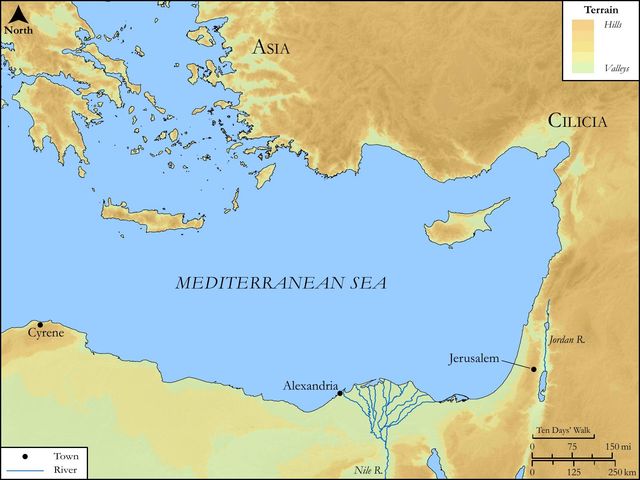
See on the biblical-era maps


Study this verse
Public-domain commentary
Matthew Henry
From his Commentary on the Whole Bible. Henry comments on passages, not single verses — this entry covers Acts 6:8–15. His four-level outline is real structure in the source text, so it is rendered as structure.
Stephen, no doubt was diligent and faithful in the discharge of his office as distributor of the church's charity, and laid out himself to put that affair in a good method, which he did to universal satisfaction; and though it appears here that he was a man of uncommon gifts, and fitted for a higher station, yet, being called to that office, he did not think it below him to do the duty of it. And, being faithful in a little, he was entrusted with more; and, though we do not find him propagating the gospel by preaching and baptizing, yet we find him here called out to very honourable services, and owned in them.
I.He proved the truth of the gospel, by working miracles in Christ's name, Act 6:8.
1.He was full of faith and power, that is, of a strong faith, by which he was enabled to do great things. Those that are full of faith are full of power, because by faith the power of God is engaged for us. His faith did so fill him that it left no room for unbelief and made room for the influences of divine grace, so that, as the prophet speaks, he was full of power by the Spirit of the Lord of hosts, Mic 3:8. By faith we are emptied of self, and so are filled with Christ, who is the wisdom of God and the power of God.
2.Being so he did great wonders and miracles among the people, openly, and in the sight of all; for Christ's miracles feared not the strictest scrutiny. It is not strange that Stephen, though he was not a preacher by office, did these great wonders, for we find that these were distinct gifts of the Spirit, and divided severally, for to one was given the working of miracles, and to another prophecy, Co1 12:10, Co1 12:11. And these signs followed not only those that preached, but those that believed. Mar 16:17
II.He pleaded the cause of Christianity against those that opposed it, and argued against it (Act 6:9, Act 6:10); he served the interests of religion as a disputant, in the high places of the field, while others were serving them as vinedressers and husbandmen.
1.We are here told who were his opponents, Act 6:9. They were Jews, but Hellenist Jews, Jews of the dispersion, who seem to have been more zealous for their religion than the native Jews; it was with difficulty that they retained the practice and profession of it in the country where they lived, where they were as speckled birds, and not without great expense and toil that they kept up their attendance at Jerusalem, and this made them more active sticklers for Judaism than those were whose profession of their religion was cheap and easy. They were of the synagogue which is called the synagogue of the Libertines; the Romans called those Liberti, or Libertini, who either, being foreigners, were naturalized, or, being slaves by birth, were manumitted, or made freemen. Some think that these Libertines were such of the Jews as had obtained the Roman freedom, as Paul had (Act 22:27, Act 22:28); and it is probable that he was the most forward man of this synagogue of the Libertines in disputing with Stephen, and engaged others in the dispute, for we find him busy in the stoning of Stephen, and consenting to his death. There were others that belonged to the synagogue of the Cyrenians and Alexandrians, of which synagogue the Jewish writers speak; and others that belonged to their synagogue who were of Cilicia and Asia; and if Paul, as a freeman of Rome, did not belong to the synagogue of the Libertines, he belonged to this, as a native of Tarsus, a city of Cilicia: it is probable that he might be a member of both. The Jews that were born in other countries, and had concerns in them, had frequent occasion, not only to resort to, but to reside in, Jerusalem. Each nation had its synagogue, as in London there are French, and Dutch, and Danish churches: and those synagogues were the schools to which the Jews of those nations sent their youth to be educated in the Jewish learning. Now those that were tutors and professors in these synagogues, seeing the gospel grow, and the rulers conniving at the growth of it, and fearing what would be the consequence of it to the Jewish religion, which they were jealous for, being confident of the goodness of their cause, and their own sufficiency to manage it, would undertake to run down Christianity by force of argument. It was a fair and rational way of dealing with it, and what religion is always ready to admit. Produce your cause, saith the Lord, bring forth your strong reasons, Isa 41:21. But why did they dispute with Stephen? And why not with the apostles themselves?
(1.)Some think because they despised the apostles as unlearned and ignorant men, whom they thought it below them to engage with; but Stephen was bred a scholar, and they thought it their honour to meddle with their match.
(2.)Others think it was because they stood in awe of the apostles, and could not be so free and familiar with them as they could be with Stephen, who was in an inferior office.
(3.)Perhaps, they having given a public challenge, Stephen was chosen and appointed by the disciples to be their champion; for it was not meet that the apostles should leave the preaching of the word of God to engage in controversy. Stephen, who was only a deacon in the church, and a very sharp young man, of bright parts, and better qualified to deal with wrangling disputants than the apostles themselves, was appointed to this service. Some historians say that Stephen had been bred up at the feet of Gamaliel, and that Saul and the rest of them set upon him as a deserter, and with a particular fury made him their mark.
(4.)It is probable that they disputed with Stephen because he was zealous to argue with them and convince them, and this was the service to which God had called him.
2.We are here told how he carried the point in this dispute (Act 6:10): They were not able to resist the wisdom and the Spirit by which he spoke. They could neither support their own arguments nor answer his. He proved by such irresistible arguments that Jesus is the Christ, and delivered himself with so much clearness and fulness that they had nothing to object against what he said; though they were not convinced, yet they were confounded. It is not said, They were not able to resist him, but, They were not able to resist the wisdom and the Spirit by which he spoke, that Spirit of wisdom which spoke by him. Now was fulfilled that promise, I will give you a mouth and wisdom which all your adversaries shall not be able to gainsay nor resist, Luk 21:15. They thought they had only disputed with Stephen, and could make their part good with him; but they were disputing with the Spirit of God in him, for whom they were an unequal match.
III.At length, he sealed it with his blood; so we shall find he did in the next chapter; here we have some steps taken by his enemies towards it. When they could not answer his arguments as a disputant, they prosecuted him as a criminal, and suborned witnesses against him, to swear blasphemy upon him. "On such terms (saith Mr. Baxter here) do we dispute with malignant men. And it is next to a miracle of providence that no greater number of religious persons have been murdered in the world, by the way of perjury and pretence of law, when so many thousands hate them who make no conscience of false oaths." They suborned men, that is, instructed them what to say, and then hired them to swear it. They were the more enraged against him because he had proved them to be in the wrong, and shown them the right way; for which they ought to have given him their best thanks. Was he therefore become their enemy, because he told them the truth, and proved it to be so? Now let us observe here,
1.How with all possible art and industry they incensed both the government and the mob against him, that, if they could not prevail by the one, they might by the other (Act 6:12): They stirred up the people against him, that, if the sanhedrim should still think fit (according to Gamaliel's advice) to let him alone, yet they might run him down by a popular rage and tumult; they also found means to stir up the elders and scribes against him, that, if the people should countenance and protect him, they might prevail by authority. Thus they doubted not but to gain their point, when then had two strings to their bow.
2.How they got him to the bar: They came upon him, when he little thought of it, and caught him and brought him to the council. They came upon him in a body, and flew upon him as a lion upon his prey; so the word signifies. By their rude and violent treatment of him, they would represent him, both to the people, and to the government, as a dangerous man, that would either flee from justice if he were not watched, or fight with it if he were not put under a force. Having caught him, they brought him triumphantly into the council, and, as it should seem, so hastily that he had none of his friends with him. They had found, when they brought many together, that they emboldened one another, and strengthened one another's hands; and therefore they will try how to deal with them singly.
3.How they were prepared with evidence ready to produce against him. They were resolved that they would not be run a-ground, as they were when they brought our Saviour upon his trial, and then had to seek for witnesses. These were got ready beforehand, and were instructed to make oath that they had heard him speak blasphemous words against Moses and against God (Act 6:11) - against this holy place and the law (Act 6:13); for they heard him say what Jesus would do to their place and their customs, Act 6:14. It is probable that he had said something to that purport; and yet those who swore it against him are called false witnesses, because, though there was something of truth in their testimony, yet they put a wrong and malicious construction upon what he had said, and perverted it. Observe,
(1.)What was the general charge exhibited against him - that he spoke blasphemous words; and, to aggravate the matter, "He ceases not to speak blasphemous words; it is his common talk, his discourse in all companies; wheresoever he comes, he makes it his business to instil his notions into all he converses with." It intimates likewise something of contumacy and contempt of admonition. "He has been warned against it, and yet ceases not to talk at this rate." Blasphemy is justly reckoned a heinous crime (to speak contemptibly and reproachfully of God our Maker), and therefore Stephen's persecutors would be thought to have a deep concern upon them for the honour of God's name, and to do this in a jealousy for that. As it was with the confessors and martyrs of the Old Testament, so it was with those of the New - their brethren that hated them, and cast them out, said, Let the Lord be glorified; and pretended they did him service in it. He is said to have spoken blasphemous words against Moses and against God. Thus far they were right, that those who blaspheme Moses (if they meant the writings of Moses, which were given by inspiration of God) blaspheme God himself. Those that speak reproachfully of the scriptures, and ridicule them, reflect upon God himself, and do despite to him. His great intention is to magnify the law and make it honourable; those therefore that vilify the law, and make it contemptible, blaspheme his name; for he has magnified his word above all his name. But did Stephen blaspheme Moses? By no means, he was far from it. Christ, and the preachers of his gospel, never said any thing that looked like blaspheming Moses; they always quoted his writings with respect, appealed to them, and said no other things than what Moses said should come; very unjustly therefore is Stephen indicted for blaspheming Moses. But,
(2.)Let us see how this charge is supported and made out; why, truly, when the thing was to be proved, all they can charge him with is that he hath spoken blasphemous words against this holy place and the law; and this must be deemed and taken as blasphemy against Moses and against God himself. Thus does the charge dwindle when it comes to the evidence.
[1.]He is charged with blaspheming this holy place. Some understand this of the city of Jerusalem, which was the holy city, and which they had a mighty jealousy for. But it is rather meant of the temple, that holy house. Christ was condemned as a blasphemer for words which were thought to reflect upon the temple, which they seemed concerned for the honour of, even when they by their wickedness had profaned it.
[2.]He is charged with blaspheming the law, of which they made their boast, and in which they put their trust, when through breaking the law they dishonoured God, Rom 2:23. Well, but how can they make this out? Why, here the charge dwindles again; for all they can accuse him of is that they had themselves heard him say (but how it came in, or what explication he gave to if, they think not themselves bound to give account) that this Jesus of Nazareth, who was so much talked of, shall destroy this place, and change the customs which Moses delivered to us. He could not be charged with having said any thing to the disparagement either of the temple or of the law. The priests had themselves profaned the temple, by making it not only a house of merchandise, but a den of thieves; yet they would be thought zealous for the honour of it, against one that had never said any thing amiss of it, but had attended it more as a house of prayer, according to the true intention of it, than they had. Nor had he ever reproached the law as they had. But, First, He had said, Jesus of Nazareth shall destroy this place, destroy the temple, destroy Jerusalem. It is probable that he might say so; and what blasphemy was it against the holy place to say that it should not be perpetual any more than Shiloh was, and that the just and holy God would not continue the privileges of his sanctuary to those that abused them? Had not the prophets given the same warning to their fathers of the destruction of that holy place by the Chaldeans? Nay, when the temple was first built, had not God himself given the same warning: This house, which is high, shall be an astonishment, Ch2 7:21. And is he a blasphemer, then, who tells them that Jesus of Nazareth, if they continue their opposition to him, will bring a just destruction upon their place and nation, and they may thank themselves? Those wickedly abuse their profession of religion who, under colour of that, call the reproofs given them for their disagreeable conversations blasphemous reflections upon their religion. Secondly, He had said, This Jesus shall change the customs which Moses delivered to us. And it was expected that in the days of the Messiah they should be changed, and that the shadows should be done away when the substance was come; yet this was no essential change of the law, but the perfecting of it. Christ came, not to destroy, but to fulfil, the law; and, if he changed some customs that Moses delivered, it was to introduce and establish those that were much better; and if the Jewish church had not obstinately refused to come into this new establishment, and adhered to the ceremonial law, for aught I know their place had not been destroyed; so that for putting them into a certain way to prevent their destruction, and for giving them certain notice of their destruction if they did not take that way, he is accused as a blasphemer.
IV.We are here told how God owned him when he was brought before the council, and made it to appear that he stood by him (Act 6:15):
All that sat in the council, the priests, scribes, and elders, looking stedfastly on him, being a stranger, and one they had not yet had before them, saw his face as it had been the face of an angel. It is usual for judges to observe the countenance of the prisoner, which sometimes is an indication either of guilt or innocence. Now Stephen appeared at the bar with the countenance as of an angel.
1.Perhaps it intimates no more than that he had an extraordinarily pleasant, cheerful countenance, and there was not in it the least sign either of fear for himself or anger at his persecutors. He looked as if he had never been better pleased in his life than he was now when he was called out to bear his testimony to the gospel of Christ, thus publicly, and stood fair for the crown of martyrdom. Such an undisturbed serenity, such an undaunted courage, and such an unaccountable mixture of mildness and majesty, there was in his countenance, that every one said he looked like an angel; enough surely to convince the Sadducees that there are angels, when they saw before their eyes an incarnate angel.
2.It should rather seem that there was a miraculous splendour and brightness upon his countenance, like that of our Saviour when he was transfigured - or, at least, that of Moses when he came down from the mount - God designing thereby to put honour upon his faithful witness and confusion upon his persecutors and judges, whose sin would be highly aggravated, and would be indeed a rebellion against the light, if, notwithstanding this, they proceeded against him. Whether he himself knew that the skin of his face shone or no we are not told; but all that sat in the council saw it, and probably took notice of it to one another, and an arrant shame it was that when they saw, and could not but see by it that he was owned of God, they did not call him from standing at the bar to sit in the chief seat upon the bench. Wisdom and holiness make a man's face to shine, and yet these will not secure men from the greatest indignities; and no wonder, when the shining of Stephen's face could not be his protection; though it had been easy to prove that if he had been guilty of putting any dishonour upon Moses God would not thus have put Moses's honour upon him.
Historical interpretation
Two Centuries of Reception
4 surviving comments on this verse. Each one is dated, so this reads as a timeline rather than a list.
Select a marker to jump to its quote. Markers stagger vertically where authors wrote within a few decades of each other.
But he was Moses still, even when he was not visible. So also Stephen had already put on the appearance of an angel, although they were none other than his human knees which bent beneath the stoning.
But to show that it was not in the nature of such a man to speak such things, and harshly, "Then all," it says, "which were in the council, looking steadfastly upon him, saw his face, as it had been the face of an angel": so mild was he even in countenance. For, in cases where persons were not falsely accused, Scripture mentions nothing of this kind: but as in this case it was all false accusation, with reason does God rectify it by the very look of the man. For the Apostles indeed were not falsely accused, but were forbidden: but this man is falsely accused: and therefore before all else his countenance pleads for him. This abashed even the priest.
"They saw his face as it had been the face of an angel." "Full of faith and of power": which is also the character given of Barnabas "he was a good man, full of faith and of the Holy Ghost." Whence we learn that the sincere and innocent are, above all others, the men to be saved, and that these same are also more gracious.
"And all that sat in the council, looking steadfastly on him, saw his face as it had been the face of an angel." So possible is it even for one in a lower degree to shine. For what, I ask, had this man less than the Apostles? He lacked not miracles, and great was the boldness he exhibited. "They saw His face," it is said, "as it had been the face of an angel." For this was his grace, this was the glory of Moses. God made him thus gracious of visage, now that he was about to say somewhat, thus at once by his very look to awe them. For there are, yes, there are faces full-fraught with spiritual grace, lovely to them that love, awful to haters and enemies. It mentions also the reason, why they suffered his oration.
Continue studying Acts 6:15 across the web’s major study libraries — every link below opens this exact verse, chapter, or book on the destination site.
Read & Compare
 BibleGatewayThis verse in more than 200 translations and 70 languages.
 Bible.comThe YouVersion reader — hundreds of translations, reading plans, and highlights.
 ESV.orgCrossway's official English Standard Version reader.
 NET BibleThe NET translation with 60,000+ translators' notes on every rendering decision.
 STEP BibleTyndale House's free study tool — original text, vocabulary, and scholarly resources.
 BibliaLogos Bible Software's free web reader.
 USCCBThe New American Bible (Revised Edition) with the U.S. bishops' study notes.
Commentaries
 BibleHub CommentariesDozens of classic commentaries on this verse, gathered on one page.
 StudyLightMore than 100 commentary sets — the largest collection on the web.
 BibleRefPlain-English commentary on what this verse means, verse by verse.
 Enduring WordDavid Guzik's free commentary on this chapter, widely used by Bible teachers.
 Bible Study ToolsVerse commentary alongside Greek and Hebrew study aids.
Original Language & Research
- BibleHub InterlinearThe verse word by word — original language, transliteration, and English.
- BibleHub LexiconEvery word's original-language definition and Strong's entry.
 Blue Letter BibleDeep-study tools — Strong's numbers, concordance, and word studies.
 CNTR CollationThe earliest Greek manuscripts of this verse, collated letter by letter.
Sermons, Hymns & Audio


TrulyRandomVerse is not affiliated with these sites and doesn’t control their content. They’re linked because they’re genuinely useful.
Summary
Acts 6:15 vividly portrays Stephen, standing accused before the Jewish Sanhedrin, as his face supernaturally radiates with a divine glow, appearing "as it had been the face of an angel." This miraculous manifestation serves as a powerful divine vindication of Stephen's character and ministry, starkly contrasting with the false accusations leveled against him, and signaling God's profound presence and approval amidst intense hostility.
Context
ShowHideLiterary Context
Acts 6 marks a significant transition in the early church, moving from internal organizational challenges (the Hellenist widows' complaint) to external persecution. Stephen is introduced as one of the seven deacons chosen to address the food distribution issue, but he quickly emerges as a powerful evangelist "full of faith and the Holy Spirit" and "full of grace and power" (Acts 6:5 and Acts 6:8). His public ministry, characterized by "great wonders and signs," provokes intense opposition from various synagogues, whose members are unable to refute his wisdom and the Spirit by which he speaks (Acts 6:9-10). Unable to win intellectually, they resort to suborning false witnesses, accusing Stephen of blasphemy against Moses, God, the Temple, and the Law (Acts 6:11-14). Verse 15 directly precedes Stephen's lengthy and profound sermon in Acts 7, setting the stage for his eloquent defense and ultimate martyrdom.
Historical & Cultural Context
Stephen's trial takes place before the Sanhedrin, the supreme Jewish judicial and religious council in Jerusalem. This body, comprised of seventy-one members including chief priests, elders, and scribes, held significant authority under Roman rule, particularly in matters of Jewish law and religion. The accusations of blasphemy against Moses and the Temple were extremely serious, carrying the death penalty under Jewish law. The Sanhedrin's authority to execute was limited by Roman oversight, but they could, and did, condemn individuals to death, often then seeking Roman approval or inciting a mob. The reference to Stephen's face appearing "as an angel" would have resonated deeply with Jewish listeners, recalling instances like Moses' radiant face after encountering God on Mount Sinai (Exodus 34:29-35), which signified divine approval and a direct encounter with God's glory. This visual sign would have been a profound, undeniable testimony to Stephen's divine favor in a court determined to condemn him.
Key Themes
ShowHideThis verse contributes to several overarching themes in Acts and the broader biblical narrative. Firstly, it highlights the theme of Divine Vindication and Empowerment, demonstrating that God actively intervenes to affirm His servants, even in the face of grave injustice and persecution. Stephen's radiant face is a visible sign of God's presence and approval, echoing the Spirit's empowerment described earlier in Acts 6:3-8. Secondly, it underscores the theme of Suffering and Glory, where faithfulness to Christ, even unto suffering, is met with divine glory and affirmation. This foreshadows Stephen's ultimate vision of Christ in Acts 7:55-56, where his earthly suffering culminates in heavenly glory. Thirdly, it speaks to the Continuity and Transformation of God's Work, showing how the Spirit's power, once manifested through Moses, now shines through Stephen, a new covenant messenger, indicating a new era of God's redemptive plan unfolding through Christ and His church.
Exposition and Analysis
ShowHideKey Word Analysis
ShowHideDerived from a compound word meaning "to stretch," this verb signifies an intense, fixed, and unwavering gaze. It implies that the council members were not merely glancing at Stephen but were staring intently, unable to look away from the profound and captivating sight before them. This emphasizes the undeniable and striking nature of the transformation they witnessed.
This term refers to the countenance, aspect, or appearance. In this context, it denotes the visible manifestation of Stephen's inner state and divine indwelling. The transformation of his "face" is not just a superficial change but a profound revelation of God's glory shining through him, making his very presence a testimony.
Meaning "messenger," this word primarily refers to a celestial being who serves as God's emissary. In biblical tradition, angels are often associated with divine glory, purity, and the manifestation of God's presence. To say Stephen's face was "as the face of an angel" implies a supernatural radiance, a divine glow, and perhaps even an aura of holiness and authority, akin to how God's messengers appear.
Verse Breakdown
ShowHide"And all that sat in the council,"
This phrase identifies the audience and setting: the entire Sanhedrin, the supreme Jewish court, convened to judge Stephen. Their collective presence underscores the gravity and official nature of the proceedings, making their shared observation of Stephen's transformed appearance all the more significant and undeniable.
"looking stedfastly on him,"
This describes the intense focus of the council members. The Greek word atenízō (stedfastly) conveys a fixed, unwavering gaze, indicating that Stephen's presence was so compelling or unusual that it commanded their undivided attention. This deliberate observation makes their subsequent perception of his face a direct and undeniable eyewitness account.
"saw his face as it had been the face of an angel."
This is the climactic observation. Despite the hostile environment and the false accusations, the council members witnessed a supernatural phenomenon: Stephen's countenance was supernaturally illuminated, radiating with a divine glory reminiscent of an angel's appearance. This simile powerfully conveys God's divine vindication of Stephen, affirming his innocence and God's presence with him, even as he stood accused. It served as a visible sign of divine approval, a silent yet potent testimony against his accusers.
Literary Devices
ShowHideActs 6:15 employs several powerful literary devices. The most prominent is Simile, explicitly stating that Stephen's face was "as it had been the face of an angel." This comparison evokes images of divine glory, purity, and the presence of God's messengers, immediately elevating Stephen's status from accused blasphemer to divinely endorsed prophet. This also creates a strong sense of Irony, as Stephen, accused of blasphemy against God, is visibly affirmed by God Himself through this miraculous manifestation. His face, meant to be seen as that of a criminal, instead shines with divine approval. Furthermore, the verse functions as Foreshadowing, hinting at the greater glory Stephen would soon experience in Acts 7:55, where he sees the glory of God and Jesus standing at His right hand. The radiant face is a preliminary glimpse of the heavenly reality that awaits him and a testament to the spiritual power at work through him.
Theological and Thematic Connections
ShowHideActs 6:15 profoundly illustrates the divine vindication and empowerment of God's faithful servants, even in the midst of severe opposition and false accusation. Stephen's radiant face is a tangible sign of God's presence and approval, serving as a powerful, silent testimony against his accusers. It highlights the truth that God is with those who stand for Him, bestowing upon them a supernatural peace and glory that transcends their earthly circumstances. This manifestation of divine glory through a human being underscores the active work of the Holy Spirit, not only in empowering Stephen's ministry but also in outwardly affirming his character and message, demonstrating that his suffering is not a sign of divine abandonment but rather a path through which God's glory can be revealed.
Reflection and Application
ShowHideStephen's trial and the miraculous radiance of his face offer profound lessons for contemporary believers facing adversity. This account reminds us that our true vindication comes from God, not from human courts or public opinion. When we stand firm in our faith and witness, even amidst false accusations or intense scrutiny, God's presence can be tangibly manifested through us, bringing an inexplicable peace and even a visible spiritual glow that confounds our detractors. Stephen's calm, radiant appearance, despite the hostile environment and the looming threat of death, testifies to an inner peace and confidence rooted in his unwavering faith and intimate connection with God. This calls us to cultivate a deep relationship with the Holy Spirit, trusting that He will empower us to remain steadfast, articulate our faith boldly, and even use our character and demeanor to display God's glory, transforming moments of trial into opportunities for divine witness. Our ultimate hope and confidence should rest in God's sovereign hand, knowing that He is able to sustain us, affirm us, and ultimately bring us into His eternal glory.
Questions for Reflection
ShowHideFAQ
ShowHideWhat does it mean for Stephen's face to appear "as the face of an angel"?
ShowHideThis phrase is a powerful simile indicating a supernatural phenomenon where Stephen's face radiated with a divine glow or splendor, akin to how angels are often depicted as shining or glorious beings. It signifies God's profound presence, favor, and approval upon Stephen, serving as a visible testament to his innocence and the divine truth of his message, despite the false accusations. It recalls instances like Moses' radiant face after being in God's presence, signifying a direct encounter with divine glory.
Was this a common occurrence for early Christians, or was it unique to Stephen?
ShowHideWhile the specific manifestation of a glowing, "angelic" face is unique to Stephen in the New Testament narrative, the concept of believers being filled with the Holy Spirit and empowered to speak with wisdom and boldness, even performing signs and wonders, was common among early Christians, as seen in Acts 2:4 and Acts 4:31. Stephen's experience, however, highlights an extraordinary divine affirmation in a moment of extreme persecution, underscoring God's special favor upon him as he stood as a witness.
How does this event relate to Stephen's subsequent martyrdom?
ShowHideStephen's radiant face in Acts 6:15 serves as a powerful prelude to his sermon in Acts 7 and his subsequent martyrdom. It visually confirms his divine calling and purity of heart, setting the stage for his Spirit-filled defense. His angelic appearance foreshadows the heavenly vision he receives just before his death, where he sees "the glory of God, and Jesus standing on the right hand of God" (Acts 7:55). This sequence emphasizes that his suffering and death were not a defeat but a glorious transition, divinely affirmed from beginning to end.
Christ-Centered Fulfillment
ShowHideActs 6:15, with Stephen's face shining "as it had been the face of an angel," finds profound Christ-centered fulfillment in several ways. Stephen, standing accused before the Sanhedrin, mirrors Jesus' own trial before the same body, where He too faced false accusations and hostility (Matthew 26:57-68). Stephen's radiant face is a visible manifestation of divine glory and vindication, a premonition of the ultimate glory that awaited him, and a powerful echo of Christ's own Transfiguration, where His "face did shine as the sun" (Matthew 17:2). This divine radiance in Stephen underscores that the glory of God, once uniquely manifest in Christ, is now, through the indwelling Holy Spirit, reflected in His faithful followers, particularly in moments of suffering and witness. Stephen's experience, culminating in his vision of Christ standing at the right hand of God (Acts 7:55-56), demonstrates that true glory and vindication are found in union with the risen Christ, who empowers His disciples to bear witness to Him even unto death, transforming their suffering into a display of His own eternal splendor and ultimate triumph over sin and death.