


1 Corinthians 12:25
Bible text: King James Version (1769 Blayney text) · Public domain
Bible text: Berean Standard Bible · Public domain
Bible text: American Standard Version (1901) · Public domain
Bible text: World English Bible, Messianic edition · Public domain
Bible text: Geneva Bible (1599) · Public domain
Bible text: Young's Literal Translation · Public domain
- ἵναinaso thatG2443CONJConjunction
- μὴmēnotG3361PRT-NNegative Particle Negative
- ᾖēthere may beG1510V-PAS-3SVerb Present Active Subjunctive 3rd Singular
- σχίσμαschismadivisionG4978N-NSNNoun Nominative Singular Neuter
- ἐνeninG1722PREPPreposition
- τῷtōtheG3588T-DSNDefinite article Dative Singular Neuter
- σώματιsōmatibodyG4983N-DSNNoun Dative Singular Neuter
- ἀλλὰallabutG235CONJConjunction
- τὸtotheG3588T-ASNDefinite article Accusative Singular Neuter
- αὐτὸautosameG846P-ASNPersonal pronoun Accusative Singular Neuter
- ὑπὲρhuperforG5228PREPPreposition
- ἀλλήλωνallēlōnone anotherG240C-GPMReciprocal pronoun Genitive Plural Masculine
- μεριμνῶσινmerimnōsinmay have concernG3309V-PAS-3PVerb Present Active Subjunctive 3rd Plural
- τὰtatheG3588T-NPNDefinite article Nominative Plural Neuter
- μέλη·melēmembersG3196N-NPNNoun Nominative Plural Neuter
English is a literal word-by-word gloss of the Greek, not the KJV's wording. Why?
This is the original text the KJV's translators worked from — each Greek word with its own literal English meaning in this verse, prepared by scholars at Tyndale House, Cambridge. The KJV translates whole sentences, not word by word, so its wording differs: one Greek word can become several English words, and the KJV may choose “charity” where the gloss reads “love”. Both are faithful — they answer different questions. For the KJV's own rendering, switch to the KJV text.
Details
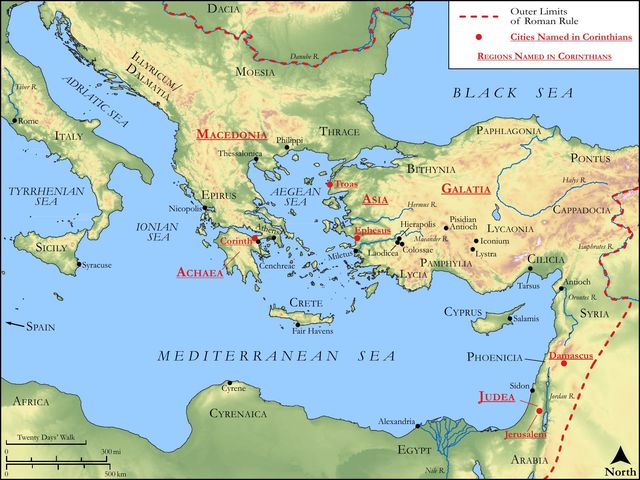
See on the biblical-era maps

Study this verse
Public-domain commentary
Matthew Henry
From his Commentary on the Whole Bible. Henry comments on passages, not single verses — this entry covers 1 Corinthians 12:12–26. His two-level outline is real structure in the source text, so it is rendered as structure.
The apostle here makes out the truth of what was above asserted, and puts the gifted men among the Corinthians in mind of their duty, by comparing the church of Christ to a human body.
I.By telling us that one body may have many members, and that the many members of the same body make but one body (Co1 12:12):
As the body is one, and hath many members, and all members of that one body, being many, are one body, so also is Christ; that is, Christ mystical, as divines commonly speak. Christ and his church making one body, as head and members, this body is made up of many parts or members, yet but one body; for all the members are baptized into the same body, and made to drink of the same Spirit, Co1 12:13. Jews and Gentiles, bond and free, are upon a level in this: all are baptized into the same body, and made partakers of the same Spirit. Christians become members of this body by baptism: they are baptized into one body. The outward rite is of divine institution, significant of the new birth, called therefore the washing of regeneration, Tit 3:5. But it is by the Spirit, by the renewing of the Holy Ghost, that we are made members of Christ's body. It is the Spirit's operation, signified by the outward administration, that makes us members. And by communion at the other ordinance we are sustained; but then it is not merely by drinking the wine, but by drinking into one Spirit. The outward administration is a means appointed of God for our participation in this great benefit; but it is baptism by the Spirit, it is internal renovation and drinking into one Spirit, partaking of his sanctifying influence from time to time, that makes us true members of Christ's body, and maintains our union with him. Being animated by one Spirit makes Christians one body. Note, All who have the spirit of Christ, without difference, are the members of Christ, whether Jew or Gentile, bond or free; and none but such. And all the members of Christ make up one body; the members many, but the body one. They are one body, because they have one principle of life; all are quickened and animated by the same Spirit.
II.Each member has its particular form, place, and use.
1.The meanest member makes a part of the body. The foot and ear are less useful, perhaps, than the hand and eye; but because one is not a hand, and the other an eye, shall they say, therefore, that they do not belong to the body? Co1 12:15, Co1 12:16. So every member of the body mystical cannot have the same place and office; but what then? Shall it hereupon disown relation to the body? Because it is not fixed in the same station, or favoured with the same gifts as others, shall it say, "I do not belong to Christ?" No, the meanest member of his body is as much a member as the noblest, and as truly regarded by him. All his members are dear to him.
2.There must be a distinction of members in the body: Were the whole body eye, where were the hearing? Were the whole ear, where were the smelling? Co1 12:17. If all were one member, where were the body? Co1 12:19. They are many members, and for that reason must have distinction among them, and yet are but one body, Co1 12:20. One member of a body is not a body; this is made up of many; and among these many there must be a distinction, difference of situation, shape, use, etc. So it is in the body of Christ; its members must have different uses, and therefore have different powers, and be in different places, some having one gift, and others a different one. Variety in the members of the body contributes to the beauty of it. What a monster would a body be if it were all ear, or eye, or arm! So it is for the beauty and good appearance of the church that there should be diversity of gifts and offices in it.
3.The disposal of members in a natural body, and their situation, are as God pleases: But now hath God set the members, every one of them, in the body, as it hath pleased him, Co1 12:18. We may plainly perceive the divine wisdom in the distribution of the members; but it was made according to the counsel of his will; he distinguished and distributed them as he pleased. So is it also in the members of Christ's body: they are chosen out to such stations, and endued with such gifts, as God pleases. He who is sovereign Lord of all disposes his favours and gifts as he will. And who should gainsay his pleasure? What foundation is here for repining in ourselves, or envying others? We should be doing the duties of our own place, and not murmuring in ourselves, nor quarrelling with others, that we are not in theirs.
4.All the members of the body are, in some respect, useful and necessary to each other: The eye cannot say to the hand, I have no need of thee; nor the head to the feet, I have no need of your: nay, those members of the body which seem to be more feeble (the bowels, etc.) are necessary (Co1 12:21, Co1 12:22); God has so fitted and tempered them together that they are all necessary to one another, and to the whole body; there is no part redundant and unnecessary. Every member serves some good purpose or other: it is useful to its fellow-members, and necessary to the good state of the whole body. Nor is there a member of the body of Christ but may and ought to be useful to his fellow-members, and at some times, and in some cases, is needful to them. None should despise and envy another, seeing God has made the distinction between them as he pleased, yet so as to keep them all in some degree of mutual dependence, and make them valuable to each other, and concerned for each other, because of their mutual usefulness. Those who excel in any gift cannot say that they have no need of those who in that gift are their inferiors, while perhaps, in other gifts, they exceed them. Nay, the lowest members of all have their use, and the highest cannot do well without them. The eye has need of the hand, and the head of the feet.
5.Such is the man's concern for his whole body that on the less honourable members more abundant honour is bestowed, and our uncomely parts have more abundant comeliness. Those parts which are not fit, like the rest, to be exposed to view, which are either deformed or shameful, we most carefully clothe and cover; whereas the comely parts have no such need. The wisdom of Providence has so contrived and tempered things that the most abundant regard and honour should be paid to that which most wanted it, Co1 12:24. So should the members of Christ's body behave towards their fellow-members: instead of despising them, or reproaching them, for their infirmities, they should endeavour to cover and conceal them, and put the best face upon them that they can.
6.Divine wisdom has contrived and ordered things in this manner that the members of the body should not be schismatics, divided from each other and acting upon separate interests, but well affected to each other, tenderly concerned for each other, having a fellow-feeling of each other's griefs and a communion in each other's pleasures and joys, Co1 12:25, Co1 12:26. God has tempered the members of the body natural in the manner mentioned, that there might be no schism in the body (Co1 12:25), no rupture nor disunion among the members, nor so much as the least mutual disregard. This should be avoided also in the spiritual body of Christ. There should be no schism in this body, but the members should be closely united by the strongest bonds of love. All decays of this affection are the seeds of schism. Where Christians grow cold towards each other, they will be careless and unconcerned for each other. And this mutual disregard is a schism begun. The members of the natural body are made to have a care and concern for each other, to prevent a schism in it. So should it be in Christ's body; the members should sympathize with each other. As in the natural body the pain of the one part afflicts the whole, the ease and pleasure of one part affects the whole, so should Christians reckon themselves honoured in the honours of their fellow-christians, and should suffer in their sufferings. Note, Christian sympathy is a great branch of Christian duty. We should be so far from slighting our brethren's sufferings that we should suffer with them, so far from envying their honours that we should rejoice with them and reckon ourselves honoured in them.
Historical interpretation
Sixteen Centuries of Reception
5 surviving comments on this verse. Each one is dated, so this reads as a timeline rather than a list.
Select a marker to jump to its quote. Markers stagger vertically where authors wrote within a few decades of each other.
With those among whom harmony is not secured, however, the bond of peace is not preserved, mildness of spirit is not maintained, but there is dissension, strife and rivalry. It would be a great piece of audacity to call such persons “members of Christ” or to say that they are ruled by him. It would be the expression of an honest mind to say openly that the wisdom of the flesh is master there and wields a royal sovereignty. .
Paul is saying that the human body is so organized that all its members are necessary, and because of this, all are concerned for one another. One cannot exist without the other, and parts which are thought to be inferior are usually more necessary. No one ought to be despised as useless.
"That there should be no schism in the body."
Next he also adds the reason, showing that with a view to their profit he both caused it to lack and more abundantly honored it. And what is the reason? "That there should be no schism," saith he, "in the body." (And he said not, "in the members," but, "in the body.") For there would indeed be a great and unfair advantage, if some members were cared for both by nature and by our forethought, others not even by either one of these. Then would they be cut off from one another, from inability to endure the connection. And when these were cut off, there would be harm done also to the rest. Seest thou how he points out, that of necessity "greater honor" is given to "that which lacketh?" "For had not this been so, the injury would have become common to all," saith he. And the reason is, that unless these received great consideration on our part, they would have been rudely treated, as not having the help of nature: and this rude treatment would have been their ruin: their ruin would have divided the body; and the body having been divided, the other members also would have perished, which are far greater than these.
Seest thou that the care of these latter is connected with making provision for those? For they have not their being so much in their own nature, as in their being one, by virtue of the body. Wherefore if the body perish, they profit nothing by such health as they have severally. But if the eye remain or the nose, preserving its proper function, yet when the bond of union is broken there will be no use for them ever after; whereas, suppose this remaining, and those injured, they both support themselves through it and speedily return to health.
But perhaps some one may say, "this indeed in the body hath reason, that 'that which lacketh hath received more abundant honor,' but among men how may this be made out?" Why, among men most especially thou mayest see this taking place. For so they who came at the eleventh hour first received their hire; and the sheep that had wandered induced the shepherd to leave behind the ninety and nine and run after it, and when it was found, he bore and did not drive it; and the prodigal son obtained more honor than he who was approved; and the thief was crowned and proclaimed before the Apostles. Thus also Joseph became eminent; thus Aaron the priest: the conspiracy of the envious caused God once and again to give His suffrage for him, and was the occasion of the rod's budding. Thus Jacob attained his abundant wealth and all those other blessings. Thus the envious pierce themselves through with ten thousand evils.
And in the case of the talents also thou mayest see this happen: in that to him that received the five talents, and to him that received two, were vouchsafed the same rewards; yea, by the very circumstance that he received the two, he was the more favored with great providential care. Since had he been entrusted with the five, with his want of ability he would have fallen from the whole: but having received the two and fulfilled his own duty, he was thought worthy of the same with him that had gained the five, having so far the advantage, as with less labor to obtain the same crown. And yet he too was a man as well as the one that traded with the five. Nevertheless, his Master doth not in any wise call him to a strict account, nor compel him to do the same with his fellow-servant, nor doth he say, "Why canst thou not gain the five?" (though he might justly have said so,) but assigned him likewise his crown.
Knowing these things therefore, ye that are greater, trample not on the less, lest, instead of them, ye injure yourselves. For when they are cut off, the whole body is destroyed. Since, what else is a body than the existence of many members? As also Paul himself saith, that "the body is not one member, but many." If therefore this be the essence of a body, let us take care that the many continue many. Since, unless this be entirely preserved, the stroke is in the vital parts; which is the reason also why the Apostle doth not require this only, their not being separated, but also their being closely united. For instance, having said, "that there be no schism in the body," he was not content with this, but added, "that the members should have the same care one for another." Adding this other cause also of the less enjoying more honor. For "therefore did he cause them to partake of greater honor," saith he, "that they might not meet with less care." And not from hence only, but also by all that befalls them, good and painful, are the members bound to one another.
Say not then, that such is an ordinary person, but consider he is a member of that body which holds together the whole: and as the eye, so also doth he cause the body to be a body. For where the body is builded up, there none hath anything more than his neighbor: since neither does this make a body, there being one part greater and another less, but their being many and diverse. For even as thou, because thou art greater, didst help to make up the body, so also he, because he is less. So that his comparative deficiency, when the body is to be builded up, turns out of equal value with thee unto this noble contribution: yea, he avails as much as thyself. And it is evident from hence. Let there be no member greater or less, nor more and less honorable: but let all be eye or all head: will not the body perish? Every one sees it. Again, if all be inferior, the same thing will happen. So that in this respect also the less are proved equal. Yea, and if one must say something more, the purpose of the less being less is that the body may remain. So that for thy sake he is less, in order that thou mayest continue to be great. And here is the cause of his demanding the same care from all. And having said, "that the members may have the same care one for another," he explains "the same thing" again.
The only rite which we know to have been instituted by Our Lord Himself is the Holy Communion ('Do this in remembrance of me' - 'If you do not eat the flesh of the Son of Man and drink His blood, ye have no life in you'). This is an order and must be obeyed. The other services are, I take it, traditional and might lawfully be altered. But the New Testament does not envisage solitary religion: some kind of regular assembly for worship and instruction is everywhere taken for granted in the Epistles. So we must be regular practising members of the Church.
Of course we differ in temperament. Some (like you - and me) find it more natural to approach God in solitude: but we must go to church as well. Others find it easier to approach Him through the services: but they must practice private prayer and reading as well. For the Church is not a human society of people united by their natural affinities but the Body of Christ in which all members however different (and He rejoices in their differences and by no means wishes to iron them out) must share the common life, complementing and helping and receiving one another precisely by their differences. (Re-read 1st Corinthians cap 12 and meditate on it. The word translated members would perhaps be better translated organs).
The Christian is called not to individualism but to membership in the mystical body... The very word membership is of Christian origin, but it has been taken over by the world and emptied of all meaning. In any book on logic you may see the expression "members of a class." It must be most emphatically stated that the items or particulars included in a homogeneous class are almost the reverse of what St. Paul meant by members. By members he meant what we should call organs, things essentially different from, and complimentary to, one another, things differing not only in structure and function but also in dignity. Thus, in a club, the committee as a whole and the servants as a whole may both properly be regarded as "members"; what we should call the members of the club are merely units. A row of identically dressed and identically trained soldiers set side by side, or a number of citizens listed as voters in a constituency are not members of anything in the Pauline sense. I am afraid that when we describe a man as "a member of the Church" we usually mean nothing Pauline; we mean only that he is a unit - that he is one more specimen of some kind of things as X and Y and Z. How true membership in a body differs from inclusion in a collective may be seen in the structure of a family. The grandfather, the parents, the grown-up son, the child, the dog, and the cat are true members (in the organic sense), precisely because they are not members or units of a homogenous class. They are not interchangeable. Each person is almost a species in himself. The mother is not simply a different person from the daughter; she is a different kind of person. The grown-up brother is not simply one unit in the class children; he is a separate estate of the realm. The father and grandfather are almost as different as the cat and the dog. If you subtract any one member, you have not simply reduced the family in number; you have inflicted an injury on its structure. Its unity is a unity of unliked, almost of incommensurables...
The society into which the Christian is called at baptism is not a collective but a Body. It is in fact that Body of which the family is an image on the natural level. If anyone came to it with the misconception that membership of the Church was membership in a debased modern sense - a massing together of persons as if they were pennies or counters - he would be corrected at the threshold by the discovery that the head of this Body is so unlike the inferior memberships that they share no predicate with Him save by analogy.
Continue studying 1 Corinthians 12:25 across the web’s major study libraries — every link below opens this exact verse, chapter, or book on the destination site.
Read & Compare
 BibleGatewayThis verse in more than 200 translations and 70 languages.
 Bible.comThe YouVersion reader — hundreds of translations, reading plans, and highlights.
 ESV.orgCrossway's official English Standard Version reader.
 NET BibleThe NET translation with 60,000+ translators' notes on every rendering decision.
 STEP BibleTyndale House's free study tool — original text, vocabulary, and scholarly resources.
 BibliaLogos Bible Software's free web reader.
 USCCBThe New American Bible (Revised Edition) with the U.S. bishops' study notes.
Commentaries
 BibleHub CommentariesDozens of classic commentaries on this verse, gathered on one page.
 StudyLightMore than 100 commentary sets — the largest collection on the web.
 BibleRefPlain-English commentary on what this verse means, verse by verse.
 Enduring WordDavid Guzik's free commentary on this chapter, widely used by Bible teachers.
 Bible Study ToolsVerse commentary alongside Greek and Hebrew study aids.
Original Language & Research
- BibleHub InterlinearThe verse word by word — original language, transliteration, and English.
- BibleHub LexiconEvery word's original-language definition and Strong's entry.
 Blue Letter BibleDeep-study tools — Strong's numbers, concordance, and word studies.
 CNTR CollationThe earliest Greek manuscripts of this verse, collated letter by letter.
Sermons, Hymns & Audio


TrulyRandomVerse is not affiliated with these sites and doesn’t control their content. They’re linked because they’re genuinely useful.
Summary
First Corinthians 12:25 stands as a pivotal declaration within Paul's discourse on the church, articulating God's divine intention for the Body of Christ: the complete absence of division and the active cultivation of profound, reciprocal care among all its members. This verse encapsulates the essence of Christian community, emphasizing that diversity in gifting and function must never lead to disunity, but rather foster a deeper interdependence and shared responsibility for one another's well-being, reflecting the harmonious operation of a healthy physical body.
Context
ShowHideLiterary Context
This verse is situated at the climax of Paul's extended analogy of the church as a human body in 1 Corinthians 12. Paul introduces this powerful metaphor in 1 Corinthians 12:12 to address the Corinthian church's significant issues with disunity, pride, and the improper valuing of spiritual gifts. Prior to verse 25, Paul meticulously details how various parts of the body—eyes, ears, feet, hands—each possess unique functions yet are indispensable to the whole (1 Corinthians 12:14-20). He specifically highlights the often "weaker" or "less honorable" parts as deserving of greater honor and care (1 Corinthians 12:21-24), setting the stage for the explicit command in verse 25 that unity and mutual concern are not merely ideals but divine imperatives for the church's healthy functioning.
Historical & Cultural Context
The Corinthian church, located in a bustling, cosmopolitan port city, was notoriously fractious. Its members hailed from diverse social, economic, and ethnic backgrounds, and they brought with them various cultural values, including a penchant for status, rhetoric, and individual prowess, which often manifested as competition and division within the Christian community. Paul's emphasis on unity and mutual care directly counters the prevailing norms of the Greeks and Romans, which often celebrated individual achievement and hierarchical structures. While the concept of a "body politic" existed in ancient thought, Paul's application of the body metaphor to the church, infused with the Spirit's work and Christ's headship, was uniquely Christian, challenging the Corinthians to live out a counter-cultural unity rooted in divine love rather than human pride or social standing.
Key Themes
ShowHideFirst Corinthians 12:25 contributes significantly to several overarching themes within the chapter and the broader epistle. Foremost is the theme of Unity in Diversity, asserting that the manifold spiritual gifts and roles within the church are designed to complement, not compete with, one another, ensuring the harmonious operation of the whole body. This directly combats the Anti-Division theme, as Paul explicitly forbids "schism," or tearing apart, within the community. Instead, the verse champions Interdependence and Mutual Care, emphasizing that every member is vital and has a responsibility to actively look out for, support, and honor fellow believers. This mutual concern is presented as the antidote to the pride and envy that fueled the Corinthian divisions, fostering a community where the well-being of one is the concern of all, echoing the call for selfless love found throughout 1 Corinthians 13.
Exposition and Analysis
ShowHideKey Word Analysis
ShowHideFrom schízō, meaning "to split" or "to tear." In this context, it refers to a division, dissension, or faction within a community. Paul uses this term to denote not just a difference of opinion, but a destructive tearing or rending of the unified fabric of the church, implying a serious breach of fellowship and harmony.
From sōzō, meaning "to save" or "to make whole." This word refers to the physical body as a sound whole, but Paul consistently uses it metaphorically in 1 Corinthians 12 to represent the church as a unified, organic entity, the "Body of Christ." The implication is that the church, like a healthy body, should function as a cohesive unit where all parts contribute to the well-being of the whole.
From mérimna, meaning "anxiety" or "worry." While often used in a negative sense (e.g., "do not be anxious"), here it is employed positively to convey a thoughtful, solicitous, and active concern for others. It implies a genuine, diligent attention to the needs and welfare of fellow members, moving beyond mere passive awareness to active engagement and support.
Verse Breakdown
ShowHide"That there should be no schism in the body"
This clause presents a negative command, a prohibition against division. The Greek particle hína mḗ (G3363), translated "that... no," expresses purpose—God's design is explicitly for the absence of internal rifts, factions, or destructive disagreements within the church, which is the "body" of Christ. This underscores the divine imperative for unity and harmony among believers, emphasizing that disunity is contrary to God's will for His people.
"but [that] the members should have the same care one for another"
This clause offers the positive counterpart and the antidote to schism. The conjunction allá (G235), "but," introduces a strong contrast. Instead of division, Paul commands that individual "members" (G3196, mélos), or parts of the body, actively demonstrate merimnáō (G3309), a thoughtful and diligent "care" for allḗlōn (G240), "one another." The phrase "the same care" (G846, autós) implies an equitable, consistent, and reciprocal concern, mirroring the natural way a body's parts instinctively protect and support each other. This mutual solicitude is the practical outworking of Christian love and the foundation for true unity.
Literary Devices
ShowHidePaul's masterful use of Analogy and Metaphor is the central literary device in 1 Corinthians 12, with the human body serving as a profound representation of the church. In verse 25, this metaphor underpins the entire command, making the abstract concept of spiritual unity tangible and relatable. The verse also employs Antithesis, sharply contrasting "no schism" with "the same care one for another." This juxtaposition highlights the destructive nature of division and the constructive power of mutual concern, presenting them as mutually exclusive states for the body of Christ. Furthermore, the Didactic Tone is evident, as Paul issues a direct, authoritative instruction, leaving no room for ambiguity regarding God's expectation for the church's internal dynamics.
Theological and Thematic Connections
ShowHideFirst Corinthians 12:25 is a profound theological statement on the nature of the church as God's unified organism, designed to function in harmonious interdependence rather than fragmented individualism. It underscores that the Holy Spirit, who distributes diverse gifts (1 Corinthians 12:7-11), does so not to create hierarchy or division, but to equip each member for the common good and the building up of the whole body. This divine design for unity is rooted in the very character of God, who is one, and reflects the Trinitarian communion. The command for mutual care elevates the well-being of the community above individual preferences or perceived status, making selfless love the operational principle of the church, thus mirroring Christ's own self-sacrificial love for His body.
Reflection and Application
ShowHideFirst Corinthians 12:25 remains profoundly relevant for the church in every age, serving as a timeless call to embody the counter-cultural unity and selfless love that define authentic Christian community. It challenges believers to actively resist any impulse toward factionalism, gossip, or competition, which tear at the fabric of fellowship. Instead, it compels us to cultivate a genuine, empathetic concern for every fellow member, recognizing that their struggles are our struggles, and their joys are our joys. This means actively listening, offering practical support, extending grace, and celebrating the unique contributions of those whose gifts or roles may seem less prominent. Embracing this verse means intentionally fostering environments where every individual feels valued, seen, and integral to the collective mission, ensuring that the church functions not as a collection of individuals, but as a living, breathing organism that powerfully testifies to the unifying power of Christ.
Questions for Reflection
ShowHideFAQ
ShowHideWhat constitutes "schism" in the church today, beyond overt denominational splits?
ShowHideWhile denominational splits are clear examples of schism, 1 Corinthians 12:25 points to a deeper, more insidious form of division within a local body. "Schism" (Greek: schísma) literally means a "tear" or "rent," implying a tearing apart of what should be whole. In a contemporary church context, this can manifest as cliques, factions, gossip, backbiting, exclusion, judgmental attitudes, or a competitive spirit regarding spiritual gifts or roles. It also includes the tendency to undervalue or disregard certain members, leading to their neglect, or to elevate oneself or one's preferred group above others. Any attitude or action that undermines the unity, harmony, and mutual respect within the local congregation, preventing the body from functioning as a cohesive unit, can be considered a form of schism.
How can a church practically cultivate "the same care one for another" as commanded in this verse?
ShowHideCultivating "the same care one for another" requires intentional effort and a shift from individualism to communal responsibility. Practically, this involves creating opportunities for genuine fellowship and relationship-building beyond Sunday services, such as small groups or ministry teams. It means encouraging active listening, empathy, and bearing one another's burdens (Galatians 6:2). Churches can promote this by highlighting the value of every gift and role, ensuring that "less visible" ministries are celebrated, and fostering a culture where members feel comfortable sharing needs and receiving support. Leadership should model vulnerability and mutual submission, and teaching should consistently emphasize the interdependence of the body and the practical outworking of agape love. Ultimately, it's about fostering a family-like environment where members are truly invested in each other's spiritual and physical well-being.
Christ-Centered Fulfillment
ShowHideFirst Corinthians 12:25 finds its ultimate fulfillment and deepest meaning in Jesus Christ, who is the very Head of the Body, the Church (Colossians 1:18). His life perfectly exemplified the "same care one for another," as He continually served, healed, and laid down His life for His disciples and for humanity (Mark 10:45). The absence of "schism" in the body is a direct reflection of Christ's prayer for His followers' unity in John 17:20-23, desiring that they be "one, just as we are one." Furthermore, Christ's atoning work on the cross broke down the dividing wall of hostility (Ephesians 2:14), creating one new humanity from diverse backgrounds, thereby establishing the foundation for a unified body. The church's ability to live out this mutual care and unity is not merely a human endeavor but a supernatural work of the Spirit, empowered by Christ's indwelling presence, allowing the world to see the love of God manifested through His unified people (John 13:35). Thus, when the church embodies the principles of 1 Corinthians 12:25, it most faithfully reflects the character and mission of its Head, Jesus Christ.