


2 Corinthians 8:13
Bible text: King James Version (1769 Blayney text) · Public domain
Bible text: Berean Standard Bible · Public domain
Bible text: American Standard Version (1901) · Public domain
Bible text: World English Bible, Messianic edition · Public domain
Bible text: Geneva Bible (1599) · Public domain
Bible text: Young's Literal Translation · Public domain
- οὐouNotG3756PRT-NNegative Particle Negative
- γὰρgarforG1063CONJConjunction
- ἵναinathatG2443CONJConjunction
- ἄλλοιςalloisto others [there may be]G243A-DPMAdjective Dative Plural Masculine
- ἄνεσιςanesiseaseG425N-NSFNoun Nominative Singular Feminine
- ὑμῖνhuminbut for youG4771P-2DPPersonal pronoun Dative 2nd Plural
- δὲdenowG1161CONJConjunction
- θλῖψιςthlipsisafflictionG2347N-NSFNoun Nominative Singular Feminine
English is a literal word-by-word gloss of the Greek, not the KJV's wording. Why?
This is the original text the KJV's translators worked from — each Greek word with its own literal English meaning in this verse, prepared by scholars at Tyndale House, Cambridge. The KJV translates whole sentences, not word by word, so its wording differs: one Greek word can become several English words, and the KJV may choose “charity” where the gloss reads “love”. Both are faithful — they answer different questions. For the KJV's own rendering, switch to the KJV text.
Details
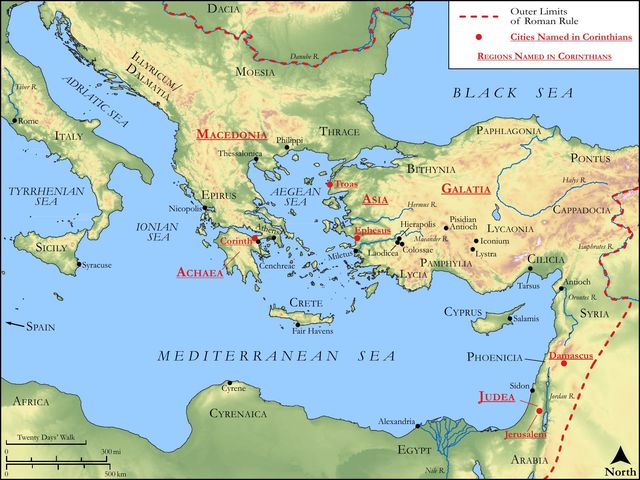
See on the biblical-era maps

Study this verse
Public-domain commentary
Matthew Henry
From his Commentary on the Whole Bible. Henry comments on passages, not single verses — this entry covers 2 Corinthians 8:7–15. His two-level outline is real structure in the source text, so it is rendered as structure.
In these verses the apostle uses several cogent arguments to stir up the Corinthians to this good work of charity.
I.He urges upon them the consideration of their eminence in other gifts and graces, and would have them excel in this of charity also, Co2 8:7. Great address and much holy art are here used by the apostle. When he would persuade the Corinthians to this good thing, he commends them for other good things that were found in them. Most people love to be complimented, especially when we ask a gift of them for ourselves or others; and it is a justice we owe to those in whom God's grace shines to give them their due commendation. Observe here, What it was that the Corinthians abounded in. Faith is mentioned first, for that is the root; and, as without faith it is impossible to please God (Heb 11:6), so those who abound in faith will abound in other graces and good works also; and this will work and show itself by love. To their faith was added utterance, which is an excellent gift, and redounds much to the glory of God and the good of the church. Many have faith who want utterance. But these Corinthians excelled most churches in spiritual gifts, and particularly in utterance; and yet this was not in them, as in too many, both the effect and evidence of ignorance; for with their utterance there appeared knowledge, abundance of knowledge. They had a treasury of things new and old, and in their utterance they brought out of this treasury. They abounded also in all diligence. Those who have great knowledge and ready utterance are not always the most diligent Christians. Great talkers are not always the best doers; but these Corinthians were diligent to do, as well as know and talk, well. And further, they had abundant love to their minister; and were not like too many, who, having gifts of their own, are but too apt to slight their ministers, and neglect them. Now to all these good things the apostle desires them to add this grace also, to abound in charity to the poor; that, where so much good was found, there should be found yet more good. Before the apostle proceeds to another argument he takes care to prevent any misapprehensions of his design to impose on them, or to bind heavy burdens upon them by his authority; and tells them (Co2 8:8) he does not speak by commandment, or in a way of authority. I give my advice, Co2 8:10. He took occasion from the forwardness of others to propose what would be expedient for them, and would prove the sincerity of their love, or be the genuine effect and evidence thereof. Note, A great difference should be made between plain and positive duty, and the improvement of a present opportunity of doing or getting good. Many a thing which is good for us to do, yet can not be said to be, by express and indispensable commandment, our duty at this or that time.
II.Another argument is taken from the consideration of the grace of our Lord Jesus Christ.
The best arguments for Christian duties are those that are taken from the love of Christ, that constraineth us. The example of the churches of Macedonia was such as the Corinthians should imitate; but the example of our Lord Jesus Christ should have much greater influence. And you know, saith the apostle, the grace of our Lord Jesus Christ (Co2 8:9), that though he was rich, as being God, equal in power and glory with the Father, rich in all the glory and blessedness of the upper world, yet for your sakes he became poor; not only did become man for us, but he became poor also. He was born in poor circumstances, lived a poor life, and died in poverty; and this was for our sakes, that we thereby might be made rich, rich in the love and favour of God, rich in the blessings and promises of the new covenant, rich in the hopes of eternal life, being heirs of the kingdom. This is a good reason why we should be charitable to the poor out of what we have, because we ourselves live upon the charity of the Lord Jesus Christ.
III.Another argument is taken from their good purposes, and their forwardness to begin this good work. As to this he tells them,
1.It was expedient for them to perform what they purposed, and finish what they had begun, Co2 8:10, Co2 8:11. What else did their good purposes and good beginnings signify? Good purposes, indeed, are good things; they are like buds and blossoms, pleasant to behold, and give hopes of good fruit; but they are lost, and signify nothing, without performances. So good beginnings are amiable; but we shall lose the benefit unless there be perseverance, and we bring forth fruit to perfection. Seeing therefore the Corinthians had shown a readiness to will, he would have them be careful also in the performance, according to their ability. For,
2.This would be acceptable to God. This willing mind is accepted (Co2 8:12), when accompanied with sincere endeavours. When men purpose that which is good, and endeavour, according to their ability, to perform also, God will accept of what they have, or can do, and not reject them for what they have not, and what is not in their power to do: and this is true as to other things besides the work of charity. But let us note here that this scripture will by no means justify those who think good meanings are enough, or that good purposes, and the profession of a willing mind, are sufficient to save them. It is accepted, indeed, where there is a performance as far as we are able, and when Providence hinders the performance, as in David's case concerning building a house for the Lord, 2 Sa. 7.
IV.Another argument is taken from the discrimination which the divine Providence makes in the distribution of the things of this world, and the mutability of human affairs, Co2 8:13-15. The force of the arguing seems to be this: - Providence gives to some more of the good things of this world, and to some less, and that with this design, that those who have a greater abundance may supply those who are in want, that there may be room for charity. And further, considering the mutability of human affairs, and how soon there may be an alteration, so that those who now have an abundance may stand in need of being supplied themselves in their wants, this should induce them to be charitable while they are able. It is the will of God that, by our mutually supplying one another, there should be some sort of equality; not an absolute equality indeed, or such a levelling as would destroy property, for in such a case there could be no exercise of charity. But as in works of charity there should be an equitable proportion observed, that the burden should not lie too heavy on some, while others are wholly eased, so all should think themselves concerned to supply those who are in want. This is illustrated by the instance of gathering and distributing manna in the wilderness, concerning which (as we may read, Ex. 16) it was the duty of every family, and all in the family, to gather what they could, which, when it was gathered, was put into some common receptacle for each family, whence the master of the family distributed to every one as he had occasion, to some more than they were able, through age and infirmity, to gather up; to others less than they gathered, because they did not need so much: and thus he that had gathered much (more than he had occasion for) had nothing over, when a communication was made to him that had gathered little, who by this method had no lack. Note, Such is the condition of men in this world that we mutually depend on one another, and should help one another. Those who have ever so much of this world have no more than food and raiment; and those who have but a little of this world seldom want these; nor, indeed, should those who have abundance suffer others to want, but be ready to afford supply.
Historical interpretation
Historical reception
2 surviving comments on this verse. Each one is dated, so this reads as a timeline rather than a list.
Select a marker to jump to its quote. Markers stagger vertically where authors wrote within a few decades of each other.
It is true that giving should not cause hardship to the givers. But at the same time, a person ought not to keep more than he needs for himself.
And yet Christ praised the contrary conduct in the widow's case, that she emptied out all of her living and gave out of her want. But because he was discoursing to Corinthians amongst whom he chose to suffer hunger; "for it were good for me rather to die, than that any man should make my glorying void;" he therefore uses a tempered exhortation, praising indeed those who had done beyond their power, but not compelling these to do so; not because he did not desire it, but because they were somewhat weak. For wherefore doth he praise those, because "in much proof of affliction the abundance of their joy and their deep poverty abounded unto the riches of their liberality:" and because they gave "beyond their power?" is it not very evident that it is as inducing these also to this conduct? So that even if he appears to permit a lower standard; he doth so, that by it he may raise them to this.
Continue studying 2 Corinthians 8:13 across the web’s major study libraries — every link below opens this exact verse, chapter, or book on the destination site.
Read & Compare
 BibleGatewayThis verse in more than 200 translations and 70 languages.
 Bible.comThe YouVersion reader — hundreds of translations, reading plans, and highlights.
 ESV.orgCrossway's official English Standard Version reader.
 NET BibleThe NET translation with 60,000+ translators' notes on every rendering decision.
 STEP BibleTyndale House's free study tool — original text, vocabulary, and scholarly resources.
 BibliaLogos Bible Software's free web reader.
 USCCBThe New American Bible (Revised Edition) with the U.S. bishops' study notes.
Commentaries
 BibleHub CommentariesDozens of classic commentaries on this verse, gathered on one page.
 StudyLightMore than 100 commentary sets — the largest collection on the web.
 BibleRefPlain-English commentary on what this verse means, verse by verse.
 Enduring WordDavid Guzik's free commentary on this chapter, widely used by Bible teachers.
 Bible Study ToolsVerse commentary alongside Greek and Hebrew study aids.
Original Language & Research
- BibleHub InterlinearThe verse word by word — original language, transliteration, and English.
- BibleHub LexiconEvery word's original-language definition and Strong's entry.
 Blue Letter BibleDeep-study tools — Strong's numbers, concordance, and word studies.
 CNTR CollationThe earliest Greek manuscripts of this verse, collated letter by letter.
Sermons, Hymns & Audio


TrulyRandomVerse is not affiliated with these sites and doesn’t control their content. They’re linked because they’re genuinely useful.
Summary
2 Corinthians 8:13 is a pivotal verse in Paul's appeal to the Corinthian church regarding their participation in a collection for the impoverished believers in Jerusalem. After commending the extraordinary generosity of the Macedonian churches and encouraging the Corinthians to complete their promised contribution, Paul clarifies his underlying intent. He assures them that his exhortation is not meant to impose an oppressive burden on them while others are made comfortable, but rather to foster a spirit of balanced, equitable, and mutual support within the broader Christian community.
Context
ShowHideLiterary Context
This verse is situated within Paul's extensive discussion (2 Corinthians 8-9) concerning the collection for the saints in Jerusalem. Paul has just presented the Macedonian churches as a powerful example of sacrificial giving, noting that "in a great trial of affliction the abundance of their joy and their deep poverty abounded in the riches of their liberality" (2 Corinthians 8:2). He then urges the Corinthians to complete their own commitment, which they had begun a year prior (2 Corinthians 8:10). Verse 13 serves as a crucial clarification of Paul's motives, ensuring that his call to generosity is understood not as an imposition of hardship, but as a means to achieve a divinely intended equity, which he further elaborates in 2 Corinthians 8:14-15.
Historical & Cultural Context
The church in Jerusalem was experiencing significant hardship, likely due to famine (as prophesied in Acts 11:28), persecution, and general economic distress. Paul's collection from the Gentile churches was not merely an act of charity but a profound theological statement. It demonstrated the unity of Jewish and Gentile believers in Christ, fulfilling a promise Paul had made to the Jerusalem apostles to "remember the poor" (Galatians 2:10). Among the Greeks and Romans, while philanthropy existed, it was often motivated by a desire for social status or reciprocal favors. Paul's emphasis on voluntary, mutual, and equitable giving, rooted in grace, stood in stark contrast to these cultural norms, reflecting a distinctively Christian ethos of communal care.
Key Themes
ShowHide2 Corinthians 8:13 contributes significantly to several overarching themes in Paul's letter and Christian theology. The principle of equitable giving is paramount, emphasizing that Christian generosity should aim for a balance where abundance meets need, preventing extreme want for some while others have surplus. This promotes a healthy mutual interdependence within the body of Christ, where believers bear one another's burdens (Galatians 6:2). Paul also underscores the grace of giving, framing it not as a legalistic obligation but as a Spirit-empowered manifestation of God's generosity working through believers (2 Corinthians 8:1). Finally, the verse implicitly highlights the unity of the church, as the collection served to bind together disparate communities of believers, fostering a sense of shared identity and responsibility in Christ.
Exposition and Analysis
ShowHideKey Word Analysis
ShowHideThis is the absolute negative adverb in Greek, used here to emphatically deny a particular intention or outcome. Paul is not merely suggesting, but firmly stating that his aim is not to create an imbalanced situation. It underscores his earnest desire to clarify his motives and prevent any misunderstanding that his exhortation for giving might be interpreted as a demand for ruinous sacrifice.
Derived from a verb meaning "to let go" or "to relax," ánesis denotes "relaxation," "relief," or "rest." In this context, it refers to the alleviation of hardship or pressure for the Jerusalem saints. Paul uses this word to describe the desired state of those receiving aid, emphasizing that the goal is genuine comfort and freedom from distress, not merely a slight improvement.
This powerful word literally means "pressure" or "squeezing," and figuratively signifies "affliction," "tribulation," "distress," or "trouble." It evokes the image of being crushed under a heavy weight. By using thlîpsis, Paul highlights the severe hardship the Corinthians would experience if his appeal were to result in their financial ruin, contrasting it sharply with the "ease" of the recipients. This choice of words underscores his commitment to preventing an inequitable transfer of suffering.
Verse Breakdown
ShowHide"For [I mean] not"
Paul initiates a crucial clarification of his purpose. The bracketed "I mean" is supplied in the KJV for clarity, as the Greek particle "gar" (G1063) introduces a reason or explanation. Paul is explicitly stating what his intention is not, setting the stage for the principle of equity he will articulate. This phrase serves to preempt any misinterpretation that he is coercing or exploiting the Corinthians.
"that other men be eased"
This clause refers to the recipients of the collection, the impoverished believers in Jerusalem. Paul acknowledges that the collection's purpose is indeed to bring "ease" or "relief" to them, alleviating their suffering and want. This is the positive outcome desired for the beneficiaries.
"and ye burdened"
This clause presents the negative outcome Paul wishes to avoid for the givers, the Corinthians. He emphatically states that his intention is not for them to be placed under a heavy "burden" or "pressure" (thlîpsis) as a result of their generosity. This highlights his pastoral concern that their giving should be sustainable and voluntary, not ruinous or forced.
Literary Devices
ShowHidePaul masterfully employs Antithesis in 2 Corinthians 8:13 by juxtaposing "eased" (ánesis) with "burdened" (thlîpsis). This stark contrast vividly illustrates the imbalance he seeks to prevent, making his point about equity exceptionally clear. The use of these two opposing terms, one signifying relief and the other intense pressure, underscores the core message that the collection is not about shifting a burden from one group to another, but about achieving a state of mutual balance. Furthermore, Paul's statement can be seen as a form of Meiosis or Understatement, where he states what he does not intend rather than directly stating his positive intention (which is the principle of equality articulated in the subsequent verse). This gentle, indirect approach can be more persuasive, as it addresses potential fears or misunderstandings before explicitly laying out the desired outcome, demonstrating his sensitivity and pastoral care for the Corinthian church.
Theological and Thematic Connections
ShowHide2 Corinthians 8:13 articulates a profound theological principle of divine order and communal responsibility within the body of Christ. It reflects God's character as one who desires justice, equity, and the well-being of all His children, not the exploitation of some for the benefit of others. This verse underscores that Christian giving is not a zero-sum game or a mechanism for transferring hardship, but a means of fostering genuine interdependence and mutual care. It reminds us that while sacrificial giving is commendable, it should always aim for the flourishing of the entire community, preventing situations where one part of the body suffers unduly while another enjoys excessive comfort. This principle of balance is rooted in the very nature of God, who provides for His people and calls them to reflect His generosity and care for the needy.
Reflection and Application
ShowHide2 Corinthians 8:13 offers timeless wisdom for how believers and churches should approach generosity and stewardship today. It challenges us to consider not only the act of giving but also its impact on both the giver and the receiver. This verse encourages a spirit of sustainable generosity, where our acts of charity are a joyful outflow of our resources and faith, rather than a burdensome obligation that leads to personal or communal distress. It reminds us that the Christian community thrives on mutual aid, where those who have more are called to help those with less, understanding that circumstances can change, and roles may reverse. This fosters a healthy interdependence, promoting unity and shared responsibility within the global body of Christ. Whether managing personal finances, church budgets, or engaging in global missions, a balanced approach to giving and receiving honors God's design for community and equity, ensuring that our contributions are made willingly and joyfully, without leading to undue hardship.
Questions for Reflection
ShowHideFAQ
ShowHideDoes this verse imply that Christians should strive for absolute equality in wealth?
ShowHideNo, 2 Corinthians 8:13 does not advocate for an absolute equalization of wealth, but rather for equity and balance in meeting needs. Paul's concern is that no one within the Christian community should suffer extreme destitution while others enjoy abundance. The principle articulated here, and further in 2 Corinthians 8:14-15, is about mutual support and ensuring that "he who gathered much had nothing over, and he who gathered little had no lack." It's about preventing undue burden on givers and alleviating severe hardship for recipients, fostering a healthy interdependence within the body of Christ.
Does Paul's statement mean that Christian giving should never be sacrificial?
ShowHideWhile 2 Corinthians 8:13 emphasizes avoiding undue burden, it does not negate the concept of sacrificial giving. Paul had just praised the Macedonian churches for giving "beyond their ability" (2 Corinthians 8:3), demonstrating that true generosity often involves sacrifice. The key distinction lies in the motive and outcome. Paul's concern is that the Corinthians' giving should not lead to their ruin or oppression to ease others, but rather contribute to a balanced state where needs are met through willing hearts. It's about preventing an unjust burden, not discouraging generous, Spirit-led sacrifice that flows from love and joy, as emphasized in 2 Corinthians 9:7.
Christ-Centered Fulfillment
ShowHide2 Corinthians 8:13 finds its ultimate fulfillment and paradigm in the person and work of Jesus Christ. The principle of mutual ease and burden-bearing is supremely embodied in the incarnation and atonement. As Paul declares just a few verses earlier, "For you know the grace of our Lord Jesus Christ, that though He was rich, yet for your sakes He became poor, that you through His poverty might become rich" (2 Corinthians 8:9). This is the divine exchange, the ultimate act of equitable giving: Christ, in His infinite glory and abundance, took upon Himself the ultimate "burden" of humanity's sin and its consequences, experiencing profound "thlîpsis" on the cross (Matthew 27:46). Through His self-emptying, He provides "ánesis" – rest, relief, and spiritual riches – for all who believe (Matthew 11:28-30). The church, as the body of Christ, is called to live out this same self-giving love and mutual support, reflecting His character and continuing His mission of bringing ease to the burdened and sharing spiritual and material abundance with those in need, all for the glory of God (Ephesians 4:15-16).