


Luke 21:35
Bible text: King James Version (1769 Blayney text) · Public domain
Bible text: Berean Standard Bible · Public domain
Bible text: American Standard Version (1901) · Public domain
Bible text: World English Bible, Messianic edition · Public domain
Bible text: Geneva Bible (1599) · Public domain
Bible text: Young's Literal Translation · Public domain
- ὡςhōsasG5613PRTParticle or Disjunctive
- παγίς·pagisa snareG3803N-NSFNoun Nominative Singular Feminine
- ἐπεισελεύσεταιepeiseleusetaiIt will enterV-FMI-3SVerb Future Middle Indicative 3rd Singular
- γὰρgarforG1063CONJConjunction
- ἐπὶepiuponG1909PREPPreposition
- πάνταςpantasallG3956A-APMAdjective Accusative Plural Masculine
- τοὺςtousthoseG3588T-APMDefinite article Accusative Plural Masculine
- καθημένουςkathēmenoussittingG2521V-PNP-APMVerb Present Middle Or Passive Deponent Participle Accusative Plural Masculine
- ἐπὶepiuponG1909PREPPreposition
- πρόσωπονprosōpon[the] faceG4383N-ASNNoun Accusative Singular Neuter
- πάσηςpasēsof allG3956A-GSFAdjective Genitive Singular Feminine
- τῆςtēstheG3588T-GSFDefinite article Genitive Singular Feminine
- γῆςgēsearthG1093N-GSFNoun Genitive Singular Feminine
English is a literal word-by-word gloss of the Greek, not the KJV's wording. Why?
This is the original text the KJV's translators worked from — each Greek word with its own literal English meaning in this verse, prepared by scholars at Tyndale House, Cambridge. The KJV translates whole sentences, not word by word, so its wording differs: one Greek word can become several English words, and the KJV may choose “charity” where the gloss reads “love”. Both are faithful — they answer different questions. For the KJV's own rendering, switch to the KJV text.
Details
See on the biblical-era maps
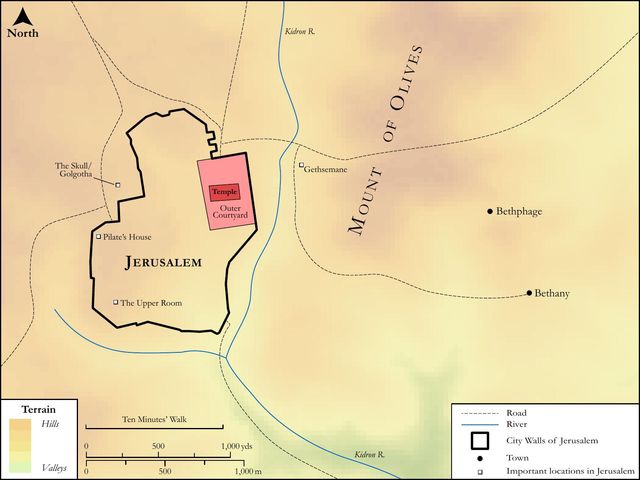
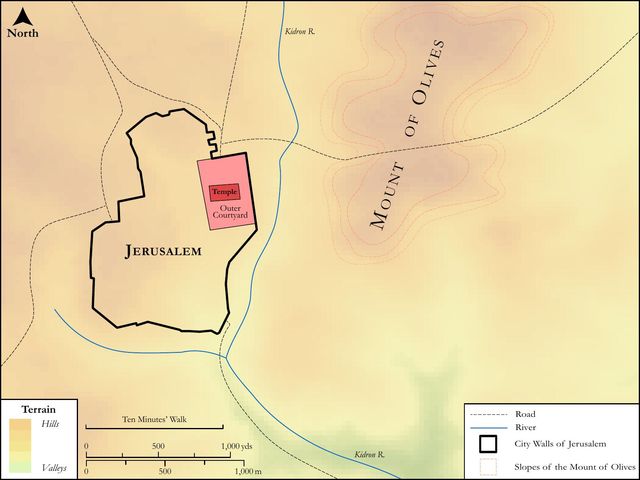
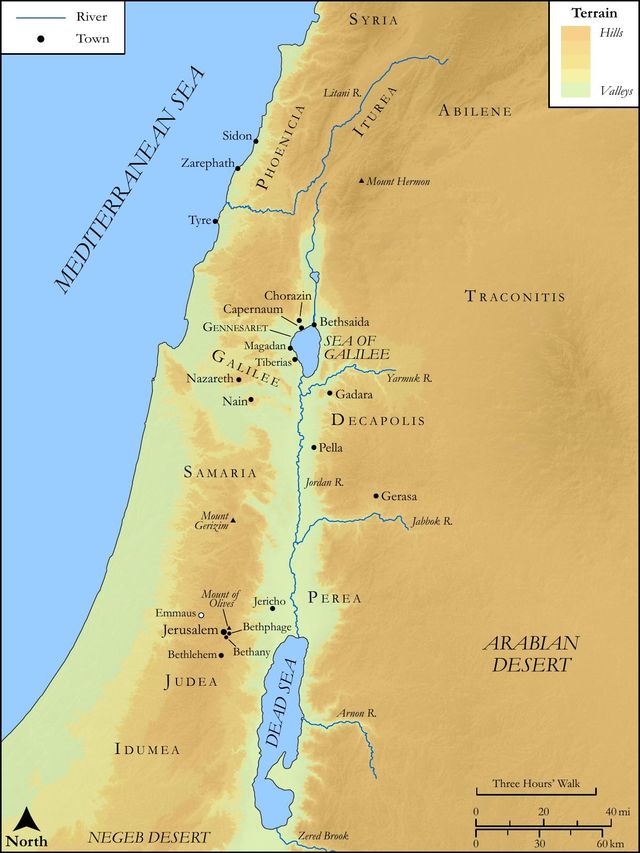
Study this verse
Public-domain commentary
Matthew Henry
From his Commentary on the Whole Bible. Henry comments on passages, not single verses — this entry covers Luke 21:29–38. His two-level outline is real structure in the source text, so it is rendered as structure.
Here, in the close of this discourse,
I.Christ appoints his disciples to observe the signs of the times, which they might judge by, if they had an eye to the foregoing directions, with as much certainty and assurance as they could judge of the approach of summer by the budding forth of the trees, Luk 21:29-31. As in the kingdom of nature there is a chain of causes, so in the kingdom of providence there is a consequence of one event upon another. When we see a nation filling up the measure of their iniquity, we may conclude that their ruin is nigh; when we see the ruin of persecuting powers hastening on, we may thence infer that the kingdom of God is nigh at hand, that when the opposition given to it is removed it shall gain ground. As we may lawfully prognosticate the change of the seasons when second causes have begun to work, so we may, in the disposal of events, expect something uncommon when God is already raised up out of his holy habitation (Zac 2:13); then stand still and see his salvation.
II.He charges them to look upon those things as neither doubtful nor distant (for then they would not make a due impression on them), but as sure and very near. The destruction of the Jewish nation,
1.Was near (Luk 21:32): This generation shall not pass away till all be fulfilled. There were some now alive that should see it; some that now heard the prediction of it.
2.It was sure; the sentence was irreversible; it was a consumption determined; the decree was gone forth (Luk 21:33): "Heaven and earth shall pass away sooner than any word of mine: nay, they certainly shall pass away, but my words shall not; whether they take hold or no, they will take effect, and not one of them fall to the ground," Sa1 3:19.
III.He cautions them against security and sensuality, by which they would unfit themselves for the trying times that were coming on, and make them to be a great surprise and terror to them (Luk 21:34, Luk 21:35): Take heed to yourselves. This is the word of command given to all Christ's disciples: "Take heed to yourselves, that you be not overpowered by temptations, nor betrayed by your own corruptions." Note, We cannot be safe if we be secure. It concerns us at all times, but especially at some times, to be very cautious. See here,
1.What our danger is: that the day of death and judgment should come upon us unawares, when we do not expect it, and are not prepared for it, - lest, when we are called to meet our Lord, that be found the furthest thing from our thoughts which ought always to be laid nearest our hearts, lest it come upon us as a snare; for so it will come upon the most of men, who dwell upon the earth, and mind earthly things only, and have no converse with heaven; to them it will be as a snare. See Ecc 9:12. It will be a terror and a destruction to them; it will put them into an inexpressible fright, and hold them fast for a doom yet more frightful.
2.What our duty is, in consideration of this danger: we must take heed lest our hearts be overcharged, lest they be burdened and overloaded, and so unfitted and disabled to do what must be done in preparation for death and judgment. Two things we must watch against, lest our hearts be overcharged with them: - (1.) The indulging of the appetites of the body, and allowing of ourselves in the gratifications of sense to an excess: Take heed lest you be overcharged with surfeiting and drunkenness, the immoderate use of meat and drink, which burden the heart, not only with the guilt thereby contracted, but by the ill influence which such disorders of the body have upon the mind; they make men dull and lifeless to their duty, dead and listless in their duty; they stupify the conscience, and cause the mind to be unaffected with those things that are most affecting. (2.) The inordinate pursuit of the good things of this world. The heart is overcharged with the cares of this life. The former is the snare of those that are given to their pleasures: this is the snare of the men of business, that will be rich. We have need to guard on both hands, not only lest at the time when death comes, but lest at any time our hearts should be thus overcharged. Our caution against sin, and our care of our own souls, must be constant.
IV.He counsels them to prepare and get ready for this great day, Luk 21:36. Here see,
1.What should be our aim: that we may be accounted worthy to escape all these things; that, when the judgments of God are abroad, we may be preserved from the malignity of them; that either we may not be involved in the common calamity or it may not be that to us which it is to others; that in the day of death we may escape the sting of it, which is the wrath of God, and the damnation of hell. Yet we must aim not only to escape that, but to stand before the Son of man; not only to stand acquitted before him as our Judge (Psa 1:5), to have boldness in the day of Christ (that is supposed in our escaping all those things), but to stand before him, to attend on him as our Master, to stand continually before his throne, and serve him day and night in his temple (Rev 7:15), always to behold his face, as the angels, Mat 18:10. The saints are here said to be accounted worthy, as before, Luk 20:35. God, by the good work of his grace in them, makes them meet for this happiness, and, by the good will of his grace towards them, accounts them worthy of it: but, as Grotius here says, a great part of our worthiness lies in an acknowledgment of our own unworthiness.
2.What should be our actings in these aims: Watch therefore, and pray always. Watching and praying must go together, Neh 4:9. Those that would escape the wrath to come, and make sure of the joys to come, must watch and pray, and must do so always, must make it the constant business of their lives, (1.) To keep a guard upon themselves. "Watch against sin, watch to every duty, and to the improvement of every opportunity of doing good. Be awake, and keep awake, in expectation of your Lord's coming, that you may be in a right frame to receive him, and bid him welcome." (2.) To keep up their communion with God: "Pray always; be always in an habitual disposition to that duty; keep up stated times for it; abound in it; pray upon all occasions." Those shall be accounted worthy to live a life of praise in the other world that live a life of prayer in this world.
V.In the last two verses we have an account how Christ disposed of himself during those three or four days between his riding in triumph into Jerusalem and the night in which he was betrayed.
1.He was all day teaching in the temple. Christ preached on week-days as well as sabbath days. He was an indefatigable preacher; he preached in the face of opposition, and in the midst of those that he knew sought occasion against him.
2.At night he went out to lodge at a friend's house, in the mount of Olives, about a mile out of town. It is probable that he had some friends in the city that would gladly have lodged him, but he was willing to retire in the evening out of the noise of the town, that he might have more time for secret devotion, now that his hour was at hand.
3.Early in the morning he was in the temple again, where he had a morning lecture for those that were willing to attend it; and the people were forward to hear one that they saw forward to preach (Luk 21:38): They all came early in the morning, flocking to the temple, like doves to their windows, to hear him, though the chief priests and scribes did all they could to prejudice them against him. Sometimes the taste and relish which serious, honest, plain people have of good preaching are more to be valued and judged by than the opinion of the witty and learned, and those in authority.
Historical interpretation
Nine Centuries of Reception
10 surviving comments on this verse. Each one is dated, so this reads as a timeline rather than a list.
Select a marker to jump to its quote. Markers stagger vertically where authors wrote within a few decades of each other.
(Clem. Al. lib. ii. Pædag. c. 2.) Drunkenness is an excessive use of wine; crapula is the uneasiness, and nausea attendant on drunkenness, a Greek word so called from the motion of the head. And a little below. As then we must partake of food lest we suffer hunger, so also of drink lest we thirst, but with still greater care to avoid falling into excess. For the indulgence of wine is deceitful, and the soul when free from wine will be the wisest and best, but steeped in the fumes of wine is lost as in a cloud.
"But take heed to yourselves lest your hearts be weighed down with dissipation and drunkenness and cares of this life, and that day come upon you suddenly like a snare." You heard the proclamation of the eternal King. You learned the deplorable end of "drunkenness" or "intoxication." Imagine a skilled and wise physician who would say, "Beware, no one should drink too much from this or that herb. If he does, he will suddenly be destroyed." I do not doubt that everyone would keep the prescriptions of the physician's warning concerning his own health. Now the Lord, who is both the physician of souls and bodies, orders them to avoid as a deadly drink the herb "of drunkenness" and the vice "of intoxication" and also the care of worldly matters. I do not know if any one can say that he is not wounded, because these things consume him.Drunkenness is therefore destructive in all things. It is the only thing that weakens the soul together with the body. According to the apostle, it can happen that when the body "is weak," then the spirit is "much stronger," and when "the exterior person is destroyed, the interior person is renewed." In the illness of drunkenness, the body and the soul are destroyed at the same time. The spirit is corrupted equally with the flesh. All the members are weakened: the feet and the hands. The tongue is loosened. Darkness covers the eyes. Forgetfulness covers the mind so that one does not know himself nor does he perceive he is a person. Drunkenness of the body has that shamefulness.
Beloved brothers and sisters, whoever serves as a soldier of God stationed in the camp of heaven already hopes for the divine things. He should recognize himself so that we should have no fear or dread at the storms and whirlwinds of the world. Through the encouragement of his provident voice, the Lord predicted that these things would come when he was instructing, teaching, preparing and strengthening the people of his church to endure everything to come. Christ foretold and prophesied that wars, famine, earthquakes and epidemics would arise in the various places. So that an unexpected and new fear of destructive agencies might not shake us, he forewarned that adversity would increase in the last times. Note that the things that were spoken of are happening. Since the things that were foretold are happening, whatever he promises will also follow. The Lord himself promises, “When you shall see these things come to pass, know that the kingdom of God is at hand.” The kingdom of God, beloved brothers and sisters, has drawn near. The reward of life, the joy of eternal salvation, the perpetual happiness and the possession of paradise once lost are now coming as the world passes away.
He taught them therefore to take heed unto the things we have just before mentioned, lest they fall into the indolence resulting therefrom. Hence it follows, Watch ye therefore, and pray always, that ye may be accounted worthy to escape all those things that shall come to pass.
As if He says, Beware lest the eyes of your mind wax heavy. For the cares of this life, and surfeiting, and drunkenness, scare away prudence, shatter and make shipwreck of faith.
(Hom. 1. in illud Atten de tibi.) Every animal has within itself certain instincts which it has received from God, for the preservation of its own being. Wherefore Christ has also given us this warning, that what comes to them by nature, may be ours by the aid of reason and prudence: that we may flee from sin as the brute creatures shun deadly food, but that we seek after righteousness, as they wholesome herbs. Therefore saith He, Take heed to yourselves, that is, that you may distinguish the noxious from the wholesome. But since there are two ways of taking heed to ourselves, the one with the bodily eyes, the other by the faculties of the soul, and the bodily eye does not reach to virtue; it remains that we speak of the operations of the soul. Take heed, that is, Look around you on all sides, keeping an ever watchful eye to the guardianship of your soul. He says not, Take heed to your own or to the things around, but to yourselves. For ye are mind and spirit, your body is only of sense. Around you are riches, arts, and all the appendages of life, you must not mind these, but your soul, of which you must take especial care. The same admonition tends both to the healing of the sick, and the perfecting of those that are well, namely, such as are the guardians of the present, the providers of the future, not judging the actions of others, but strictly searching their own, not suffering the mind to be the slave of their passions, but subduing the irrational part of the soul to the rational. But the reason why we should take heed He adds as follows, Lest at any time your hearts be overcharged, &c.
(in Reg. Brev. ad int. 88.) But carefulness, or the care of this life, although it seems to have nothing unlawful in it, nevertheless if it conduce not to religion, must be avoided. And the reason why He said this He shows by what comes next, And so that day come upon you unawares.
You see him in the clouds. I certainly do not think that Christ will come in the darkness of mist and the chill of rain. The clouds are visible and surely cover the heaven in foggy cold. How has he set his tabernacle in the sun if his coming brings the rain? Some clouds suitably cover the radiance of the heavenly mystery. Some clouds grow moist with the dew of spiritual grace. Consider the cloud in the Old Testament. “He spoke to them,” it says, “in a pillar of cloud.” … He comes in a calm cloud in the Song of Songs, shining with the joy of a bridegroom. He also comes in a swift light cloud, incarnate of the Virgin. The prophet saw him as a cloud coming from the east. He fittingly said, “a light cloud,” that earthly vices would not weigh down. See the cloud upon which the Holy Spirit came and the power of the Most High overshadowed. When Christ will appear in the clouds, the tribes of the earth will grieve over themselves.
The fig tree therefore has a double meaning: when the wild is tamed or when sins abound. Like the believer’s faith that shriveled up before it will flower, so also sinners will glory through the grace of their transgressions. On the one hand is the fruit of faith, and on the other the lewdness of unbelief. The gardening of the Evangelist as farmer produces the fruit of the fig tree for me. We must not despair if sinners cover themselves with the leaves of the fig tree as with a garment of deceit, so that they may veil their conscience. Leaves without fruit are therefore suspicious.
Now supposing a physician should bid us beware of the juice of a certain herb, lest a sudden death overtake us, we should most earnestly attend to his command; but when our Saviour warns us to shun drunkenness and surfeiting, and the cares of this world, men have no fear of being wounded and destroyed by them; for the faith which they put in the caution of the physician, they disdain to give to the words of God.
Our Lord declared above the fearful and sensible signs of the evils which should overtake sinners, against which the only remedy is watching and prayer, as it is said, And take heed to yourselves, lest at any time, &c.
For that day will not come when men are expecting it, but unlooked for and by stealth, taking as a snare those who are unwary. For as a snare shall it come upon all them that sit upon the face of the earth. But this we may diligently keep far from us. For that day will take those that sit on the face of the earth, as the unthinking and slothful. But as many as are prompt and active in the way of good, not sitting and loitering on the ground, but rising from it, saying to themselves, Rise up, begone, for here there is no rest for thee. To such that day is not as a perilous snare, but a day of rejoicing.
Namely, hunger, pestilence, and such like, which for a time only threaten the elect and others, and those things also which are hereafter the lot of the guilty for ever. For these we can in no wise escape, save by watching and prayer.
And because a Christian needs not only to flee evil, but to strive to obtain glory, He adds, And to stand before the Son of man. For this is the glory of angels, to stand before the Son of man, our God, and always to behold His face.
Continue studying Luke 21:35 across the web’s major study libraries — every link below opens this exact verse, chapter, or book on the destination site.
Read & Compare
 BibleGatewayThis verse in more than 200 translations and 70 languages.
 Bible.comThe YouVersion reader — hundreds of translations, reading plans, and highlights.
 ESV.orgCrossway's official English Standard Version reader.
 NET BibleThe NET translation with 60,000+ translators' notes on every rendering decision.
 STEP BibleTyndale House's free study tool — original text, vocabulary, and scholarly resources.
 BibliaLogos Bible Software's free web reader.
 USCCBThe New American Bible (Revised Edition) with the U.S. bishops' study notes.
Commentaries
 BibleHub CommentariesDozens of classic commentaries on this verse, gathered on one page.
 StudyLightMore than 100 commentary sets — the largest collection on the web.
 BibleRefPlain-English commentary on what this verse means, verse by verse.
 Enduring WordDavid Guzik's free commentary on this chapter, widely used by Bible teachers.
 Bible Study ToolsVerse commentary alongside Greek and Hebrew study aids.
Original Language & Research
- BibleHub InterlinearThe verse word by word — original language, transliteration, and English.
- BibleHub LexiconEvery word's original-language definition and Strong's entry.
 Blue Letter BibleDeep-study tools — Strong's numbers, concordance, and word studies.
 CNTR CollationThe earliest Greek manuscripts of this verse, collated letter by letter.
Sermons, Hymns & Audio


TrulyRandomVerse is not affiliated with these sites and doesn’t control their content. They’re linked because they’re genuinely useful.
Summary
Luke 21:35 delivers a profound warning from Jesus Christ, likening the sudden and inescapable arrival of future eschatological events to a "snare." This verse underscores the universal impact of these momentous occurrences, which will affect "all them that dwell on the face of the whole earth," emphasizing the critical need for constant spiritual vigilance and readiness in light of their unexpected and comprehensive nature.
Context
ShowHideLiterary Context
This verse is an integral part of Jesus' "Olivet Discourse," recorded in Luke 21:5-36. Delivered on the Mount of Olives, this prophetic teaching follows Jesus' lament over Jerusalem and His disciples' admiration of the Temple's grandeur. Jesus begins by foretelling the Temple's utter destruction (Luke 21:5-6), then shifts to broader signs preceding His second coming and the end of the age. The immediate preceding verse, Luke 21:34, provides the direct impetus for verse 35, warning disciples to guard their hearts against "surfeiting, and drunkenness, and cares of this life," lest "that day come upon you unawares." Verse 35 then explains how it will come upon them if they are not vigilant—suddenly and inescapably, like a trap. The discourse culminates in Luke 21:36, which explicitly calls for continuous watchfulness and prayer to be deemed worthy to escape these things and to stand before the Son of Man.
Historical & Cultural Context
Jesus' Olivet Discourse was delivered to His disciples in the shadow of the magnificent Second Temple, a symbol of Jewish identity and divine presence. For first-century Jews living under Roman occupation, the Temple's destruction would have been an unthinkable catastrophe, deeply intertwined with their national and religious hopes. Their understanding of the Messiah often included a triumphant, earthly king who would liberate them from Roman rule and restore Israel's glory. Jesus' prophecies, however, challenged these expectations by speaking of a future marked by tribulation, deception, and a surprising, universal judgment. The concept of a "snare" would have been familiar to an agrarian society, where traps were commonly used for hunting. Culturally, the Jewish people were accustomed to prophetic warnings and calls for repentance, often delivered through vivid imagery. The warning in Luke 21:35 would have resonated with their understanding of divine judgment, albeit applied in a new and unexpected eschatological context.
Key Themes
ShowHideLuke 21:35 powerfully contributes to several overarching themes within the Olivet Discourse and Luke's Gospel. Firstly, it emphasizes the Suddenness and Inescapability of Eschatological Events. Whether applied to the fall of Jerusalem in A.D. 70 or the ultimate return of Christ, the "snare" metaphor highlights that these events will arrive unexpectedly and without warning for the unprepared, leaving no opportunity for escape or last-minute repentance. Secondly, the verse underscores the Universality of Impact. The phrase "on all them that dwell on the face of the whole earth" signifies that the consequences of these events will not be limited to a specific region or people but will affect humanity globally, demonstrating God's sovereign reach and ultimate authority over all creation. Finally, implicit in this stark warning is an urgent Call to Vigilance and Spiritual Preparedness. By likening the coming day to a snare, Jesus provides a powerful incentive for His disciples to remain spiritually alert, sober, and prayerful, as explicitly commanded in Luke 21:36, ensuring they are not caught off guard by the Lord's return or the day of accountability.
Exposition and Analysis
ShowHideKey Word Analysis
ShowHideFrom the root pēgnumi (to fasten), this word literally denotes a trap, noose, or gin used for catching birds or wild animals. Figuratively, as used here, it conveys the idea of a trick, stratagem, or temptation. In Luke 21:35, it powerfully illustrates the sudden, unexpected, and inescapable nature of the impending events, suggesting a capture that offers no warning or means of escape once it is sprung.
Derived from epi (upon) and erchomai (to come), this verb means "to supervene," "to arrive," "to occur," or "to impend." It can also carry the connotation of an attack or influence. Here, it emphasizes the active, decisive, and often forceful arrival of the "day," reinforcing the sense of an event that descends upon individuals, leaving them no time to react or prepare if they are not already vigilant.
From kata (down) and a root akin to hedraios (to sit), this verb means "to sit down," and figuratively, "to remain" or "to reside." In the context of Luke 21:35, "them that dwell" refers to the inhabitants of the earth, highlighting their settled, perhaps complacent, existence which will be abruptly interrupted by the "snare." It underscores the universal reach of the impending events to all who are living their ordinary lives.
Verse Breakdown
ShowHide"For as a snare"
This introductory phrase immediately establishes the central metaphor of the verse. The Greek particle gar (for) indicates that this clause explains the preceding warning in Luke 21:34. The comparison to a "snare" (Greek, pagís) vividly portrays an unforeseen, sudden, and inescapable trap. Just as an animal is caught unaware, so too will "that day" (referring to the day of judgment or the Lord's return) descend upon humanity. The emphasis is on the lack of warning and the swiftness of the event, leaving no time for last-minute preparation or escape.
"shall it come on all them that dwell"
This clause describes the arrival and the scope of the event. The verb "come" (Greek, epérchomai) indicates an active, decisive, and often forceful descent. It is not a gradual process but an event that "comes upon" people. The phrase "on all them that dwell" stresses the universality of this impact. It will affect everyone, without exception, who is living on earth at that time, implying that no one will be immune to its consequences, regardless of their status, location, or perceived security.
"on the face of the whole earth"
This concluding phrase further amplifies the universal scope of the warning. "The face of the whole earth" (Greek, prosopon of pas gē) is a comprehensive expression, leaving no doubt that the impending events—whether the destruction of Jerusalem or the ultimate Second Coming of Christ—will have a global reach. It signifies that the judgment or the Lord's return will not be localized but will encompass all humanity, reinforcing the urgency of the call for universal vigilance and preparedness.
Literary Devices
ShowHideThe primary literary device employed in Luke 21:35 is Metaphor. Jesus uses the vivid image of a "snare" to describe the unexpected and inescapable nature of the coming "day." A snare is a hidden trap that catches its victim unawares, offering no chance of escape once sprung. This powerful comparison effectively communicates the suddenness, inevitability, and comprehensive reach of the eschatological events, whether the fall of Jerusalem or the Second Coming of Christ. The Hyperbole in "on the face of the whole earth" emphasizes the universal scope, ensuring that no one feels exempt from this warning. Furthermore, the verse functions as Foreshadowing, hinting at the future judgment and the ultimate accountability that awaits all humanity, urging a proactive response of spiritual readiness.
Theological and Thematic Connections
ShowHideLuke 21:35 serves as a profound theological statement on divine sovereignty, human accountability, and the nature of eschatological events. It underscores that God's plan for history will unfold according to His perfect timing, often catching humanity unprepared due to spiritual apathy or worldly preoccupations. The "snare" metaphor highlights the element of surprise and the inescapable reality of divine judgment or the Lord's return, emphasizing that no one will be able to avoid this ultimate reckoning. This warning is not meant to instill fear for the vigilant, but to awaken the complacent and to motivate believers to live lives of continuous watchfulness and faithful stewardship, recognizing that the "day" will indeed come for everyone. It calls for a sober assessment of one's spiritual state and priorities in light of eternity.
Reflection and Application
ShowHideLuke 21:35 is a timeless and urgent call to spiritual vigilance, challenging every believer to live with an acute awareness of God's sovereign timeline and the ultimate return of Christ. It compels us to examine our daily lives, asking whether our priorities align with an eternal perspective or if we are becoming entangled in the "cares of this life" that can dull our spiritual senses. The metaphor of the "snare" serves as a powerful reminder that the Lord's coming, or our own personal encounter with eternity, will be sudden and definitive. Therefore, our response should be one of continuous readiness, cultivating a lifestyle of prayer, obedience, and active anticipation of His return. This isn't about living in fear, but living with purpose, ensuring that we are found faithful and prepared to stand before Him, having lived lives that reflect our hope in His glorious appearing.
Questions for Reflection
ShowHideFAQ
ShowHideWhat does "that day" refer to in the context of Luke 21:35?
ShowHideIn the broader context of Jesus' Olivet Discourse (Luke 21), "that day" carries a dual fulfillment. Primarily, it refers to the catastrophic destruction of Jerusalem and its Temple by the Romans in A.D. 70, an event that indeed came suddenly and devastatingly upon the Jewish people. However, Jesus' prophecies often have a layered meaning, pointing also to the ultimate, future "Day of the Lord"—the Second Coming of Christ, His final judgment, and the consummation of all things. The "snare" metaphor applies equally well to both events, emphasizing their unexpected and inescapable nature for the unprepared.
Is this warning only for those living at the time of Jesus, or does it apply to us today?
ShowHideWhile the immediate audience was Jesus' disciples, the warning in Luke 21:35 is timeless and universally applicable. The phrase "on all them that dwell on the face of the whole earth" extends its relevance to all generations. The principles of vigilance, preparedness, and avoiding spiritual complacency are perennial commands for believers throughout history. Just as the destruction of Jerusalem came as a snare to many, so too will the ultimate return of Christ or the moment of one's death come unexpectedly to individuals in every age, underscoring the ongoing need for spiritual readiness.
How can I ensure I am not caught "as a snare" by the coming day?
ShowHideJesus provides the answer in the very next verse, Luke 21:36: "Watch ye therefore, and pray always, that ye may be accounted worthy to escape all these things that shall come to pass, and to stand before the Son of man." This involves actively guarding your heart against the distractions and temptations of the world (Luke 21:34), living a life of consistent prayer, maintaining a close relationship with God, and faithfully obeying His commands. It's about cultivating a lifestyle of spiritual alertness and readiness, rather than a last-minute scramble.
Christ-Centered Fulfillment
ShowHideWhile Luke 21:35 warns of a coming "snare" of judgment, its ultimate fulfillment and the believer's hope are profoundly centered in Christ. The "day" that comes like a snare is ultimately the Day of the Lord, a day of both judgment for the unrepentant and glorious vindication for those who belong to Christ. Jesus, as the promised Messiah, is not only the one who warns of this day but also the one who delivers from its snare. Through His first coming, His perfect life, atoning death, and victorious resurrection, Christ has provided the only means of escape from the condemnation that will fall upon the unprepared. Those who trust in Him are not destined for wrath but for salvation (1 Thessalonians 5:9). His second coming, though sudden for the world, will be a joyful reunion for His watchful bride, the Church (John 14:3). Thus, the call to vigilance in Luke 21:35 is not rooted in fear of an unknown future, but in the confident expectation of the Lord Jesus Christ, who is our sure hope and the ultimate fulfillment of all God's promises (Titus 2:13). He is the one who empowers us to "stand before the Son of Man" (Luke 21:36) not in our own righteousness, but in His.