


1 Samuel 29:2
Bible text: King James Version (1769 Blayney text) · Public domain
Bible text: Berean Standard Bible · Public domain
Bible text: American Standard Version (1901) · Public domain
Bible text: World English Bible, Messianic edition · Public domain
Bible text: Geneva Bible (1599) · Public domain
Bible text: Young's Literal Translation · Public domain
- וְסַרְנֵיve·sar·Neiand [the] rulers ofH5633Conj-w ¦ N-mpcNoun Plural Masculine Constructוְandסַרְנֵי[the] rulers of
- פְלִשְׁתִּיםfe·lish·Tim[the] PhilistinesH6430N-mpNoun Gentilic Plural Masculine Absolute
- עֹבְרִים'oe·Rim[were] passing alongH5674V-Qal-Prtcpl-mpVerb Qal Participle Plural Masculine Absolute
- לְמֵאוֹתle·me·'otto hundredsH3967Prep-l ¦ N-fpNoun Plural Feminine Absoluteלְtoמֵאוֹתhundreds
- וְלַאֲלָפִיםve·la·'a·la·Fimand to thousandsH505Conj-w ¦ Prep-l ¦ N-cpNoun Plural common gender Absoluteוְandלַtoאֲלָפִיםthousands
- וְדָוִדve·da·Vidand DavidH1732Conj-w ¦ N-proper-mNoun Proper MasculineוְandדָוִדDavid
- וַאֲנָשָׁיוva·'a·na·Shavand his menH582Conj-w ¦ N-mpc ¦ 3msNoun Plural Masculine Constructוַandאֲנָשָׁיmenוhis
- עֹבְרִים'oe·Rim[were] passing alongH5674V-Qal-Prtcpl-mpVerb Qal Participle Plural Masculine Absolute
- בָּאַחֲרֹנָהba·'a·cha·ro·Nahat the lastH314Prep-b ¦ Adj-fsAdjective Singular Feminine Absoluteבָּat theאַחֲרֹנָהlast
- עִם'imwithH5973PrepPreposition
- אָכִישׁ'a·KhishAchishH397N-proper-mNoun Proper Masculine
English is a literal word-by-word gloss of the Hebrew, not the KJV's wording. Why?
This is the original text the KJV's translators worked from — each Hebrew word with its own literal English meaning in this verse, prepared by scholars at Tyndale House, Cambridge. The KJV translates whole sentences, not word by word, so its wording differs: one Hebrew word can become several English words, and the KJV may choose “the LORD” where the gloss reads “Yahweh”. Both are faithful — they answer different questions. For the KJV's own rendering, switch to the KJV text.
Details
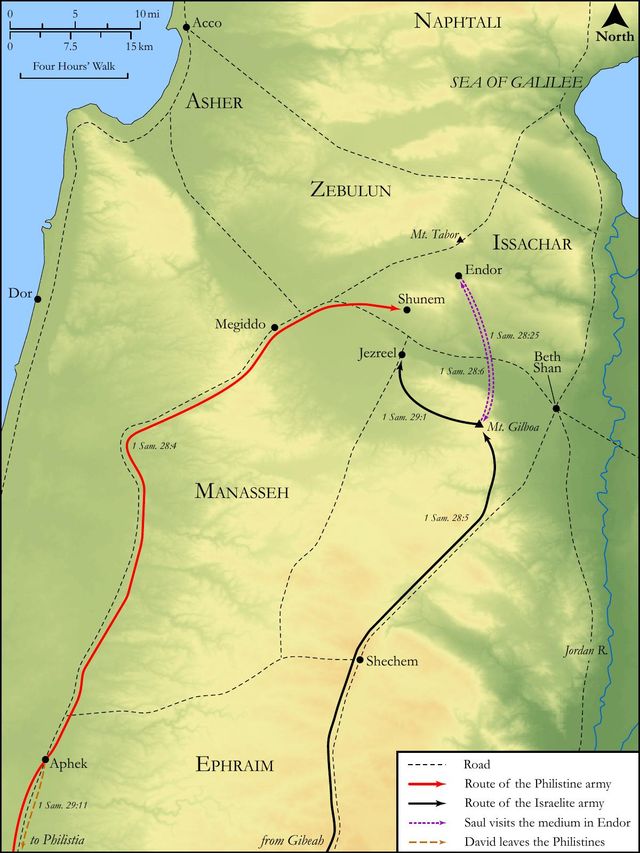
See on the biblical-era map
Study this verse
Public-domain commentary
Matthew Henry
From his Commentary on the Whole Bible. Henry comments on passages, not single verses — this entry covers 1 Samuel 29:1–5.
Here is, I. The great strait that David was in, which we may suppose he himself was aware of, though we read not of his asking advice from God, nor of any project of his own to get clear of it. The two armies of the Philistines and the Israelites were encamped and ready to engage, Sa1 29:1. Achish, who had been kind to David, had obliged him to come himself and bring the forces he had into his service. David came accordingly, and, upon a review of the army, was found with Achish, in the post assigned him in the rear, Sa1 29:2. Now, 1. If, when the armies engaged, he should retire, and quit his post, he would fall under the indelible reproach, not only of cowardice and treachery, but of base ingratitude to Achish, who had been his protector and benefactor and had reposed a confidence in him, and from whom he had received a very honourable commission. Such an unprincipled thing as this he could by no means persuade himself to do. 2. If he should, as was expected from him, fight for the Philistines against Israel, he would incur the imputation of being an enemy to the Israel of God and a traitor to his country, would make his own people hate him, and unanimously oppose his coming to the crown, as unworthy the name of an Israelite, much more the honour and trust of a king of Israel, when he had fought against them under the banner of the uncircumcised. If Saul should be killed (as it proved he was) in this engagement, the fault would be laid at David's door, as if he had killed him. So that on each side there seemed to be both sin and scandal. This was the strait he was in; and a great strait it was to a good man, greater to see sin before him than to see trouble. Into this strait he brought himself by his own unadvisedness, in quitting the land of Judah, and going among the uncircumcised. It is strange if those that associate themselves with wicked people, and grow intimate with them, come off without guilt, or grief, or both. What he himself proposed to do does not appear. Perhaps he designed to act only as keeper to the king's head, the post assigned him (Sa1 28:2) and not to do any thing offensively against Israel. But it would have been very hard to come so near the brink of sin and not to fall in. Therefore, though God might justly have left him in this difficulty, to chastise him for his folly, yet, because his heart was upright with him, he would not suffer him to be tempted above what he was able, but with the temptation made a way for him to escape, Co1 10:13.
II.A door opened for his deliverance out of this strait.
God inclined the hearts of the princes of the Philistines to oppose his being employed in the battle, and to insist upon his being dismissed. Thus their enmity befriended him, when no friend he had was capable of doing him such a kindness. 1. It was a proper question which they asked, upon the mustering of the forces, "What do these Hebrews here? Sa1 29:3. What confidence can we put in them, or what service can we expect from them?" A Hebrew is out of his place, and, if he has the spirit of a Hebrew, is out of his element, when he is in the camp of the Philistines, and deserves to be made uneasy there. David used to hate the congregation of evil doers, however he came now to be among them, Psa 26:5. It was an honourable testimony which Achish, on this occasion, gave to David. He looked upon him as a refugee, that fled from a wrongful prosecution in his own country, and had put himself under his protection, whom therefore he was obliged, in justice, to take care of, and thought he might in prudence employ; "for (says he) he has been with me these days, or these years," that is, a considerable time, many days at his court and a year or two in his country, and he never found any fault in him, nor saw any cause to distrust his fidelity, or to think any other than that he had heartily come over to him. By this it appears that David had conducted himself with a great deal of caution, and had prudently concealed the affection he still retained for his own people. We have need to walk in wisdom towards those that are without, to keep our mouth when the wicked is before us, and to be upon the reserve. 3. Yet the princes are peremptory in it, that he must be sent home; and they give good reasons for their insisting on it. (1.) Because he had been an old enemy to the Philistines; witness what was sung in honour of his triumphs over them: Saul slew his thousands, and David his ten thousands, Sa1 29:5. "It will be a reproach to us to harbour and trust so noted a destroyer of our people; nor can it be thought that he will now act heartily against Saul who then acted so vigorously with him and for him." Who would be fond of popular praise or applause when, even that may, another time, be turned against a man to his reproach? (2.) Because he might be a most dangerous enemy to them, and do them more mischief then all Saul's army could (Sa1 29:4): "He may in the battle be an adversary to us, and surprise us with an attack in the rear, while their army charges us in the front; and we have reason to think he will do so, that, by betraying us, he may reconcile himself to his master. Who can trust a man who, besides his affection to his country, will think it his interest to be false to us?" It is dangerous to put confidence in a reconciled enemy.
Historical interpretation
Historical reception
1 surviving comment on this verse from the historical church.
And the satraps of the Philistines indeed marched by the hundreds, etc. Understand the last contingent either by the merit of humility or by the order of time. For in every age of the world, the nations of the gentiles have set up in battle array against the Jews, since that nation was founded, and strive to defeat them by hand or mouth; but also against the heretics, because they are a portion of the Church, burning with a similar mind due to envy of the name of Christ, the Lord appears humble and despised by those chosen from the secular world; because the children of this age are wiser in their generation than the children of light (Luke XVI). He also, having incarnated in his time, and in the fullness of times, appeared humble to the world, showing examples of humility, rejection, and poverty outwardly to his followers, whom he instructed within on how desirable it is to be mighty in hand for defeating the proud, and in blessing the submissive.
Continue studying 1 Samuel 29:2 across the web’s major study libraries — every link below opens this exact verse, chapter, or book on the destination site.
Read & Compare
 BibleGatewayThis verse in more than 200 translations and 70 languages.
 Bible.comThe YouVersion reader — hundreds of translations, reading plans, and highlights.
 ESV.orgCrossway's official English Standard Version reader.
 NET BibleThe NET translation with 60,000+ translators' notes on every rendering decision.
 STEP BibleTyndale House's free study tool — original text, vocabulary, and scholarly resources.
 BibliaLogos Bible Software's free web reader.
 USCCBThe New American Bible (Revised Edition) with the U.S. bishops' study notes.
Commentaries
 BibleHub CommentariesDozens of classic commentaries on this verse, gathered on one page.
 StudyLightMore than 100 commentary sets — the largest collection on the web.
 BibleRefPlain-English commentary on what this verse means, verse by verse.
 Enduring WordDavid Guzik's free commentary on this chapter, widely used by Bible teachers.
 Bible Study ToolsVerse commentary alongside Greek and Hebrew study aids.
Original Language & Research
- BibleHub InterlinearThe verse word by word — original language, transliteration, and English.
- BibleHub LexiconEvery word's original-language definition and Strong's entry.
 Blue Letter BibleDeep-study tools — Strong's numbers, concordance, and word studies.
 SefariaThe Hebrew text with Rashi and centuries of Jewish commentary.
Sermons, Hymns & Audio


TrulyRandomVerse is not affiliated with these sites and doesn’t control their content. They’re linked because they’re genuinely useful.
Summary
1 Samuel 29:2 vividly captures David's profoundly complex and morally precarious situation as the formidable Philistine armies gather for a decisive battle against Israel. Having sought refuge with Achish, king of Gath, David finds himself seemingly aligned with the enemies of his own people, marching in the rear guard of Achish's contingent. This verse powerfully portrays the immense military might of the Philistines and underscores the deep ethical dilemma David faced as the future king of Israel, appearing to prepare for war against his own nation.
Context
ShowHideLiterary Context
This verse is situated at a pivotal moment in David's narrative within 1 Samuel, immediately preceding the climactic battle of Gilboa. Following years of relentless persecution by King Saul, David had sought asylum with Achish, king of Gath, residing in the Philistine city of Ziklag for over a year and four months, a period marked by strategic deception to maintain Achish's trust while raiding non-Israelite peoples (1 Samuel 27:1-12). Chapter 29 opens with the Philistines assembling their full military might at Aphek, preparing for a major confrontation with Israel, a conflict that will tragically result in the deaths of King Saul and his sons on Mount Gilboa (1 Samuel 28:1; 1 Samuel 31:1-6). Verse 2 specifically describes the formal review of the Philistine army, setting the stage for the dramatic and providential intervention in the subsequent verses, where the other Philistine lords express their distrust of David, leading to his dismissal from the Philistine ranks and sparing him from an impossible moral choice (1 Samuel 29:3-5).
Historical & Cultural Context
The Philistines were a dominant military power in the land of Canaan, renowned for their advanced iron technology and highly organized military structure. Their army, described as passing "by hundreds, and by thousands," reflects a disciplined and efficient fighting force, posing an existential threat to Israelite sovereignty. Gath was one of the five major Philistine city-states, and Achish, as its king, wielded significant regional authority. David's relationship with Achish was that of a servant to his lord, a common political and military arrangement among the kings of that day. As Achish's servant, David was expected to provide military service to his lord. This cultural expectation placed David in an incredibly difficult and compromising position, as his loyalty was ostensibly pledged to a foreign king who was a sworn enemy of his own people and God. The ongoing Philistine-Israelite conflict was a long-standing struggle for control of the land, making David's presence among the Philistine ranks a profound anomaly and a test of his ultimate allegiance.
Key Themes
ShowHideThis verse powerfully contributes to several key themes within the book of 1 Samuel and David's life. Firstly, it highlights David's compromised position and the profound ethical dilemmas he faced during his period of exile. His alliance with Achish, while providing a temporary sanctuary from Saul, forced him into a situation where his identity as an Israelite and the divinely anointed future king was severely tested. Secondly, the verse subtly introduces the theme of divine providence. Although God's direct intervention is not explicitly stated in this verse, the subsequent events reveal that God was sovereignly orchestrating circumstances to protect David from having to fight against Israel, thereby preserving his integrity and ensuring the purity of his future kingship (1 Samuel 29:6-11). This demonstrates God's unwavering faithfulness to His promises, even when His chosen servant is in a morally challenging or compromising situation. Finally, the detailed description of the Philistine army passing "by hundreds, and by thousands" emphasizes the magnitude of the threat they posed to Israel, underscoring the severity of the impending battle and the desperate state of Saul's kingdom, which God was preparing to transition to David.
Exposition and Analysis
ShowHideKey Word Analysis
ShowHideThis term refers to the five "lords" or "princes" of the Philistine confederacy (Gaza, Ashdod, Ashkelon, Gath, and Ekron). These were powerful, independent rulers who collectively governed the Philistine city-states and led their military and political affairs. Their inspection of the troops, as they "passed on by hundreds, and by thousands," signifies their supreme authority and the vast, organized nature of their assembled forces.
This primitive root means "to cross over" and is used very widely to describe any transition, literal or figurative, including movement, going through, or passing by. In this context, it describes the movement of the Philistine contingents as they parade or are reviewed by their lords. It conveys the sense of a continuous, orderly procession, emphasizing the sheer number and disciplined movement of their forces.
This word, derived from a root meaning "hinder," refers to the rear guard of an army. In a military formation, the rereward is the contingent that brings up the rear, often responsible for protecting the main body from attack from behind or for gathering stragglers. David's position in the "rereward with Achish" suggests his place at the very end of Achish's personal contingent, highlighting his status as a servant who is not fully integrated into the Philistine command structure, or perhaps a position from which he could be closely observed by Achish.
Verse Breakdown
ShowHide"And the lords of the Philistines passed on by hundreds, and by thousands"
This initial clause sets the scene, depicting a formal military review or parade of the Philistine army. The phrase "by hundreds, and by thousands" functions as a merism, signifying the immense size, meticulous organization, and formidable power of their military force. It conveys the impression of a vast, disciplined, and well-equipped army, ready for battle under the inspection of their supreme commanders.
"but David and his men passed on in the rereward with Achish"
This second clause introduces a stark contrast, highlighted by the conjunction "but," which emphasizes the anomalous and deeply ironic presence of David. David, the divinely anointed future king of Israel and the renowned slayer of the Philistine champion Goliath, is now marching alongside the very enemies of his people. His position "in the rereward with Achish" places him at the very back of Achish's personal contingent, underscoring his precarious standing as a servant and his uncomfortable alignment with the Philistines as they prepare to attack Israel.
Literary Devices
ShowHideThe verse effectively employs several Literary Devices to convey its meaning and heighten the dramatic tension. Juxtaposition is central, as it places David, the divinely appointed king of Israel, within the ranks of Israel's most formidable enemies. This stark contrast immediately highlights David's morally compromised and ethically perilous situation. There is also a strong sense of Irony, given David's past as the champion who defeated Goliath and consistently fought against the Philistines; now he appears to be fighting for them. The detailed description of the Philistine army passing "by hundreds, and by thousands" utilizes Military Imagery and Hyperbole (or merism) to emphasize their overwhelming power, organization, and numerical superiority, creating a palpable sense of impending doom for Israel. Furthermore, the verse subtly employs Foreshadowing, as David's anomalous position among the Philistines, though seemingly a dire predicament, will soon lead to his providential dismissal by the other Philistine lords, sparing him from the impossible choice of fighting against his own people and preserving his integrity for his future kingship.
Theological and Thematic Connections
ShowHideThis verse serves as a profound theological statement on God's sovereignty and providential care, even amidst human error and compromise. David's presence among the Philistines was a consequence of his flight from Saul, a choice born of fear and self-preservation, which led him into a morally ambiguous alliance. Yet, even in this deeply compromised position, God's unseen hand was at work, orchestrating events to protect His chosen one and preserve His divine plan for Israel's kingship. The situation highlights that God can work through, and even redeem, difficult circumstances and human failings to achieve His purposes. It underscores the truth that God's faithfulness is not contingent upon our perfect obedience, but rather His unwavering commitment to His covenant promises and His ability to direct the paths of His people.
Reflection and Application
ShowHide1 Samuel 29:2 challenges us to consider the complexities of navigating life when our choices, even those made for self-preservation or survival, lead us into morally ambiguous or compromising situations. David's predicament reminds us that even devout believers can find themselves in places where their loyalties are divided, their integrity is tested, or their actions seem to contradict their core identity. This passage encourages us to trust in God's overarching sovereignty, recognizing that His hand is at work even when circumstances seem dire, when our own actions have led us astray, or when we are caught between conflicting allegiances. It's a powerful reminder that God's plan for us is often preserved not just by our perfect choices, but by His faithful intervention and protection, guiding our steps even when we stumble. We are called to discern our associations carefully, ensuring that our alliances and pursuits do not ultimately compromise our faith, our calling, or our witness for God. Ultimately, it reassures us that God's grace is sufficient, and He can deliver us from situations we cannot escape on our own, preserving us for His greater purposes and demonstrating His unwavering commitment to His covenant.
Questions for Reflection
ShowHideFAQ
ShowHideWhy was David with the Philistines, the enemies of Israel?
ShowHideDavid was with the Philistines because he had fled from King Saul, who was relentlessly pursuing him to kill him (1 Samuel 27:1). In desperation and fear for his life, David sought refuge with Achish, the Philistine king of Gath, becoming his servant. Achish granted David and his men the city of Ziklag as their dwelling place. This arrangement provided David with safety from Saul but placed him in a deeply compromising position, as he was now obligated to serve a foreign king who was an enemy of his own people and God.
What does "rereward" mean in the context of this verse?
ShowHideThe term "rereward" (KJV) or "rear guard" refers to the contingent of an army that marches at the very back. In 1 Samuel 29:2, it signifies David and his men's position at the end of Achish's division as the Philistine army was being reviewed. This position could imply a few things: it might have been a less prominent or trusted role for a stranger in his service, a strategic position for protection, or simply the designated place for Achish's personal contingent. Given the subsequent events where the other Philistine lords express their strong distrust of David, it most likely suggests a position where he was under close observation or not fully integrated into the main fighting force.
Did David intend to fight against Israel in this battle?
ShowHideThe biblical text does not explicitly state David's intention to fight against Israel. His presence in the Philistine ranks certainly put him in an impossible and morally compromising situation, forcing him to choose between betraying his people or betraying his protector. However, God's providential hand intervened through the other Philistine lords, who expressed strong distrust of David and insisted that Achish send him away (1 Samuel 29:3-5). This divine intervention spared David from having to make the terrible choice of fighting against his own countrymen, thus preserving his integrity and ensuring he remained unstained by direct conflict with Israel, which would have jeopardized his future kingship.
Christ-Centered Fulfillment
ShowHide1 Samuel 29:2, with David's precarious and compromised position, powerfully foreshadows the perfect integrity and ultimate triumph of Jesus Christ. David, though chosen by God, found himself in a situation born of human fear and compromise, seemingly allied with the enemies of his people. Yet, God's sovereign hand providentially intervened to protect David from having to fight against Israel, preserving his purity for his future kingship. This narrative points to Christ, the true King, who never once compromised His divine mission or His perfect obedience to the Father, even when tempted in every way, yet without sin (Hebrews 4:15). While David was delivered from a moral dilemma by external intervention, Christ willingly entered the ultimate "compromised position" by taking on human flesh and bearing the sin of the world. He became sin for us though He knew no sin, so that in Him we might become the righteousness of God (2 Corinthians 5:21). His perfect life and sacrificial death accomplished what no human, not even David, could: a complete and unblemished victory over sin and death. The divine providence that protected David for his earthly throne finds its ultimate and glorious fulfillment in God's sovereign plan for Christ's eternal kingdom, a kingdom established not by human maneuvering or compromise, but by divine love, perfect obedience, and the ultimate sacrifice of the Lamb of God (Luke 1:32-33).