


1 Samuel 23:3
Bible text: King James Version (1769 Blayney text) · Public domain
Bible text: Berean Standard Bible · Public domain
Bible text: American Standard Version (1901) · Public domain
Bible text: World English Bible, Messianic edition · Public domain
Bible text: Geneva Bible (1599) · Public domain
Bible text: Young's Literal Translation · Public domain
- וַיֹּאמְרוּvai·Yo·me·Ruand they saidH559Conj-w ¦ V-Qal-ConsecImperf-3mpVerb Qal Consecutive Imperfect 3rd Plural Masculineוַandיֹּאמְרוּthey said
- אַנְשֵׁי'an·Shei[the] men ofH582N-mpcNoun Plural Masculine Construct
- דָוִדda·VidDavidH1732N-proper-mNoun Proper Masculine
- אֵלָיו'e·Lavto himH413Prep ¦ 3msPreposition Definiteאֵלָיtoוhim
- הִנֵּהhi·Nehhere!H2009PrtParticle Interjection
- אֲנַחְנוּ'a·Nach·nuweH587Pro-1cpPronoun Personal 1st Plural common gender
- פֹהfohhereH6311AdvAdverb
- בִּיהוּדָהbi·hu·Dahin JudahH3063Prep-b ¦ N-properNoun Proper LocationבִּinיהוּדָהJudah
- יְרֵאִיםye·re·'Im[are] fearfulH3373Adj-mpAdjective Plural Masculine Absolute
- וְאַףve·'Afand indeed?H637Conj-w ¦ PrtParticle Interjectionוְandאַףindeed?
- כִּיkiifH3588PrtParticle Conditional
- נֵלֵךְne·Lekhwe will goH1980V-Qal-Imperf-1cpVerb Qal Imperfect 1st Plural common gender
- קְעִלָהke·'i·LahKeilahH7084N-properNoun Proper Location
- אֶל'elagainstH413PrepPreposition
- מַעַרְכוֹתma·'ar·Khot[the] battle lines ofH4634N-fpcNoun Plural Feminine Construct
- פְּלִשְׁתִּיםpe·lish·Tim[the] PhilistinesH6430N-mpNoun Gentilic Plural Masculine Absolute
English is a literal word-by-word gloss of the Hebrew, not the KJV's wording. Why?
This is the original text the KJV's translators worked from — each Hebrew word with its own literal English meaning in this verse, prepared by scholars at Tyndale House, Cambridge. The KJV translates whole sentences, not word by word, so its wording differs: one Hebrew word can become several English words, and the KJV may choose “the LORD” where the gloss reads “Yahweh”. Both are faithful — they answer different questions. For the KJV's own rendering, switch to the KJV text.
Details
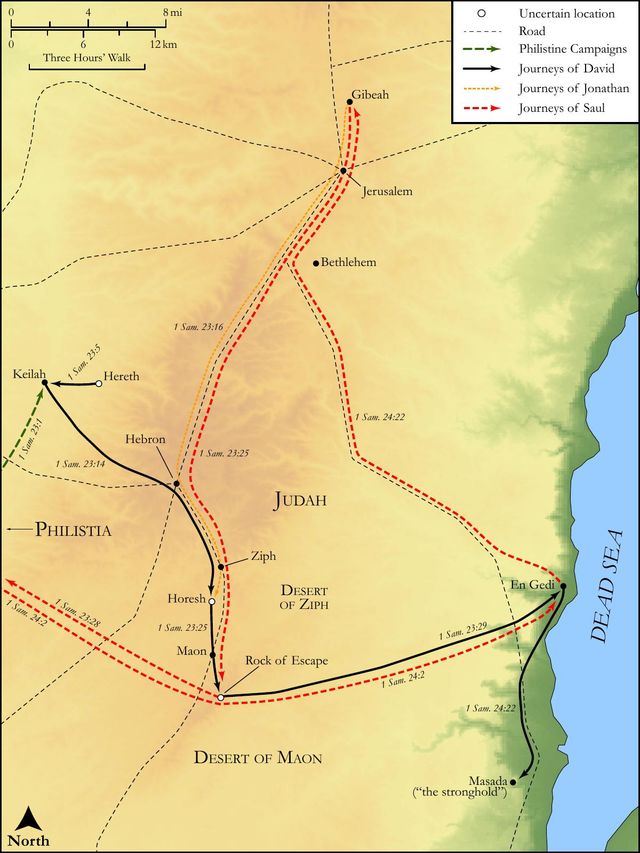
See on the biblical-era map
Study this verse
Public-domain commentary
Matthew Henry
From his Commentary on the Whole Bible. Henry comments on passages, not single verses — this entry covers 1 Samuel 23:1–6. His two-level outline is real structure in the source text, so it is rendered as structure.
Now we find why the prophet Gad (by divine direction, no doubt) ordered David to go into the land of Judah, Sa1 22:5. It was that, since Saul neglected the public safety, he might take care of it, notwithstanding the ill treatment that was given him; for he must render good for evil, and therein be a type of him who not only ventured his life, but laid down his life, for those that were his enemies.
I.Tidings are brought to David, as to the patron and protector of his country's liberties, that the Philistines had made a descent upon the city of Keilah and plundered the country thereabouts, Sa1 23:1. Probably it was the departure both of God and David from Saul that encouraged the Philistines to make this incursion. When princes begin to persecute God's people and ministers, let them expect no other than vexation on all sides. The way for any country to be quiet is to let God's church be quiet in it. If Saul fight against David, the Philistines shall fight against his country.
II.David is forward enough to come in for their relief, but is willing to enquire of the Lord concerning it. Here is an instance,
1.Of David's generosity and public-spiritedness. Though his head and hands were full of his own business, and he had enough to do, with the little force he had, to secure himself, yet he was concerned for the safety of his country and could not sit still to see that ravaged: nay, though Saul, whose business it was to guard the borders of his land, hated him and sought his life, yet he was willing, to the utmost of his power, to serve him and his interests against the common enemy, and bravely abhorred the thought of sacrificing the common welfare to his private revenge. Those are unlike to David who sullenly decline to do good because they have not been so well considered as they deserved for the services they have done.
2.Of David's piety and regard to God. He enquired of the Lord by the prophet Gad; for it should seem (by Sa1 23:6) that Abiathar came not to him with the ephod till he was in Keilah. His enquiry is, Shall I go and smite these Philistines? He enquires both concerning the duty (whether he might lawfully take Saul's work out of his hand, and act without a commission from him) and concerning the event, whether he might safely venture against such a force as the Philistines had with such a handful of men at his feet, and such a dangerous enemy as Saul was at his back. It is our duty, and will be our case and comfort, whatever happens, to acknowledge God in all our ways and to seek direction from him.
III.God appointed him once and again to go against the Philistines, and promised him success:
Go, and smite the Philistines, Sa1 23:2. His men opposed it, Sa1 23:3. No sooner did he begin to have soldiers of his own than he found it hard enough to manage them. They objected that they had enemies enough among their own countrymen, they needed not to make the Philistines their enemies. Their hearts failed them when they only apprehended themselves in danger from Saul's band of pursuers, much more when they came to engage the Philistine-armies. To satisfy them, therefore, he enquired of the Lord again, and now received, not only a full commission, which would warrant him to fight though he had no orders from Saul (Arise, go down to Keilah), but also a full assurance of victory: I will deliver the Philistines into thy hand, Sa1 23:4. This was enough to animate the greatest coward he had in his regiment.
IV.He went accordingly against the Philistines, routed them, and rescued Keilah, (Sa1 23:5), and it should seem he made a sally into the country of the Philistines, for he carried off their cattle by way of reprisal for the wrong they did to the men of Keilah in robbing their threshing-floors. Here notice is taken (Sa1 23:6) that it was while David remained in Keilah, after he had cleared it of the Philistines, that Abiathar came to him with the ephod in his hand, that is, the high priest's ephod, in which the urim and thummin were. It was a great comfort to David, in his banishment, that when he could not go to the house of God he had some of the choicest treasures of that house brought to him, the high priest and his breast-plate of judgment.
Continue studying 1 Samuel 23:3 across the web’s major study libraries — every link below opens this exact verse, chapter, or book on the destination site.
Read & Compare
 BibleGatewayThis verse in more than 200 translations and 70 languages.
 Bible.comThe YouVersion reader — hundreds of translations, reading plans, and highlights.
 ESV.orgCrossway's official English Standard Version reader.
 NET BibleThe NET translation with 60,000+ translators' notes on every rendering decision.
 STEP BibleTyndale House's free study tool — original text, vocabulary, and scholarly resources.
 BibliaLogos Bible Software's free web reader.
 USCCBThe New American Bible (Revised Edition) with the U.S. bishops' study notes.
Commentaries
 BibleHub CommentariesDozens of classic commentaries on this verse, gathered on one page.
 StudyLightMore than 100 commentary sets — the largest collection on the web.
 BibleRefPlain-English commentary on what this verse means, verse by verse.
 Enduring WordDavid Guzik's free commentary on this chapter, widely used by Bible teachers.
 Bible Study ToolsVerse commentary alongside Greek and Hebrew study aids.
Original Language & Research
- BibleHub InterlinearThe verse word by word — original language, transliteration, and English.
- BibleHub LexiconEvery word's original-language definition and Strong's entry.
 Blue Letter BibleDeep-study tools — Strong's numbers, concordance, and word studies.
 SefariaThe Hebrew text with Rashi and centuries of Jewish commentary.
Sermons, Hymns & Audio


TrulyRandomVerse is not affiliated with these sites and doesn’t control their content. They’re linked because they’re genuinely useful.
Summary
In 1 Samuel 23:3, David's loyal but fearful men voice profound apprehension regarding their leader's divinely sanctioned plan to rescue the city of Keilah from a Philistine attack. Despite David having sought and received explicit divine guidance to proceed, his followers express deep-seated reluctance, highlighting their vulnerability even in their current refuge in Judah, and amplifying their dread at the prospect of confronting the formidable Philistine armies in a fortified city. This moment underscores the tension between natural human fear in the face of overwhelming odds and the call to trust in God's revealed will, posing a significant challenge to David's leadership and the faith of his men.
Context
ShowHideLiterary Context
This verse is situated within a critical and dangerous period of David's life as an outlaw, relentlessly pursued by King Saul. Immediately preceding this, David and his men are in the wilderness, having fled Saul's wrath. News reaches David that the Philistines are attacking Keilah, a city within Judah, and plundering its threshing floors. David, demonstrating his consistent reliance on God, consults the Lord via the ephod in 1 Samuel 23:2, asking if he should go and save Keilah. The Lord unequivocally instructs him to go. However, 1 Samuel 23:3 reveals the men's immediate and visceral reaction of fear, prompting David to inquire of the Lord a second time in 1 Samuel 23:4, receiving renewed divine assurance. This sequence highlights the human struggle to align with divine command when faced with palpable danger, setting the stage for David's eventual obedience and God's faithfulness in the subsequent rescue of Keilah.
Historical & Cultural Context
At this point, David and his men are living as fugitives, a small, mobile band constantly evading King Saul's larger, organized army. Their existence is precarious, marked by resourcefulness and a deep reliance on God's provision. The Philistines, a powerful and technologically superior enemy (possessing iron weaponry, as seen in 1 Samuel 13:19-22), were a persistent threat to Israel's security and sovereignty. Keilah was a fortified city in the Shephelah, a region of low hills and valleys forming a natural border between the Philistine plain and the Judean highlands. Its strategic location made it a frequent target in the ongoing conflict. The men's fear is entirely rational given their vulnerable position, the Philistines' military prowess, and the additional danger of exposing themselves to Saul's forces by entering a city. Their statement reflects a common human instinct for self-preservation in a volatile geopolitical landscape where survival was a daily challenge.
Key Themes
ShowHideThis verse powerfully contributes to several overarching themes within the book of 1 Samuel. Firstly, it underscores the tension between human fear and divine will. David's men, despite their loyalty, are paralyzed by the immediate threat, contrasting with David's consistent practice of seeking and obeying God's counsel, even when it seems illogical or dangerous. Secondly, it highlights the challenges of leadership and the necessity of trust. David must not only discern God's will but also inspire and persuade his fearful followers to act upon that guidance, demonstrating his emerging qualities as a leader who prioritizes divine direction over human apprehension. This episode also reinforces the ever-present Philistine threat as a backdrop to Israel's national narrative, emphasizing the ongoing need for courageous, God-directed action against formidable adversaries, a theme seen repeatedly in the lives of both Saul and David, and ultimately resolved through divine intervention and faithful obedience, as exemplified by David's victory in 1 Samuel 23:5.
Exposition and Analysis
ShowHideKey Word Analysis
ShowHideThis verb (H3373) signifies a deep-seated fear, dread, or reverence. In this context, it conveys a profound sense of apprehension and terror in the face of danger. It's not merely a slight uneasiness but a paralyzing fear that makes action difficult. The men's use of "we be afraid here in Judah" emphasizes that even in their relatively secure, familiar territory, they feel vulnerable, thus magnifying their dread of confronting the Philistines in a more exposed position. This word highlights their emotional state of being "fearing."
This noun (H4634) refers to an arrangement, specifically a military array or fighting force. Here, it denotes a well-organized, formidable, and numerous body of troops. The phrase "armies of the Philistines" evokes the image of a powerful military machine, known for their superiority and aggressive campaigns against Israel. This term underscores the overwhelming odds David's men perceive themselves to be facing, emphasizing the sheer scale and organized nature of the enemy.
Verse Breakdown
ShowHide"And David's men said unto him,"
This opening clause establishes the speaker and the recipient, highlighting a moment of direct communication and challenge to David's authority. It sets up the immediate tension that follows, indicating a collective expression of concern from his followers to their leader.
"Behold, we be afraid here in Judah:"
This is the core expression of their fear. The interjection "Behold" (Hebrew: הִנֵּה, hinneh) draws attention to the stark reality of their emotional state, emphasizing its immediacy and intensity. They confess their fear not just of the Philistines, but even of their current circumstances in Judah, where they are constantly hunted by Saul. This admission of vulnerability forms the premise for their greater apprehension, revealing their deep sense of insecurity even in familiar territory.
"how much more then if we come to Keilah against the armies of the Philistines?"
This rhetorical question serves as a powerful expression of their profound reluctance and perceived insurmountable odds. If they are afraid in their current, relatively safer position, their terror would be exponentially greater when facing the renowned military might of the Philistines in a direct confrontation within a besieged city like Keilah. It articulates their perceived insurmountable odds and their profound reluctance to engage, highlighting the perceived escalation of danger.
Literary Devices
ShowHideThe verse employs several significant literary devices to convey the men's apprehension. The most prominent is Dialogue, which provides direct insight into the emotional state and perspective of David's men, making their fear palpable and humanizing their struggle. The use of Rhetorical Question ("how much more then if we come to Keilah...") is highly effective in conveying the overwhelming nature of their apprehension, implying an answer that underscores their profound dread without explicitly stating it. This rhetorical device also functions as a form of Hyperbole, exaggerating their current fear to emphasize the far greater terror they anticipate from a direct confrontation with the Philistines. Finally, the scene presents a subtle Foreshadowing of David's future challenges in leading a people who often struggle with faith and obedience, even when God's will is clear, setting up a pattern of human doubt against divine certainty.
Theological and Thematic Connections
ShowHideThis pivotal moment in 1 Samuel 23:3 vividly illustrates the perennial tension between human fear and divine command. David's men, though loyal, are gripped by a natural and understandable fear of a superior enemy, overlooking or doubting the divine assurance David has received. This highlights a fundamental theological truth: God's will often calls us beyond our comfort zones and natural inclinations, demanding a faith that transcends human logic and fear. The narrative underscores that while fear is a natural human emotion, it must not dictate our obedience to God. David's subsequent actions demonstrate the importance of persistent inquiry and unwavering trust in God's leading, even when those around us are hesitant or afraid, thereby affirming God's sovereignty over human circumstances.
Reflection and Application
ShowHideThe fear expressed by David's men in 1 Samuel 23:3 resonates deeply with the human experience. We often find ourselves in situations where God's clear direction seems to lead us into circumstances that feel overwhelming, dangerous, or beyond our capacity. This verse reminds us that it is natural to feel afraid when faced with such challenges, even when we believe we are following God's leading. However, it also calls us to consider whether our fear is rooted in a lack of trust in God's power and faithfulness. Just as David had to patiently reassure and lead his men, we are called to seek God's counsel, acknowledge our fears, but ultimately choose to step out in faith, trusting that His presence and power are sufficient to overcome any obstacle. This requires a willingness to surrender our perceived safety and lean into the divine promise, knowing that true security is found not in avoiding danger, but in obeying God's call, even when it demands courage beyond our natural inclination.
Questions for Reflection
ShowHideFAQ
ShowHideWhy were David's men so afraid, even after God had given clear direction?
ShowHideDavid's men were afraid for several understandable reasons, even after God's instruction. Firstly, they were already living a precarious existence as fugitives, constantly on the run from King Saul's relentless pursuit in Judah. This made them acutely aware of their vulnerability. Secondly, the Philistines were a formidable military power, known for their superior weaponry and organization, and engaging their "armies" was a daunting prospect for David's relatively small and less-equipped band. Thirdly, entering a fortified city like Keilah, even to rescue it, would expose them to a direct confrontation with the Philistines and potentially reveal their location to Saul, putting them in a strategic trap. Their fear was a natural human response to overwhelming odds and significant personal risk, highlighting the tension between human logic and divine command.
Christ-Centered Fulfillment
ShowHideThe fear of David's men in 1 Samuel 23:3, set against David's determination to obey God's will despite the danger, foreshadows the ultimate triumph of faith over fear found in Christ. While David's men hesitated, Jesus, the Greater David, faced the ultimate "Keilah moment" in Gethsemane, confronting the terrifying prospect of bearing the sins of the world and enduring God's wrath. Yet, unlike David's men, He perfectly submitted His human will to the divine, praying, "Nevertheless, not my will, but yours, be done" (Luke 22:42). His perfect obedience, even unto death on the cross, conquered not only sin but also the power of death and the fear it instills (Hebrews 2:14-15). Through Christ, believers are empowered by the Holy Spirit to live not by a "spirit of fear, but of power and of love and of a sound mind" (2 Timothy 1:7). His victory enables us to trust God's leading even when circumstances seem terrifying, knowing that "If God is for us, who can be against us?" (Romans 8:31), and that He will "never leave us nor forsake us" (Hebrews 13:5).