


2 Samuel 1:14
Bible text: King James Version (1769 Blayney text) · Public domain
Bible text: Berean Standard Bible · Public domain
Bible text: American Standard Version (1901) · Public domain
Bible text: World English Bible, Messianic edition · Public domain
Bible text: Geneva Bible (1599) · Public domain
Bible text: Young's Literal Translation · Public domain
- וַיֹּאמֶרvai·Yo·merand he saidH559Conj-w ¦ V-Qal-ConsecImperf-3msVerb Qal Consecutive Imperfect 3rd Singular Masculineוַandיֹּאמֶרhe said
- אֵלָיו'e·Lavto himH413Prep ¦ 3msPreposition Definiteאֵלָיtoוhim
- דָּוִדda·VidDavidH1732N-proper-mNoun Proper Masculine
- אֵיךְ'eikhhow?H349InterrogParticle Interrogative
- לֹאlo'notH3808NegParticle Negative
- יָרֵאתָya·Re·tawere you afraidH3372V-Qal-Perf-2msVerb Qal Perfect 2nd Singular Masculine
- לִשְׁלֹחַlish·Lo·achto stretch outH7971Prep-l ¦ V-Qal-InfVerb Qal Infinitive Constructלִtoשְׁלֹחַstretch out
- יָדְךָya·de·Khayour handH3027N-csc ¦ 2msNoun Singular common gender Constructיָדְhandךָyour
- לְשַׁחֵתle·sha·Chetto destroyH7843Prep-l ¦ V-Piel-InfVerb Piel Infinitive Constructלְtoשַׁחֵתdestroy
- אֶת'et<obj.>H853DirObjMParticle Object Indicator
- מְשִׁיחַme·Shi·ach[the] [one] anointed ofH4899N-mscNoun Singular Masculine Construct
- יְהוָהYah·wehYahwehH3068N-properNoun Proper Title
English is a literal word-by-word gloss of the Hebrew, not the KJV's wording. Why?
This is the original text the KJV's translators worked from — each Hebrew word with its own literal English meaning in this verse, prepared by scholars at Tyndale House, Cambridge. The KJV translates whole sentences, not word by word, so its wording differs: one Hebrew word can become several English words, and the KJV may choose “the LORD” where the gloss reads “Yahweh”. Both are faithful — they answer different questions. For the KJV's own rendering, switch to the KJV text.
Details
See on the biblical-era maps
Study this verse
Public-domain commentary
Matthew Henry
From his Commentary on the Whole Bible. Henry comments on passages, not single verses — this entry covers 2 Samuel 1:11–16. His three-level outline is real structure in the source text, so it is rendered as structure.
Here is, I. David's reception of these tidings. So far was he from falling into a transport of joy, as the Amalekite expected, that he fell into a passion of weeping, rent his clothes (Sa2 1:11), mourned and fasted (Sa2 1:12), not only for his people Israel and Jonathan his friend but for Saul his enemy. This he did, not only as a man of honour, in observance of that decorum which forbids us to insult over those that are fallen, and requires us to attend our relations to the grave with respect, whatever we lost by their life or got by their death, but as a good man and a man of conscience, that had forgiven the injuries Saul had done him and bore him no malice. He knew it, before his son wrote it (Pro 24:17, Pro 24:18), that if we rejoice when our enemy falls the Lord sees it, and it displeases him; and that he who is glad at calamities shall not go unpunished, Pro 17:5. By this it appears that those passages in David's psalms which express his desire of, and triumph in, the ruin of his enemies, proceeded not from a spirit of revenge, nor any irregular passion, but from a holy zeal for the glory of God and the public good; for by what he did here, when he heard of Saul's death, we may perceive that his natural temper was very tender, and that he was kindly affected even to those that hated him. He was very sincere, no question, in his mourning for Saul, and it was not pretended, or a copy of his countenance only. His passion was so strong, on this occasion, that it moved those about him; all that were with him, at least in complaisance to him, rent their clothes, and they fasted till even, in token of their sorrow; and probably it was a religious fast: they humbled themselves under the hand of God, and prayed for the repairing of the breaches made upon Israel by this defeat.
II.The reward he gave to him that brought him the tidings.
Instead of preferring him, he put him to death, judged him out of his own mouth, as a murderer of his prince, and ordered him to be forthwith executed for the same. What a surprise was this to the messenger, who thought he should have favour shown him for his pains. In vain did he plead that he had Saul's order for it, that it was a real kindness to him, that he must inevitably have died; all those pleas are overruled: "Thy mouth has testified against thee, saying, I have slain the Lord's anointed (Sa2 1:16), therefore thou must die." Now,
1.David herein did not do unjustly. For,
(1.)The man was an Amalekite. This, lest he should have mistaken it in his narrative, he made him own a second time, Sa2 1:13. That nation, and all that belonged to it, were doomed to destruction, so that, in slaying him, David did what his predecessor should have done and was rejected for not doing.
(2.)He did himself confess the crime, so that the evidence was, by the consent of all laws, sufficient to convict him; for every man is presumed to make the best of himself. If he did as he said, he deserved to die for treason (Sa2 1:14), doing that which, it is probable, he heard Saul's own armour-bearer refuse to do; if not, yet by boasting that he had done it he plainly showed that if there had been occasion he would have done it, and would have made nothing of it; and, by boasting of it to David, he showed what opinion he had of him, that he would rejoice in it, as one altogether like himself, which was an intolerable affront to him who had himself once and again refused to stretch forth his hand against the Lord's anointed. And his lying to David, if indeed it was a lie, was highly criminal, and proved, as sooner or later that sin will prove, lying against his own head.
2.He did honourably and well. Hereby he demonstrated the sincerity of his grief, discouraged all others from thinking by doing the like to ingratiate themselves with him, and did that which might probably oblige the house of Saul and win upon them, and recommend him to the people as one that was zealous for public justice, without regard to his own private interest. We may learn from it that to give assistance to any in murdering themselves, directly or indirectly, if done wittingly, incurs the guilt of blood, and that the lives of princes ought to be, in a special manner, precious to us.
Historical interpretation
Historical reception
3 surviving comments on this verse. Each one is dated, so this reads as a timeline rather than a list.
Select a marker to jump to its quote. Markers stagger vertically where authors wrote within a few decades of each other.
Hence, “his blood will come upon him,” that is, he will be the cause of his own death, according to which principle David said to the one who had announced Saul’s death and had related that the king of Israel fell on his own sword: “Your blood be upon your head.” Not by my sentence, but by the blood of Saul will your blood be spilled.
But when no laws or lawful authorities give command, it is not lawful to kill another, even if he wishes and asks for it and has no longer the strength to live, as is clearly proved by the Scripture in the book of Kings [Samuel], where King David ordered the slayer of King Saul to be put to death, although he said that he had been importuned by the wounded and half-dead king to kill him with one blow and to free his soul struggling with the fetters of the body and longing to be released from those torments.
We know that David went beyond the precepts of the law when, despite Moses’ command to pay back one’s enemies in kind, he not only did not do this but even embraced his persecutors in love, prayed devoutly to the Lord on their behalf, even wept mournfully for them and revenged them when they were slain.
Continue studying 2 Samuel 1:14 across the web’s major study libraries — every link below opens this exact verse, chapter, or book on the destination site.
Read & Compare
 BibleGatewayThis verse in more than 200 translations and 70 languages.
 Bible.comThe YouVersion reader — hundreds of translations, reading plans, and highlights.
 ESV.orgCrossway's official English Standard Version reader.
 NET BibleThe NET translation with 60,000+ translators' notes on every rendering decision.
 STEP BibleTyndale House's free study tool — original text, vocabulary, and scholarly resources.
 BibliaLogos Bible Software's free web reader.
 USCCBThe New American Bible (Revised Edition) with the U.S. bishops' study notes.
Commentaries
 BibleHub CommentariesDozens of classic commentaries on this verse, gathered on one page.
 StudyLightMore than 100 commentary sets — the largest collection on the web.
 BibleRefPlain-English commentary on what this verse means, verse by verse.
 Enduring WordDavid Guzik's free commentary on this chapter, widely used by Bible teachers.
 Bible Study ToolsVerse commentary alongside Greek and Hebrew study aids.
Original Language & Research
- BibleHub InterlinearThe verse word by word — original language, transliteration, and English.
- BibleHub LexiconEvery word's original-language definition and Strong's entry.
 Blue Letter BibleDeep-study tools — Strong's numbers, concordance, and word studies.
 SefariaThe Hebrew text with Rashi and centuries of Jewish commentary.
Sermons, Hymns & Audio


TrulyRandomVerse is not affiliated with these sites and doesn’t control their content. They’re linked because they’re genuinely useful.
Summary
In 2 Samuel 1:14, King David confronts the Amalekite who claims to have delivered the final blow to King Saul. This pivotal verse encapsulates David's profound reverence for the divine appointment of rulers and his unwavering understanding of God's ultimate sovereignty over all earthly authority, even concerning his persecutor. David's rhetorical question expresses deep shock and condemnation, highlighting the sacredness of Saul's office as "the LORD'S anointed" and the grave offense committed by anyone who would presume to take such a life.
Context
ShowHideLiterary Context
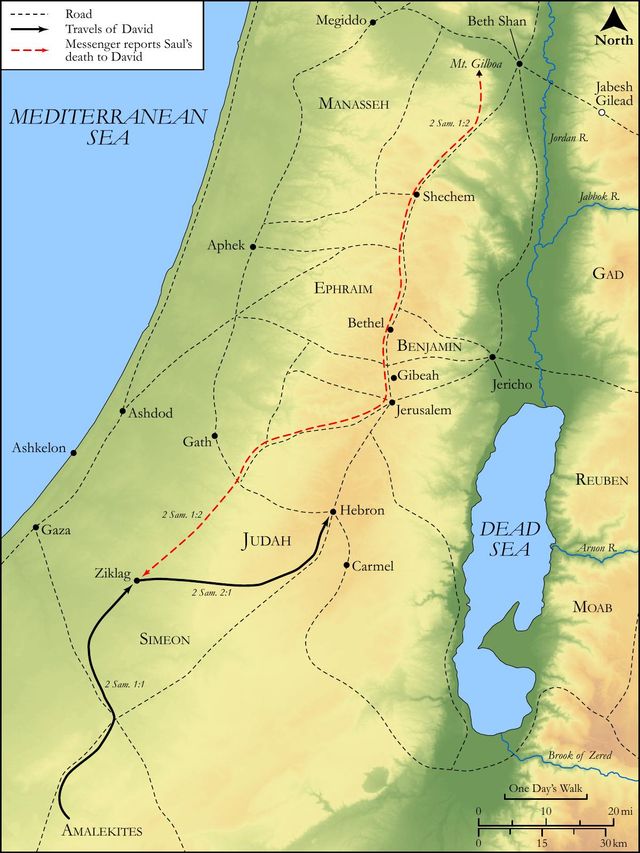
This verse is situated at a crucial turning point in Israel's history, immediately following the devastating news of King Saul's death on Mount Gilboa, alongside his sons, including Jonathan, David's dearest friend. The Amalekite, a survivor of the battle, approaches David, bearing Saul's crown and bracelet, and claims to have mercifully dispatched the mortally wounded king at Saul's own request. This account directly contradicts the narrative of Saul's suicide in 1 Samuel 31:4-5. David's response in 2 Samuel 1:11-12 is one of profound grief, not triumph, as he and his men tear their clothes and mourn for Saul, Jonathan, and the house of Israel. Verse 14 is David's direct, indignant challenge to the Amalekite's audacity, leading directly to the Amalekite's swift execution in 2 Samuel 1:15-16, underscoring the severity of the perceived transgression.
Historical & Cultural Context
The concept of "the LORD'S anointed" was central to the understanding of kingship in ancient Israel. A king was not merely a political leader but one chosen, set apart, and consecrated by God, often through anointing with oil by a prophet, as was the case with both Saul (1 Samuel 10:1) and David (1 Samuel 16:13). This divine appointment rendered the king's person sacred, making any act of violence against him an affront to God Himself. David had consistently demonstrated this reverence throughout his years of persecution by Saul, famously refusing to harm Saul even when he had the opportunity, stating, "The LORD forbid that I should do this thing to my lord, the LORD'S anointed, to stretch out my hand against him, seeing he is the LORD'S anointed" (1 Samuel 24:6). The Amalekites were also a long-standing, cursed enemy of Israel, with a history of treachery and cruelty (Deuteronomy 25:17-19). David's condemnation of the Amalekite, therefore, also resonates with the historical animosity and divine judgment against this people.
Key Themes
ShowHideThis verse powerfully contributes to several key themes within the book of 2 Samuel and the broader Deuteronomistic History. Foremost is the sacredness of divine appointment and the reverence for God's anointed. David's reaction solidifies his character as a man who deeply respects God's sovereignty, even when it involves a flawed leader like Saul who sought his life. This contrasts sharply with the Amalekite's presumptuous disregard for divine authority. Another theme is divine sovereignty over human affairs, particularly over the rise and fall of kings. David understood that Saul's end was in God's hands, not man's. Furthermore, the verse highlights David's moral authority and commitment to justice. His immediate condemnation of the Amalekite, despite the Amalekite's perceived "service," demonstrates that David would rule with righteousness and uphold God's standards, not merely personal gain or vengeance. This sets a crucial precedent for his future reign as king of Israel, emphasizing that his kingdom would be founded on divine principles.
Exposition and Analysis
ShowHideKey Word Analysis
ShowHideThis term (H4899) refers to someone consecrated or set apart for a special office by God, typically through anointing with oil. In the Old Testament, kings like Saul were divinely appointed and thus considered "the LORD'S anointed," signifying their sacred status and God's unique relationship with them. To harm such a person was seen as an affront to God Himself, who had established them in that position.
The Hebrew verb (H7843) means "to decay, ruin, spoil, or destroy." It implies an act that not only ends life but also corrupts or brings to ruin something that was whole or sacred. In this context, it emphasizes the profound violation of Saul's divinely appointed status, suggesting the Amalekite's act was an attempt to desecrate a sacred order.
This Hebrew verb (H3372) encompasses a range of meanings from simple fear to deep awe, reverence, or respect for God. David's rhetorical question, "How wast thou not afraid?", implies a shocking lack of reverential fear before God and His chosen representative. It highlights the Amalekite's spiritual temerity and disregard for the sacredness of the king's office.
Verse Breakdown
ShowHide"And David said unto him,"
This opening clause signals a direct confrontation. David, having just received the news and mourned, now turns his attention to the messenger, shifting from grief to righteous indignation.
"How wast thou not afraid"
This is a powerful rhetorical question, expressing David's utter astonishment and moral outrage. It implies that any person with a proper understanding of God's authority and the sanctity of His anointed would naturally be filled with a reverential fear that would prevent such an act. It highlights the Amalekite's spiritual blindness or audacious disrespect.
"to stretch forth thine hand"
This phrase denotes a deliberate, active, and violent act. It emphasizes that the Amalekite consciously chose to engage in the action, rather than it being an accident or an unavoidable circumstance. It points to the intentionality of the transgression.
"to destroy the LORD'S anointed?"
This is the core of David's condemnation. The object of the Amalekite's action was not merely a king, but "the LORD'S anointed" – a person consecrated by God Himself. The act of "destroying" such a figure was seen as a direct affront to God's sovereignty and a violation of the divine order. David's question encapsulates his deep theological conviction regarding the sacredness of God's chosen leaders.
Literary Devices
ShowHideThe primary literary device at play in 2 Samuel 1:14 is Rhetorical Question. David's query, "How wast thou not afraid to stretch forth thine hand to destroy the LORD'S anointed?", is not posed to elicit information but to express his profound shock, condemnation, and moral outrage. It underscores the Amalekite's audacious disregard for divine authority and the sacredness of Saul's office. This question serves to highlight the enormity of the Amalekite's perceived transgression from David's perspective. Furthermore, there is an element of Irony present in the broader narrative surrounding this verse. The Amalekite, expecting praise and reward from David for eliminating his rival, instead faces immediate judgment and execution. This ironic twist emphasizes David's unwavering commitment to God's principles over personal gain or vengeance. Finally, the verse employs Contrast by juxtaposing David's consistent, deeply held reverence for Saul as God's anointed, even in the face of relentless persecution, with the Amalekite's casual and presumptuous act of violence against him. This contrast serves to elevate David's character and establish his moral authority as the rightful successor to the throne.
Theological and Thematic Connections
ShowHideDavid's response in 2 Samuel 1:14 is a profound theological statement, revealing a deep understanding of divine sovereignty and the sacred nature of God-ordained authority. Even though Saul had been David's relentless persecutor and a deeply flawed king, David consistently refused to take matters into his own hands, recognizing that Saul's life and reign were ultimately in God's control. To lay a hand on "the LORD'S anointed" was to usurp God's prerogative and demonstrate a lack of reverential fear for the divine order. This principle extends beyond the specific context of kingship to a broader understanding of respecting authority, trusting God's timing for justice, and recognizing that vengeance belongs to the Lord. David's actions set a powerful precedent for righteous leadership, demonstrating that true kingship is characterized by submission to God's will, even when it is personally costly.
Reflection and Application
ShowHideDavid's indignant question in 2 Samuel 1:14 offers timeless lessons for believers today concerning our posture towards authority, our trust in God's timing, and the sacredness of life. In a world often characterized by disrespect, rebellion, and a desire for immediate gratification or vengeance, David's example calls us to a higher standard. We are reminded that all authority, whether in government, church, or family, is ultimately instituted by God (Romans 13:1). While we are called to discern and rebuke the powerful, our approach should be marked by respect for the office, even when we disagree with the person holding it. Furthermore, David's unwavering trust that God would deal with Saul in His own time challenges us to relinquish our desire for personal retribution and to wait patiently for God's perfect justice to unfold. This verse encourages us to cultivate a reverential fear of God that shapes our interactions, preventing us from taking matters into our own hands or acting presumptuously against those whom God has placed, however imperfectly, in positions of leadership. It underscores that true spiritual maturity involves submitting our desires for control and vengeance to the sovereign hand of God.
Questions for Reflection
ShowHideFAQ
ShowHideWhy was David so upset by the Amalekite's claim, especially since Saul was his enemy?
ShowHideDavid's profound distress stemmed from his deep theological conviction that Saul, despite his flaws and relentless persecution of David, was "the LORD'S anointed." This meant Saul's kingship was divinely ordained, and his life was sacred in God's eyes. David understood that to lay a hand on God's anointed, even to deliver a mercy blow, was to usurp God's authority and prerogative. David had consistently refused to harm Saul when he had the opportunity (1 Samuel 24:6 and 1 Samuel 26:9), demonstrating his unwavering respect for God's choice. His reaction was not about personal vengeance but about upholding divine principles and acknowledging God's sovereignty over life and death, and over the rise and fall of kings.
What does "the LORD'S anointed" signify in this context?
ShowHide"The LORD'S anointed" (Hebrew: māšîaḥ Yahweh) refers to someone consecrated or set apart by God for a specific, sacred office, typically through anointing with oil. In this instance, it refers to King Saul, who was chosen by God and anointed by the prophet Samuel to be the first king of Israel (1 Samuel 10:1). This designation meant that Saul held a unique, divinely appointed status. Any act of violence against him was not merely an attack on a human king but was considered a direct affront to God Himself, who had established him in that position. David's question highlights the Amalekite's shocking disregard for this sacred, divinely bestowed authority.
Christ-Centered Fulfillment
ShowHideDavid's profound reverence for "the LORD'S anointed" in 2 Samuel 1:14 finds its ultimate and perfect fulfillment in Jesus Christ, the true and eternal Anointed One, the Messiah. While Saul was a flawed human king, anointed for a temporary earthly reign, Jesus is the Son of God, eternally anointed by the Holy Spirit, and King of kings and Lord of lords (Acts 2:36). David's refusal to touch Saul, understanding that vengeance and the end of Saul's reign belonged to God, foreshadows the divine plan for the ultimate Anointed One. No human hand could truly "destroy" Jesus against His will; rather, He willingly laid down His life as the perfect sacrifice for the sins of the world (John 10:18). He is the Lamb of God, who takes away the sin of the world (John 1:29), who was led like a lamb to the slaughter, yet opened not His mouth (Isaiah 53:7). The sacredness of Saul's office pales in comparison to the inherent holiness and divine authority of Jesus, whose death was not a destruction by human hands but a redemptive act of God's sovereign love, culminating in His glorious resurrection and exaltation to the highest place (Philippians 2:8-11). Thus, David's reverence for a temporal, earthly anointed one points us to the eternal reverence due to Christ, the perfectly obedient and divinely appointed King and Savior.