


2 Samuel 1:15
- וַיִּקְרָאvai·yik·Ra'and he calledH7121Conj-w ¦ V-Qal-ConsecImperf-3msVerb Qal Consecutive Imperfect 3rd Singular Masculineוַandיִּקְרָאhe called
- דָוִדda·VidDavidH1732N-proper-mNoun Proper Masculine
- לְאַחַדle·'a·Chadto oneH259Prep-l ¦ N-fsNoun Singular Feminine Absoluteלְtoאַחַדone
- מֵהַנְּעָרִיםme·ha·ne·'a·Rimfrom the young menH5288Prep-m ¦ Art ¦ N-mpNoun Plural Masculine Absoluteמֵfromהַtheנְּעָרִיםyoung men
- וַיֹּאמֶרvai·Yo·merand he saidH559Conj-w ¦ V-Qal-ConsecImperf-3msVerb Qal Consecutive Imperfect 3rd Singular Masculineוַandיֹּאמֶרhe said
- גַּשׁgashdraw nearH5066V-Qal-Imp-2msVerb Qal Imperative 2nd Singular Masculine
- פְּגַעpe·ga'fallH6293V-Qal-Imp-2msVerb Qal Imperative 2nd Singular Masculine
- בּוֹboon <the> himPrep-b ¦ 3msSuffix Personal 3rd Singular Masculineבּon <the>וֹhim
- וַיַּכֵּהוּvai·ya·Ke·huand he struck down himH5221Conj-w ¦ V-Hiphil-ConsecImperf-3ms ¦ 3msVerb Hiphil Consecutive Imperfect 3rd Singular Masculineוַandיַּכֵּhe struck downהוּhim
- וַיָּמֹתvai·ya·Motand he diedH4191Conj-w ¦ V-Qal-ConsecImperf-3msVerb Qal Consecutive Imperfect 3rd Singular Masculineוַandיָּמֹתhe died
English is a literal word-by-word gloss of the Hebrew, not the KJV's wording. Why?
This is the original text the KJV's translators worked from — each Hebrew word with its own literal English meaning in this verse, prepared by scholars at Tyndale House, Cambridge. The KJV translates whole sentences, not word by word, so its wording differs: one Hebrew word can become several English words, and the KJV may choose “the LORD” where the gloss reads “Yahweh”. Both are faithful — they answer different questions. For the KJV's own rendering, switch to the KJV text.
Details
See on the biblical-era map
Study this verse
Public-domain commentary
Matthew Henry
From his Commentary on the Whole Bible. Henry comments on passages, not single verses — this entry covers 2 Samuel 1:11–16. His three-level outline is real structure in the source text, so it is rendered as structure.
Here is, I. David's reception of these tidings. So far was he from falling into a transport of joy, as the Amalekite expected, that he fell into a passion of weeping, rent his clothes (Sa2 1:11), mourned and fasted (Sa2 1:12), not only for his people Israel and Jonathan his friend but for Saul his enemy. This he did, not only as a man of honour, in observance of that decorum which forbids us to insult over those that are fallen, and requires us to attend our relations to the grave with respect, whatever we lost by their life or got by their death, but as a good man and a man of conscience, that had forgiven the injuries Saul had done him and bore him no malice. He knew it, before his son wrote it (Pro 24:17, Pro 24:18), that if we rejoice when our enemy falls the Lord sees it, and it displeases him; and that he who is glad at calamities shall not go unpunished, Pro 17:5. By this it appears that those passages in David's psalms which express his desire of, and triumph in, the ruin of his enemies, proceeded not from a spirit of revenge, nor any irregular passion, but from a holy zeal for the glory of God and the public good; for by what he did here, when he heard of Saul's death, we may perceive that his natural temper was very tender, and that he was kindly affected even to those that hated him. He was very sincere, no question, in his mourning for Saul, and it was not pretended, or a copy of his countenance only. His passion was so strong, on this occasion, that it moved those about him; all that were with him, at least in complaisance to him, rent their clothes, and they fasted till even, in token of their sorrow; and probably it was a religious fast: they humbled themselves under the hand of God, and prayed for the repairing of the breaches made upon Israel by this defeat.
II.The reward he gave to him that brought him the tidings.
Instead of preferring him, he put him to death, judged him out of his own mouth, as a murderer of his prince, and ordered him to be forthwith executed for the same. What a surprise was this to the messenger, who thought he should have favour shown him for his pains. In vain did he plead that he had Saul's order for it, that it was a real kindness to him, that he must inevitably have died; all those pleas are overruled: "Thy mouth has testified against thee, saying, I have slain the Lord's anointed (Sa2 1:16), therefore thou must die." Now,
1.David herein did not do unjustly. For,
(1.)The man was an Amalekite. This, lest he should have mistaken it in his narrative, he made him own a second time, Sa2 1:13. That nation, and all that belonged to it, were doomed to destruction, so that, in slaying him, David did what his predecessor should have done and was rejected for not doing.
(2.)He did himself confess the crime, so that the evidence was, by the consent of all laws, sufficient to convict him; for every man is presumed to make the best of himself. If he did as he said, he deserved to die for treason (Sa2 1:14), doing that which, it is probable, he heard Saul's own armour-bearer refuse to do; if not, yet by boasting that he had done it he plainly showed that if there had been occasion he would have done it, and would have made nothing of it; and, by boasting of it to David, he showed what opinion he had of him, that he would rejoice in it, as one altogether like himself, which was an intolerable affront to him who had himself once and again refused to stretch forth his hand against the Lord's anointed. And his lying to David, if indeed it was a lie, was highly criminal, and proved, as sooner or later that sin will prove, lying against his own head.
2.He did honourably and well. Hereby he demonstrated the sincerity of his grief, discouraged all others from thinking by doing the like to ingratiate themselves with him, and did that which might probably oblige the house of Saul and win upon them, and recommend him to the people as one that was zealous for public justice, without regard to his own private interest. We may learn from it that to give assistance to any in murdering themselves, directly or indirectly, if done wittingly, incurs the guilt of blood, and that the lives of princes ought to be, in a special manner, precious to us.
Historical interpretation
Historical reception
3 surviving comments on this verse. Each one is dated, so this reads as a timeline rather than a list.
Select a marker to jump to its quote. Markers stagger vertically where authors wrote within a few decades of each other.
Hence, “his blood will come upon him,” that is, he will be the cause of his own death, according to which principle David said to the one who had announced Saul’s death and had related that the king of Israel fell on his own sword: “Your blood be upon your head.” Not by my sentence, but by the blood of Saul will your blood be spilled.
But when no laws or lawful authorities give command, it is not lawful to kill another, even if he wishes and asks for it and has no longer the strength to live, as is clearly proved by the Scripture in the book of Kings [Samuel], where King David ordered the slayer of King Saul to be put to death, although he said that he had been importuned by the wounded and half-dead king to kill him with one blow and to free his soul struggling with the fetters of the body and longing to be released from those torments.
We know that David went beyond the precepts of the law when, despite Moses’ command to pay back one’s enemies in kind, he not only did not do this but even embraced his persecutors in love, prayed devoutly to the Lord on their behalf, even wept mournfully for them and revenged them when they were slain.
Continue studying 2 Samuel 1:15 across the web’s major study libraries — every link below opens this exact verse, chapter, or book on the destination site.
Read & Compare
 BibleGatewayThis verse in more than 200 translations and 70 languages.
 Bible.comThe YouVersion reader — hundreds of translations, reading plans, and highlights.
 ESV.orgCrossway's official English Standard Version reader.
 NET BibleThe NET translation with 60,000+ translators' notes on every rendering decision.
 STEP BibleTyndale House's free study tool — original text, vocabulary, and scholarly resources.
 BibliaLogos Bible Software's free web reader.
 USCCBThe New American Bible (Revised Edition) with the U.S. bishops' study notes.
Commentaries
 BibleHub CommentariesDozens of classic commentaries on this verse, gathered on one page.
 StudyLightMore than 100 commentary sets — the largest collection on the web.
 BibleRefPlain-English commentary on what this verse means, verse by verse.
 Enduring WordDavid Guzik's free commentary on this chapter, widely used by Bible teachers.
 Bible Study ToolsVerse commentary alongside Greek and Hebrew study aids.
Original Language & Research
- BibleHub InterlinearThe verse word by word — original language, transliteration, and English.
- BibleHub LexiconEvery word's original-language definition and Strong's entry.
 Blue Letter BibleDeep-study tools — Strong's numbers, concordance, and word studies.
 SefariaThe Hebrew text with Rashi and centuries of Jewish commentary.
Sermons, Hymns & Audio


TrulyRandomVerse is not affiliated with these sites and doesn’t control their content. They’re linked because they’re genuinely useful.
Summary
2 Samuel 1:15 records King David's decisive and immediate judgment upon an Amalekite who claimed responsibility for King Saul's death. This pivotal moment, occurring directly after David receives news of Saul's demise and Israel's defeat, profoundly showcases David's unwavering reverence for God's anointed, his commitment to divine justice, and his swift, uncompromising character as he steps into his destined role as the new king over Israel.
Context
ShowHideLiterary Context
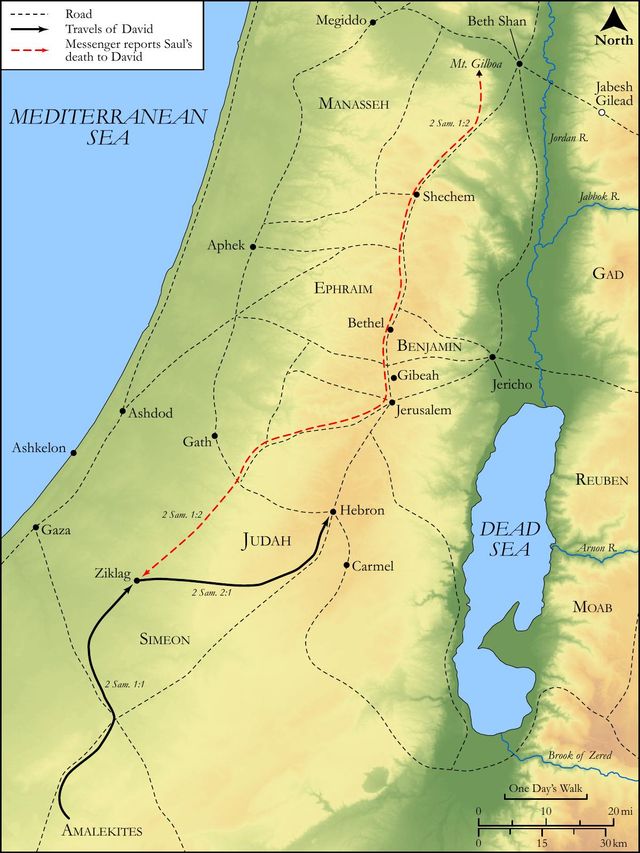
This verse serves as a dramatic and crucial turning point in the narrative, immediately following the Amalekite's self-incriminating account of Saul's death on Mount Gilboa. The Amalekite's narrative (2 Samuel 1:6-10) directly contradicts the earlier, more reliable account in 1 Samuel 31:4-5, which states that Saul fell on his own sword. The Amalekite, likely seeking favor and reward from David, presents Saul's crown and bracelet as proof of his deed (2 Samuel 1:10). However, David's response is not one of celebration over a rival's demise, but of profound grief, lamentation, and swift, uncompromising judgment. This act sets a foundational tone for David's reign, demonstrating his unwavering reverence for the sacred office of God's anointed king, even when that king was his adversary. It also highlights David's commitment to justice, even at the cost of personal gain or political expediency.
Historical & Cultural Context
The Amalekites were a long-standing, bitter enemy of Israel, against whom God had declared perpetual war (Exodus 17:16). King Saul himself had been commanded by God through Samuel to utterly destroy the Amalekites, but he famously failed to carry out this divine mandate completely, sparing King Agag and the best of the livestock (1 Samuel 15:3, 1 Samuel 15:9). This historical backdrop adds a profound layer of irony and divine judgment to the Amalekite's fate. He, a descendant of a people Israel was commanded to annihilate, now claims to have killed Israel's king, the very one who failed to complete the divine task against his people. Culturally, touching or harming a king, especially God's anointed, was considered an act of sacrilege, punishable by death. The Amalekite's expectation of reward reveals a profound misunderstanding of David's character and the spiritual significance of kingship in Israel.
Key Themes
ShowHideThis verse powerfully contributes to several key themes in 2 Samuel and the broader Deuteronomistic History. Firstly, it underscores the theme of Divine Justice and Vengeance, demonstrating that actions against God's anointed, whether truly committed or falsely claimed, have severe consequences. David acts as an agent of divine justice, punishing what he perceives as a heinous crime against the Lord's chosen. Secondly, it reinforces David's consistent and unwavering Respect for God's Anointed. Throughout his conflict with Saul, David repeatedly refused to harm him, even when presented with clear opportunities (1 Samuel 24:6, 1 Samuel 26:9). This execution solidifies David's character as one who reveres God's established order and authority. Finally, the incident highlights the Consequences of Presumption and Falsehood. The Amalekite's boastful, likely fabricated or embellished story, intended to curry favor and gain reward, instead led directly to his swift demise, serving as a stark warning against deceit and self-serving manipulation, especially in matters of life and death before God.
Exposition and Analysis
ShowHideKey Word Analysis
ShowHideThis primitive root means "to impinge, by accident or violence, or (figuratively) by importunity." In this context, David's command "fall upon him" is an imperative for a violent, lethal encounter. It signifies not merely to approach, but to strike with deadly force, leading to the Amalekite's demise. The word underscores the immediate and fatal intent of David's order.
This primitive root means "to strike (lightly or severely, literally or figuratively); causatively, to kill." Here, it describes the executioner's action, confirming that the young man delivered a fatal blow as commanded. The use of this verb leaves no ambiguity about the outcome: the Amalekite was killed, demonstrating the severity and finality of David's judgment.
This primitive root means "to die (literally or figuratively); causatively, to kill." This word explicitly states the ultimate consequence of the smiting. It confirms the successful completion of David's command and the finality of the judgment against the Amalekite. The pairing of "smote" and "died" emphasizes the direct cause-and-effect of the execution.
Verse Breakdown
ShowHide"And David called one of the young men,"
This opening clause immediately establishes David's direct and personal involvement in the judgment. He does not delegate the decision or delay, but personally summons an agent to carry out his will. This highlights his decisive leadership and the gravity with which he views the situation.
"and said, Go near, [and] fall upon him."
This is David's unequivocal command for execution. The phrase "Go near" indicates proximity and readiness for action, while "fall upon him" (as explored in Key Word Analysis) is a direct order to strike the Amalekite down fatally. David's words are precise and leave no room for misunderstanding regarding the intended outcome.
"And he smote him that he died."
This final clause confirms the immediate and effective execution of David's command. The young man, acting on David's authority, delivers the fatal blow, bringing the Amalekite's life to an end. The swiftness of the action underscores the gravity of the Amalekite's confessed crime in David's eyes, and the finality of the divine justice he enacted.
Literary Devices
ShowHideThe narrative of 2 Samuel 1:15 employs several potent literary devices. There is significant Irony in the Amalekite's fate: he, a descendant of a people Israel was commanded to destroy, attempts to gain favor by claiming to have killed the very king who failed to complete that divine command. His attempt at self-promotion leads directly to his own destruction. The passage also uses Characterization through action, immediately establishing David as a king who prioritizes divine justice and respect for God's anointed over personal gain or political expediency. His swift, uncompromising judgment acts as a Foreshadowing of his reign, indicating a leader who will rule with a strong hand and a deep reverence for Yahweh's decrees. The Contrast between the Amalekite's false boast (or at least, embellished truth) and the true account of Saul's death (1 Samuel 31:4-5) underscores the theme of truth versus deception, with severe consequences for the latter.
Theological and Thematic Connections
ShowHideDavid's execution of the Amalekite resonates with profound theological implications, underscoring the sanctity of God's anointing and the severe consequences for those who presume to touch it. This act is not merely a display of personal vengeance but a demonstration of David's understanding of divine justice and the sacredness of the kingly office established by God. It highlights that God holds His chosen leaders in a unique regard, and any act against them, particularly regicide, is seen as an affront to God Himself. David, who consistently refused to lay a hand on Saul despite provocation, here acts as God's agent, upholding a divine standard for kingship and demonstrating that true leadership involves a zealous commitment to righteousness, even when it is costly or unpopular. This event also serves as a stark reminder of the dangers of deceit and seeking personal gain through falsehood, as the Amalekite's lie (or exaggeration) directly led to his demise, illustrating that God's justice ultimately prevails.
Reflection and Application
ShowHideThe swift and uncompromising justice meted out by David in 2 Samuel 1:15 serves as a powerful, albeit challenging, lesson for believers today. While we live under the New Covenant, the underlying principles of respecting God-ordained authority, upholding truth, and understanding the gravity of sin remain timeless. This passage calls us to consider the seriousness with which God views those He has set apart, whether in spiritual or secular leadership, and the consequences of undermining or attacking such authority. It also serves as a stark warning against the dangers of dishonesty and manipulation, particularly when seeking personal advantage. The Amalekite's fate reminds us that our words and claims have real-world, and potentially eternal, consequences. For the Christian, this translates into a call for integrity, a reverence for all life, and a commitment to justice that reflects God's own character, even when it demands difficult choices and a willingness to stand for truth regardless of popular opinion or personal cost.
Questions for Reflection
ShowHideFAQ
ShowHideWhy did David execute the Amalekite so swiftly, especially since the Amalekite claimed to have helped David by killing his rival?
ShowHideDavid's swift execution of the Amalekite was rooted in several profound reasons, primarily his unwavering respect for God's anointed king. David had twice refused to harm Saul, even when Saul was actively trying to kill him (1 Samuel 24:6 and 1 Samuel 26:9). For David, touching "the Lord's anointed" was a sacrilege, an act against God Himself. The Amalekite, by his own confession, claimed to have committed this ultimate offense. Furthermore, David likely saw this as an act of divine justice against an Amalekite, a people against whom God had declared perpetual war (Exodus 17:16), and whom Saul himself had failed to utterly destroy (1 Samuel 15:3). David's action immediately established his character as a king who honored God's decrees and sacred institutions above personal ambition or political convenience.
Was the Amalekite telling the truth about killing Saul?
ShowHideThe Amalekite's story, as recorded in 2 Samuel 1:6-10, directly contradicts the account of Saul's death found in 1 Samuel 31:4-5, which states that Saul fell on his own sword. It is highly probable that the Amalekite either fabricated the story entirely or significantly embellished it, perhaps finding Saul already dead or dying and then taking his crown and bracelet as proof. He likely assumed David would be pleased to hear of Saul's death and would reward the one who delivered the news, or even claimed to have delivered the final blow. Regardless of the full truth, the Amalekite's confession of having "slain the Lord's anointed" was sufficient grounds for David's judgment. His lie, or at least his presumption, sealed his fate.
What does this event tell us about David's character as a king?
ShowHideThis event provides crucial insight into David's character and foreshadows the nature of his kingship. It demonstrates his deep reverence for God's established order and the sacredness of the kingly office. Unlike a ruthless usurper, David did not rejoice in Saul's death but mourned deeply, and he punished severely anyone who claimed to have harmed God's anointed. This act immediately establishes David as a man of justice, integrity, and profound spiritual sensitivity, qualities that would define his reign. It shows he was not driven by personal vendetta or political expediency, but by a desire to uphold God's law and honor His chosen ones. This sets him apart as a king "after God's own heart" (1 Samuel 13:14).
Christ-Centered Fulfillment
ShowHideDavid's zealous act of justice in 2 Samuel 1:15, punishing the one who claimed to have touched God's anointed, powerfully foreshadows the ultimate authority and righteous judgment of Jesus Christ, the true and eternal King. Just as David fiercely protected the sanctity of the kingly office, so Christ, the Son of David, is the one through whom all divine justice is executed. The Amalekite's swift demise for presuming to lay hands on Saul, God's anointed, serves as a stark reminder of the judgment awaiting those who reject or harm God's ultimate Anointed One. Christ, the Lamb of God, came not to destroy but to save, yet He is also the one to whom all judgment has been committed by the Father (John 5:22). His return will be marked by righteous judgment against all who have opposed Him and His kingdom (Revelation 19:11-16). David's action, while earthly and imperfect, points to the perfect justice of Christ, who will ultimately bring to account every deed and every word, establishing a kingdom where righteousness reigns supreme and all who have rebelled against God's Anointed will face their just recompense.