


2 Samuel 4:10
Bible text: King James Version (1769 Blayney text) · Public domain
Bible text: King James Version with Strong's numbers · Public domain
Bible text: Berean Standard Bible · Public domain
Bible text: American Standard Version (1901) · Public domain
Bible text: World English Bible, Messianic edition · Public domain
Bible text: Geneva Bible (1599) · Public domain
Bible text: Young's Literal Translation · Public domain
- כִּיkiifH3588PrtParticle Conditional
- הַמַּגִּידha·ma·Gidthe [one who] toldH5046Art ¦ V-Hiphil-Prtcpl-msVerb Hiphil Participle Singular Masculine Absoluteהַtheמַּגִּיד[one who] told
- לִיlito <the> mePrep-l ¦ 1csSuffix Personal 1st Singular common genderלִto <the>יme
- לֵאמֹרle·Mor<to> sayingH559Prep-l ¦ V-Qal-InfVerb Qal Infinitive Constructלֵ<to>אמֹרsaying
- הִנֵּהhi·nehhere!H2009PrtParticle Interjection
- מֵתmethe has diedH4191V-Qal-Perf-3msVerb Qal Perfect 3rd Singular Masculine
- שָׁאוּלsha·'UlSaulH7586N-proper-mNoun Proper Masculine
- וְהוּאve·hu'and heH1931Conj-w ¦ Pro-3msPronoun Personal 3rd Singular Masculineוְandהוּאhe
- הָיָהha·Yahhe wasH1961V-Qal-Perf-3msVerb Qal Perfect 3rd Singular Masculine
- כִמְבַשֵּׂרkhim·va·Serlike a bearer of newsH1319Prep-k ¦ V-Piel-Prtcpl-msVerb Piel Participle Singular Masculine Absoluteכִlikeמְבַשֵּׂרa bearer of news
- בְּעֵינָיוbe·'ei·Navin his own eyesH5869Prep-b ¦ N-fdc ¦ 3msNoun Dual Feminine Constructבְּinעֵינָיown eyesוhis
- וָאֹחֲזָהva·'o·cha·Zahand I took hold !H270Conj-w ¦ V-Qal-ConsecImperf-1cs ¦ SfxVerb Qal Consecutive Imperfect 1st Singular common genderוָandאֹחֲזָI took holdה!
- בוֹvoon <the> himPrep-b ¦ 3msSuffix Personal 3rd Singular Masculineבon <the>וֹhim
- וָאֶהְרְגֵהוּva·'eh·re·Ge·huand I killed himH2026Conj-w ¦ V-Qal-ConsecImperf-1cs ¦ 3msVerb Qal Consecutive Imperfect 1st Singular common genderוָandאֶהְרְגֵI killedהוּhim
- בְּצִקְלָגbe·tzik·Lagin ZiklagH6860Prep-b ¦ N-properNoun Proper LocationבְּinצִקְלָגZiklag
- אֲשֶׁר'a·SherthatH834RelParticle Relative
- לְתִתִּיle·ti·tito I giveH5414Prep-l ¦ V-Qal-Inf ¦ 1csVerb Qal Infinitive ConstructלְtoתִתִּgiveיI
- לוֹloto <the> himPrep-l ¦ 3msSuffix Personal 3rd Singular Masculineלto <the>וֹhim
- בְּשֹׂרָהbe·so·Rahgood newsH1309N-fsNoun Singular Feminine Absolute
English is a literal word-by-word gloss of the Hebrew, not the KJV's wording. Why?
This is the original text the KJV's translators worked from — each Hebrew word with its own literal English meaning in this verse, prepared by scholars at Tyndale House, Cambridge. The KJV translates whole sentences, not word by word, so its wording differs: one Hebrew word can become several English words, and the KJV may choose “the LORD” where the gloss reads “Yahweh”. Both are faithful — they answer different questions. For the KJV's own rendering, switch to the KJV text.
Details
See on the biblical-era maps

Study this verse
Public-domain commentary
Matthew Henry
From his Commentary on the Whole Bible. Henry comments on passages, not single verses — this entry covers 2 Samuel 4:9–12. His three-level outline is real structure in the source text, so it is rendered as structure.
We have here justice done upon the murderers of Ish-bosheth.
I.Sentence passed upon them.
There needed no evidence, their own tongues witnessed against them; they were so far from denying the fact that they gloried in it. David therefore shows them the heinousness of the crime, and that blood called for blood from his hand, who was now the chief magistrate, and was by office the avenger of blood. And, perhaps, he was the more vigorous in the prosecution because for reasons of state he had spared Joab: "Shall I not require the blood of the slain at the hand of the slayers, and, since they cannot make restitution, take theirs instead of it?" Observe,
1.How he aggravates the crime, Sa2 4:11. Ish-bosheth was a righteous person, he had done them no wrong, nor designed them any. As to himself, David was satisfied that what opposition he gave him was not from malice, but mistake, from an idea he had of his own title to the crown, and the influence of others upon him, who urged him to put in for it. Note, Charity teaches us to make the best, not only of our friends, but of our enemies, and to think those may be righteous persons who yet, in some instances, do us wrong. I must not presently judge a man a bad man because I think him so to me. David owns Ish-bosheth an honest man, though he had created him a great deal of trouble unjustly. The manner of it much aggravated the crime. To slay him in his own house, which should have been his castle, and upon his bed, when he was in no capacity of making any opposition, this is treacherous and barbarous, and all that is base, and that which the heart of every man who is not perfectly lost to all honour and humanity will rise with indignation at the thought of. Assassinating is confessedly the most odious and villainous way of murdering. Cursed is he that smiteth his neighbour secretly.
2.He quotes a precedent (Sa2 4:10): he had put him to death who had brought him the tidings of the death of Saul, because he thought it would be good tidings to David. Nothing is here said of that Amalekite's helping Saul to kill himself, only of his bringing the tidings of his death, by which it should seem that the story he told was upon enquiry found to be false, and that he lied against his own head. "Now" (says David) "did I treat him as a criminal, and not a favourite" (as he expected), "who brought me Saul's crown, and shall those be held guiltless that bring me Ish-bosheth's head?" 3. He ratifies the sentence with an oath (Sa2 4:9): As the Lord liveth, who hath redeemed my soul out of all adversity. He expresses himself thus resolutely, to prevent the making of any intercession for the criminals by those about him, and thus piously to intimate that his dependence was upon God for the putting of him in possession of the promised throne, and that he would not be beholden to any man to help him to it by any indirect or unlawful practices. God had redeemed him from all adversity hitherto, helped him over many a difficulty and through many a danger, and therefore he would depend upon him to crown and complete his own work. He speaks of his redemption from all adversity as a thing done, though he had many a storm yet before him, because he knew that he who had delivered would deliver. 4. Hereupon he signs a warrant for the execution of these men, Sa2 4:12. This may seem severe, when they intended him a kindness in what they did; but,
(1.)He would thus show his detestation of the villany. When he heard that the Lord smote Nabal, he gave thanks (Sa1 25:38, Sa1 25:39), for he is the God to whom vengeance belongeth; but, if wicked men smite Ish-bosheth, they deserve to die for taking God's work out of his hand.
(2.)He would thus show his resentment of the great affront they put upon him in expecting that he should patronize and reward it; they could scarcely have done him a greater injury than thus to think him altogether such a one as themselves, one that cared not what blood he waded through to the crown.
II.Execution done.
The murderers were put to death according to law, and their hands and feet were hung up; not their whole bodies, the law forbade that; but only their hands and feet, in terrorem - to frighten others, to be monuments of David's justice, and to make that to be taken notice of which would recommend him to the esteem of the people, as a man fit to rule, and that aimed not at his own preferment, nor had any enmity to the house of Saul, but only and sincerely designed the public welfare. But what a confusion was this to the two murderers! What a horrid disappointment! And such those will meet with who think to serve the interests of the Son of David by any immoral practices, by war and persecution, fraud and rapine, who, under colour of religion, murder princes, break solemn contracts, lay countries waste, hate their brethren, and cast them out, and say, Let the Lord be glorified, kill them, and think they do God good service. However men may canonize such methods of serving the church and the catholic cause, Christ will let them know, another day, that Christianity was not intended to destroy humanity; and those who thus think to merit heaven shall not escape the damnation of hell.
Continue studying 2 Samuel 4:10 across the web’s major study libraries — every link below opens this exact verse, chapter, or book on the destination site.
Read & Compare
 BibleGatewayThis verse in more than 200 translations and 70 languages.
 Bible.comThe YouVersion reader — hundreds of translations, reading plans, and highlights.
 ESV.orgCrossway's official English Standard Version reader.
 NET BibleThe NET translation with 60,000+ translators' notes on every rendering decision.
 STEP BibleTyndale House's free study tool — original text, vocabulary, and scholarly resources.
 BibliaLogos Bible Software's free web reader.
 USCCBThe New American Bible (Revised Edition) with the U.S. bishops' study notes.
Commentaries
 BibleHub CommentariesDozens of classic commentaries on this verse, gathered on one page.
 StudyLightMore than 100 commentary sets — the largest collection on the web.
 BibleRefPlain-English commentary on what this verse means, verse by verse.
 Enduring WordDavid Guzik's free commentary on this chapter, widely used by Bible teachers.
 Bible Study ToolsVerse commentary alongside Greek and Hebrew study aids.
Original Language & Research
- BibleHub InterlinearThe verse word by word — original language, transliteration, and English.
- BibleHub LexiconEvery word's original-language definition and Strong's entry.
 Blue Letter BibleDeep-study tools — Strong's numbers, concordance, and word studies.
 SefariaThe Hebrew text with Rashi and centuries of Jewish commentary.
Sermons, Hymns & Audio


TrulyRandomVerse is not affiliated with these sites and doesn’t control their content. They’re linked because they’re genuinely useful.
Summary
In 2 Samuel 4:10, King David recounts a pivotal past event to justify his swift and severe judgment upon Baanah and Rechab, the assassins of Ish-bosheth. He recalls the fate of the Amalekite who falsely claimed to have killed King Saul, expecting a reward for what he believed were "good tidings." David, however, executed him in Ziklag for laying hands on the Lord's anointed, establishing a clear precedent for his unwavering commitment to divine authority and justice, and serving as a stark warning against treachery and opportunistic ambition.
Context
ShowHideLiterary Context
This verse is embedded within David's impassioned and furious response to Baanah and Rechab, the sons of Rimmon the Beerothite, who had brutally murdered Ish-bosheth, Saul's son and the nominal king over Israel. They brought Ish-bosheth's severed head to David in Hebron, presuming they would be rewarded for eliminating his rival and clearing his path to the throne (2 Samuel 4:8). David's immediate and unequivocal reaction in 2 Samuel 4:9-12 draws a direct and powerful parallel to an earlier, similar incident detailed in 2 Samuel 1:1-16. In that account, an Amalekite messenger claimed responsibility for Saul's death, expecting commendation from David for bringing such news. David's consistent and severe response in both instances underscores his profound reverence for God's anointed, regardless of personal gain or political expediency, highlighting his moral consistency and his role as an instrument of divine justice, which stands in stark contrast to the opportunistic and self-serving actions of the assassins.
Historical & Cultural Context
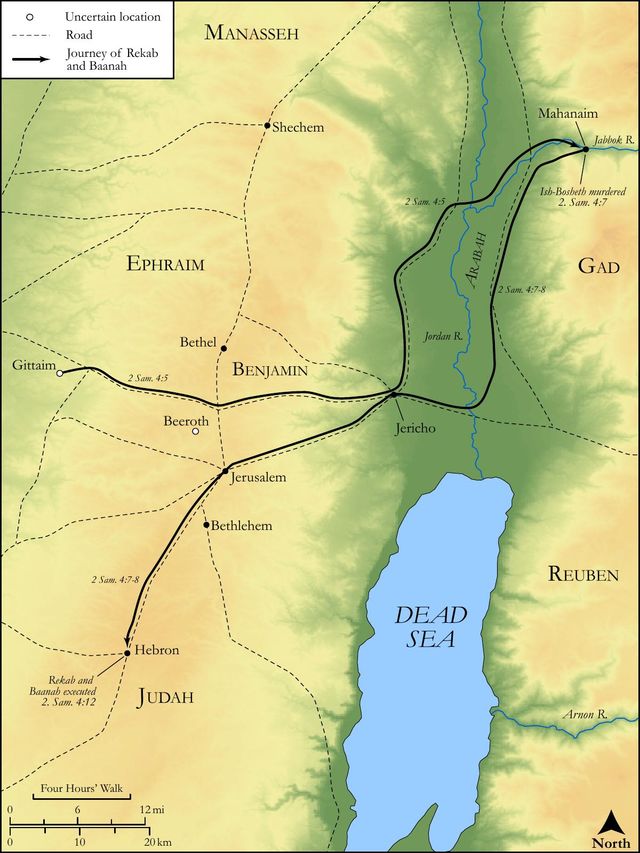
The period described in 2 Samuel is one of intense transition and civil war following the deaths of Saul and his sons at Mount Gilboa. Israel was deeply divided, with Ish-bosheth ruling precariously over the northern tribes from Mahanaim, while David reigned securely over Judah from Hebron. The concept of "the Lord's anointed" (מְשִׁיחַ יְהוָה, meshiach Yahweh) was foundational to Israelite kingship, signifying that the king was divinely chosen, consecrated, and therefore inviolable. Any act against him, especially regicide, was considered an act against God's established order. Among the kings of that day, messengers bringing news of a king's death, particularly if it benefited a successor, might indeed expect a substantial reward. However, David's response radically subverted this expectation, demonstrating a unique theological understanding of kingship that transcended mere political power plays or human custom. Ziklag, a Philistine city where David had taken refuge during his exile from Saul (1 Samuel 27:6), serves as the geographical backdrop for the earlier execution, emphasizing that David's principled stand was established even before he became king over all Israel.
Key Themes
ShowHideThe primary theme is Reverence for God's Anointed, a principle David consistently upheld despite Saul's relentless pursuit and attempts on his life. David's actions here reinforce the idea that God's chosen leaders, even flawed ones, are to be honored and their lives protected, as seen in David's refusal to harm Saul in 1 Samuel 24:6 and 1 Samuel 26:9. This also highlights Divine Justice, as David acts as God's instrument, ensuring that those who presume to take the life of a king, even one who had fallen from God's favor, face severe consequences. David does not tolerate treachery or the usurpation of God's prerogative to appoint and remove rulers. Finally, the verse powerfully illustrates Misjudgment and Consequences. Both the Amalekite and Ish-bosheth's assassins completely misjudged David's character and moral compass, expecting reward for acts David deemed abhorrent. This underscores the danger of acting on self-serving assumptions rather than divine principles and the profound difference between human expediency and God's righteous standards.
Exposition and Analysis
ShowHideKey Word Analysis
ShowHideThe Hebrew word בְּשׂוֹרָה (bᵉsôwrâh) literally means "glad tidings" or "good news," and by implication, "reward for good news." The profound irony in 2 Samuel 4:10 is that the Amalekite presented what he believed was bᵉsôwrâh—news that would surely please David and earn him a reward—yet for David, the death of God's anointed, even his adversary, was anything but good news. This term, which later develops significant theological weight in the New Testament as "gospel" (εὐαγγέλιον, euangelion), here highlights the stark contrast between human perception of "good" (political advantage) and divine perspective (the sanctity of God's chosen).
The root verb הָרַג (hârag) means "to smite with deadly intent; to kill, murder, slay." David's use of this verb to describe his action ("I took hold of him, and slew him") emphasizes the decisive, deliberate, and personal nature of the execution. This was not a casual act but a direct and intentional taking of life, reflecting David's conviction that the Amalekite had committed a grave offense against God's established order. David took direct responsibility for the act, demonstrating his unwavering commitment to the principle he upheld, even when it meant executing someone who thought they were acting in his favor. This highlights David's role as an executor of justice, not merely a recipient of political gain.
Verse Breakdown
ShowHide"When one told me, saying, Behold, Saul is dead"
This clause sets the scene, recalling the moment the Amalekite messenger delivered the news of Saul's demise to David in Ziklag, as detailed in 2 Samuel 1:1-10. The messenger's direct address, "Behold, Saul is dead," suggests an expectation of a positive reaction from David, given Saul's relentless pursuit of him. The messenger likely anticipated that David would view Saul's death as a welcome removal of an obstacle to his kingship.
"thinking to have brought good tidings"
This phrase reveals the Amalekite's profound miscalculation of David's character and principles. He perceived Saul's death as beneficial news for David, assuming David would be pleased to have his rival removed. This highlights the messenger's self-serving motivation and his failure to grasp David's deep reverence for the divine anointing of kingship, which transcended personal animosity and political expediency. He projected his own opportunistic worldview onto David.
"I took hold of him, and slew him in Ziklag"
This describes David's swift, personal, and decisive action. Instead of a reward, the Amalekite met immediate execution. The location, Ziklag, is significant as it was David's base during his exile, underscoring that this principle of respecting God's anointed was firmly established in David's character even before he fully assumed the throne of Israel. David's personal involvement ("I took hold of him, and slew him") underscores the gravity of the offense and his unwavering commitment to divine justice.
"who [thought] that I would have given him a reward for his tidings"
This final clause reiterates the Amalekite's mistaken expectation, emphasizing the stark contrast between his worldly, opportunistic mindset and David's divinely informed moral compass. The messenger's assumption of reward for regicide reveals a fundamental misunderstanding of David's integrity and his profound respect for God's sovereign choice, even when that choice was embodied in his enemy. This misjudgment sealed his fate.
Literary Devices
ShowHideThe verse employs several powerful literary devices that amplify its message. Irony is prominent, as the "good tidings" (בְּשׂוֹרָה, bᵉsôwrâh) the Amalekite expected to bring a reward instead brought his own death. This highlights the vast chasm between human perception of what is beneficial and God's righteous standards. There is also a strong element of Foreshadowing and Parallelism with the current situation David is addressing. David's recounting of the Amalekite's fate serves as a direct warning and a clear precedent for the fate of Ish-bosheth's assassins. The parallel between the two incidents underscores David's consistent moral framework and his unwavering commitment to divine justice, demonstrating that he is not a man to be manipulated by political expediency or self-serving ambition, but one who operates by a higher, divinely ordained code.
Theological and Thematic Connections
ShowHideDavid's actions in 2 Samuel 4:10 are deeply rooted in a profound theological understanding of God's sovereignty and the sanctity of His chosen instruments. His refusal to celebrate Saul's death or reward those who claimed responsibility for it demonstrates a submission to God's will that transcends personal interest or political gain. David understood that Saul, despite his failures and hostility, remained "the Lord's anointed." To lay hands on him, even in death, was to violate a sacred trust and usurp God's prerogative to appoint and remove kings. This principle underscores the divine origin of authority and the accountability of those who wield it, as well as the grave consequences for those who disrespect it. David's swift justice serves as a testament to his commitment to upholding God's righteous order in the nascent kingdom.
Reflection and Application
ShowHideDavid's decisive action in 2 Samuel 4:10 offers profound lessons for believers today concerning integrity, discernment, and respect for authority. In a world often driven by self-interest, political maneuvering, and the pursuit of personal gain, David's unwavering commitment to God's principles, even when seemingly counter-intuitive to his own advancement, stands as a powerful example. We are called to discern what truly constitutes "good news" from God's perspective, not our own, and to trust in His ultimate judgment and timing. This passage challenges us to examine our own motives when dealing with authority, whether in the church, government, or family, and to resist the temptation to act opportunistically or to undermine those God has placed in positions of leadership, even when we disagree with them or feel wronged. It reminds us that true righteousness often requires sacrificing personal advantage for the sake of divine principle, upholding God's order even when it conflicts with our immediate desires.
Questions for Reflection
ShowHideFAQ
ShowHideWhy did David kill the Amalekite messenger who claimed to have killed Saul?
ShowHideDavid killed the Amalekite messenger not because he was upset about Saul's death per se, but because the messenger claimed to have laid hands on "the Lord's anointed" (Saul), a sacrilegious act in David's eyes. David consistently demonstrated profound respect for God's chosen king, even when Saul was his enemy and actively sought his life (1 Samuel 24:6 and 1 Samuel 26:9). The Amalekite's claim, whether true or false, was a boast of regicide against a divinely appointed king, an act David considered an affront to God's sovereignty and worthy of death. He saw himself as executing divine justice, upholding the sanctity of God's established order.
Was the Amalekite telling the truth about killing Saul?
ShowHideIt is highly unlikely the Amalekite was telling the truth. The account in 1 Samuel 31:4-5 explicitly states that Saul fell on his own sword, and his armor-bearer refused to kill him. The Amalekite likely fabricated or embellished his story, perhaps finding Saul already dead or dying, and then taking Saul's crown and armlet to present as proof to David (2 Samuel 1:10). He probably thought this "good tidings" would earn him a reward from David, unaware of David's deep reverence for the Lord's anointed. His lie, intended for personal gain, sealed his fate.
What is the significance of David executing the Amalekite in Ziklag?
ShowHideZiklag was a Philistine city where David and his men had taken refuge from Saul (1 Samuel 27:6). The execution of the Amalekite there, as recounted in 2 Samuel 1:15, is significant because it demonstrates that David's principle of respecting God's anointed was not a political maneuver adopted after he became king, but a deeply held conviction that guided his actions even during his exile. It established a clear precedent for his future reign, showing that he would not tolerate acts of treachery or disrespect against God-given authority, even if they seemed to benefit him. This act solidified his moral foundation for leadership.
Christ-Centered Fulfillment
ShowHideDavid's unwavering commitment to upholding the sanctity of "the Lord's anointed," even at personal cost, powerfully foreshadows the ultimate Anointed One, Jesus Christ. While David executed the Amalekite for claiming to have slain a king who was God's anointed, Christ, the true King and ultimate Anointed One (Psalm 2:2), willingly allowed Himself to be "slain" by human hands, not for His own sin, but for the sins of the world (John 1:29). The "good tidings" (בְּשׂוֹרָה, bᵉsôwrâh) that the Amalekite mistakenly thought would bring reward find their true and glorious fulfillment in the "good news" (εὐαγγέλιον, euangelion) of Christ's death and resurrection. His sacrifice, far from being an act of rebellion against God's anointed, was the ultimate act of obedience (Philippians 2:8), fulfilling God's righteous plan for salvation. Unlike Saul, whose death was a tragedy despite his anointing, Christ's death was the triumph that brought true reward—eternal life—to all who believe (Romans 5:8). David's justice prefigures God's perfect justice, which is fully revealed in Christ, who both upholds divine law and provides atonement for its violation, transforming the "bad news" of sin into the glorious "good news" of redemption and reconciliation with God (2 Corinthians 5:19).