


2 Samuel 4:11
Bible text: King James Version (1769 Blayney text) · Public domain
Bible text: King James Version with Strong's numbers · Public domain
Bible text: Berean Standard Bible · Public domain
Bible text: American Standard Version (1901) · Public domain
Bible text: World English Bible, Messianic edition · Public domain
Bible text: Geneva Bible (1599) · Public domain
Bible text: Young's Literal Translation · Public domain
- אַף'afindeed?H637PrtParticle Interjection
- כִּיkiifH3588PrtParticle Conditional
- אֲנָשִׁים'a·na·ShimmenH582N-mpNoun Plural Masculine Absolute
- רְשָׁעִיםre·sha·'ImwickedH7563N-mpNoun Plural Masculine Absolute
- הָרְגוּha·re·Guthey have killedH2026V-Qal-Perf-3cpVerb Qal Perfect 3rd Plural common gender
- אֶת'et<obj.>H853DirObjMParticle Object Indicator
- אִישׁ'isha manH376N-msNoun Singular Masculine Absolute
- צַדִּיקtza·DikrighteousH6662Adj-msAdjective Singular Masculine Absolute
- בְּבֵיתוֹbe·vei·Toin his own houseH1004Prep-b ¦ N-msc ¦ 3msNoun Singular Masculine Constructבְּinבֵיתown houseוֹhis
- עַל'alonH5921PrepPreposition
- מִשְׁכָּבוֹmish·ka·Vohis own bedH4904N-msc ¦ 3msNoun Singular Masculine Constructמִשְׁכָּבown bedוֹhis
- וְעַתָּהve·'a·Tahand thereforeH6258Conj-w ¦ AdvAdverbוְandעַתָּהtherefore
- הֲלוֹאha·Lo'¿ notH3808Interrog ¦ NegParticle Negativeהֲ¿לוֹאnot
- אֲבַקֵּשׁ'a·va·Keshwill I requireH1245V-Piel-Imperf-1csVerb Piel Imperfect 1st Singular common gender
- אֶת'et<obj.>H853DirObjMParticle Object Indicator
- דָּמוֹda·Mohis bloodH1818N-msc ¦ 3msNoun Singular Masculine Constructדָּמbloodוֹhis
- מִיֶּדְכֶםmi·yed·Khemfrom your handH3027Prep-m ¦ N-csc ¦ 2mpNoun Singular common gender Constructמִfromיֶּדְhandכֶםyour
- וּבִעַרְתִּיu·vi·'ar·Tiand I will removeH1197Conj-w ¦ V-Piel-ConsecPerf-1csVerb Piel Consecutive Perfect 1st Singular common genderוּandבִעַרְתִּיI will remove
- אֶתְכֶם'et·Khem<obj.> youH853DirObjM ¦ 2mpParticle Object Indicatorאֶתְ<obj.>כֶםyou
- מִןminfromH4480PrepPreposition
- הָאָרֶץha·'A·retzthe earthH776Art ¦ N-fsNoun Singular Feminine Absoluteהָtheאָרֶץearth
English is a literal word-by-word gloss of the Hebrew, not the KJV's wording. Why?
This is the original text the KJV's translators worked from — each Hebrew word with its own literal English meaning in this verse, prepared by scholars at Tyndale House, Cambridge. The KJV translates whole sentences, not word by word, so its wording differs: one Hebrew word can become several English words, and the KJV may choose “the LORD” where the gloss reads “Yahweh”. Both are faithful — they answer different questions. For the KJV's own rendering, switch to the KJV text.
Details
See on the biblical-era maps
Study this verse
Public-domain commentary
Matthew Henry
From his Commentary on the Whole Bible. Henry comments on passages, not single verses — this entry covers 2 Samuel 4:9–12. His three-level outline is real structure in the source text, so it is rendered as structure.
We have here justice done upon the murderers of Ish-bosheth.
I.Sentence passed upon them.
There needed no evidence, their own tongues witnessed against them; they were so far from denying the fact that they gloried in it. David therefore shows them the heinousness of the crime, and that blood called for blood from his hand, who was now the chief magistrate, and was by office the avenger of blood. And, perhaps, he was the more vigorous in the prosecution because for reasons of state he had spared Joab: "Shall I not require the blood of the slain at the hand of the slayers, and, since they cannot make restitution, take theirs instead of it?" Observe,
1.How he aggravates the crime, Sa2 4:11. Ish-bosheth was a righteous person, he had done them no wrong, nor designed them any. As to himself, David was satisfied that what opposition he gave him was not from malice, but mistake, from an idea he had of his own title to the crown, and the influence of others upon him, who urged him to put in for it. Note, Charity teaches us to make the best, not only of our friends, but of our enemies, and to think those may be righteous persons who yet, in some instances, do us wrong. I must not presently judge a man a bad man because I think him so to me. David owns Ish-bosheth an honest man, though he had created him a great deal of trouble unjustly. The manner of it much aggravated the crime. To slay him in his own house, which should have been his castle, and upon his bed, when he was in no capacity of making any opposition, this is treacherous and barbarous, and all that is base, and that which the heart of every man who is not perfectly lost to all honour and humanity will rise with indignation at the thought of. Assassinating is confessedly the most odious and villainous way of murdering. Cursed is he that smiteth his neighbour secretly.
2.He quotes a precedent (Sa2 4:10): he had put him to death who had brought him the tidings of the death of Saul, because he thought it would be good tidings to David. Nothing is here said of that Amalekite's helping Saul to kill himself, only of his bringing the tidings of his death, by which it should seem that the story he told was upon enquiry found to be false, and that he lied against his own head. "Now" (says David) "did I treat him as a criminal, and not a favourite" (as he expected), "who brought me Saul's crown, and shall those be held guiltless that bring me Ish-bosheth's head?" 3. He ratifies the sentence with an oath (Sa2 4:9): As the Lord liveth, who hath redeemed my soul out of all adversity. He expresses himself thus resolutely, to prevent the making of any intercession for the criminals by those about him, and thus piously to intimate that his dependence was upon God for the putting of him in possession of the promised throne, and that he would not be beholden to any man to help him to it by any indirect or unlawful practices. God had redeemed him from all adversity hitherto, helped him over many a difficulty and through many a danger, and therefore he would depend upon him to crown and complete his own work. He speaks of his redemption from all adversity as a thing done, though he had many a storm yet before him, because he knew that he who had delivered would deliver. 4. Hereupon he signs a warrant for the execution of these men, Sa2 4:12. This may seem severe, when they intended him a kindness in what they did; but,
(1.)He would thus show his detestation of the villany. When he heard that the Lord smote Nabal, he gave thanks (Sa1 25:38, Sa1 25:39), for he is the God to whom vengeance belongeth; but, if wicked men smite Ish-bosheth, they deserve to die for taking God's work out of his hand.
(2.)He would thus show his resentment of the great affront they put upon him in expecting that he should patronize and reward it; they could scarcely have done him a greater injury than thus to think him altogether such a one as themselves, one that cared not what blood he waded through to the crown.
II.Execution done.
The murderers were put to death according to law, and their hands and feet were hung up; not their whole bodies, the law forbade that; but only their hands and feet, in terrorem - to frighten others, to be monuments of David's justice, and to make that to be taken notice of which would recommend him to the esteem of the people, as a man fit to rule, and that aimed not at his own preferment, nor had any enmity to the house of Saul, but only and sincerely designed the public welfare. But what a confusion was this to the two murderers! What a horrid disappointment! And such those will meet with who think to serve the interests of the Son of David by any immoral practices, by war and persecution, fraud and rapine, who, under colour of religion, murder princes, break solemn contracts, lay countries waste, hate their brethren, and cast them out, and say, Let the Lord be glorified, kill them, and think they do God good service. However men may canonize such methods of serving the church and the catholic cause, Christ will let them know, another day, that Christianity was not intended to destroy humanity; and those who thus think to merit heaven shall not escape the damnation of hell.
Historical interpretation
Historical reception
1 surviving comment on this verse from the historical church.
Ish-bosheth, the son of Saul, is killed through a ruse at the hands of Rechab and Baanah, the sons of Rimmon, the Beerothite. And, when they announced the news to David and showed him the head of his enemy, they were killed by David, who said, “Wicked men have slain a just man in his own house upon his bed.” Ish-bosheth was certainly not a just man, and yet he is called a just man because he was innocently killed.
Continue studying 2 Samuel 4:11 across the web’s major study libraries — every link below opens this exact verse, chapter, or book on the destination site.
Read & Compare
 BibleGatewayThis verse in more than 200 translations and 70 languages.
 Bible.comThe YouVersion reader — hundreds of translations, reading plans, and highlights.
 ESV.orgCrossway's official English Standard Version reader.
 NET BibleThe NET translation with 60,000+ translators' notes on every rendering decision.
 STEP BibleTyndale House's free study tool — original text, vocabulary, and scholarly resources.
 BibliaLogos Bible Software's free web reader.
 USCCBThe New American Bible (Revised Edition) with the U.S. bishops' study notes.
Commentaries
 BibleHub CommentariesDozens of classic commentaries on this verse, gathered on one page.
 StudyLightMore than 100 commentary sets — the largest collection on the web.
 BibleRefPlain-English commentary on what this verse means, verse by verse.
 Enduring WordDavid Guzik's free commentary on this chapter, widely used by Bible teachers.
 Bible Study ToolsVerse commentary alongside Greek and Hebrew study aids.
Original Language & Research
- BibleHub InterlinearThe verse word by word — original language, transliteration, and English.
- BibleHub LexiconEvery word's original-language definition and Strong's entry.
 Blue Letter BibleDeep-study tools — Strong's numbers, concordance, and word studies.
 SefariaThe Hebrew text with Rashi and centuries of Jewish commentary.
Sermons, Hymns & Audio


TrulyRandomVerse is not affiliated with these sites and doesn’t control their content. They’re linked because they’re genuinely useful.
Summary
King David, in 2 Samuel 4:11, delivers a stern and uncompromising judgment against Rechab and Baanah, the treacherous assassins of Ish-bosheth, Saul's son. His pronouncement underscores a profound commitment to divine justice and an unwavering abhorrence of opportunistic violence and betrayal, particularly when committed against a vulnerable and "righteous" individual within the sanctity of his own home. David's righteous indignation signals that such heinous acts, far from being rewarded, will incur swift and severe retribution, demonstrating his integrity as God's appointed king.
Context
ShowHideLiterary Context
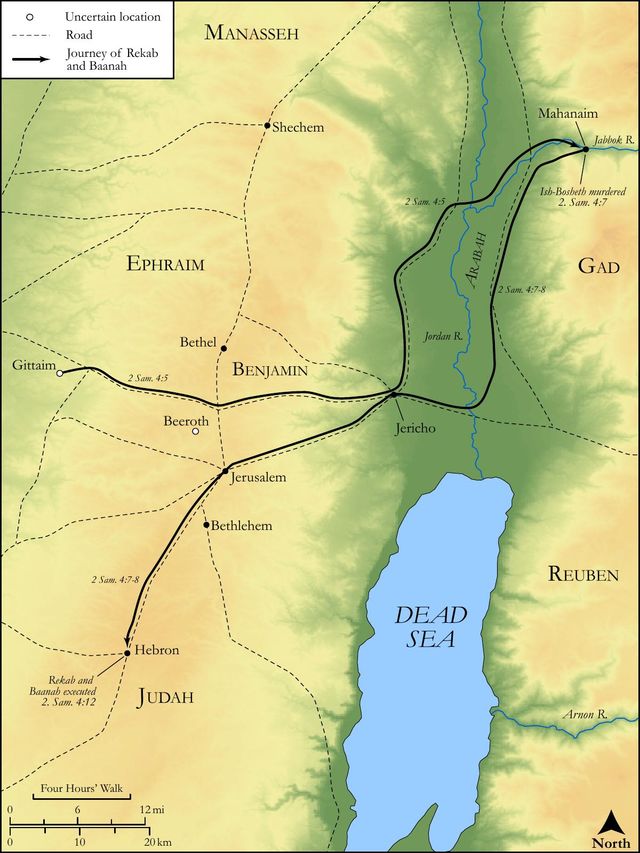
This verse marks a pivotal moment in the narrative of David's consolidation of power and the eventual unification of Israel under his rule. Following the tragic deaths of King Saul and his heir Jonathan, a protracted civil war ensued, pitting David's reign over Judah against Ish-bosheth's fragile kingship over the northern tribes, largely propped up by Saul's general, Abner. Abner's assassination by Joab, David's commander, left Ish-bosheth critically vulnerable and without his primary protector, as detailed in 2 Samuel 3. It is into this power vacuum that Rechab and Baanah, two opportunistic captains, murder Ish-bosheth in his bed, believing they would curry favor with David by delivering his rival's head. David's response in this verse powerfully echoes his earlier condemnation and execution of the Amalekite who falsely claimed to have killed Saul, as recorded in 2 Samuel 1:15, consistently demonstrating his rejection of illicit means to power and his unwavering commitment to justice, even for his adversaries.
Historical & Cultural Context
Among the kingdoms of that day, the transition of power was often fraught with violence, and regicide was a common, albeit condemned, means of seizing control. However, David's actions here defy the typical political expediency of the time. While a new king might be expected to reward those who eliminate rivals, David consistently demonstrates a different standard, rooted in Israelite law and divine principles. The phrase "in his own house upon his bed" highlights the extreme violation of hospitality and personal security, which were deeply valued in Israel. Murder within one's home, especially while asleep, was considered a particularly heinous act of treachery, violating sacred trust and sanctuary. David's judgment also reflects the Old Testament principle of "bloodguilt," where the shedding of innocent blood defiled the land and required strict retribution, often carried out by the "avenger of blood" or, in this case, the king as God's representative.
Key Themes
ShowHideThe judgment pronounced in 2 Samuel 4:11 powerfully reinforces several overarching themes within the book of Samuel and the broader biblical narrative. Firstly, it underscores the theme of Divine Justice and Retribution, demonstrating that God's appointed king is an instrument of righteous judgment, particularly for the shedding of innocent blood. David's actions align with the divine decree that "whoever sheds the blood of man, by man shall his blood be shed," as stated in Genesis 9:6. Secondly, it highlights David's Abhorrence of Treachery and Opportunistic Violence. David consistently rejects the notion that the ends justify the means, refusing to condone acts of betrayal, even when they might seem to benefit his political aspirations. His refusal to accept Ish-bosheth's murder as a legitimate pathway to the throne solidifies his Righteous Character and Integrity as a leader, contrasting sharply with the ruthlessness often seen in other ancient rulers. Finally, the verse powerfully affirms the Sanctity of Human Life, emphasizing that every life, even that of a political rival, is precious in God's sight and its unjust taking demands severe accountability. This incident contributes significantly to David's portrayal as a king after God's own heart, whose reign would be founded on justice and righteousness, not on Machiavellian schemes or bloodshed.
Exposition and Analysis
ShowHideKey Word Analysis
ShowHideThis term (H6662), applied to Ish-bosheth, is significant. It does not necessarily imply moral perfection or a theological endorsement of his kingship, but rather designates him as innocent concerning the specific manner of his death. He was not killed in battle as a legitimate combatant, but rather murdered treacherously while vulnerable and defenseless. David's use of "righteous" here emphasizes the heinousness of the crime as an unprovoked act against an unsuspecting individual, highlighting the victim's blamelessness in the context of his assassination.
This primitive root (H1245) means "to search out (by any method, specifically in worship or prayer); by implication, to strive after; ask, beg, beseech, desire, enquire, get, make inquisition, procure, (make) request, require, seek (for)." In the context of "require his blood," it is a strong legal and theological phrase, signifying the demand for an accounting or payment for the spilled blood. It implies the need for retribution and justice for murder, often carrying the connotation of divine accountability. David, as king, acts as God's agent in executing this divine demand for justice.
This word (H4904), derived from a root meaning "to lie down," refers to "a bed (figuratively, a bier); abstractly, sleep; by euphemism, carnal intercourse." The detail "upon his bed" powerfully underscores the vulnerability of the victim and the extreme treachery of the perpetrators. The bed, typically a place of rest, safety, and intimacy within one's private dwelling, becomes the scene of a brutal and cowardly act. This specific phrase intensifies the wickedness of the crime, highlighting the violation of sanctuary, trust, and the most basic human expectation of security within one's own home.
Verse Breakdown
ShowHide"How much more, when wicked men have slain a righteous person in his own house upon his bed?"
This opening rhetorical question sets the stage for David's judgment. The phrase "How much more" builds upon David's previous swift justice against the Amalekite who claimed to have killed Saul, implying that the current crime is even more egregious. It highlights the extreme depravity of the "wicked men" (Rechab and Baanah) who murdered an "innocent person" (Ish-bosheth) in the most vulnerable and sacred of settings—"in his own house upon his bed." This emphasizes the profound violation of trust, hospitality, and the sanctity of life, making the crime particularly heinous in David's eyes.
"shall I not therefore now require his blood of your hand,"
This is the core of David's pronouncement of judgment. The rhetorical question demands an affirmative answer, asserting David's moral and legal obligation to exact justice. To "require his blood of your hand" means to hold Rechab and Baanah fully accountable for the murder, implying that their lives are forfeit as retribution for the innocent blood they shed. David, acting as God's appointed king and the ultimate dispenser of justice in Israel, assumes the role of the avenger of blood, ensuring that justice is served according to divine law.
"and take you away from the earth?"
This concluding clause specifies the ultimate consequence of their crime: execution. "Take you away from the earth" is a euphemism for capital punishment, signifying their complete removal from the land of the living as a result of their wickedness. This swift and decisive judgment demonstrates David's unwavering commitment to upholding righteousness and purging evil from his kingdom, reinforcing the principle that the shedding of innocent blood will not go unpunished under his reign.
Literary Devices
ShowHideDavid's pronouncement in 2 Samuel 4:11 is rich with literary devices that amplify its impact and convey the gravity of the situation. The primary device is the Rhetorical Question, "How much more... shall I not...?" This is not a question seeking an answer, but a powerful statement designed to emphasize the obviousness and undeniable necessity of David's judgment. It compels the listener (and the reader) to agree with the severity of the impending retribution. There is also a strong element of Contrast or Juxtaposition at play, highlighting the stark opposition between the "wicked men" and the "righteous person," and between the expected sanctuary of "his own house upon his bed" and the violent act committed within it. This contrast underscores the profound violation of moral and social norms. Furthermore, the phrase "How much more" functions as a form of Intensification or A Fortiori Argument, building upon David's previous acts of justice (like the execution of the Amalekite in chapter 1) to convey that this current crime is even more egregious and therefore demands an even more certain and severe response.
Theological and Thematic Connections
ShowHideThe judgment in 2 Samuel 4:11 resonates deeply with core biblical themes of justice, the sanctity of life, and divine sovereignty over human affairs. David's actions are not merely those of a shrewd politician consolidating power, but of a king who understands his role as God's vice-regent, tasked with upholding righteousness and executing justice according to divine standards. The emphasis on "requiring blood" underscores the profound value God places on human life, created in His image, and the severe consequences for its unjust taking. This principle, established early in salvation history, demonstrates God's unwavering commitment to moral order and accountability, ensuring that wickedness, particularly treachery and murder, will ultimately face His righteous judgment. David's integrity in this moment foreshadows the ultimate righteous King who will perfectly administer justice.
Reflection and Application
ShowHideDavid's response to the murder of Ish-bosheth serves as a timeless paradigm for righteous leadership and personal integrity. In a world often tempted by expediency and the pursuit of power through any means, David's unwavering commitment to justice, even when it might appear politically disadvantageous, stands as a powerful challenge. This passage calls us to reflect on our own willingness to uphold moral principles, even when it means rejecting perceived shortcuts or easy gains. It reminds us that true integrity is demonstrated not just in what we pursue, but in what we refuse to condone. Furthermore, the sanctity of life, so fiercely defended by David here, remains a foundational biblical truth that compels us to seek justice and protect the vulnerable in our own contexts, whether in our communities, workplaces, or global society. We are called to be agents of righteousness, abhorring treachery and violence, and trusting that ultimately, God's justice will prevail, ensuring that all actions, both good and evil, will be brought to account.
Questions for Reflection
ShowHideFAQ
ShowHideWhy did David call Ish-bosheth "righteous" when he was his political rival?
ShowHideDavid's use of "righteous" (tsaddîyq, H6662) for Ish-bosheth does not imply an endorsement of his kingship or a statement about his overall moral character. Rather, it specifically refers to Ish-bosheth's innocence concerning the manner of his death. He was not killed in a legitimate battle or as a direct act of war, but was treacherously murdered while vulnerable in his own home. David consistently condemned opportunistic violence and the shedding of innocent blood, even if the victim was a political adversary. This highlights David's commitment to divine justice and his refusal to benefit from illicit acts, reinforcing his character as a king who valued righteousness over political expediency, as seen also in his response to the Amalekite who claimed to have killed Saul in 2 Samuel 1:15.
What is the significance of "require his blood of your hand"?
ShowHideThis phrase carries profound legal and theological weight. To "require blood" (Hebrew: bâqash dâm, H1245 and H1818) signifies the demand for accountability and retribution for the shedding of innocent life. In ancient Israelite law, murder incurred "bloodguilt" upon the perpetrator and the land, necessitating a just response, often capital punishment, to cleanse the land and satisfy divine justice. David, as the king, acts as God's appointed agent, fulfilling the divine mandate to avenge innocent blood and ensure that such heinous crimes do not go unpunished. It underscores the principle that human life is sacred and its unjust taking demands a severe reckoning before God.
How does this incident contribute to David's character portrayal?
ShowHideThis incident is crucial in solidifying David's image as a king "after God's own heart." It powerfully reinforces his unwavering commitment to divine justice, his abhorrence of treachery, and his refusal to achieve power through illicit or violent means. By executing Rechab and Baanah, David demonstrates that his kingdom would be established on righteousness, not on Machiavellian schemes or the shedding of innocent blood, even if it seemingly benefited him. This act distinguishes David from other ambitious rulers of his time and underscores his integrity and moral compass as God's chosen leader for Israel, setting a precedent for his reign that would eventually unite all Israel under his just rule, as described in 2 Samuel 5.
Christ-Centered Fulfillment
ShowHideDavid's righteous indignation and his unwavering commitment to requiring justice for the shedding of innocent blood in 2 Samuel 4:11 powerfully foreshadow the ultimate and perfect justice found in Jesus Christ. David, as an earthly king, acts as God's agent to avenge innocent blood, but his actions point to a greater reality: the divine requirement for justice for all sin, especially the shedding of innocent blood. The ultimate "righteous person" whose blood was shed was Jesus Christ, the spotless Lamb of God, who willingly laid down His life, not as a victim of treachery to be avenged, but as the atoning sacrifice for the sins of humanity. His innocent blood, unlike Ish-bosheth's, was shed not to bring judgment upon His murderers, but to bring forgiveness to the guilty. The divine requirement for blood, established in the Old Testament, where "without the shedding of blood there is no forgiveness," as stated in Hebrews 9:22, finds its complete and final satisfaction in Christ's sacrifice on the cross, where God's justice and mercy perfectly converge, demonstrating His righteousness in justifying those who have faith in Jesus, as detailed in Romans 3:25-26. Jesus, the true King, establishes His kingdom not by executing those who oppose Him through treachery, but by bearing the full weight of God's righteous judgment for sin, thereby "taking away" our sin and offering reconciliation, as 1 Peter 2:24 affirms. Ultimately, while David's justice was earthly and limited, Christ's justice is eternal and redemptive, culminating in His return as the perfectly righteous Judge who will finally "require" all blood and bring ultimate justice to the earth, as prophesied in Revelation 19:11.