


2 Samuel 1:13
- וַיֹּאמֶרvai·Yo·merand he saidH559Conj-w ¦ V-Qal-ConsecImperf-3msVerb Qal Consecutive Imperfect 3rd Singular Masculineוַandיֹּאמֶרhe said
- דָּוִדda·VidDavidH1732N-proper-mNoun Proper Masculine
- אֶל'eltoH413PrepPreposition
- הַנַּעַרha·Na·'arthe young manH5288Art ¦ N-msNoun Singular Masculine Absoluteהַtheנַּעַרyoung man
- הַמַּגִּידha·ma·Gidwho had toldH5046Art ¦ V-Hiphil-Prtcpl-msVerb Hiphil Participle Singular Masculine Absoluteהַwhoמַּגִּידhad told
- לוֹloto <the> himPrep-l ¦ 3msSuffix Personal 3rd Singular Masculineלto <the>וֹhim
- אֵי'eiwhere?H335InterrogParticle Interrogative
- מִזֶּהmi·Zehfrom thisH2088Prep-m ¦ PrtParticle Demonstrativeמִfromזֶּהthis
- אָתָּה'A·tah[are] youH859Pro-2msPronoun Personal 2nd Singular Masculine
- וַיֹּאמֶרvai·Yo·merand he saidH559Conj-w ¦ V-Qal-ConsecImperf-3msVerb Qal Consecutive Imperfect 3rd Singular Masculineוַandיֹּאמֶרhe said
- בֶּןben[am the] son ofH1121N-mscNoun Singular Masculine Construct
- אִישׁ'isha manH376N-msNoun Singular Masculine Absolute
- גֵּרgera sojournerH1616N-msNoun Singular Masculine Absolute
- עֲמָלֵקִי'a·mal·Kian AmalekiteH6003N-msNoun Gentilic Singular Masculine Absolute
- אָנֹכִי'a·No·khiIH595Pro-1csPronoun Personal 1st Singular common gender
English is a literal word-by-word gloss of the Hebrew, not the KJV's wording. Why?
This is the original text the KJV's translators worked from — each Hebrew word with its own literal English meaning in this verse, prepared by scholars at Tyndale House, Cambridge. The KJV translates whole sentences, not word by word, so its wording differs: one Hebrew word can become several English words, and the KJV may choose “the LORD” where the gloss reads “Yahweh”. Both are faithful — they answer different questions. For the KJV's own rendering, switch to the KJV text.
Details
See on the biblical-era map
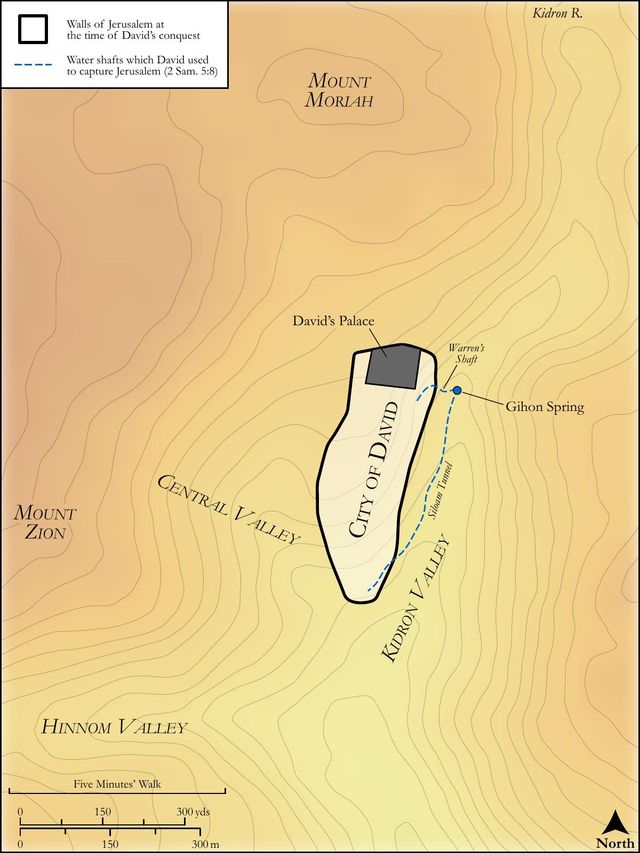
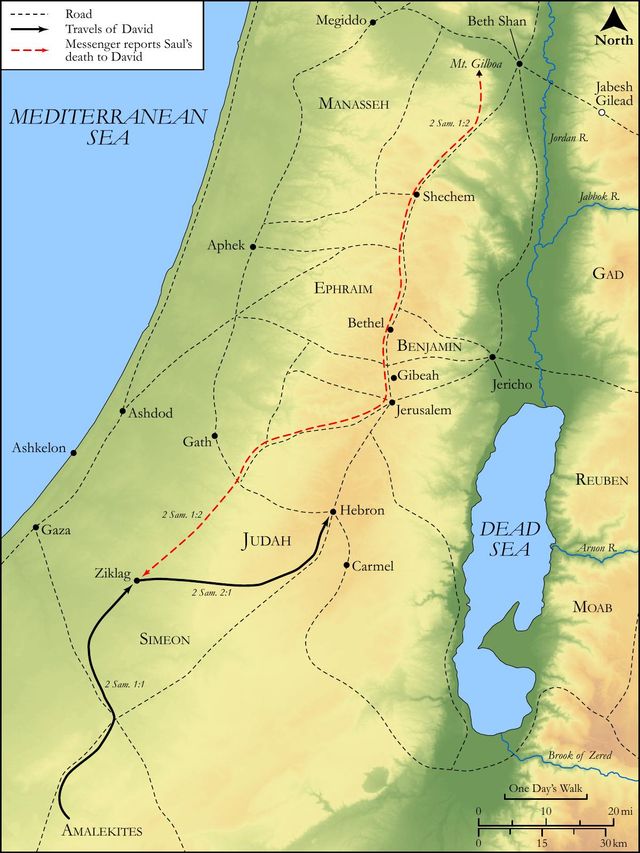
Study this verse
Public-domain commentary
Matthew Henry
From his Commentary on the Whole Bible. Henry comments on passages, not single verses — this entry covers 2 Samuel 1:11–16. His three-level outline is real structure in the source text, so it is rendered as structure.
Here is, I. David's reception of these tidings. So far was he from falling into a transport of joy, as the Amalekite expected, that he fell into a passion of weeping, rent his clothes (Sa2 1:11), mourned and fasted (Sa2 1:12), not only for his people Israel and Jonathan his friend but for Saul his enemy. This he did, not only as a man of honour, in observance of that decorum which forbids us to insult over those that are fallen, and requires us to attend our relations to the grave with respect, whatever we lost by their life or got by their death, but as a good man and a man of conscience, that had forgiven the injuries Saul had done him and bore him no malice. He knew it, before his son wrote it (Pro 24:17, Pro 24:18), that if we rejoice when our enemy falls the Lord sees it, and it displeases him; and that he who is glad at calamities shall not go unpunished, Pro 17:5. By this it appears that those passages in David's psalms which express his desire of, and triumph in, the ruin of his enemies, proceeded not from a spirit of revenge, nor any irregular passion, but from a holy zeal for the glory of God and the public good; for by what he did here, when he heard of Saul's death, we may perceive that his natural temper was very tender, and that he was kindly affected even to those that hated him. He was very sincere, no question, in his mourning for Saul, and it was not pretended, or a copy of his countenance only. His passion was so strong, on this occasion, that it moved those about him; all that were with him, at least in complaisance to him, rent their clothes, and they fasted till even, in token of their sorrow; and probably it was a religious fast: they humbled themselves under the hand of God, and prayed for the repairing of the breaches made upon Israel by this defeat.
II.The reward he gave to him that brought him the tidings.
Instead of preferring him, he put him to death, judged him out of his own mouth, as a murderer of his prince, and ordered him to be forthwith executed for the same. What a surprise was this to the messenger, who thought he should have favour shown him for his pains. In vain did he plead that he had Saul's order for it, that it was a real kindness to him, that he must inevitably have died; all those pleas are overruled: "Thy mouth has testified against thee, saying, I have slain the Lord's anointed (Sa2 1:16), therefore thou must die." Now,
1.David herein did not do unjustly. For,
(1.)The man was an Amalekite. This, lest he should have mistaken it in his narrative, he made him own a second time, Sa2 1:13. That nation, and all that belonged to it, were doomed to destruction, so that, in slaying him, David did what his predecessor should have done and was rejected for not doing.
(2.)He did himself confess the crime, so that the evidence was, by the consent of all laws, sufficient to convict him; for every man is presumed to make the best of himself. If he did as he said, he deserved to die for treason (Sa2 1:14), doing that which, it is probable, he heard Saul's own armour-bearer refuse to do; if not, yet by boasting that he had done it he plainly showed that if there had been occasion he would have done it, and would have made nothing of it; and, by boasting of it to David, he showed what opinion he had of him, that he would rejoice in it, as one altogether like himself, which was an intolerable affront to him who had himself once and again refused to stretch forth his hand against the Lord's anointed. And his lying to David, if indeed it was a lie, was highly criminal, and proved, as sooner or later that sin will prove, lying against his own head.
2.He did honourably and well. Hereby he demonstrated the sincerity of his grief, discouraged all others from thinking by doing the like to ingratiate themselves with him, and did that which might probably oblige the house of Saul and win upon them, and recommend him to the people as one that was zealous for public justice, without regard to his own private interest. We may learn from it that to give assistance to any in murdering themselves, directly or indirectly, if done wittingly, incurs the guilt of blood, and that the lives of princes ought to be, in a special manner, precious to us.
Continue studying 2 Samuel 1:13 across the web’s major study libraries — every link below opens this exact verse, chapter, or book on the destination site.
Read & Compare
 BibleGatewayThis verse in more than 200 translations and 70 languages.
 Bible.comThe YouVersion reader — hundreds of translations, reading plans, and highlights.
 ESV.orgCrossway's official English Standard Version reader.
 NET BibleThe NET translation with 60,000+ translators' notes on every rendering decision.
 STEP BibleTyndale House's free study tool — original text, vocabulary, and scholarly resources.
 BibliaLogos Bible Software's free web reader.
 USCCBThe New American Bible (Revised Edition) with the U.S. bishops' study notes.
Commentaries
 BibleHub CommentariesDozens of classic commentaries on this verse, gathered on one page.
 StudyLightMore than 100 commentary sets — the largest collection on the web.
 BibleRefPlain-English commentary on what this verse means, verse by verse.
 Enduring WordDavid Guzik's free commentary on this chapter, widely used by Bible teachers.
 Bible Study ToolsVerse commentary alongside Greek and Hebrew study aids.
Original Language & Research
- BibleHub InterlinearThe verse word by word — original language, transliteration, and English.
- BibleHub LexiconEvery word's original-language definition and Strong's entry.
 Blue Letter BibleDeep-study tools — Strong's numbers, concordance, and word studies.
 SefariaThe Hebrew text with Rashi and centuries of Jewish commentary.
Sermons, Hymns & Audio


TrulyRandomVerse is not affiliated with these sites and doesn’t control their content. They’re linked because they’re genuinely useful.
Summary
Following the catastrophic news of Israel's defeat and the deaths of King Saul and his son Jonathan, King David's immediate and penetrating inquiry into the identity of the messenger reveals his profound discernment and strategic leadership. The young man's self-identification as "the son of a stranger, an Amalekite" carries immense theological and historical weight, setting the stage for David's decisive action and underscoring the enduring consequences of disobedience to God's explicit commands. This brief exchange is pivotal, highlighting themes of divine justice, the significance of covenant identity, and the character of a righteous king.
Context
ShowHideLiterary Context
This verse is situated at a moment of profound national grief and uncertainty, immediately following the messenger's dramatic arrival from the battlefield at Mount Gilboa. The preceding verses 2 Samuel 1:1-12 describe the messenger bearing the tattered clothes of Saul and Jonathan, and delivering the devastating report of their deaths and Israel's rout. David and his men, upon hearing the news, immediately tore their clothes, wept, and fasted until evening, demonstrating the depth of their sorrow and the profound impact of the tragedy. It is out of this intense emotional backdrop that David, ever the discerning leader, shifts from mourning to a critical inquiry about the messenger's origin. This seemingly simple question, "Whence [art] thou?", is not casual; it is a calculated probe that sets the stage for David's subsequent judgment and reveals his commitment to justice, even in the midst of personal grief and national calamity. The narrative flow moves swiftly from national tragedy to a personal reckoning, with David acting as God's anointed executor of justice.
Historical & Cultural Context
The identity of the messenger as an "Amalekite" is laden with centuries of historical and cultural significance for Israel. The Amalekites were a nomadic people, descendants of Esau Genesis 36:12, who had been a persistent and treacherous enemy of Israel since the Exodus, attacking the Israelites from the rear when they were weary and vulnerable Exodus 17:8-16. God had explicitly commanded Israel, through Moses, to "blot out the remembrance of Amalek from under heaven" Deuteronomy 25:19. This divine mandate was a test of Israel's obedience and a perpetual reminder of Amalek's enduring hostility. Critically, King Saul's downfall and rejection as king were directly linked to his incomplete obedience to this very command, as he spared Agag, the Amalekite king, and the best of their livestock 1 Samuel 15:1-9. Thus, for an Amalekite to appear at this moment, claiming responsibility for Saul's death, would have resonated with profound historical and theological irony for David and his contemporaries, signaling a divinely orchestrated consequence.
Key Themes
ShowHideThis verse contributes significantly to several overarching themes within 2 Samuel and the broader biblical narrative. Firstly, it highlights the theme of Divine Justice and Sovereignty. The appearance of an Amalekite, claiming to have killed Saul, serves as a powerful, albeit ironic, echo of Saul's ultimate failure to obey God's command regarding Amalek. God's justice, though sometimes delayed, is ultimately certain, and even through human agents or their claims, His purposes are fulfilled. Secondly, the passage emphasizes Identity and Allegiance. David's immediate concern about the messenger's origin underscores the critical importance of one's background and loyalties, especially in a covenant community. The Amalekite's foreign and hostile lineage immediately raises red flags, contrasting sharply with the covenant identity of Israel and the divine command concerning Amalek. Finally, David's sharp questioning demonstrates his Discernment and Righteous Leadership. Unlike Saul, who often acted impulsively or out of fear, David exhibits a measured, probing, and ultimately just response, even in the face of overwhelming grief. His actions here foreshadow his reign as a king who seeks to align himself with God's commands and execute righteous judgment, as seen in his subsequent actions in 2 Samuel 1:15-16.
Exposition and Analysis
ShowHideKey Word Analysis
ShowHideThis term, derived from a root meaning "to build," signifies a son as a builder of the family name or lineage. In this context, the messenger's declaration "I am the son of a stranger" emphasizes his direct lineage and identity. It highlights that his very being is defined by his parentage, which in turn leads to his specific ethnic and national identification as an Amalekite, underscoring the importance of tribal and familial identity in the ancient world.
This word refers to a resident alien or sojourner, someone living among a people but not native-born. It denotes a non-Israelite who has taken up residence within Israelite territory, often under specific legal and social protections, but who retains their distinct ethnic or national identity. The messenger's use of "son of a stranger" emphasizes his non-Israelite parentage, setting him apart from the covenant community and preparing for the more specific and damning identification that follows.
This is the crucial identifying term. As discussed in the context, the Amalekites were a long-standing, divinely cursed enemy of Israel. Their name alone would have evoked centuries of conflict and the specific command from God to utterly destroy them. For the messenger to identify himself as an Amalekite immediately places him within a lineage of hostility towards Israel and, more significantly, directly connects him to the very people Saul was commanded to eradicate but failed to do so completely. This revelation is central to the dramatic irony and David's subsequent actions.
Verse Breakdown
ShowHide"And David said unto the young man that told him,"
This clause establishes the direct interaction between David and the messenger. It emphasizes David's active role in seeking further information, moving beyond passive reception of the news to an investigative posture. The "young man" (נַעַר, na'ar) highlights his relative youth, perhaps suggesting he was not a seasoned warrior but possibly a camp follower or a survivor seeking to gain favor. This detail underscores the vulnerability and potential opportunism of the messenger.
"Whence [art] thou?"
This is David's precise and probing question. It is not a casual inquiry but a demand for the messenger's origin and identity. This signifies David's immediate shift from mourning to discernment, understanding that the source of such monumental news, especially in a time of national crisis, is as important as the news itself. This question reveals David's astute leadership, seeking to understand the implications of the messenger's presence and the reliability of his report.
"And he answered, I [am] the son of a stranger, an Amalekite."
The messenger's response is a self-identification that carries profound implications. By stating he is "the son of a stranger," he acknowledges his non-Israelite background, immediately marking him as an outsider. The subsequent, specific identification as an "Amalekite" is the critical revelation. This confession immediately places him within the lineage of Israel's ancient and divinely-cursed enemies, setting the stage for David's judgment, which is rooted in both the historical enmity and Saul's specific failure concerning the Amalekites. This admission seals his fate.
Literary Devices
ShowHideThe primary literary device at play in 2 Samuel 1:13 is Irony, specifically Dramatic Irony. The audience is acutely aware of King Saul's fateful disobedience regarding the Amalekites, a failure that directly led to his rejection as king 1 Samuel 15. For an Amalekite to now appear, claiming to have delivered the final blow to Saul, creates a profound and bitter irony. Saul, who failed to utterly destroy Amalek as commanded by God, is now, by this messenger's own account, brought down by one of their own. This serves as a powerful testament to the far-reaching consequences of disobedience and God's sovereign justice, which often works in unexpected and ironically fitting ways. Additionally, there is an element of Foreshadowing in David's immediate and discerning inquiry. His careful attention to the messenger's identity and his subsequent swift and righteous judgment 2 Samuel 1:15-16 foreshadow David's character as a king who, unlike Saul, would generally seek to obey God's commands and administer justice righteously, setting the tone for his future reign.
Theological and Thematic Connections
ShowHideThe revelation of the messenger's Amalekite identity in 2 Samuel 1:13 is a powerful theological statement about divine justice, the consequences of disobedience, and the nature of God's covenant faithfulness. Saul's failure to fully eradicate the Amalekites, a direct command from God, was a pivotal moment in his rejection as king. That his death is now reported, and even claimed by, an Amalekite, underscores the principle that God's word does not return to Him empty, and His judgments, though they may unfold over time, are ultimately executed. This passage serves as a stark reminder that disobedience has far-reaching and often ironic consequences, demonstrating God's sovereignty even in the midst of human failure and the chaos of war. David's immediate discernment and subsequent righteous judgment further highlight the contrast between Saul's failed kingship and David's emerging role as a king after God's own heart, one who prioritizes divine commands and justice.
Reflection and Application
ShowHideThe exchange in 2 Samuel 1:13 offers profound lessons for contemporary believers. David's immediate and probing question, "Whence [art] thou?", challenges us to cultivate a spirit of discernment, especially in a world saturated with information and misinformation. In times of crisis or significant news, it is crucial not just to react emotionally but to carefully consider the source, motives, and context of the information we receive. This passage also serves as a potent reminder of the enduring consequences of disobedience to God's commands. Saul's incomplete obedience regarding the Amalekites had long-term repercussions that ironically culminated in his own demise being reported by one of the very people he was meant to destroy. This underscores the biblical principle that our actions, both obedient and disobedient, have ripple effects that can extend far beyond our immediate understanding. For us, this means taking God's commands seriously, understanding that even seemingly "small" acts of compromise can have significant spiritual and practical consequences. Ultimately, the passage calls us to live lives of integrity, discernment, and faithful obedience, trusting in God's sovereign justice and His unwavering commitment to His purposes.
Questions for Reflection
ShowHideFAQ
ShowHideWhy was David so concerned about the messenger's identity?
ShowHideDavid's concern was not mere curiosity but a strategic and theological inquiry. In ancient Near Eastern cultures, a messenger's identity, especially in matters of war and national security, was critical for assessing the veracity and implications of their report. For David, knowing the messenger's origin was essential for understanding the full context of Saul's death and for determining the appropriate response. The revelation that the messenger was an Amalekite immediately connected him to Israel's ancient, divinely cursed enemy and, more specifically, to King Saul's most significant act of disobedience, which involved sparing the Amalekites. This identity provided David with a crucial piece of information that would inform his subsequent judgment.
What is the significance of the messenger being an "Amalekite"?
ShowHideThe significance is profound and multi-layered. The Amalekites were a people whom God had commanded Israel to utterly destroy due to their persistent hostility and treacherous attacks on the Israelites during the Exodus Deuteronomy 25:17-19. King Saul's greatest failure, which led to his rejection as king, was his incomplete obedience to this very command, as he spared the Amalekite king Agag and their best livestock 1 Samuel 15:1-9. For an Amalekite to now appear, claiming to have delivered the final blow to Saul, creates a powerful and bitter irony. It underscores God's sovereign justice and the enduring consequences of disobedience, demonstrating that even through unexpected means, God's word and judgment are fulfilled.
Did the Amalekite really kill Saul?
ShowHideIt is highly unlikely that the Amalekite actually killed Saul. The account in 1 Samuel 31:4-5 clearly states that Saul fell on his own sword after his armor-bearer refused to kill him. The Amalekite likely found Saul already dead or mortally wounded and saw an opportunity to gain favor with David by claiming responsibility for the king's death. In ancient warfare, it was common for individuals to claim credit for killing an enemy leader to curry favor or receive reward. However, this opportunistic lie sealed his fate, as David, operating under the principle of divine justice and the sacredness of God's anointed, executed him for laying a hand on the Lord's anointed, regardless of whether the claim was true or false 2 Samuel 1:14-16.
Christ-Centered Fulfillment
ShowHideThe dramatic exchange in 2 Samuel 1:13, marked by David's discerning inquiry and the Amalekite's self-identification, finds its ultimate Christ-centered fulfillment in several profound ways. David's immediate and righteous judgment of the Amalekite, who claimed to have laid hands on the Lord's anointed, foreshadows the perfect and ultimate justice of Christ. Unlike Saul, who failed to fully obey God's command regarding the Amalekites, David acts decisively to uphold divine justice, pointing to Jesus, the true King, who perfectly executes the Father's will and administers righteous judgment over all His enemies. The Amalekites, as a persistent and divinely cursed enemy of Israel, can be seen as a type of the spiritual enemies of God's people—sin, death, and Satan. Just as David brought swift judgment upon the Amalekite, so Christ, through His death and resurrection, has achieved decisive victory over these spiritual foes, "disarming the powers and authorities" and "triumphing over them by the cross" Colossians 2:15. Furthermore, the contrast between Saul's fatal disobedience and David's emerging obedience points to Christ's perfect obedience to the Father, even unto death on the cross Philippians 2:8, which brings salvation and eternal life, unlike the consequences of sin that lead to death. Christ is the ultimate "son" who perfectly fulfills God's will, establishing a kingdom of righteousness and peace that endures forever Isaiah 9:6-7.