


2 Samuel 1:8
Bible text: King James Version (1769 Blayney text) · Public domain
Bible text: Berean Standard Bible · Public domain
Bible text: American Standard Version (1901) · Public domain
Bible text: World English Bible, Messianic edition · Public domain
Bible text: Geneva Bible (1599) · Public domain
Bible text: Young's Literal Translation · Public domain
- וַיֹּאמֶרvai·Yo·merand he saidH559Conj-w ¦ V-Qal-ConsecImperf-3msVerb Qal Consecutive Imperfect 3rd Singular Masculineוַandיֹּאמֶרhe said
- לִיlito <the> mePrep-l ¦ 1csSuffix Personal 1st Singular common genderלִto <the>יme
- מִיmiwho?H4310InterrogPronoun Interrogative
- אָתָּה'A·tah[are] youH859Pro-2msPronoun Personal 2nd Singular Masculine
- וָאֹמַרvai·yo·merand I saidH559Conj-w ¦ V-Qal-ConsecImperf-1csVerb Qal Consecutive Imperfect 1st Singular common genderוָandאֹמַרI said
- אֵלָיו'e·Lavto himH413Prep ¦ 3msPreposition Definiteאֵלָיtoוhim
- עֲמָלֵקִי'a·mal·Ki[am] an AmalekiteH6003N-msNoun Gentilic Singular Masculine Absolute
- אָנֹכִי'a·No·khiIH595Pro-1csPronoun Personal 1st Singular common gender
English is a literal word-by-word gloss of the Hebrew, not the KJV's wording. Why?
This is the original text the KJV's translators worked from — each Hebrew word with its own literal English meaning in this verse, prepared by scholars at Tyndale House, Cambridge. The KJV translates whole sentences, not word by word, so its wording differs: one Hebrew word can become several English words, and the KJV may choose “the LORD” where the gloss reads “Yahweh”. Both are faithful — they answer different questions. For the KJV's own rendering, switch to the KJV text.
Details
See on the biblical-era maps
Study this verse
Public-domain commentary
Matthew Henry
From his Commentary on the Whole Bible. Henry comments on passages, not single verses — this entry covers 2 Samuel 1:1–10. His two-level outline is real structure in the source text, so it is rendered as structure.
Here is, I. David settling again in Ziklag, his own city, after he had rescued his family and friends out of the hands of the Amalekites (Sa2 1:1): He abode in Ziklag. Thence he was now sending presents to his friends (Sa1 30:26), and there he was ready to receive those that came into his interests; not men in distress and debt, as his first followers were, but persons of quality in their country, mighty men, men of war, and captains of thousands (as we find, Ch1 12:1, Ch1 12:8, Ch1 12:20); such came day by day to him, God stirring up their hearts to do so, till he had a great host, like the host of God, as it is said, Ch1 12:22. The secret springs of revolutions are unaccountable, and must be resolved into that Providence which turns all hearts as the rivers of water.
II.Intelligence brought him thither of the death of Saul.
It was strange that he did not leave some spies about the camp, to bring him early notice of the issue of the engagement, a sign that he desired not Saul's woeful day, nor was impatient to come to the throne, but willing to wait till those tidings were brought to him which many a one would have sent more than half-way to meet. He that believes does not make haste, takes good news when it comes and is not uneasy while it is in the coming.
1.The messenger presents himself to David as an express, in the posture of a mourner for the deceased prince and a subject to the succeeding one. He came with his clothes rent, and made obeisance to David (Sa2 1:2), pleasing himself with the fancy that he had the honour to be the first that did him homage as his sovereign, but it proved he was the first that received from him sentence of death as his judge. He told David he came from the camp of Israel, and intimated the bad posture it was in when he said he had escaped out of it, having much ado to get away with his life, Sa2 1:3.
2.He gives him a general account of the issue of the battle. David was very desirous to know how the matter went, as one that had more reason than any to be concerned for the public; and he told him very distinctly that the army of Israel was routed, many slain, and, among the rest, Saul and Jonathan, Sa2 1:4. He named only Saul and Jonathan, because he knew David would be most solicitous to know their fate; for Saul was the man whom he most feared and Jonathan the man whom he most loved.
3.He gives him a more particular account of the death of Saul. It is probable that David had heard, by the report of others, what the issue of the war was, for multitudes resorted to him, it should seem, in consequence; but he was desirous to know the certainty of the report concerning Saul and Jonathan, either because he was not forward to believe it or because he would not proceed upon it to make his own claims till he was fully assured of it. He therefore asks, How knowest thou that Saul and Jonathan are dead? in answer to which the young man tells him a very ready story, putting it past doubt that Saul was dead, for he himself had been not only an eye-witness of his death, but an instrument of it, and therefore David might rely upon his testimony. He says nothing, in his narrative, of the death of Jonathan, knowing how ungrateful that would be to David, but accounts only for Saul, thinking (as David understood it well enough, Sa2 4:10) that he should be welcome for that, and rewarded as one that brought good tidings. The account he gives of this matter is, (1.) Very particular. That he happened to go to the place where Saul was (Sa2 1:6) as a passenger, not as a soldier, and therefore an indifferent person, that he found Saul endeavouring to run himself through with his own spear, none of his attendants being willing to do it for him; and, it seems, he could not do it dexterously for himself: his hand and heart failed him. The miserable man had not courage enough either to live or die; he therefore called this stranger to him (Sa2 1:7), enquired what countryman he was, for, provided he was not a Philistine, he would gladly receive from his hand the coup de grace (as the French call it concerning those that are broken on the wheel) - the merciful stroke, that might dispatch him out of his pain. Understanding that he was an Amalekite (neither one of his subjects nor one of his enemies), he begs this favour from him (Sa2 1:9): Stand upon me, and slay me. He is now sick of his dignity and willing to be trampled upon, sick of his life and willing to be slain. Who then would be inordinately fond of life or honour? The case may he such, even with those that have no hope in their death, that yet they may desire to die, and death flee from them, Rev 9:6. Anguish has come upon me; so we read it, as a complaint of the pain and terror his spirit was seized with. If his conscience now brought to mind the javelin he had cast at David, his pride, malice, and perfidiousness, and especially the murder of the priests, no marvel that anguish came upon him: moles (they say) open their eyes when they are dying. Sense of unpardoned guilt will make death indeed the king of terrors. Those that have baffled their convictions will perhaps, in their dying moments, be overpowered by them. The margin reads it as a complaint of the inconvenience of his clothes; that his coat of mail which he had for defence, or his embroidered coat which he had for ornament, hindered him, that he could not get the spear far enough into his body, or so straitened him, now that his body swelled with anguish, that he could not expire. Let no man's clothes be his pride, for it may so happen that they may be his burden and snare. "Hereupon," saith our young man, "I stood upon him, and slew him" (Sa2 1:10) at which word, perhaps, he observed David look upon him with some show of displeasure, and therefore he excuses himself in the next words: "For I was sure he could not live; his life was whole in him indeed, but he would certainly have fallen into the hands of the Philistines or given himself another thrust." (2.) It is doubtful whether this story be true. If it be, the righteousness of God is to be observed, that Saul, who spared the Amalekites in contempt of the divine command, received his death's wound from an Amalekite. But most interpreters think that it was false, and that, though he might happen to be present, yet he was not assisting in the death of Saul, but told David so in expectation that he would reward him for it, as having done him a piece of good service. Those who would rejoice at the fall of an enemy are apt to measure others by themselves, and to think that they will do so too. But a man after God's own heart is not to be judged of by common men. I am not clear whether this young man's story was true or no: it may consist with the narrative in the chapter before, and be an addition to it, as Peter's account of the death of Judas (Act 1:18) is to the narrative, Mat 27:5. What is there called a sword may here be called a spear, or when he fell upon his sword he leaned on his spear. (3.) However he produced that which was proof sufficient of the death of Saul, the crown that was upon his head and the bracelet that was on his arm. It should seem Saul was so foolishly fond of these as to wear them in the field of battle, which made him a fair mark for the archers, by distinguishing him from those about him; but as pride (we say) feels no cold, so it fears no danger, from that which gratifies it. These fell into the hands of this Amalekite. Saul spared the best of their spoil, and now the best of his came to one of that devoted nation. He brought them to David, as the rightful owner of them now that Saul was dead, not doubting but by his officiousness herein to recommend himself to the best preferments in his court or camp. The tradition of the Jews is that this Amalekite was the son of Doeg (for the Amalekites were descendants from Edom), and that Doeg, who they suppose was Saul's armour-bearer, before he slew himself gave Saul's crown and bracelet (the ensigns of his royalty) to his son, and bade him carry them to David, to curry favour with him. But this is a groundless conceit. Doeg's son, it is likely, was so well known to Saul that he needed not ask him as he did this Amalekite (Sa2 1:8), Who art thou? David had been long waiting for the crown, and now it was brought to him by an Amalekite. See how God can serve his own purposes of kindness to his people, even by designing (ill-designing) men, who aim at nothing but to set up themselves.
Continue studying 2 Samuel 1:8 across the web’s major study libraries — every link below opens this exact verse, chapter, or book on the destination site.
Read & Compare
 BibleGatewayThis verse in more than 200 translations and 70 languages.
 Bible.comThe YouVersion reader — hundreds of translations, reading plans, and highlights.
 ESV.orgCrossway's official English Standard Version reader.
 NET BibleThe NET translation with 60,000+ translators' notes on every rendering decision.
 STEP BibleTyndale House's free study tool — original text, vocabulary, and scholarly resources.
 BibliaLogos Bible Software's free web reader.
 USCCBThe New American Bible (Revised Edition) with the U.S. bishops' study notes.
Commentaries
 BibleHub CommentariesDozens of classic commentaries on this verse, gathered on one page.
 StudyLightMore than 100 commentary sets — the largest collection on the web.
 BibleRefPlain-English commentary on what this verse means, verse by verse.
 Enduring WordDavid Guzik's free commentary on this chapter, widely used by Bible teachers.
 Bible Study ToolsVerse commentary alongside Greek and Hebrew study aids.
Original Language & Research
- BibleHub InterlinearThe verse word by word — original language, transliteration, and English.
- BibleHub LexiconEvery word's original-language definition and Strong's entry.
 Blue Letter BibleDeep-study tools — Strong's numbers, concordance, and word studies.
 SefariaThe Hebrew text with Rashi and centuries of Jewish commentary.
Sermons, Hymns & Audio


TrulyRandomVerse is not affiliated with these sites and doesn’t control their content. They’re linked because they’re genuinely useful.
Summary
2 Samuel 1:8 records the critical exchange between a mortally wounded King Saul and an unnamed Amalekite on Mount Gilboa. In his final moments, Saul urgently inquires about the man's identity, to which the Amalekite unequivocally declares his origin. This brief dialogue is laden with dramatic irony and profound theological implications, immediately setting the stage for David's severe judgment upon the bearer of the news of Saul's death, thereby highlighting themes of identity, divine judgment, and the inescapable consequences of one's words and actions.
Context
ShowHideLiterary Context
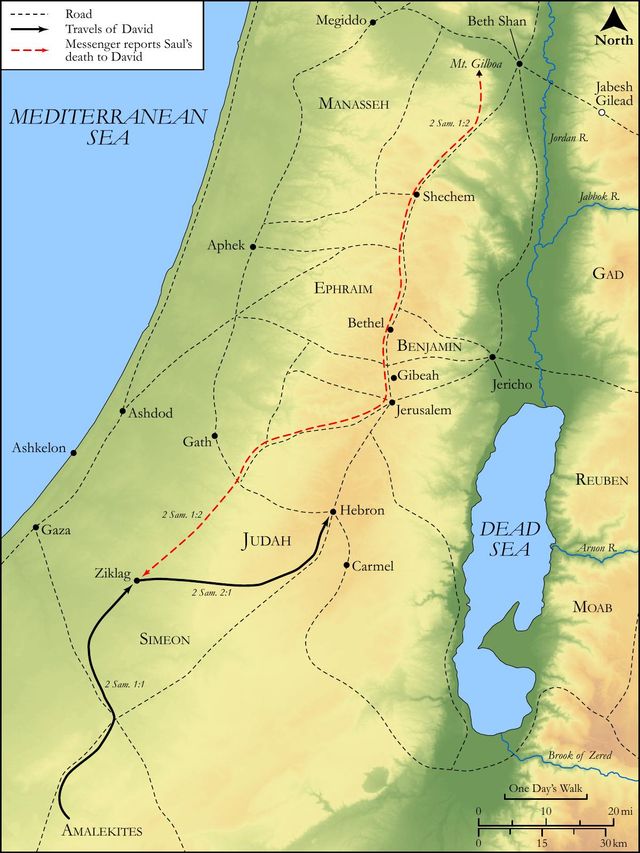
This pivotal verse stands in the dramatic opening narrative of 2 Samuel, serving as part of the immediate aftermath of the tragic events detailed in 1 Samuel 31. The preceding chapter describes Israel's devastating defeat by the Philistines on Mount Gilboa, culminating in the deaths of King Saul and his three sons, including Jonathan. David, having been in Ziklag, receives the news from this Amalekite, who claims to have been present at Saul's death and even to have delivered the final, merciful blow. The Amalekite's self-declaration in 2 Samuel 1:8 is the first direct interaction between the dying king and this messenger, establishing the messenger's identity, which proves crucial to David's subsequent judgment in 2 Samuel 1:16. The narrative suspense builds from the Amalekite's arrival in 2 Samuel 1:2 to his detailed, yet likely fabricated, account of Saul's death in 2 Samuel 1:9-10.
Historical & Cultural Context
The declaration "I am an Amalekite" carries immense historical and cultural weight within the Israelite narrative. The Amalekites were a nomadic people, perennial enemies of Israel from the time of the Exodus, having launched an unprovoked attack on the weary Israelites in the wilderness (Exodus 17:8-16). This act prompted a divine decree that their memory should be blotted out (Deuteronomy 25:17-19). King Saul himself had been specifically commanded by God through Samuel to utterly destroy the Amalekites, including their king Agag, but he famously disobeyed, sparing Agag and the best of the livestock (1 Samuel 15:1-9). This act of disobedience led directly to God's rejection of Saul as king. Thus, for an Amalekite to appear at Saul's death, especially one claiming to have killed him, is deeply ironic and culturally significant, linking Saul's end to his most significant failure. The cultural expectation would have been for a loyal Israelite to assist their king, not a member of a divinely cursed enemy nation.
Key Themes
ShowHideThe primary themes converging in this verse include Identity and Origin, as the Amalekite's self-identification immediately places him within a long history of conflict and divine judgment against his people. This declaration powerfully highlights the Consequences of Disobedience, particularly Saul's failure to eradicate the Amalekites as commanded by God, which now ironically culminates in an Amalekite's presence at his death. The verse also touches upon the Weight of a Confession and the Nature of Truth, as the Amalekite's claim, whether entirely true or fabricated for perceived reward, ultimately seals his fate. David's subsequent reaction underscores the theme of Divine Justice and Vengeance, as he acts swiftly to punish one who claims to have laid hands on "the Lord's anointed," a concept central to David's profound respect for divine authority, even over his adversary, Saul, as seen in 1 Samuel 24:6.
Exposition and Analysis
ShowHideKey Word Analysis
ShowHideThis primitive root verb (H559) is used with great latitude, encompassing meanings like to speak, answer, command, declare, or utter. In this context, it describes Saul's urgent inquiry, reflecting his weakened and desperate state, and the Amalekite's subsequent declaration. The verb highlights the directness and immediacy of the dialogue, which is crucial for establishing the identity of the interlocutors and the gravity of the situation.
This patronymic noun (H6003) denotes a descendant of Amalek or collectively the Amalekites. The self-identification as an "Amalekite" is laden with immense historical and theological significance. It immediately invokes the long-standing, divinely ordained enmity between Israel and Amalek, as commanded in passages like Exodus 17:16 and Deuteronomy 25:19. This identity is particularly poignant given King Saul's own failure to fully execute God's judgment against the Amalekites, an act of disobedience that led to his rejection as king (1 Samuel 15:9). The Amalekite's declaration thus connects Saul's end to his most significant spiritual failure.
Verse Breakdown
ShowHide"And he said unto me, Who [art] thou?"
This clause presents the dying Saul's final recorded words to a human before his death (as relayed by the Amalekite). The question is direct and personal, indicating Saul's awareness of another presence and his desperate need to identify them. The bracketed "art" is an English grammatical insertion by the KJV translators to make the Hebrew more natural; the original Hebrew is a concise "Who you?" This question underscores Saul's vulnerability and possibly his desperation for assistance or a merciful end to his suffering.
"And I answered him, I [am] an Amalekite."
This is the Amalekite's stark and self-incriminating declaration. The simple "I am an Amalekite" (the bracketed "am" being a KJV insertion) immediately establishes his identity as a member of Israel's ancient, cursed enemy. This confession, whether entirely true regarding his role in Saul's death or fabricated for perceived reward from David, is the crucial piece of information that will determine his fate. It places him in a position of direct opposition to the covenant people and, ironically, links him to Saul's own past disobedience.
Literary Devices
ShowHideThe verse employs several potent literary devices that amplify its dramatic and theological impact. Irony is profoundly evident, as an Amalekite—the very people Saul was commanded by God to utterly destroy, and whose sparing led to his downfall—is now present at Saul's death and claims to have delivered the fatal blow. This creates a powerful, tragic echo of Saul's disobedience. Dialogue is used to convey a moment of intense, albeit brief, interaction, highlighting the directness of Saul's urgent inquiry and the Amalekite's bold, self-identifying response. The Amalekite's declaration also serves as a form of Foreshadowing, hinting at the severe consequences that will inevitably befall him at David's hand, as his identity and claim are irreconcilable with David's reverence for God's anointed. The starkness of the declaration also lends itself to Symbolism, where "Amalekite" represents not just an ethnic group but a persistent, divinely condemned enemy of God's people, and perhaps even the lingering consequences of unaddressed sin.
Theological and Thematic Connections
ShowHideThe Amalekite's declaration in 2 Samuel 1:8 is deeply intertwined with the biblical narrative of divine judgment and the severe consequences of disobedience. The Amalekites were marked out by God as a people whose inherent evil deserved complete eradication due to their unprovoked and cowardly attack on Israel in the wilderness. Saul's failure to carry out this divine command, specifically his sparing of King Agag and the best of the livestock, was a pivotal moment in his rejection as king. Thus, the presence of an Amalekite at Saul's death, particularly one who claims responsibility for it, serves as a grim theological bookend to Saul's reign, powerfully illustrating how the consequences of sin and disobedience can manifest in unexpected and ironic ways. David's subsequent swift judgment on the Amalekite (2 Samuel 1:15-16) underscores his unwavering commitment to God's justice and his profound reverence for God's anointed, even in the case of his adversary, Saul.
Reflection and Application
ShowHideThe brief exchange in 2 Samuel 1:8, though rooted in ancient history, offers profound insights into the nature of identity, truth, and consequences that resonate deeply today. The Amalekite's self-declaration, whether a truthful account or a calculated lie for perceived gain, ultimately defined him in David's eyes and sealed his fate. This narrative serves as a powerful reminder that our identity, particularly our spiritual identity, is not merely a superficial label but a profound reality that shapes our actions, influences our choices, and ultimately determines our destiny. Are we identified with Christ, or with the world and its fleeting promises? Furthermore, the account highlights the immense weight of our words. What we confess, claim, or declare, especially in critical moments, carries significant spiritual and practical consequences. It prompts us to consider the truthfulness and integrity of our own declarations, the motivations behind our speech, and the ultimate source of our hope and security.
Questions for Reflection
ShowHideFAQ
ShowHideWas the Amalekite telling the truth about killing Saul?
ShowHideWhile the Amalekite claimed to have delivered the fatal blow to Saul and to have taken his crown and armlet, the biblical account in 1 Samuel 31:4-5 states unequivocally that Saul fell on his own sword, and his armor-bearer refused to kill him. This discrepancy strongly suggests the Amalekite fabricated or exaggerated his role, likely to curry favor with David, believing David would reward him for removing his rival. However, David's response was not one of reward but of swift and severe judgment, as he considered it an unthinkable act to lay hands on "the Lord's anointed." The Amalekite's claim, whether true or false, was ultimately his undoing.
Christ-Centered Fulfillment
ShowHideThe narrative of the Amalekite, a persistent and divinely condemned enemy of God's people, and his encounter with Saul and David, finds its ultimate fulfillment in the person and redemptive work of Jesus Christ. Just as the Amalekite represented a historical enemy that Israel was commanded to utterly defeat, humanity, in its fallen state, is an enemy of God, alienated by sin and rebellion (Romans 5:10). However, Christ did not come to destroy the "enemy" in the same retributive way David executed the Amalekite. Instead, He came to reconcile enemies to God through His sacrificial death on the cross. On the cross, Jesus defeated the ultimate spiritual enemies: sin, death, and the power of Satan, disarming the spiritual rulers and authorities (Colossians 2:15). He became the true King who, unlike Saul, perfectly obeyed God's will, even to the point of death on a cross (Philippians 2:8). Through Christ, our identity is transformed from "enemy" or "stranger" to "child of God" and "heir with Christ" (John 1:12 and Romans 8:17). The victory over Amalek, a type of persistent evil, is fully realized in Christ's triumph over all spiritual wickedness, offering redemption and a new identity to all who believe, rather than condemnation based on their past enmity (2 Corinthians 5:17).