


Genesis 50:9
- וַיַּעַלvai·Ya·'aland it went upH5927Conj-w ¦ V-Qal-ConsecImperf-3msVerb Qal Consecutive Imperfect 3rd Singular Masculineוַandיַּעַלit went up
- עִמּוֹi·Mowith himH5973Prep ¦ 3msPrepositionעִמּwithוֹhim
- גַּםgambothH1571AdvAdverb
- רֶכֶבRe·khevchariotryH7393N-msNoun Singular Masculine Absolute
- גַּםgamas well asH1571AdvAdverb
- פָּרָשִׁיםpa·ra·ShimhorsemenH6571N-mpNoun Plural Masculine Absolute
- וַיְהִיvay·Hiand it wasH1961Conj-w ¦ V-Qal-ConsecImperf-3msVerb Qal Consecutive Imperfect 3rd Singular Masculineוַandיְהִיit was
- הַמַּחֲנֶהha·ma·cha·Nehthe companyH4264Art ¦ N-fsNoun Singular Feminine Absoluteהַtheמַּחֲנֶהcompany
- כָּבֵדka·VednumerousH3515Adj-msAdjective Singular Masculine Absolute
- מְאֹדme·'OdveryH3966Adj-msAdjective Numerical Singular Masculine Absolute
English is a literal word-by-word gloss of the Hebrew, not the KJV's wording. Why?
This is the original text the KJV's translators worked from — each Hebrew word with its own literal English meaning in this verse, prepared by scholars at Tyndale House, Cambridge. The KJV translates whole sentences, not word by word, so its wording differs: one Hebrew word can become several English words, and the KJV may choose “the LORD” where the gloss reads “Yahweh”. Both are faithful — they answer different questions. For the KJV's own rendering, switch to the KJV text.
Details
See on the biblical-era map


Study this verse
Public-domain commentary
Matthew Henry
From his Commentary on the Whole Bible. Henry comments on passages, not single verses — this entry covers Genesis 50:7–14.
We have here an account of Jacob's funeral. Of the funerals of the kings of Judah, usually, no more is said than this, They were buried with their fathers in the city of David: but the funeral of the patriarch Jacob is more largely and fully described, to show how much better God was to him than he expected (he had spoken more than once of dying for grief, and going to the grave bereaved of his children, but, behold, he dies in honour, and is followed to the grave by all his children), and also because his orders concerning his burial were given and observed in faith, and in expectation both of the earthly and of the heavenly Canaan. Now, 1. It was a stately funeral. He was attended to the grave, not only by his own family, but by the courtiers, and all the great men of the kingdom, who, in token of their gratitude to Joseph, showed this respect to his father for his sake, and did him honour at his death. Though the Egyptians had had an antipathy to the Hebrews, and had looked upon them with disdain (Gen 43:32), yet now, that they were better acquainted with them, they began to have a respect for them. Good old Jacob had conducted himself so well among them as to gain universal esteem. Note, Professors of religion should endeavour, by wisdom and love, to remove the prejudices which many may have conceived against them because they do not know them. There went abundance of chariots and horsemen, not only to attend them a little way, but to go through with them. Note, The decent solemnities of funerals, according to a man's situation, are very commendable; and we must not say of them, To what purpose is this waste? See Act 8:2; Luk 7:12. 2. It was a sorrowful funeral (Gen 50:10, Gen 50:11); standers-by took notice of it as a grievous mourning. Note, The death of good men is a great loss to any place, and ought to be greatly lamented. Stephen dies a martyr, and yet devout men make great lamentations for him. The solemn mourning for Jacob gave a name to the place, Abel-Mizraim, the mourning of the Egyptians, which served for a testimony against the next generation of the Egyptians, who oppressed the posterity of this Jacob to whom their ancestors showed such respect.
Continue studying Genesis 50:9 across the web’s major study libraries — every link below opens this exact verse, chapter, or book on the destination site.
Read & Compare
 BibleGatewayThis verse in more than 200 translations and 70 languages.
 Bible.comThe YouVersion reader — hundreds of translations, reading plans, and highlights.
 ESV.orgCrossway's official English Standard Version reader.
 NET BibleThe NET translation with 60,000+ translators' notes on every rendering decision.
 STEP BibleTyndale House's free study tool — original text, vocabulary, and scholarly resources.
 BibliaLogos Bible Software's free web reader.
 USCCBThe New American Bible (Revised Edition) with the U.S. bishops' study notes.
Commentaries
 BibleHub CommentariesDozens of classic commentaries on this verse, gathered on one page.
 StudyLightMore than 100 commentary sets — the largest collection on the web.
 BibleRefPlain-English commentary on what this verse means, verse by verse.
 Enduring WordDavid Guzik's free commentary on this chapter, widely used by Bible teachers.
 Bible Study ToolsVerse commentary alongside Greek and Hebrew study aids.
Original Language & Research
- BibleHub InterlinearThe verse word by word — original language, transliteration, and English.
- BibleHub LexiconEvery word's original-language definition and Strong's entry.
 Blue Letter BibleDeep-study tools — Strong's numbers, concordance, and word studies.
 SefariaThe Hebrew text with Rashi and centuries of Jewish commentary.
Sermons, Hymns & Audio


TrulyRandomVerse is not affiliated with these sites and doesn’t control their content. They’re linked because they’re genuinely useful.
Summary
Genesis 50:9 vividly portrays the immense scale and profound dignity of Jacob's funeral procession, as Joseph and his family journey from Egypt to Canaan for the patriarch's burial. This verse highlights the unprecedented nature of the event, featuring a formidable escort of "both chariots and horsemen" and an exceptionally "very great company," signifying Joseph's exalted status in Pharaoh's court and the deep reverence accorded to Jacob, a foundational patriarch of Israel.
Context
ShowHideLiterary Context
This verse is situated within the final chapter of Genesis, which concludes the narrative of Joseph's life and the patriarchal era. Following Jacob's death in Egypt (Genesis 49:33), Joseph immediately begins preparations to fulfill his father's dying wish: to be buried in the land of Canaan, specifically in the cave of Machpelah with his ancestors Genesis 49:29-32. Genesis 50:1-8 describes the elaborate mourning period in Egypt and Joseph's petition to Pharaoh for permission to travel for the burial. Verse 9 then details the composition of the funeral entourage, emphasizing its grandeur. The subsequent verses (Genesis 50:10-14) describe their arrival at Goren Atad, a further period of mourning, and the eventual burial in Machpelah, followed by Joseph's return to Egypt. This grand procession serves as a climactic moment, underscoring the fulfillment of a patriarchal desire and the immense honor bestowed upon Jacob.
Historical & Cultural Context
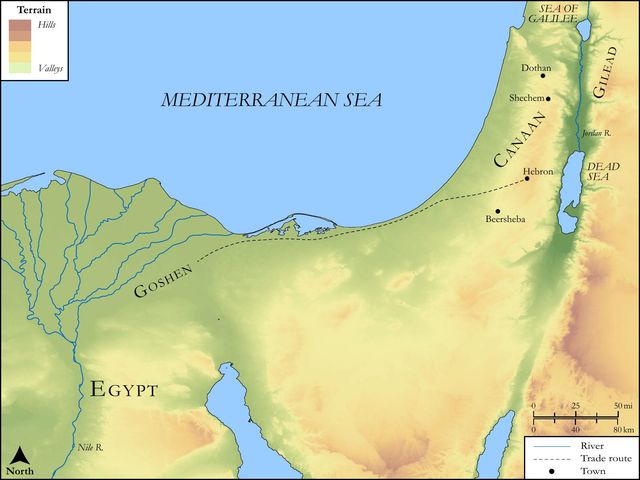
Ancient Egyptian funeral practices for high-ranking individuals were elaborate, often involving extensive processions and a significant display of wealth and power. Chariots and horsemen represented the elite military and official power of Egypt. Chariots, in particular, were expensive, technologically advanced war machines, typically reserved for the pharaoh and his highest officials. Their inclusion in Jacob's funeral procession was an extraordinary honor, transforming a family burial into a state affair. This display not only provided security for the long journey through potentially hostile territories but also publicly affirmed Joseph's unparalleled influence as Pharaoh's vizier. The journey from Goshen in Egypt to Hebron in Canaan was a considerable distance, necessitating a large, well-equipped company for logistics, protection, and to maintain the solemnity and dignity of such a significant undertaking.
Key Themes
ShowHideGenesis 50:9 contributes significantly to several overarching themes in Genesis. Firstly, it underscores the theme of honoring parents and elders, as Joseph goes to extraordinary lengths to fulfill his father's final request, demonstrating profound filial piety. Secondly, it highlights God's divine providence and elevation; Joseph, once a slave and prisoner, is now so highly esteemed by the world's most powerful ruler that he can command such a magnificent escort for his father's burial, fulfilling the promises of God's blessing on his life, as seen in Genesis 41:40-43. Thirdly, the journey back to Canaan for burial powerfully reinforces the covenant promise of the land. Despite dying in Egypt, Jacob's insistence on burial in Canaan (Genesis 49:29) and the subsequent elaborate journey, even for his remains, affirms the enduring faith of the patriarchs in God's promise of the land to Abraham and his descendants, a promise foundational to the entire narrative of Israel's formation as a nation, as reiterated in Genesis 15:18-21.
Exposition and Analysis
ShowHideKey Word Analysis
ShowHideThis primitive root signifies to "ascend," "mount," or "go up." In this context, it denotes the movement of the entire procession from Egypt (a lower geographical region, or symbolically, a place of temporary sojourn) to Canaan (a higher geographical region, or symbolically, the Promised Land). It emphasizes the deliberate and organized departure, highlighting the magnitude of the undertaking as a grand ascent.
Derived from a root meaning "to ride," this term refers to a "vehicle" or, by implication, a "team" or "cavalry." In ancient Egypt, chariots were the pinnacle of military technology and status symbols, used by pharaohs and high-ranking officials. Their presence in the procession signifies not merely transportation but a powerful display of state authority, military might, and immense honor, elevating the funeral to an unprecedented level of official recognition.
This word, from a root meaning "to encamp," primarily refers to an "encampment" or "army." It denotes a large, organized group, often with military connotations. When described as "very" (an intensive adverb meaning "exceedingly" or "mightily") and "great" (meaning "heavy," "numerous," or "important"), machăneh here conveys a vast, weighty, and highly significant assembly. It suggests not just a crowd, but a disciplined, imposing retinue befitting a state occasion, far beyond a typical family gathering.
Verse Breakdown
ShowHide"And there went up with him"
This phrase establishes the action and the central figure, Joseph, who is leading this monumental journey. The verb "went up" (from Egypt to Canaan) indicates a purposeful and significant movement, emphasizing the deliberate nature of this grand procession. It highlights Joseph's leadership and commitment to fulfilling his father's last wish.
"both chariots and horsemen"
This specific enumeration details the military and official component of the escort. The inclusion of chariots, the elite units of ancient Egyptian warfare, alongside horsemen, underscores the extraordinary nature of the procession. It signifies not only protection for the long journey but also an unparalleled display of state honor and Joseph's immense authority within Pharaoh's court. This was a clear demonstration of power and prestige.
"and it was a very great company"
This final clause provides an overarching description of the entire entourage, emphasizing its immense size and significance. The Hebrew intensifiers "very" and "great" amplify the term "company" (which itself implies a large, organized group, often military). This phrase conveys the overwhelming scale of the procession, indicating that it was a truly exceptional event, reflecting the profound respect for Jacob and the high regard for Joseph.
Literary Devices
ShowHideThe verse effectively employs Hyperbole and Symbolism to convey the magnitude and significance of Jacob's funeral procession. The phrase "very great company" uses hyperbole to emphasize the extraordinary size of the entourage, going beyond a mere factual description to evoke a sense of awe and grandeur. This exaggeration underscores the unprecedented honor bestowed upon Jacob and, by extension, upon Joseph. Furthermore, the mention of "chariots and horsemen" is rich in Symbolism. These elements are not merely descriptive; they symbolize the immense power, authority, and wealth of the Egyptian state, and by extension, Joseph's unparalleled influence within that state. Their presence transforms a personal family mourning into a public, state-sanctioned event, symbolizing the profound respect and dignity afforded to the patriarch of Israel. The entire scene serves as a powerful visual Metaphor for the fulfillment of God's promises through Joseph's elevation.
Theological and Thematic Connections
ShowHideThe grand funeral procession for Jacob, as described in Genesis 50:9, is a profound testament to God's faithfulness and the enduring significance of His covenant with Abraham, Isaac, and Jacob. It underscores the biblical principle of honoring parents, even in death, and highlights God's sovereign hand in elevating Joseph to a position where he could orchestrate such an event, not for personal glory, but to honor his father and uphold the family's connection to the Promised Land. This event powerfully demonstrates that even in times of seeming displacement (Jacob dying in Egypt), God's promises regarding the land and the future of His people remain steadfast. The dignity afforded to Jacob in death also reflects the sacredness of human life and the importance of legacy within God's redemptive plan.
Reflection and Application
ShowHideThe account of Jacob's funeral procession in Genesis 50:9 offers timeless insights for believers today. It serves as a powerful reminder of the importance of honoring our parents and elders, fulfilling their final wishes with respect and care, as Joseph did for Jacob. This passage also beautifully illustrates God's sovereign hand in human affairs. Joseph, once betrayed and sold into slavery, was divinely elevated to a position of immense power, not for his own glory, but to preserve his family and to fulfill God's redemptive plan, as Joseph himself acknowledged in Genesis 50:20. This narrative encourages us to trust in God's ability to turn adversity into triumph, using our circumstances, no matter how challenging, to accomplish His greater purposes in our lives and for His kingdom. It calls us to live lives that, even in their conclusion, bear witness to faith and the enduring promises of God.
Questions for Reflection
ShowHideFAQ
ShowHideWhy was such a large and prominent company necessary for Jacob's funeral?
ShowHideThe immense size and military composition of the company served multiple purposes. Primarily, it was a profound demonstration of honor and respect for Jacob, not just from his family but from the Egyptian nation. It also underscored Joseph's extraordinary status and influence as Pharaoh's second-in-command, showcasing his ability to command significant state resources to fulfill his father's dying wish. This grand procession essentially constituted a state funeral, reflecting the high regard in which Joseph was held and, by extension, his family. Furthermore, such a large escort provided security for the long and arduous journey from Egypt to Canaan, traversing potentially unsafe territories.
What was the significance of chariots and horsemen in the procession?
ShowHideChariots and horsemen represented the elite military and official power of ancient Egypt. Their presence signified that this was no ordinary family burial but a highly organized, state-sanctioned event. Chariots were particularly potent symbols of royal authority and military might. Their inclusion provided security for the long journey, conveyed immense prestige and dignity upon the deceased, and publicly affirmed Joseph's powerful position within Pharaoh's court. It was a visible display of the honor and resources Egypt was willing to expend for Joseph and his father, an unprecedented tribute to a foreign patriarch.
Why was Jacob buried in Canaan instead of Egypt, where he died?
ShowHideJacob's burial in Canaan was a direct fulfillment of his dying wish, as recorded in Genesis 49:29-32. This desire stemmed from the Abrahamic covenant, where God promised the land of Canaan to Abraham and his descendants as an eternal inheritance. By insisting on burial in Canaan, Jacob reaffirmed his unwavering faith in God's covenant promises, emphasizing his family's spiritual connection and future inheritance in the Promised Land, even while they temporarily resided in Egypt. It was an act of profound faith, looking forward to the ultimate fulfillment of God's word and the future return of his descendants to their promised homeland.
Christ-Centered Fulfillment
ShowHideThe grand procession for Jacob, a patriarch who died in faith, culminating in his burial in the Promised Land, profoundly foreshadows the ultimate honor and eternal inheritance secured through Jesus Christ. Just as Joseph, through his immense power and authority as Pharaoh's vizier, ensured his father's wishes were fulfilled and his body laid to rest in the land of promise, so too does Christ, through His ultimate sacrifice on the cross and His glorious resurrection, guarantee the eternal rest and inheritance for all who believe in Him. Jacob's journey to Canaan for burial points to the believer's ultimate home in the new heavens and new earth, a spiritual Canaan secured by Christ's triumph over death and sin, as promised in Revelation 21:1-4. Furthermore, the immense honor shown to Jacob, who died in faith, anticipates the glorious resurrection and the eternal honor bestowed upon all who are "in Christ," when they will be gathered to Him in a company far greater and more glorious than any earthly procession, as described in 1 Thessalonians 4:16-17. Through Christ, believers inherit an imperishable and undefiled inheritance, kept in heaven for them, as 1 Peter 1:3-4 proclaims.