


Genesis 50:8
Bible text: King James Version (1769 Blayney text) · Public domain
Bible text: King James Version with Strong's numbers · Public domain
Bible text: Berean Standard Bible · Public domain
Bible text: American Standard Version (1901) · Public domain
Bible text: World English Bible, Messianic edition · Public domain
Bible text: Geneva Bible (1599) · Public domain
Bible text: Young's Literal Translation · Public domain
- וְכֹלve·Kholand allH3605Conj-w ¦ N-mscNoun Singular Masculine Constructוְandכֹלall
- בֵּיתbeit[the] household ofH1004N-mscNoun Singular Masculine Construct
- יוֹסֵףyo·SefJosephH3130N-proper-mNoun Proper Masculine
- וְאֶחָיוve·'e·Chavand his brothersH251Conj-w ¦ N-mpc ¦ 3msNoun Plural Masculine Constructוְandאֶחָיbrothersוhis
- וּבֵיתu·Veitand [the] household ofH1004Conj-w ¦ N-mscNoun Singular Masculine Constructוּandבֵית[the] household of
- אָבִיו'a·Vivhis fatherH1N-msc ¦ 3msNoun Singular Masculine Constructאָבִיfatherוhis
- רַקRakonlyH7535AdvAdverb
- טַפָּםta·Pamtheir little one[s]H2945N-msc ¦ 3mpNoun Singular Masculine Constructטַפָּlittle one[s]םtheir
- וְצֹאנָםve·tzo·Namand their sheepH6629Conj-w ¦ N-csc ¦ 3mpNoun Singular common gender Constructוְandצֹאנָsheepםtheir
- וּבְקָרָםu·ve·ka·Ramand their cattleH1241Conj-w ¦ N-csc ¦ 3mpNoun Singular common gender Constructוּandבְקָרָcattleםtheir
- עָזְבוּ'a·ze·Vuthey leftH5800V-Qal-Perf-3cpVerb Qal Perfect 3rd Plural common gender
- בְּאֶרֶץbe·'E·retzin [the] land ofH776Prep-b ¦ N-fscNoun Singular Feminine Constructבְּinאֶרֶץ[the] land of
- גֹּשֶׁןGo·shenGoshenH1657N-properNoun Proper Location
English is a literal word-by-word gloss of the Hebrew, not the KJV's wording. Why?
This is the original text the KJV's translators worked from — each Hebrew word with its own literal English meaning in this verse, prepared by scholars at Tyndale House, Cambridge. The KJV translates whole sentences, not word by word, so its wording differs: one Hebrew word can become several English words, and the KJV may choose “the LORD” where the gloss reads “Yahweh”. Both are faithful — they answer different questions. For the KJV's own rendering, switch to the KJV text.
Details
See on the biblical-era maps


Study this verse
Public-domain commentary
Matthew Henry
From his Commentary on the Whole Bible. Henry comments on passages, not single verses — this entry covers Genesis 50:7–14.
We have here an account of Jacob's funeral. Of the funerals of the kings of Judah, usually, no more is said than this, They were buried with their fathers in the city of David: but the funeral of the patriarch Jacob is more largely and fully described, to show how much better God was to him than he expected (he had spoken more than once of dying for grief, and going to the grave bereaved of his children, but, behold, he dies in honour, and is followed to the grave by all his children), and also because his orders concerning his burial were given and observed in faith, and in expectation both of the earthly and of the heavenly Canaan. Now, 1. It was a stately funeral. He was attended to the grave, not only by his own family, but by the courtiers, and all the great men of the kingdom, who, in token of their gratitude to Joseph, showed this respect to his father for his sake, and did him honour at his death. Though the Egyptians had had an antipathy to the Hebrews, and had looked upon them with disdain (Gen 43:32), yet now, that they were better acquainted with them, they began to have a respect for them. Good old Jacob had conducted himself so well among them as to gain universal esteem. Note, Professors of religion should endeavour, by wisdom and love, to remove the prejudices which many may have conceived against them because they do not know them. There went abundance of chariots and horsemen, not only to attend them a little way, but to go through with them. Note, The decent solemnities of funerals, according to a man's situation, are very commendable; and we must not say of them, To what purpose is this waste? See Act 8:2; Luk 7:12. 2. It was a sorrowful funeral (Gen 50:10, Gen 50:11); standers-by took notice of it as a grievous mourning. Note, The death of good men is a great loss to any place, and ought to be greatly lamented. Stephen dies a martyr, and yet devout men make great lamentations for him. The solemn mourning for Jacob gave a name to the place, Abel-Mizraim, the mourning of the Egyptians, which served for a testimony against the next generation of the Egyptians, who oppressed the posterity of this Jacob to whom their ancestors showed such respect.
Continue studying Genesis 50:8 across the web’s major study libraries — every link below opens this exact verse, chapter, or book on the destination site.
Read & Compare
 BibleGatewayThis verse in more than 200 translations and 70 languages.
 Bible.comThe YouVersion reader — hundreds of translations, reading plans, and highlights.
 ESV.orgCrossway's official English Standard Version reader.
 NET BibleThe NET translation with 60,000+ translators' notes on every rendering decision.
 STEP BibleTyndale House's free study tool — original text, vocabulary, and scholarly resources.
 BibliaLogos Bible Software's free web reader.
 USCCBThe New American Bible (Revised Edition) with the U.S. bishops' study notes.
Commentaries
 BibleHub CommentariesDozens of classic commentaries on this verse, gathered on one page.
 StudyLightMore than 100 commentary sets — the largest collection on the web.
 BibleRefPlain-English commentary on what this verse means, verse by verse.
 Enduring WordDavid Guzik's free commentary on this chapter, widely used by Bible teachers.
 Bible Study ToolsVerse commentary alongside Greek and Hebrew study aids.
Original Language & Research
- BibleHub InterlinearThe verse word by word — original language, transliteration, and English.
- BibleHub LexiconEvery word's original-language definition and Strong's entry.
 Blue Letter BibleDeep-study tools — Strong's numbers, concordance, and word studies.
 SefariaThe Hebrew text with Rashi and centuries of Jewish commentary.
Sermons, Hymns & Audio


TrulyRandomVerse is not affiliated with these sites and doesn’t control their content. They’re linked because they’re genuinely useful.
Summary
Genesis 50:8 meticulously details the composition of the solemn funeral procession for Jacob, the patriarch, from Egypt to Canaan. It highlights the remarkable unity and commitment of "all the house of Joseph, and his brethren, and his father's house" in fulfilling Jacob's dying wish for burial in the promised land. Crucially, the verse also notes the practical wisdom and responsible stewardship exercised by the family, as "their little ones, and their flocks, and their herds" were prudently left behind in the fertile and secure land of Goshen, ensuring their safety and the preservation of essential resources during the arduous journey.
Context
ShowHideLiterary Context
Genesis 50:8 is situated within the concluding narrative of the book of Genesis, specifically following Jacob's death, embalming, and Joseph's securing of Pharaoh's permission for the burial in Canaan. The verses immediately preceding describe the seventy days of mourning for Jacob in Egypt and Joseph's appeal to Pharaoh, emphasizing the deep respect accorded to Jacob and Joseph's prominent position in the Egyptian court (Genesis 50:1-7). This verse, along with the subsequent verses, paints a vivid picture of an exceptionally large and dignified funeral cortege, underscoring the significance of Jacob's legacy and the family's commitment to his final wishes, which included being buried with his ancestors in the Cave of Machpelah.
Historical & Cultural Context
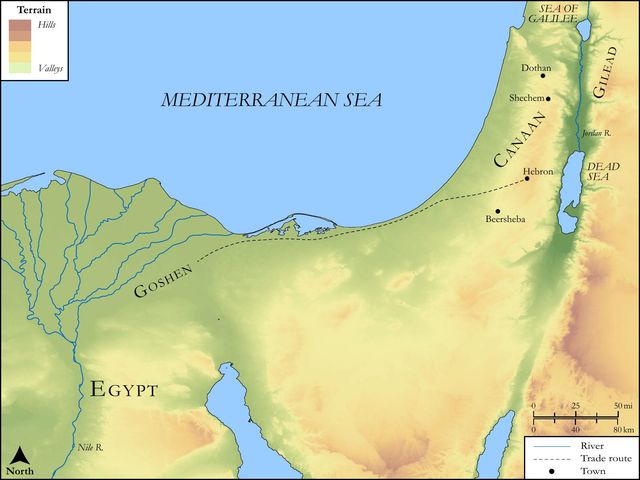
The elaborate funeral procession described here aligns with the grandeur of Egyptian funerary customs for high-ranking officials and their families. Embalming, as mentioned for Jacob in Genesis 50:2-3, was a meticulous and lengthy process, primarily an Egyptian practice. The journey from Egypt to Canaan was a significant undertaking, traversing considerable distance through varying terrain, which necessitated careful planning. The decision to leave the vulnerable "little ones" and valuable livestock in Goshen reflects sound logistical and cultural considerations, as large-scale migrations with dependents and herds were slow and exposed them to risks. Goshen itself, a fertile region in the eastern Nile Delta, had been specifically granted to Jacob's family by Pharaoh, providing a secure and prosperous base for their extensive flocks and herds (Genesis 47:6).
Key Themes
ShowHideThis verse contributes to several overarching themes in Genesis. It powerfully illustrates filial piety and covenant faithfulness, as Joseph and his family meticulously honor Jacob's dying request to be buried in the land of Canaan, thereby affirming their connection to the promises made to Abraham, Isaac, and Jacob regarding the land (Genesis 12:7). The comprehensive participation of the family, including "all the house of Joseph, and his brethren, and his father's house," highlights the theme of family unity and reconciliation, a remarkable achievement given the earlier deep divisions and betrayals within Jacob's family, particularly concerning Joseph (Genesis 45:4-8). Furthermore, the pragmatic decision to leave the vulnerable behind in Goshen demonstrates responsible stewardship and prudence, emphasizing the importance of wise management of people and resources.
Exposition and Analysis
ShowHideGenesis 50:8 provides a concise yet profound snapshot of the participants in Jacob's funeral procession, highlighting both the family's comprehensive involvement and their practical wisdom. The phrasing emphasizes unity and collective action, while the exclusion of the most vulnerable underscores a strategic and caring decision.
Key Word Analysis
ShowHideThis word, appearing twice in the verse ("house of Joseph," "father's house"), signifies more than a physical dwelling. It broadly refers to a family, household, or even a lineage. Its repetition here emphasizes the collective and comprehensive nature of Jacob's extended family, including all direct descendants and their immediate households, participating as a unified entity.
This term specifically denotes infants, young children, or dependents. Its inclusion highlights the most vulnerable members of the family. The decision to leave them behind underscores the arduous nature of the journey and the family's protective care, prioritizing the safety and well-being of those least able to endure the rigors of travel.
This verb means "to loosen, relinquish, permit, forsake, leave behind." In this context, it signifies a deliberate and strategic act of leaving certain members and assets in a secure location. It is not an abandonment but a responsible and temporary delegation, allowing the main body of the family to undertake the sacred duty without undue burden or risk to their most precious possessions.
Verse Breakdown
ShowHide"And all the house of Joseph, and his brethren, and his father's house:"
This clause comprehensively describes the participants in the funeral procession. "All the house of Joseph" refers to Joseph's immediate family, including his sons Manasseh and Ephraim, who held prominent positions in Egypt. "His brethren" denotes the other eleven sons of Jacob, who were the heads of the burgeoning tribes of Israel. "His father's house" encompasses the broader direct descendants of Jacob who had migrated to Egypt. Together, these phrases signify the full, collective involvement of Jacob's entire extended family, demonstrating their unity and shared purpose in honoring their patriarch.
"only their little ones, and their flocks, and their herds,"
This segment identifies the specific groups and assets that were not part of the procession. "Their little ones" refers to the young children and infants, highlighting their vulnerability. "Their flocks, and their herds" represent the family's primary source of wealth, sustenance, and livelihood. The exclusion of these elements underscores the practical challenges and potential risks associated with such a long and arduous journey for the most vulnerable and valuable resources.
"they left in the land of Goshen."
This final clause specifies the location where the dependents and livestock were kept. Goshen was the fertile region in Egypt where Pharaoh had settled Jacob's family. This action demonstrates a strategic and prudent decision to ensure the safety and well-being of those not directly involved in the funeral procession, allowing the adults to focus on their solemn duty without the added burden or risk of transporting vulnerable family members and essential economic assets. Goshen served as a secure and stable base.
Literary Devices
ShowHideThe verse effectively employs Merism by listing "all the house of Joseph, and his brethren, and his father's house" to signify the entirety of Jacob's descendants. This comprehensive enumeration emphasizes the complete and unified participation of the family, highlighting their solidarity. There is also an implicit Contrast between the solemn, arduous journey of the adults and the secure, stable environment provided for the vulnerable in Goshen. This contrast underscores the family's foresight and responsible planning. Furthermore, the act of burying Jacob in Canaan, anticipated by this procession, functions as Symbolism and Foreshadowing, pointing to the future return of the entire nation of Israel to the promised land, thereby reinforcing God's covenant promises.
Theological and Thematic Connections
ShowHideGenesis 50:8 is rich with theological implications, showcasing profound themes of covenant faithfulness, family unity, and responsible stewardship. The meticulous fulfillment of Jacob's dying wish to be buried in Canaan transcends mere filial piety; it is an act of faith in God's covenant promises regarding the land and the future of His people. This collective journey, undertaken by a family previously fractured by jealousy and betrayal, powerfully demonstrates the transformative power of reconciliation and shared purpose, culminating in a remarkable display of solidarity. The pragmatic decision to safeguard the vulnerable and valuable assets in Goshen further illustrates biblical principles of wise resource management and care for dependents, underscoring that spiritual devotion is often accompanied by practical wisdom.
Reflection and Application
ShowHideGenesis 50:8 offers profound lessons for contemporary believers, emphasizing the enduring importance of honoring commitments and demonstrating unwavering loyalty, particularly within the sacred bonds of family and community. The unified effort of Jacob's descendants, transcending past grievances to fulfill a solemn duty, serves as a powerful testament to the value of solidarity and mutual support, especially in moments of grief or significant life transitions. This passage challenges us to consider how we cultivate and maintain unity within our own families and spiritual communities, actively working towards reconciliation and shared purpose. Furthermore, the family's prudent decision to safeguard their most vulnerable members and essential resources in Goshen highlights the timeless principle of responsible stewardship. We are called to wisely manage the people, possessions, and opportunities entrusted to us, ensuring their safety, well-being, and flourishing. Ultimately, this passage encourages us to deeply value our spiritual heritage, recognizing that our faithful actions today contribute to the legacy we pass on to future generations, connecting us to God's unfolding promises throughout history.
Questions for Reflection
ShowHideFAQ
ShowHideWhy did the entire extended family participate in Jacob's funeral procession?
ShowHideThe participation of "all the house of Joseph, and his brethren, and his father's house" signifies a profound sense of family unity, respect, and commitment to their patriarch. It was a collective act of honoring Jacob's dying wish to be buried in Canaan, reinforcing their shared identity and connection to the covenant promises of God regarding the land and their future as a nation. This grand procession also reflected Joseph's high status in Egypt, allowing for such a large and dignified entourage.
What is the significance of leaving the "little ones, and their flocks, and their herds" in Goshen?
ShowHideThis decision demonstrates practical wisdom and responsible stewardship. The journey from Egypt to Canaan was long, arduous, and potentially dangerous. Leaving the vulnerable children and valuable livestock in the secure and fertile land of Goshen ensured their safety and well-being, allowing the adults to undertake the solemn duty without unnecessary burdens or risks. It highlights a prudent approach to managing resources and caring for dependents, prioritizing their security over their presence in a difficult journey. Goshen had been a place of provision and safety for the family since their arrival in Egypt (Genesis 47:6).
How does this event connect to the broader theme of the Promised Land?
ShowHideJacob's insistence on being buried in Canaan, and the family's dedication to fulfilling this wish, powerfully connects them to the land promises made to Abraham, Isaac, and Jacob throughout Genesis (Genesis 12:7). His burial in the Cave of Machpelah, a family tomb in the promised land, was not merely a family tradition but a tangible act of faith. It served as a symbolic anticipation of the future return of all Israel to their God-given inheritance, reinforcing their heritage and future hope, even while they were still dwelling in Egypt.
Christ-Centered Fulfillment
ShowHideWhile Genesis 50:8 describes a specific historical event concerning Jacob's burial, it offers profound shadows and types that find their ultimate fulfillment in Christ. The profound unity and commitment displayed by Jacob's family in honoring their patriarch and fulfilling his dying wish foreshadows the spiritual unity of the church, the new family of God, gathered under Christ, our ultimate Patriarch and Head (Ephesians 4:4-6). Just as Jacob's burial in the Promised Land affirmed God's covenant promises to his descendants, Christ's death, burial, and resurrection secure the true and eternal inheritance for all who believe, ushering us into the spiritual "Promised Land" of God's presence and eternal life (Hebrews 9:15 and 1 Peter 1:3-4). His journey to the cross, fulfilling all righteousness and God's promises, involved a divine "leaving behind" of heavenly glory for a greater redemptive purpose, echoing the family's willingness to leave their "little ones" and possessions in Goshen for the sacred duty (Philippians 2:5-8). Ultimately, Christ's perfect obedience and self-sacrifice fulfill the deepest longings for legacy, reconciliation, and the secure future that the patriarchs dimly perceived, providing the true rest and inheritance for all who are in Him (Matthew 11:28-30).