


Daniel 6:3
Bible text: King James Version (1769 Blayney text) · Public domain
Bible text: King James Version with Strong's numbers · Public domain
Bible text: Berean Standard Bible · Public domain
Bible text: American Standard Version (1901) · Public domain
Bible text: World English Bible, Messianic edition · Public domain
Bible text: Geneva Bible (1599) · Public domain
Bible text: Young's Literal Translation · Public domain
- אֱדַיִן'e·Da·yinthenH116AdvAdverb
- דָּנִיֵּאלda·ni·YelDanielH1841N-proper-mNoun Proper Masculine
- דְּנָהde·NahthisH1836PrtParticle Demonstrative
- הֲוָאha·Va'he wasH1934V-Peal-Perf-3msVerb Peal Perfect 3rd Singular Masculine
- מִתְנַצַּחmit·na·Tzachdistinguishing himselfH5330V-Hitpaal-Prtcpl-msVerb Hitpaal Participle Singular Masculine Absolute
- עַל'aloverH5922PrepPreposition
- סָרְכַיָּאsa·re·khai·Ya'overseers theH5632N-mp ¦ ArtNoun Plural Masculine Definiteסָרְכַיָּoverseersאthe
- וַאֲחַשְׁדַּרְפְּנַיָּאva·'a·chash·dar·pe·nai·Ya'and satraps theH324Conj-w ¦ N-mp ¦ ArtNoun Plural Masculine Definiteוַandאֲחַשְׁדַּרְפְּנַיָּsatrapsאthe
- כָּלkolas toPrep-k ¦ Prep-lPrepositionכָּasלto
- קֳבֵלko·VelbecauseH6903N-csNoun Singular common gender Absolute
- דִּיdithatH1768ConjConjunction
- רוּחַRu·acha spiritH7308N-csNoun Singular common gender Absolute
- יַתִּירָאya·ti·Ra'extraordinaryH3493Adj-fsAdjective Singular Feminine Absolute
- בֵּהּBeh[was] in himPrep-b ¦ 3msSuffix Personal 3rd Singular Masculineבֵּ[was] inהּhim
- וּמַלְכָּאu·mal·Ka'and king theH4430Conj-w ¦ N-cs ¦ ArtNoun Singular common gender Definiteוּandמַלְכָּkingאthe
- עֲשִׁית'a·Shit[was] planningH6246V-Peil-Prtcpl-msVerb Peil Participle Singular Masculine Absolute
- לַהֲקָמוּתֵהּla·ha·ka·mu·Tehto appoint himH6966Prep-l ¦ V-Hiphil-Inf ¦ 3fsVerb Hiphil Infinitive Constructלַtoהֲקָמוּתֵappointהּhim
- עַל'aloverH5922PrepPreposition
- כָּלkolallH3606N-cscNoun Singular common gender Construct
- מַלְכוּתָאmal·khu·Ta'kingdom theH4437N-fs ¦ ArtNoun Singular Feminine Definiteמַלְכוּתָkingdomאthe
English is a literal word-by-word gloss of the Hebrew, not the KJV's wording. Why?
This is the original text the KJV's translators worked from — each Hebrew word with its own literal English meaning in this verse, prepared by scholars at Tyndale House, Cambridge. The KJV translates whole sentences, not word by word, so its wording differs: one Hebrew word can become several English words, and the KJV may choose “the LORD” where the gloss reads “Yahweh”. Both are faithful — they answer different questions. For the KJV's own rendering, switch to the KJV text.
Details
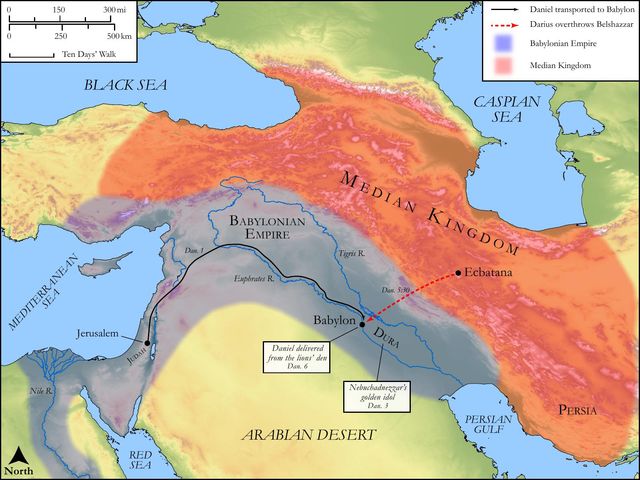
See on the biblical-era map
Study this verse
Public-domain commentary
Matthew Henry
From his Commentary on the Whole Bible. Henry comments on passages, not single verses — this entry covers Daniel 6:1–5. His two-level outline is real structure in the source text, so it is rendered as structure.
We are told concerning Daniel,
I.What a great man he was.
When Darius, upon his accession to the crown of Babylon by conquest, new-modelled the government, he made Daniel prime-minister of state, set him at the helm, and made him first commissioner both of the treasury and of the great seal. Darius's dominion was very large; all he got by his conquests and acquests was that he had so many more countries to take care of; no more can be expected from himself than what one man can do, and therefore others must be employed under him. He set over the kingdom 120 princes (Dan 6:1), and appointed them their districts, in which they were to administer justice, preserve the public peace, and levy the king's revenue. Note, Inferior magistrates are ministers of God to us for good as well as the sovereign; and therefore we must submit ourselves both to the king as supreme and to the governors that are constituted and commissioned by him, Pe1 2:13, Pe1 2:14. Over these princes there was a triumvirate, or three presidents, who were to take and state the public accounts, to receive appeals from the princes, or complaints against them in case of mal-administration, that the king should have no damage (Dan 6:2), that he should not sustain loss in his revenue and that the power he delegated to the princes might not be abused to the oppression of the subject, for by that the king (whether he thinks so or no) receives real damage, both as it alienates the affections of his people from him and as it provokes the displeasure of his God against him. Of these three Daniel was chief, because he was found to go beyond them all in all manner of princely qualifications. He was preferred above the presidents and princes (Dan 6:3), and so wonderfully well pleased the king was with his management that he thought to set him over the whole realm, and let him place and displace at his pleasure. Now,
1.We must take notice of it to the praise of Darius that he would prefer a man thus purely for his personal merit, and his fitness for business; and those sovereigns that would be well served must go by that rule. Daniel had been a great man in the kingdom that was conquered, and for that reason, one would think, should have been looked upon as an enemy, and as such imprisoned or banished. He was a native of a foreign kingdom, and a ruined one, and upon that account might have been despised as a stranger and captive. But, Darius, it seems, was very quick-sighted in judging of men's capacities, and was soon aware that this Daniel had something extraordinary in him, and therefore, though no doubt he had creatures of his own, not a few, that expected preferment in this newly-conquered kingdom, and were gaping for it, and those that had been long his confidants would depend upon it that they should be now his presidents, yet so well did he consult the public welfare that, finding Daniel to excel them all in prudence and virtue, and probably having heard of his being divinely inspired, he made him his right hand.
2.We must take notice of it, to the glory of God, that, though Daniel was now very old (it was above seventy years since he was brought a captive to Babylon), yet he was as able as ever for business both in body and mind, and that he who had continued faithful to his religion through all the temptations of the foregoing reigns in a new government was as much respected as ever. He kept in by being an oak, not by being a willow, by a constancy in virtue, not by a pliableness to vice. Such honesty is the best policy, for it secures a reputation; and those who thus honour God he will honour.
II.What a good man he was:
An excellent spirit was in him, Dan 6:3. And he was faithful to every trust, dealt fairly between the sovereign and the subject, and took care that neither should be wronged, so that there was no error, or fault, to be found in him, Dan 6:4. He was not only not chargeable with any treachery or dishonesty, but not even with any mistake or indiscretion. He never made any blunder, nor had any occasion to plead inadvertency or forgetfulness for his excuse. This is recorded for an example to all that are in places of public trust to approve themselves both careful and conscientious, that they may be free, not only from fault, but from error, not only from crime, but from mistake.
III.What ill-will was borne him, both for his greatness and for his goodness.
The presidents and princes envied him because he was advanced above them, and probably hated him because he had a watchful eye upon them and took care they should not wrong the government to enrich themselves. See here,
1.The cause of envy, and that is every thing that is good. Solomon complains of it as a vexation that for every right work a man is envied of his neighbour (Ecc 4:4), that the better a man is the worse he is thought of by his rivals. Daniel is envied because he has a more excellent spirit than his neighbours.
2.The effect of envy, and that is every thing that is bad. Those that envied Daniel sought no less than his ruin. His disgrace would not serve them; it was his death that they desired. Wrath is cruel, and anger is outrageous, but who can stand before envy? Pro 27:4. Daniel's enemies set spies upon him, to observe him in the management of his place; they sought to find occasion against him, something on which to ground an accusation concerning the kingdom, some instance of neglect or partiality, some hasty word spoken, some person borne hard upon, or some necessary business overlooked. And if they could but have found the mote, the mole-hill, of a mistake, it would have been soon improved to the beam, to the mountain, of an unpardonable misdemeanour. But they could find no occasion against him; they owned that they could not. Daniel always acted honestly, and now the more warily, and stood the more upon his guard, because of his observers, Psa 27:11. Note, We have all need to walk circumspectly, because we have many eyes upon us, and some that watch for our halting. Those especially have need to carry their cup even that have it full. They concluded, at length, that they should not find any occasion against him except concerning the law of his God Dan 6:5. It seems then that Daniel kept up the profession of his religion, and held it fast without wavering or shrinking, and yet that was no bar to his preferment; there was no law that required him to be of the king's religion, or incapacitated him to bear office in the state unless he were. It was all one to the king what God he prayed to, so long as he did the business of his place faithfully and well. He was at the king's service usque ad aras - as far as the altars; but there he left him. In this matter therefore his enemies hoped to ensnare him. Quaerendum est crimen laesae religionis ubi majestatis deficit - When treason could not be charged upon him he was accused of impiety. Grotius. Note, It is an excellent thing, and much for the glory of God, when those who profess religion conduct themselves so inoffensively in their whole conversation that their most watchful spiteful enemies may find no occasion of blaming them, save only in the matters of their God, in which they walk according to their consciences. It is observable that, when Daniel's enemies could find no occasion against him concerning the kingdom, they had so much sense of justice left that they did not suborn witnesses against him to accuse him of crimes he was innocent of, and to swear treason upon him, wherein they shame many that were called Jews and are called Christians.
Historical interpretation
Historical reception
2 surviving comments on this verse. Each one is dated, so this reads as a timeline rather than a list.
Select a marker to jump to its quote. Markers stagger vertically where authors wrote within a few decades of each other.
Verses 3, 4. "Moreover the king was planning to set Daniel over the whole realm. Consequently the princes and satraps sought an opportunity to find out something against Daniel as touching the king..." Instead of "princes" - the rendering used by Symmachus - Theodotion translated it as taktikoi, and Aquila as synektikoi. And when I inquired as to who these tacticians or liaison princes might be, I read it more clearly specified in the Septuagint, which renders: "...and the two men whom the king had appointed with Daniel, and also the one hundred twenty satraps." And so it was the fact that the king was planning to appoint Daniel as chief ruler even over the two princes who had been associated with him in a triumvirate that gave rise to the envy and intrigue. They sought an opportunity to find out something against Daniel as touching the king. And in this passage the Jews have ventured some such deduction as this: the side of the king is tantamount to the queen or his concubines and other wives who slept at his side. And so they were seeking for a pretext in things of this sort, to see whether they could accuse Daniel of wrong in his speech or touch or movements of his head or any of his sensory organs. But, say the Jews, they could find no cause for suspicion whatsoever. Since he was a eunuch, they could not even accuse him on the score of lewdness. This interpretation was made by those, who make a practice of fabricating long tales on the pretext of a single word. I myself would simply interpret this as meaning that they were unable to discover any pretext of accusation against him in any matter in which he had injured the king, for the simple reason that he was a faithful man and no suspicion of blame was discoverable in him. Instead of "suspicion" Theodotion and Aquila have rendered "offense" (amblakema), which is essaitha in the Chaldee. And when I asked a Jew for the meaning of this word, he replied that the basic significance of it was "snare," and we may render it as a "lure" or sphalma, that is, a "mistake." Furthermore Euripides in his "Medea" equates the word amplakiai (spelling it with a p instead of a b) to hamartiai, that is to say, "sins."
[Daniel] had received from God a greater and more abundant grace. Now, from this we learn that to those also who are entrusted with conduct of earthly affairs, even if unsympathetic to religion, a grace of wisdom is given from God for their management of those they rule. Blessed Daniel implied as much in saying, “Because there was an extraordinary spirit in him,” that is, he had received the grace in keeping with his religious sentiments.
Continue studying Daniel 6:3 across the web’s major study libraries — every link below opens this exact verse, chapter, or book on the destination site.
Read & Compare
 BibleGatewayThis verse in more than 200 translations and 70 languages.
 Bible.comThe YouVersion reader — hundreds of translations, reading plans, and highlights.
 ESV.orgCrossway's official English Standard Version reader.
 NET BibleThe NET translation with 60,000+ translators' notes on every rendering decision.
 STEP BibleTyndale House's free study tool — original text, vocabulary, and scholarly resources.
 BibliaLogos Bible Software's free web reader.
 USCCBThe New American Bible (Revised Edition) with the U.S. bishops' study notes.
Commentaries
 BibleHub CommentariesDozens of classic commentaries on this verse, gathered on one page.
 StudyLightMore than 100 commentary sets — the largest collection on the web.
 BibleRefPlain-English commentary on what this verse means, verse by verse.
 Enduring WordDavid Guzik's free commentary on this chapter, widely used by Bible teachers.
 Bible Study ToolsVerse commentary alongside Greek and Hebrew study aids.
Original Language & Research
- BibleHub InterlinearThe verse word by word — original language, transliteration, and English.
- BibleHub LexiconEvery word's original-language definition and Strong's entry.
 Blue Letter BibleDeep-study tools — Strong's numbers, concordance, and word studies.
 SefariaThe Hebrew text with Rashi and centuries of Jewish commentary.
Sermons, Hymns & Audio


TrulyRandomVerse is not affiliated with these sites and doesn’t control their content. They’re linked because they’re genuinely useful.
Summary
Daniel 6:3 vividly portrays the exceptional character and administrative prowess of Daniel, an exiled Judean, which led to his unparalleled elevation within the newly established Medo-Persian Empire under King Darius. His profound inner quality, described as an "excellent spirit," distinguished him significantly above all other high-ranking officials and provincial governors, prompting the king's intention to appoint him as the chief administrator over the entire vast kingdom. This verse establishes Daniel's preeminent standing, serving as the crucial narrative pivot that both highlights divine favor and sets the stage for the intense jealousy and subsequent conspiracy that would inevitably arise from his remarkable promotion.
Context
ShowHideLiterary Context
Daniel 6:3 is strategically placed within the narrative of Daniel's service under King Darius, immediately following the Medo-Persian conquest of Babylon, which is succinctly detailed in Daniel 5:30-31. The preceding verses (Daniel 6:1-2) describe Darius's methodical reorganization of his vast new empire, establishing 120 satraps (princes) and three presidents over them, with Daniel being one of these three. This verse specifically highlights Daniel's unique qualifications and the king's profound recognition of his superior abilities, explaining why he was preferred and why the other officials would later conspire against him. It serves as the pivotal point that escalates Daniel's influence and simultaneously ignites the envy of his peers, directly leading to the dramatic events of the lions' den, making it a crucial setup for the chapter's climax.
Historical & Cultural Context
The Medo-Persian Empire, under Darius the Mede (likely a high-ranking general or viceroy operating under the ultimate authority of Cyrus the Great), had just absorbed the vast Babylonian territories. This transition period often involved significant administrative restructuring to consolidate power, ensure efficient governance, and integrate diverse peoples and conquered lands. In such a context, loyalty, competence, and unwavering integrity were highly valued, especially in foreign administrators who could bridge cultural gaps and manage complex affairs. Daniel, despite being an exile from Judah, had already demonstrated exceptional wisdom, administrative skill, and divine favor under previous Babylonian kings, particularly during the reigns of Nebuchadnezzar (Daniel 2) and Belshazzar (Daniel 5), making him a known and trusted figure. His advanced age and long-standing experience would have further contributed to his gravitas and perceived reliability in the eyes of Darius, who sought to establish a stable and effective administration for his burgeoning empire. The appointment of foreigners to high office was not unheard of in the courts of kings, as with Joseph in Egypt, provided they proved their loyalty and capability, and Daniel's track record was impeccable.
Key Themes
ShowHideThis verse powerfully contributes to several overarching themes woven throughout the book of Daniel. Firstly, it underscores the theme of Divine Sovereignty and Providence, demonstrating how God sovereignly elevates His faithful servants even in pagan empires, using them to achieve His purposes and bear witness to His power and truth (Daniel 2:20-23). Secondly, it highlights the theme of Integrity and Excellence in Public Service. Daniel's "excellent spirit" signifies not just profound spiritual piety but also unparalleled administrative competence, moral uprightness, and incorruptibility, which made him indispensable to the king. This theme is further developed as his enemies are unable to find any fault or corruption in his conduct (Daniel 6:4). Lastly, it sets the stage for the theme of Conflict Between God's People and Worldly Powers, as Daniel's divine favor and human excellence inevitably provoke the jealousy, envy, and opposition of those who operate by lesser standards and worldly ambition, leading to direct confrontation.
Exposition and Analysis
ShowHideKey Word Analysis
ShowHideThis Aramaic term, corresponding to the Hebrew natsach, signifies "to become chief" or "to be preferred." It implies Daniel's elevation to a position of preeminence and authority above others. It is not merely a matter of being chosen, but of being recognized as superior and thus granted a position of leadership. This word highlights the active choice and recognition by the king, based on Daniel's demonstrated qualities and capabilities, setting him apart from his peers.
This adjective means "preeminent" or "exceeding(-ly)." It describes a quality that is far above the ordinary, marking Daniel as truly exceptional and extraordinary. When applied to his "spirit," it suggests a surpassing quality of mind, character, and wisdom that set him apart from all his contemporaries. It emphasizes an extraordinary, rather than merely good or sufficient, quality, indicating a level of distinction that was undeniable even to a pagan king.
In this context, rûwach refers to Daniel's inner disposition, intellect, character, and moral essence. While it can mean "wind" or "breath," here it denotes the animating principle or the very essence of Daniel's being, imbued with divine insight and integrity. The combination with "excellent" indicates a profound spiritual and intellectual endowment, suggesting a mind guided by divine wisdom, a character marked by integrity and discernment, and a moral compass that was unswerving.
Verse Breakdown
ShowHide"Then this Daniel was preferred above the presidents and princes,"
This clause immediately establishes Daniel's elevated status within the newly reorganized Medo-Persian government. It highlights his unique position, rising not only above the 120 princes (satraps) but also above the other two presidents who shared his rank. The use of "this Daniel" emphasizes his identity as the same individual known for his wisdom and integrity under previous Babylonian kings, underscoring the continuity of his exceptional character and divine favor. His preference was not arbitrary or based on favoritism, but a direct recognition of his proven capabilities and superior qualities.
"because an excellent spirit [was] in him;"
This is the pivotal explanatory clause, providing the core reason for Daniel's preeminence. The phrase "an excellent spirit" points to an extraordinary inner quality—a combination of profound wisdom, exceptional discernment, impeccable integrity, and perhaps a divine anointing. This spirit transcended mere human intelligence or administrative skill; it implied a moral and intellectual superiority that was evident to all, including the pagan king. It suggests a character that was incorruptible, highly efficient, and divinely guided, making him an invaluable asset to the empire.
"and the king thought to set him over the whole realm."
This final clause reveals the king's ultimate intention for Daniel, demonstrating the extent of the trust and confidence placed in him. Not content with Daniel's role as one of three presidents, Darius recognized Daniel's singular capability and planned to make him the chief administrator over the entire vast Medo-Persian Empire. This proposed promotion signifies the highest possible human authority within the imperial system, further emphasizing Daniel's unparalleled standing. This intention also serves as the direct catalyst for the intense jealousy and conspiracy that would inevitably follow from the other high-ranking officials.
Literary Devices
ShowHideDaniel 6:3 masterfully employs several literary devices to convey its powerful message. Characterization is central, as the verse directly describes Daniel's intrinsic quality ("an excellent spirit") as the primary reason for his promotion. This direct characterization immediately establishes Daniel as a figure of exceptional virtue, wisdom, and capability, setting him apart from all others. The phrase "excellent spirit" itself functions as a potent Epithet, a descriptive phrase expressing a quality characteristic of the person mentioned, effectively summarizing Daniel's unique and divinely endowed nature. Furthermore, the verse utilizes Foreshadowing, as the king's intention to "set him over the whole realm" implicitly hints at the immense power Daniel would wield, and by extension, the intense jealousy and opposition this elevation would provoke from other officials, thereby setting the stage for the dramatic conflict and the subsequent events of the lions' den. There is also a clear element of Contrast implied within the verse, as Daniel's "excellent spirit" implicitly contrasts with the presumed lesser or corrupt spirits of the other presidents and princes, highlighting his singular moral, intellectual, and administrative superiority.
Theological and Thematic Connections
ShowHideDaniel 6:3 profoundly illustrates that true excellence, particularly when divinely endowed and faithfully cultivated, is recognized and rewarded, even in secular spheres and by pagan authorities. Daniel's "excellent spirit" is not merely a testament to his natural gifts but points to a divine enablement and wisdom that set him apart. This verse underscores the biblical principle that God can and does use His faithful servants in positions of significant influence within worldly systems, not for their personal aggrandizement, but to advance His kingdom purposes, bear witness to His truth, and demonstrate His power. Daniel's integrity, competence, and incorruptibility were a direct outflow of his deep relationship with God, making him an invaluable asset to the king and a powerful testimony in a land steeped in idolatry. This divine favor and human excellence serve as a compelling model for believers called to operate in various professional capacities, demonstrating that faithfulness to God can lead to unexpected opportunities for impact.
Reflection and Application
ShowHideDaniel 6:3 offers a timeless blueprint for impactful living and leadership, particularly for believers navigating professional and public spheres in a world often hostile to godly principles. Daniel's "excellent spirit" was not a passive quality but manifested actively in diligent, honest, and supremely competent service that earned the profound trust and respect of a pagan king. This challenges us to pursue excellence in our own vocations, recognizing that our work ethic, integrity, and character are powerful, tangible testimonies to the God we serve. It reminds us that true influence often stems not from overtly seeking positions of power or engaging in self-promotion, but from cultivating an inner life of integrity, wisdom, and faithfulness, empowered by God's Spirit. When we operate with an "excellent spirit"—marked by diligence, honesty, humility, and a steadfast commitment to righteousness—we become indispensable, not just to human employers or organizations, but as instruments in God's hands, capable of impacting our communities and cultures for His glory and the advancement of His kingdom. Our quiet faithfulness in daily tasks can speak volumes.
Questions for Reflection
ShowHideFAQ
ShowHideWhat exactly is meant by "an excellent spirit" in Daniel 6:3, and is it a spiritual or intellectual quality?
ShowHideThe phrase "an excellent spirit" (Aramaic: rûwach yattîyr) refers to Daniel's extraordinary inner quality, encompassing a profound combination of intellectual acumen, exceptional discernment, impeccable moral integrity, and superior administrative capability. It signifies a character that was not only morally upright and incorruptible but also intellectually sharp, highly efficient, and divinely inspired. This was not merely human talent or acquired skill, but a supernatural endowment from God, enabling Daniel to perform his duties with unparalleled effectiveness and honesty, setting him apart from his contemporaries. This divine wisdom and insight had been evident throughout his life, as seen in his ability to interpret dreams and understand visions (e.g., Daniel 1:17 and Daniel 2:19-23). Therefore, it is both a spiritual and intellectual quality, divinely infused and practically manifested.
How did Daniel, an exile, manage to attain such high positions in successive pagan empires without compromising his faith?
ShowHideDaniel's consistent elevation to high office across different empires (Babylonian and Medo-Persian) can be attributed to a unique combination of factors, all rooted in God's sovereign plan and Daniel's unwavering faithfulness. First, he possessed genuine, God-given wisdom and insight that far surpassed that of the local wise men and administrators (as powerfully demonstrated in Daniel 2 and Daniel 5). Second, he maintained unwavering integrity, moral uprightness, and faithfulness to God, even under immense pressure, which made him trustworthy and incorruptible in the eyes of the kings, who often faced corruption among their own officials. Third, God's divine favor was clearly upon him, orchestrating circumstances for Daniel to be recognized, promoted, and protected, ensuring His servant was strategically positioned to bear witness to His power and truth in the heart of these world powers, all while remaining steadfast in his devotion (Daniel 6:10).
Christ-Centered Fulfillment
ShowHideDaniel's "excellent spirit" and his subsequent elevation to a position of unparalleled authority within a vast pagan empire serve as a profound foreshadowing of Jesus Christ. While Daniel possessed an excellent spirit, Christ is the very embodiment of the Spirit of God, in whom "are hidden all the treasures of wisdom and knowledge" (Colossians 2:3). Daniel's impeccable integrity, administrative competence, and the trust that led a pagan king to consider setting him over the whole realm, all point to Christ's perfect righteousness and His ultimate, universal reign. Jesus, the true Son of David, did not merely have an "excellent spirit" but was filled with the Holy Spirit without measure (John 3:34), demonstrating perfect obedience, wisdom, and authority throughout His earthly ministry. Just as Daniel was preferred above all others by an earthly king, God the Father has "highly exalted Him and bestowed on Him the name that is above every name" (Philippians 2:9), setting Him not merely over a temporary earthly realm, but over "all things" (Ephesians 1:22) as the King of kings and Lord of lords (Revelation 19:16). Daniel's story, therefore, is a beautiful type, reflecting the preeminence, wisdom, and ultimate authority that belong to Christ alone, the one through whom all creation was made and by whom all things are sustained (Colossians 1:16-17).