


Deuteronomy 10:3
Bible text: King James Version (1769 Blayney text) · Public domain
Bible text: King James Version with Strong's numbers · Public domain
Bible text: Berean Standard Bible · Public domain
Bible text: American Standard Version (1901) · Public domain
Bible text: World English Bible, Messianic edition · Public domain
Bible text: Geneva Bible (1599) · Public domain
Bible text: Young's Literal Translation · Public domain
- וָאַעַשׂva·'A·'asand I madeH6213Conj-w ¦ V-Qal-ConsecImperf-1csVerb Qal Consecutive Imperfect 1st Singular common genderוָandאַעַשׂI made
- אֲרוֹן'a·rOnan ark ofH727N-mscNoun Singular Masculine Construct
- עֲצֵי'a·Tzeiwood<s> ofH6086N-mpcNoun Plural Masculine Construct
- שִׁטִּיםshi·TimacaciaH7848N-mpNoun Plural Masculine Absolute
- וָאֶפְסֹלva·'ef·Soland I cut outH6458Conj-w ¦ V-Qal-ConsecImperf-1csVerb Qal Consecutive Imperfect 1st Singular common genderוָandאֶפְסֹלI cut out
- שְׁנֵיshe·neitwoH8147N-cdcNoun Dual common gender Construct
- לֻחֹתlu·Chottablets ofH3871N-fpcNoun Plural Feminine Construct
- אֲבָנִים'a·va·Nimstone<s>H68N-fpNoun Plural Feminine Absolute
- כָּרִאשֹׁנִיםka·ri·sho·Nimlike the former [tablets]H7223Prep-k ¦ Adj-mpAdjective Numerical Position Plural Masculine Absoluteכָּlike theרִאשֹׁנִיםformer [tablets]
- וָאַעַלva·'A·'aland I went upH5927Conj-w ¦ V-Qal-ConsecImperf-1csVerb Qal Consecutive Imperfect 1st Singular common genderוָandאַעַלI went up
- הָהָרָהha·Ha·rahthe mountain towardsH2022Art ¦ N-ms ¦ SfxNoun Singular Masculine Absoluteהָtheהָרָmountainהtowards
- וּשְׁנֵיu·she·Neiand [the] twoH8147Conj-w ¦ N-cdcNoun Dual common gender Constructוּandשְׁנֵי[the] two
- הַלֻּחֹתha·lu·Chotthe tabletsH3871Art ¦ N-fpNoun Plural Feminine Absoluteהַtheלֻּחֹתtablets
- בְּיָדִיbe·ya·Di[were] in my handH3027Prep-b ¦ N-csc ¦ 1csNoun Singular common gender Constructבְּ[were] inיָדִhandיmy
English is a literal word-by-word gloss of the Hebrew, not the KJV's wording. Why?
This is the original text the KJV's translators worked from — each Hebrew word with its own literal English meaning in this verse, prepared by scholars at Tyndale House, Cambridge. The KJV translates whole sentences, not word by word, so its wording differs: one Hebrew word can become several English words, and the KJV may choose “the LORD” where the gloss reads “Yahweh”. Both are faithful — they answer different questions. For the KJV's own rendering, switch to the KJV text.
Details
See on the biblical-era map
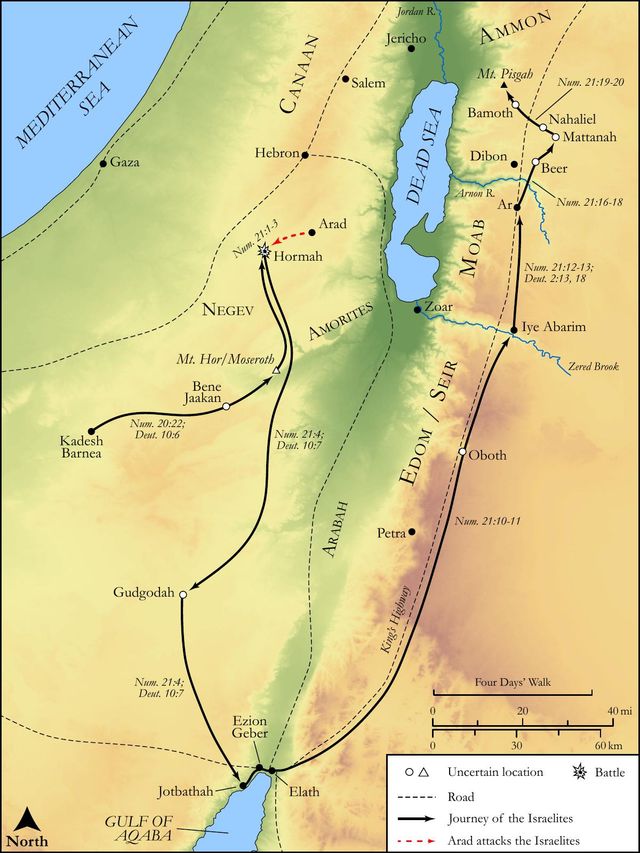
Study this verse
Public-domain commentary
Matthew Henry
From his Commentary on the Whole Bible. Henry comments on passages, not single verses — this entry covers Deuteronomy 10:1–11. His two-level outline is real structure in the source text, so it is rendered as structure.
There were four things in and by which God showed himself reconciled to Israel and made them truly great and happy, and in which God's goodness took occasion from their badness to make him the more illustrious: -
I.He gave them his law, gave it to them in writing, as a standing pledge of his favour.
Though the tables that were first written were broken, because Israel had broken the commandments, and God might justly break the covenant, yet when his anger was turned away the tables were renewed, Deu 10:1, Deu 10:2. Note, God's putting his law in our reconciliation to God and the best earnest of our happiness in him. Moses is told to hew the tables; for the law prepares the heart by conviction and humiliation for the grace of God, but it is only that grace that then writes the law in it. Moses made an ark of shittim-wood (Deu 10:3), a plain chest, the same, I suppose, in which the tables were afterwards preserved: but Bezaleel is said to make it (Exo 37:1), because he afterwards finished it up and overlaid it with gold. Or Moses is said to make it because, when he went up the second time into the mount, he ordered it to be made by Bezaleel against he came down. And it is observable that for this reason the ark was the first thing that God gave orders about, Exo 25:10. And this left an earnest to the congregation that the tables should not miscarry this second time, as they had done the first. God will send his law and gospel to those whose hearts are prepared as arks to receive them. Christ is the ark in which now our salvation is kept safely, that it may not be lost as it was in the first Adam, when he had it in his own hand. Observe,
1.What it was that God wrote on the two tables, the ten commandments (Deu 10:4), or ten words, intimating in how little a compass they were contained: they were not ten volumes, but ten words: it was the same with the first writing, and both the same that he spoke in the mount. The second edition needed no correction nor amendment, nor did what he wrote differ form what he spoke. The written word is as truly the word of God as that which he spoke to his servants the prophets.
2.What care was taken of it. These two tables, thus engraven, were faithfully laid up in the ark. And there they be, said Moses, pointing it is probable towards the sanctuary, Deu 10:5. That good thing which was committed to him he transmitted to them, and left it pure and entire in their hands; now let them look to it at their peril. Thus we may say to the rising generation, "God has entrusted us with Bibles, sabbaths, sacraments, etc., as tokens of his presence and favour, and there they be; we lodge them with you," Ti2 1:13, Ti2 1:14.
II.He led them forward towards Canaan, though they in their hearts turned back towards Egypt, and he might justly have chosen their delusions, Deu 10:6, Deu 10:7. He brought them to a land of rivers of waters, out of a dry and barren wilderness. Sometimes God supplied their wants by the ordinary course of nature: when that failed, then by miracles; and yet after this, when they were brought into a little distress, we find them distrusting God and murmuring, Num 20:3, Num 20:4.
III.He appointed a standing ministry among them, to deal for them in holy things.
At that time when Moses went up a second time to the mount, or soon after, he had orders to separate the tribe of Levi to God, and to his immediate service, they having distinguished themselves by their zeal against the worshippers of the golden calf, Deu 10:8, Deu 10:9. The Kohathites carried the ark; they and the other Levites stood before the Lord, to minister to him in all the offices of the tabernacle; and the priests, who were of that tribe, were to bless the people. This was a standing ordinance, which had now continued almost forty years, even unto this day; and provision was made for the perpetuating of it by the settled maintenance of that tribe, which was such as gave them great encouragement in their work, and no diversion from it. The Lord is his inheritance. Note, A settled ministry is a great blessing to a people, and a special token of God's favour. And, since the particular priests could not continue by reason of death, God showed his care of the people in securing a succession, which Moses takes notice of here, Deu 10:6. When Aaron died, the priesthood did not die with him, but Eleazar his son ministered in his stead, and took care of the ark, in which the tables of stone, those precious stones, were deposited, that they should suffer no damage; there they be, and he has the custody of them. Under the law, a succession in the ministry was kept up, by an entail of the office on a certain tribe and family. But now, under the gospel, when the effusion of the Spirit is more plentiful and powerful, the succession is kept up by the Spirit's operation on men's hearts, qualifying men for, and inclining men to, that work, some in every age, that the name of Israel may not be blotted out.
IV.He accepted Moses as an advocate or intercessor for them, and therefore constituted him their prince and leader (Deu 10:10, Deu 10:11):
The Lord hearkened to me and said, Arise, go before the people. It was a mercy to them that they had such a friend, so faithful both to him that appointed him and to those for whom he was appointed. It was fit that he who had saved them from ruin, by his intercession with heaven, should have the conduct and command of them. And herein he was a type of Christ, who, as he ever lives making intercession for us, so he has all power both in heaven and in earth.
Continue studying Deuteronomy 10:3 across the web’s major study libraries — every link below opens this exact verse, chapter, or book on the destination site.
Read & Compare
 BibleGatewayThis verse in more than 200 translations and 70 languages.
 Bible.comThe YouVersion reader — hundreds of translations, reading plans, and highlights.
 ESV.orgCrossway's official English Standard Version reader.
 NET BibleThe NET translation with 60,000+ translators' notes on every rendering decision.
 STEP BibleTyndale House's free study tool — original text, vocabulary, and scholarly resources.
 BibliaLogos Bible Software's free web reader.
 USCCBThe New American Bible (Revised Edition) with the U.S. bishops' study notes.
Commentaries
 BibleHub CommentariesDozens of classic commentaries on this verse, gathered on one page.
 StudyLightMore than 100 commentary sets — the largest collection on the web.
 BibleRefPlain-English commentary on what this verse means, verse by verse.
 Enduring WordDavid Guzik's free commentary on this chapter, widely used by Bible teachers.
 Bible Study ToolsVerse commentary alongside Greek and Hebrew study aids.
Original Language & Research
- BibleHub InterlinearThe verse word by word — original language, transliteration, and English.
- BibleHub LexiconEvery word's original-language definition and Strong's entry.
 Blue Letter BibleDeep-study tools — Strong's numbers, concordance, and word studies.
 SefariaThe Hebrew text with Rashi and centuries of Jewish commentary.
Sermons, Hymns & Audio


TrulyRandomVerse is not affiliated with these sites and doesn’t control their content. They’re linked because they’re genuinely useful.
Summary
Deuteronomy 10:3 recounts Moses' faithful obedience to God's command to construct an ark of acacia wood and to hew two new stone tablets, mirroring the first set, after Israel's profound sin with the golden calf. This pivotal act, preceding Moses' re-ascent of Mount Horeb, powerfully underscores God's boundless grace, His unwavering commitment to covenant renewal, and the re-establishment of the foundational principles of His relationship with a rebellious people, symbolizing His enduring presence and the immutability of His divine law.
Context
ShowHideLiterary Context
Deuteronomy 10:3 is strategically placed within Moses' second major discourse, delivered to the new generation of Israelites on the plains of Moab as they prepare to enter the Promised Land. This verse specifically falls within a section Deuteronomy 9-10 where Moses vividly recounts Israel's past rebellions, particularly the catastrophic golden calf incident, and God's subsequent enduring faithfulness and mercy. The immediate preceding verses detail Moses' fervent intercession on behalf of the people after he broke the first tablets in righteous anger Deuteronomy 9:15-17. Deuteronomy 10:1-2 directly sets the stage for this verse, describing God's command for Moses to prepare new tablets and an ark, highlighting the divine initiative in restoring the broken covenant. Moses' personal involvement in making the ark and preparing the tablets, as stated in this verse, emphasizes his crucial mediatorial role in facilitating this profound act of restoration and reconciliation.
Historical & Cultural Context
The setting for this passage is the culmination of Israel's forty-year wilderness wandering, with the generation that experienced the initial covenant at Sinai having largely passed away. Moses' address serves as a vital re-orientation for the new generation, reminding them of their covenant obligations and the character of the God who delivered them. The construction of the Ark of the Covenant, even in this summary account, was of paramount importance in ancient Israelite worship. The tables of the covenant, which the LORD Himself had written, were placed in the ark as the abiding witness of His authority. The Ark, made of durable acacia (shittim) wood—a material readily available in the desert—would become the central cultic object for Israel, signifying Yahweh's dwelling among His people and housing the very terms of His covenant. The act of hewing new tablets, precisely "like unto the first," was a powerful, tangible symbol of God's willingness to re-engage with His people on the original, unchanging terms, despite their profound infidelity.
Key Themes
ShowHideDeuteronomy 10:3 powerfully contributes to several overarching themes that permeate the book of Deuteronomy and the broader Pentateuch. A primary theme is Divine Forgiveness and Restoration. Despite Israel's egregious idolatry with the golden calf, God, in His boundless grace, chose to renew His covenant, commanding the preparation of new tablets and an ark to house them. This demonstrates God's profound patience and His unwavering commitment to His covenant promises, even when His people prove unfaithful Deuteronomy 4:31. Secondly, the verse underscores the Centrality and Enduring Authority of God's Law. The Ten Commandments, inscribed on these stone tablets, were not merely suggestions but the foundational principles for Israel's life, identity, and relationship with God. Their re-inscription and placement in the Ark signify their eternal relevance and the necessity of obedience for national flourishing. Finally, the verse highlights Moses' Unique Role as Mediator. Moses' actions—making the ark, hewing the tablets, and ascending the mount—reaffirm his indispensable position as the one chosen by God to intercede for Israel and to deliver God's commands, a role that profoundly foreshadows the ultimate mediator to come Deuteronomy 18:15.
Exposition and Analysis
ShowHideKey Word Analysis
ShowHideThis term, derived from a root meaning "to gather," refers to a box or chest. In this sacred context, it specifically denotes the Ark of the Covenant, which was far more than a mere container. It served as the most sacred object in Israelite worship, symbolizing God's throne, His immanent presence among His people, and the dwelling place of His covenant. Its construction was a crucial step in re-establishing the visible symbols of God's relationship with Israel.
This feminine noun refers to the acacia tree, common in the desert regions where Israel wandered. The wood of the acacia tree is renowned for its exceptional hardness, durability, and natural resistance to decay and insect infestation. Its selection for the Ark and other Tabernacle furnishings was not arbitrary; it symbolized the enduring, unyielding, and steadfast nature of God's covenant and His commands, designed to withstand the tests of time and the challenges of human frailty.
This word, possibly meaning "to glisten," refers to a tablet, typically of stone, wood, or metal. Here, it specifically denotes the stone tablets (Hebrew, ʼeben, H68) upon which the Ten Commandments were inscribed by the finger of God. The choice of stone as the material conveys permanence and immutability, reflecting the eternal and unchanging nature of God's law. The fact that new tables were hewn "like unto the first" emphasizes the continuity and renewal of the covenant on its original, foundational terms, not a new covenant with different stipulations.
Verse Breakdown
ShowHide"And I made an ark [of] shittim wood"
This clause emphasizes Moses' direct and obedient response to God's command (Exodus 34:1). While the detailed construction of the Ark was later executed by Bezalel (Exodus 37:1-9), Moses' statement here, in his summary address, highlights his personal initiative and oversight in the process of covenant renewal. The specific mention of "shittim wood" (acacia) underscores the practical and symbolic qualities of durability and sacredness, ensuring a fitting and lasting container for the divine law.
"and hewed two tables of stone like unto the first"
This phrase is profoundly significant, signifying the re-establishment of the covenant on its original, unchanging terms. The first tables were broken by Moses in righteous indignation over Israel's idolatry (Exodus 32:19), symbolizing the broken covenant relationship. God's command for new tables, and Moses' diligent act of hewing them, demonstrates God's willingness to restore the relationship and Israel's active participation in that restoration through obedience. The crucial phrase "like unto the first" ensures continuity, affirming the unchanging nature of God's moral law and His covenant demands.
"and went up into the mount, having the two tables in mine hand"
This final clause vividly portrays Moses' indispensable mediatorial role and his direct, intimate encounter with God. His ascent to Mount Horeb (Sinai) with the newly prepared tablets signifies the solemn renewal of the covenant, where God would once again inscribe His law. The image of Moses carrying the tables underscores his weighty responsibility as the chosen conduit for God's word to His people, a sacred task that highlights his unique position between God and Israel.
Literary Devices
ShowHideDeuteronomy 10:3 is rich with powerful literary devices. Recapitulation is central, as Moses retells a pivotal event from Israel's recent past. This is not merely a historical recounting but a didactic tool, designed to instruct the new generation on God's unwavering faithfulness despite their ancestors' rebellion, and to impress upon them their ongoing covenant obligations. The verse is replete with profound Symbolism: the "ark of shittim wood" symbolizes God's enduring presence among His people and the sacred repository for His covenant; the "tables of stone" symbolize the permanence, authority, and immutability of God's divine law; and Moses' ascent "into the mount" symbolizes direct, intimate communion with the divine, as well as the solemnity of covenant renewal. There is also a clear Emphasis on divine grace and human obedience; God's command for new tablets highlights His restorative character and His willingness to forgive, while Moses' immediate and faithful action underscores the critical importance of a responsive and obedient human will in the face of divine initiative.
Theological and Thematic Connections
ShowHideDeuteronomy 10:3 stands as a profound testament to God's character as a God of second chances, demonstrating His unwavering commitment to His covenant people even in the face of their profound infidelity. Despite Israel's egregious sin of idolatry with the golden calf, God mercifully initiates a path to reconciliation, showcasing His boundless grace and immense patience. This act of covenant renewal underscores that God's faithfulness is not contingent on human perfection but is rooted in His own steadfast love and sovereign purposes. The preparation of the ark and the new tablets emphasizes the enduring centrality of God's word and His manifest presence in the life of His people, providing the indispensable foundation for their identity, their moral framework, and their ongoing walk with Him. It powerfully teaches us that even in the face of profound failure and brokenness, genuine repentance and faithful obedience can lead to divine restoration and renewed intimacy with God.
Reflection and Application
ShowHideDeuteronomy 10:3 offers a powerful and enduring message of hope and restoration for believers in every generation. It serves as a profound reminder that our God is a God of infinite patience and boundless grace, always ready to extend forgiveness and offer a path to renewal, even after our most significant failures and acts of rebellion. Just as He did not abandon Israel after the catastrophic golden calf incident, He does not abandon us in our sin, but persistently invites us to return to Him, to humbly embrace His restorative grace, and to re-engage with His timeless truths. The emphasis on the Ark and the tablets calls us to a deep introspection about what we truly hold central in our lives—is it God's word and His manifest presence that define our existence? This verse encourages us to live in humble, responsive obedience to His commands, recognizing that His law is not a burdensome set of rules but a divine guide to true life, flourishing, and freedom. It challenges us to emulate Moses' responsiveness to God's call, committing ourselves to carrying His truth and embodying His grace in a world that desperately needs both.
Questions for Reflection
ShowHideFAQ
ShowHideWhy did Moses make the ark in this account, when Exodus attributes its construction to Bezalel?
ShowHideMoses' account in Deuteronomy is a summary, a retrospective address to the new generation of Israelites, designed to emphasize key lessons and God's faithfulness. In this context, Moses highlights his own direct involvement in the process of covenant renewal, underscoring his obedience to God's command to prepare for the re-inscription of the law. While Bezalel was indeed the divinely gifted craftsman who executed the detailed construction of the Ark according to the specifications given in Exodus 25:10-22, Moses' statement "I made an ark" in Deuteronomy 10:3 can be understood as Moses overseeing, initiating, or even representing the collective effort under his leadership. The focus here is on the purpose and necessity of the Ark in the renewal of the covenant, underscoring Moses' indispensable mediatorial role in facilitating the entire process of reconciliation.
What is the significance of "shittim wood" for the Ark?
ShowHide"Shittim wood" is the common name for acacia wood, which was readily available in the desert regions where the Israelites journeyed. Its significance lies in both its practical qualities and its profound symbolic meaning. Acacia wood is remarkably durable, exceptionally hard, and highly resistant to decay and insect infestation, making it an ideal material for sacred objects meant to last for generations. Symbolically, its enduring nature powerfully reflects the permanence, steadfastness, and unyielding truth of God's covenant and His divine commands, which are designed to withstand the test of time and the challenges faced by His people throughout history.
Why were new tables of stone needed, and why were they "like unto the first"?
ShowHideNew tables were needed because the first set, inscribed by God Himself, was broken by Moses in righteous anger when he witnessed Israel's idolatrous worship of the golden calf (Exodus 32:19). This dramatic act symbolized the profound breaking of the covenant by Israel's egregious sin. God's subsequent command for Moses to hew new tables demonstrated His boundless willingness to forgive and renew the covenant despite Israel's profound failure. The crucial phrase "like unto the first" is highly significant, signifying that the terms of the covenant remained unchanged. God's law and His expectations for His people were constant and immutable, emphasizing the continuity of His moral demands and His unwavering faithfulness to His original promises.
Christ-Centered Fulfillment
ShowHideDeuteronomy 10:3, with its account of the Ark and the renewed stone tablets, profoundly foreshadows the person and redemptive work of Jesus Christ. The Ark, serving as the dwelling place of God's presence among His people and containing the sacred law, finds its ultimate and perfect fulfillment in Christ. He is the true tabernacle, the very embodiment of God's presence, for in Him "all the fullness of God was pleased to dwell" (Colossians 1:19). Just as the Ark housed the written law, Christ is the living Word of God, the perfect expression of divine truth, righteousness, and the very will of God (John 1:1). The breaking of the first tablets symbolized humanity's inherent inability to perfectly keep God's law, leading inevitably to a broken covenant and condemnation. However, the renewal of the tablets points forward to the new covenant established through Christ's sacrificial death and glorious resurrection. Under this new covenant, God's law is no longer merely inscribed on external stone tablets but is powerfully "written on their hearts" (Jeremiah 31:33; Hebrews 8:10), empowered by the indwelling Holy Spirit. Moses, as the faithful mediator who ascended the mount with the tablets to receive God's law, prefigures Christ, the "mediator of a better covenant" (Hebrews 8:6). Through His perfect obedience, His sinless life, and His once-for-all sacrifice, Jesus has reconciled humanity to a holy God, securing not merely a renewed relationship but an eternal, unbreakable covenant of grace.