


Exodus 37:1
Bible text: King James Version (1769 Blayney text) · Public domain
Bible text: King James Version with Strong's numbers · Public domain
Bible text: Berean Standard Bible · Public domain
Bible text: American Standard Version (1901) · Public domain
Bible text: World English Bible, Messianic edition · Public domain
Bible text: Geneva Bible (1599) · Public domain
Bible text: Young's Literal Translation · Public domain
- וַיַּעַשׂvai·Ya·'asand he madeH6213Conj-w ¦ V-Qal-ConsecImperf-3msVerb Qal Consecutive Imperfect 3rd Singular Masculineוַandיַּעַשׂhe made
- בְּצַלְאֵלbe·tzal·'ElBezalelH1212N-proper-mNoun Proper Masculine
- אֶת'et<obj.>H853DirObjMParticle Object Indicator
- הָאָרֹןha·'a·Ronthe arkH727Art ¦ N-msNoun Singular Masculine Absoluteהָtheאָרֹןark
- עֲצֵי'a·Tzeiwood<s> ofH6086N-mpcNoun Plural Masculine Construct
- שִׁטִּיםshi·TimacaciaH7848N-mpNoun Plural Masculine Absolute
- אַמָּתַיִם'a·ma·Ta·yim[was] two cubitsH520N-fdNoun Dual Feminine Absolute
- וָחֵצִיva·Che·tziand a halfH2677Conj-w ¦ N-msNoun Singular Masculine Absoluteוָandחֵצִיa half
- אָרְכּוֹ'a·re·Koits lengthH753N-msc ¦ 3msNoun Singular Masculine Constructאָרְכּlengthוֹits
- וְאַמָּהve·'a·Mahand [was] a cubitH520Conj-w ¦ N-fsNoun Singular Feminine Absoluteוְandאַמָּה[was] a cubit
- וָחֵצִיva·Che·tziand a halfH2677Conj-w ¦ N-msNoun Singular Masculine Absoluteוָandחֵצִיa half
- רָחְבּוֹra·che·Boits breadthH7341N-msc ¦ 3msNoun Singular Masculine Constructרָחְבּbreadthוֹits
- וְאַמָּהve·'a·Mahand [was] a cubitH520Conj-w ¦ N-fsNoun Singular Feminine Absoluteוְandאַמָּה[was] a cubit
- וָחֵצִיva·Che·tziand a halfH2677Conj-w ¦ N-msNoun Singular Masculine Absoluteוָandחֵצִיa half
- קֹמָתוֹko·ma·Toits heightH6967N-fsc ¦ 3msNoun Singular Feminine Constructקֹמָתheightוֹits
English is a literal word-by-word gloss of the Hebrew, not the KJV's wording. Why?
This is the original text the KJV's translators worked from — each Hebrew word with its own literal English meaning in this verse, prepared by scholars at Tyndale House, Cambridge. The KJV translates whole sentences, not word by word, so its wording differs: one Hebrew word can become several English words, and the KJV may choose “the LORD” where the gloss reads “Yahweh”. Both are faithful — they answer different questions. For the KJV's own rendering, switch to the KJV text.
Details
See on the biblical-era maps

Study this verse
Public-domain commentary
Matthew Henry
From his Commentary on the Whole Bible. Henry comments on passages, not single verses — this entry covers Exodus 37:1–9. His two-level outline is real structure in the source text, so it is rendered as structure.
I.It may be thought strange that Moses, when he had recorded so fully the instructions given him upon the mount for the making of all these things, should here record as particularly the making of them, when it might have sufficed only to have said, in a few words, that each of these things was made exactly according to the directions before recited. We are sure that Moses, when he wrote by divine inspiration, used no vain repetitions; there are no idle words in scripture. Why then are so many chapters taken up with this narrative, which we are tempted to think needless and tedious? But we must consider,
1.That Moses wrote primarily for the people of Israel, to whom it would be of great use to read and hear often of these divine and sacred treasures with which they were entrusted. These several ornaments wherewith the tabernacle was furnished they were not admitted to see, but the priests only, and therefore it was requisite that they should be thus largely described particularly to them. That which they ought to read again (lest they should fail of doing it) is written again and again: thus many of the same passages of the history of Christ are in the New Testament related by two or three, and some by four of the evangelists, for the same reason. The great things of God's law and gospel we need to have inculcated upon us again and again. To write the same (says St. Paul) to me is not grievous, but for you it is safe, Phi 3:1.
2.Moses would thus show the great care which he and his workmen took to make every thing exactly according to the pattern shown him in the mount. Having before given us the original, he here givers us the copy, that we may compare them, and observe how exactly they agree. Thus he appeals to every reader concerning his fidelity to him that appointed him, in all his house, and in all the particulars of it, Heb 3:5. And thus he teaches us to have respect to all God's commandments, even to every iota and tittle of them.
3.It is intimated hereby that God takes delight in the sincere obedience of his people, and keeps an exact account of it, which shall be produced to their honour in the resurrection of the just. None can be so punctual in their duty, but God will be as punctual in his notices of it. He is not unrighteous to forget the work and labour of love, in any instance of it, Heb 6:10.
4.The spiritual riches and beauties of the gospel tabernacle are hereby recommended to our frequent and serious consideration. Go walk about this Zion, view it and review it: the more you contemplate the glories of the church, the more you will admire them and be in love with them. The charter of its privileges, and the account of its constitution, will very well bear a second reading.
II.In these verses we have an account of the making of the ark, with its glorious and most significant appurtenances, the mercy-seat and the cherubim. Consider these three together, and they represent the glory of a holy god, the sincerity of a holy heart, and the communion that is between them, in and by a Mediator.
1.It is the glory of a holy god that he dwells between the cherubim; that is, is continually attended and adored by the blessed angels, whose swiftness was signified by their faces being one towards another.
2.It is the character of an upright heart that, like the ark of the testimony, it has the law of God hid and kept in it.
3.By Jesus Christ, the great propitiation, there is reconciliation made, and a communion settled, between us and God: he interposes between us and God's displeasure; and not only so, but through him we become entitled to God's favour. If he write his law in our heart, he will be to us a God and we shall be to him a people. From the mercy-seat he will teach us, there he will accept us, and show himself merciful to our unrighteousness; and under the shadow of his wings we shall be safe and easy.
Continue studying Exodus 37:1 across the web’s major study libraries — every link below opens this exact verse, chapter, or book on the destination site.
Read & Compare
 BibleGatewayThis verse in more than 200 translations and 70 languages.
 Bible.comThe YouVersion reader — hundreds of translations, reading plans, and highlights.
 ESV.orgCrossway's official English Standard Version reader.
 NET BibleThe NET translation with 60,000+ translators' notes on every rendering decision.
 STEP BibleTyndale House's free study tool — original text, vocabulary, and scholarly resources.
 BibliaLogos Bible Software's free web reader.
 USCCBThe New American Bible (Revised Edition) with the U.S. bishops' study notes.
Commentaries
 BibleHub CommentariesDozens of classic commentaries on this verse, gathered on one page.
 StudyLightMore than 100 commentary sets — the largest collection on the web.
 BibleRefPlain-English commentary on what this verse means, verse by verse.
 Enduring WordDavid Guzik's free commentary on this chapter, widely used by Bible teachers.
 Bible Study ToolsVerse commentary alongside Greek and Hebrew study aids.
Original Language & Research
- BibleHub InterlinearThe verse word by word — original language, transliteration, and English.
- BibleHub LexiconEvery word's original-language definition and Strong's entry.
 Blue Letter BibleDeep-study tools — Strong's numbers, concordance, and word studies.
 SefariaThe Hebrew text with Rashi and centuries of Jewish commentary.
Sermons, Hymns & Audio


TrulyRandomVerse is not affiliated with these sites and doesn’t control their content. They’re linked because they’re genuinely useful.
Summary
Exodus 37:1 initiates the practical construction of the Tabernacle's most sacred component, the Ark of the Covenant, under the direct supervision of Bezaleel. This verse highlights the immediate and faithful execution of God's precise instructions given to Moses, detailing the Ark's dimensions and the use of shittim (acacia) wood. It underscores the divine appointment of Bezaleel, whose craftsmanship was divinely enabled, and emphasizes the paramount importance of the Ark as the symbolic center of God's holy presence and covenantal relationship with Israel in the wilderness.
Context
ShowHideLiterary Context
Exodus 37:1 marks a pivotal transition from divine command to human obedience within the broader narrative of the Tabernacle's construction. The preceding chapters, specifically Exodus 25-31, meticulously record God's detailed blueprints for the entire sanctuary and its furnishings, including the Ark, delivered to Moses on Mount Sinai. This period of instruction is interrupted by the profound crisis of the golden calf apostasy in Exodus 32, followed by the renewal of the covenant in Exodus 34. Chapters Exodus 35-40 then chronicle the faithful execution of these divine instructions. By commencing chapter 37 with the construction of the Ark, the text immediately focuses on the most holy and central item, signaling its preeminence and setting the tone for the meticulous and Spirit-empowered completion of the entire sanctuary. This sequence emphasizes that despite human failure, God's redemptive plan for dwelling among His people moves forward through obedient response to His word.
Historical & Cultural Context
The construction of the Tabernacle occurred during Israel's nomadic journey through the Sinai wilderness, a period of profound formation following their liberation from Egyptian slavery. Among the nations, temples and cultic objects were common, serving as tangible representations of a deity's presence and power. However, Israel's Tabernacle was unique: a portable sanctuary, signifying Yahweh's dynamic and mobile presence among His people, distinct from the localized deities of surrounding nations. The specific use of "shittim wood" (acacia) was both practical and symbolic. This wood, abundant in the Sinai desert, is exceptionally durable, decay-resistant, and impervious to insects, making it an ideal material for sacred objects intended to endure the harsh desert environment and the rigors of travel. Its inherent qualities symbolically speak to the permanence and enduring nature of God's covenant and His truth, even amidst transient circumstances. The divine appointment and gifting of Bezaleel (Exodus 31:2-3), alongside Oholiab, highlights God's direct involvement in equipping His servants with supernatural wisdom and skill for sacred tasks, a principle consistently demonstrated throughout biblical history.
Key Themes
ShowHideThis verse, within the broader context of the Tabernacle's construction, contributes to several major theological themes. It powerfully illustrates the theme of Divine Presence and Immanence, as the Ark was the symbolic throne of God among His people, making His presence tangible. The meticulous adherence to dimensions and materials underscores the theme of Divine Sovereignty and Exactitude, emphasizing that God's work must be done precisely according to His revealed will, leaving no room for human improvisation. The naming of Bezaleel highlights the theme of Divine Empowerment for Service, demonstrating that God not only gives commands but also supernaturally equips His chosen instruments with the necessary wisdom, understanding, and skill (Exodus 35:30-35). Furthermore, the entire Tabernacle project, initiated by the Ark, speaks to the theme of Covenant Faithfulness, both God's faithfulness in dwelling among His people and Israel's call to faithful obedience in response to His covenant.
Exposition and Analysis
ShowHideKey Word Analysis
ShowHideDerived from "in the shadow of God" or "in the protection of God," this name is deeply significant. Bezaleel was not merely a talented craftsman but one divinely chosen and supernaturally gifted by God's Spirit for the monumental task of constructing the Tabernacle and its furnishings (Exodus 31:2-5). His name itself suggests that his extraordinary abilities and the success of his work were not due to innate human skill alone, but were directly enabled and protected by God's presence, underscoring the concept of divine enablement for sacred service and the dependency of human effort on divine grace.
This primitive root verb signifies "to do or make, in the broadest sense and widest application." In the context of the Tabernacle, it denotes not just simple fabrication but skilled, intentional, and comprehensive craftsmanship. It implies the entire process of design, execution, and completion, highlighting the meticulous and purposeful work involved in bringing God's architectural blueprint into physical reality. The use of this verb emphasizes the active and diligent obedience of Bezaleel and his team in fulfilling the divine mandate.
This term refers to the acacia tree, indigenous to the Sinai peninsula. The wood is renowned for its exceptional hardness, density, durability, and resistance to decay and insect infestation. Its practical qualities made it an ideal choice for sacred objects that needed to withstand the rigors of desert travel and the passage of time. Symbolically, its enduring nature speaks to the permanence, immutability, and incorruptibility of God's covenant, His promises, and His divine truth, providing a stark contrast to the transient nature of the wilderness journey.
Verse Breakdown
ShowHide"And Bezaleel made the ark of shittim wood"
This opening phrase immediately identifies the divinely appointed chief artisan, Bezaleel, as the primary agent of construction. The verb "made" (from ʻâsâh') emphasizes not a casual act but a skilled, intentional, and comprehensive work of craftsmanship, reflecting the meticulous nature of the divine blueprint. The material, "shittim wood" (acacia), highlights both its practical suitability as a durable, readily available resource in the desert and its symbolic resonance with the enduring nature of God's covenant. This clause sets the stage for the faithful and precise execution of God's commands.
"two cubits and a half was the length of it, and a cubit and a half the breadth of it, and a cubit and a half the height of it"
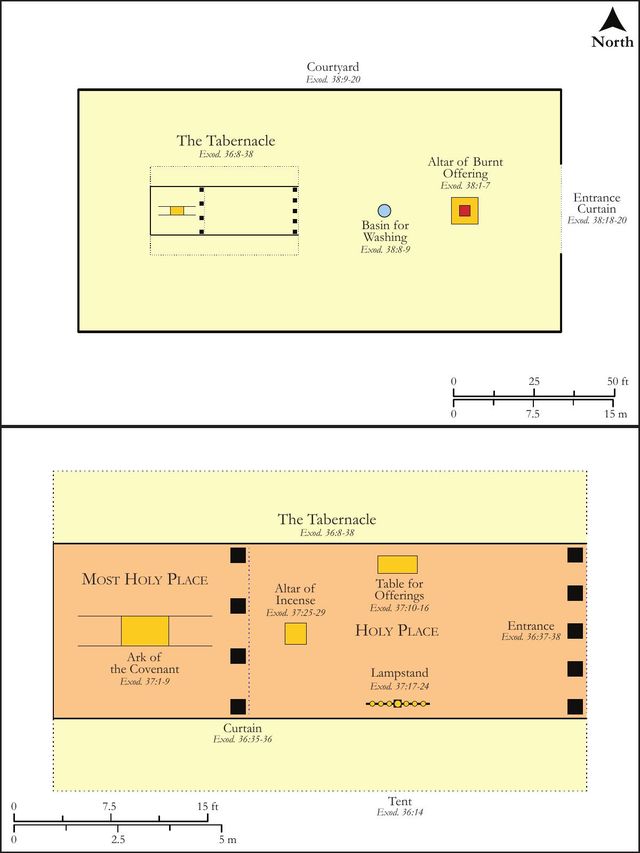
This precise enumeration of dimensions (approximately 45 inches long, 27 inches wide, and 27 inches high, assuming a common cubit of 18 inches) underscores the absolute necessity of adhering to God's exact specifications. These measurements were not arbitrary but divinely ordained (Exodus 25:10), emphasizing the foundational principle that God's work must be done according to His revealed will, with no room for human deviation or improvisation. The repetition of "a cubit and a half" for both breadth and height indicates a perfect square cross-section, adding to its symbolic perfection, stability, and balance, reflecting the order and holiness of the God it represented.
Literary Devices
ShowHideThe text of Exodus 37:1 employs several literary devices to convey its profound meaning and emphasize its theological significance. Precision is conspicuously evident in the detailed dimensions provided for the Ark, highlighting the divine mandate for exactitude in sacred construction. This serves as a powerful metaphor for the importance of adhering to God's word in all aspects of life, underscoring that divine work requires divine standards. The mention of Bezaleel functions as a form of Synecdoche, where the chief craftsman stands for the entire team of skilled artisans working under him. This emphasizes not only divine empowerment and leadership in the work but also the collaborative nature of God's kingdom endeavors. The choice of shittim wood functions as powerful Symbolism, representing durability, permanence, and the enduring nature of God's covenant and His presence, particularly in the harsh and transient wilderness environment. Furthermore, the entire narrative of the Tabernacle's construction, commencing with the Ark, is a profound Type, foreshadowing future spiritual realities, most notably the ultimate dwelling of God among His people in the person of Jesus Christ.
Theological and Thematic Connections
ShowHideExodus 37:1 powerfully illustrates the theological principle of divine initiative and human obedience in the establishment of God's dwelling among His people. The meticulous construction of the Ark, as the most sacred object, underscores God's demand for holiness, precision, and reverence in worship, reflecting His own perfect character and order. It highlights that God not only provides the detailed blueprint but also supernaturally equips those He calls for His service, as vividly seen in Bezaleel's Spirit-filled craftsmanship. This commitment to exact detail in the physical sanctuary foreshadows the spiritual reality of God's desire to dwell among His people, culminating in the person and work of Jesus Christ, who is the ultimate embodiment of God's presence and the fulfillment of all the Tabernacle's symbolic meaning.
Reflection and Application
ShowHideExodus 37:1, while describing ancient craftsmanship, offers timeless and profound lessons for contemporary believers. It serves as a powerful reminder that God values excellence, precision, and faithful obedience in all that pertains to His kingdom and His glory. Just as Bezaleel was divinely enabled and meticulously followed God's blueprint for the Ark, we too are called to utilize our Spirit-given gifts and talents with diligence, integrity, and a deep sense of reverence in our service to God and others. This verse challenges us to critically examine whether our efforts in ministry, worship, and daily life reflect the same commitment to God's revealed will and the same pursuit of excellence. It underscores that true spiritual work is not merely human effort but a divinely empowered endeavor, requiring us to seek God's wisdom and guidance in every detail. Our faithfulness in the seemingly "small" details often reflects the depth of our reverence for God's presence and His authoritative word, reminding us that even the most mundane tasks can become sacred when performed with divine purpose and precision.
Questions for Reflection
ShowHideFAQ
ShowHideWhat was the purpose of the Ark of the Covenant?
ShowHideThe Ark of the Covenant was the most sacred object in the Tabernacle, serving multiple crucial purposes. Primarily, it symbolized God's immediate presence among His people, Israel, acting as His throne and the place where He would meet with Moses (Exodus 25:22). It contained the two tablets of the Law, representing the covenant agreement between God and Israel (Deuteronomy 10:1-5), a pot of manna as a memorial of God's miraculous provision (Exodus 16:33-34), and Aaron's staff that budded, signifying divine authentication of the priesthood (Numbers 17:10). Its lid, the "mercy seat" (kapporet), was where the High Priest performed the annual atonement ritual on Yom Kippur, making it the focal point of Israel's reconciliation with God (Leviticus 16:14-16). Its presence was central to Israel's worship, national identity, and understanding of God's holiness, justice, and faithfulness.
Why was Bezaleel specifically chosen for this task?
ShowHideBezaleel was chosen directly by God Himself because he was divinely gifted and filled with the Spirit of God for the specific purpose of designing and executing the intricate craftsmanship required for the Tabernacle and its furnishings. Exodus 31:2-5 explicitly states that God "has filled him with the Spirit of God, in wisdom and understanding, in knowledge and in all manner of workmanship, to design artistic works, to work in gold, in silver, in bronze, in cutting jewels for setting, in carving wood, and to work in all manner of craftsmanship." This was not merely natural talent but a supernatural endowment, ensuring that the sacred objects were constructed precisely according to God's divine blueprint and with the highest possible skill and artistry, reflecting the glory and perfection of God Himself. His appointment underscores that God equips those He calls for His purposes.
Christ-Centered Fulfillment
ShowHideExodus 37:1, detailing the meticulous construction of the Ark of the Covenant, finds its ultimate and glorious fulfillment in the person and work of Jesus Christ. The Ark, as the symbolic dwelling place of God's presence among His people, housing the Law and serving as the mercy seat, powerfully foreshadows Christ. He is the true and ultimate dwelling of God among humanity, the very Word made flesh who tabernacled among us. Just as the Ark contained the Law, Christ perfectly embodied and fulfilled the Law, not merely containing its precepts but living them out in perfect obedience and becoming the end of the Law for righteousness to everyone who believes (Matthew 5:17; Romans 10:4). The mercy seat, covering the Ark, where atonement was made through the sprinkling of blood, points directly to Christ as our propitiation, the one through whom God's wrath against sin is satisfied and mercy is extended to all who believe (Romans 3:25). Furthermore, Bezaleel, divinely empowered to build God's earthly dwelling, serves as a type for Christ, the ultimate builder of God's spiritual house, the Church, who is "worthy of more glory than Moses" (Hebrews 3:3-6). Through Christ's finished work on the cross, we no longer need a physical ark or temple to access God's presence, for He has opened a new and living way into the holiest place through His blood (Hebrews 10:19-20), making us, His redeemed people, the true temple where God's Spirit now dwells (1 Corinthians 3:16).