


Exodus 36:38
Bible text: King James Version (1769 Blayney text) · Public domain
Bible text: Berean Standard Bible · Public domain
Bible text: American Standard Version (1901) · Public domain
Bible text: World English Bible, Messianic edition · Public domain
Bible text: Geneva Bible (1599) · Public domain
Bible text: Young's Literal Translation · Public domain
- וְאֶתve·'Etand <obj.>H853Conj-w ¦ DirObjMParticle Object Indicatorוְandאֶת<obj.>
- עַמּוּדָיו'a·mu·Davits pillarsH5982N-mpc ¦ 3msNoun Plural Masculine Constructעַמּוּדָיpillarsוits
- חֲמִשָּׁהcha·mi·ShahfiveH2568Adj-csAdjective Numerical Singular common gender Absolute
- וְאֶתve·'Etand <obj.>H853Conj-w ¦ DirObjMParticle Object Indicatorוְandאֶת<obj.>
- וָוֵיהֶםva·vei·Hemtheir hooksH2053N-mpc ¦ 3mpNoun Plural Masculine Constructוָוֵיhooksהֶםtheir
- וְצִפָּהve·tzi·Pahand he overlaidH6823Conj-w ¦ V-Piel-ConsecPerf-3msVerb Piel Consecutive Perfect 3rd Singular Masculineוְandצִפָּהhe overlaid
- רָאשֵׁיהֶםra·shei·Hemtheir topsH7218N-mpc ¦ 3mpNoun Plural Masculine Constructרָאשֵׁיtopsהֶםtheir
- וַחֲשֻׁקֵיהֶםva·cha·shu·kei·Hemand their bandsH2838Conj-w ¦ N-mpc ¦ 3mpNoun Plural Masculine Constructוַandחֲשֻׁקֵיbandsהֶםtheir
- זָהָבza·HavgoldH2091N-msNoun Singular Masculine Absolute
- וְאַדְנֵיהֶםve·'ad·nei·Hemand their basesH134Conj-w ¦ N-mpc ¦ 3mpNoun Plural Masculine Constructוְandאַדְנֵיbasesהֶםtheir
- חֲמִשָּׁהcha·mi·ShahfiveH2568Adj-csAdjective Numerical Singular common gender Absolute
- נְחֹשֶׁתne·Cho·shet[were] bronzeH5178N-fsNoun Singular Feminine Absolute
English is a literal word-by-word gloss of the Hebrew, not the KJV's wording. Why?
This is the original text the KJV's translators worked from — each Hebrew word with its own literal English meaning in this verse, prepared by scholars at Tyndale House, Cambridge. The KJV translates whole sentences, not word by word, so its wording differs: one Hebrew word can become several English words, and the KJV may choose “the LORD” where the gloss reads “Yahweh”. Both are faithful — they answer different questions. For the KJV's own rendering, switch to the KJV text.
Details
See on the biblical-era maps

Study this verse
Public-domain commentary
Matthew Henry
From his Commentary on the Whole Bible. Henry comments on passages, not single verses — this entry covers Exodus 36:35–38.
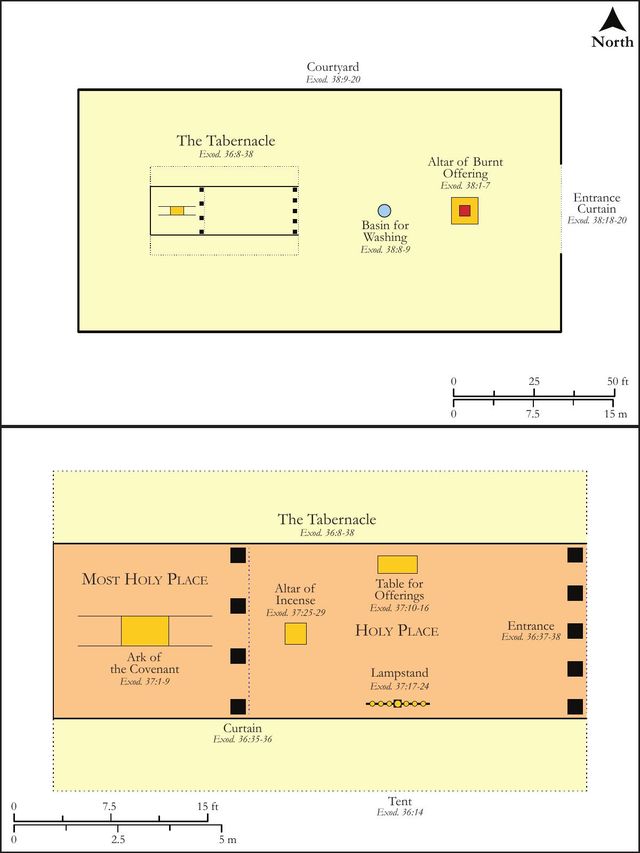
In the building of a house there is a great deal of work about the doors and partitions. In the tabernacle these were answerable to the rest of the fabric; there were curtains for doors, and veils for partitions. 1. There was a veil made for a partition between the holy place, and the most holy, Exo 36:35, Exo 36:36. This signified the darkness and distance of that dispensation, compared with the New Testament, which shows us the glory of God more clearly and invites us to draw near to it; and the darkness and distance of our present state, in comparison with heaven, where we shall be ever with the Lord and see him as he is. 2. There was a veil made for the door of the tabernacle, Exo 36:37, Exo 36:38. At this door the people assembled, though forbidden to enter; for, while we are in this present state, we must get as near to God as we can.
Continue studying Exodus 36:38 across the web’s major study libraries — every link below opens this exact verse, chapter, or book on the destination site.
Read & Compare
 BibleGatewayThis verse in more than 200 translations and 70 languages.
 Bible.comThe YouVersion reader — hundreds of translations, reading plans, and highlights.
 ESV.orgCrossway's official English Standard Version reader.
 NET BibleThe NET translation with 60,000+ translators' notes on every rendering decision.
 STEP BibleTyndale House's free study tool — original text, vocabulary, and scholarly resources.
 BibliaLogos Bible Software's free web reader.
 USCCBThe New American Bible (Revised Edition) with the U.S. bishops' study notes.
Commentaries
 BibleHub CommentariesDozens of classic commentaries on this verse, gathered on one page.
 StudyLightMore than 100 commentary sets — the largest collection on the web.
 BibleRefPlain-English commentary on what this verse means, verse by verse.
 Enduring WordDavid Guzik's free commentary on this chapter, widely used by Bible teachers.
 Bible Study ToolsVerse commentary alongside Greek and Hebrew study aids.
Original Language & Research
- BibleHub InterlinearThe verse word by word — original language, transliteration, and English.
- BibleHub LexiconEvery word's original-language definition and Strong's entry.
 Blue Letter BibleDeep-study tools — Strong's numbers, concordance, and word studies.
 SefariaThe Hebrew text with Rashi and centuries of Jewish commentary.
Sermons, Hymns & Audio


TrulyRandomVerse is not affiliated with these sites and doesn’t control their content. They’re linked because they’re genuinely useful.
Summary
Exodus 36:38 concludes the detailed construction of the Tabernacle's entrance screen, focusing on the five pillars that demarcated the sacred threshold to the Holy Place. This verse meticulously describes the materials and craftsmanship, noting the gold overlay on their decorative capitals and connecting bands, and the durable bronze (brass) used for their foundational sockets. It underscores the divine glory and purity associated with God's dwelling, juxtaposed with the strength and stability required for His earthly sanctuary, faithfully executed according to God's precise architectural blueprint.
Context
ShowHideLiterary Context
Exodus 36:38 serves as the concluding verse in a chapter dedicated to the actual construction of the Tabernacle's structural components. This chapter follows the detailed divine instructions given to Moses on Mount Sinai, as recorded in Exodus 25-31, and the call for materials and skilled workers in Exodus 35. Specifically, Exodus 36 systematically describes the making of the dwelling's curtains (verses 8-18), its coverings (verse 19), the wooden frames and connecting bars (verses 20-30), the inner veil separating the Holy Place from the Most Holy Place (verses 31-35), and finally, the screen for the entrance to the Holy Place (verses 36-38). Thus, this verse completes the description of the Tabernacle's core architectural elements, setting the stage for the construction of its sacred furnishings in subsequent chapters.
Historical & Cultural Context
The construction of the Tabernacle took place during the Israelites' forty-year sojourn in the wilderness, a pivotal period for their identity as God's chosen nation. Unlike the permanent, often imposing temples of surrounding Canaanite and Egyptian cultures, the Tabernacle was designed as a portable sanctuary, reflecting Israel's nomadic journey and God's dynamic, immanent presence among His people (Exodus 25:8-9). The materials specified – gold, silver, bronze, fine linen, and various dyed skins – were incredibly valuable and required a significant collective effort and sacrificial giving from the community, demonstrating their devotion and obedience to Yahweh. The extraordinary precision and meticulous detail in the design, from the grand overall structure down to the smallest components like these pillars and their fittings, were not merely for aesthetic appeal but profoundly theological, ensuring that the Tabernacle precisely mirrored the divine pattern revealed to Moses, thereby establishing it as a sacred space where a holy God could dwell and commune with His people.
Key Themes
ShowHideExodus 36:38 contributes to several overarching themes within the book of Exodus and the Pentateuch. Primarily, it underscores the theme of Divine Presence and Dwelling, emphasizing God's desire to reside among His people, albeit in a manner that highlights His holiness and their need for a mediated approach. The meticulous adherence to the divine blueprint reinforces the theme of Obedience and Faithfulness to God's revealed will, showcasing Bezaleel and Aholiab's exemplary craftsmanship as an act of worship. The contrasting materials of gold and bronze within the verse itself subtly introduce the theme of Holiness and Atonement, where the precious gold signifies divine glory and purity, while the robust bronze, often associated with judgment and sacrifice in the Tabernacle's outer court (as seen with the bronze altar), points to the necessary foundation for a sinful people to approach a holy God. Finally, the "five pillars" forming an entrance highlight the theme of Access to God, a privilege carefully regulated and divinely appointed, foreshadowing the ultimate access provided through Christ.
Exposition and Analysis
ShowHideKey Word Analysis
ShowHideMeaning "the head." In this architectural context, it refers to the decorative capitals or tops of the pillars. These were the uppermost parts of the columns, often ornamented, serving both a structural and aesthetic purpose. Being overlaid with gold, they visually proclaimed the sanctity and glory of the entrance to the Holy Place, drawing the eye upwards towards the divine presence within.
Meaning "attached" or "a fence-rail or rod connecting the posts or pillars." This term refers to the connecting rods or bands that linked the five pillars together, providing crucial structural integrity for the screen and ensuring the stability of the curtain it supported. Their overlay of gold further emphasized the preciousness and divine nature of even the functional, stabilizing elements of God's dwelling.
Meaning "copper, hence, something made of that metal," often translated as "bronze" (an alloy of copper and tin). Bronze was a common, durable, and weighty metal. In biblical symbolism, it frequently signifies strength, endurance, and, notably, judgment, as seen with the bronze altar for sacrifices. Here, as the foundational sockets, bronze represents the solid, enduring base upon which the glorious structure rests, capable of bearing the weight of the pillars and enduring the harsh wilderness conditions.
Verse Breakdown
ShowHide"And the five pillars of it with their hooks:"
This initial clause introduces the primary structural elements of the screen that formed the entrance to the Tabernacle's Holy Place. The specification of "five pillars" indicates the precise number of supports for the entrance curtain, establishing a distinct and regulated gateway. The "hooks" (H2053, vâv) were essential, small, but vital components, designed for hanging the curtain itself, allowing it to be opened or closed, thereby providing or restricting access to the sacred interior.
"and he overlaid their chapiters and their fillets with gold:"
This part details the precious material used for the upper, visible, and decorative elements of these five pillars. The "chapiters" (capitals) and "fillets" (connecting rods/bands) were meticulously covered in pure gold (H2091, zâhâb). This signifies the divine glory, purity, and preciousness intrinsically linked to God's presence. Gold, being incorruptible and lustrous, consistently points to the holiness, majesty, and unblemished nature of God throughout the Tabernacle's design, emphasizing the sacredness of the entrance.
"but their five sockets [were of] brass."
This final clause describes the foundational elements of these pillars. The "sockets" (H134, ʼeden) were heavy, solid bases into which the pillars were securely set, providing essential stability and support for the entire structure. The use of "brass" (bronze, H5178, nᵉchôsheth) for these foundational elements is highly significant. While the upper parts were adorned with glorious gold, the sturdy, weighty bronze formed the enduring base, symbolizing strength, steadfastness, and the capacity to bear the immense weight of the structure. This deliberate contrast between the radiant gold above and the robust bronze below reflects different, yet complementary, aspects of encountering the divine.
Literary Devices
ShowHideThe primary literary device at play in Exodus 36:38, and indeed throughout the detailed descriptions of the Tabernacle's construction, is Symbolism. The choice of materials is not arbitrary but laden with profound theological meaning. The gold adorning the chapiters and fillets symbolizes God's transcendent glory, unblemished purity, and heavenly majesty, pointing to the sacredness of the space and the divine nature of the One who dwells within. In contrast, the bronze (brass) sockets symbolize strength, endurance, and, significantly, the concept of judgment and atonement, serving as the solid, earthly foundation that bears the weight of the structure and the reality of humanity's sin. This striking juxtaposition of gold and bronze creates a visual and theological tension, highlighting both God's absolute holiness and His immanent presence among a people who still required a means of atonement. Furthermore, the meticulous precision and detailed enumeration of components (e.g., "five pillars," "five sockets") serve to emphasize the divine authority behind the design and the paramount importance of exact obedience to God's revealed will, underscoring the sacredness of every detail.
Theological and Thematic Connections
ShowHideExodus 36:38, as an integral part of the Tabernacle's construction, powerfully conveys God's profound desire for intimate dwelling with His people while simultaneously emphasizing His absolute holiness and the necessity of a divinely ordained way to approach Him. The five pillars forming a distinct entrance underscore the concept of regulated access – a specific, holy way into God's presence, not an arbitrary one. The contrasting materials of gold and bronze speak to the dual nature of encountering God: His glorious, pure divinity (gold) and the reality of His righteous judgment (bronze), which must be addressed for fellowship to occur. This tension between divine glory and human sinfulness sets the stage for the entire sacrificial system and ultimately points to a greater fulfillment in the New Covenant.
Reflection and Application
ShowHideThe meticulous detail in Exodus 36:38 serves as a profound reminder that God is a God of order, precision, and intentionality. Every single component of the Tabernacle, down to the specific materials and the exact number of pillars, was divinely specified, teaching us that faithfulness in God's service extends to seemingly minor details. This divine attention to detail reflects God's perfect character and underscores the critical importance of reverent obedience in our walk with Him. Furthermore, the very presence of an "entrance" with its specific design signifies that access to God is not arbitrary or earned by human effort but is divinely appointed and provided. For the Israelites, this meant following the prescribed rituals and approaching through the Tabernacle. For believers today, it prompts profound reflection on the "way" we approach God, recognizing that true and intimate access is only possible through the path He has graciously provided. The rich symbolism of gold and bronze also invites us to consider the unapproachable glory of God and the unshakeable foundation upon which our relationship with Him rests, acknowledging both His transcendent holiness and His merciful provision for our sin.
Questions for Reflection
ShowHideFAQ
ShowHideWhy were there five pillars at the entrance to the Holy Place, and what is their significance?
ShowHideThe text of Exodus 36:38, echoing the divine instructions in Exodus 26:37, explicitly specifies "five pillars" for the entrance to the Holy Place. While the number five is sometimes associated with grace or divine completeness in biblical numerology, the primary significance of these five pillars lies in their functional and symbolic role: they formed the distinct, defined gateway to the Holy Place, supporting the beautiful curtain that served as the Tabernacle's main entrance. This specific number created a clear, regulated point of entry, emphasizing that access to God's presence was not open to all without distinction but was divinely appointed and required a specific, holy approach. They visually separated the sacred space from the outer court, marking the threshold for the priests to perform their sacred duties.
What is the symbolic meaning of gold and brass (bronze) in the Tabernacle's construction?
ShowHideThe pervasive use of gold and bronze throughout the Tabernacle, as highlighted in Exodus 36:38, is deeply symbolic. Gold consistently represents divinity, purity, glory, and the preciousness of God's presence. Its incorruptible nature and brilliant luster point to the holiness, majesty, and unblemished character of God Himself. The gold on the chapiters and fillets of the pillars signifies that even the entrance to God's dwelling is imbued with His divine glory and sacredness. Brass (more accurately, bronze) typically symbolizes strength, endurance, and, significantly, judgment. The bronze altar in the outer court, where sacrifices were made for sin, is a prime example of its association with divine judgment and atonement. In this verse, the bronze sockets symbolize the solid, enduring foundation that bears the weight of the structure, capable of withstanding the wilderness conditions, and subtly points to the necessary foundation of judgment and atonement that undergirds and enables access to a holy God.
Christ-Centered Fulfillment
ShowHideExodus 36:38, with its meticulous description of the glorious entrance to the Holy Place, finds its profound and ultimate fulfillment in the person and work of Jesus Christ. The entire Tabernacle, including its carefully designed entrance, served as a shadow pointing to the reality of God dwelling among His people, a reality perfectly embodied in Christ, who is described as the Word made flesh, who "dwelt among us" (literally, "tabernacled" among us, as in John 1:14). The five pillars, with their golden chapiters and fillets, speak of the divine glory, purity, and preciousness of the way into God's presence. Jesus, as the very "image of the invisible God" (Colossians 1:15) and the radiance of God's glory (Hebrews 1:3), is the true and living way into the Father's presence, declaring, "I am the way, the truth, and the life: no man cometh unto the Father, but by me" (John 14:6). The bronze sockets, symbolizing strength, endurance, and judgment, powerfully foreshadow Christ's sacrificial work on the cross, where He, as the Lamb of God who takes away the sin of the world (John 1:29), bore the full judgment for our sins, thereby becoming the solid, enduring foundation of our salvation (1 Corinthians 3:11). Through His broken body, which serves as the new and living veil torn in two (Hebrews 10:20), we now have bold and unrestricted access to the very presence of God, no longer restricted by physical barriers or the limitations of the Old Covenant Tabernacle.