


Exodus 36:37
Bible text: King James Version (1769 Blayney text) · Public domain
Bible text: Berean Standard Bible · Public domain
Bible text: American Standard Version (1901) · Public domain
Bible text: World English Bible, Messianic edition · Public domain
Bible text: Geneva Bible (1599) · Public domain
Bible text: Young's Literal Translation · Public domain
- וַיַּעַשׂvai·Ya·'asand he madeH6213Conj-w ¦ V-Qal-ConsecImperf-3msVerb Qal Consecutive Imperfect 3rd Singular Masculineוַandיַּעַשׂhe made
- מָסָךְma·soKha screenH4539N-msNoun Singular Masculine Absolute
- לְפֶתַחle·Fe·tachfor [the] entrance ofH6607Prep-l ¦ N-mscNoun Singular Masculine Constructלְforפֶתַח[the] entrance of
- הָאֹהֶלha·'O·helthe tentH168Art ¦ N-msNoun Singular Masculine Absoluteהָtheאֹהֶלtent
- תְּכֵלֶתte·Khe·letviolet stuffH8504N-fsNoun Singular Feminine Absolute
- וְאַרְגָּמָןve·'ar·ga·Manand purpleH713Conj-w ¦ N-msNoun Singular Masculine Absoluteוְandאַרְגָּמָןpurple
- וְתוֹלַעַתve·to·La·'atand scarlet stuff ofH8438Conj-w ¦ N-fscNoun Singular Feminine Constructוְandתוֹלַעַתscarlet stuff of
- שָׁנִיsha·NiscarletH8144N-msNoun Singular Masculine Absolute
- וְשֵׁשׁve·Sheshand fine linenH8336Conj-w ¦ N-msNoun Singular Masculine Absoluteוְandשֵׁשׁfine linen
- מָשְׁזָרma·she·ZartwistedH7806V-Hophal-PassPrtcpl-msVerb Hophal Participle Passive Singular Masculine Absolute
- מַעֲשֵׂהma·'a·Seh[the] work ofH4639N-mscNoun Singular Masculine Construct
- רֹקֵםro·Kema worker in colorsH7551V-Qal-Prtcpl-msVerb Qal Participle Singular Masculine Absolute
English is a literal word-by-word gloss of the Hebrew, not the KJV's wording. Why?
This is the original text the KJV's translators worked from — each Hebrew word with its own literal English meaning in this verse, prepared by scholars at Tyndale House, Cambridge. The KJV translates whole sentences, not word by word, so its wording differs: one Hebrew word can become several English words, and the KJV may choose “the LORD” where the gloss reads “Yahweh”. Both are faithful — they answer different questions. For the KJV's own rendering, switch to the KJV text.
Details
See on the biblical-era maps

Study this verse
Public-domain commentary
Matthew Henry
From his Commentary on the Whole Bible. Henry comments on passages, not single verses — this entry covers Exodus 36:35–38.
In the building of a house there is a great deal of work about the doors and partitions. In the tabernacle these were answerable to the rest of the fabric; there were curtains for doors, and veils for partitions. 1. There was a veil made for a partition between the holy place, and the most holy, Exo 36:35, Exo 36:36. This signified the darkness and distance of that dispensation, compared with the New Testament, which shows us the glory of God more clearly and invites us to draw near to it; and the darkness and distance of our present state, in comparison with heaven, where we shall be ever with the Lord and see him as he is. 2. There was a veil made for the door of the tabernacle, Exo 36:37, Exo 36:38. At this door the people assembled, though forbidden to enter; for, while we are in this present state, we must get as near to God as we can.
Continue studying Exodus 36:37 across the web’s major study libraries — every link below opens this exact verse, chapter, or book on the destination site.
Read & Compare
 BibleGatewayThis verse in more than 200 translations and 70 languages.
 Bible.comThe YouVersion reader — hundreds of translations, reading plans, and highlights.
 ESV.orgCrossway's official English Standard Version reader.
 NET BibleThe NET translation with 60,000+ translators' notes on every rendering decision.
 STEP BibleTyndale House's free study tool — original text, vocabulary, and scholarly resources.
 BibliaLogos Bible Software's free web reader.
 USCCBThe New American Bible (Revised Edition) with the U.S. bishops' study notes.
Commentaries
 BibleHub CommentariesDozens of classic commentaries on this verse, gathered on one page.
 StudyLightMore than 100 commentary sets — the largest collection on the web.
 BibleRefPlain-English commentary on what this verse means, verse by verse.
 Enduring WordDavid Guzik's free commentary on this chapter, widely used by Bible teachers.
 Bible Study ToolsVerse commentary alongside Greek and Hebrew study aids.
Original Language & Research
- BibleHub InterlinearThe verse word by word — original language, transliteration, and English.
- BibleHub LexiconEvery word's original-language definition and Strong's entry.
 Blue Letter BibleDeep-study tools — Strong's numbers, concordance, and word studies.
 SefariaThe Hebrew text with Rashi and centuries of Jewish commentary.
Sermons, Hymns & Audio


TrulyRandomVerse is not affiliated with these sites and doesn’t control their content. They’re linked because they’re genuinely useful.
Summary
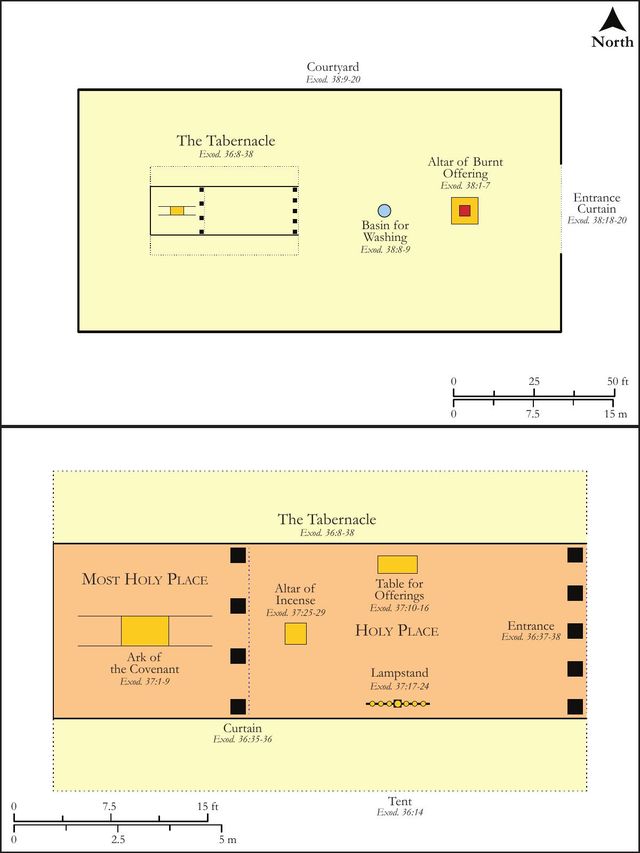
Exodus 36:37 meticulously details the construction of the entrance curtain for the Tabernacle, a pivotal component of the portable sanctuary God commanded Israel to build in the wilderness. This verse highlights the use of specific, richly symbolic materials—blue, purple, scarlet, and fine twined linen—alongside the exquisite "needlework" of skilled artisans, underscoring the divine blueprint for beauty, holiness, and ordered access to God's presence within the consecrated space.
Context
ShowHideLiterary Context
Exodus 36:37 is situated within the extensive narrative of the Tabernacle's construction, spanning Exodus chapters 35-39. These chapters describe the faithful execution of God's detailed instructions given to Moses on Mount Sinai, as recorded in Exodus chapters 25-31. Specifically, this verse focuses on the making of the "hanging" or screen for the door of the Tabernacle itself, which served as the entrance to the Holy Place, distinct from the outer court gate or the inner veil. It follows the construction of the Tabernacle's framework and inner coverings (Exodus 36:8-36) and precedes the making of the altar of burnt offering and the court's hangings (Exodus 38). The meticulous repetition of materials and methods throughout these chapters emphasizes the Israelites' faithful obedience to God's precise architectural and artistic specifications, reflecting the divine pattern revealed to Moses (as instructed in Exodus 25:9).
Historical & Cultural Context
The Tabernacle served as God's mobile dwelling place among His people during their wilderness wanderings, a tangible symbol of His presence, guidance, and covenant faithfulness. Among the nations, temples and sacred spaces were universally adorned with costly materials and intricate craftsmanship, reflecting the honor and majesty of the deity worshipped. The specific colors and materials mentioned—blue, purple, scarlet, and fine twined linen—were highly prized and often associated with royalty, divinity, and purity. Blue dye (tekhelet) was derived from a rare mollusk and symbolized the heavens and God's transcendence. Purple (argaman) was even more expensive, associated with kingship, wealth, and imperial authority. Scarlet (shani tola'at), derived from an insect, often symbolized life, vitality, or sacrifice. Fine twined linen (shesh mashzar) represented purity, righteousness, and the garments of priests. The "needlework" (embroidery) demonstrated a high level of artistic skill, which was divinely endowed for this sacred task, as seen in the gifting of Bezalel and Oholiab. This level of detail, expense, and artistry underscored the unique holiness of the Tabernacle and the supreme worthiness of the God it housed.
Key Themes
ShowHideThis verse contributes significantly to several key themes prevalent in the book of Exodus and the Pentateuch. It highlights the theme of Divine Presence and Holiness, as the Tabernacle was God's dwelling place, and its entrance, with its rich materials, emphasized the sacredness of the space and the reverence required to approach God. The detailed instructions and their faithful execution underscore the theme of Obedience to Divine Command, demonstrating Israel's commitment to following God's precise blueprint. The use of precious materials and intricate craftsmanship speaks to the theme of Excellence in Worship and Service, conveying that God is worthy of the very best offerings of human skill and resources. Furthermore, the symbolism embedded in the colors and materials (e.g., blue for heaven, purple for royalty, scarlet for sacrifice, linen for purity) points to the overarching theme of Redemption and Access to God, foreshadowing the means by which a holy God could dwell among an unholy people and eventually provide a way for them to draw near, a theme that finds its ultimate expression in Christ (as seen in Hebrews 9:1-10).
Exposition and Analysis
ShowHideKey Word Analysis
ShowHideThis term (H168) is derived from a root meaning "to shine" or "to be conspicuous," referring to a tent that is clearly visible from a distance. In the context of the Exodus, it denotes the portable sanctuary, the "tent of meeting," where God's presence resided among the Israelites. Its construction, including the door hanging, was central to establishing a visible dwelling place for God, symbolizing His immanence and guidance throughout their wilderness journey.
This term (H4539) refers specifically to a cover, veil, curtain, or screen. In the Tabernacle's context, it denotes the outer curtain at the entrance to the Holy Place, distinguishing it from the inner veil (parokhet) that separated the Holy Place from the Most Holy Place (Exodus 26:31). The masak regulated access, allowing priests and authorized individuals to enter the sacred space, while simultaneously serving as a visual demarcation of the boundary between the common and the holy. Its purpose was both to invite and to delineate.
This term (H7551) is a primitive root meaning "to variegate color," specifically to embroider or fabricate with intricate designs. When combined with maʻăseh (H4639, "work" or "thing made"), as in the phrase maʻăseh râqam, it signifies skilled embroidery or "broidered work." This detail highlights the artistic excellence and the high degree of craftsmanship involved, suggesting that the beauty and artistry were as much a part of the divine command as the materials themselves. It speaks to the concept that God desires not only obedience but also excellence and beauty in the worship and service rendered to Him.
Verse Breakdown
ShowHide"And he made a hanging for the tabernacle door"
This initial clause establishes the specific purpose and location of this curtain—it was the primary entrance to the Tabernacle proper, the tent of meeting. The "he" refers to Bezalel and the skilled craftsmen working under his divine inspiration and direction, faithfully executing God's blueprint. The hanging served as a physical boundary, marking the transition from the outer court, accessible to all Israelites, to the more sacred interior, primarily accessible to the priests. This demarcation underscored the holiness of God and the reverent approach required.
"[of] blue, and purple, and scarlet, and fine twined linen"
This specifies the luxurious and deeply symbolic materials used. Each color held profound significance: Blue (H8504, tᵉkêleth) often represented the heavens, divinity, and God's transcendence, connecting the earthly sanctuary to the divine realm. Purple (H713, ʼargâmân) symbolized royalty, kingship, and majesty, signifying that the Tabernacle was the dwelling place of the King of Kings. Scarlet (H8144, shânîy, often with H8438, tôwlâʻ, referring to the crimson grub from which the dye was derived) could represent life, vitality, blood, or sacrifice, foreshadowing the atoning work necessary for access to God. Fine twined linen (H8336, shêsh, with H7806, shâzar, "to twist") symbolized purity, righteousness, and holiness, emphasizing the clean and undefiled nature of God and the purity required to approach Him. The combination of these colors created a vibrant, visually striking entrance, reflecting divine glory.
"of needlework"
This final phrase reiterates the intricate craftsmanship involved, using the term maʻăseh râqam (H4639, H7551). The curtain was not simply dyed fabric but was adorned with detailed embroidery, likely depicting cherubim or other symbolic patterns, similar to the inner veil (Exodus 26:31). This artistic embellishment further underscored the sacredness, glory, and beauty of the space it guarded, reflecting the divine artistry of the Creator Himself and emphasizing the excellence required in all aspects of worship.
Literary Devices
ShowHideThe verse employs several literary devices to convey its meaning and significance. Symbolism is paramount, with each color and material carrying profound theological weight, representing aspects of God's character (divinity, royalty, holiness) and the means of approach (sacrifice, purity). The "hanging" itself is a powerful symbol of both access and separation, a permeable boundary that nonetheless delineates sacred space. The detailed enumeration of materials (blue, purple, scarlet, linen) is a form of merism, where listing constituent parts emphasizes the completeness, richness, and divine precision of the whole. Furthermore, the entire account of the Tabernacle's construction, including this verse, is an example of repetition and emphasis, as the text reiterates God's precise instructions and the Israelites' faithful execution, reinforcing the theme of divine blueprint and human obedience. The "needlework" highlights the artistry and excellence demanded in God's service, transforming mere fabric into a work of sacred art.
Theological and Thematic Connections
ShowHideExodus 36:37, in its description of the Tabernacle's entrance, powerfully communicates several enduring theological truths. It underscores God's meticulous nature and His desire for beauty and excellence in worship, reflecting His own glory and perfect order. The specific materials and their symbolism point to the character of God—His heavenly majesty, His royal sovereignty, and His absolute holiness—while also hinting at the sacrificial means by which humanity might approach Him. The "hanging" served as a constant reminder that while God desired to dwell among His people, His holiness required a defined and reverent approach, a boundary between the common and the sacred. This earthly sanctuary, with its carefully designed entrance, was a tangible representation of a greater spiritual reality, foreshadowing the ultimate means of access to God.
Reflection and Application
ShowHideThe intricate details of the Tabernacle's door hanging in Exodus 36:37 invite us to reflect deeply on the nature of God and our approach to Him. The beauty, costliness, and precision reflect God's own character—a God of order, beauty, and infinite worth, who deserves nothing less than our very best. It challenges us to consider the quality of our own worship and service: do we offer God our best, or merely what is convenient or leftover? The hanging also served as a boundary, reminding us of God's unapproachable holiness and the reverence due to Him. While Christ has now opened full and direct access to the Father, this does not diminish God's holiness but rather elevates the immense privilege of drawing near. We are called to approach Him with both confidence (due to Christ's work) and profound awe (due to His nature), recognizing the immense sacrifice that opened the way. This verse encourages us to appreciate the beauty in God's creation and in His commands, understanding that every detail in His divine plan serves a profound purpose in revealing His glory and drawing us into deeper, more intimate relationship with Him.
Questions for Reflection
ShowHideFAQ
ShowHideWhat was the primary function of the "hanging for the tabernacle door"?
ShowHideThe primary function of the "hanging for the tabernacle door" was to serve as the entrance curtain to the Tabernacle proper, specifically the Holy Place. It acted as a visible boundary, regulating access for the priests and authorized individuals, while also distinguishing the sacred interior from the outer court. It was not a solid barrier but a beautiful, permeable screen that both invited and delineated the holy space, symbolizing the reverent approach required to enter God's presence.
Why were the specific colors (blue, purple, scarlet) and materials (fine twined linen) so important for this hanging?
ShowHideThe specific colors and materials were chosen for their deep symbolic significance, reflecting the nature of God and the Tabernacle's purpose. Blue symbolized the heavens and God's divine, transcendent nature. Purple represented royalty and kingship, signifying that the Tabernacle was the dwelling of the King of Kings. Scarlet often pointed to life, blood, and sacrifice, foreshadowing the necessary atonement for sin. Fine twined linen symbolized purity, righteousness, and holiness, emphasizing the undefiled nature of God and the purity required for those who would approach Him. Together, these elements conveyed the glory, majesty, and holiness of the God who dwelt within.
How does the Tabernacle's door hanging relate to the concept of access to God in the New Testament?
ShowHideThe Tabernacle's door hanging, which regulated access to God's presence, finds its ultimate fulfillment in Jesus Christ. Just as the hanging was the way into the Tabernacle, Jesus declared, "I am the door. If anyone enters through Me, he will be saved." He also stated, "I am the way, the truth, and the life. No one comes to the Father except through Me." The tearing of the temple veil (which separated the Holy Place from the Most Holy Place) at Christ's crucifixion (Matthew 27:51) symbolized the opening of direct, unhindered access to God through His sacrificial death, fulfilling the Tabernacle's temporary function and inviting all believers into a new and living way to the Father.
Christ-Centered Fulfillment
ShowHideExodus 36:37, in its description of the Tabernacle's entrance curtain, finds profound Christ-centered fulfillment in the person and work of Jesus. The "hanging for the tabernacle door," with its rich symbolism of blue (heavenly origin), purple (royalty), scarlet (sacrifice), and fine twined linen (purity), beautifully foreshadows Christ Himself. Jesus is the ultimate "door" through whom humanity gains access to God, declaring, "I am the door" and "I am the way, the truth, and the life. He is the King of Kings, robed in divine majesty, whose blood provides the perfect sacrifice, and who embodies perfect righteousness and purity. The Tabernacle, as God's dwelling place among His people, pointed to the greater reality of Christ, in whom "all the fullness of the Deity dwells in bodily form" (Colossians 2:9). While the physical curtain regulated access, Christ's sacrificial death on the cross tore the ultimate veil, the one separating humanity from the Most Holy God (Matthew 27:51; Hebrews 10:19-20), opening a new and living way directly into God's presence. Thus, the exquisite craftsmanship and symbolic materials of the Tabernacle's door hanging find their glorious and complete meaning in Jesus, our High Priest and the very access point to the Father.