


Deuteronomy 10:2
Bible text: King James Version (1769 Blayney text) · Public domain
Bible text: Berean Standard Bible · Public domain
Bible text: American Standard Version (1901) · Public domain
Bible text: World English Bible, Messianic edition · Public domain
Bible text: Geneva Bible (1599) · Public domain
Bible text: Young's Literal Translation · Public domain
- וְאֶכְתֹּבve·'ekh·Toso I may inscribeH3789Conj-w ¦ V-Qal-ConjImperf-1csVerb Qal Conjunction+Imperfect 1st Singular common genderוְsoאֶכְתֹּבI may inscribe
- עַל'alonH5921PrepPreposition
- הַלֻּחֹתha·lu·Chotthe tabletsH3871Art ¦ N-fpNoun Plural Feminine Absoluteהַtheלֻּחֹתtablets
- אֶת'et<obj.>H853DirObjMParticle Object Indicator
- הַדְּבָרִיםha·de·va·Rimthe wordsH1697Art ¦ N-mpNoun Plural Masculine Absoluteהַtheדְּבָרִיםwords
- אֲשֶׁר'a·SherwhichH834RelParticle Relative
- הָיוּha·Yuthey wereH1961V-Qal-Perf-3cpVerb Qal Perfect 3rd Plural common gender
- עַל'alonH5921PrepPreposition
- הַלֻּחֹתha·lu·Chotthe tabletsH3871Art ¦ N-fpNoun Plural Feminine Absoluteהַtheלֻּחֹתtablets
- הָרִאשֹׁנִיםha·ri·sho·Nim<the> formerH7223Art ¦ Adj-mpAdjective Numerical Position Plural Masculine Absoluteהָ<the>רִאשֹׁנִיםformer
- אֲשֶׁר'a·SherwhichH834RelParticle Relative
- שִׁבַּרְתָּshi·Bar·tayou shatteredH7665V-Piel-Perf-2msVerb Piel Perfect 2nd Singular Masculine
- וְשַׂמְתָּםve·sam·Tamand you will put themH7760Conj-w ¦ V-Qal-ConsecPerf-2ms ¦ 3mpVerb Qal Consecutive Perfect 2nd Singular Masculineוְandשַׂמְתָּyou will putםthem
- בָּאָרוֹןba·'a·Ronin the arkH727Prep-b ¦ N-msNoun Singular Masculine Absoluteבָּin theאָרוֹןark
English is a literal word-by-word gloss of the Hebrew, not the KJV's wording. Why?
This is the original text the KJV's translators worked from — each Hebrew word with its own literal English meaning in this verse, prepared by scholars at Tyndale House, Cambridge. The KJV translates whole sentences, not word by word, so its wording differs: one Hebrew word can become several English words, and the KJV may choose “the LORD” where the gloss reads “Yahweh”. Both are faithful — they answer different questions. For the KJV's own rendering, switch to the KJV text.
Details
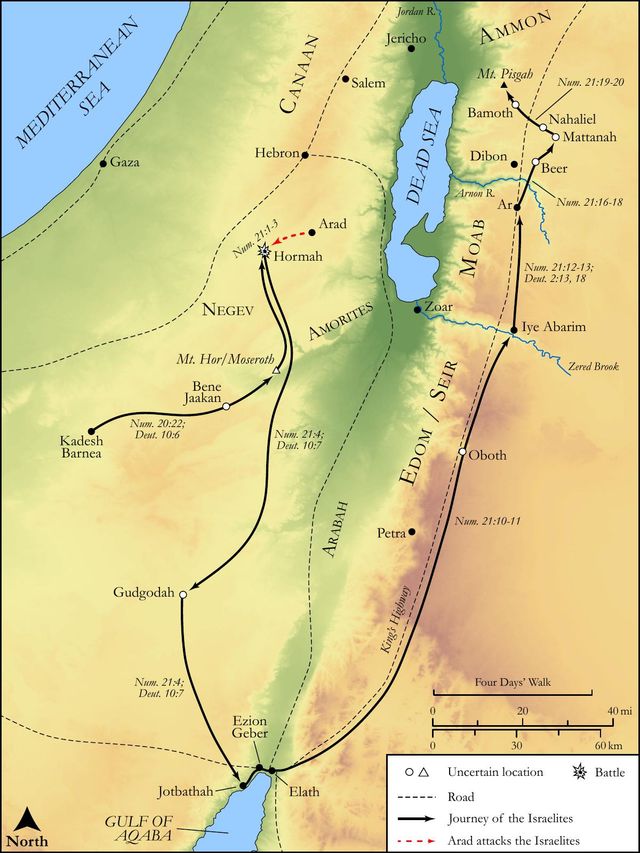
See on the biblical-era map
Study this verse
Public-domain commentary
Matthew Henry
From his Commentary on the Whole Bible. Henry comments on passages, not single verses — this entry covers Deuteronomy 10:1–11. His two-level outline is real structure in the source text, so it is rendered as structure.
There were four things in and by which God showed himself reconciled to Israel and made them truly great and happy, and in which God's goodness took occasion from their badness to make him the more illustrious: -
I.He gave them his law, gave it to them in writing, as a standing pledge of his favour.
Though the tables that were first written were broken, because Israel had broken the commandments, and God might justly break the covenant, yet when his anger was turned away the tables were renewed, Deu 10:1, Deu 10:2. Note, God's putting his law in our reconciliation to God and the best earnest of our happiness in him. Moses is told to hew the tables; for the law prepares the heart by conviction and humiliation for the grace of God, but it is only that grace that then writes the law in it. Moses made an ark of shittim-wood (Deu 10:3), a plain chest, the same, I suppose, in which the tables were afterwards preserved: but Bezaleel is said to make it (Exo 37:1), because he afterwards finished it up and overlaid it with gold. Or Moses is said to make it because, when he went up the second time into the mount, he ordered it to be made by Bezaleel against he came down. And it is observable that for this reason the ark was the first thing that God gave orders about, Exo 25:10. And this left an earnest to the congregation that the tables should not miscarry this second time, as they had done the first. God will send his law and gospel to those whose hearts are prepared as arks to receive them. Christ is the ark in which now our salvation is kept safely, that it may not be lost as it was in the first Adam, when he had it in his own hand. Observe,
1.What it was that God wrote on the two tables, the ten commandments (Deu 10:4), or ten words, intimating in how little a compass they were contained: they were not ten volumes, but ten words: it was the same with the first writing, and both the same that he spoke in the mount. The second edition needed no correction nor amendment, nor did what he wrote differ form what he spoke. The written word is as truly the word of God as that which he spoke to his servants the prophets.
2.What care was taken of it. These two tables, thus engraven, were faithfully laid up in the ark. And there they be, said Moses, pointing it is probable towards the sanctuary, Deu 10:5. That good thing which was committed to him he transmitted to them, and left it pure and entire in their hands; now let them look to it at their peril. Thus we may say to the rising generation, "God has entrusted us with Bibles, sabbaths, sacraments, etc., as tokens of his presence and favour, and there they be; we lodge them with you," Ti2 1:13, Ti2 1:14.
II.He led them forward towards Canaan, though they in their hearts turned back towards Egypt, and he might justly have chosen their delusions, Deu 10:6, Deu 10:7. He brought them to a land of rivers of waters, out of a dry and barren wilderness. Sometimes God supplied their wants by the ordinary course of nature: when that failed, then by miracles; and yet after this, when they were brought into a little distress, we find them distrusting God and murmuring, Num 20:3, Num 20:4.
III.He appointed a standing ministry among them, to deal for them in holy things.
At that time when Moses went up a second time to the mount, or soon after, he had orders to separate the tribe of Levi to God, and to his immediate service, they having distinguished themselves by their zeal against the worshippers of the golden calf, Deu 10:8, Deu 10:9. The Kohathites carried the ark; they and the other Levites stood before the Lord, to minister to him in all the offices of the tabernacle; and the priests, who were of that tribe, were to bless the people. This was a standing ordinance, which had now continued almost forty years, even unto this day; and provision was made for the perpetuating of it by the settled maintenance of that tribe, which was such as gave them great encouragement in their work, and no diversion from it. The Lord is his inheritance. Note, A settled ministry is a great blessing to a people, and a special token of God's favour. And, since the particular priests could not continue by reason of death, God showed his care of the people in securing a succession, which Moses takes notice of here, Deu 10:6. When Aaron died, the priesthood did not die with him, but Eleazar his son ministered in his stead, and took care of the ark, in which the tables of stone, those precious stones, were deposited, that they should suffer no damage; there they be, and he has the custody of them. Under the law, a succession in the ministry was kept up, by an entail of the office on a certain tribe and family. But now, under the gospel, when the effusion of the Spirit is more plentiful and powerful, the succession is kept up by the Spirit's operation on men's hearts, qualifying men for, and inclining men to, that work, some in every age, that the name of Israel may not be blotted out.
IV.He accepted Moses as an advocate or intercessor for them, and therefore constituted him their prince and leader (Deu 10:10, Deu 10:11):
The Lord hearkened to me and said, Arise, go before the people. It was a mercy to them that they had such a friend, so faithful both to him that appointed him and to those for whom he was appointed. It was fit that he who had saved them from ruin, by his intercession with heaven, should have the conduct and command of them. And herein he was a type of Christ, who, as he ever lives making intercession for us, so he has all power both in heaven and in earth.
Continue studying Deuteronomy 10:2 across the web’s major study libraries — every link below opens this exact verse, chapter, or book on the destination site.
Read & Compare
 BibleGatewayThis verse in more than 200 translations and 70 languages.
 Bible.comThe YouVersion reader — hundreds of translations, reading plans, and highlights.
 ESV.orgCrossway's official English Standard Version reader.
 NET BibleThe NET translation with 60,000+ translators' notes on every rendering decision.
 STEP BibleTyndale House's free study tool — original text, vocabulary, and scholarly resources.
 BibliaLogos Bible Software's free web reader.
 USCCBThe New American Bible (Revised Edition) with the U.S. bishops' study notes.
Commentaries
 BibleHub CommentariesDozens of classic commentaries on this verse, gathered on one page.
 StudyLightMore than 100 commentary sets — the largest collection on the web.
 BibleRefPlain-English commentary on what this verse means, verse by verse.
 Enduring WordDavid Guzik's free commentary on this chapter, widely used by Bible teachers.
 Bible Study ToolsVerse commentary alongside Greek and Hebrew study aids.
Original Language & Research
- BibleHub InterlinearThe verse word by word — original language, transliteration, and English.
- BibleHub LexiconEvery word's original-language definition and Strong's entry.
 Blue Letter BibleDeep-study tools — Strong's numbers, concordance, and word studies.
 SefariaThe Hebrew text with Rashi and centuries of Jewish commentary.
Sermons, Hymns & Audio


TrulyRandomVerse is not affiliated with these sites and doesn’t control their content. They’re linked because they’re genuinely useful.
Summary
Deuteronomy 10:2 recounts God's gracious command to Moses to prepare new stone tablets, upon which He would re-inscribe the Ten Commandments—the very words that were on the original tablets Moses had broken in righteous anger after Israel's grievous sin with the golden calf. This divine act of re-inscription, followed by the instruction to place these renewed tablets within the sacred Ark of the Covenant, powerfully symbolizes God's unwavering faithfulness, His willingness to restore a broken covenant relationship, and the enduring authority of His divine law, even in the face of profound human rebellion.
Context
ShowHideLiterary Context
This verse is intricately woven into Moses's second major discourse to the Israelites, delivered on the plains of Moab just before their momentous entry into the Promised Land. In this section of Deuteronomy, Moses is not merely reciting history but strategically re-presenting the covenant to a new generation. Deuteronomy 9 and 10 serve as a powerful recollection of Israel's past failures, particularly their egregious idolatry at Horeb (Mount Sinai) with the golden calf, and critically, God's subsequent, astonishing mercy. Deuteronomy 10:1-5 specifically details the events immediately following Moses's fervent intercession for Israel after the initial covenant breach. It functions as a direct continuation and re-emphasis of the narrative found in Exodus 32-34, where God Himself commands the cutting of new tablets and re-inscribes His law, culminating in their placement in the Ark. This recounting reinforces the covenant's enduring terms and God's immutable character to a new generation on the cusp of inheriting His promises.
Historical & Cultural Context
The historical backdrop for Deuteronomy 10:2 is the vast wilderness, approximately 40 years after the miraculous Exodus from Egypt. The generation that directly experienced the golden calf incident and the initial covenant at Sinai had largely passed away, making Moses's recounting vital for the new generation. The act of receiving and re-inscribing divine law on stone tablets held profound significance for Israel. The tablets were written by the LORD Himself and laid up in the ark, signifying their permanence and divine authority. The Ark of the Covenant, whose meticulous design and construction are detailed in Exodus 25, was the paramount cultic object for Israel. It served as God's earthly throne, representing His holy presence dwelling among His people. The placement of the re-inscribed tablets within the Ark therefore underscored their supreme authority, their foundational role in the covenant, and their vital importance to Israel's identity and their unique relationship with Yahweh.
Key Themes
ShowHideDeuteronomy 10:2 profoundly contributes to several overarching theological and narrative themes woven throughout Deuteronomy and the broader Pentateuch. Foremost among these is the theme of Divine Forgiveness and Restoration, vividly demonstrating God's boundless grace in re-establishing His covenant despite Israel's profound idolatry and unfaithfulness. This divine patience and willingness to restore are consistently portrayed in God's dealings with His people, as seen throughout the narratives in the Book of Numbers. The verse also powerfully highlights the Enduring Nature of God's Law, emphasizing that His commandments are eternal, immutable, and not subject to human failure or whim. This truth, that God's Word stands forever, is a foundational principle reiterated with poetic beauty and conviction throughout Psalm 119. Finally, the command to place the tablets in the Ark underscores the theme of God's Desire to Dwell Among His People. The Ark, containing the very words of God, symbolizes His intimate presence and the centrality of His covenant relationship, serving as a profound precursor to the ultimate dwelling of God with humanity in the person of Christ, a reality anticipated in prophecies such as Isaiah 7:14.
Exposition and Analysis
ShowHideKey Word Analysis
ShowHideThis primitive root signifies the act of engraving, inscribing, or recording. In Deuteronomy 10:2, its use emphasizes that the "words" on the new tablets are not merely a human recollection or re-creation, but are directly authored and inscribed by God Himself. This reinforces their divine origin, immutability, and absolute authority. It profoundly speaks to God's initiative and sovereign will in restoring a broken covenant, demonstrating His commitment to His people despite their sin.
This primitive root means to burst, shatter, or crush. The phrase "which thou brakest" directly attributes the breaking of the first tablets to Moses. While Moses's act was born of righteous indignation at Israel's profound idolatry (Exodus 32:19), it served as a powerful visual symbol of the covenant that Israel had already shattered through their unfaithfulness. The stark contrast between Moses's destructive act and God's subsequent act of re-writing highlights the profound difference between human failure and divine restoration.
This term refers specifically to the Ark of the Covenant, the most sacred object in Israel's worship. It was a chest overlaid with gold, designed to contain the tablets of the law, along with a pot of manna and Aaron's rod (Hebrews 9:4). Its placement in the Most Holy Place of the Tabernacle signified God's dwelling presence among His people. The command to place the re-inscribed tablets within the Ark emphasizes their sacredness, their foundational role as the very heart of the covenant, and their preservation as the enduring testimony of God's relationship with Israel.
Verse Breakdown
ShowHide"And I will write on the tables the words that were in the first tables"
This opening clause reveals God's astonishing grace, sovereign initiative, and unwavering commitment to His covenant. Despite Israel's profound sin of idolatry at Sinai, God Himself promises to re-inscribe His law. The phrase "the words that were in the first tables" is crucial, signifying that this is not a new law or a modified covenant, but the very same divine decrees, emphasizing the unchanging nature of God's moral demands and His faithfulness to His original covenant promises. It speaks powerfully to divine restoration rather than abandonment.
"which thou brakest"
This parenthetical yet pivotal phrase serves as a stark and immediate reminder of the cause for the need for new tablets: Moses's act of breaking the original ones. This dramatic act, vividly described in Exodus 32:19, was a symbolic representation of Israel's broken covenant with God through their worship of the golden calf. It highlights the severe consequence of human sin and the gravity of their rebellion, even as God, in His mercy, extends grace.
"and thou shalt put them in the ark"
This is a direct divine command to Moses, instructing him on the proper and sacred place for the newly inscribed tablets. The Ark of the Covenant was the designated, holy repository for the covenant documents, symbolizing God's presence and the absolute centrality of His law to Israel's identity and worship. Placing the tablets there signifies the re-establishment and sacred preservation of the covenant, ensuring that God's foundational words would remain at the very heart of Israel's worship, national life, and ongoing relationship with Him.
Literary Devices
ShowHideDeuteronomy 10:2 employs several potent literary devices that amplify its theological message. Repetition is evident in the phrase "the words that were in the first tables," which powerfully underscores the continuity and immutability of God's law, despite the physical breaking of the original tablets. This highlights God's steadfastness and the eternal nature of His decrees. Symbolism is paramount throughout the verse: the broken tablets symbolize Israel's profound covenant breach and their spiritual adultery, while the new, re-inscribed tablets placed within the sacred Ark symbolize God's gracious restoration of the covenant and His enduring, faithful presence among His people. The Ark itself stands as a powerful symbol of God's dwelling and His throne. Furthermore, the verse uses Divine Speech ("And I will write...") to convey the direct, authoritative, and deeply personal nature of God's action, emphasizing that this covenant renewal originates solely from His sovereign will and boundless mercy, not from any human merit.
Theological and Thematic Connections
ShowHideDeuteronomy 10:2 stands as a profound testament to God's immutable character, revealing His unwavering commitment to His covenant people despite their egregious failures. It showcases His divine patience, restorative grace, and the enduring authority of His Word. The re-inscription of the law after the devastating golden calf incident powerfully illustrates that while human sin can indeed break our side of the covenant, God's faithfulness remains constant, providing a path to reconciliation and renewal. This act establishes a pattern of divine mercy that profoundly anticipates the new covenant, where God promises to write His law not on perishable stone, but directly on the hearts of His people. The sacred placement of the law within the Ark also serves as a poignant foreshadowing of the ultimate indwelling of God's presence among His people through the person of Christ.
Reflection and Application
ShowHideDeuteronomy 10:2 offers a magnificent and deeply comforting portrait of God as the God of second chances—a truth that resonates profoundly with the universal human experience of failure, regret, and the longing for redemption. In a world where mistakes often lead to irreversible consequences and where shame can paralyze, this verse reminds us that God's grace is infinitely greater than our deepest sin. When we, like ancient Israel, stumble, break faith, or fall short of His glorious standards, God remains ever ready to forgive, to restore, and to re-establish His relationship with us, not based on our fleeting merit but on His enduring covenant faithfulness. This passage calls us to profound humility in acknowledging our brokenness and to confident hope in God's boundless mercy. It also challenges us to cherish God's Word, recognizing its divine origin and enduring authority, and to allow it to be enshrined not just in sacred texts or physical objects, but in the very "ark" of our hearts, guiding our thoughts, words, and actions, and shaping our very being.
Questions for Reflection
ShowHideFAQ
ShowHideWhy did Moses break the first tablets, and what was the significance of that act?
ShowHideMoses broke the first tablets in a powerful and visceral display of righteous anger and profound grief upon witnessing Israel's idolatrous worship of the golden calf at the foot of Mount Sinai, as vividly described in Exodus 32:19. This act was far from a random outburst; it was a deeply symbolic and prophetic demonstration. The tablets represented the covenant agreement meticulously established between God and Israel. By shattering them, Moses visually and dramatically demonstrated that Israel had already shattered their side of the covenant through their profound unfaithfulness and rebellion against the very God who had just miraculously delivered them from slavery. It underscored the severity of their sin and the immediate, devastating consequence of their covenant breach.
What is the deeper meaning of God re-writing the law on new tablets and commanding them to be placed in the Ark?
ShowHideThe re-writing of the law on new tablets, as commanded by God Himself in Exodus 34:1, signifies God's incredible, persistent grace and His unwavering commitment to His covenant despite Israel's abject failure. It powerfully demonstrates that God's law is eternal and unchanging, and His purposes for His people remain steadfast and true. The subsequent command to place these new tablets in the Ark of the Covenant, as detailed in Exodus 25:16, was immensely significant. The Ark was the most sacred object in Israel, representing God's very throne and His dwelling presence among them. Placing the law within it meant that God's foundational words were enshrined at the very heart of His presence and the nation's identity, ensuring their preservation and emphasizing their central, foundational role in the renewed covenant relationship. It was a tangible sign of divine reconciliation, enduring faithfulness, and the immutable nature of God's Word.
Christ-Centered Fulfillment
ShowHideDeuteronomy 10:2, with its poignant narrative of broken tablets and divine re-inscription, finds its ultimate and most profound fulfillment in the person and work of Jesus Christ. The first set of tablets, broken by Moses in righteous indignation, powerfully symbolized the Old Covenant, which Israel, in its inherent sinfulness, was utterly unable to keep. The subsequent re-inscription by God, however, foreshadows the New Covenant, a radical transformation not merely involving a re-writing on stone, but a divine work where God's law is written directly on human hearts by the power of the Holy Spirit. Jesus Christ is the living Word of God, the ultimate embodiment and perfect fulfillment of the law, as He Himself declared in Matthew 5:17. He did not come to abolish the law but to fulfill it perfectly, both in His righteous, sinless life and in His atoning death on the cross. Through His perfect sacrifice, He inaugurated a new and living covenant, where the very presence of God, once symbolized by the Ark containing the tablets in the Most Holy Place, now dwells intimately within believers by the indwelling Holy Spirit, making our bodies temples of the Holy Spirit, as profoundly taught in 1 Corinthians 6:19. Thus, Jesus is the true "Ark" of God's presence, the one in whom the divine law is perfectly embodied, and through whom a broken humanity is reconciled to a faithful God, establishing a relationship far more intimate, personal, and enduring than any covenant written on stone.