


Deuteronomy 10:5
Bible text: King James Version (1769 Blayney text) · Public domain
Bible text: Berean Standard Bible · Public domain
Bible text: American Standard Version (1901) · Public domain
Bible text: World English Bible, Messianic edition · Public domain
Bible text: Geneva Bible (1599) · Public domain
Bible text: Young's Literal Translation · Public domain
- וָאֵפֶןva·'E·fenand I turnedH6437Conj-w ¦ V-Qal-ConsecImperf-1csVerb Qal Consecutive Imperfect 1st Singular common genderוָandאֵפֶןI turned
- וָאֵרֵדva·'e·Redand I came downH3381Conj-w ¦ V-Qal-ConsecImperf-1csVerb Qal Consecutive Imperfect 1st Singular common genderוָandאֵרֵדI came down
- מִןminfromH4480PrepPreposition
- הָהָרha·Harthe mountainH2022Art ¦ N-msNoun Singular Masculine Absoluteהָtheהָרmountain
- וָאָשִׂםva·'a·Simand I putH7760Conj-w ¦ V-Qal-ConsecImperf-1csVerb Qal Consecutive Imperfect 1st Singular common genderוָandאָשִׂםI put
- אֶת'et<obj.>H853DirObjMParticle Object Indicator
- הַלֻּחֹתha·lu·Chotthe tabletsH3871Art ¦ N-fpNoun Plural Feminine Absoluteהַtheלֻּחֹתtablets
- בָּאָרוֹןba·'a·Ronin the arkH727Prep-b ¦ N-msNoun Singular Masculine Absoluteבָּin theאָרוֹןark
- אֲשֶׁר'a·SherwhichH834RelParticle Relative
- עָשִׂיתִי'a·Si·tiI had madeH6213V-Qal-Perf-1csVerb Qal Perfect 1st Singular common gender
- וַיִּהְיוּvai·Yih·yuand they have beenH1961Conj-w ¦ V-Qal-ConsecImperf-3mpVerb Qal Consecutive Imperfect 3rd Plural Masculineוַandיִּהְיוּthey have been
- שָׁםShamthereH8033AdvAdverb
- כַּאֲשֶׁרka·'a·Sherjust asH834Prep-k ¦ RelParticle Relativeכַּjustאֲשֶׁרas
- צִוַּנִיtzi·Va·nihe commanded meH6680V-Piel-Perf-3ms ¦ 1csVerb Piel Perfect 3rd Singular Masculineצִוַּhe commandedנִיme
- יְהוָהYah·wehYahwehH3068N-properNoun Proper Title
English is a literal word-by-word gloss of the Hebrew, not the KJV's wording. Why?
This is the original text the KJV's translators worked from — each Hebrew word with its own literal English meaning in this verse, prepared by scholars at Tyndale House, Cambridge. The KJV translates whole sentences, not word by word, so its wording differs: one Hebrew word can become several English words, and the KJV may choose “the LORD” where the gloss reads “Yahweh”. Both are faithful — they answer different questions. For the KJV's own rendering, switch to the KJV text.
Details
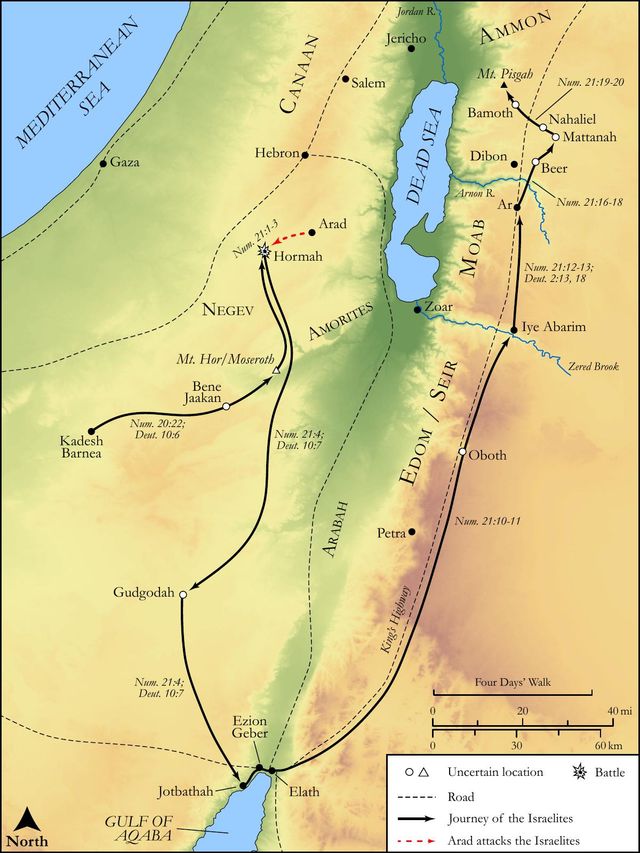
See on the biblical-era map
Study this verse
Public-domain commentary
Matthew Henry
From his Commentary on the Whole Bible. Henry comments on passages, not single verses — this entry covers Deuteronomy 10:1–11. His two-level outline is real structure in the source text, so it is rendered as structure.
There were four things in and by which God showed himself reconciled to Israel and made them truly great and happy, and in which God's goodness took occasion from their badness to make him the more illustrious: -
I.He gave them his law, gave it to them in writing, as a standing pledge of his favour.
Though the tables that were first written were broken, because Israel had broken the commandments, and God might justly break the covenant, yet when his anger was turned away the tables were renewed, Deu 10:1, Deu 10:2. Note, God's putting his law in our reconciliation to God and the best earnest of our happiness in him. Moses is told to hew the tables; for the law prepares the heart by conviction and humiliation for the grace of God, but it is only that grace that then writes the law in it. Moses made an ark of shittim-wood (Deu 10:3), a plain chest, the same, I suppose, in which the tables were afterwards preserved: but Bezaleel is said to make it (Exo 37:1), because he afterwards finished it up and overlaid it with gold. Or Moses is said to make it because, when he went up the second time into the mount, he ordered it to be made by Bezaleel against he came down. And it is observable that for this reason the ark was the first thing that God gave orders about, Exo 25:10. And this left an earnest to the congregation that the tables should not miscarry this second time, as they had done the first. God will send his law and gospel to those whose hearts are prepared as arks to receive them. Christ is the ark in which now our salvation is kept safely, that it may not be lost as it was in the first Adam, when he had it in his own hand. Observe,
1.What it was that God wrote on the two tables, the ten commandments (Deu 10:4), or ten words, intimating in how little a compass they were contained: they were not ten volumes, but ten words: it was the same with the first writing, and both the same that he spoke in the mount. The second edition needed no correction nor amendment, nor did what he wrote differ form what he spoke. The written word is as truly the word of God as that which he spoke to his servants the prophets.
2.What care was taken of it. These two tables, thus engraven, were faithfully laid up in the ark. And there they be, said Moses, pointing it is probable towards the sanctuary, Deu 10:5. That good thing which was committed to him he transmitted to them, and left it pure and entire in their hands; now let them look to it at their peril. Thus we may say to the rising generation, "God has entrusted us with Bibles, sabbaths, sacraments, etc., as tokens of his presence and favour, and there they be; we lodge them with you," Ti2 1:13, Ti2 1:14.
II.He led them forward towards Canaan, though they in their hearts turned back towards Egypt, and he might justly have chosen their delusions, Deu 10:6, Deu 10:7. He brought them to a land of rivers of waters, out of a dry and barren wilderness. Sometimes God supplied their wants by the ordinary course of nature: when that failed, then by miracles; and yet after this, when they were brought into a little distress, we find them distrusting God and murmuring, Num 20:3, Num 20:4.
III.He appointed a standing ministry among them, to deal for them in holy things.
At that time when Moses went up a second time to the mount, or soon after, he had orders to separate the tribe of Levi to God, and to his immediate service, they having distinguished themselves by their zeal against the worshippers of the golden calf, Deu 10:8, Deu 10:9. The Kohathites carried the ark; they and the other Levites stood before the Lord, to minister to him in all the offices of the tabernacle; and the priests, who were of that tribe, were to bless the people. This was a standing ordinance, which had now continued almost forty years, even unto this day; and provision was made for the perpetuating of it by the settled maintenance of that tribe, which was such as gave them great encouragement in their work, and no diversion from it. The Lord is his inheritance. Note, A settled ministry is a great blessing to a people, and a special token of God's favour. And, since the particular priests could not continue by reason of death, God showed his care of the people in securing a succession, which Moses takes notice of here, Deu 10:6. When Aaron died, the priesthood did not die with him, but Eleazar his son ministered in his stead, and took care of the ark, in which the tables of stone, those precious stones, were deposited, that they should suffer no damage; there they be, and he has the custody of them. Under the law, a succession in the ministry was kept up, by an entail of the office on a certain tribe and family. But now, under the gospel, when the effusion of the Spirit is more plentiful and powerful, the succession is kept up by the Spirit's operation on men's hearts, qualifying men for, and inclining men to, that work, some in every age, that the name of Israel may not be blotted out.
IV.He accepted Moses as an advocate or intercessor for them, and therefore constituted him their prince and leader (Deu 10:10, Deu 10:11):
The Lord hearkened to me and said, Arise, go before the people. It was a mercy to them that they had such a friend, so faithful both to him that appointed him and to those for whom he was appointed. It was fit that he who had saved them from ruin, by his intercession with heaven, should have the conduct and command of them. And herein he was a type of Christ, who, as he ever lives making intercession for us, so he has all power both in heaven and in earth.
Continue studying Deuteronomy 10:5 across the web’s major study libraries — every link below opens this exact verse, chapter, or book on the destination site.
Read & Compare
 BibleGatewayThis verse in more than 200 translations and 70 languages.
 Bible.comThe YouVersion reader — hundreds of translations, reading plans, and highlights.
 ESV.orgCrossway's official English Standard Version reader.
 NET BibleThe NET translation with 60,000+ translators' notes on every rendering decision.
 STEP BibleTyndale House's free study tool — original text, vocabulary, and scholarly resources.
 BibliaLogos Bible Software's free web reader.
 USCCBThe New American Bible (Revised Edition) with the U.S. bishops' study notes.
Commentaries
 BibleHub CommentariesDozens of classic commentaries on this verse, gathered on one page.
 StudyLightMore than 100 commentary sets — the largest collection on the web.
 BibleRefPlain-English commentary on what this verse means, verse by verse.
 Enduring WordDavid Guzik's free commentary on this chapter, widely used by Bible teachers.
 Bible Study ToolsVerse commentary alongside Greek and Hebrew study aids.
Original Language & Research
- BibleHub InterlinearThe verse word by word — original language, transliteration, and English.
- BibleHub LexiconEvery word's original-language definition and Strong's entry.
 Blue Letter BibleDeep-study tools — Strong's numbers, concordance, and word studies.
 SefariaThe Hebrew text with Rashi and centuries of Jewish commentary.
Sermons, Hymns & Audio


TrulyRandomVerse is not affiliated with these sites and doesn’t control their content. They’re linked because they’re genuinely useful.
Summary
Deuteronomy 10:5 captures a crucial moment in Israel's wilderness journey, as Moses recounts his obedient act of placing the second set of the Ten Commandments within a specially constructed ark. This verse underscores God's meticulous command for the preservation of His sacred law, symbolizing His enduring covenant faithfulness despite Israel's rebellion, and highlighting the centrality of His word to the nation's identity and future.
Context
ShowHideLiterary Context
This verse is embedded within Moses' second major discourse to the Israelites, delivered on the plains of Moab just before their entry into the Promised Land. Moses is not introducing new laws here but is rather recapitulating Israel's history with God, emphasizing key events, divine commands, and the consequences of obedience and disobedience. Specifically, Deuteronomy 10:1-11 details God's gracious provision of a second set of tablets following the catastrophic golden calf incident, which had led to the breaking of the first tablets (recounted in Exodus 32:19). Moses' recounting serves as both a reminder of God's mercy and a call to renewed covenant fidelity for a new generation poised to inherit the land. The immediate verses, Deuteronomy 10:1-4 describe God's instruction to Moses to hew new stone tablets and to make a wooden ark to house them, setting the stage for the fulfillment of that command in verse 5.
Historical & Cultural Context
The historical backdrop is Israel's forty-year wilderness wandering, a period marked by divine provision, covenant formation, and repeated rebellion. The incident of the golden calf (recorded in Exodus 32) was a profound breach of the covenant, demonstrating Israel's propensity for idolatry even immediately after receiving God's law. The tablets of the covenant, written by the LORD Himself, were laid up in the ark, symbolizing their importance and the presence of the LORD among His people. The act of placing the tablets in an ark, therefore, was marked by its divine origin and the unique nature of Israel's covenant with Yahweh. This ark, though initially a simple wooden chest made by Moses, served as a precursor to the more elaborate Ark of the Covenant constructed later, which became the central cultic object in Israel's worship, symbolizing God's presence and the enduring nature of His law.
Key Themes
ShowHideDeuteronomy 10:5 contributes significantly to several overarching themes within Deuteronomy and the broader Pentateuch. Firstly, it powerfully illustrates the theme of Divine Forgiveness and Restoration. Despite Israel's egregious sin with the golden calf, God, in His boundless mercy, did not abandon His people but initiated a path to covenant renewal by commanding new tablets. This act of grace underscores God's unwavering commitment to His covenant people, even when they fail. Secondly, the verse highlights Divine Command and Human Obedience. Moses' explicit statement, "as the LORD commanded me," emphasizes his faithful execution of God's precise instructions. This obedience is presented as the proper human response to divine grace and is foundational to Israel's relationship with Yahweh, a theme reiterated throughout the book of Deuteronomy as a condition for blessing in the Promised Land (e.g., Deuteronomy 28:1-14). Finally, the verse underscores the Sacredness and Preservation of God's Law. The careful placement of the tablets in the ark signifies the immense value and enduring authority of God's word. The ark itself became the central repository of the Law, serving as a tangible reminder of God's presence and the foundational principles governing Israel's life, worship, and identity, reinforcing the idea that God's word is to be cherished and guarded (as seen in Psalm 119:11).
Exposition and Analysis
ShowHideKey Word Analysis
ShowHideThis term refers to a chest or box. In this context, it specifically denotes the temporary wooden chest Moses constructed at God's command to house the second set of tablets. Unlike the later, more ornate Ark of the Covenant described in Exodus 25, this initial "ark which I had made" (as Moses states) was simpler, serving an immediate, functional purpose. Its significance lies not in its material splendor but in its sacred contents and divine purpose: to preserve God's direct revelation. The progression from a simple wooden ark to the gold-covered Ark of the Covenant highlights the increasing sanctification and centrality of God's presence and law within Israel's developing worship.
This verb signifies a divine imperative, a direct and authoritative instruction from God. The phrase "as the LORD commanded me" is a recurring motif in Moses' recounting and throughout the Pentateuch, emphasizing the divine origin of the law and the necessity of human obedience. It underscores that Moses' actions were not arbitrary but were a faithful execution of God's sovereign will, establishing a pattern of submission to divine authority for all Israel.
Verse Breakdown
ShowHide"And I turned myself and came down from the mount,"
This clause refers to Moses' descent from Mount Horeb (Sinai) after receiving the second set of tablets. The "turning" signifies a deliberate action, a physical reorientation from the divine presence on the mountain back to the people below. This descent marks the culmination of a period of intense communion with God, during which the covenant was renewed and the law re-inscribed, symbolizing God's willingness to re-engage with His rebellious people.
"and put the tables in the ark which I had made;"
This is the central action of the verse. Moses, having hewn the new tablets and constructed the wooden ark as commanded by God in Deuteronomy 10:1-3, now fulfills the command to deposit the sacred law within this designated vessel. The act of "putting" (שׂוּם, sûwm) implies a careful, deliberate placement, underscoring the reverence due to God's word. The ark, though temporary, immediately became the sacred repository, ensuring the physical preservation and symbolic centrality of the Ten Commandments.
"and there they be, as the LORD commanded me."
This concluding phrase serves as a powerful affirmation of Moses' obedience and the enduring presence of God's law. The phrase "there they be" (וַיִּהְיוּ שָׁם, vayihyu sham) confirms the continued existence and accessibility of the tablets within the ark, underscoring their permanent significance for Israel. The final declaration, "as the LORD commanded me," reiterates the divine authority behind the entire process and validates Moses' faithful execution of God's will, emphasizing that the entire arrangement was divinely ordained, not humanly conceived.
Literary Devices
ShowHideDeuteronomy 10:5 employs several significant literary devices. Recapitulation is central, as Moses is recounting past events to a new generation, reinforcing the historical continuity of God's covenant with Israel. This serves a pedagogical purpose, reminding the people of God's faithfulness and their obligations. The phrase "as the LORD commanded me" functions as a form of Emphasis and Repetition, appearing multiple times in this immediate context (Deuteronomy 10:4, Deuteronomy 10:8) to underscore divine authority and Moses' unwavering obedience. This repetition instills in the audience the paramount importance of adhering to God's instructions. Furthermore, Symbolism is deeply embedded in the verse. The tablets themselves are symbols of God's direct revelation and the covenant relationship. The ark, even in its simpler form, symbolizes God's presence, the sacredness of His word, and His commitment to preserving His law among His people. The act of placing the tablets within the ark is a symbolic gesture of safeguarding the foundational principles of Israel's faith and identity.
Theological and Thematic Connections
ShowHideDeuteronomy 10:5 profoundly illustrates God's unyielding commitment to His covenant with Israel, even in the face of their profound failure. The provision of a second set of tablets, housed in an ark, is a powerful testament to God's restorative grace and His desire to maintain a relationship with His people. It demonstrates that God's faithfulness is not contingent upon human perfection but is rooted in His own character and sovereign will. This act of divine initiative in renewing the covenant underscores that salvation and restoration originate solely from God's mercy. The preservation of the law within the ark further emphasizes the enduring nature and absolute authority of God's word, which remains the unchanging standard for life and worship. It teaches that God's commands are not transient but are foundational for a thriving relationship with Him and for the flourishing of His people.
Reflection and Application
ShowHideDeuteronomy 10:5 offers profound insights for contemporary believers, reminding us of God's incredible patience and restorative power. Just as God gave Israel a second chance after their grievous sin, He continually extends grace and new opportunities to us through Christ. Our past failures do not define our future; rather, God's mercy invites us to renewed obedience and a deeper relationship with Him. This verse also underscores the supreme value of God's Word. The meticulous care taken to preserve the tablets in the ark should inspire us to hold the Bible in the highest esteem, making it central to our lives, our families, and our communities. It is not merely a historical document but a living and active guide, a lamp to our feet and a light to our path. Our obedience, like Moses', should be a heartfelt response to God's unfathomable grace, not a burdensome duty, but a joyful expression of our love and gratitude for His enduring faithfulness.
Questions for Reflection
ShowHideFAQ
ShowHideWhat is the difference between the ark Moses made and the Ark of the Covenant?
ShowHideDeuteronomy 10:5 refers to a temporary, simple wooden ark that Moses himself constructed at God's immediate command (as detailed in Deuteronomy 10:1-3). This ark was made specifically and quickly to house the second set of stone tablets containing the Ten Commandments. It served as an immediate, functional repository for the sacred law. In contrast, the more famous Ark of the Covenant, described in meticulous detail in Exodus 25:10-22, was a much more elaborate, gold-covered chest, constructed later by skilled craftsmen like Bezalel as part of the Tabernacle's furnishings. This permanent Ark of the Covenant became the central symbol of God's presence among His people, serving as the mercy seat and the ultimate dwelling place for the tablets of the Law. Moses' ark was a provisional measure, while the Ark of the Covenant was the divinely designed, enduring centerpiece of Israel's worship and national identity.
Christ-Centered Fulfillment
ShowHideDeuteronomy 10:5, with its emphasis on the preservation of God's law in the ark and God's gracious renewal of the covenant, finds profound fulfillment in Jesus Christ. The stone tablets, though sacred, represented a covenant that Israel continually broke, revealing humanity's inability to perfectly keep God's righteous demands. Jesus, however, is the ultimate fulfillment of the Law, not by abolishing it, but by perfectly embodying and upholding its every command (Matthew 5:17). He is the true "ark" in whom the fullness of God's presence dwells (Colossians 2:9), and through whom God's law is not merely preserved on stone but is written upon the hearts of believers by the Holy Spirit, ushering in the New Covenant prophesied in Jeremiah 31:33 and established through His blood (Luke 22:20). Just as God graciously provided a second set of tablets after Israel's failure, Christ's death and resurrection provide the ultimate "second chance" for humanity, offering complete forgiveness and reconciliation, making us new creations in Him (2 Corinthians 5:17). He is the obedient Lamb of God, whose perfect obedience accomplishes what the law on stone could not, bringing us into a living, restored relationship with God.