


Deuteronomy 10:4
Bible text: King James Version (1769 Blayney text) · Public domain
Bible text: King James Version with Strong's numbers · Public domain
Bible text: Berean Standard Bible · Public domain
Bible text: American Standard Version (1901) · Public domain
Bible text: World English Bible, Messianic edition · Public domain
Bible text: Geneva Bible (1599) · Public domain
Bible text: Young's Literal Translation · Public domain
- וַיִּכְתֹּבvai·yikh·Toand he wroteH3789Conj-w ¦ V-Qal-ConsecImperf-3msVerb Qal Consecutive Imperfect 3rd Singular Masculineוַandיִּכְתֹּבhe wrote
- עַל'alonH5921PrepPreposition
- הַלֻּחֹתha·lu·Chotthe tabletsH3871Art ¦ N-fpNoun Plural Feminine Absoluteהַtheלֻּחֹתtablets
- כַּמִּכְתָּבka·mikh·Tavlike the writingH4385Prep-k ¦ N-msNoun Singular Masculine Absoluteכַּlike theמִּכְתָּבwriting
- הָרִאשׁוֹןha·ri·Shon<the> formerH7223Art ¦ Adj-msAdjective Numerical Position Singular Masculine Absoluteהָ<the>רִאשׁוֹןformer
- אֵת'et<obj.>H853DirObjMParticle Object Indicator
- עֲשֶׂרֶת'a·Se·ret[the] tenH6235N-fscNoun Singular Feminine Construct
- הַדְּבָרִיםha·de·va·Rimthe wordsH1697Art ¦ N-mpNoun Plural Masculine Absoluteהַtheדְּבָרִיםwords
- אֲשֶׁר'a·SherwhichH834RelParticle Relative
- דִּבֶּרdi·Berhe had spokenH1696V-Piel-Perf-3msVerb Piel Perfect 3rd Singular Masculine
- יְהוָהYah·wehYahwehH3068N-properNoun Proper Title
- אֲלֵיכֶם'a·lei·Khemto youH413Prep ¦ 2mpPreposition Definiteאֲלֵיtoכֶםyou
- בָּהָרba·Haron the mountainH2022Prep-b ¦ N-msNoun Singular Masculine Absoluteבָּon theהָרmountain
- מִתּוֹךְmi·Tokhfrom [the] middle ofH8432Prep-m ¦ N-mscNoun Singular Masculine Constructמִfromתּוֹךְ[the] middle of
- הָאֵשׁha·'Eshthe fireH784Art ¦ N-csNoun Singular common gender Absoluteהָtheאֵשׁfire
- בְּיוֹםbe·Yomon [the] day ofH3117Prep-b ¦ N-mscNoun Singular Masculine Constructבְּonיוֹם[the] day of
- הַקָּהָלha·ka·Halthe assemblyH6951Art ¦ N-msNoun Singular Masculine Absoluteהַtheקָּהָלassembly
- וַיִּתְּנֵםvai·yi·te·Nemand he gave themH5414Conj-w ¦ V-Qal-ConsecImperf-3ms ¦ 3mpVerb Qal Consecutive Imperfect 3rd Singular Masculineוַandיִּתְּנֵhe gaveםthem
- יְהוָהYah·wehYahwehH3068N-properNoun Proper Title
- אֵלָי'e·Laito meH413Prep ¦ 1csPreposition Definiteאֵלָtoיme
English is a literal word-by-word gloss of the Hebrew, not the KJV's wording. Why?
This is the original text the KJV's translators worked from — each Hebrew word with its own literal English meaning in this verse, prepared by scholars at Tyndale House, Cambridge. The KJV translates whole sentences, not word by word, so its wording differs: one Hebrew word can become several English words, and the KJV may choose “the LORD” where the gloss reads “Yahweh”. Both are faithful — they answer different questions. For the KJV's own rendering, switch to the KJV text.
Details
See on the biblical-era map
Study this verse
Public-domain commentary
Matthew Henry
From his Commentary on the Whole Bible. Henry comments on passages, not single verses — this entry covers Deuteronomy 10:1–11. His two-level outline is real structure in the source text, so it is rendered as structure.
There were four things in and by which God showed himself reconciled to Israel and made them truly great and happy, and in which God's goodness took occasion from their badness to make him the more illustrious: -
I.He gave them his law, gave it to them in writing, as a standing pledge of his favour.
Though the tables that were first written were broken, because Israel had broken the commandments, and God might justly break the covenant, yet when his anger was turned away the tables were renewed, Deu 10:1, Deu 10:2. Note, God's putting his law in our reconciliation to God and the best earnest of our happiness in him. Moses is told to hew the tables; for the law prepares the heart by conviction and humiliation for the grace of God, but it is only that grace that then writes the law in it. Moses made an ark of shittim-wood (Deu 10:3), a plain chest, the same, I suppose, in which the tables were afterwards preserved: but Bezaleel is said to make it (Exo 37:1), because he afterwards finished it up and overlaid it with gold. Or Moses is said to make it because, when he went up the second time into the mount, he ordered it to be made by Bezaleel against he came down. And it is observable that for this reason the ark was the first thing that God gave orders about, Exo 25:10. And this left an earnest to the congregation that the tables should not miscarry this second time, as they had done the first. God will send his law and gospel to those whose hearts are prepared as arks to receive them. Christ is the ark in which now our salvation is kept safely, that it may not be lost as it was in the first Adam, when he had it in his own hand. Observe,
1.What it was that God wrote on the two tables, the ten commandments (Deu 10:4), or ten words, intimating in how little a compass they were contained: they were not ten volumes, but ten words: it was the same with the first writing, and both the same that he spoke in the mount. The second edition needed no correction nor amendment, nor did what he wrote differ form what he spoke. The written word is as truly the word of God as that which he spoke to his servants the prophets.
2.What care was taken of it. These two tables, thus engraven, were faithfully laid up in the ark. And there they be, said Moses, pointing it is probable towards the sanctuary, Deu 10:5. That good thing which was committed to him he transmitted to them, and left it pure and entire in their hands; now let them look to it at their peril. Thus we may say to the rising generation, "God has entrusted us with Bibles, sabbaths, sacraments, etc., as tokens of his presence and favour, and there they be; we lodge them with you," Ti2 1:13, Ti2 1:14.
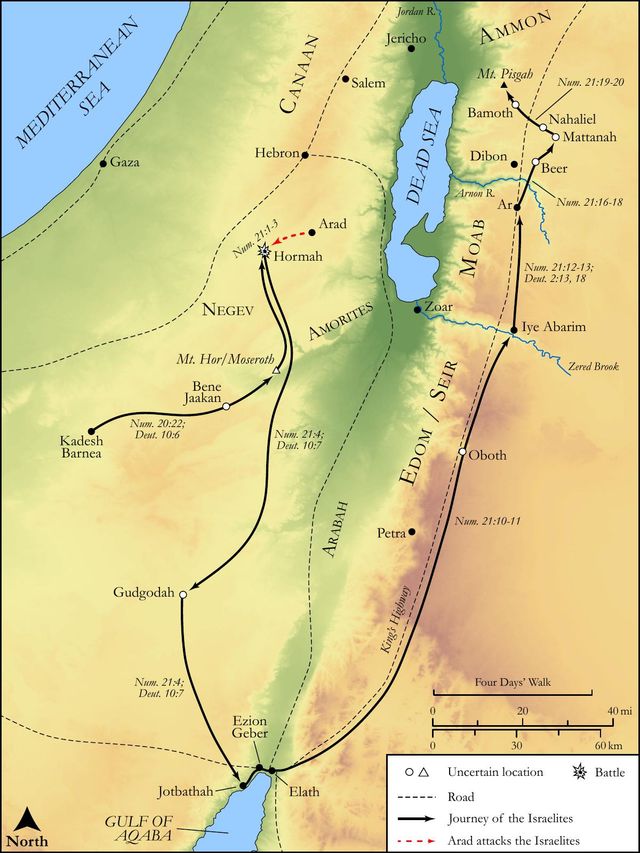
II.He led them forward towards Canaan, though they in their hearts turned back towards Egypt, and he might justly have chosen their delusions, Deu 10:6, Deu 10:7. He brought them to a land of rivers of waters, out of a dry and barren wilderness. Sometimes God supplied their wants by the ordinary course of nature: when that failed, then by miracles; and yet after this, when they were brought into a little distress, we find them distrusting God and murmuring, Num 20:3, Num 20:4.
III.He appointed a standing ministry among them, to deal for them in holy things.
At that time when Moses went up a second time to the mount, or soon after, he had orders to separate the tribe of Levi to God, and to his immediate service, they having distinguished themselves by their zeal against the worshippers of the golden calf, Deu 10:8, Deu 10:9. The Kohathites carried the ark; they and the other Levites stood before the Lord, to minister to him in all the offices of the tabernacle; and the priests, who were of that tribe, were to bless the people. This was a standing ordinance, which had now continued almost forty years, even unto this day; and provision was made for the perpetuating of it by the settled maintenance of that tribe, which was such as gave them great encouragement in their work, and no diversion from it. The Lord is his inheritance. Note, A settled ministry is a great blessing to a people, and a special token of God's favour. And, since the particular priests could not continue by reason of death, God showed his care of the people in securing a succession, which Moses takes notice of here, Deu 10:6. When Aaron died, the priesthood did not die with him, but Eleazar his son ministered in his stead, and took care of the ark, in which the tables of stone, those precious stones, were deposited, that they should suffer no damage; there they be, and he has the custody of them. Under the law, a succession in the ministry was kept up, by an entail of the office on a certain tribe and family. But now, under the gospel, when the effusion of the Spirit is more plentiful and powerful, the succession is kept up by the Spirit's operation on men's hearts, qualifying men for, and inclining men to, that work, some in every age, that the name of Israel may not be blotted out.
IV.He accepted Moses as an advocate or intercessor for them, and therefore constituted him their prince and leader (Deu 10:10, Deu 10:11):
The Lord hearkened to me and said, Arise, go before the people. It was a mercy to them that they had such a friend, so faithful both to him that appointed him and to those for whom he was appointed. It was fit that he who had saved them from ruin, by his intercession with heaven, should have the conduct and command of them. And herein he was a type of Christ, who, as he ever lives making intercession for us, so he has all power both in heaven and in earth.
Continue studying Deuteronomy 10:4 across the web’s major study libraries — every link below opens this exact verse, chapter, or book on the destination site.
Read & Compare
 BibleGatewayThis verse in more than 200 translations and 70 languages.
 Bible.comThe YouVersion reader — hundreds of translations, reading plans, and highlights.
 ESV.orgCrossway's official English Standard Version reader.
 NET BibleThe NET translation with 60,000+ translators' notes on every rendering decision.
 STEP BibleTyndale House's free study tool — original text, vocabulary, and scholarly resources.
 BibliaLogos Bible Software's free web reader.
 USCCBThe New American Bible (Revised Edition) with the U.S. bishops' study notes.
Commentaries
 BibleHub CommentariesDozens of classic commentaries on this verse, gathered on one page.
 StudyLightMore than 100 commentary sets — the largest collection on the web.
 BibleRefPlain-English commentary on what this verse means, verse by verse.
 Enduring WordDavid Guzik's free commentary on this chapter, widely used by Bible teachers.
 Bible Study ToolsVerse commentary alongside Greek and Hebrew study aids.
Original Language & Research
- BibleHub InterlinearThe verse word by word — original language, transliteration, and English.
- BibleHub LexiconEvery word's original-language definition and Strong's entry.
 Blue Letter BibleDeep-study tools — Strong's numbers, concordance, and word studies.
 SefariaThe Hebrew text with Rashi and centuries of Jewish commentary.
Sermons, Hymns & Audio


TrulyRandomVerse is not affiliated with these sites and doesn’t control their content. They’re linked because they’re genuinely useful.
Summary
Deuteronomy 10:4 encapsulates a pivotal moment in Israel's covenant history, emphasizing God's profound grace and unwavering commitment to His people despite their egregious sin. Moses recounts how the LORD, in an act of divine faithfulness, personally reinscribed the Decalogue onto new stone tablets, replicating the original divine inscription, and delivered them to him. This verse powerfully underscores the enduring authority of God's divinely revealed law, the awe-inspiring nature of His presence at Mount Horeb, and His steadfast determination to maintain His covenant relationship with Israel.
Context
ShowHideLiterary Context
Deuteronomy 10:4 is situated within Moses' second major address to the Israelites, delivered on the plains of Moab as they stand on the threshold of the Promised Land. This discourse, spanning chapters 5-26, serves as a comprehensive review and reaffirmation of the Mosaic Covenant, preparing the new generation for life in Canaan. Specifically, chapter 10 is part of Moses' detailed recollection of the events immediately following Israel's catastrophic idolatry with the golden calf, which led to the shattering of the first set of tablets (as vividly described in Exodus 32:19). Moses' recounting here emphasizes God's persistent grace and commitment to His covenant people, even after their profound failure, reminding them of God's command to prepare new tablets and ascend Mount Horeb for the law to be rewritten, demonstrating divine initiative in covenant renewal (see Exodus 34:1-4).
Historical & Cultural Context
The historical backdrop for this address is approximately 40 years after the Exodus from Egypt, with the generation that rebelled at Sinai having largely passed away. The Israelites are now encamped in Moab, poised to enter Canaan. The "day of the assembly" refers to the momentous and terrifying gathering at Mount Sinai (also known as Horeb), where God first descended in a fiery theophany to reveal His Law and establish His covenant with Israel (as detailed in Exodus 19). This event was characterized by thunder, lightning, thick cloud, and consuming fire, instilling both profound awe and terror in the people. The writing of the commandments on stone tablets signified permanence, authority, and the binding nature of the stipulations. The fact that God Himself inscribed the "ten commandments" elevated their status far above any human legislation, marking them as uniquely divine.
Key Themes
ShowHideThis verse powerfully contributes to several overarching themes within Deuteronomy and the broader Pentateuch. It highlights the Divine Authorship and Authority of the Law, unequivocally stating that the "ten commandments" are not human constructs but direct, authoritative pronouncements from the LORD Himself, spoken "out of the midst of the fire." It profoundly underscores God's Enduring Faithfulness and Grace, demonstrating His willingness to restore the covenant even after Israel's catastrophic idolatry with the golden calf, serving as a stark reminder of their sinfulness and His steadfast love (compare Deuteronomy 9:7-21). The phrase "according to the first writing" reinforces the Unchanging Nature of God's Moral Law, indicating that the content of His foundational principles remains constant despite the physical replacement of the tablets. Finally, it reiterates the Awe-Inspiring and Terrifying Nature of Divine Revelation, recalling the dramatic theophany at Sinai, which serves as a perpetual reminder of the solemnity and weight of God's word (as described in Deuteronomy 5:22-26).
Exposition and Analysis
ShowHideKey Word Analysis
ShowHideThis primitive root signifies the act of engraving, inscribing, or writing. In Deuteronomy 10:4, the subject of this verb is "He," referring explicitly to the LORD. This divine agency in "writing" the commandments is profoundly significant, underscoring their absolute authority, permanence, and sacredness. It distinguishes these laws as direct, immutable divine decrees, not human constructs, making them the very word of God inscribed by His own hand.
Derived from the root "to speak," this noun literally translates to "word" or "utterance." In the context of "the ten commandments" (literally "the ten words"), this term emphasizes that these are not merely human rules or statutes, but direct, spoken pronouncements originating from God Himself. It highlights their nature as foundational declarations of God's character and will, forming the bedrock of Israel's covenant relationship with Yahweh and serving as divine speech given for human obedience.
A primitive word denoting literal or figurative fire, this term is a recurring and powerful motif in biblical theophanies, particularly at Mount Sinai. In this verse, "fire" symbolizes God's holy, consuming presence, His unapproachable glory, and the intense purity of His revelation. Its presence during the giving of the Law signifies the overwhelming and terrifying nature of the divine encounter, impressing upon the Israelites the gravity, solemnity, and absolute holiness of the commands issued from the very heart of God's glory.
Verse Breakdown
ShowHide"And he wrote on the tables, according to the first writing,"
This opening clause immediately establishes the divine authorship of the Law, with "he" unequivocally referring to the LORD. The crucial phrase "according to the first writing" signifies that the content inscribed on this second set of tablets was identical to the original Decalogue, which Moses had broken. This emphasizes the unchanging nature of God's moral law and His unwavering faithfulness in restoring what was lost due to human sin, rather than altering or abandoning His foundational principles. It highlights divine initiative in covenant renewal.
"the ten commandments, which the LORD spake unto you in the mount out of the midst of the fire in the day of the assembly:"
This segment identifies the specific content—the Decalogue, literally "the ten words"—and vividly recalls the dramatic circumstances of its initial revelation. It underscores the direct, oral communication from "the LORD" to "you" (the assembled Israelites) at Mount Horeb (Sinai). The powerful imagery of "the mount out of the midst of the fire" and "the day of the assembly" evokes the terrifying and glorious theophany, emphasizing the unique, personal, and awe-inspiring nature of God's self-revelation and the solemnity with which His Law was given.
"and the LORD gave them unto me."
This concluding clause confirms Moses' indispensable role as the divinely appointed mediator. After God personally inscribed the commandments, He delivered them directly to Moses, who then brought them down to the people. This highlights the divine origin and authoritative transmission of the Law, reinforcing its supreme authority and Moses' unique and privileged position in receiving it directly from the hand of God.
Literary Devices
ShowHideDeuteronomy 10:4 masterfully employs several potent literary devices to convey its profound theological message. The Repetition of "the LORD" (twice in the latter half of the verse) serves to underscore divine agency and absolute authority, reinforcing that God alone is the ultimate author and giver of the Law, not Moses or any human entity. The phrase "according to the first writing" functions as a powerful form of Recapitulation or Allusion, drawing the audience's memory back to the initial, dramatic giving of the Law and its subsequent breakage due to Israel's sin, thereby highlighting God's steadfastness and grace despite human failure. Vivid Imagery is powerfully utilized with phrases such as "out of the midst of the fire" and "day of the assembly," which evoke the overwhelming sensory experience of the Sinai covenant. This imagery impresses upon the audience the solemnity, weight, and terrifying glory of God's direct revelation. This vivid imagery is central to the overall Theophany motif, describing a visible and audible manifestation of God's presence, which is a cornerstone of the narrative surrounding the reception of the Law.
Theological and Thematic Connections
ShowHideDeuteronomy 10:4 stands as a powerful testament to the enduring nature of God's covenant faithfulness and the unchangeable character of His divine will. Despite Israel's profound betrayal through the golden calf idolatry, God, in His boundless grace, chose to renew His covenant, personally re-inscribing the very same "ten words" that had been broken. This act underscores that God's commitment to His promises and His moral standards are not contingent upon human perfection, but rooted in His own immutable and steadfast character. The divine authorship of the Law highlights its absolute authority and its foundational role in shaping a people set apart for God, serving as a constant guide for righteous living and a mirror reflecting human sinfulness, pointing to the need for divine grace.
Reflection and Application
ShowHideDeuteronomy 10:4 offers profound and enduring lessons for contemporary believers, reminding us of God's unwavering commitment to His people and His word, even in the face of our imperfections and failures. Just as God graciously restored the broken tablets to Israel, He consistently extends mercy and a path to restoration when we falter, demonstrating His steadfast love and patience. This verse invites us to reflect deeply on the divine origin and unchanging nature of God's moral principles, recognizing that they are not arbitrary rules but perfect expressions of His holy character, designed for our ultimate good and flourishing. It challenges us to cultivate a profound sense of awe and reverence with which we approach God's word, recognizing it as a direct utterance from the Creator of the universe, spoken from the very midst of His glory. Our appropriate response to such a profound and gracious gift should be one of humble obedience, seeking to align our lives with His perfect will, trusting in His empowering grace to enable us where we fall short and to lead us into deeper communion with Him.
Questions for Reflection
ShowHideFAQ
ShowHideWhy did God rewrite the commandments instead of giving new ones?
ShowHideGod rewrote the commandments "according to the first writing" to powerfully demonstrate the unchanging nature of His moral law and His covenant stipulations. The breaking of the first tablets by Moses symbolized Israel's breaking of the covenant through their egregious idolatry with the golden calf (see Exodus 32:19). By rewriting the exact same "ten words," God emphatically underscored that His divine standards and His holy character do not waver or change, even when His people fail spectacularly. This act was a profound demonstration of His grace and a powerful act of covenant renewal, signifying His unwavering faithfulness to His original promises and His fervent desire to restore His relationship with Israel, rather than abandoning them or altering His perfect will. It also reinforced the absolute divine authority of the law, as it was God Himself who inscribed them not once, but twice (see Exodus 34:1).
Christ-Centered Fulfillment
ShowHideDeuteronomy 10:4, with its profound emphasis on the divine authorship, enduring nature, and gracious restoration of the Law, finds its ultimate fulfillment and redemptive transformation in the person and work of Jesus Christ. While the Law was given on stone tablets amidst fire and thunder, a revelation that powerfully highlighted humanity's inherent inability to perfectly obey its righteous demands, Christ embodies the Law perfectly and completely (as He Himself declared in Matthew 5:17). He is the living Word, the ultimate and most complete revelation of God, far surpassing the revelation at Sinai (see John 1:1-3 and Hebrews 1:1-3). The Old Covenant, inscribed externally on stone, exposed sin but was inherently weak in its inability to empower obedience (as articulated in Romans 8:3). However, through Christ's perfect life, atoning sacrifice, and glorious resurrection, He inaugurates a New Covenant where God's law is no longer merely an external code but is supernaturally written "on their hearts" by the indwelling Holy Spirit (as powerfully prophesied in Jeremiah 31:33 and profoundly explained in Hebrews 8:10). Thus, the divine writing on stone in Deuteronomy 10:4 beautifully foreshadows the divine writing on human hearts, enabling a genuine, Spirit-empowered obedience and transformation that the Law itself could not produce, all made possible through the boundless grace and complete redemption found in Jesus Christ, the true Lamb of God who takes away the sin of the world (see John 1:29).