


Deuteronomy 10:11
Bible text: King James Version (1769 Blayney text) · Public domain
Bible text: King James Version with Strong's numbers · Public domain
Bible text: Berean Standard Bible · Public domain
Bible text: American Standard Version (1901) · Public domain
Bible text: World English Bible, Messianic edition · Public domain
Bible text: Geneva Bible (1599) · Public domain
Bible text: Young's Literal Translation · Public domain
- וַיֹּאמֶרvai·Yo·merand he saidH559Conj-w ¦ V-Qal-ConsecImperf-3msVerb Qal Consecutive Imperfect 3rd Singular Masculineוַandיֹּאמֶרhe said
- יְהוָהYah·wehYahwehH3068N-properNoun Proper Title
- אֵלַי'e·Laito meH413Prep ¦ 1csPreposition Definiteאֵלַtoיme
- קוּםkumariseH6965V-Qal-Imp-2msVerb Qal Imperative 2nd Singular Masculine
- לֵךְlekhgoH1980V-Qal-Imp-2msVerb Qal Imperative 2nd Singular Masculine
- לְמַסַּעle·ma·Sa'to journeyingH4550Prep-l ¦ N-msNoun Singular Masculine Absoluteלְtoמַסַּעjourneying
- לִפְנֵיlif·Nei<to> beforeH6440Prep-l ¦ N-mpcNoun Plural Masculine Constructלִ<to>פְנֵיbefore
- הָעָםha·'Amthe peopleH5971Art ¦ N-msNoun Singular Masculine Absoluteהָtheעָםpeople
- וְיָבֹאוּve·ya·Vo·'uso they may goH935Conj-w ¦ V-Qal-ConjImperf-3mpVerb Qal Conjunction+Imperfect 3rd Plural Masculineוְsoיָבֹאוּthey may go
- וְיִרְשׁוּve·yir·Shuand they may take possession ofH3423Conj-w ¦ V-Qal-ConjImperf-3mpVerb Qal Conjunction+Imperfect 3rd Plural Masculineוְandיִרְשׁוּthey may take possession of
- אֶת'et<obj.>H853DirObjMParticle Object Indicator
- הָאָרֶץha·'A·retzthe landH776Art ¦ N-fsNoun Singular Feminine Absoluteהָtheאָרֶץland
- אֲשֶׁר'a·SherwhichH834RelParticle Relative
- נִשְׁבַּעְתִּיnish·Ba'·tiI sworeH7650V-Niphal-Perf-1csVerb Niphal Perfect 1st Singular common gender
- לַאֲבֹתָםla·'a·vo·Tamto their ancestorsH1Prep-l ¦ N-fpc ¦ 3mpNoun Plural Feminine Constructלַtoאֲבֹתָancestorsםtheir
- לָתֵתla·Tetto giveH5414Prep-l ¦ V-Qal-InfVerb Qal Infinitive Constructלָtoתֵתgive
- לָהֶםla·Hemto <the> themPrep-l ¦ 3mpSuffix Personal 3rd Plural Masculineלָto <the>הֶםthem
English is a literal word-by-word gloss of the Hebrew, not the KJV's wording. Why?
This is the original text the KJV's translators worked from — each Hebrew word with its own literal English meaning in this verse, prepared by scholars at Tyndale House, Cambridge. The KJV translates whole sentences, not word by word, so its wording differs: one Hebrew word can become several English words, and the KJV may choose “the LORD” where the gloss reads “Yahweh”. Both are faithful — they answer different questions. For the KJV's own rendering, switch to the KJV text.
Details
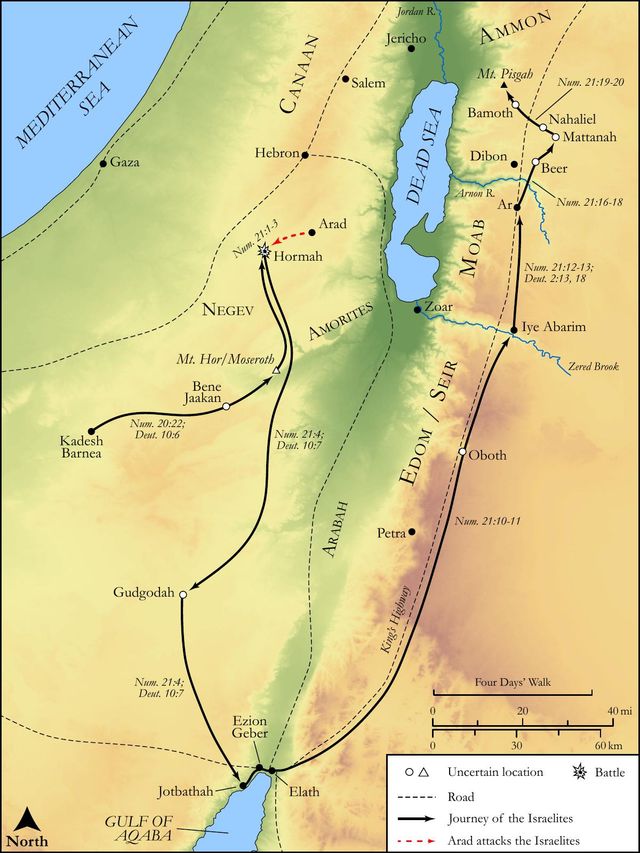
See on the biblical-era map
Study this verse
Public-domain commentary
Matthew Henry
From his Commentary on the Whole Bible. Henry comments on passages, not single verses — this entry covers Deuteronomy 10:1–11. His two-level outline is real structure in the source text, so it is rendered as structure.
There were four things in and by which God showed himself reconciled to Israel and made them truly great and happy, and in which God's goodness took occasion from their badness to make him the more illustrious: -
I.He gave them his law, gave it to them in writing, as a standing pledge of his favour.
Though the tables that were first written were broken, because Israel had broken the commandments, and God might justly break the covenant, yet when his anger was turned away the tables were renewed, Deu 10:1, Deu 10:2. Note, God's putting his law in our reconciliation to God and the best earnest of our happiness in him. Moses is told to hew the tables; for the law prepares the heart by conviction and humiliation for the grace of God, but it is only that grace that then writes the law in it. Moses made an ark of shittim-wood (Deu 10:3), a plain chest, the same, I suppose, in which the tables were afterwards preserved: but Bezaleel is said to make it (Exo 37:1), because he afterwards finished it up and overlaid it with gold. Or Moses is said to make it because, when he went up the second time into the mount, he ordered it to be made by Bezaleel against he came down. And it is observable that for this reason the ark was the first thing that God gave orders about, Exo 25:10. And this left an earnest to the congregation that the tables should not miscarry this second time, as they had done the first. God will send his law and gospel to those whose hearts are prepared as arks to receive them. Christ is the ark in which now our salvation is kept safely, that it may not be lost as it was in the first Adam, when he had it in his own hand. Observe,
1.What it was that God wrote on the two tables, the ten commandments (Deu 10:4), or ten words, intimating in how little a compass they were contained: they were not ten volumes, but ten words: it was the same with the first writing, and both the same that he spoke in the mount. The second edition needed no correction nor amendment, nor did what he wrote differ form what he spoke. The written word is as truly the word of God as that which he spoke to his servants the prophets.
2.What care was taken of it. These two tables, thus engraven, were faithfully laid up in the ark. And there they be, said Moses, pointing it is probable towards the sanctuary, Deu 10:5. That good thing which was committed to him he transmitted to them, and left it pure and entire in their hands; now let them look to it at their peril. Thus we may say to the rising generation, "God has entrusted us with Bibles, sabbaths, sacraments, etc., as tokens of his presence and favour, and there they be; we lodge them with you," Ti2 1:13, Ti2 1:14.
II.He led them forward towards Canaan, though they in their hearts turned back towards Egypt, and he might justly have chosen their delusions, Deu 10:6, Deu 10:7. He brought them to a land of rivers of waters, out of a dry and barren wilderness. Sometimes God supplied their wants by the ordinary course of nature: when that failed, then by miracles; and yet after this, when they were brought into a little distress, we find them distrusting God and murmuring, Num 20:3, Num 20:4.
III.He appointed a standing ministry among them, to deal for them in holy things.
At that time when Moses went up a second time to the mount, or soon after, he had orders to separate the tribe of Levi to God, and to his immediate service, they having distinguished themselves by their zeal against the worshippers of the golden calf, Deu 10:8, Deu 10:9. The Kohathites carried the ark; they and the other Levites stood before the Lord, to minister to him in all the offices of the tabernacle; and the priests, who were of that tribe, were to bless the people. This was a standing ordinance, which had now continued almost forty years, even unto this day; and provision was made for the perpetuating of it by the settled maintenance of that tribe, which was such as gave them great encouragement in their work, and no diversion from it. The Lord is his inheritance. Note, A settled ministry is a great blessing to a people, and a special token of God's favour. And, since the particular priests could not continue by reason of death, God showed his care of the people in securing a succession, which Moses takes notice of here, Deu 10:6. When Aaron died, the priesthood did not die with him, but Eleazar his son ministered in his stead, and took care of the ark, in which the tables of stone, those precious stones, were deposited, that they should suffer no damage; there they be, and he has the custody of them. Under the law, a succession in the ministry was kept up, by an entail of the office on a certain tribe and family. But now, under the gospel, when the effusion of the Spirit is more plentiful and powerful, the succession is kept up by the Spirit's operation on men's hearts, qualifying men for, and inclining men to, that work, some in every age, that the name of Israel may not be blotted out.
IV.He accepted Moses as an advocate or intercessor for them, and therefore constituted him their prince and leader (Deu 10:10, Deu 10:11):
The Lord hearkened to me and said, Arise, go before the people. It was a mercy to them that they had such a friend, so faithful both to him that appointed him and to those for whom he was appointed. It was fit that he who had saved them from ruin, by his intercession with heaven, should have the conduct and command of them. And herein he was a type of Christ, who, as he ever lives making intercession for us, so he has all power both in heaven and in earth.
Continue studying Deuteronomy 10:11 across the web’s major study libraries — every link below opens this exact verse, chapter, or book on the destination site.
Read & Compare
 BibleGatewayThis verse in more than 200 translations and 70 languages.
 Bible.comThe YouVersion reader — hundreds of translations, reading plans, and highlights.
 ESV.orgCrossway's official English Standard Version reader.
 NET BibleThe NET translation with 60,000+ translators' notes on every rendering decision.
 STEP BibleTyndale House's free study tool — original text, vocabulary, and scholarly resources.
 BibliaLogos Bible Software's free web reader.
 USCCBThe New American Bible (Revised Edition) with the U.S. bishops' study notes.
Commentaries
 BibleHub CommentariesDozens of classic commentaries on this verse, gathered on one page.
 StudyLightMore than 100 commentary sets — the largest collection on the web.
 BibleRefPlain-English commentary on what this verse means, verse by verse.
 Enduring WordDavid Guzik's free commentary on this chapter, widely used by Bible teachers.
 Bible Study ToolsVerse commentary alongside Greek and Hebrew study aids.
Original Language & Research
- BibleHub InterlinearThe verse word by word — original language, transliteration, and English.
- BibleHub LexiconEvery word's original-language definition and Strong's entry.
 Blue Letter BibleDeep-study tools — Strong's numbers, concordance, and word studies.
 SefariaThe Hebrew text with Rashi and centuries of Jewish commentary.
Sermons, Hymns & Audio


TrulyRandomVerse is not affiliated with these sites and doesn’t control their content. They’re linked because they’re genuinely useful.
Summary
Deuteronomy 10:11 records a pivotal divine command from the LORD to Moses, instructing him to resume the journey and lead the Israelites into the Promised Land. This directive, issued after a period of covenant reaffirmation following Israel's profound rebellion at Mount Horeb, powerfully underscores God's unwavering faithfulness to His ancient promises made to the patriarchs, His active involvement in the destiny of His chosen people, and the essential role of human obedience and action in the ultimate fulfillment of His sovereign redemptive plan for their inheritance.
Context
ShowHideLiterary Context
This verse is strategically placed within Moses' second major discourse in the book of Deuteronomy, delivered to the new generation of Israelites on the plains of Moab, just as they stand poised to enter the Promised Land. It immediately follows a crucial period of covenant renewal at Mount Horeb (Sinai). Moses recounts God's profound grace in restoring the covenant after the catastrophic golden calf incident, where the first set of tablets was shattered due to Israel's idolatry. The LORD, in His boundless mercy, commanded Moses to hew a second set of stone tablets, upon which He re-inscribed the Ten Commandments, a testament to His enduring commitment to His people, as detailed in Deuteronomy 10:1-5. Following this profound act of covenant restoration and the subsequent appointment of the Levites, Deuteronomy 10:11 marks the divine signal for the Israelites to finally depart from Horeb, where they had encamped for nearly a year, and continue their journey toward Canaan. It is a direct, urgent command, signifying the transition from a period of theological instruction and covenant reaffirmation to active obedience and the tangible fulfillment of God's promise.
Historical & Cultural Context
The setting is the wilderness journey, approximately 40 years after the Exodus from Egyptian bondage. The Israelites, a vast multitude, had experienced both miraculous divine provision and severe divine judgment throughout their wanderings. Mount Horeb (Sinai) was the sacred site of the initial covenant, where God formally established Israel as His special, holy people. The golden calf incident, vividly narrated in Exodus 32, represented a profound act of apostasy that threatened to irrevocably sever the covenant relationship. God's subsequent renewal of the covenant, despite their egregious sin, profoundly highlighted His steadfast love, patient endurance, and unwavering commitment to His chosen nation. Culturally, the concept of a "promised land" was deeply significant to the heirs of Abraham; land was not merely territory but integral to a people's identity, security, economic stability, and the fulfillment of divine blessing. The command to "possess" implied not just physical occupation but the establishment of a national identity, a divinely sanctioned claim to the territory, and often involved military conquest against existing inhabitants, which was a common means of establishing dominion in that era.
Key Themes
ShowHideDeuteronomy 10:11 powerfully articulates several core themes central to the book of Deuteronomy and the broader Pentateuch. Firstly, it emphatically highlights God's Unwavering Faithfulness to His Covenant Promises. Despite Israel's repeated failures and profound acts of disobedience, God remains immutably committed to the sacred oath He swore to Abraham, Isaac, and Jacob regarding the land, as first recorded in Genesis 12:7. Secondly, the verse beautifully illustrates the dynamic interplay between Divine Sovereignty and Human Responsibility. While God has sovereignly promised the land and guaranteed its possession, its actualization requires the active obedience and participatory engagement of His people, led by Moses, to "go in and possess" it. This is not a passive reception but an active, courageous engagement under divine guidance. Thirdly, the verse unequivocally underscores Moses' Divinely Appointed Leadership. The command "Arise, take thy journey before the people" reaffirms Moses' unique and indispensable role as the mediator, prophet, and guide, specifically chosen by God to lead Israel into their promised inheritance, echoing his initial, momentous commission in Exodus 3:10.
Exposition and Analysis
ShowHideKey Word Analysis
ShowHideThis Hebrew verb (H6965) often carries a powerful sense of urgency, readiness, or the initiation of decisive action. It is more than merely standing up; it signifies a command to "get up and go," implying a decisive movement from a state of rest, waiting, or even stagnation, to one of active, purposeful engagement. In this specific context, it signifies the immediate divine imperative for Moses and the people to break their prolonged encampment at Horeb and move forward in their journey. It is a direct call to action after a significant period of reflection, covenant renewal, and preparation.
This verb (H3423) is rich in meaning, signifying not just to occupy or inherit, but to take full, rightful, and often forceful possession, typically implying the dispossessing or driving out of previous inhabitants. It speaks of a complete and legitimate claim to the land, established through divine decree and actualized through human action. It underscores the idea of an inheritance that must be actively claimed and secured, not passively received, and implies the establishment of dominion, ownership, and the exercise of authority over the territory.
This noun (H1) refers to the patriarchal ancestors—Abraham, Isaac, and Jacob—to whom God originally swore the covenant promises concerning the land. The reference to "fathers" anchors the present command in the ancient, foundational promises of God, emphasizing the continuity of God's redemptive plan across generations. It highlights the covenantal basis of Israel's claim to the land, underscoring God's faithfulness to His sworn word and the unbreakable nature of His commitment to His chosen lineage.
Verse Breakdown
ShowHide"And the LORD said unto me, Arise,"
This opening clause unequivocally establishes the divine origin and supreme authority of the command. The LORD Himself (Yᵉhôvâh, H3068) is speaking directly to Moses, emphasizing the immense weight, immediacy, and personal nature of this instruction. The imperative "Arise" is a direct, urgent call, signaling a critical transition from their current state of encampment to active, forward movement.
"take [thy] journey before the people,"
This specifies Moses' indispensable role as the divinely appointed leader. He is not merely to go, but to lead "before the people," indicating his position as their vanguard, guide, and shepherd. This highlights his profound responsibility to direct, organize, and shepherd the vast Israelite nation, setting the pace and determining the direction for their advance into the promised territory.
"that they may go in and possess the land,"
This clause clearly states the immediate, overarching purpose of the journey: for the people to enter and take full, rightful ownership of the promised territory. The dual verbs "go in" (bôwʼ, H935) and "possess" (yârash, H3423) emphasize both the physical entry into the geographical space and the subsequent establishment of dominion, inheritance, and permanent settlement. It clarifies that Moses' leadership is instrumental in enabling the entire nation to achieve this divinely ordained goal.
"which I sware unto their fathers to give unto them."
This final clause provides the ultimate theological grounding and covenantal basis for the entire command. The land is not merely a destination but the direct fulfillment of a sacred, unbreakable oath (shâbaʻ, H7650) made by God to the patriarchs—Abraham, Isaac, and Jacob. This powerful reiteration of the divine oath underscores God's immutable faithfulness, His covenantal commitment, and the eternal certainty of Israel's claim to the land, assuring them that their efforts are perfectly aligned with God's eternal, sovereign purpose.
Literary Devices
ShowHideDeuteronomy 10:11 masterfully employs several significant literary devices to convey its profound message. The most prominent is Divine Command, where God issues a direct, authoritative imperative to Moses, highlighting His absolute sovereignty and active, personal involvement in the unfolding narrative of His people. This command is firmly framed within Covenant Language, specifically referencing the sacred oath sworn to the patriarchs, which grounds the immediate instruction in the broader, enduring, and unbreakable promises of God. The phrase "go in and possess" functions as a powerful Hendiadys, where two distinct words are used to express a single, more complex idea—not merely entering the land, but entering for the explicit purpose of taking full and complete possession of it. Furthermore, there is a clear element of Foreshadowing, as this divine command sets the stage for the subsequent narratives of conquest and settlement found in the book of Joshua, where the people indeed "go in and possess" the land under divine guidance and leadership, fulfilling the very words spoken in this verse.
Theological and Thematic Connections
ShowHideDeuteronomy 10:11 stands as a powerful testament to God's steadfast faithfulness and His unwavering commitment to His covenant promises, even in the face of profound human failure and rebellion. It profoundly demonstrates that God's sovereign plans are not ultimately thwarted by human sin, but rather, His boundless mercy provides a pathway for restoration, reconciliation, and the ultimate fulfillment of His purposes. The command to "arise" and "possess" reveals a dynamic and essential relationship between divine sovereignty and human responsibility: God graciously grants the inheritance, but His people must actively step into it through courageous obedience and unwavering faith. This foundational principle resonates throughout the entirety of scripture, emphasizing that God's blessings and purposes are often realized through our active participation in His revealed will, trusting implicitly in His divine leadership and provision.
Reflection and Application
ShowHideDeuteronomy 10:11 serves as a profound and enduring reminder that God's promises are absolutely secure and His faithfulness remains unwavering, even when our past actions, failures, or periods of stagnation might suggest otherwise. Just as God, in His infinite mercy, graciously renewed His covenant with Israel after their devastating idolatry and commanded them to move forward into their promised inheritance, so too does He call believers today to "arise" and courageously step into the spiritual inheritance and divine purposes He has meticulously prepared for us. This verse powerfully encourages us to move beyond past failures, periods of spiritual lethargy, or self-imposed limitations, trusting fully in God's unwavering faithfulness and His empowering grace. It reminds us that while our spiritual blessings and inheritance are a pure gift of grace, their full experience and realization often require active faith, courageous obedience, and decisive steps forward under the guidance of His Spirit. We are called not to passively wait, but to actively "possess" the spiritual ground God has given us—whether that involves overcoming a persistent personal struggle, faithfully pursuing a divine calling, courageously engaging in evangelism, or diligently committing to discipleship and spiritual growth.
Questions for Reflection
ShowHideFAQ
ShowHideWhat is the significance of God commanding Moses to lead the people, rather than simply telling the people to go themselves?
ShowHideThe divine command directly to Moses ("unto me") highlights his indispensable and unique role as the divinely appointed mediator, prophet, and leader of Israel. God's direct address underscores the profound relationship and the specific authority bestowed upon him. Moses was not merely a guide; he was the one through whom God communicated His divine will, delivered His sacred law, and meticulously orchestrated the nation's movements. This emphasis on Moses' singular leadership reinforces the profound biblical principle that God often chooses to work through specific, commissioned individuals to accomplish His grand purposes, requiring both divine commissioning and faithful human obedience from the chosen leader. It also ensured that the people would be led by someone who had intimately experienced God's presence, received His direct instructions, and possessed the wisdom and authority to navigate the challenges ahead, providing them with essential confidence and clear direction as they prepared to "go in and possess the land" as commanded in Deuteronomy 10:11.
Christ-Centered Fulfillment
ShowHideDeuteronomy 10:11, with its profound emphasis on a divinely appointed leader guiding God's people into a promised inheritance, finds its ultimate and glorious fulfillment in the person and work of Jesus Christ. Moses, as the faithful servant who brought the law and led Israel to the very threshold of the physical promised land, serves as a powerful type and foreshadowing of Christ. Jesus, the "prophet like Moses" foretold in Deuteronomy 18:15, is the true and ultimate leader who does not merely lead us to a physical land but into a spiritual, eternal, and far more glorious inheritance. He is the one who enables us to "possess" the immeasurable blessings of the new covenant, not through military conquest or human effort, but through His perfect obedience, His atoning sacrifice on the cross, and His triumphant resurrection. Through Christ, believers are graciously given "every spiritual blessing in the heavenly places" (Ephesians 1:3) and an inheritance that is "imperishable, undefiled, and unfading, kept in heaven for you" (1 Peter 1:4). Just as God's unwavering faithfulness ensured Israel's entry into Canaan despite their repeated failures, so Christ's perfect faithfulness guarantees our entry into God's eternal rest and the full realization of His spiritual promises, not based on our flawed obedience to the law, but on His perfect obedience and the transformative power of His indwelling Spirit who enables us to "arise" and walk in glorious newness of life (Romans 6:4).