


Deuteronomy 10:7
Bible text: King James Version (1769 Blayney text) · Public domain
Bible text: Berean Standard Bible · Public domain
Bible text: American Standard Version (1901) · Public domain
Bible text: World English Bible, Messianic edition · Public domain
Bible text: Geneva Bible (1599) · Public domain
Bible text: Young's Literal Translation · Public domain
- מִשָּׁםmi·Shamfrom thereH8033Prep-m ¦ AdvAdverbמִfromשָּׁםthere
- נָסְעוּna·se·'Uthey set outH5265V-Qal-Perf-3cpVerb Qal Perfect 3rd Plural common gender
- הַגֻּדְגֹּדָהha·gud·Go·dah<the> Gudgodah towardsH1412Art ¦ N-proper ¦ SfxNoun Proper Locationהַ<the>גֻּדְגֹּדָGudgodahהtowards
- וּמִןu·minand fromH4480Conj-w ¦ PrepPrepositionוּandמִןfrom
- הַגֻּדְגֹּדָהha·gud·Go·dah<the> Gudgodah towardsH1412Art ¦ N-proper ¦ SfxNoun Proper Locationהַ<the>גֻּדְגֹּדָGudgodahהtowards
- יָטְבָתָהya·te·Va·tahJotbathahH3193N-properNoun Proper Location
- אֶרֶץ'E·retza land ofH776N-fscNoun Singular Feminine Construct
- נַחֲלֵיNa·cha·leitorrents ofH5158N-mpcNoun Plural Masculine Construct
- מָיִםMa·yimwaterH4325N-mpNoun Plural Masculine Absolute
English is a literal word-by-word gloss of the Hebrew, not the KJV's wording. Why?
This is the original text the KJV's translators worked from — each Hebrew word with its own literal English meaning in this verse, prepared by scholars at Tyndale House, Cambridge. The KJV translates whole sentences, not word by word, so its wording differs: one Hebrew word can become several English words, and the KJV may choose “the LORD” where the gloss reads “Yahweh”. Both are faithful — they answer different questions. For the KJV's own rendering, switch to the KJV text.
Details
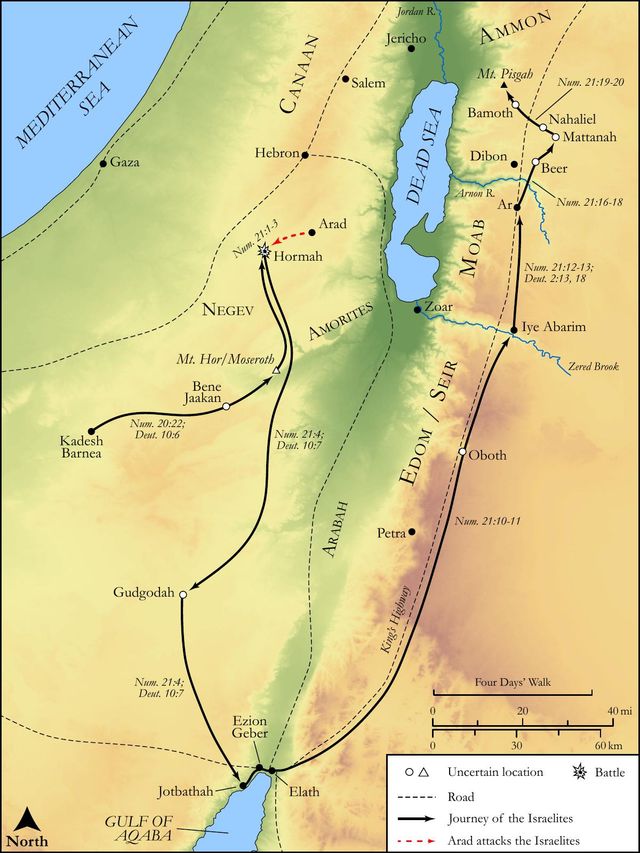
See on the biblical-era map
Study this verse
Public-domain commentary
Matthew Henry
From his Commentary on the Whole Bible. Henry comments on passages, not single verses — this entry covers Deuteronomy 10:1–11. His two-level outline is real structure in the source text, so it is rendered as structure.
There were four things in and by which God showed himself reconciled to Israel and made them truly great and happy, and in which God's goodness took occasion from their badness to make him the more illustrious: -
I.He gave them his law, gave it to them in writing, as a standing pledge of his favour.
Though the tables that were first written were broken, because Israel had broken the commandments, and God might justly break the covenant, yet when his anger was turned away the tables were renewed, Deu 10:1, Deu 10:2. Note, God's putting his law in our reconciliation to God and the best earnest of our happiness in him. Moses is told to hew the tables; for the law prepares the heart by conviction and humiliation for the grace of God, but it is only that grace that then writes the law in it. Moses made an ark of shittim-wood (Deu 10:3), a plain chest, the same, I suppose, in which the tables were afterwards preserved: but Bezaleel is said to make it (Exo 37:1), because he afterwards finished it up and overlaid it with gold. Or Moses is said to make it because, when he went up the second time into the mount, he ordered it to be made by Bezaleel against he came down. And it is observable that for this reason the ark was the first thing that God gave orders about, Exo 25:10. And this left an earnest to the congregation that the tables should not miscarry this second time, as they had done the first. God will send his law and gospel to those whose hearts are prepared as arks to receive them. Christ is the ark in which now our salvation is kept safely, that it may not be lost as it was in the first Adam, when he had it in his own hand. Observe,
1.What it was that God wrote on the two tables, the ten commandments (Deu 10:4), or ten words, intimating in how little a compass they were contained: they were not ten volumes, but ten words: it was the same with the first writing, and both the same that he spoke in the mount. The second edition needed no correction nor amendment, nor did what he wrote differ form what he spoke. The written word is as truly the word of God as that which he spoke to his servants the prophets.
2.What care was taken of it. These two tables, thus engraven, were faithfully laid up in the ark. And there they be, said Moses, pointing it is probable towards the sanctuary, Deu 10:5. That good thing which was committed to him he transmitted to them, and left it pure and entire in their hands; now let them look to it at their peril. Thus we may say to the rising generation, "God has entrusted us with Bibles, sabbaths, sacraments, etc., as tokens of his presence and favour, and there they be; we lodge them with you," Ti2 1:13, Ti2 1:14.
II.He led them forward towards Canaan, though they in their hearts turned back towards Egypt, and he might justly have chosen their delusions, Deu 10:6, Deu 10:7. He brought them to a land of rivers of waters, out of a dry and barren wilderness. Sometimes God supplied their wants by the ordinary course of nature: when that failed, then by miracles; and yet after this, when they were brought into a little distress, we find them distrusting God and murmuring, Num 20:3, Num 20:4.
III.He appointed a standing ministry among them, to deal for them in holy things.
At that time when Moses went up a second time to the mount, or soon after, he had orders to separate the tribe of Levi to God, and to his immediate service, they having distinguished themselves by their zeal against the worshippers of the golden calf, Deu 10:8, Deu 10:9. The Kohathites carried the ark; they and the other Levites stood before the Lord, to minister to him in all the offices of the tabernacle; and the priests, who were of that tribe, were to bless the people. This was a standing ordinance, which had now continued almost forty years, even unto this day; and provision was made for the perpetuating of it by the settled maintenance of that tribe, which was such as gave them great encouragement in their work, and no diversion from it. The Lord is his inheritance. Note, A settled ministry is a great blessing to a people, and a special token of God's favour. And, since the particular priests could not continue by reason of death, God showed his care of the people in securing a succession, which Moses takes notice of here, Deu 10:6. When Aaron died, the priesthood did not die with him, but Eleazar his son ministered in his stead, and took care of the ark, in which the tables of stone, those precious stones, were deposited, that they should suffer no damage; there they be, and he has the custody of them. Under the law, a succession in the ministry was kept up, by an entail of the office on a certain tribe and family. But now, under the gospel, when the effusion of the Spirit is more plentiful and powerful, the succession is kept up by the Spirit's operation on men's hearts, qualifying men for, and inclining men to, that work, some in every age, that the name of Israel may not be blotted out.
IV.He accepted Moses as an advocate or intercessor for them, and therefore constituted him their prince and leader (Deu 10:10, Deu 10:11):
The Lord hearkened to me and said, Arise, go before the people. It was a mercy to them that they had such a friend, so faithful both to him that appointed him and to those for whom he was appointed. It was fit that he who had saved them from ruin, by his intercession with heaven, should have the conduct and command of them. And herein he was a type of Christ, who, as he ever lives making intercession for us, so he has all power both in heaven and in earth.
Continue studying Deuteronomy 10:7 across the web’s major study libraries — every link below opens this exact verse, chapter, or book on the destination site.
Read & Compare
 BibleGatewayThis verse in more than 200 translations and 70 languages.
 Bible.comThe YouVersion reader — hundreds of translations, reading plans, and highlights.
 ESV.orgCrossway's official English Standard Version reader.
 NET BibleThe NET translation with 60,000+ translators' notes on every rendering decision.
 STEP BibleTyndale House's free study tool — original text, vocabulary, and scholarly resources.
 BibliaLogos Bible Software's free web reader.
 USCCBThe New American Bible (Revised Edition) with the U.S. bishops' study notes.
Commentaries
 BibleHub CommentariesDozens of classic commentaries on this verse, gathered on one page.
 StudyLightMore than 100 commentary sets — the largest collection on the web.
 BibleRefPlain-English commentary on what this verse means, verse by verse.
 Enduring WordDavid Guzik's free commentary on this chapter, widely used by Bible teachers.
 Bible Study ToolsVerse commentary alongside Greek and Hebrew study aids.
Original Language & Research
- BibleHub InterlinearThe verse word by word — original language, transliteration, and English.
- BibleHub LexiconEvery word's original-language definition and Strong's entry.
 Blue Letter BibleDeep-study tools — Strong's numbers, concordance, and word studies.
 SefariaThe Hebrew text with Rashi and centuries of Jewish commentary.
Sermons, Hymns & Audio


TrulyRandomVerse is not affiliated with these sites and doesn’t control their content. They’re linked because they’re genuinely useful.
Summary
Deuteronomy 10:7 offers a concise yet profound geographical interlude in Moses' recounting of Israel's wilderness journey, detailing their movement from Gudgodah to Jotbath, a place remarkably described as "a land of rivers of waters." Far from a mere itinerary, this verse underscores God's meticulous and faithful guidance, demonstrating His precise leading of His people through challenging desert landscapes and His miraculous provision of life-sustaining resources even in the most unexpected and arid environments. It serves as a testament to His unwavering care and sovereignty over every detail of their pilgrimage.
Context
ShowHideLiterary Context
Deuteronomy 10:7 is embedded within Moses' second major discourse to the new generation of Israelites on the plains of Moab, just before they enter the Promised Land. Specifically, it follows a passage in Deuteronomy 10:6 that recounts the death of Aaron and the establishment of Eleazar as high priest, linking a specific segment of the journey to the Levites' role and the ongoing divine presence. This brief geographical account (Deuteronomy 10:6-7) serves as a historical anchor, grounding Moses' theological exhortations in the tangible reality of their shared past. It reminds the people that God's covenant faithfulness was not abstract but demonstrated through concrete acts of leading and sustaining them through every stage of their forty-year wilderness sojourn, even after periods of divine discipline, as seen in the broader narrative of the wilderness wanderings.
Historical & Cultural Context
The wilderness journey was a defining period for Israel, transforming a disparate group of former slaves into a nation under God's covenant. The mention of specific waypoints like Gudgodah and Jotbath highlights the arduous nature of their nomadic existence in a largely barren and hostile environment. In the wilderness, water sources were paramount for survival, making the description of Jotbath as "a land of rivers of waters" exceptionally significant. This detail would have resonated deeply with an audience acutely aware of the scarcity of water and the constant threat of dehydration. The forty-year trek was not merely a physical journey but a period of divine testing, discipline, and formation, designed to teach Israel dependence on God and prepare them for life in the Promised Land.
Key Themes
ShowHideThe verse powerfully illustrates several core themes central to Deuteronomy and the Pentateuch. Divine Guidance is paramount, as God meticulously directed Israel's every step, even to seemingly obscure locations. This highlights His active involvement in the details of His people's lives, ensuring they reached their destination. Closely related is Divine Provision, exemplified by Jotbath's description as an oasis; God faithfully supplied their needs, even in the most challenging circumstances, demonstrating His power to bring forth refreshment in the desert (Exodus 17:6). Furthermore, the specificity of the locations lends Historical Veracity to the narrative, affirming the real-world experience of the Exodus generation and reinforcing the truthfulness of God's covenant relationship with them. This detailed recounting serves to remind the new generation of God's enduring faithfulness, encouraging them to obey the covenant commands as they prepare to enter the land (see Deuteronomy 11).
Exposition and Analysis
ShowHideKey Word Analysis
ShowHideThis place name (H1412) is identified with Hor-hagidgad in Numbers 33:32, one of the stations of the Israelites' wilderness journey. Derived from a root meaning "cleft" or "cut," it suggests a rugged or difficult terrain. Its inclusion here, following Mosera (where Aaron died), emphasizes the continuous, often challenging, nature of the journey and God's leading through every segment, regardless of the terrain.
Also spelled Jotbathah in Numbers 33:33, this name (H3193) likely derives from a root meaning "goodness" or "pleasantness." The description that follows, "a land of rivers of waters," strongly supports this etymology, suggesting it was indeed a welcome and refreshing stop in the arid wilderness. Its pleasantness stands in stark contrast to the harshness of much of the journey.
This word (H5158) refers to a stream, especially a winter torrent, or a valley through which a brook runs. In the phrase "rivers of waters" (nachal mayim), it is combined with mayim (H4325, "waters") to emphasize an abundance of water, not merely a dry wadi that occasionally fills. This vivid description highlights an extraordinary and life-sustaining provision in the midst of a desert, making Jotbath a true oasis.
Verse Breakdown
ShowHide"From thence they journeyed unto Gudgodah;"
This clause marks the continuation of Israel's divinely directed pilgrimage. "Thence" refers to Mosera (Deuteronomy 10:6), a significant location associated with Aaron's death and the Levites' appointment. The journey to Gudgodah signifies that even after periods of loss or transition, God's plan for His people's movement and destiny continued uninterrupted, demonstrating His steadfast purpose.
"and from Gudgodah to Jotbath,"
This second leg of the journey emphasizes the precision and intentionality of God's leading. The specific naming of these two consecutive stops underscores the historical reality of their movements and that their path was not random but orchestrated by divine design, guiding them step by step towards the Promised Land. It highlights God's active involvement in the minute details of their collective experience.
"a land of rivers of waters."
This concluding phrase provides a crucial detail about Jotbath, transforming it from a mere geographical marker into a symbol of divine grace. In the parched wilderness, the presence of "rivers of waters" signifies not just adequate but abundant provision. It speaks to God's faithfulness to sustain His people, providing refreshment and life-giving resources in unexpected places, even after strenuous and difficult segments of their journey. This detail underscores the miraculous nature of God's care.
Literary Devices
ShowHideDeuteronomy 10:7 employs Topography as Theology, where the specific geographical details serve a profound theological purpose. The journey from Gudgodah (a likely dry or challenging area) to Jotbath, "a land of rivers of waters," creates a powerful Contrast. This contrast between the typical wilderness harshness and the unexpected abundance of water at Jotbath highlights God's miraculous power and faithful Provision. The Repetition of the journeying motif ("From thence they journeyed... and from Gudgodah to Jotbath") emphasizes the continuous, step-by-step nature of God's guidance and the historical veracity of the account. Furthermore, the phrase "rivers of waters" functions as Hyperbole or vivid imagery, conveying not just a trickle but a significant, life-giving source, underscoring the extraordinary nature of God's care in a desert environment.
Theological and Thematic Connections
ShowHideDeuteronomy 10:7, though brief, encapsulates profound theological truths about God's character and His relationship with His people. It reaffirms God's meticulous care, demonstrating that His covenant faithfulness extends to the most practical and detailed aspects of their lives, including their physical sustenance and safe passage through hostile terrain. The journey from a potentially dry Gudgodah to a refreshing Jotbath serves as a microcosm of God's overarching pattern of leading His people through trials to places of rest and provision. It teaches that even in the wilderness, where human resources fail, divine resources abound. This continuous guidance and provision are not merely historical anecdotes but foundational truths about the God who remains actively involved in the lives of His children, orchestrating their paths and supplying their needs, often in unexpected and miraculous ways, to fulfill His purposes.
Reflection and Application
ShowHideDeuteronomy 10:7 offers a timeless message of hope and encouragement for believers today. Our spiritual journey, much like Israel's physical one, is marked by various seasons and terrains. There will be "Gudgodahs"—periods of dryness, challenge, uncertainty, or even loss—where the path seems arduous and resources scarce. Yet, this verse reminds us that God's guidance is precise and His provision unfailing. He is capable of leading us through these difficult stretches and, in His perfect timing, bringing us to our "Jotbath"—a place of unexpected refreshment, abundant grace, and renewed strength. This might manifest as a breakthrough in a struggle, a season of spiritual renewal, or simply the quiet assurance of His presence in the midst of our trials. The call to us is to trust in His sovereign leading, even when the path ahead is unclear, and to remain expectant of His provision, knowing that He is deeply invested in the details of our lives and will never leave us without the "rivers of waters" we need to persevere.
Questions for Reflection
ShowHideFAQ
ShowHideWhy are these specific places, Gudgodah and Jotbath, mentioned in Deuteronomy 10:7?
ShowHideThe mention of Gudgodah and Jotbath serves multiple purposes. Firstly, it grounds Moses' discourse in historical reality, providing concrete evidence of Israel's journey and God's active involvement in their past. These specific waypoints, also found in the detailed itinerary of Numbers 33, lend authenticity to the narrative. Secondly, their inclusion here, immediately following the account of Aaron's death and the Levites' appointment (Deuteronomy 10:6), connects the physical journey to the spiritual and priestly lineage, emphasizing that God's care extended to every aspect of their national life. Thirdly, the description of Jotbath as "a land of rivers of waters" highlights God's miraculous provision, demonstrating His faithfulness to sustain His people even in the most desolate environments.
What is the significance of "a land of rivers of waters" in the context of the wilderness journey?
ShowHideIn the arid wilderness, water was the most critical resource for survival. The phrase "a land of rivers of waters" (Hebrew: nachal mayim) for Jotbath is highly significant because it describes an oasis with abundant, perhaps perennial, water sources, rather than just transient wadis. This detail underscores God's extraordinary and gracious provision for the millions of Israelites and their livestock. It stands in stark contrast to the typical scarcity of water in the desert, serving as a powerful reminder that God is not limited by circumstances and can miraculously provide for His people's needs, turning barrenness into refreshment, as He did when providing water from the rock in Exodus 17:6.
Christ-Centered Fulfillment
ShowHideDeuteronomy 10:7, with its vivid portrayal of God's precise guidance and miraculous provision in the wilderness, finds its ultimate fulfillment in Jesus Christ. Israel's journey through the desert, marked by periods of trial and divine sustenance, foreshadows the spiritual pilgrimage of humanity, a journey through the "wilderness" of this fallen world. Just as God led His people from Gudgodah to Jotbath, providing "rivers of waters," so too does Christ serve as our ultimate Guide and Provider. He is the Good Shepherd, leading His sheep through dangerous paths to "green pastures and still waters" (Psalm 23:2). More profoundly, Jesus is the very source of the "rivers of living water" (John 7:37-38), offering eternal spiritual refreshment to all who believe in Him. He perfectly embodies the divine presence that went before Israel, providing manna and water; He is the Bread of Life and the Living Water who satisfies our deepest thirst. Through Him, we are not merely led to a temporary oasis but to the eternal Promised Land, the new heavens and new earth, where God Himself will wipe away every tear and there will be no more thirst (Revelation 21:4).