


Deuteronomy 10:6
- וּבְנֵיu·ve·Neiand [the] people ofH1121Conj-w ¦ N-mpcNoun Plural Masculine Constructוּandבְנֵי[the] people of
- יִשְׂרָאֵלYis·ra·'ElIsraelH3478N-properNoun Proper Location
- נָסְעוּna·se·'Uthey set outH5265V-Qal-Perf-3cpVerb Qal Perfect 3rd Plural common gender
- מִבְּאֵרֹתmi·be·'e·Rotfrom BeerothH881Prep-m ¦ N-properNoun Proper LocationמִfromבְּאֵרֹתBeeroth
- בְּנֵיbe·neiBene-H1142N-properNoun Proper Location
- יַעֲקָןya·'a·KanYaaqanH1142N-properNoun Proper Location
- מוֹסֵרָהmo·se·RahMoserahH4149N-properNoun Proper Location
- שָׁםshamthereH8033AdvAdverb
- מֵתmethe diedH4191V-Qal-Perf-3msVerb Qal Perfect 3rd Singular Masculine
- אַהֲרֹן'a·ha·RonAaronH175N-proper-mNoun Proper Masculine
- וַיִּקָּבֵרvai·yi·ka·Verand he was buriedH6912Conj-w ¦ V-Niphal-ConsecImperf-3msVerb Niphal Consecutive Imperfect 3rd Singular Masculineוַandיִּקָּבֵרhe was buried
- שָׁםShamthereH8033AdvAdverb
- וַיְכַהֵןvay·kha·Henand he served as priestH3547Conj-w ¦ V-Piel-ConsecImperf-3msVerb Piel Consecutive Imperfect 3rd Singular Masculineוַandיְכַהֵןhe served as priest
- אֶלְעָזָר'el·'a·ZarEleazarH499N-proper-mNoun Proper Masculine
- בְּנוֹbe·Nohis sonH1121N-msc ¦ 3msNoun Singular Masculine Constructבְּנsonוֹhis
- תַּחְתָּיוtach·Tavin place of himH8478N-mpc ¦ 3msNoun Plural Masculine Constructתַּחְתָּיin place ofוhim
English is a literal word-by-word gloss of the Hebrew, not the KJV's wording. Why?
This is the original text the KJV's translators worked from — each Hebrew word with its own literal English meaning in this verse, prepared by scholars at Tyndale House, Cambridge. The KJV translates whole sentences, not word by word, so its wording differs: one Hebrew word can become several English words, and the KJV may choose “the LORD” where the gloss reads “Yahweh”. Both are faithful — they answer different questions. For the KJV's own rendering, switch to the KJV text.
Details
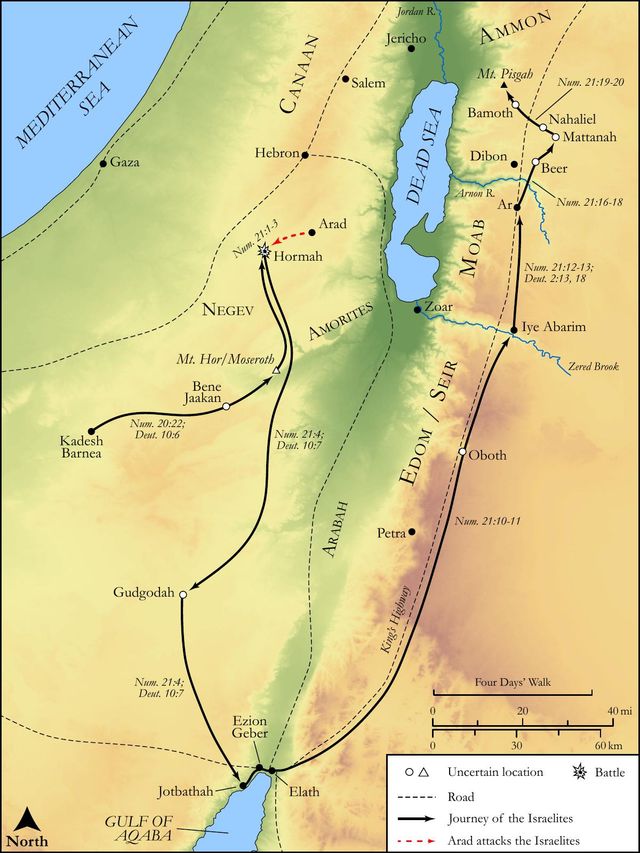
See on the biblical-era map
Study this verse
Public-domain commentary
Matthew Henry
From his Commentary on the Whole Bible. Henry comments on passages, not single verses — this entry covers Deuteronomy 10:1–11. His two-level outline is real structure in the source text, so it is rendered as structure.
There were four things in and by which God showed himself reconciled to Israel and made them truly great and happy, and in which God's goodness took occasion from their badness to make him the more illustrious: -
I.He gave them his law, gave it to them in writing, as a standing pledge of his favour.
Though the tables that were first written were broken, because Israel had broken the commandments, and God might justly break the covenant, yet when his anger was turned away the tables were renewed, Deu 10:1, Deu 10:2. Note, God's putting his law in our reconciliation to God and the best earnest of our happiness in him. Moses is told to hew the tables; for the law prepares the heart by conviction and humiliation for the grace of God, but it is only that grace that then writes the law in it. Moses made an ark of shittim-wood (Deu 10:3), a plain chest, the same, I suppose, in which the tables were afterwards preserved: but Bezaleel is said to make it (Exo 37:1), because he afterwards finished it up and overlaid it with gold. Or Moses is said to make it because, when he went up the second time into the mount, he ordered it to be made by Bezaleel against he came down. And it is observable that for this reason the ark was the first thing that God gave orders about, Exo 25:10. And this left an earnest to the congregation that the tables should not miscarry this second time, as they had done the first. God will send his law and gospel to those whose hearts are prepared as arks to receive them. Christ is the ark in which now our salvation is kept safely, that it may not be lost as it was in the first Adam, when he had it in his own hand. Observe,
1.What it was that God wrote on the two tables, the ten commandments (Deu 10:4), or ten words, intimating in how little a compass they were contained: they were not ten volumes, but ten words: it was the same with the first writing, and both the same that he spoke in the mount. The second edition needed no correction nor amendment, nor did what he wrote differ form what he spoke. The written word is as truly the word of God as that which he spoke to his servants the prophets.
2.What care was taken of it. These two tables, thus engraven, were faithfully laid up in the ark. And there they be, said Moses, pointing it is probable towards the sanctuary, Deu 10:5. That good thing which was committed to him he transmitted to them, and left it pure and entire in their hands; now let them look to it at their peril. Thus we may say to the rising generation, "God has entrusted us with Bibles, sabbaths, sacraments, etc., as tokens of his presence and favour, and there they be; we lodge them with you," Ti2 1:13, Ti2 1:14.
II.He led them forward towards Canaan, though they in their hearts turned back towards Egypt, and he might justly have chosen their delusions, Deu 10:6, Deu 10:7. He brought them to a land of rivers of waters, out of a dry and barren wilderness. Sometimes God supplied their wants by the ordinary course of nature: when that failed, then by miracles; and yet after this, when they were brought into a little distress, we find them distrusting God and murmuring, Num 20:3, Num 20:4.
III.He appointed a standing ministry among them, to deal for them in holy things.
At that time when Moses went up a second time to the mount, or soon after, he had orders to separate the tribe of Levi to God, and to his immediate service, they having distinguished themselves by their zeal against the worshippers of the golden calf, Deu 10:8, Deu 10:9. The Kohathites carried the ark; they and the other Levites stood before the Lord, to minister to him in all the offices of the tabernacle; and the priests, who were of that tribe, were to bless the people. This was a standing ordinance, which had now continued almost forty years, even unto this day; and provision was made for the perpetuating of it by the settled maintenance of that tribe, which was such as gave them great encouragement in their work, and no diversion from it. The Lord is his inheritance. Note, A settled ministry is a great blessing to a people, and a special token of God's favour. And, since the particular priests could not continue by reason of death, God showed his care of the people in securing a succession, which Moses takes notice of here, Deu 10:6. When Aaron died, the priesthood did not die with him, but Eleazar his son ministered in his stead, and took care of the ark, in which the tables of stone, those precious stones, were deposited, that they should suffer no damage; there they be, and he has the custody of them. Under the law, a succession in the ministry was kept up, by an entail of the office on a certain tribe and family. But now, under the gospel, when the effusion of the Spirit is more plentiful and powerful, the succession is kept up by the Spirit's operation on men's hearts, qualifying men for, and inclining men to, that work, some in every age, that the name of Israel may not be blotted out.
IV.He accepted Moses as an advocate or intercessor for them, and therefore constituted him their prince and leader (Deu 10:10, Deu 10:11):
The Lord hearkened to me and said, Arise, go before the people. It was a mercy to them that they had such a friend, so faithful both to him that appointed him and to those for whom he was appointed. It was fit that he who had saved them from ruin, by his intercession with heaven, should have the conduct and command of them. And herein he was a type of Christ, who, as he ever lives making intercession for us, so he has all power both in heaven and in earth.
Historical interpretation
Historical reception
1 surviving comment on this verse from the historical church.
Mosera: By mount Hor, for there Aaron died, Num. 20. This and the following verses seem to be inserted by way of parenthesis.
Continue studying Deuteronomy 10:6 across the web’s major study libraries — every link below opens this exact verse, chapter, or book on the destination site.
Read & Compare
 BibleGatewayThis verse in more than 200 translations and 70 languages.
 Bible.comThe YouVersion reader — hundreds of translations, reading plans, and highlights.
 ESV.orgCrossway's official English Standard Version reader.
 NET BibleThe NET translation with 60,000+ translators' notes on every rendering decision.
 STEP BibleTyndale House's free study tool — original text, vocabulary, and scholarly resources.
 BibliaLogos Bible Software's free web reader.
 USCCBThe New American Bible (Revised Edition) with the U.S. bishops' study notes.
Commentaries
 BibleHub CommentariesDozens of classic commentaries on this verse, gathered on one page.
 StudyLightMore than 100 commentary sets — the largest collection on the web.
 BibleRefPlain-English commentary on what this verse means, verse by verse.
 Enduring WordDavid Guzik's free commentary on this chapter, widely used by Bible teachers.
 Bible Study ToolsVerse commentary alongside Greek and Hebrew study aids.
Original Language & Research
- BibleHub InterlinearThe verse word by word — original language, transliteration, and English.
- BibleHub LexiconEvery word's original-language definition and Strong's entry.
 Blue Letter BibleDeep-study tools — Strong's numbers, concordance, and word studies.
 SefariaThe Hebrew text with Rashi and centuries of Jewish commentary.
Sermons, Hymns & Audio


TrulyRandomVerse is not affiliated with these sites and doesn’t control their content. They’re linked because they’re genuinely useful.
Summary
Deuteronomy 10:6 presents a concise, yet significant, historical interjection within Moses' final address to Israel, detailing a specific segment of their wilderness journey from Beeroth of the children of Jaakan to Mosera. This verse pivotally records the death and burial of Aaron, Israel's first high priest, immediately followed by the divinely ordained succession of his son, Eleazar, into the priestly office, thereby underscoring God's unwavering commitment to the continuity of His covenantal work and established sacred institutions despite human mortality.
Context
ShowHideLiterary Context
This verse is strategically placed within Moses' second major discourse to the new generation of Israelites assembled on the plains of Moab, specifically within a historical retrospective spanning Deuteronomy 9:7-10:11. In this section, Moses recounts pivotal events from their forty-year wilderness sojourn, reminding them of past rebellions, such as the infamous golden calf incident which directly precedes this passage, and juxtaposing these failures with God's persistent faithfulness. The brief mention of Aaron's death and Eleazar's seamless succession serves as a crucial interjection, emphasizing divine provision and the unbroken continuity of the established order for worship. It highlights God's unwavering commitment to His covenant and the sacred institutions He established, ensuring their perpetuation even as foundational individuals pass away.
Historical & Cultural Context
The verse describes a specific, though geographically debated, segment of Israel's arduous wilderness wanderings preceding their entry into the Promised Land. Beeroth of the children of Jaakan and Mosera represent points of encampment in their long journey. Aaron's death was a momentous event, signifying the end of an era for one of Israel's most foundational leaders and the inaugural high priest. In ancient Israelite society, the high priesthood was a hereditary office, central to the nation's covenant relationship with God, holding responsibilities for mediating atonement, offering sacrifices, and providing divine instruction. Eleazar's immediate succession underscores the vital importance of this office and God's provision for its uninterrupted continuation. The apparent discrepancy with Numbers 20:28 and Numbers 33:38, which place Aaron's death at Mount Hor, is commonly reconciled by scholars who suggest Mosera was a regional name encompassing Mount Hor, a nearby encampment, or a different perspective on the same event within the broader itinerary.
Key Themes
ShowHideDeuteronomy 10:6 contributes significantly to several overarching themes within Deuteronomy and the Pentateuch. It powerfully illustrates Divine Guidance and Provision, showcasing God's meticulous oversight of Israel's journey, even through challenging terrains and significant losses. The immediate mention of Eleazar stepping into Aaron's role underscores the theme of Succession and Continuity of Leadership, demonstrating that God ensures His work and the sacred service of the priesthood continue uninterrupted, even with the passing of key figures. This reflects God's faithfulness to His covenant and the divinely established order for worship. Furthermore, the death of Aaron, a pivotal figure in Israel's history and the first to hold the high priestly office, vividly portrays the theme of Mortality and God's Enduring Plan. Human leaders are mortal, but God's covenant purposes transcend the life of any single individual, ensuring the preservation of the vital priestly office for Israel's ongoing relationship with God.
Exposition and Analysis
ShowHideKey Word Analysis
ShowHideThis geographical reference, unique to Deuteronomy 10:6 as the place of Aaron's death, contrasts with the more common Mount Hor found in Numbers 20 and Numbers 33. The name itself might allude to the difficult, corrective nature of the wilderness journey, or even the "binding" nature of death. Scholars often reconcile the discrepancy by suggesting Mosera was a region encompassing Mount Hor, a nearby encampment, or a different name for the same location from a specific perspective, highlighting the divine orchestration of Aaron's final journey.
This primitive root signifies "to die" (literally or figuratively), and causatively, "to kill." In this context, it marks the physical cessation of life for Aaron, a monumental event for Israel. The term underscores the mortality of even their most revered leaders, emphasizing that no human figure, no matter how divinely appointed, is exempt from the universal decree of death. This reality necessitates divine provision for succession, ensuring the continuity of God's plan.
This primitive root means "to officiate as a priest" or "to mediate in religious services." It signifies the immediate and divinely sanctioned assumption of the full duties and responsibilities of the high priestly office by Eleazar. This was not merely a succession of title but of sacred function—offering sacrifices, interceding for the people, and instructing them in God's law. The use of this specific term emphasizes the continuity of the divinely established cultic system, ensuring that Israel's relationship with God through atonement and worship remained unbroken despite the death of its foundational high priest.
Verse Breakdown
ShowHide"And the children of Israel took their journey from Beeroth of the children of Jaakan to Mosera:"
This clause succinctly traces a specific, though geographically debated, segment of Israel's arduous wilderness journey. Beeroth of the children of Jaakan (also known as Bene-Jaakan in Numbers 33:31) and Mosera mark points of encampment, highlighting the continuous, divinely guided movement of the Israelite nation. The inclusion of such precise, albeit obscure, geographical details underscores the historical veracity of the narrative and God's meticulous oversight of their forty-year pilgrimage.
"there Aaron died, and there he was buried;"
This brief, stark declaration records a monumental event: the death and burial of Aaron, Moses' brother and the first high priest of Israel. The repetition of "there" emphasizes the specific location (Mosera/Mount Hor) as the site of this significant transition. Aaron's death marked the passing of a pivotal figure in Israel's formative history, a leader who had served as Moses' spokesman and the architect of Israel's sacrificial system, reminding the new generation of the mortality of even their most esteemed leaders.
"and Eleazar his son ministered in the priest's office in his stead."
Immediately following the account of Aaron's death, this clause highlights the divinely ordained principle of succession within the high priesthood. Eleazar, Aaron's third son, seamlessly assumed the sacred duties, ensuring the uninterrupted continuity of the priestly service vital for Israel's covenant relationship with God. This swift transition demonstrates God's faithfulness to His established order and His provision for the ongoing spiritual needs of His people, illustrating that His purposes transcend the life of any single individual.
Literary Devices
ShowHideThe verse employs Conciseness and Narrative Summary, compressing significant historical events—a journey segment, a major leader's death, and a crucial succession—into a single, impactful sentence. This brevity, rather than diminishing the events, highlights their factual importance and the divine orchestration behind them within the broader historical recounting. There is also a powerful element of Juxtaposition, placing the solemn account of Aaron's death immediately alongside the swift and seamless succession of Eleazar. This rapid succession emphasizes God's providential care for the continuity of His work, demonstrating that even in moments of profound loss and transition, His divine plan for Israel's spiritual leadership remains unbroken and divinely sustained. The factual, almost reportorial tone lends an air of historical authority and gravitas to Moses' address.
Theological and Thematic Connections
ShowHideDeuteronomy 10:6, though a historical aside, is rich in profound theological implications. It underscores God's meticulous oversight of Israel's journey, even through difficult transitions and the profound loss of key leaders. The immediate succession of Eleazar to Aaron's high priestly office powerfully reveals God's unwavering commitment to the continuity of His covenantal relationship with Israel, ensuring that the divinely established means of atonement, intercession, and spiritual guidance remain perpetually available. This principle of divine provision for leadership and the enduring nature of God's plan, even in the face of human mortality, is a recurring theme throughout Scripture. It teaches us that God's work is not ultimately dependent on any single individual, but on His sovereign will and the faithful succession of those He calls and empowers.
Reflection and Application
ShowHideDeuteronomy 10:6, while detailing a specific historical event, offers profound and timeless insights for believers today regarding leadership, transition, and God's enduring faithfulness. It serves as a powerful reminder that God's overarching plans and purposes are not contingent upon the life or presence of any single human leader, no matter how influential or indispensable they may seem. Just as He seamlessly transitioned the high priesthood from Aaron to Eleazar, God continues to orchestrate leadership changes in His church, in our communities, and even in our personal lives, always ensuring that His sovereign purposes are fulfilled according to His perfect will. This verse calls us to cultivate a deep trust in His sovereignty during times of loss, uncertainty, or significant change, to faithfully invest in and prepare the next generation of leaders, and to humbly recognize that the work of the Kingdom is ultimately God's, carried out through His chosen instruments. It provides immense comfort, assuring us that even in the face of human mortality and the passing of beloved figures, God's redemptive plan moves forward, unbroken and eternally secure.
Questions for Reflection
ShowHideFAQ
ShowHideWhy does Deuteronomy 10:6 place Aaron's death at Mosera, while Numbers 20:28 and Numbers 33:38 say Mount Hor?
ShowHideThis apparent discrepancy has been a subject of scholarly discussion, but it is not a contradiction. Numbers 20:28 and Numbers 33:38 explicitly state that Aaron died on Mount Hor. Mosera (or Moseroth, as in Numbers 33:30) is most likely a general region or an encampment near Mount Hor. It is common in ancient itineraries and historical accounts for a significant event to be associated with either the specific peak or the broader area where the camp was located. Alternatively, some scholars suggest that Mosera was the starting point of the ascent to Mount Hor where Aaron died, or perhaps the place where the record of his death was made, or where his burial journey began. Moses, in Deuteronomy, is giving a summary of events from a different perspective than the detailed itinerary in Numbers, focusing on the journey's progression rather than the exact peak. The core fact—Aaron's death and Eleazar's seamless succession—remains consistent across all accounts, highlighting the divine orchestration of this crucial transition in Israel's history.
Christ-Centered Fulfillment
ShowHideThe historical account of Aaron's death and Eleazar's immediate succession in Deuteronomy 10:6 powerfully foreshadows the ultimate, perfect, and eternal priesthood of Jesus Christ. The Aaronic priesthood, though divinely instituted and vital for Israel's covenant relationship with God, was inherently temporary and subject to the mortality of its human incumbents, as vividly seen in Aaron's passing and the subsequent need for a successor. Each high priest, like Aaron and Eleazar, served only for a limited time, and their sacrifices had to be continually repeated because they could not perfectly atone for sin (Hebrews 7:23). In stark contrast, Christ is our great High Priest, "who holds His priesthood permanently, because He continues forever" (Hebrews 7:24). His death on the cross was not an end that required succession, but the glorious consummation of His priestly work—a single, perfect, and sufficient sacrifice that atoned for sin once for all time (Hebrews 9:11). Unlike Aaron, who died and was buried, Christ "was declared to be the Son of God in power according to the Spirit of holiness by His resurrection from the dead" (Romans 1:4), ascending to the right hand of God where He now lives to intercede for us eternally (Hebrews 7:25). Thus, the temporary, mortal priesthood of the Old Testament points forward to the everlasting, perfect, and life-giving ministry of our Lord Jesus Christ, through whom we have direct, confident access to God's throne of grace (Hebrews 4:14).