


Numbers 20:23
Bible text: King James Version (1769 Blayney text) · Public domain
Bible text: Berean Standard Bible · Public domain
Bible text: American Standard Version (1901) · Public domain
Bible text: World English Bible, Messianic edition · Public domain
Bible text: Geneva Bible (1599) · Public domain
Bible text: Young's Literal Translation · Public domain
- וַיֹּאמֶרvai·Yo·merand he saidH559Conj-w ¦ V-Qal-ConsecImperf-3msVerb Qal Consecutive Imperfect 3rd Singular Masculineוַandיֹּאמֶרhe said
- יְהוָהYah·wehYahwehH3068N-properNoun Proper Title
- אֶל'eltoH413PrepPreposition
- מֹשֶׁהmo·ShehMosesH4872N-proper-mNoun Proper Masculine
- וְאֶלve·'eland toH413Conj-w ¦ PrepPrepositionוְandאֶלto
- אַהֲרֹן'a·ha·RonAaronH175N-proper-mNoun Proper Masculine
- בְּהֹרbe·Horat HorH2023Prep-b ¦ N-properNoun Proper LocationבְּatהֹרHor
- הָהָרha·Harthe mountainH2022Art ¦ N-msNoun Singular Masculine Absoluteהָtheהָרmountain
- עַל'alonH5921PrepPreposition
- גְּבוּלge·Vul[the] border ofH1366N-mscNoun Singular Masculine Construct
- אֶרֶץ'e·retz[the] land ofH776N-fscNoun Singular Feminine Construct
- אֱדוֹם'e·DomEdomH123N-proper-mNoun Proper Masculine
- לֵאמֹרle·Mor<to> sayingH559Prep-l ¦ V-Qal-InfVerb Qal Infinitive Constructלֵ<to>אמֹרsaying
English is a literal word-by-word gloss of the Hebrew, not the KJV's wording. Why?
This is the original text the KJV's translators worked from — each Hebrew word with its own literal English meaning in this verse, prepared by scholars at Tyndale House, Cambridge. The KJV translates whole sentences, not word by word, so its wording differs: one Hebrew word can become several English words, and the KJV may choose “the LORD” where the gloss reads “Yahweh”. Both are faithful — they answer different questions. For the KJV's own rendering, switch to the KJV text.
Details
See on the biblical-era maps
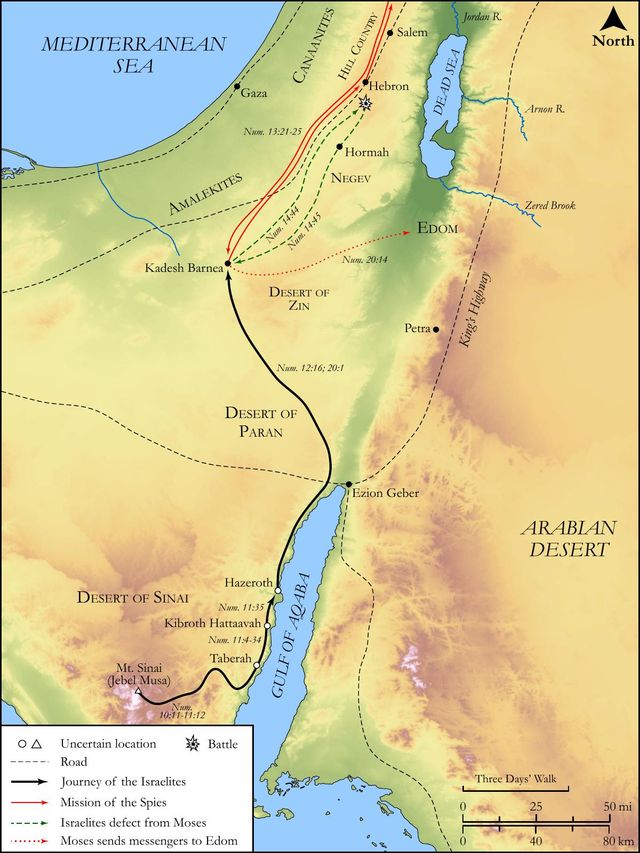
Study this verse
Public-domain commentary
Matthew Henry
From his Commentary on the Whole Bible. Henry comments on passages, not single verses — this entry covers Numbers 20:22–29. His three-level outline is real structure in the source text, so it is rendered as structure.
The chapter began with the funeral of Miriam, and it ends with the funeral of her brother Aaron. When death comes into a family, it often strikes double. Israel had not improved the former affliction they were under, by the death of the prophetess, and therefore, soon after, God took away their priest, to try if they would lay that to heart. This happened at the very next stage, when they removed to Mount Hor, fetching a compass round the Edomites' country, leaving it on their left hand. Wherever we go, death attends us, and the graves are ready for us.
I.God bids Aaron die, Num 20:24.
God takes Moses and Aaron aside, and tells them, Aaron shall be gathered to his people. These two dear brothers are told that they must part. Aaron the elder must die first, but Moses is not likely to be long after him; so that it is but for a while, a little while, that they are parted.
1.There is something of displeasure in these orders. Aaron must not enter Canaan, because he had failed in his duty at the waters of strife. The mention of this, no doubt, went to the heart of Moses, who knew himself, perhaps, at that time, to be the guiltier of the two.
2.There is much of mercy in them. Aaron, though he dies for his transgression, is not put to death as a malefactor, by a plague, or fire from heaven, but dies with ease and in honour. He is not cut off from his people, as the expression usually is concerning those that die by the hand of divine justice, but he is gathered to his people, as one that died in the arms of divine grace.
3.There is much of type and significancy in them. Aaron must not enter Canaan, to show that the Levitical priesthood could make nothing perfect: that must be done by the bringing in of a better hope. Those priests could not continue by reason of sin and death, but the priesthood of Christ, being undefiled, is unchangeable, and to this, which abides for ever, Aaron must resign all his honour, Heb 7:23-25.
II.Aaron submits, and dies in the method and manner appointed, and, for aught that appears, with as much cheerfulness as if he had been going to bed.
1.He puts on his holy garments to take his leave of them, and goes up with his brother and son to the top of Mount Hor, and probably some of the elders of Israel with him, Num 20:27. They went up in the sight of all the congregation, who, it is likely, were told on what errand they went up; by this solemn procession Aaron lets Israel know that he is neither afraid nor ashamed to die, but, when the bridegroom comes, can trim his lamp and go forth to meet him. His going up the hill to die signified that the death of saints (and Aaron is called the saint of the Lord) is their ascension; they rather go up than go down to death.
2.Moses, whose hands had first clothed Aaron with his priestly garments, now strips him of them; for, in reverence to the priesthood, it was not fit that he should die in them. Note, Death will strip us; naked we came into the world, and naked we must go out. We shall see little reason to be proud of our clothes, our ornaments, or marks of honour, if we consider how soon death will strip us of our glory, divest us of all our offices and honours, and take the crown off from our head.
3.Moses immediately puts the priestly garments upon Eleazar his son, clothes him with his father's robe, and strengthens him with his girdle, Isa 22:21. Now,
(1.)This was a great comfort to Moses, by whose hand the law of the priesthood was given to see that it should be kept up in a succession, and that a lamp was ordained for the anointed, which should not be extinguished by death itself. This was a happy earnest and indication to the church of the care God would take that as one generation of ministers and Christians (spiritual priests) passes away another generation should come up instead of it.
(2.)It was a great satisfaction to Aaron to see his son, who was dear to him, thus preferred, and his office, which was dearer, thus preserved and secured, and especially to see in this a figure of Christ's everlasting priesthood, in which alone his would be perpetuated. Now, Lord, might Aaron say, let thy servant depart in peace, for my eyes have seen thy salvation.
(3.)It was a great kindness to the people. The installing of Eleazar before Aaron was dead would prevent those who bore ill-will to Aaron's family from attempting to set up another upon his death, in competition with his son. What could they do when the matter was already settled? It would likewise encourage those among them that feared God, and be a token for good to them, that he would not leave them, nor suffer his faithfulness to fail.
4.Aaron died there. Quickly after he was stripped of his priestly garments, he laid himself down and died contentedly; for a good man would desire, if it were the will of God, not to outlive his usefulness. Why should we covet to continue any longer in this world than while we may do God and our generation some service in it?
5.Moses and Eleazar, with those that attended them, buried Aaron where he died, as appears by Deu 10:6, and then came down from the mount. And now, when they came down, and had left Aaron behind, it might be proper for them to think that he had rather gone up to the better world and had left them behind.
6.All the congregation mourned for Aaron thirty days, Num 20:29. Though the loss was well made up in Eleazar, who, being in the prime of life, was fitter from public service that Aaron would have been if he had lived, yet it was a debt owing to their deceased high priest to mourn for him. While he lived, they were murmuring at him upon all occasions, but now that he was dead they mourned for him. Thus many are taught to lament the loss of those mercies which they would not learn to be thankful for the enjoyment of. Many good men have had more honour done to their memories than ever they had to their persons, witness those that were persecuted while they lived, but when they were dead had their sepulchres garnished.
Continue studying Numbers 20:23 across the web’s major study libraries — every link below opens this exact verse, chapter, or book on the destination site.
Read & Compare
 BibleGatewayThis verse in more than 200 translations and 70 languages.
 Bible.comThe YouVersion reader — hundreds of translations, reading plans, and highlights.
 ESV.orgCrossway's official English Standard Version reader.
 NET BibleThe NET translation with 60,000+ translators' notes on every rendering decision.
 STEP BibleTyndale House's free study tool — original text, vocabulary, and scholarly resources.
 BibliaLogos Bible Software's free web reader.
 USCCBThe New American Bible (Revised Edition) with the U.S. bishops' study notes.
Commentaries
 BibleHub CommentariesDozens of classic commentaries on this verse, gathered on one page.
 StudyLightMore than 100 commentary sets — the largest collection on the web.
 BibleRefPlain-English commentary on what this verse means, verse by verse.
 Enduring WordDavid Guzik's free commentary on this chapter, widely used by Bible teachers.
 Bible Study ToolsVerse commentary alongside Greek and Hebrew study aids.
Original Language & Research
- BibleHub InterlinearThe verse word by word — original language, transliteration, and English.
- BibleHub LexiconEvery word's original-language definition and Strong's entry.
 Blue Letter BibleDeep-study tools — Strong's numbers, concordance, and word studies.
 SefariaThe Hebrew text with Rashi and centuries of Jewish commentary.
Sermons, Hymns & Audio


TrulyRandomVerse is not affiliated with these sites and doesn’t control their content. They’re linked because they’re genuinely useful.
Summary
Numbers 20:23 serves as a solemn divine declaration to Moses and Aaron on Mount Hor, a significant peak bordering the land of Edom. This verse acts as the immediate precursor to Aaron's divinely ordained death and the subsequent transfer of the high priesthood to his son, Eleazar. It powerfully underscores God's absolute sovereignty, His direct and authoritative communication with His chosen leaders, and the unwavering execution of His righteous judgment, even as His redemptive plan for Israel continues to unfold through successive generations.
Context
ShowHideLiterary Context
Numbers 20:23 is strategically positioned within a pivotal and somber section of Israel's wilderness narrative. Immediately preceding this verse, the text recounts the Israelites' renewed grumbling for water, culminating in the infamous incident at Meribah. There, Moses and Aaron, in a moment of frustration and disobedience, struck the rock twice instead of speaking to it as commanded by the LORD. This act, which failed to "sanctify" God in the eyes of the people, resulted in their divine sentence: neither would enter the Promised Land, a decree explicitly stated in Numbers 20:12. Following Meribah, the narrative details Israel's unsuccessful attempt to pass through Edomite territory, met with refusal and the threat of military confrontation, as recorded in Numbers 20:14-21. Thus, Numbers 20:23 sets the stage for the next major event: the divinely orchestrated death of Aaron and the transfer of his priestly garments and office to Eleazar, which immediately follows in Numbers 20:24-29. This verse functions as a solemn transition, moving from the consequences of past disobedience to the execution of divine judgment and the necessary continuity of priestly leadership.
Historical & Cultural Context
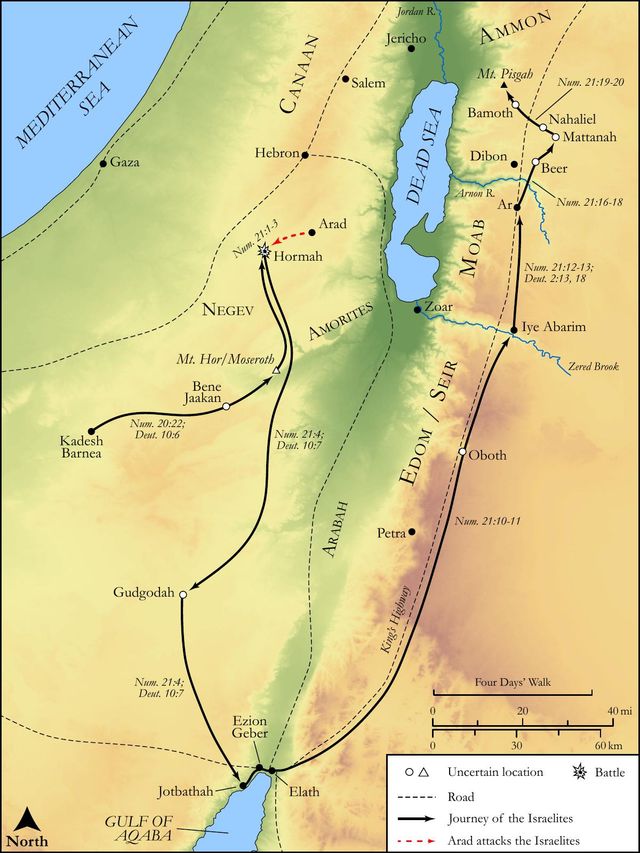
The geographical setting of "mount Hor, by the coast of the land of Edom," is precise and historically resonant. Mount Hor is traditionally identified with Jebel Harun, a prominent mountain near Petra in modern-day Jordan, situated on the eastern border of Edom. The Edomites, descendants of Esau (Jacob's brother), maintained a strained and often hostile relationship with Israel, as evidenced by their refusal of passage despite shared ancestry—a recurring theme throughout Israel's history. The wilderness journey itself was a prolonged period of divine testing, discipline, and purification for the generation that exited Egypt, preparing them for the Promised Land. Within this context, Moses and Aaron held unparalleled roles as divinely appointed leaders, serving as mediators and intercessors between God and His people. Their failure at Meribah, despite their exalted positions, powerfully underscored the principle that even those closest to God were held to strict account, particularly in matters concerning God's holiness and reputation before the congregation. This incident also served as a stark reminder of the mortality of even the greatest human leaders, necessitating God's divine provision for succession to ensure the continuation of His covenant purposes.
Key Themes
ShowHideNumbers 20:23 contributes significantly to several overarching themes woven throughout the book of Numbers and the Pentateuch. It profoundly illustrates Divine Communication, emphasizing that God actively and directly speaks to His leaders, revealing His will and decrees, even when they are difficult or sorrowful. The recurring phrase "And the LORD spake" consistently highlights God's initiative and ongoing guidance throughout the wilderness wanderings, reinforcing His intimate involvement in Israel's journey. Furthermore, the verse introduces the theme of Sovereignty and Judgment, as it foreshadows God's absolute control over life and death, and His unwavering commitment to upholding His righteous standards, even when it involves His chosen servants. This judgment, though severe, is intrinsically linked to God's larger redemptive plan, leading directly into the theme of Transition of Leadership and the Continuity of God's Covenant. The impending death of Aaron, though a consequence of sin, is immediately followed by the transfer of the high priesthood to Eleazar, ensuring the uninterrupted continuation of the sacrificial system and intercession vital to Israel's covenant relationship with God. Finally, Geographical Significance is paramount, as Mount Hor becomes a sacred, albeit solemn, waypoint—a place of divine appointment, judgment, and sacred transition, marking a crucial stage in Israel's arduous journey toward the Promised Land, as seen in the broader narrative of Numbers 20.
Exposition and Analysis
ShowHideKey Word Analysis
ShowHideThis is the sacred, covenantal name of God, Yahweh. Its use here emphasizes that the decree concerning Aaron's death comes not from an impersonal force, but from the personal, relational, and covenant-keeping God who has bound Himself to Israel. It highlights His faithfulness to His word, His justice, and His ultimate authority over life and death, even in moments of severe judgment. This divine communication carries the full weight of His covenant promises and righteous character.
This primitive root signifies a direct, intentional, and authoritative verbal communication. It is not a mere suggestion or a general impression, but a clear, unambiguous pronouncement from God to His chosen leaders. The directness of God's speech underscores His active involvement in the minute details of Israel's journey and the lives of His leaders, even concerning the most difficult and personal matters of life and death, reinforcing the gravity and certainty of His decree.
Meaning "mountain," and related to H2022 (har), also "mountain." The name "Hor" itself means "mountain," suggesting a prominent or significant peak. Its naming here is not merely a geographical marker but imbues the location with profound solemnity and divine purpose. Mount Hor becomes the divinely appointed stage for a major transition in Israel's leadership and a public demonstration of God's unwavering judgment, transforming a physical location into a site of deep theological significance.
Verse Breakdown
ShowHide"And the LORD spake unto Moses and Aaron"
This opening clause immediately establishes the divine origin and supreme authority of the message. It highlights God's direct initiative in communicating His will, specifically to the two principal leaders of Israel. This direct address underscores their unique position of responsibility and accountability before God, and the profound gravity of the message that is about to be delivered.
"in mount Hor"
This specifies the exact geographical location where this divine communication takes place. Mount Hor is not just a random mountain; it is the divinely chosen setting for a pivotal event in Israel's history. Its prominence and isolation likely contributed to its suitability as a place for such a solemn and significant divine decree, setting it apart as a sacred space for this momentous transition.
"by the coast of the land of Edom"
This phrase provides further geographical context, situating Mount Hor near the border of Edom. This detail is significant because of the recent conflict with Edom and the forced detour of the Israelites. It places the divine decree within the immediate narrative flow of Israel's journey, emphasizing that even in their wanderings and challenges, God's sovereign plan is unfolding precisely as He intends, despite human resistance or geographical obstacles.
"saying,"
This simple conjunction serves as an immediate introduction to the content of God's speech. It signals that the following verses will contain the direct words of the LORD, which, in this context, will be the solemn decree concerning Aaron's impending death and the transfer of his priestly office. It draws the reader's attention to the divine pronouncement itself, preparing them for the weighty message that follows.
Literary Devices
ShowHideNumbers 20:23 employs several literary devices to convey its profound and somber message. Foreshadowing is prominently featured, as the verse acts as a direct prelude to Aaron's death and the transfer of the high priesthood, an event of immense theological and practical significance for the nation of Israel. The specific mention of "mount Hor" functions as a potent Geographical Marker, transforming a physical location into a symbolic space of divine judgment, sacred transition, and the execution of God's decrees. This precise naming anchors the narrative in a tangible reality, making the subsequent events more impactful and memorable. The recurring phrase "And the LORD spake... saying," is a classic Divine Speech Formula common throughout the Pentateuch, emphasizing the directness, authority, and intentionality of God's communication. This formula reinforces the theological truth that God is actively involved in the history of His people, guiding their journey and orchestrating events according to His sovereign and immutable will.
Theological and Thematic Connections
ShowHideNumbers 20:23, though brief, is rich in profound theological implications. It powerfully illustrates God's absolute sovereignty over life and death, even for His most esteemed servants. The divine decree concerning Aaron's demise is a direct consequence of disobedience, underscoring the gravity of sin and the immutable principle that even those in positions of high spiritual authority are held accountable to God's righteous and holy standards. Yet, within this context of judgment, there is also the profound truth of God's unwavering faithfulness to His covenant and His overarching plan for His people. The impending transition of the priesthood ensures the continuity of intercession and atonement, demonstrating that God's eternal purposes will not be thwarted by human failure or the passing of individuals. This verse reminds us that God's word is precise, purposeful, and always fulfilled, even when it involves difficult truths and solemn transitions that shape the course of redemptive history.
Reflection and Application
ShowHideNumbers 20:23 calls us to sober reflection on the nature of divine authority, human accountability, and the unwavering progression of God's redemptive plan. It reminds us that God's standards are immutable, and disobedience, even from those in positions of spiritual leadership, carries significant consequences. This principle fosters a deep humility and a profound reverence for God's holiness and justice. We are called to examine our own lives, particularly in areas of spiritual leadership or influence, ensuring that our actions consistently reflect God's character and commands, and that we do not take His grace or our positions for granted. Furthermore, the verse offers comfort and assurance in the face of transition and loss, demonstrating that even as human leaders pass from the scene, God's purposes endure and His provision for His people remains steadfast. It encourages us to trust in God's sovereign hand, knowing that He orchestrates all events, even difficult ones, for the ultimate good of His kingdom and the faithful fulfillment of His promises.
Questions for Reflection
ShowHideFAQ
ShowHideWhat is the significance of "mount Hor" in this verse?
ShowHideMount Hor is highly significant as the divinely appointed location for Aaron's death and the transfer of the high priesthood to his son, Eleazar. It transforms from a mere geographical point into a sacred site where God's judgment for disobedience is executed, and His plan for the continuity of the priestly office is publicly enacted. Its prominence, suggested by its name meaning "mountain," may also suggest its importance as a place of divine encounter and solemn transition, marking a pivotal moment in Israel's wilderness journey and the ongoing narrative of God's dealings with His people.
Why is the location "by the coast of the land of Edom" mentioned?
ShowHideThe mention of "by the coast of the land of Edom" provides crucial geographical and narrative context. It situates Mount Hor near the territory of the Edomites, with whom Israel had recently experienced a hostile encounter, being refused passage through their land, as detailed in Numbers 20:14-21. This detail emphasizes the Israelites' continued journey through challenging terrain and hostile neighbors, highlighting God's sovereign guidance even through detours and conflicts. It also underscores that Aaron's death occurs not in the Promised Land, but still within the wilderness, a direct consequence of the disobedience at Meribah, as stated in Numbers 20:12.
Does this verse explain why Aaron died?
ShowHideWhile Numbers 20:23 itself only states that the LORD "spake" concerning Aaron, the preceding verses in Numbers 20:12 clearly explain the reason for Aaron's (and Moses') impending death: their disobedience at the waters of Meribah. There, they failed to "sanctify" God in the eyes of the Israelites by striking the rock for water instead of speaking to it as commanded. This act, born of frustration and a lack of faith, meant they would not be permitted to bring the congregation into the Promised Land. Thus, Numbers 20:23 serves as the divine announcement of the execution of that judgment, setting the stage for the events described in Numbers 20:24-29.
Christ-Centered Fulfillment
ShowHideNumbers 20:23, with its solemn pronouncement of Aaron's impending death and the subsequent transfer of the high priesthood, points powerfully to the ultimate and eternal priesthood of Jesus Christ. Aaron's death, a consequence of his disobedience at Meribah, highlights the inherent limitations and imperfections of the Old Covenant priesthood. It necessitated a continuous succession of priests because human priests were mortal, fallible, and unable to perfectly mediate between a holy God and sinful humanity or to offer a final, all-sufficient atonement for sin. This constant need for succession, as seen in Eleazar taking Aaron's place on Mount Hor, underscores the temporary and typological nature of the Aaronic priesthood. In stark contrast, Jesus Christ is our great High Priest, "appointed forever" (Hebrews 5:6) according to the order of Melchizedek, not Aaron. His priesthood is not subject to death or sin, for He offered Himself as the perfect, once-for-all sacrifice for sin (Hebrews 7:27). Unlike Aaron, who died outside the Promised Land due to disobedience, Christ, through His perfect obedience and sinless life, entered the heavenly sanctuary and secured eternal redemption for us (Hebrews 9:12). Thus, Aaron's passing on Mount Hor, a place of judgment and transition, ultimately foreshadows the coming of the High Priest who would never need a successor, whose life, death, and resurrection would fulfill all the types and shadows of the Old Testament priesthood, offering a perfect and everlasting intercession for His people (Hebrews 7:24-25).