


Revelation 5:3
Bible text: King James Version (1769 Blayney text) · Public domain
Bible text: Berean Standard Bible · Public domain
Bible text: American Standard Version (1901) · Public domain
Bible text: World English Bible, Messianic edition · Public domain
Bible text: Geneva Bible (1599) · Public domain
Bible text: Young's Literal Translation · Public domain
- καὶkaiAndG2532CONJConjunction
- οὐδεὶςoudeisno [one]G3762A-NSMAdjective Nominative Singular Masculine
- ἐδύνατοedunatowas ableG1410V-INI-3SVerb Imperfect Middle Or Passive Deponent Indicative 3rd Singular
- ἐνeninG1722PREPPreposition
- τῷtō<the>G3588T-DSMDefinite article Dative Singular Masculine
- οὐρανῷouranōheavenG3772N-DSMNoun Dative Singular Masculine
- οὐδὲoudenorG3761CONJ-NConjunction Negative
- ἐπὶepiuponG1909PREPPreposition
- τῆςtēstheG3588T-GSFDefinite article Genitive Singular Feminine
- γῆςgēsearthG1093N-GSFNoun Genitive Singular Feminine
- οὐδὲoudenorG3761CONJ-NConjunction Negative
- ὑποκάτωhupokatōunderG5270PREPPreposition
- τῆςtēstheG3588T-GSFDefinite article Genitive Singular Feminine
- γῆςgēsearthG1093N-GSFNoun Genitive Singular Feminine
- ἀνοῖξαιanoixaito openG455V-AANVerb Aorist Active Infinitive
- τὸtotheG3588T-ASNDefinite article Accusative Singular Neuter
- βιβλίονbiblionscrollG975N-ASNNoun Accusative Singular Neuter
- οὔτεoutenorG3777CONJ-NConjunction Negative
- βλέπεινblepeinto seeG991V-PANVerb Present Active Infinitive
- αὐτόautoitG846P-ASNPersonal pronoun Accusative Singular Neuter
English is a literal word-by-word gloss of the Greek, not the KJV's wording. Why?
This is the original text the KJV's translators worked from — each Greek word with its own literal English meaning in this verse, prepared by scholars at Tyndale House, Cambridge. The KJV translates whole sentences, not word by word, so its wording differs: one Greek word can become several English words, and the KJV may choose “charity” where the gloss reads “love”. Both are faithful — they answer different questions. For the KJV's own rendering, switch to the KJV text.
Details
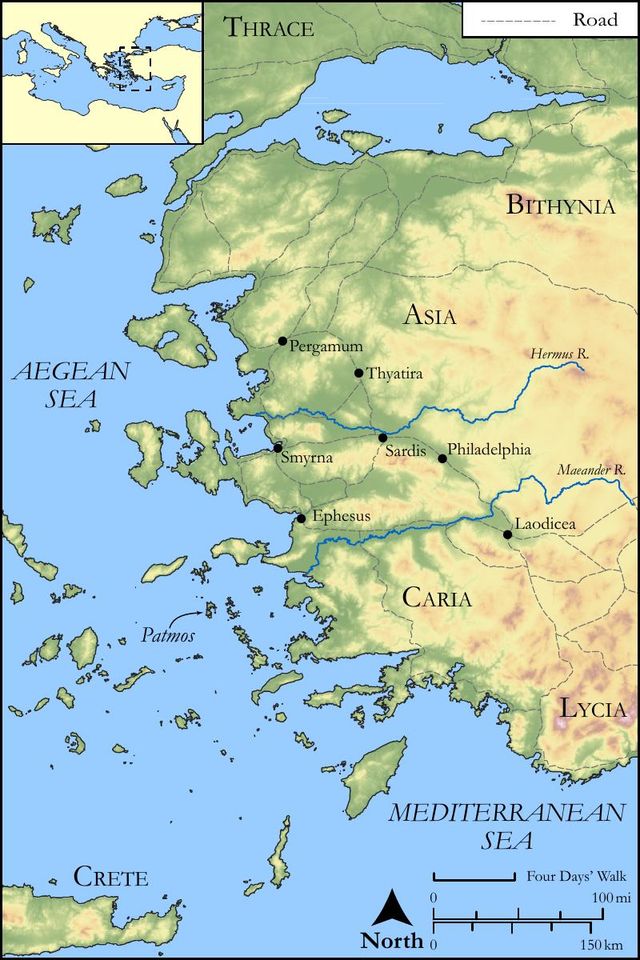
See on the biblical-era maps

Study this verse
Public-domain commentary
Matthew Henry
From his Commentary on the Whole Bible. Henry comments on passages, not single verses — this entry covers Revelation 5:1–5. His two-level outline is real structure in the source text, so it is rendered as structure.
Hitherto the apostle had seen only the great God, the governor of all things, now,
I.He is favoured with a sight of the model and methods of his government, as they are all written down in a book which he holds in his hand; and this we are now to consider as shut up and sealed in the hand of God. Observe,
1.The designs and methods of divine Providence towards the church and the world are stated and fixed; they are resolved upon and agreed to, as that which is written in a book. The great design is laid, every part adjusted, all determined, and every thing passed into decree and made a matter of record. The original and first draught of this book is the book of God's decrees, laid up in his own cabinet, in his eternal mind: but there is a transcript of so much as was necessary to be known in the book of the scriptures in general, in the prophetical part of the scripture especially, and in this prophecy in particular.
2.God holds this book in his right hand, to declare the authority of the book, and his readiness and resolution to execute all the contents thereof, all the counsels and purposes therein recorded.
3.This book in the hand of God is shut up and sealed; it is known to none but himself, till he allows it to be opened. Known unto God, and to him alone, are all his works, from the beginning of the world; but it is his glory to conceal the matter as he pleases. The times and seasons, and their great events, he hath kept in his own hand and power.
4.It is sealed with seven seals. This tells us with what inscrutable secrecy the counsels of God are laid, how impenetrable by the eye and intellect of the creature; and also points us to seven several parts of this book of God's counsels. Each part seems to have its particular seal, and, when opened, discovers its proper events; these seven parts are not unsealed and opened at once, but successively, one scene of Providence introducing another, and explaining it, till the whole mystery of God's counsel and conduct be finished in the world.
II.He heard a proclamation made concerning this sealed book.
1.The crier was a strong angel; not that there are any weak ones among the angels in heaven, though there are many among the angels of the churches. This angel seems to come out, not only as a crier, but as a champion, with a challenge to any or all the creatures to try the strength of their wisdom in opening the counsels of God; and, as a champion, he cried with a loud voice, that every creature might hear.
2.The cry or challenge proclaimed was, "Who is worthy to open the book, and to loose the seals thereof? Rev 5:2. If there by any creature who thinks himself sufficient either to explain or execute the counsels of God, let him stand forth, and make the attempt." 3. None in heaven or earth could accept the challenge and undertake the task: none in heaven, none of the glorious holy angels, though before the throne of God, and the ministers of his providence; they with all their wisdom cannot dive into the decrees of God: none on earth, no man, the wisest or the best of men, none of the magicians and soothsayers, none of the prophets of God, any further than he reveals his mind to them: none under the earth, none of the fallen angels, none of the spirits of men departed, though they should return to our world, can open this book. Satan himself, with all his subtlety, cannot do it; the creatures cannot open it, nor look on it; they cannot read it. God only can do it.
III.He felt a great concern in himself about this matter:
the apostle wept much; it was a great disappointment to him. By what he had seen in him who sat upon the throne, he was very desirous to see and know more of his mind and will: this desire, when not presently gratified, filled him with sorrow, and fetched many tears from his eyes. Here observe,
1.Those who have seen most of God in this world are most desirous to see more; and those who have seen his glory desire to know his will.
2.Good men may be too eager and to hasty to look into the mysteries of divine conduct.
3.Such desires, not presently answered, turn to grief and sorrow. Hope deferred makes the heart sick.
IV.The apostle was comforted and encouraged to hope this sealed book would yet be opened. Here observe,
1.Who it was that gave John the hint: One of the elders. God had revealed it to his church. If angels do not refuse to learn from the church, ministers should not disdain to do it. God can make his people to instruct and inform their teachers when he pleases.
2.Who it was that would do the thing - the Lord Jesus Christ, called the lion of the tribe of Judah, according to his human nature, alluding to Jacob's prophecy (Gen 49:10), and the root of David according to his divine nature, though a branch of David according to the flesh. He who is a middle person, God and man, and bears the office of Mediator between God and man, is fit and worthy to open and execute all the counsels of God towards men. And this he does in his mediatorial state and capacity, as the root of David and the offspring of Judah, and as the King and head of the Israel of God; and he will do it, to the consolation and joy of all his people.
Historical interpretation
Ten Centuries of Reception
13 surviving comments on this verse. Each one is dated, so this reads as a timeline rather than a list.
Select a marker to jump to its quote. Markers stagger vertically where authors wrote within a few decades of each other.
"And I saw an angel full of strength proclaiming with a loud voice, Who is worthy to open the book, and to loose the seals thereof? And no one was found worthy, neither in the earth nor under the earth, to open the book." Now to open the book is to overcome death for man.
[Daniel 12:4] "But Thou, O Daniel, shut up the words and seal the book, even to the time appointed. Many shall pass over, and knowledge shall be manifold." He who had revealed manifold truth to Daniel now signifies that the things he has said are matters of secrecy, and he orders him to roll up the scroll containing his words and set a seal upon the book, with the result that many shall read it and inquire as to its fulfilment in history, differing in their opinions because of its great obscurity. And as for the statement, "Many shall pass over" or "go through," this indicates that it will be read by many people. For it is a familiar expression to say: "I have gone through a book," or, "I have passed through an historical account." Indeed this is the idea which Isaiah also expressed in regard to the obscurity of his own book: "And the sayings of that book shall be like the words of a book that is sealed. And if they shall give it to an illiterate man, saying, 'Read it,' he will reply, 'I do not know how to read.' But if they give it to a man who does know how to read and say, 'Read the book,' he will reply, 'I cannot read it, because it is sealed up'" (Isaiah 29:11-12). Also in the Revelation of John, there is a book seen which is sealed with seven seals inside and outside. And when no one proves able to break its seals, John says, "I wept sore; and a voice came to me, saying, 'Weep not: behold the Lion of the tribe of Judah, the Root of David, has prevailed to open the book and break its seals'" (Revelation 5:1-5). But that book can be opened by one who has learned the mysteries of Scripture and understands its hidden truths, and its words which seem dark because of the greatness of the secrets they contain. He it is who can interpret the parables and transmute the letter which killeth into the spirit which quickeneth.
that is, neither angel, nor anyone living on earth, nor any of the dead, to contemplate the brightness of the grace of the New Testament.
When it says that no one in heaven was found worthy, it indicates that [opening the scroll] exceeded the capacities of the angels. This was not because they were ignorant of the future mystery of the Lord’s incarnation and work but because this was not to be completed through an angelic creature. For the Son of God, who through the assumption of true humanity was going to redeem humanity, wishes to fulfill all things through himself. Therefore Isaiah said, “Neither an angel nor a messenger but the Lord himself saved them.” When it says that no one on the earth was worthy, it means that no one of the just remains perfect in this life, for in order to be re-created man requires the assistance of him who alone is Creator. And that no one could be found under the earth means that no one among the saints who had died was found worthy to open the scroll or even to see it. Here “to see” means “to comprehend,” and therefore Paul says that he preaches the unsearchable riches of Christ to the Gentiles of which the Lord spoke, that is, the glory of the New Testament that was hidden in the law and that Christ reserved for his own presence. And so, no one was able to see this with an adequate sight, so that he might be able to effect it, since Christ had the power to fulfill it by his own dispensation. For [this glory] could only be foreseen by them, but it could not be effected.
or another sense; For a human to conquer death no one was found worthy to do this, neither among the angels of heaven, nor among humans on earth, nor among the souls of the saints in their rest, except Jesus Christ the Son of God alone.
But it occurs to me that if we call an object “infernal” because it lies in a lower position, then hell ought to be “infernal” to the earth just as the earth is to the sky. This is perhaps what the psalmist had in mind when he said, “You have freed my soul from the lower infernal regions.” The earth then is the “upper infernal,” and lying below this is the “lower infernal.” The words of John, too, are in keeping with this concept. He says he saw a book sealed with seven seals, and, because no one was found worthy to open the seals, either in heaven or on earth or under the earth, he “was all in tears.” Yet, later, he says that the Lion of the tribe of Judah opened the book. This book can refer only to sacred Scriptures, for no one opened it but Christ our Redeemer, who became man, and by his death, resurrection and ascension opened the way to all the mysteries it contained. No one in heaven opened it, because no angel could. No one on earth opened it, because no one living in the flesh had the power of doing so. No one under the earth was found worthy to open it, because souls separated from their bodies do not have such powers. No one but our Lord could open up the hidden meanings of the sacred word. Since, then, no one under the earth was found worthy to unseal the book, I see no reason why we should not believe that hell is under the earth.
This means that neither angels nor human beings, those in the flesh, nor the saints who had departed from the flesh are able to understand the knowledge of the divine judgments, except the lamb of God, by His presence releasing the obscurity of the things prophesied about him.
And no one was able in heaven or on earth, etc. Neither angel, nor any of the righteous even freed from the bond of the flesh, could reveal or investigate the mysteries of the divine law, nor look upon it, that is, to contemplate the splendor of the grace of the New Testament. Just as the children of Israel could not look upon the face of the giver of the Old Testament, which contains the New.
QUESTION: And no man was able, neither in heaven, nor on earth, nor under the earth, to open the book. ANSWER: No angel nor any of the just, even freed from the bond of the flesh, was able to reveal or discover the mysteries of the divine law. — Nor to look on it. —That is, to contemplate the splendor of the grace of the New Testament, just like the children of Israel were unable to look at the face of the one who brought the Old Testament which contained the New. (5:4) THERE FOLLOWS: And I wept much. ANSWER: It means that he realized the common misery of mankind and felt sad. (5:5) THERE FOLLOWS: And one of the ancients said to me: Weep not; behold the lion of the tribe of Juda, the root of David, hath prevailed. ANSWER: He is forbidden to weep because the mystery that had long lain hidden had then already been fulfilled in Christ's Passion.
And no man was able, neither in heaven, that is no angel was able to, nor on earth, that is no human being, nor under the earth, that is no soul, to open the book, nor to look on it: for none of these was able to achieve the plan for the salvation of man. But, blessed John, how could no one look on the book, while you yourself say, “I saw a book in the right hand of God?” Perhaps you were neither in heaven, nor on earth, nor under the earth? Then, in order for it not to be contradictory, we should take look on to mean “comprehend.” Indeed, who is able to comprehend how God can become incarnate without seed, how a man God can come out of the closed womb of a virgin, and how the Lord of glory can be crucified, when only the flesh dies?
He said, But no one in Heaven, on earth, or under the earth was able to open the little scroll. For neither an angel accomplished these things for us, as Isaiah says; "neither an elder nor an angel, but he himself saved them because he loved them," (Isa. 63:9) neither a living man, nor any of the dead. "A brother is not redeemed, a man shall not redeem himself," as it is written somewhere (Ps. 48:8). And what do I mean by saying to open the little scroll, when no one among men was able to look at it? For how could anyone filled with the mist of sin gaze upon the divine throne before which the little scroll was placed?
in heaven" refer to the angels, "on earth" to men living in the body, and "under the earth" to souls in hell.
And no man was able, neither in heaven: The angels. nor on earth: Humans. nor under the earth: The demons in whom the natural things remain intact. to open the book: No one can understand the divine mysteries, unless God, who first revealed them to the human Christ and Christ to John, reveals them.
Continue studying Revelation 5:3 across the web’s major study libraries — every link below opens this exact verse, chapter, or book on the destination site.
Read & Compare
 BibleGatewayThis verse in more than 200 translations and 70 languages.
 Bible.comThe YouVersion reader — hundreds of translations, reading plans, and highlights.
 ESV.orgCrossway's official English Standard Version reader.
 NET BibleThe NET translation with 60,000+ translators' notes on every rendering decision.
 STEP BibleTyndale House's free study tool — original text, vocabulary, and scholarly resources.
 BibliaLogos Bible Software's free web reader.
 USCCBThe New American Bible (Revised Edition) with the U.S. bishops' study notes.
Commentaries
 BibleHub CommentariesDozens of classic commentaries on this verse, gathered on one page.
 StudyLightMore than 100 commentary sets — the largest collection on the web.
 BibleRefPlain-English commentary on what this verse means, verse by verse.
 Enduring WordDavid Guzik's free commentary on this chapter, widely used by Bible teachers.
 Bible Study ToolsVerse commentary alongside Greek and Hebrew study aids.
Original Language & Research
- BibleHub InterlinearThe verse word by word — original language, transliteration, and English.
- BibleHub LexiconEvery word's original-language definition and Strong's entry.
 Blue Letter BibleDeep-study tools — Strong's numbers, concordance, and word studies.
 CNTR CollationThe earliest Greek manuscripts of this verse, collated letter by letter.
Sermons, Hymns & Audio


TrulyRandomVerse is not affiliated with these sites and doesn’t control their content. They’re linked because they’re genuinely useful.
Summary
Revelation 5:3 depicts a profound cosmic crisis: despite a universal search, no created being in all of existence—neither in the celestial realms, on the earth, nor among the departed—was found worthy or capable of opening the divinely sealed scroll held by God. This stark declaration of universal incapacity establishes the immense gravity of the scroll's contents, underscoring the absolute sovereignty of God's redemptive plan and setting the stage for the unique worthiness of the Lamb.
Context
ShowHideLiterary Context
This verse is a critical turning point within John's grand apocalyptic vision. It immediately follows the majestic and awe-inspiring throne room scene described in Revelation 4, where John witnesses the worship of God the Father. In Revelation 5:1, John sees a scroll in the right hand of God, sealed with seven seals. The subsequent question posed by a mighty angel in Revelation 5:2—"Who is worthy to open the book, and to loose the seals thereof?"—creates an intense dramatic tension. Verse 3 delivers the crushing answer to this question, revealing the universal inability of any created being to fulfill this monumental task, thereby intensifying John's despair, as expressed in Revelation 5:4. This despair then serves as the perfect backdrop for the triumphant introduction of the Lamb in Revelation 5:5.
Historical & Cultural Context
Scrolls were the primary form of written documents in the ancient world, often made of papyrus or parchment. Important documents, such as legal wills, deeds, or decrees, were frequently sealed to ensure their authenticity, privacy, and the authority of their contents. Multiple seals indicated a document of significant importance, often requiring the breaking of each seal in sequence to reveal the full content. The act of "opening" such a scroll implied not just physical access but the authority to understand, execute, or implement its contents. The three-tiered cosmic structure—heaven, earth, and under the earth—was a common ancient Near Eastern worldview, encompassing all realms of existence and all created beings, from angelic hosts to departed spirits. This universal scope emphasizes that the worthiness required was not merely human but transcended all created categories.
Key Themes
ShowHideRevelation 5:3 powerfully contributes to several overarching themes in the book of Revelation and biblical theology. Foremost is the theme of Divine Sovereignty, highlighting that God's ultimate plan for history, judgment, and redemption is entirely in His hands and beyond the grasp or manipulation of any created entity. It also underscores the Universal Incapacity of Creation, demonstrating that no angel, human, or spirit possesses the inherent worthiness or power to unveil or enact God's eschatological purposes. This universal inability serves to magnify the Unique Worthiness of Christ, as it creates a profound vacuum that only the Lamb of God can fill. The verse thus builds the dramatic tension necessary to introduce Jesus as the sole worthy one, setting the stage for the unfolding of God's redemptive and judgmental decrees, a theme central to the entire book, particularly in the subsequent chapters detailing the breaking of the seals and the trumpet and bowl judgments, as seen in Revelation 6-16.
Exposition and Analysis
ShowHideKey Word Analysis
ShowHideDerived from "not even one," this term emphasizes an absolute and comprehensive negation. It signifies that literally "not one" individual, regardless of their status, power, or location within the created order, possessed the necessary qualification. This highlights the unique and unparalleled nature of the worthiness required.
This verb denotes inherent power, capability, or possibility. Its use here indicates that the inability was not merely a lack of permission but a fundamental lack of intrinsic power or authority. No created being possessed the inherent might or moral qualification to perform the task of opening the scroll.
Referring to a "scroll" or "roll," this term signifies a written document. In this context, it is no ordinary scroll but symbolizes God's divine decrees, His sovereign plan for the ages, the title deed to creation, or the record of His redemptive and judgmental purposes. Its sealed nature implies that its contents are hidden until the appointed time and by the appointed one.
Verse Breakdown
ShowHide"And no man in heaven, nor in earth, neither under the earth,"
This clause employs a figure of speech known as a merism, encompassing all possible realms of existence and all created beings within them. "In heaven" refers to angelic beings and glorified saints; "in earth" refers to all humanity; and "under the earth" refers to the spirits of the departed, whether righteous or unrighteous. The emphatic repetition of "nor... neither" underscores the absolute universality of this inability.
"was able to open the book,"
This phrase identifies the specific action that no one could perform: to unroll and reveal the contents of the sealed scroll. "To open" implies not just physical access but the authority to break its seals, understand its divine purposes, and execute its decrees. This highlights the profound significance and sacredness of the scroll's contents, which are beyond the reach of any created power.
"neither to look thereon."
This final clause further emphasizes the complete inaccessibility of the scroll. "To look thereon" (Greek: blépō) means more than a casual glance; it implies to gaze intently, to behold, to comprehend, or to understand. The inability to even look upon it suggests that its contents are too sacred, too profound, or too authoritative for any created being to grasp or interact with, let alone implement.
Literary Devices
ShowHideRevelation 5:3 masterfully employs several literary devices to convey its profound theological message. Merism is prominently featured in the phrase "in heaven, nor in earth, neither under the earth," which comprehensively covers all realms of existence and all created beings. This device emphasizes the absolute and universal nature of the incapacity described. The verse also utilizes Symbolism, with "the book" or "scroll" serving as a powerful symbol for God's sovereign plan, His divine decrees concerning redemption and judgment, or even the title deed to creation itself. The act of "opening" and "looking thereon" are symbolic actions representing the authority to unveil, comprehend, and execute God's ultimate purposes. Furthermore, the verse creates intense Dramatic Tension and Foreshadowing. By declaring that no one is worthy, it builds anticipation for the revelation of the one who is worthy, setting the stage for the triumphant appearance of the Lamb in the subsequent verses. This universal helplessness underscores the unique and unparalleled nature of Christ's authority and worthiness.
Theological and Thematic Connections
ShowHideRevelation 5:3 is a pivotal theological statement, establishing a cosmic dilemma that only the unique worthiness of Christ can resolve. It asserts the absolute transcendence and sovereignty of God's ultimate plan, which remains hidden and inaccessible to all created beings, whether angelic, human, or departed spirits. This universal inability to open or even look upon the scroll underscores the immense gravity of its contents—God's eschatological purposes for creation, redemption, and judgment. The verse thus highlights the profound chasm between the Creator and creation, emphasizing that divine authority and the power to enact God's ultimate will reside solely with the Godhead. This dramatic impasse serves to magnify the redemptive work and inherent glory of the Lamb, who alone possesses the unique qualifications to bridge this gap and execute the divine plan.
Reflection and Application
ShowHideRevelation 5:3 offers profound insights for personal reflection and practical application. It confronts us with the sobering reality of our own limitations and the limitations of all creation in comprehending and controlling God's ultimate purposes. In a world that often seeks human solutions to spiritual problems, this verse is a powerful reminder that the most significant challenges and the unfolding of divine history are beyond our capacity. It calls us to humility, recognizing that our wisdom, power, and authority are finite compared to God's. However, this initial despair quickly gives way to immense hope. The universal inability of "no man" sets the stage for the singular worthiness of Christ. This should lead us to deepen our trust in God's sovereign plan, knowing that even when circumstances seem insurmountable or chaotic, there is a divine blueprint being perfectly executed by the only One truly capable. It encourages us to fix our gaze not on human efforts or earthly powers, but on the Lamb, who holds the keys to history and the future. Our hope is not in our ability to understand or control, but in His perfect wisdom and power to fulfill all of God's promises.
Questions for Reflection
ShowHideFAQ
ShowHideWhat is the "book" or "scroll" mentioned in Revelation 5:3?
ShowHideThe "book" (Greek: biblíon) refers to a scroll, a common form of written document in the ancient world. In the context of Revelation 5, this scroll is no ordinary document but a highly symbolic representation of God's divine decrees, His sovereign plan for the ages, or even the title deed to creation itself. It contains the blueprint for future events, including God's judgments and the consummation of His redemptive purposes. Its seven seals indicate its supreme importance, security, and the necessity of a uniquely qualified individual to open it and reveal its contents.
Christ-Centered Fulfillment
ShowHideRevelation 5:3, by declaring the universal inability of any created being to open the sealed scroll, powerfully sets the stage for the Christ-centered fulfillment found in the very next verses. The despair of "no man in heaven, nor in earth, neither under the earth, was able" is precisely what magnifies the unparalleled worthiness of Jesus Christ. He is revealed as the "Lion of the tribe of Judah, the Root of David," who "has triumphed, so that he can open the scroll and its seven seals" (Revelation 5:5). This triumph is rooted in His perfect obedience, His sacrificial death on the cross where He declared, "It is finished!," and His glorious resurrection and ascension, which exalted Him to the right hand of God (Acts 2:33). Because He is both fully God and fully man, the sinless Lamb of God who takes away the sin of the world (John 1:29), He alone possesses the intrinsic authority, perfect righteousness, and redemptive power to execute God's ultimate plan. He is the sole Mediator between God and humanity (1 Timothy 2:5), the one through whom all things were created and in whom all things hold together (Colossians 1:16-17). Thus, Revelation 5:3 underscores that the unfolding of God's redemptive history is entirely dependent on the unique person and finished work of Jesus Christ, the worthy Lamb who is also the sovereign King of Kings and Lord of Lords (Revelation 19:16).