


Daniel 12:12
Bible text: King James Version (1769 Blayney text) · Public domain
Bible text: Berean Standard Bible · Public domain
Bible text: American Standard Version (1901) · Public domain
Bible text: World English Bible, Messianic edition · Public domain
Bible text: Geneva Bible (1599) · Public domain
Bible text: Young's Literal Translation · Public domain
- אַשְׁרֵי'ash·Reihow blessed!H835N-mpcNoun Plural Masculine Construct
- הַמְחַכֶּהham·cha·Keh[is] the [one who] waitsH2442Art ¦ V-Piel-Prtcpl-msVerb Piel Participle Singular Masculine Absoluteהַ[is] theמְחַכֶּה[one who] waits
- וְיַגִּיעַve·ya·Gi·a'and he may arriveH5060Conj-w ¦ V-Hiphil-ConjImperf-3msVerb Hiphil Conjunction+Imperfect 3rd Singular Masculineוְandיַגִּיעַhe may arrive
- לְיָמִיםle·ya·Mimto daysH3117Prep-l ¦ N-mpNoun Plural Masculine Absoluteלְtoיָמִיםdays
- אֶלֶף'E·lefone thousandH505Adj-csAdjective Numerical Singular common gender Absolute
- שְׁלֹשׁshe·LoshthreeH7969Adj-cscAdjective Numerical Singular common gender Construct
- מֵאוֹתme·'othundredsH3967Adj-fpAdjective Numerical Plural Feminine Absolute
- שְׁלֹשִׁיםshe·lo·ShimthirtyH7970Adj-mpAdjective Numerical Plural Masculine Absolute
- וַחֲמִשָּׁהva·cha·mi·Shahand fiveH2568Conj-w ¦ Adj-csAdjective Numerical Singular common gender Absoluteוַandחֲמִשָּׁהfive
English is a literal word-by-word gloss of the Hebrew, not the KJV's wording. Why?
This is the original text the KJV's translators worked from — each Hebrew word with its own literal English meaning in this verse, prepared by scholars at Tyndale House, Cambridge. The KJV translates whole sentences, not word by word, so its wording differs: one Hebrew word can become several English words, and the KJV may choose “the LORD” where the gloss reads “Yahweh”. Both are faithful — they answer different questions. For the KJV's own rendering, switch to the KJV text.
Details
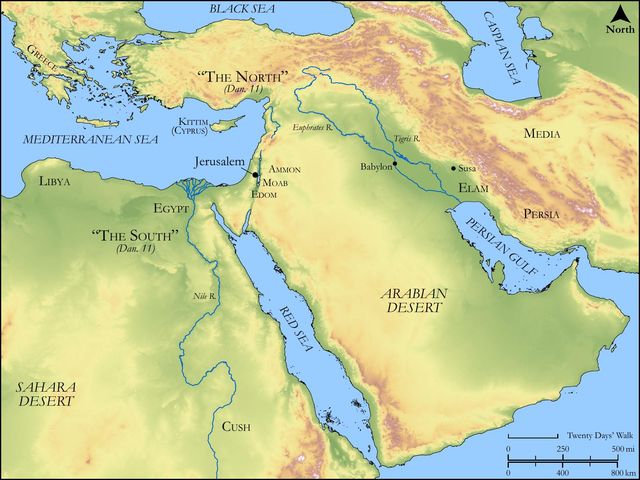
See on the biblical-era map
Study this verse
Public-domain commentary
Matthew Henry
From his Commentary on the Whole Bible. Henry comments on passages, not single verses — this entry covers Daniel 12:5–13. His four-level outline is real structure in the source text, so it is rendered as structure.
Daniel had been made to foresee the amazing revolutions of states and kingdoms, as far as the Israel of God was concerned in them; in them he foresaw troublous times to the church, suffering trying times, the prospect of which much affected him and filled him with concern. Now there were two questions proper to be asked upon this head: - When shall the end be? And, What shall the end be? These two questions are asked and answered here, in the close of the book; and though the comforts prescribed in the foregoing verses, one would think, were satisfactory enough, yet, for more abundant satisfaction, this is added.
I.The question, When shall the end be? is asked by an angel, Dan 12:5, Dan 12:6. Concerning this we may observe,
1.Who it was that asked the question. Daniel had had a vision of Christ in his glory, the man clothed in linen, Dan 10:5. But his discourse had been with the angel Gabriel, and now he looks, and behold other two (Dan 12:5), two angels that he had not seen before, one upon the bank of the river on one side and the other on the other side, that, the river being between them, they might not whisper to one another, but what they said might be heard. Christ stood on the waters of the river, (Dan 12:6), between the banks of Ulai; it was therefore proper that the angels his attendants should stand on either bank, that they might be ready to go, one one way and the other the other way, as he should order them. These angels appeared,
(1.)To adorn the vision, and make it the more illustrious; and to add to the glory of the Son of man, Heb 1:6. Daniel had not seen them before, though it is probable that they were there; but now, when they began to speak, he looked up, and saw them. Note, The further we look into the things of God, and the more we converse with them, the more we shall see of those things, and still new discoveries will be made to us; those that know much, if they improve it, shall know more.
(2.)To confirm the discovery, that out of the mouth of two or three witnesses the word might be established. Three angels appeared to Abraham.
(3.)To inform themselves, to hear and ask questions; for the mysteries of God's kingdom are things which the angels desire to look into (Pe1 1:12) and they are known to the church, Eph 3:10. Now one of these two angels said, When shall the end be? Perhaps they both asked, first one and then the other, but Daniel heard only one.
2.To whom this question was put, to the man clothed in linen, of whom we read before (Dan 10:5), to Christ our great high priest, who was upon the waters of the river, and whose spokesman, or interpreter, the angel Gabriel had all this while been. This river was Hiddekel (Dan 10:4), the same with Tigris, the place whereabout many of the events prophesied of would happen; there therefore is the scene laid. Hiddekel was mentioned as one of the rivers that watered the garden of Eden (Gen 2:14); fitly therefore does Christ stand upon that river, for by him the trees in the paradise of God are watered. Waters signify people, and so his standing upon the waters denotes his dominion over all; he sits upon the flood (Psa 29:10); he treads upon the waters of the sea, Job 9:8. And Christ, to show that this was he, in the days of his flesh walked upon the waters, Mat 14:25. He was above the waters of the river (so some read it); he appeared in the air over the river.
3.What the question was: How long shall it be to the end of these wonders? Daniel would not ask the question, because he would not pry into what was hidden, nor seem inquisitive concerning the times and the seasons, which the Father has put in his own power, Act 1:7. But, that he might have the satisfaction of the answer, the angel put the question in his hearing. Our Lord Jesus sometimes answered the questions which his disciples were afraid or ashamed to ask, Joh 16:19. The angel asked as one concerned, How long shall it be? What is the time prefixed in the divine counsels for the end of these wonders, these suffering trying times, that are to pass over the people of God? Note,
(1.)The troubles of the church are the wonder of angels. They are astonished that God will suffer his church to be thus afflicted, and are anxious to know what good he will do his church by its afflictions.
(2.)Good angels know no more of things to come than God is pleased to discover to them, much less do evil angels.
(3.)The holy angels in heaven are concerned for the church on earth, and lay to heart its afflictions; how much more then should we, who are more immediately related to it, and have so much of our peace in its peace?
4.What answer was returned to it by him who is indeed the numberer of secrets, and knows things to come.
(1.)Here is a more general account given of the continuance of these troubles to the angel that made the enquiry (Dan 12:7), that they shall continue for a time, times, and a half, that is, a year, two years, and half a year, as was before intimated (Dan 7:25), but the one half of a prophetical week. Some understand it indefinitely, a certain time for an uncertain; it shall be for a time (a considerable time), for times (a longer time yet, double what it was thought at first that it would be), and yet indeed it shall be but half a time, or a part of a time; when it is over it shall seem not half so much as was feared. But it is rather to be taken for a certain time; we meet with it in the Revelation, under the title sometimes of three days and a half, put for three years and a half, sometimes forty-two months, sometimes 1260 days. Now this determination of the time is here [1.] Confirmed by an oath. The man clothed in linen lifted up both his hands to heaven, and swore by him that lives for ever and ever that it should be so. Thus the mighty angel whom St. John saw is brought in, with a plain reference to this vision, standing with his right foot on the sea and his left foot on the earth, and with his hand lifted up to heaven, swearing that there shall be no longer delay, Rev 10:5, Rev 10:6. This Mighty One that Daniel saw stood with both feet on the water, and swore with both hands lifted up. Note, An oath is of use for confirmation; God only is to be sworn by, for he is the proper Judge to whom we are to appeal; and lifting up the hand is a very proper and significant sign to be used in a solemn oath. [2.] It is illustrated with a reason. God will suffer him to prevail till he shall have accomplished to scatter the power of the holy people. God will suffer him to do his worst, and run his utmost length, and then all these things shall be finished. Note, God's time to succour and relieve his people is when their affairs are brought to the last extremity; in the mount of the Lord it shall be seen that Isaac is saved just when he lies ready to be sacrificed. Now the event answered the prediction; Josephus says expressly, in his book of the Wars of the Jews, that Antiochus, surnamed Epiphanes, surprised Jerusalem by force, and held it three years and six months, and was then cast out of the country by the Asmoneans or Maccabees. Christ's public ministry continued three years and a half, during which time he endured the contradiction of sinners against himself, and lived in poverty and disgrace; and then when his power seemed to be quite scattered at his death, and his enemies triumphed over him, he obtained the most glorious victory and said, It is finished.
(2.)Here is something added more particularly concerning the time of the continuance of those troubles, in what is said to Daniel, Dan 12:11, Dan 12:12, where we have,
[1.]The event fixed from which the time of the trouble is to be dated, from the taking away of the daily sacrifice by Antiochus, and the setting up of the image of Jupiter upon the altar, which was the abomination of desolation. They must reckon their troubles to begin indeed when they were deprived of the benefit of public ordinances; that was to them the beginning of sorrows; that was what they laid most to heart.
[2.]The continuance of their trouble; it shall last 1290 days, three years and seven months, or (as some reckon) three years, six months, and fifteen days; and then, it is probable, the daily sacrifice was restored, and the abomination of desolation taken away, in remembrance of which the feast of dedication was observed even to our Saviour's time, Joh 10:22. Though it does not appear by the history that it was exactly so long to a day, yet it appears that the beginning of the trouble was in the 145th year of the Seleucidae, and the end of it in the 148th year; and either the restoring of the sacrifice, and the taking away of the image, were just so many days after, or some other previous event that was remarkable, which is not recorded. There are many particular times fixed in the scripture-prophecies, which it does not appear by any history, sacred or profane, that the event answered, and yet no doubt it did punctually; as Isa 16:14.
[3.]The completing of their deliverance, or at least a further advance towards it, which is here set forty-five days after the former, and, some think, points at the death of Antiochus, 1335 days after his profaning the temple. Blessed is he that waits and comes to that time. It is said (1 Macc. 9:28; 10:1) that the Maccabees, under a divine conduct, recovered the temple and the city. Many good interpreters make these to be prophetical days (that is, so many years), and date them from the destruction of Jerusalem by the Romans; but what events they then fall upon they are not agreed. Others date them from the corruption of the gospel-worship by the antichrist, whose reign is confined in the Apocalypse to 1260 days (that is, years), at the end of which he shall begin to fall; but thirty years after he shall be quite fallen, at the end of 1290 days; and whoever lives forty years longer, to 1335 days, will see glorious times indeed. Whether it looks so far forward or no I cannot tell; but this, however, we may learn, First, That there is a time fixed for the termination of the church's troubles, and the bringing about of her deliverance, and that this time will be punctually observed to a day. Secondly, That this time must be waited for with faith and patience. Thirdly, That, when it comes, it will abundantly recompense us for our long expectations of it. Blessed is he who, having waited long, comes to it at last, for he will then have reason to say, Lo, this is our God, and we have waited for him.
II.The question, What shall the end be? is asked by Daniel, and an answer given to it. Observe,
1.Why Daniel asked this question; it was because, though he heard what was said to the angel, yet he did not understand it, Dan 12:8. Daniel was a very intelligent man, and had been conversant in visions and prophecies, and yet here he was puzzled; he did not understand the meaning of the time, times, and the part of a time, at least not so clearly and with so much certainty as he wished. Note, The best men are often much at a loss in their enquiries concerning divine things, and meet with that which they do not understand. But the better they are the more sensible they are of their own weaknesses and ignorance, and the more ready to acknowledge them.
2.What the question was: O my Lord! What shall be the end of these things? He directs his enquiry not to the angel that talked with him, but immediately to Christ, for to whom else should we go with our enquiries? "What shall be the final issue of these events? What do they tend to? What will then end in?" Note, When we take a view of the affairs of this world, and of the church of God in it, we cannot but think, What will be the end of these things? We see things move as if they would end in the utter ruin of God's kingdom among men. When we observe the prevalence of vice and impiety, the decay of religion, the sufferings of the righteous, and the triumphs of the ungodly over them, we may well ask, O my Lord! what will be the end of these things? But this may satisfy us in general, that all will end well at last. Great is the truth, and will prevail at long-run. All opposing rule, principality, and power, will be put down, and holiness and love will triumph, and be in honour, to eternity. The end, this end, will come.
3.What answer is returned to this question. Besides what refers to the time (Dan 12:11, Dan 12:12), of which before, here are some general instructions given to Daniel, with which he is dismissed from further attendance.
(1.)He must content himself with the discoveries that had been made to him, and not enquire any further: "Go thy way, Daniel; let it suffice thee that thou has been admitted thus far to the foresight of things to come, but stop here. Go thy way about the king's business again, Dan 8:27. Go thy way, and record what thou hast seen and heard, for the benefit of posterity, and covet not to see and hear more at present." Note, Communion with God is not our continual feast in this world; we sometimes are taken to be witnesses of Christ's glory, and we say, It is good to be here; but we must go down from the mount, and have there no continuing city. Those that know much know but in part, and still see there is a great deal that they are kept in the dark about, and are likely to be so till the veil is rent; hitherto their knowledge shall go, but no further. "Go thy way, Daniel, satisfied with what thou hast."
(2.)He must not expect that what had been said to him would be fully understood till it was accomplished: The words are closed up and sealed, are involved in perplexities, and are likely to be so, till the time of the end, till the end of these things; nay, till the end of all things. Daniel was ordered to seal the book to the time of the end, Dan 12:4. The Jews used to say, When Elias comes he will tell us all things. "They are closed up and sealed, that is, the discovery designed to be made by them is now fully settled and completed; nothing is to be added to it nor taken from it, for it is closed up and sealed; ask not therefore after more." Nescire velle quae magister maximus docere non vult erudita inscitia est - He has learned much who is willing to be ignorant of those things which the great teacher does not choose to impart.
(3.)He must count upon no other than that, as long as the world stands, there will still be in it such a mixture as now we see there is of good and bad, Dan 12:10. We long to see all wheat and no tares in God's field, all corn and no chaff in God's floor; but it will not be till the time of ingathering, till the winnowing day, comes; both must grow together until the harvest. As it has been, so it is, and will be, The wicked shall do wickedly, but the wise shall understand. In this, as in other things, St. John's Revelation closes as Daniel did. Rev 22:11, He that is filthy, let him be filthy still; and he that is holy, let him be holy still.
[1.]There is no remedy but that wicked people will do wickedly; and such people there are and will be in the world to the end of time. So said the proverb of the ancients, Wickedness proceeds from the wicked (Sa1 24:13); and the observation of the moderns says the same. Bad men will do bad things; and a corrupt tree will never bring forth good fruit. Do men gather grapes of thorns, or bring forth good things from an evil treasure in the heart? No; wicked practices are the natural products of wicked principles and dispositions. Marvel not at the matter then, Ecc 5:8. We are told, before, that the wicked will do wickedly; we can expect no better from them: but, which is worse, none of the wicked shall understand. This is either, First, A part of their sin. They will not understand; they shut their eyes against the light, and none so blind as those that will not see. Therefore they are wicked because they will not understand. If they did but rightly know the truths of God, they would readily obey the laws of God, Psa 82:5. Wilful sin is the effect of wilful ignorance; they will not understand because they are wicked; they hate the light, and come not to the light, because their deeds are evil, Joh 3:19. Or, Secondly, It is a part of their punishment; they will do wickedly, and therefore God has given them up to blindness of mind, and has said concerning them, They shall not understand, nor be converted and healed, Mat 13:14, Mat 13:15. God will not give them eyes to see, because they will do wickedly, Deu 29:4.
[2.]Yet, bad as the world is, God will secure to himself a remnant of good people in it; still there shall be some, there shall be many, to whom the providences and ordinances of God shall be a savour of life unto life, while to others they are a savour of death unto death. First, the providences of God shall do them good: Many shall be purified, and made white, and tried, by their troubles (compare Dan 11:35), by the same troubles which will but stir up the corruptions of the wicked and make them do more wickedly. Note, The afflictions of good people are designed for their trial; but by these trials they are purified and made white, their corruptions are purged out, their graces are brightened, and made both more vigorous and more conspicuous, and are found to praise, and honour, and glory, Pe1 1:7. To those who are themselves sanctified and good every event is sanctified, and works for good, and helps to make them better. Secondly, The word of God shall do them good. When the wicked understand not, but stumble at the word, the wise shall understand. Those who are wise in practice shall understand doctrine; those who are influenced and governed by the divine law and love shall be illuminated with a divine light. For if any man will do his will he shall know the truth, Joh 7:17. Give instruction to a wise man, and he will be yet wiser.
(4.)He must comfort himself with the pleasing prospect of his own happiness in death, in judgment, and to eternity, Dan 12:13. Daniel was now very old, and had been long engaged both in an intimate acquaintance with heaven and in a great deal of public business on this earth. And now he must think of bidding farewell to this present state: Go thou thy way till the end be. [1.] It is good for us all to think much of going away from this world; we are still going, and must be gone shortly, gone the way of all the earth. That must be our way; but this is our comfort, We shall not go till God calls for us to another world, and till he has done with us in this world, till he says, "Go thou thy way; thou hast finished thy testimony, done thy work, and accomplished as a hireling thy day, therefore now, Go thy way, and leave it to others to take thy room." [2.] When a good man goes his way from this world he enters into rest: "Thou shalt rest from all thy present toils and agitations, and shalt not see the evils that are coming on the next generation." Never can a child of God say more pertinently than in his dying moments, Return unto thy rest, O my soul! [3.] Time and days will have an end; not only our time and days will end very shortly, but all times and days will have an end at length; yet a little while, and time shall be no more, but all its revolutions will be numbered and finished. [4.] Our rest in the grave will be but till the end of the days; and then the peaceful rest will be happily disturbed by a joyful resurrection. Job foresaw this when he said of the dead, Till the heavens be no more, they shall not awake, nor be raised out of their sleep, implying that then they shall, Job 14:12. [5.] We must every one of us stand in our lot at the end of the days. In the judgment of the great day we must have our allotment according to what we were, and what we did, in the body, either, Come, you blessed or, Go, you cursed; and we must stand for ever in that lot. It was a comfort to Daniel, it is a comfort to all the saints, that, whatever their lot is in the days of time, they shall have a happy lot in the end of the days, shall have their lot among the chosen. And it ought to be the great care and concern of every one of us to secure a happy lot at last in the end of the days, and they we may well be content with our present lot, welcome the will of God. [6.] A believing hope and prospect of a blessed lot in the heavenly Canaan, at the end of the days, will be an effectual support to us when we are going our way out of this world, and will furnish us with living comforts in dying moments.
Historical interpretation
Five Centuries of Reception
5 surviving comments on this verse. Each one is dated, so this reads as a timeline rather than a list.
Select a marker to jump to its quote. Markers stagger vertically where authors wrote within a few decades of each other.
“Blessed is he that waits.” … That is why we are to go into hiding and take to flight. For quite likely “we shall not have gone over the cities of Israel till the Son of man comes.” Who are the “blessed” that bear witness devoutly for Christ? I tell you that those who are martyrs at that time take precedence over all other martyrs. For … the martyrs under antichrist do battle with Satan in his own person.… [The antichrist will] show illusory signs and wonders.… May it not enter into anyone’s heart to ask, “What did Christ do greater than this? For what power enables this man to do such deeds? Unless God willed it, he would not have allowed it.”
The conflict lasted a month and a half, and in that time the victory became complete, as did also the deliverance of the Jews from the evils that weighed heavy on them. And when he said, “Blessed is the one who stands firm 1, days,” he revealed their deliverance. He did not simply say, “the one who attains,” but “the one who stands firm and attains.” The reason for this is that many of the unholy ones saw the change, but he does not call them happy; he calls blessed only those who gave witness during the time of troubles, who did not desert their religion and who then found abatement of their ills.
Verse 12. "Blessed is he that waiteth and cometh unto a thousand three hundred and thirty-five days." He means that he is blessed who waits for forty-five days beyond the predetermined number, for it is within that period that our Lord and Savior is to come in His glory. But the reason for the forty-five days of inaction after the slaying of the Antichrist is a matter which rests in the knowledge of God; unless, of course, we say that the rule of the saints is delayed in order that their patience may be tested. Porphyry explains this passage in the following way, that the forty-five days beyond the one thousand two hundred and ninety signify the interval of victory over the generals of Antiochus, or the period when Judas Maccabaeus fought with bravery and cleansed the Temple and broke the idol to pieces, offering blood-sacrifices in the Temple of God. He might have been correct in this statement if the Book of Maccabees had recorded that the Temple was polluted over a period of three and a half years instead of just three years (I Mac. 4).
He suggests and indicates that when this person sustains a divine blow, the great Elijah will continue preaching the remaining forty-five days when the Lord will appear, borne on the clouds of heaven, and will crown those who kept inviolate their treasure acquired by patience. Also the Lord says this in the holy Gospels: “Whoever endures to the end will be saved.”
Blessed are those who will go through the days mentioned before and will exceed them by 45 days; that is, When the evils are completed, there will be rest for the people and the end of their afflictions. According to others: 1, days, that is, “Jesus Christ, Great Savior”—if you count the letters of these four words, they give the name cited above; that is, [Daniel] has received the revelation that he will encounter and see Jesus, etc. Severus says, “Happy are those who persevere” in order to see the days in which his economy is fulfilled, after his baptism to his ascension, and in which he has been pleased with his aspect and miracles, [days] that will make 1,335. Theodoret asserts that these three years and a half constitute the time when the antichrist will reign at the end, and the 45 days the time beginning from the moment in which “the son of perdition” will be condemned, and Elijah will triumph and will drive all people away from the [antichrist], will admonish the Jews and will pray our Lord until he appears from heaven.
Continue studying Daniel 12:12 across the web’s major study libraries — every link below opens this exact verse, chapter, or book on the destination site.
Read & Compare
 BibleGatewayThis verse in more than 200 translations and 70 languages.
 Bible.comThe YouVersion reader — hundreds of translations, reading plans, and highlights.
 ESV.orgCrossway's official English Standard Version reader.
 NET BibleThe NET translation with 60,000+ translators' notes on every rendering decision.
 STEP BibleTyndale House's free study tool — original text, vocabulary, and scholarly resources.
 BibliaLogos Bible Software's free web reader.
 USCCBThe New American Bible (Revised Edition) with the U.S. bishops' study notes.
Commentaries
 BibleHub CommentariesDozens of classic commentaries on this verse, gathered on one page.
 StudyLightMore than 100 commentary sets — the largest collection on the web.
 BibleRefPlain-English commentary on what this verse means, verse by verse.
 Enduring WordDavid Guzik's free commentary on this chapter, widely used by Bible teachers.
 Bible Study ToolsVerse commentary alongside Greek and Hebrew study aids.
Original Language & Research
- BibleHub InterlinearThe verse word by word — original language, transliteration, and English.
- BibleHub LexiconEvery word's original-language definition and Strong's entry.
 Blue Letter BibleDeep-study tools — Strong's numbers, concordance, and word studies.
 SefariaThe Hebrew text with Rashi and centuries of Jewish commentary.
Sermons, Hymns & Audio


TrulyRandomVerse is not affiliated with these sites and doesn’t control their content. They’re linked because they’re genuinely useful.
Summary
Daniel 12:12 concludes a series of complex prophetic declarations concerning the end times, offering a profound blessing to those who not only endure but actively persevere through a specific, divinely appointed period of tribulation. This verse highlights God's favor upon the faithful who maintain hope and steadfastness until the culmination of these challenging days, emphasizing the ultimate reward for patient endurance in the face of unprecedented global distress.
Context
ShowHideLiterary Context
Daniel 12:12 stands as the final chronological statement in a series of highly symbolic and apocalyptic revelations given to Daniel. Chapter 12 itself serves as the climactic conclusion to the visions presented from chapter 10 onwards, detailing a period of unparalleled distress Daniel 12:1 for God's people, followed by resurrection and final judgment. Verse 11 introduces a period of 1,290 days, linked to the cessation of the daily sacrifice and the setting up of the "abomination that makes desolate." Verse 12 then extends this timeline by an additional 45 days, culminating in the 1,335 days, and pronounces a special blessing on those who reach this latter threshold. This progression of numbers suggests a refining process and a specific endpoint to the tribulation.
Historical & Cultural Context
The book of Daniel was written during a period of significant upheaval for the Jewish people, first under Babylonian exile and then under Persian rule, with prophetic glimpses into the Hellenistic period and beyond. The "time of trouble" described in Daniel 12:1 has historical parallels in the persecution under Antiochus IV Epiphanes (c. 167 BC), who desecrated the Jerusalem Temple. However, the scope of Daniel's prophecy extends far beyond this, pointing to an ultimate, eschatological tribulation. The concept of "waiting" (H2442, châkâh) was deeply ingrained in Jewish piety, reflecting a long history of anticipating God's deliverance and the fulfillment of His promises, particularly the coming of the Messiah and the establishment of His kingdom. The detailed numerical prophecies, while enigmatic, reflect a biblical pattern of God revealing His sovereign control over history through precise, though often symbolic, temporal markers.
Key Themes
ShowHideThis verse powerfully contributes to several overarching themes within Daniel and biblical prophecy. Firstly, it underscores the theme of Divine Sovereignty and Control over History, demonstrating that even in times of extreme chaos and suffering, God has a precise timetable and a predetermined end for all things. Secondly, the emphasis on "waiting" and "coming to" highlights the theme of Faithful Endurance and Perseverance. The blessing is not for those who merely survive, but for those who actively maintain their faith and hope through the crucible of tribulation. This aligns with the broader biblical message that perseverance under trial produces character and leads to a blessed outcome, as seen in passages like James 1:12. Finally, the verse speaks to the theme of Ultimate Vindication and Reward for the Righteous. Despite the unprecedented suffering described in Daniel 12:1, God promises a blessed state for those who remain faithful to the very end, foreshadowing the resurrection and eternal life for the wise and righteous mentioned in Daniel 12:2-3.
Exposition and Analysis
ShowHideKey Word Analysis
ShowHideThis word (H835) signifies a state of happiness, well-being, or fortunate condition. It is often used in the Psalms (e.g., Psalm 1:1) and carries the connotation of divine favor and flourishing. Here, it explicitly links this state of blessedness to the act of waiting and reaching a specific prophetic milestone, implying that true blessedness is found in faithful alignment with God's timing and plan, especially during difficult periods.
From the primitive root (H2442), this word implies more than passive waiting; it suggests active adherence, longing, and tarrying with expectation. It conveys a sense of patient endurance and hopeful anticipation, not merely idleness. In the context of Daniel 12:12, it describes one who steadfastly maintains faith and hope through a prolonged period of tribulation, actively trusting in God's ultimate deliverance and the fulfillment of His promises.
This primitive root (H5060) means "to touch," "to reach," or "to arrive." It implies successfully reaching a destination or a specific point in time. In this verse, it signifies the successful completion of the waiting period, indicating that the individual has persevered through the entire duration of the 1,335 days. The blessing is specifically for those who not only wait but arrive at the appointed end, having endured the full measure of the prophetic period.
Verse Breakdown
ShowHide"Blessed [is] he that waiteth"
This clause pronounces a divine favor and a state of profound well-being upon the individual who actively and patiently endures. The "waiting" is not a passive state but an active, hopeful, and persevering trust in God's timing and ultimate plan, particularly during a period of intense tribulation. It speaks to the spiritual discipline of maintaining faith and hope when circumstances are dire.
"and cometh"
This phrase emphasizes the successful completion of the period of waiting. It signifies that the blessed individual not only begins the waiting process but perseveres through it to its very end, reaching the designated prophetic milestone. This implies steadfastness, faithfulness, and resilience in the face of prolonged difficulty, highlighting that the blessing is for those who finish the race.
"to the thousand three hundred and five and thirty days"
This specifies the exact duration of the period that must be endured. Following the 1,290 days mentioned in Daniel 12:11, this extended period of 1,335 days marks a distinct prophetic endpoint. While the precise historical or eschatological fulfillment of these numbers remains a subject of ongoing scholarly debate, their presence underscores God's meticulous sovereignty over time and history, assuring the faithful that the tribulation has a defined limit and a blessed conclusion.
Literary Devices
ShowHideDaniel 12:12 employs several literary devices to convey its profound message. The most prominent is Prophetic Numerology, where specific numbers (1,290 days in verse 11, and 1,335 days here) are used to denote precise, divinely ordained periods within the eschatological timeline. While their exact interpretation is debated, these numbers function to assure the reader of God's absolute control over history and the finite nature of tribulation. The verse also utilizes Emphasis through repetition of the theme of endurance, building on the call to "wait" and "come to" a specific end, thereby underscoring the importance of perseverance. Furthermore, there is a strong element of Conditional Blessing, where the promise of "blessedness" is contingent upon the active and faithful waiting and reaching of the appointed time, serving as an encouragement and a challenge to the audience.
Theological and Thematic Connections
ShowHideDaniel 12:12 offers a powerful theological statement on the nature of divine blessing and human perseverance. It teaches that God's favor is not merely for those who avoid hardship, but profoundly for those who endure through it with steadfast faith. This verse connects the concept of blessedness directly to active waiting and successful completion of a divinely appointed period, implying that the journey through tribulation, when undertaken in faith, is itself a path to deeper spiritual flourishing and ultimate reward. It reinforces the biblical truth that God is sovereign over all time and events, and that His ultimate plan for His people includes both purification through suffering and glorious vindication.
Reflection and Application
ShowHideDaniel 12:12, while rooted in specific end-time prophecy, offers timeless principles for all believers. It calls us to cultivate a spirit of patient endurance, recognizing that God's plans unfold according to His perfect timing, not ours. In a world often characterized by instant gratification and a desire to escape discomfort, this verse reminds us that true blessedness can be found in the crucible of waiting and perseverance. It encourages us to view trials not as insurmountable obstacles, but as divinely appointed periods that, when navigated with faith, lead to a deeper experience of God's favor and the fulfillment of His promises. Our "waiting" should not be passive idleness, but an active, hopeful, and prayerful posture, trusting that God will bring His purposes to pass and that our faithfulness will be richly rewarded.
Questions for Reflection
ShowHideFAQ
ShowHideWhat is the significance of the "thousand three hundred and five and thirty days"?
ShowHideThe "thousand three hundred and five and thirty days" (1,335 days) in Daniel 12:12 represents a specific prophetic period, extending 45 days beyond the 1,290 days mentioned in Daniel 12:11. While the precise interpretation and fulfillment of these numbers have been debated by scholars for centuries, they are generally understood to refer to a distinct duration of time within the end-time tribulation. Many interpreters see them as literal days, while others view them symbolically. Regardless of the exact interpretation, their significance lies in demonstrating God's meticulous sovereignty over the timeline of history and prophecy. They assure believers that even the most intense periods of suffering have a divinely appointed end, and that God has a precise culmination point for His plans, leading to a blessed outcome for the faithful.
Christ-Centered Fulfillment
ShowHideWhile Daniel 12:12 speaks of a blessing for those who endure to a specific prophetic endpoint in the Old Testament context, its ultimate fulfillment and spiritual depth are found in Christ. Jesus Himself is the supreme example of one who "waited" and "came to" the appointed time, enduring the cross for the joy set before Him Hebrews 12:2. His resurrection and ascension marked the ultimate "coming to" the Father, securing the blessing of salvation for all who believe. For the New Testament believer, the "blessing" promised in Daniel 12:12 is realized through union with Christ. We are called to persevere in our faith, knowing that our ultimate blessedness is not merely reaching an earthly prophetic milestone, but participating in Christ's victory over sin and death 1 Corinthians 15:57. The "waiting" for us is the patient endurance until Christ's return Titus 2:13 and the full establishment of His kingdom, a waiting that is empowered by the Holy Spirit and sustained by the promise of eternal life in Him John 14:1-3. Thus, the blessing of Daniel 12:12 foreshadows the profound and eternal blessedness found in Christ for those who faithfully endure until His glorious appearing.