


Romans 2:12
Bible text: King James Version (1769 Blayney text) · Public domain
Bible text: King James Version with Strong's numbers · Public domain
Bible text: Berean Standard Bible · Public domain
Bible text: American Standard Version (1901) · Public domain
Bible text: World English Bible, Messianic edition · Public domain
Bible text: Geneva Bible (1599) · Public domain
Bible text: Young's Literal Translation · Public domain
- ὍσοιHosoiAs many asG3745K-NPMCorrelative pronoun Nominative Plural Masculine
- γὰρgarforG1063CONJConjunction
- ἀνόμωςanomōswithout [the] LawG460ADVAdverb
- ἥμαρτονhēmartonhave sinnedG264V-2AAI-3PVerb 2nd Aorist Active Indicative 3rd Plural
- ἀνόμωςanomōswithout [the] LawG460ADVAdverb
- καὶkaialsoG2532CONJConjunction
- ἀπολοῦνται·apolountaiwill perishG622V-FMI-3PVerb Future Middle Indicative 3rd Plural
- καὶkaiandG2532CONJConjunction
- ὅσοιhosoias many asG3745K-NPMCorrelative pronoun Nominative Plural Masculine
- ἐνeninG1722PREPPreposition
- νόμῳnomō[the] LawG3551N-DSMNoun Dative Singular Masculine
- ἥμαρτονhēmartonhave sinnedG264V-2AAI-3PVerb 2nd Aorist Active Indicative 3rd Plural
- διὰdiathroughG1223PREPPreposition
- νόμουnomou[the] LawG3551N-GSMNoun Genitive Singular Masculine
- κριθήσονται·krithēsontaiwill be judgedG2919V-FPI-3PVerb Future Passive Indicative 3rd Plural
English is a literal word-by-word gloss of the Greek, not the KJV's wording. Why?
This is the original text the KJV's translators worked from — each Greek word with its own literal English meaning in this verse, prepared by scholars at Tyndale House, Cambridge. The KJV translates whole sentences, not word by word, so its wording differs: one Greek word can become several English words, and the KJV may choose “charity” where the gloss reads “love”. Both are faithful — they answer different questions. For the KJV's own rendering, switch to the KJV text.
Details
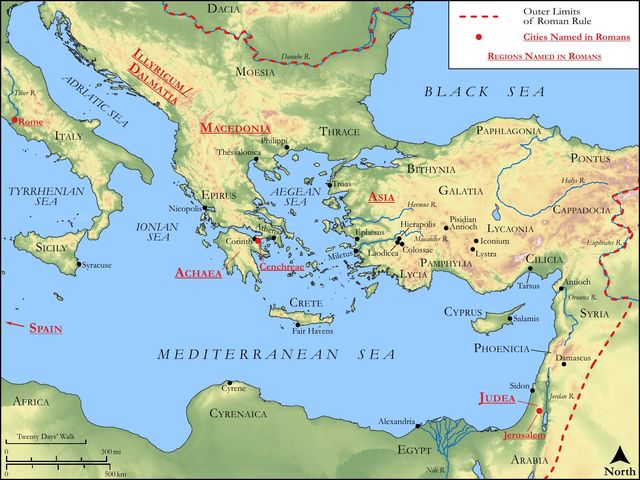
See on the biblical-era maps

Study this verse
Public-domain commentary
Matthew Henry
From his Commentary on the Whole Bible. Henry comments on passages, not single verses — this entry covers Romans 2:1–16. His four-level outline is real structure in the source text, so it is rendered as structure.
In the former chapter the apostle had represented the state of the Gentile world to be as bad and black as the Jews were ready enough to pronounce it. And now, designing to show that the state of the Jews was very bad too, and their sin in many respects more aggravated, to prepare his way he sets himself in this part of the chapter to show that God would proceed upon equal terms of justice with Jews and Gentiles; and now with such a partial hand as the Jews were apt to think he would use in their favour.
I.He arraigns them for their censoriousness and self-conceit (Rom 2:1):
Thou art inexcusable, O man, whosoever thou art that judgest. As he expresses himself in general terms, the admonition may reach those many masters (Jam 3:1), of whatever nation or profession they are, that assume to themselves a power to censure, control, and condemn others. But he intends especially the Jews, and to them particularly he applies this general charge (Rom 2:21), Thou who teachest another teachest thou not thyself? The Jews were generally a proud sort of people, that looked with a great deal of scorn and contempt upon the poor Gentiles, as not worthy to be set with the dogs of their flock; while in the mean time they were themselves as bad and immoral - though not idolaters, as the Gentiles, yet sacrilegious, Rom 2:22. Therefore thou art inexcusable. If the Gentiles, who had but the light of nature, were inexcusable (Rom 1:20), much more the Jews, who had the light of the law, the revealed will of God, and so had greater helps than the Gentiles.
II.He asserts the invariable justice of the divine government, Rom 2:2, Rom 2:3.
To drive home the conviction, he here shows what a righteous God that is with whom we have to do, and how just in his proceedings. It is usual with the apostle Paul, in his writings, upon mention of some material point, to make large digressions upon it; as here concerning the justice of God (Rom 2:2), That the judgment of God is according to truth, - according to the eternal rules of justice and equity, - according to the heart, and not according to the outward appearance (Sa1 16:7), - according to the works, and not with respect to persons, is a doctrine which we are all sure of, for he would not be God if he were not just; but it behoves those especially to consider it who condemn others for those things which they themselves are guilty of, and so, while they practise sin and persist in that practice, think to bribe the divine justice by protesting against sin and exclaiming loudly upon others that are guilty, as if preaching against sin would atone for the guilt of it. But observe how he puts it to the sinner's conscience (Rom 2:3): Thinkest thou this, O man? O man, a rational creature, a dependent creature, made by God, subject under him, and accountable to him. The case is so plain that we may venture to appeal to the sinner's own thoughts: "Canst thou think that thou shalt escape the judgment of God? Can the heart-searching God be imposed upon by formal pretences, the righteous Judge of all so bribed and put off?" The most plausible politic sinners, who acquit themselves before men with the greatest confidence, cannot escape the judgment of God, cannot avoid being judged and condemned.
III.He draws up a charge against them (Rom 2:4, Rom 2:5) consisting of two branches: -
1.Slighting the goodness of God (Rom 2:4), the riches of his goodness. This is especially applicable to the Jews, who had singular tokens of the divine favour. Means are mercies, and the more light we sin against the more love we sin against. Low and mean thoughts of the divine goodness are at the bottom of a great deal of sin. There is in every wilful sin an interpretative contempt of the goodness of God; it is spurning at his bowels, particularly the goodness of his patience, his forbearance and long-suffering, taking occasion thence to be so much the more bold in sin, Ecc 8:11. Not knowing, that is, not considering, not knowing practically and with application, that the goodness of God leadeth thee, the design of it is to lead thee, to repentance. It is not enough for us to know that God's goodness leads to repentance, but we must know that it leads us - thee in particular. See here what method God takes to bring sinners to repentance. He leads them, not drives them like beasts, but leads them like rational creatures, allures them (Hos 2:14); and it is goodness that leads, bands of love, Hos 11:4. Compare Jer 31:3. The consideration of the goodness of God, his common goodness to all (the goodness of his providence, of his patience, and of his offers), should be effectual to bring us all to repentance; and the reason why so many continue in impenitency is because they do not know and consider this.
2.Provoking the wrath of God, Rom 2:5. The rise of this provocation is a hard and impenitent heart; and the ruin of sinners is their walking after such a heart, being led by it. To sin is to walk in the way of the heart; and when that is a hard and impenitent heart (contracted hardness by long custom, besides that which is natural), how desperate must the course needs be! The provocation is expressed by treasuring up wrath. Those that go on in a course of sin are treasuring up unto themselves wrath. A treasure denotes abundance. It is a treasure that will be spending to eternity, and yet never exhausted; and yet sinners are still adding to it as to a treasure. Every wilful sin adds to the score, and will inflame the reckoning; it brings a branch to their wrath, as some read that (Eze 8:17), they put the branch to their nose. A treasure denotes secrecy. The treasury or magazine of wrath is the heart of God himself, in which it lies hid, as treasures in some secret place sealed up; see Deu 32:34; Job 14:17. But withal it denotes reservation to some further occasion; as the treasures of the hail are reserved against the day of battle and war, Job 38:22, Job 38:23. These treasures will be broken open like the fountains of the great deep, Gen 7:11. They are treasured up against the day of wrath, when they will be dispensed by the wholesale, poured out by full vials. Though the present day be a day of patience and forbearance towards sinners, yet there is a day of wrath coming-wrath, and nothing but wrath. Indeed, every day is to sinners a day of wrath, for God is angry with the wicked every day (Psa 7:11), but there is the great day of wrath coming, Rev 6:17. And that day of wrath will be the day of the revelation of the righteous judgment of God. The wrath of God is not like our wrath, a heat and passion; no, fury is not in him (Isa 27:4): but it is a righteous judgment, his will to punish sin, because he hates it as contrary to his nature. This righteous judgment of God is now many times concealed in the prosperity and success of sinners, but shortly it will be manifested before all the world, these seeming disorders set to rights, and the heavens shall declare his righteousness, Psa 50:6. Therefore judge nothing before the time.
IV.He describes the measures by which God proceeds in his judgment.
Having mentioned the righteous judgment of God in Rom 2:5, he here illustrates that judgment, and the righteousness of it, and shows what we may expect from God, and by what rule he will judge the world. The equity of distributive justice is the dispensing of frowns and favours with respect to deserts and without respect to persons: such is the righteous judgment of God.
1.He will render to every man according to his deeds (Rom 2:6), a truth often mentioned in scripture, to prove that the Judge of all the earth does right.
(1.)In dispensing his favours; and this is mentioned twice here, both in Rom 2:7 and Rom 2:10. For he delights to show mercy. Observe,
[1.]The objects of his favour: Those who by patient continuance, etc. By this we may try our interest in the divine favour, and may hence be directed what course to take, that we may obtain it. Those whom the righteous God will reward are, First, Such as fix to themselves the right end, that seek for glory, and honour, and immortality; that is, the glory and honour which are immortal - acceptance with God here and for ever. There is a holy ambition which is at the bottom of all practical religion. This is seeking the kingdom of God, looking in our desires and aims as high as heaven, and resolved to take up with nothing short of it. This seeking implies a loss, sense of that loss, desire to retrieve it, and pursuits and endeavours consonant to those desires. Secondly, Such as, having fixed the right end, adhere to the right way: A patient continuance in well-doing. 1. There must be well-doing, working good, Rom 2:10. It is not enough to know well, and speak well, and profess well, and promise well, but we must do well: do that which is good, not only for the matter of it, but for the manner of it. We must do it well. 2. A continuance in well-doing. Not for a fit and a start, like the morning cloud and the early dew; but we must endure to the end: it is perseverance that wins the crown. 3. A patient continuance. This patience respects not only the length of the work, but the difficulties of it and the oppositions and hardships we may meet with in it. Those that will do well and continue in it must put on a great deal of patience.
[2.]The product of his favour. He will render to such eternal life. Heaven is life, eternal life, and it is the reward of those that patiently continue in well-doing; and it is called (Rom 2:10) glory, honour, and peace. Those that seek for glory and honour (Rom 2:7) shall have them. Those that seek for the vain glory and honour of this world often miss of them, and are disappointed; but those that seek for immortal glory and honour shall have them, and not only glory and honour, but peace. Worldly glory and honour are commonly attended with trouble; but heavenly glory and honour have peace with them, undisturbed everlasting peace.
(2.)In dispensing his frowns (Rom 2:8, Rom 2:9). Observe,
[1.]The objects of his frowns. In general those that do evil, more particularly described to be such as are contentious and do not obey the truth. Contentious against God. every wilful sin is a quarrel with God, it is striving with our Maker (Isa 45:9), the most desperate contention. The Spirit of God strives with sinners (Gen 6:3), and impenitent sinners strive against the Spirit, rebel against the light (Job 24:13), hold fast deceit, strive to retain that sin which the Spirit strives to part them from. Contentious, and do not obey the truth. The truths of religion are not only to be known, but to be obeyed; they are directing, ruling, commanding; truths relating to practice. Disobedience to the truth is interpreted a striving against it. But obey unrighteousness - do what unrighteousness bids them do. Those that refuse to be the servants of truth will soon be the slaves of unrighteousness.
[2.]The products or instances of these frowns: Indignation and wrath, tribulation and anguish. These are the wages of sin. Indignation and wrath the causes - tribulation and anguish the necessary and unavoidable effects. And this upon the soul; souls are the vessels of that wrath, the subjects of that tribulation and anguish. Sin qualifies the soul for this wrath. The soul is that in or of man which is alone immediately capable of this indignation, and the impressions or effects of anguish therefrom. Hell is eternal tribulation and anguish, the product of wrath and indignation. This comes of contending with God, of setting briers and thorns before a consuming fire, Isa 27:4. Those that will not bow to his golden sceptre will certainly be broken by his iron rod. Thus will God render to every man according to his deeds.
2.There is no respect of persons with God, Rom 2:11. As to the spiritual state, there is a respect of persons; but not as to outward relation or condition. Jews and Gentiles stand upon the same level before God. This was Peter's remark upon the first taking down of the partition-wall (Act 10:34), that God is no respecter of persons; and it is explained in the next words, that in every nation he that fears God, and works righteousness, is accepted of him. God does not save men with respect to their external privileges or their barren knowledge and profession of the truth, but according as their state and disposition really are. In dispensing both his frowns and favours it is both to Jew and Gentile. If to the Jews first, who had greater privileges, and made a greater profession, yet also to the Gentiles, whose want of such privileges will neither excuse them from the punishment of their ill-doing nor bar them out from the reward of their well-doing (see Col 3:11); for shall not the Judge of all the earth do right?
V.He proves the equity of his proceedings with all, when he shall actually come to Judge them (Rom 2:12-16), upon this principle, that that which is the rule of man's obedience is the rule of God's judgment. Three degrees of light are revealed to the children of men: -
1.The light of nature. This the Gentiles have, and by this they shall be judged: As many as have sinned without law shall perish without law; that is, the unbelieving Gentiles, who had no other guide but natural conscience, no other motive but common mercies, and had not the law of Moses nor any supernatural revelation, shall not be reckoned with for the transgression of the law they never had, nor come under the aggravation of the Jews' sin against and judgment by the written law; but they shall be judged by, as they sin against, the law of nature, not only as it is in their hearts, corrupted, defaced, and imprisoned in unrighteousness, but as in the uncorrupt original the Judge keeps by him. Further to clear this (Rom 2:14, Rom 2:15), in a parenthesis, he evinces that the light of nature was to the Gentiles instead of a written law. He had said (Rom 2:12) they had sinned without law, which looks like a contradiction; for where there is no law there is no transgression. But, says he, though they had not the written law (Psa 147:20), they had that which was equivalent, not to the ceremonial, but to the moral law. They had the work of the law. He does not mean that work which the law commands, as if they could produce a perfect obedience; but that work which the law does. The work of the law is to direct us what to do, and to examine us what we have done. Now,
(1.)They had that which directed them what to do by the light of nature: by the force and tendency of their natural notions and dictates they apprehended a clear and vast difference between good and evil. They did by nature the things contained in the law. They had a sense of justice and equity, honour and purity, love and charity; the light of nature taught obedience to parents, pity to the miserable, conservation of public peace and order, forbade murder, stealing, lying, perjury, etc. Thus they were a law unto themselves.
(2.)They had that which examined them as to what they had done: Their conscience also bearing witness. They had that within them which approved and commended what was well done and which reproached them for what was done amiss. Conscience is a witness, and first or last will bear witness, though for a time it may be bribed or brow-beaten. It is instead of a thousand witnesses, testifying of that which is most secret; and their thoughts accusing or excusing, passing a judgment upon the testimony of conscience by applying the law to the fact. Conscience is that candle of the Lord which was not quite put out, no, not in the Gentile world. The heathen have witnessed to the comfort of a good conscience.
- Hic murus aheneus esto,
Nil conscire sibi -
Be this thy brazen bulwark of defence,
Still to preserve thy conscious innocence.
- Hor.
and to the terror of a bad one:
- Quos diri conseia facti
Mens habet attonitos, et surdo verbere caedit -
No lash is heard, and yet the guilty heart
Is tortur'd with a self-inflicted smart
- Juv. Sat. 13.
Their thoughts the meanwhile, metaxu allēlōn - among themselves, or one with another. The same light and law of nature that witnesses against sin in them, and witnessed against it in others, accused or excused one another. Vicissim, so some read it, by turns; according as they observed or broke these natural laws and dictates, their consciences did either acquit or condemn them. All this did evince that they had that which was to them instead of a law, which they might have been governed by, and which will condemn them, because they were not so guided and governed by it. So that the guilty Gentiles are left without excuse. God is justified in condemning them. They cannot plead ignorance, and therefore are likely to perish if they have not something else to plead.
2.The light of the law. This the Jews had, and by this they shall be judged (Rom 2:12): As many as have sinned in the law shall be judged by the law. They sinned, not only having the law, but en nomō - in the law, in the midst of so much law, in the face and light of so pure and clear a law, the directions of which were so very full and particular, and the sanctions of it so very cogent and enforcing. These shall be judged by the law; their punishment shall be, as their sin is, so much the greater for their having the law. The Jew first, Rom 2:9. It shall be more tolerable for Tyre and Sidon. Thus Moses did accuse them (Joh 5:45), and they fell under the many stripes of him that knew his master's will, and did it not, Luk 12:47. The Jews prided themselves very much in the law; but, to confirm what he had said, the apostle shows (Rom 2:13) that their having, and hearing, and knowing the law, would not justify them, but their doing it. The Jewish doctors bolstered up their followers with an opinion that all that were Jews, how bad soever they lived, should have a place in the world to come. This the apostle here opposes: it was a great privilege that they had the law, but not a saving privilege, unless they lived up to the law they had, which it is certain the Jews did not, and therefore they had need of a righteousness wherein to appear before God. We may apply it to the gospel: it is not hearing, but doing that will save us, Joh 13:17; Jam 1:22.
3.The light of the gospel: and according to this those that enjoyed the gospel shall be judge (Rom 2:16): According to my gospel; not meant of any fifth gospel written by Paul, as some conceit; or of the gospel written by Luke, as Paul's amanuensis (Euseb. Hist. lib 3, cap. 8), but the gospel in general, called Paul's because he was a preacher of it. As many as are under that dispensation shall be judged according to that dispensation, Mar 16:16. Some refer those words, according to my gospel, to what he says of the day of judgment: "There will come a day of judgment, according as I have in my preaching often told you; and that will be the day of the final judgment both of Jews and Gentiles." It is good for us to get acquainted with what is revealed concerning that day.
(1.)There is a day set for a general judgment. The day, the great day, his day that is coming, Psa 37:13.
(2.)The judgment of that day will be put into the hands of Jesus Christ. God shall judge by Jesus Christ, Act 17:31. It will be part of the reward of his humiliation. Nothing speaks more terror to sinners, or more comfort to saints, than this, that Christ shall be the Judge.
(3.)The secrets of men shall then be judged. Secret services shall be then rewarded, secret sins shall be then punished, hidden things shall be brought to light. That will be the great discovering day, when that which is now done in corners shall be proclaimed to all the world.
Historical interpretation
Two Centuries of Reception
13 surviving comments on this verse. Each one is dated, so this reads as a timeline rather than a list.
Select a marker to jump to its quote. Markers stagger vertically where authors wrote within a few decades of each other.
1. As I have heard from a certain presbyter,
If, then, God will judge the secrets of men-both of those who have sinned in the law, and of those who have sinned without law (inasmuch as they who know not the law yet do by nature the things contained in the law) -surely the God who shall judge is He to whom belong both the law, and that nature which is the rule to them who know not the law.
When the apostle says that those who are without the law will perish without the law, the question arises as to whether this should be understood only of the law of Moses or whether it should be extended to cover the law of Christ or even some other law under which mortal men may live. Will such a person be judged according to the law under which he has sinned, or will he perish as if he were outside the law because he is outside the law of Moses, even if he lives under some other law? For the apostle Paul himself, when he speaks to those who are outside the law, says that he too is virtually outside the law but adds: “I am not without law, but I am in the law of Christ,” thus showing that although he may not be under the law of Moses he is nevertheless still under law. But whether human laws also belong to this category remains to be seen.
Paul to the Romans: "As many as have sinned without law, shall perish without law; and as many as have sinned in the law, shall be judged also by the law."
As many as have sinned in law shall be judged according to law, and as many as have sinned without law shall perish without law.
How can someone sin without the law, when Paul says that everyone is subject to the law of nature? By “law” he means the law of Moses, to which the Jews are bound although they do not believe. The Gentiles are also under the judgment of the natural law, but only insofar as they have chosen not to attach themselves to it. Thus the Gentile unbelievers are doubly in trouble, because they have neither assented to the law given through Moses, nor have they received the grace of Christ. Therefore it is quite right that they should perish. So just as the person who sins without the law will perish, so also the one who has kept the law without knowing it will be justified. For the keeper of the law maintains his righteousness by nature. For if the law is given not for the righteous but for the unrighteous, whoever does not sin is a friend of the law. For him faith alone is the way by which he is made perfect. For others mere avoidance of evil will not gain them any advantage with God unless they also believe in God, so that they may be righteous on both counts. For the one righteousness is temporal; the other is eternal.The Gentiles even if they keep the natural law will perish if they do not accept the faith of Christ. For it is a greater thing to confess faith in the one Lord, since God is one, than it is to avoid sinning (for the first of these has to do with God, the second with us). The Jews who live under the law will be accused and judged by the law, insofar as they have not accepted the Christ promised to them in the law. And if you wonder about this, the fate of the Jews will be worse than that of the Gentiles, for it is worse to lose what was promised than not to receive what was not hoped for in the first place. The unbelieving Gentile has not entered the kingdom of God, but the unbelieving Jew has been removed from it.
Those who lived before the giving of the law will not receive the same sentence as those after the law. Those sinning after the giving of the law will undergo heavier penalties.
"For as many," he says, "as have sinned without law shall also perish without law: and as many as have sinned in the law shall be judged by the law." For here, as I said before, he shows not only the equality of the Jew and the Gentile, but that the Jew was even much burdened by the gift of the Law. For the Gentile is judged without law. But this "without law" here expresses not the worse plight but the easier, that is, he has not the Law to accuse him. For "without law" (that is, without the condemnation arising from it), is he condemned solely from the reasonings of nature, but the Jew, "in the Law," that is, with nature and the Law too to accuse him. For the greater the attention he enjoyed, the greater the punishment he will suffer. See how much greater is the necessity which he lays upon the Jews of a speedy recourse to grace! For in that they said, they needed not grace, being justified by the Law, he shows that they need it more than the Gentiles, considering they are liable to be punished more.
“Will perish” means the same thing as “will be judged,” for the man who perishes perishes by God’s judgment, and the man who is judged a sinner perishes. Paul puts Jews and Gentiles on the same level when he says that doers rather than hearers of the law are righteous and then adds that the Gentiles will be judged on the day of the Lord. For does anyone doubt that those under the law will perish just as those who lived without the law, unless they have believed in Christ?
The ungodly without the law shall perish forever. But the sinner under the law who comes to faith in God will not perish.
So as not to appear to be condemning them out of hatred Paul has repeated himself here, saying that those who have sinned without the law will perish without the law and that those under the law will be judged by the law.
The apostle did not mean to say that those who sin in ignorance will suffer worse punishment than those who know the law. It seems that it is worse to perish than to be judged. Rather the apostle here was merely distinguishing between Jews and Gentiles.
It is generally agreed that judgment is the usual expression for eternal damnation.
Continue studying Romans 2:12 across the web’s major study libraries — every link below opens this exact verse, chapter, or book on the destination site.
Read & Compare
 BibleGatewayThis verse in more than 200 translations and 70 languages.
 Bible.comThe YouVersion reader — hundreds of translations, reading plans, and highlights.
 ESV.orgCrossway's official English Standard Version reader.
 NET BibleThe NET translation with 60,000+ translators' notes on every rendering decision.
 STEP BibleTyndale House's free study tool — original text, vocabulary, and scholarly resources.
 BibliaLogos Bible Software's free web reader.
 USCCBThe New American Bible (Revised Edition) with the U.S. bishops' study notes.
Commentaries
 BibleHub CommentariesDozens of classic commentaries on this verse, gathered on one page.
 StudyLightMore than 100 commentary sets — the largest collection on the web.
 BibleRefPlain-English commentary on what this verse means, verse by verse.
 Enduring WordDavid Guzik's free commentary on this chapter, widely used by Bible teachers.
 Bible Study ToolsVerse commentary alongside Greek and Hebrew study aids.
Original Language & Research
- BibleHub InterlinearThe verse word by word — original language, transliteration, and English.
- BibleHub LexiconEvery word's original-language definition and Strong's entry.
 Blue Letter BibleDeep-study tools — Strong's numbers, concordance, and word studies.
 CNTR CollationThe earliest Greek manuscripts of this verse, collated letter by letter.
Sermons, Hymns & Audio


TrulyRandomVerse is not affiliated with these sites and doesn’t control their content. They’re linked because they’re genuinely useful.
Summary
Romans 2:12 profoundly articulates God's impartial and universal standard of judgment, asserting that all humanity stands accountable before Him, irrespective of their knowledge of the Mosaic Law. Paul establishes that those who sin without the explicit written Law will face consequences commensurate with their understanding of God's moral order, leading to their ruin. Conversely, those who possess the Law and transgress it will be judged according to its strict demands, highlighting that mere possession of the Law does not grant immunity from its condemnation but rather intensifies accountability. This verse underscores the pervasive nature of sin and the inescapable reality of divine judgment for all.
Context
ShowHideLiterary Context
Romans 2:12 is a pivotal statement within Paul's broader argument concerning God's righteous judgment, which begins in Romans 1. In Romans 1:18-32, Paul meticulously lays out the guilt of the Gentiles, demonstrating how their suppression of the truth about God, evident in creation, led to widespread idolatry and moral depravity. Chapter 2 then shifts focus, confronting those (primarily Jews) who might judge the Gentiles while being guilty of similar transgressions themselves. Paul asserts that God's judgment is based on truth and deeds, not on outward status or mere possession of the Law (Romans 2:6), emphatically stating that "there is no respect of persons with God" (Romans 2:11). Verse 12 directly explains how this impartial judgment will be applied to the two main categories of humanity: those "without law" (Gentiles) and those "in the law" (Jews).
Historical & Cultural Context
In the Greco-Roman world of Paul's time, there was a significant distinction between Jews and Gentiles. Jews prided themselves on possessing the Mosaic Law, believing it set them apart as God's chosen people and granted them a privileged status. They often viewed Gentiles as morally inferior and outside of God's covenant. Paul challenges this deeply ingrained cultural and religious assumption. For Gentiles, while they lacked the Mosaic Law, Paul would later argue that God's moral requirements are "written on their hearts" and revealed through their conscience (Romans 2:14-15). Therefore, both groups, despite their differing relationships to the written Law, were accountable to God for their actions. This verse dismantles any notion of special privilege based on ethnicity or religious observance, leveling the playing field before a righteous God.
Key Themes
ShowHideThis verse contributes significantly to several overarching themes in Romans. Firstly, it reinforces the theme of Impartial Judgment, demonstrating that God's justice is applied universally and without favoritism, judging all humanity based on their deeds and knowledge, not their religious or ethnic identity. Secondly, it highlights Universal Accountability, emphasizing that no one is exempt from God's scrutiny; ignorance of the written Law does not equate to immunity from the consequences of sin. Those "without law" are still held accountable to the natural revelation and conscience God has given them (Romans 1:19-20). Thirdly, it illuminates The Law's Function, particularly for those "in the law." The Mosaic Law, rather than being a means of salvation, serves as a standard that reveals sin and demonstrates humanity's inability to perfectly fulfill God's righteous demands. As Paul states elsewhere, "through the law comes knowledge of sin" (Romans 3:20). This sets the stage for the necessity of God's gracious provision of righteousness through faith in Christ.
Exposition and Analysis
ShowHideKey Word Analysis
ShowHideThis word, literally meaning "to miss the mark," carries the profound theological sense of failing to meet God's standard of righteousness. It denotes an act of transgression, a deviation from God's will, whether through commission or omission. In this context, it emphasizes that both groups—those with and without the Law—have actively engaged in this "missing of the mark," incurring guilt before God.
This adverb describes the state of being "lawlessly," specifically referring to those who are not under the Mosaic Law. It does not imply a state of being without any moral compass or accountability, but rather without the specific, written code given to Israel. Paul's argument is that even without this explicit code, humanity is not excused from moral responsibility, as God's moral order is implicitly known.
This verb signifies "to destroy fully," "to lose," or "to ruin." When applied to human beings in a theological context, it speaks of eternal ruin, spiritual destruction, or being lost from God's presence and favor. It points to the dire, ultimate consequence of sin for those who stand condemned by God's righteous judgment, emphasizing the severity of their fate.
Verse Breakdown
ShowHide"For as many as have sinned without law"
This clause introduces the first category of humanity Paul addresses: those who have committed sin but do not possess the written Mosaic Law. This primarily refers to Gentiles, who, despite not having the explicit commandments of Sinai, have nevertheless transgressed against the moral light and conscience God has given them, revealing their inherent sinfulness.
"shall also perish without law"
This is the consequence for the first group. Their judgment will be consistent with their state—they will "perish," experiencing ruin and destruction, not because they violated a law they never knew, but because they sinned against the moral truth accessible to them. Their condemnation will be based on their deeds and the light they possessed, not on the Mosaic Law.
"and as many as have sinned in the law"
This introduces the second category: those who have sinned while being "in the law," meaning they are under the Mosaic Law. This refers to the Jewish people, who were entrusted with God's written revelation and covenant. Their sin is a direct violation of the explicit commandments they possessed and claimed to uphold.
"shall be judged by the law"
This is the consequence for the second group. Their judgment will be according to the very Law they possessed. The Law, which they considered their privilege and guide, will become the standard by which their transgressions are measured, leading to their condemnation. This highlights the Law's function not as a means of salvation, but as an instrument that exposes sin and brings judgment.
Literary Devices
ShowHidePaul employs several literary devices to powerfully convey his message in Romans 2:12. The most prominent is Antithesis, which is the juxtaposition of contrasting ideas or terms. Here, the contrast is between "without law" (anómōs) and "in the law" (en nómō), highlighting the two distinct groups of humanity Paul is addressing (Gentiles and Jews). This antithetical structure sets up a clear comparison of their respective relationships to God's revealed will. Closely related to this is Parallelism, specifically Antithetical Parallelism, where the second part of the verse mirrors the first but presents a contrasting idea or outcome. "Sinned without law shall also perish without law" is paralleled by "sinned in the law shall be judged by the law." This structure emphasizes that while the context of their sin differs, the reality of their sin and the certainty of judgment are universal. The use of the repeated phrase "without law" and "by the law" also creates a sense of Chiasm or Repetition, reinforcing the specific standard of judgment for each group. These devices collectively underscore Paul's central point: God's judgment is impartial and universally applied, leaving no one exempt from accountability for their sin.
Theological and Thematic Connections
ShowHideRomans 2:12 is foundational to Paul's argument for the universal need for salvation through Christ. It dismantles any notion of human righteousness based on external adherence to a code or ethnic privilege, demonstrating that both those with and without the Law are equally condemned by their sin. This verse sets the stage for the glorious revelation of God's righteousness apart from the Law, which is freely given through faith in Jesus Christ. It underscores the severity of sin and the absolute justice of God, preparing the reader to grasp the profound grace offered in the Gospel. The theological implication is clear: humanity's problem is not merely ignorance of the Law, but an inherent inability to keep it, leading to universal guilt before a holy God.
Reflection and Application
ShowHideRomans 2:12 serves as a profound reminder of God's unwavering justice and the universal accountability of all people. It shatters any illusion that ignorance of specific divine commands, or conversely, mere possession of them, can exempt one from God's righteous judgment. For those who feel they are "good people" or have not been exposed to the full scope of God's Word, this verse warns that a moral standard exists, written on the heart and evident in creation, by which all are judged. For those who are deeply familiar with Scripture, it serves as a sobering caution against spiritual pride or hypocrisy, reminding us that knowledge of the Law increases our accountability. Ultimately, this verse levels the playing field, revealing that every human being, regardless of background or religious exposure, stands guilty before a holy God. This universal condemnation, however, is not meant to leave us in despair, but to highlight our desperate need for a Savior who can perfectly fulfill the Law and bear its judgment on our behalf. It compels us to embrace God's grace, which alone provides the solution for our universal sin problem.
Questions for Reflection
ShowHideFAQ
ShowHideDoes "without law" mean that Gentiles are judged by a different standard than Jews?
ShowHideNot necessarily a different standard, but a different basis of accountability. Paul clarifies in Romans 2:14-15 that Gentiles, though not possessing the written Mosaic Law, have the "law written on their hearts," meaning their conscience bears witness to God's moral requirements. Therefore, they are judged according to the light and truth they do possess, which is sufficient to condemn them because they have suppressed it (Romans 1:18-20). Jews, on the other hand, are judged by the explicit, revealed Mosaic Law. The ultimate standard for both is God's perfect righteousness, but the means by which their guilt is established differs.
Does this verse imply that people can be saved by keeping the law, or by not having the law?
ShowHideNo, quite the opposite. This verse emphatically states that both groups—those with and without the Law—are condemned because they have "sinned." For those "without law," their sin leads to perishing; for those "in the law," their sin leads to being judged. The Law's purpose, as Paul explains in Romans 3:20, is not to provide a path to righteousness but to bring the "knowledge of sin." It serves as a mirror, reflecting humanity's inability to meet God's perfect standard, thereby demonstrating the universal need for a different solution—God's grace through faith.
Christ-Centered Fulfillment
ShowHideRomans 2:12, by unequivocally declaring the universal guilt of humanity—both those "without law" and those "in the law"—lays the essential groundwork for the glorious revelation of God's solution in Jesus Christ. This verse highlights the inescapable reality that no one can achieve righteousness or escape judgment through their own efforts, whether by adhering to a written code or by relying on an innate moral compass. It levels the playing field, demonstrating that all are equally lost and in need of salvation. The Christ-centered fulfillment of this dire prognosis is found in the Gospel: Jesus Christ, the perfect Son of God, stepped into humanity's predicament. He perfectly fulfilled the Law's righteous demands on behalf of those "in the law" and bore the judgment for the sins of all, including those "without law." Through His sacrificial death on the cross, He absorbed the wrath of God that both groups deserved, offering a righteousness that is not earned by works of the law, but freely given through faith (Romans 3:21-26). Thus, Christ becomes the sole means by which both Jew and Gentile can escape the perishing and judgment described in this verse, offering reconciliation and eternal life to all who believe in Him (John 3:16-18). He is the Lamb of God who takes away the sin of the world, providing the ultimate answer to humanity's universal condemnation (John 1:29).