


1 Corinthians 9:21
Bible text: King James Version (1769 Blayney text) · Public domain
Bible text: King James Version with Strong's numbers · Public domain
Bible text: Berean Standard Bible · Public domain
Bible text: American Standard Version (1901) · Public domain
Bible text: World English Bible, Messianic edition · Public domain
Bible text: Geneva Bible (1599) · Public domain
Bible text: Young's Literal Translation · Public domain
- τοῖςtoisTo thoseG3588T-DPMDefinite article Dative Plural Masculine
- ἀνόμοιςanomoisoutside [the] LawG459A-DPMAdjective Dative Plural Masculine
- ὡςhōslikeG5613PRTParticle or Disjunctive
- ἄνομοςanomosoutside [the] Law —G459A-NSMAdjective Nominative Singular Masculine
- μὴmēnotG3361PRT-NNegative Particle Negative
- ὢνōnbeingG1510V-PAP-NSMVerb Present Active Participle Nominative Singular Masculine
- ἄνομοςanomosoutside [the] lawG459A-NSMAdjective Nominative Singular Masculine
- θεοῦtheouof GodG2316N-GSM-TNoun Genitive Singular Masculine Title
- ἀλλ᾽all᾽butG235CONJConjunction
- ἔννομοςennomosunder [the] lawG1772A-NSMAdjective Nominative Singular Masculine
- ΧριστοῦChristouof Christ —G5547N-GSM-TNoun Genitive Singular Masculine Title
- ἵναinaso thatG2443CONJConjunction
- κερδάνωkerdanōI may winG2770V-AAS-1SVerb Aorist Active Subjunctive 1st Singular
- ἀνόμουςanomousoutside [the] LawG459A-APMAdjective Accusative Plural Masculine
English is a literal word-by-word gloss of the Greek, not the KJV's wording. Why?
This is the original text the KJV's translators worked from — each Greek word with its own literal English meaning in this verse, prepared by scholars at Tyndale House, Cambridge. The KJV translates whole sentences, not word by word, so its wording differs: one Greek word can become several English words, and the KJV may choose “charity” where the gloss reads “love”. Both are faithful — they answer different questions. For the KJV's own rendering, switch to the KJV text.
Details
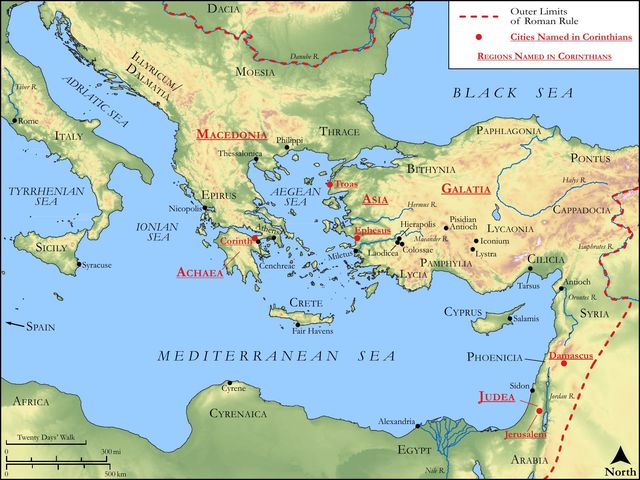
See on the biblical-era maps

Study this verse
Public-domain commentary
Matthew Henry
From his Commentary on the Whole Bible. Henry comments on passages, not single verses — this entry covers 1 Corinthians 9:19–23. His two-level outline is real structure in the source text, so it is rendered as structure.
The apostle takes occasion from what he had before discoursed to mention some other instances of his self-denial and parting with his liberty for the benefit of others.
I.He asserts his liberty (Co1 9:19):
Though I be free from all men. He was free-born, a citizen of Rome. He was in bondage to none, nor depended upon any for his subsistence; yet he made himself a servant to all, that he might gain the more. He behaved as a servant; he laboured for their good as a servant; he was careful to please, as a servant to his master; he acted in many cases as if he had no privileges; and this that he might gain the more, or make the more converts to Christianity. He made himself a servant, that they might be made free.
II.He specifies some particulars wherein he made himself a servant to all. He accommodated himself to all sorts of people.
1.To the Jews, and those under the law, he became a Jew, and as under the law, to gain them. Though he looked on the ceremonial law as a yoke taken off by Christ, yet in many instances he submitted to it, that he might work upon the Jews, remove their prejudices, prevail with them to hear the gospel, and win them over to Christ.
2.To those that are without the law as without law that is, to the Gentiles, whether converted to the Christian faith or not. In innocent things he could comply with people's usages or humours for their advantage. He would reason with the philosophers in their own way. And, as to converted Gentiles, he behaved among them as one that was not under the bondage of the Jewish laws, as he had asserted and maintained concerning them, though he did not act as a lawless person, but as one who was bound by the laws of Christ. He would transgress no laws of Christ to please or humour any man; but he would accommodate himself to all men, where he might do it lawfully, to gain some. Paul was the apostle of the Gentiles, and so, one would have thought, might have excused himself from complying with the Jews; and yet, to do them good, and win them over to Christ, he did, in innocent things, neglect the power he had to do otherwise, and conformed to some of their usages and laws. And though he might, by virtue of that character, have challenged authority over the Gentiles, yet he accommodated himself, as much as he innocently might, to their prejudices and ways of thinking. Doing good was the study and business of his life; and, so that he might reach this end, he did not stand on privileges and punctilios.
3.To the weak he became as weak, that he might gain the weak, Co1 9:22. He was willing to make the best of them. He did not despise nor judge them, but became as one of them, forbore to use his liberty for their sake, and was careful to lay no stumbling-block in their way. Where any, through the weakness of their understanding, or the strength of their prejudices, were likely to fall into sin, or fall off from the gospel into heathen idolatry, through his use of his liberty, he refrained himself. He denied himself for their sakes, that he might insinuate into their affections, and gain their souls. In short, he became all things to all men, that he might by all means (all lawful means) gain some. He would not sin against God to save the soul of his neighbour, but he would very cheerfully and readily deny himself. The rights of God he could not give up, but he might resign his own, and he very often did so for the good of others.
III.He assigns his reason for acting in this manner (Co1 9:23):
This I do for the gospel's sake, and that I may be partaker thereof with you; that is, for the honour of Christ, whose the gospel is, and for the salvation of souls, for which it was designed, and that he and they might communicate in the privileges of it, or partake together of them. For these ends did he thus condescend, deny himself as to his liberty, and accommodate himself to the capacities and usages of those with whom he had to do, where he lawfully might. Note, A heart warmed with zeal for God, and breathing after the salvation of men, will not plead and insist upon rights and privileges in bar to this design. Those manifestly abuse their power in the gospel who employ it not to edification but destruction, and therefore breathe nothing of its spirit.
Historical interpretation
Historical reception
4 surviving comments on this verse. Each one is dated, so this reads as a timeline rather than a list.
Select a marker to jump to its quote. Markers stagger vertically where authors wrote within a few decades of each other.
To be under the law of Christ is to be under the law of God, because everything which is of Christ is of God.
"To them that are without law, as without law." These were neither Jews, nor Christians, nor Greeks; but "outside of the Law," as was Cornelius, and if there were any others like him. For among these also making his appearance, he used to assume many of their ways. But some say that he hints at his discourse with the Athenians from the inscription on the altar, and that so he saith, "to them that are without law, as without law."
Then, lest any should think that the matter was a change of mind, he added, "not being without law to God, but under law to Christ;" i.e., "so far from being without law, I am not simply under the Law, but I have that law which is much more exalted than the older one, viz. that of the Spirit and of grace." Wherefore also he adds, "to Christ." Then again, having made them confident of his judgment, he states also the gain of such condescension, saying, "that I might gain them that are without law." And every where he brings forward the cause of his condescension, and stops not even here, but says,
Paul states, somewhat surprisingly, that he is under the law of Christ, lest anyone think that he is under the law of Moses.
He did this by compassion, not by lying. For each one becomes like him whom he wants to help when such great mercy prevails as that each one would wish for himself if he were in the same misery. And so he becomes like the other—not by deceiving him but by putting himself in the other’s place.
Continue studying 1 Corinthians 9:21 across the web’s major study libraries — every link below opens this exact verse, chapter, or book on the destination site.
Read & Compare
 BibleGatewayThis verse in more than 200 translations and 70 languages.
 Bible.comThe YouVersion reader — hundreds of translations, reading plans, and highlights.
 ESV.orgCrossway's official English Standard Version reader.
 NET BibleThe NET translation with 60,000+ translators' notes on every rendering decision.
 STEP BibleTyndale House's free study tool — original text, vocabulary, and scholarly resources.
 BibliaLogos Bible Software's free web reader.
 USCCBThe New American Bible (Revised Edition) with the U.S. bishops' study notes.
Commentaries
 BibleHub CommentariesDozens of classic commentaries on this verse, gathered on one page.
 StudyLightMore than 100 commentary sets — the largest collection on the web.
 BibleRefPlain-English commentary on what this verse means, verse by verse.
 Enduring WordDavid Guzik's free commentary on this chapter, widely used by Bible teachers.
 Bible Study ToolsVerse commentary alongside Greek and Hebrew study aids.
Original Language & Research
- BibleHub InterlinearThe verse word by word — original language, transliteration, and English.
- BibleHub LexiconEvery word's original-language definition and Strong's entry.
 Blue Letter BibleDeep-study tools — Strong's numbers, concordance, and word studies.
 CNTR CollationThe earliest Greek manuscripts of this verse, collated letter by letter.
Sermons, Hymns & Audio


TrulyRandomVerse is not affiliated with these sites and doesn’t control their content. They’re linked because they’re genuinely useful.
Summary
In 1 Corinthians 9:21, the Apostle Paul articulates a profound principle of evangelistic adaptability, explaining his strategic approach to those "without law"—primarily Gentiles not bound by the Mosaic Law. He clarifies that this flexibility does not equate to moral relativism or lawlessness, but rather a submission to a higher authority: being "under the law to Christ." Paul's ultimate aim in this nuanced approach is to remove unnecessary barriers and effectively "gain" or win these individuals for the Gospel, demonstrating his unwavering commitment to the spread of Christ's message above personal preference or legalistic rigidity.
Context
ShowHideLiterary Context
This verse is an integral part of Paul's extended defense of his apostolic ministry and his radical commitment to the Gospel, detailed in 1 Corinthians 9. Throughout this chapter, Paul argues for his right to financial support as an apostle but immediately asserts his voluntary renunciation of this and other personal rights for the sake of the Gospel's advance. He employs various analogies, including that of an athlete (1 Corinthians 9:24-27), to illustrate the discipline and sacrifice required for effective ministry. Verse 21 specifically elaborates on his principle, stated earlier in 1 Corinthians 9:19, of becoming "a servant to all, that I might win the more," and more broadly, becoming "all things to all men that he "might by all means save some" (1 Corinthians 9:22). Thus, 1 Corinthians 9:21 serves as a specific application of this overarching missionary strategy, focusing on his engagement with the Gentile world.
Historical & Cultural Context
The Corinthian church was a diverse community, comprising both Jewish and Gentile converts. This diversity often led to tensions and misunderstandings, particularly concerning the relevance of the Mosaic Law for Christian living. For Jews, the Law (Torah) was central to their identity, covenant, and daily life, encompassing ceremonial, civil, and moral aspects. Gentiles, by contrast, had no such inherited legal framework and often came from pagan backgrounds with vastly different ethical and social norms. Paul, as the Apostle to the Gentiles, constantly navigated this cultural and theological divide. His ministry involved presenting the Gospel in a way that was accessible and compelling to non-Jews without compromising its truth, a challenge that sometimes led to accusations of antinomianism (being against the law). The cultural milieu of Corinth, a bustling port city known for its moral laxity and diverse religious practices, made Paul's adaptable approach particularly pertinent, as he sought to bridge vast cultural gaps to share the message of Christ.
Key Themes
ShowHide1 Corinthians 9:21 powerfully encapsulates several key themes central to Paul's theology and missionary practice. Foremost is Evangelistic Adaptability, highlighting Paul's willingness to adjust his external conduct and communication style to effectively reach diverse audiences. This flexibility is not about compromising truth but about removing unnecessary cultural or legal barriers to the Gospel, driven by the supreme priority of "gaining" souls. This leads to the theme of Gospel Priority, where the advancement of Christ's kingdom and the salvation of individuals supersede personal rights, preferences, or even traditional religious observances. Paul's radical self-denial and strategic flexibility are always subservient to this ultimate goal, echoing his declaration in Philippians 3:8 that he considers all things loss for the sake of Christ. Finally, the verse introduces the crucial concept of the "Law of Christ," which represents a profound theological shift. While Paul acts "as without law" to those outside the Mosaic code, he clarifies that he is "not without law to God, but under the law to Christ." This "law" is not a rigid external code but an internal, Spirit-empowered principle of love and obedience rooted in Christ's teachings and example, as seen in passages like Galatians 6:2 where believers are called to "bear one another's burdens, and so fulfill the law of Christ." It signifies a liberation from legalism into a higher form of spiritual allegiance and ethical living, guided by love for God and neighbor, as summarized by Jesus in Matthew 22:37-40.
Exposition and Analysis
ShowHideKey Word Analysis
ShowHideFrom a negative particle and nómos (law), meaning "lawless," "without law," or "not subject to (the Jewish) law." In this context, it refers specifically to Gentiles who were not under the Mosaic Law. Paul is not implying moral lawlessness, but rather operating outside the specific legal framework of Judaism when ministering to non-Jews. The repetition of this term emphasizes the group he is targeting and the nature of his adaptation.
From en (in) and nómos (law), meaning "in law," "subject to law," or "bound by law." When combined with "to Christ," it signifies being "under the law to Christ" or "bound by Christ's law." This term highlights the crucial distinction Paul makes: his freedom from the Mosaic Law does not mean he is without any law; rather, he is governed by the moral and spiritual authority of Christ, which is a higher, internal principle.
To "gain" or "win," either literally or figuratively. Here, it is used in a spiritual sense, referring to winning souls for Christ. This word underscores Paul's primary motivation for his strategic flexibility: the salvation of others. His adaptations are not for personal convenience but for the effective propagation of the Gospel and the expansion of God's kingdom.
Verse Breakdown
ShowHide"To them that are without law, as without law,"
Paul describes his approach to Gentiles, who were not bound by the Mosaic Law. He adapted his methods and presentation to be relatable to them, acting "as if" he himself were not under that specific legal code. This meant not imposing Jewish customs or dietary laws on them as a prerequisite for the Gospel.
"(being not without law to God, but under the law to Christ,)"
This parenthetical clause is a critical clarification. Paul emphatically states that his flexibility towards Gentiles does not imply moral anarchy or a disregard for God's will. Instead, he operates under a new, higher form of law—the "law to Christ." This signifies a shift from external, ceremonial regulations to an internal, Christ-centered principle of living, characterized by love, faith, and obedience to Christ's teachings and example.
"that I might gain them that are without law."
This final phrase reveals the ultimate purpose and driving force behind Paul's adaptable ministry. His entire strategy, including his willingness to forgo personal rights and adjust his approach, was singularly focused on the evangelistic goal of winning or "gaining" these non-Jewish individuals for Christ. The salvation of souls was paramount.
Literary Devices
ShowHidePaul masterfully employs several literary devices in this concise verse to convey his complex theological and missional strategy. The most prominent is Paradox, as he claims to be "as without law" yet simultaneously "not without law to God, but under the law to Christ." This apparent contradiction highlights the nuanced nature of Christian liberty, where freedom from one legal system leads to deeper submission to another. Closely related is Antithesis, setting up a clear contrast between being "without law" (in the Mosaic sense) and being "under the law to Christ." This juxtaposition emphasizes the fundamental shift from external legalism to internal, Christ-centered obedience. Furthermore, Paul uses Repetition of the phrase "without law" (Greek ánomos) to underscore the specific group he is addressing and the particular challenge they present to his evangelistic efforts. This repetition also serves to frame the central paradox, drawing the reader's attention to the distinction Paul is about to make concerning his true allegiance.
Theological and Thematic Connections
ShowHidePaul's declaration in 1 Corinthians 9:21 is profoundly significant for understanding Christian liberty, the nature of obedience in the New Covenant, and the imperative of evangelism. It demonstrates that freedom from the Mosaic Law does not equate to moral license but rather to a higher form of ethical living rooted in Christ. This "law of Christ" is fundamentally a law of love, compelling believers to serve others and prioritize the Gospel above personal preferences or rights. Paul's example challenges believers to consider how their own cultural contexts and personal liberties might be leveraged or even set aside for the sake of reaching those who are different from them, always with the aim of presenting an unhindered Gospel message. This principle resonates throughout the New Testament, emphasizing that love for God and neighbor is the fulfillment of all law, and that the ultimate goal of the Christian life is to glorify God through sacrificial service and the proclamation of His truth.
Reflection and Application
ShowHidePaul's strategic flexibility in 1 Corinthians 9:21 offers timeless wisdom for contemporary believers and the church. It challenges us to move beyond rigid adherence to cultural norms or personal preferences when engaging with those outside the faith. True evangelistic effectiveness often requires a willingness to step into another's world, understand their perspectives, and communicate the Gospel in a way that is culturally sensitive and relatable, without ever compromising the core truths of Scripture. This means discerning what truly constitutes a "stumbling block" for non-believers and being prepared to set aside non-essential practices or traditions if they hinder the Gospel's reception. However, Paul's crucial clarification—"not without law to God, but under the law to Christ"—serves as a vital safeguard. Our adaptability must always be governed by the moral and ethical principles of the New Covenant, rooted in love for God and neighbor, and ultimately submitted to the authority and example of Christ. This balance ensures that our flexibility is driven by love and truth, not by expediency or compromise.
Questions for Reflection
ShowHideFAQ
ShowHideWhat does Paul mean by "without law" in this verse?
ShowHideWhen Paul refers to "them that are without law," he is primarily speaking of Gentiles, non-Jews who were not bound by the Mosaic Law. This does not imply that they were morally lawless or that Paul himself advocated for antinomianism (being against all law). Rather, it signifies that he adapted his evangelistic approach to those who did not operate under the specific legal and ceremonial requirements of Judaism. His goal was to remove unnecessary cultural or legalistic stumbling blocks to the Gospel for these individuals, as seen in his broader principle of becoming "all things to all men.
What is the "law to Christ" that Paul mentions?
ShowHideThe "law to Christ" (Greek: ennomos Christou) is a profound theological concept that defines the believer's ethical and spiritual allegiance in the New Covenant. It signifies a shift from external adherence to the Mosaic Law's regulations to an internal, Spirit-empowered obedience to the moral and spiritual teachings of Jesus Christ. This "law" is primarily understood as the law of love (Galatians 5:14), the command to love God with all one's heart and to love one's neighbor as oneself (Matthew 22:37-40). It is a law of grace and freedom, where believers are motivated by their relationship with Christ and the indwelling Holy Spirit, rather than by a legalistic code, to live righteously and sacrificially.
Does Paul's approach mean he compromised his beliefs or the truth of the Gospel?
ShowHideAbsolutely not. Paul explicitly clarifies that while he acted "as without law" to Gentiles, he was "not without law to God, but under the law to Christ." This distinction is crucial. Paul's adaptability was a strategic means to an end—to "gain" souls for Christ—not a compromise of truth. He never advocated for moral relativism or diluted the Gospel message. Instead, he demonstrated a profound understanding that the unchanging truth of salvation through Christ could be communicated effectively by adjusting non-essential cultural or traditional practices, always remaining firmly rooted in the moral authority and teachings of Jesus, which constituted his true "law." His flexibility was a demonstration of love and wisdom, aimed at removing barriers to faith, not undermining it.
Christ-Centered Fulfillment
ShowHidePaul's radical adaptability and submission to the "law to Christ" in 1 Corinthians 9:21 find their ultimate fulfillment and perfect embodiment in Jesus Christ Himself. Christ, though fully God, did not cling to His divine prerogatives but "emptied himself, by taking the form of a servant, being born in the likeness of men" (Philippians 2:7). He became "without law" in the sense that He entered humanity's fallen condition, not bound by the limitations of sin, yet fully empathetic to it. He perfectly fulfilled the Mosaic Law not by abolishing it, but by embodying its true intent—love for God and neighbor (Matthew 5:17). Jesus lived entirely "under the law to God," perfectly obedient to the Father's will even to the point of death on a cross (Philippians 2:8). His entire earthly ministry was an act of profound self-emptying and strategic engagement with humanity, crossing the ultimate divide between divinity and humanity, Jew and Gentile, to "gain" those who were lost (Luke 19:10). Thus, Paul's willingness to become "all things to all men" for the sake of the Gospel is a direct reflection and imitation of Christ's own incarnational mission, making Him the supreme example of sacrificial love and evangelistic passion.